Rigveda 7.31: To Indra
Introduction
Rigveda 7.31 is a hymn of 12 verses addressed to Indra. It stands in book (maṇḍala) 7, the family book of Vasiṣṭha. The Rigveda is the oldest collection of Sanskrit hymns, composed in the second half of the second millennium BCE and handed down orally for many centuries before it was written down.
The manuscript shown is Penn Ms. Coll. 390 Item 41 (University of Pennsylvania), an undated paper manuscript of the padapāṭha (the word-by-word recitation text, in which every word is written separately and compounds are split) of the whole Ṛgveda in Devanāgarī, 884 leaves in fascicles, 7-9 lines to the page, accents in red; this hymn stands on fol. 511v-512v. Each section below gives the verses that end on one page; the page boundaries were read on the images (the opening words of every page), not counted out. Where the manuscript is a padapāṭha (the word-by-word recitation text), the section shows Aufrecht's continuous (saṃhitā) text first and, as the edition text, the padapāṭha of the same verses, which is the form written on the page.
How was this verified? (Provenance)
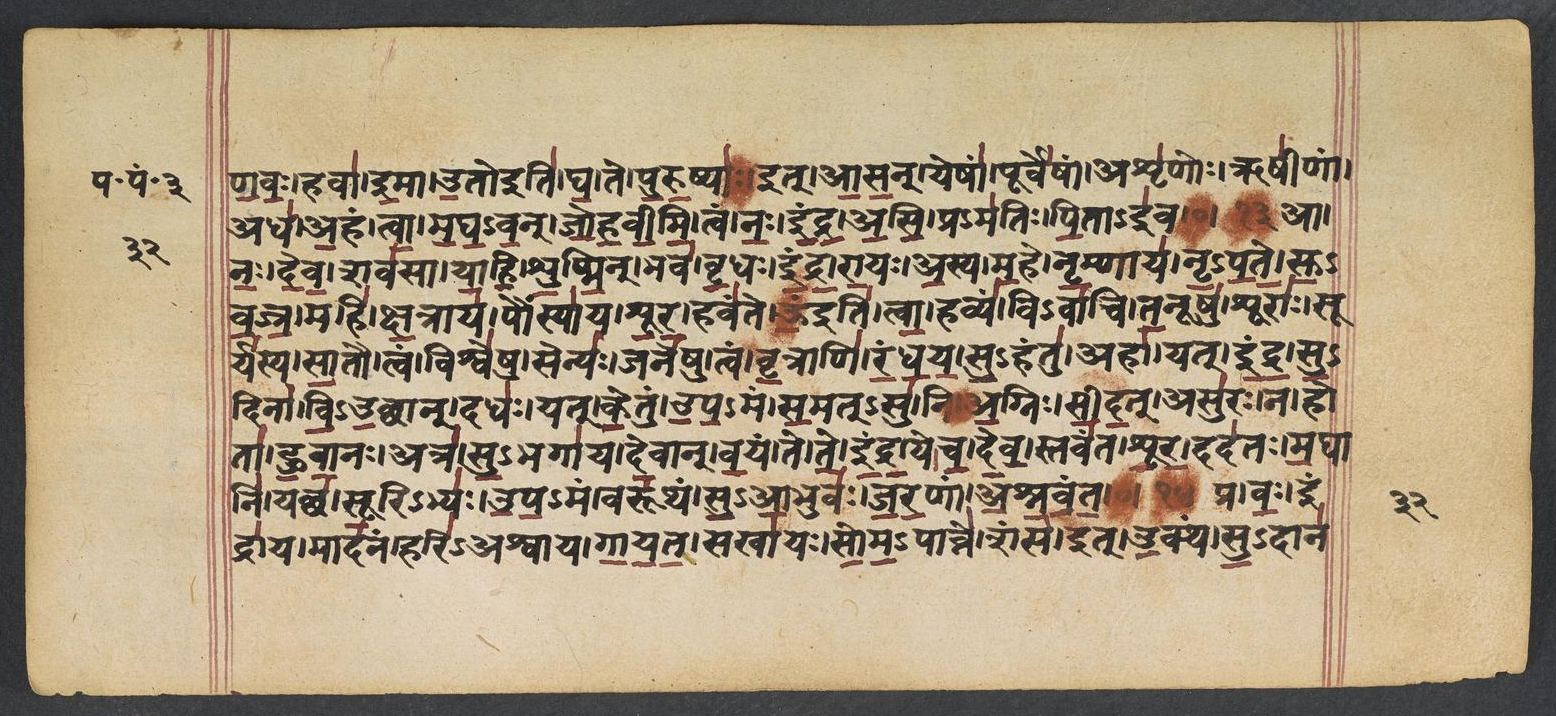
Where on the image
Penn Ms. Coll. 390 Item 41, fol. 511v (numbered 32v by the scribe) (OPenn image 512, upper leaf). Checked on the image: the Rigveda text on this page begins in RV 7.29.3 ‹-śṛṇavaḥ havā imā›. The next page with Rigveda text, fol. 512r (numbered 33r by the scribe), begins in RV 7.31.2 ‹-su-dānave uta dyukṣam yathā›. Verse 7.31.1 ends on this page.
1pra va̱ indrā̍ya̱ māda̍na̱ṁ harya̍śvāya gāyata | sakhā̍yaḥ soma̱pāvne̍ ||
Compare: Padapāṭha (word-by-word text written in the manuscript; Sansknet e-text via GRETIL)
1pra | vaḥ | indrāya | mādanam | hari-aśvāya | gāyata | sakhāyaḥ | soma-pāvne
1SING ye a song, to make him glad, to Indra, Lord of Tawny Steeds, The Soma-drinker, O my friends.
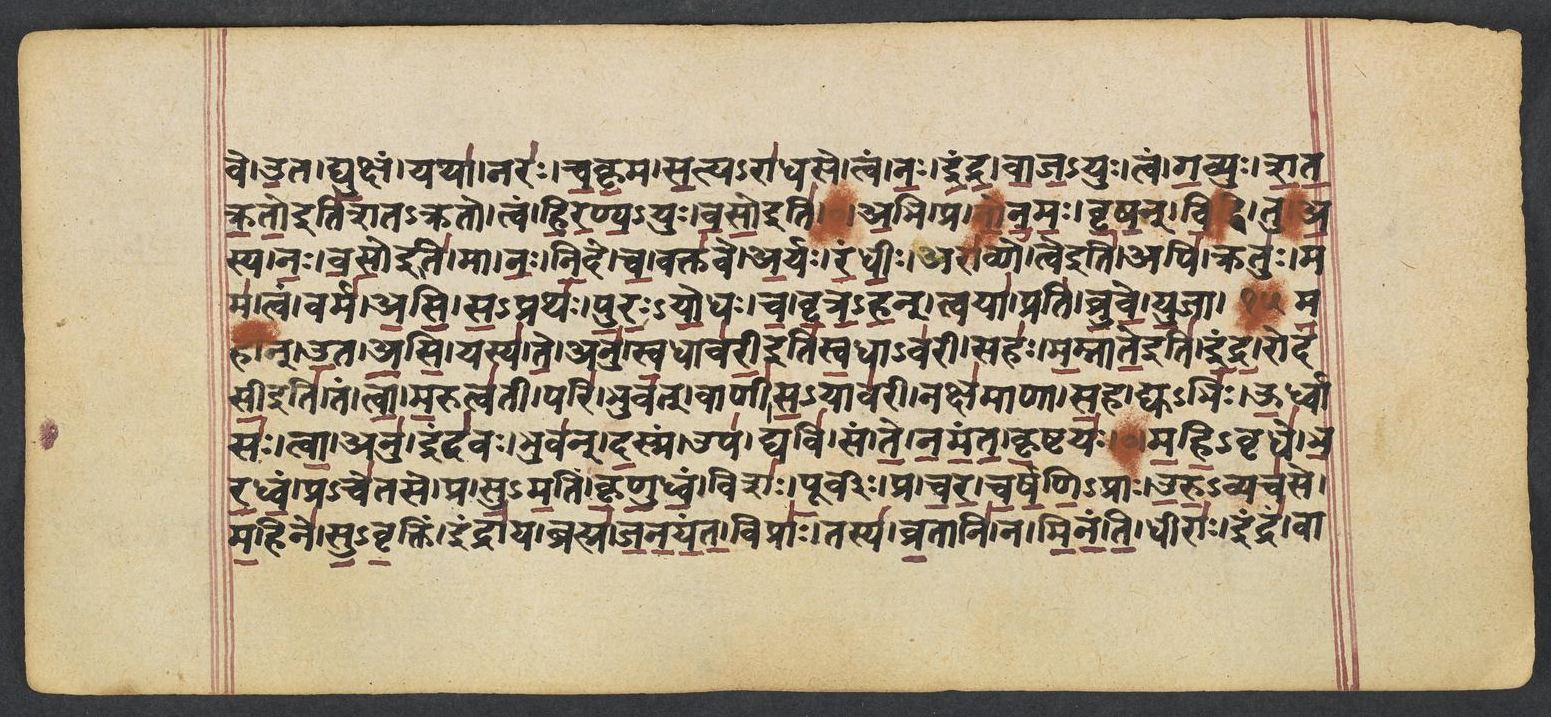
Where on the image
Penn Ms. Coll. 390 Item 41, fol. 512r (numbered 33r by the scribe) (OPenn image 512, lower leaf). Checked on the image: the Rigveda text on this page begins in RV 7.31.2 ‹-su-dānave uta dyukṣam yathā›. The next page with Rigveda text, fol. 512v (numbered 33v by the scribe), begins in RV 7.31.12 ‹-vāṇīḥ anutta-manyum eva satrā›. Verses 7.31.2-11 end on this page; 7.31.2 begins on fol. 511v (numbered 32v by the scribe).
2śaṁsed u̱kthaṁ su̱dāna̍va u̱ta dyu̱kṣaṁ yathā̱ nara̍ḥ | ca̱kṛ̱mā sa̱tyarā̍dhase ||
3tvaṁ na̍ indra vāja̱yus tvaṁ ga̱vyuḥ śa̍takrato | tvaṁ hi̍raṇya̱yur va̍so ||
4va̱yam i̍ndra tvā̱yavo̱ 'bhi pra ṇo̍numo vṛṣan | vi̱ddhī tv a1̱̍sya no̍ vaso ||
5mā no̍ ni̱de ca̱ vakta̍ve̱ 'ryo ra̍ndhī̱r arā̍vṇe | tve api̱ kratu̱r mama̍ ||
6tvaṁ varmā̍si sa̱pratha̍ḥ puroyo̱dhaś ca̍ vṛtrahan | tvayā̱ prati̍ bruve yu̱jā ||
7ma̱hām̐ u̱tāsi̱ yasya̱ te 'nu̍ sva̱dhāva̍rī̱ saha̍ḥ | ma̱mnāte̍ indra̱ roda̍sī ||
8taṁ tvā̍ ma̱rutva̍tī̱ pari̱ bhuva̱d vāṇī̍ sa̱yāva̍rī | nakṣa̍māṇā sa̱ha dyubhi̍ḥ ||
9ū̱rdhvāsa̱s tvānv inda̍vo̱ bhuva̍n da̱smam upa̱ dyavi̍ | saṁ te̍ namanta kṛ̱ṣṭaya̍ḥ ||
10pra vo̍ ma̱he ma̍hi̱vṛdhe̍ bharadhva̱m prace̍tase̱ pra su̍ma̱tiṁ kṛ̍ṇudhvam | viśa̍ḥ pū̱rvīḥ pra ca̍rā carṣaṇi̱prāḥ ||
11u̱ru̱vyaca̍se ma̱hine̍ suvṛ̱ktim indrā̍ya̱ brahma̍ janayanta̱ viprā̍ḥ | tasya̍ vra̱tāni̱ na mi̍nanti̱ dhīrā̍ḥ ||
Compare: Padapāṭha (word-by-word text written in the manuscript; Sansknet e-text via GRETIL)
2śaṃsa | it | uktham | su-dānave | uta | dyukṣam | yathā | naraḥ | cakṛma | satya-rādhase
3tvam | naḥ | indra | vāja-yuḥ | tvam | gavyuḥ | śatakrato itiśata-krato | tvam | hiraṇya-yuḥ | vaso iti
4vayam | indra | tvāyavaḥ | abhi | pra | nonumaḥ | vṛṣan | viddhi | tu | asya | naḥ | vaso iti
5mā | naḥ | nide | ca | vaktave | aryaḥ | randhīḥ | arāvṇe | tve iti | api | kratuḥ | mama
6tvam | varma | asi | sa-prathaḥ | puraḥ-yodhaḥ | ca | vṛtra-han | tvayā | prati | bruve | yujā
7mahān | uta | asi | yasya | te | anu | svadhāvarī itisvadhāvarī | sahaḥ | mamnāteiti | indra | rodasī iti
8tam | tvā | marutvatī | pari | bhuvat | vāṇī | sa-yāvarī | nakṣamāṇā | saha | dyu-bhi ḥ
9ūrdhvāsaḥ | tvā | anu | indavaḥ | bhuvan | dasmam | upa | dyavi | sam | te | namanta | kṛṣṭayaḥ
10pra | vaḥ | mahe | mahi-vṛdhe | bharadhvam | pra-cetase | pra | su-matim | kṛṇudhvam | viśaḥ | pūrvīḥ | pra | cara | carṣaṇi-prāḥ
11uru-vyacase | mahine | su-vṛktim | indrāya | brahma | janayanta | viprāḥ | tasya | vratāni | na | minanti | dhīrāḥ
2To him the Bounteous say the laud, and let us glorify, as men May do, the Giver of true gifts.
3O Indra, Lord of boundless might, for us thou winnest strength and kine, Thou winnest gold for us, Good Lord.
4Faithful to thee we loudly sing, heroic Indra, songs to thee: Mark, O Good Lord, this act of ours.
5Give us not up to man's reproach, to foeman's hateful calumny: In thee alone is all my strength.
6Thou art mine ample coat of mail, my Champion, Vr̥itra-Slayer, thou: With thee for Friend I brave the foe.
7Yea, great art thou whose conquering might two independent Powers confess. The Heaven, O Indra, and the Earth.
8So let the voice surround thee, which attends the Maruts on their way, Reaching thee with the rays of light.
9Let the ascending drops attain to thee, the Wondrous God, in heaven: Let all the folk bow down to thee.
10Bring to the Wise, the Great, who waxeth mighty, your offerings, and make ready your devotion; To many clans he goeth, man's controller.
11For Indra, the sublime, the far-pervading, have singers generated prayer and praises: The sages never violate his statutes.
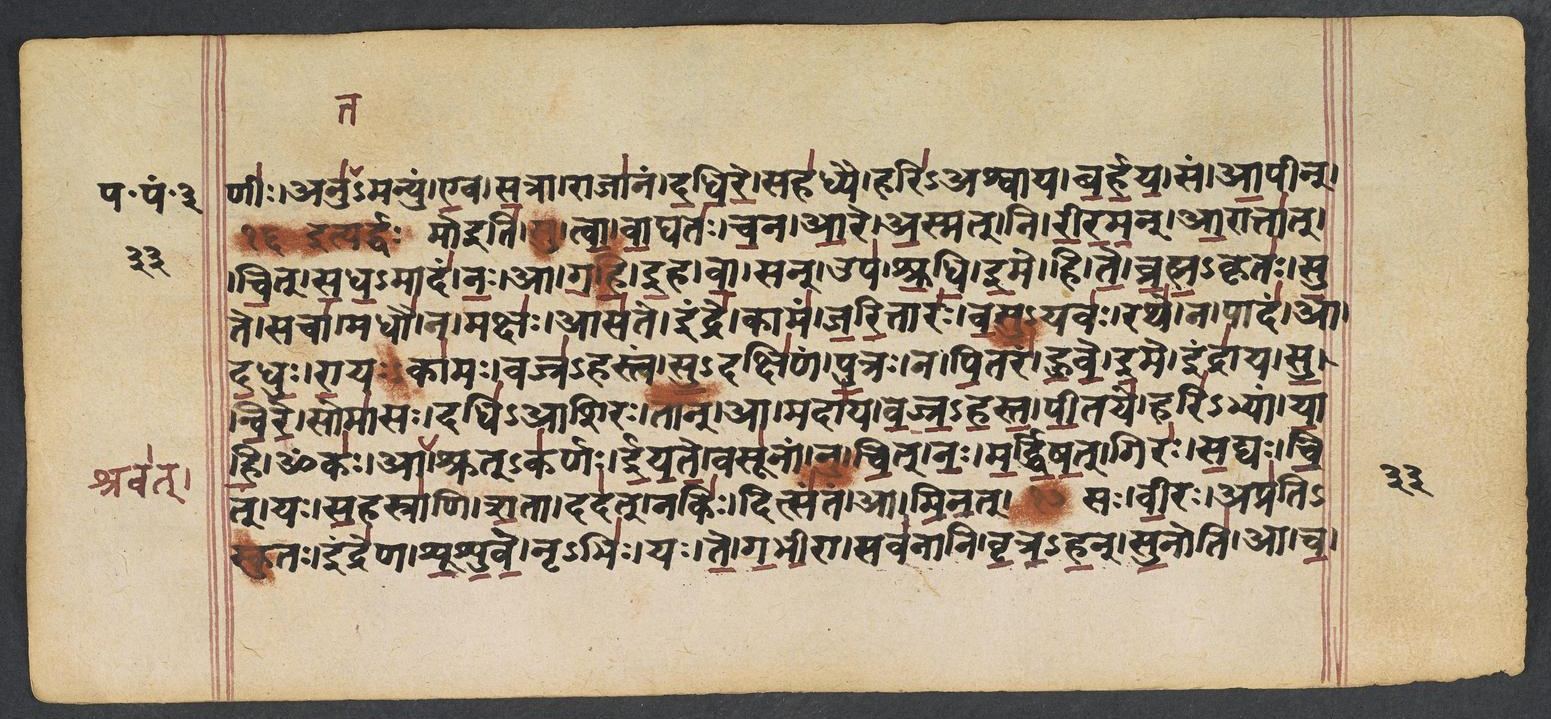
Where on the image
Penn Ms. Coll. 390 Item 41, fol. 512v (numbered 33v by the scribe) (OPenn image 513, upper leaf). Checked on the image: the Rigveda text on this page begins in RV 7.31.12 ‹-vāṇīḥ anutta-manyum eva satrā›. The next page with Rigveda text, fol. 513r (numbered 34r by the scribe), begins in RV 7.32.6 ‹dhāvati›. Verse 7.31.12 ends on this page; 7.31.12 begins on fol. 512r (numbered 33r by the scribe).
12indra̱ṁ vāṇī̱r anu̍ttamanyum e̱va sa̱trā rājā̍naṁ dadhire̱ saha̍dhyai | harya̍śvāya barhayā̱ sam ā̱pīn ||
Compare: Padapāṭha (word-by-word text written in the manuscript; Sansknet e-text via GRETIL)
12indram | vāṇīḥ | anutta-manyum | eva | satrā | rājānam | dadhire | sahadhyai | hari-aśvāya | barhaya | sam | āpīn
12The choirs have stablished Indra King for ever, for victory, him whose anger is resistless: And, for the Bays' Lord, strengthened those he loveth.
Notes
- Sanskrit: Aufrecht's edition (1877) with the Vedic accents, as entered by van Nooten and Holland (GRETIL).
- English: Ralph T. H. Griffith, The Hymns of the Rigveda (1889-1892; 2nd ed. 1896-1897), from the VedaWeb digital text; OCR slips in that text were corrected against the printed 2nd edition (data/sources/rigveda/griffith_errata.json).
- Padapāṭha (edition text): Sansknet e-text via GRETIL (CC BY-NC-SA 4.0).
Cite
Sources
- Source: Penn Ms. Coll. 390 Item 41 (undated (catalogued with Penn's 18th-19th c. Vedic manuscripts)), OPenn, Public Domain Mark + Aufrecht's accented text (GRETIL) + Griffith's English (VedaWeb) (holding institution)
- Critical edition: Aufrecht (1877), accented e-text via GRETIL
← previous · → next · v cycle view · l back to library