Rigveda 7.41: To Bhaga and other gods
Introduction
Rigveda 7.41 is a hymn of 7 verses addressed to Bhaga and other gods. It stands in book (maṇḍala) 7, the family book of Vasiṣṭha. The Rigveda is the oldest collection of Sanskrit hymns, composed in the second half of the second millennium BCE and handed down orally for many centuries before it was written down.
The manuscript shown is Penn Ms. Coll. 390 Item 41 (University of Pennsylvania), an undated paper manuscript of the padapāṭha (the word-by-word recitation text, in which every word is written separately and compounds are split) of the whole Ṛgveda in Devanāgarī, 884 leaves in fascicles, 7-9 lines to the page, accents in red; this hymn stands on fol. 521v-522r. Each section below gives the verses that end on one page; the page boundaries were read on the images (the opening words of every page), not counted out. Where the manuscript is a padapāṭha (the word-by-word recitation text), the section shows Aufrecht's continuous (saṃhitā) text first and, as the edition text, the padapāṭha of the same verses, which is the form written on the page.
How was this verified? (Provenance)
Where on the image
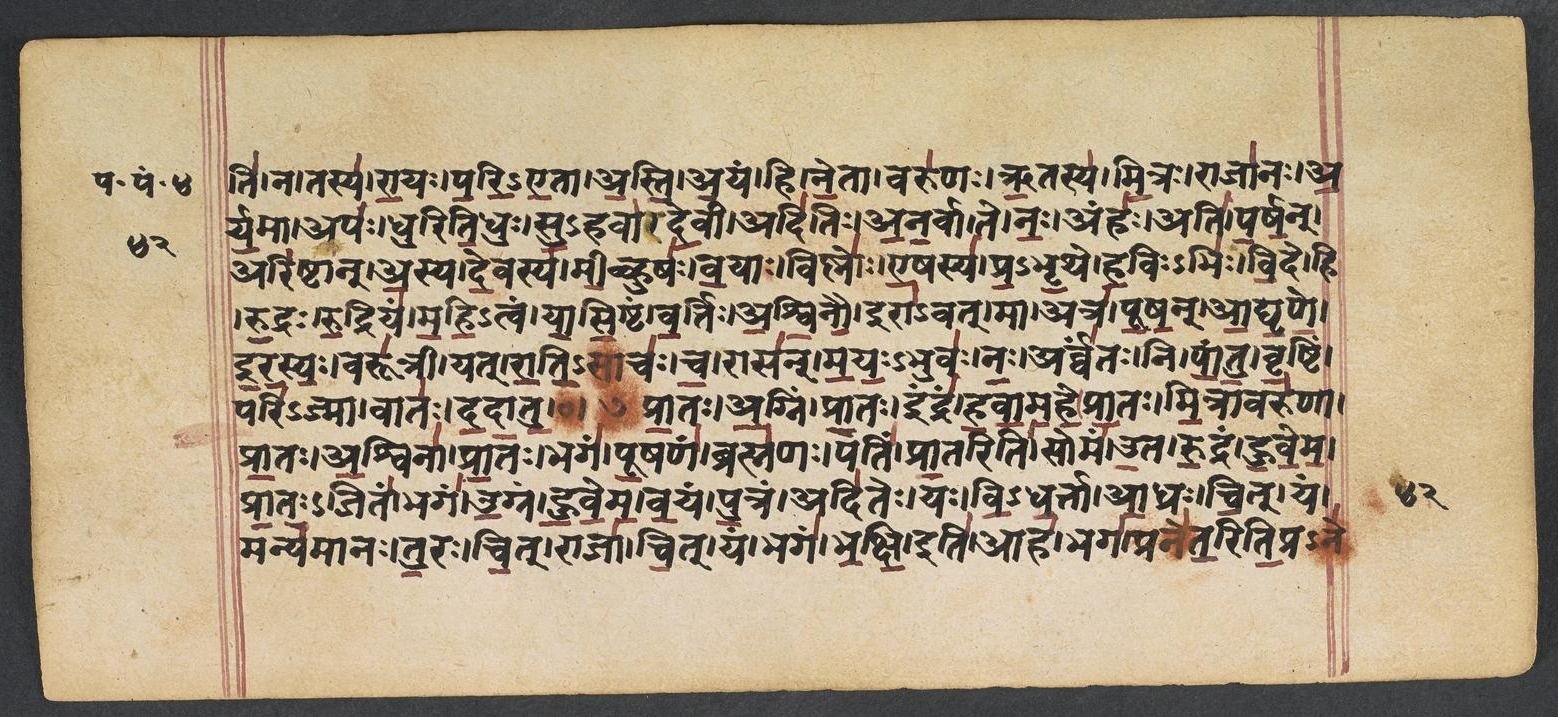
Penn Ms. Coll. 390 Item 41, fol. 521v (numbered 42v by the scribe) (OPenn image 522, upper leaf). Checked on the image: the Rigveda text on this page begins in RV 7.40.3 ‹-junanti na tasya rāyaḥ›. The next page with Rigveda text, fol. 522r (numbered 43r by the scribe), begins in RV 7.41.3 ‹-pra-netaritipra-netaḥ bhaga satya-rādhaḥ bhaga›. Verses 7.41.1-2 end on this page.
1prā̱tar a̱gnim prā̱tar indra̍ṁ havāmahe prā̱tar mi̱trāvaru̍ṇā prā̱tar a̱śvinā̍ | prā̱tar bhaga̍m pū̱ṣaṇa̱m brahma̍ṇa̱s pati̍m prā̱taḥ soma̍m u̱ta ru̱draṁ hu̍vema ||
2prā̱ta̱rjita̱m bhaga̍m u̱graṁ hu̍vema va̱yam pu̱tram adi̍te̱r yo vi̍dha̱rtā | ā̱dhraś ci̱d yam manya̍mānas tu̱raś ci̱d rājā̍ ci̱d yam bhaga̍m bha̱kṣīty āha̍ ||
Compare: Padapāṭha (word-by-word text written in the manuscript; Sansknet e-text via GRETIL)
1prātaḥ | agnim | prataḥ | indram | havāmahe | prataḥ | mitrāvaruṇā | prātaḥ | aśvinā | prataḥ | bhagam | pūṣaṇam | brahmaṇaḥ | patim | prataḥ | somam | uta | rudram | huvema
2prātaḥ-jitam | bhagam | ugram | huvema | vayam | putram | aditeḥ | yaḥ | vi-dhatār | ādhraḥ | cit | yam | manyamānaḥ | turaḥ | cit | rājā | cit | yam | bhagam | bhakṣi | it i | āha
1AGNI at dawn, and Indra we invoke at dawn, and Varuṇa and Mitra, and the Aṣvins twain. Bhaga at dawn, Pûshan, and Brahmaṇaspati, Soma at dawn, Rudra we will invoke at dawn.
2We will invoke strong, early-conquering Bhaga, the Son of Aditi, the great supporter: Thinking of whom, the poor, yea, even the mighty, even the King himself says, Give me Bhaga.
Where on the image
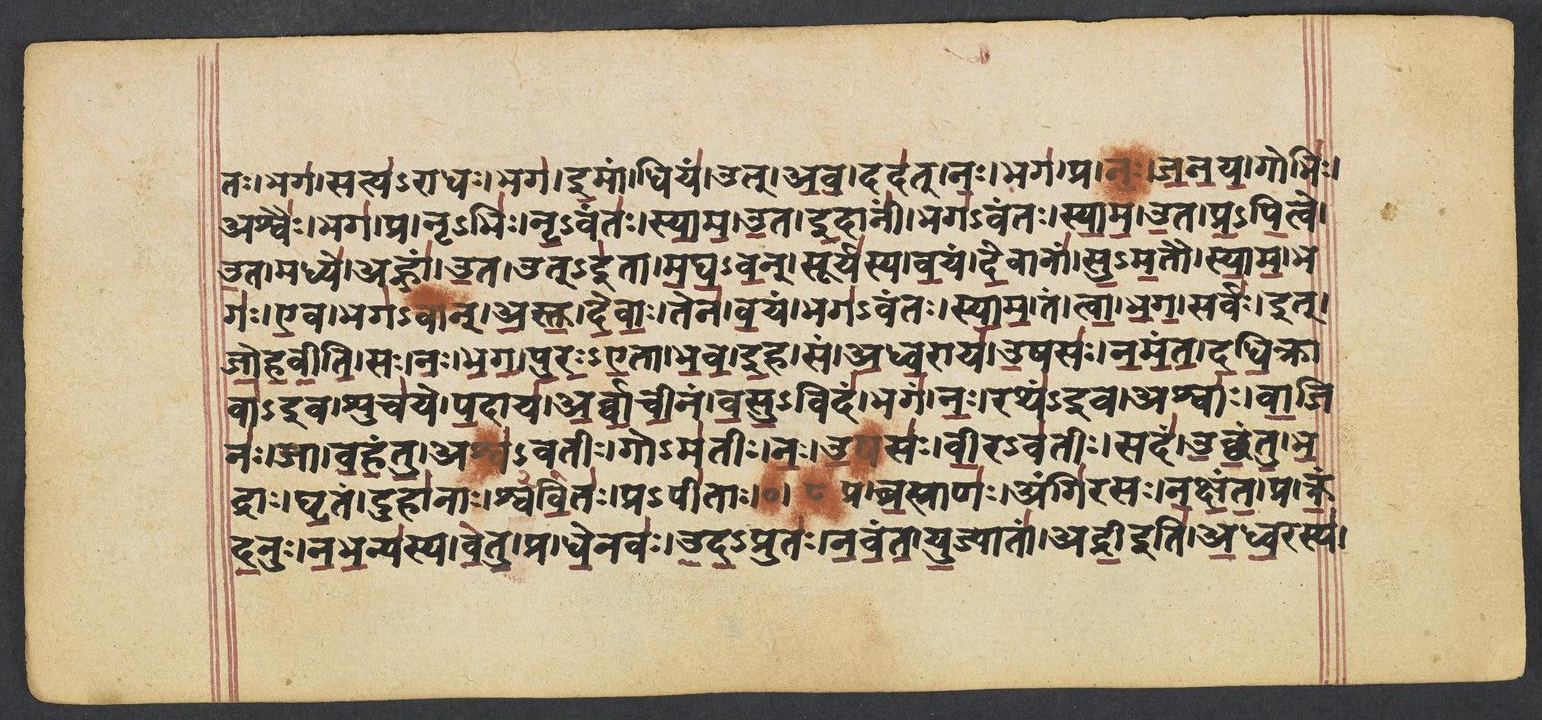
Penn Ms. Coll. 390 Item 41, fol. 522r (numbered 43r by the scribe) (OPenn image 522, lower leaf). Checked on the image: the Rigveda text on this page begins in RV 7.41.3 ‹-pra-netaritipra-netaḥ bhaga satya-rādhaḥ bhaga›. The next page with Rigveda text, fol. 522v (numbered 43v by the scribe), begins in RV 7.42.1 ‹peśaḥ›. Verses 7.41.3-7 end on this page; 7.41.3 begins on fol. 521v (numbered 42v by the scribe).
3bhaga̱ praṇe̍ta̱r bhaga̱ satya̍rādho̱ bhage̱māṁ dhiya̱m ud a̍vā̱ dada̍n naḥ | bhaga̱ pra ṇo̍ janaya̱ gobhi̱r aśvai̱r bhaga̱ pra nṛbhi̍r nṛ̱vanta̍ḥ syāma ||
4u̱tedānī̱m bhaga̍vantaḥ syāmo̱ta pra̍pi̱tva u̱ta madhye̱ ahnā̍m | u̱todi̍tā maghava̱n sūrya̍sya va̱yaṁ de̱vānā̍ṁ suma̱tau syā̍ma ||
5bhaga̍ e̱va bhaga̍vām̐ astu devā̱s tena̍ va̱yam bhaga̍vantaḥ syāma | taṁ tvā̍ bhaga̱ sarva̱ ij jo̍havīti̱ sa no̍ bhaga purae̱tā bha̍ve̱ha ||
6sam a̍dhva̱rāyo̱ṣaso̍ namanta dadhi̱krāve̍va̱ śuca̍ye pa̱dāya̍ | a̱rvā̱cī̱naṁ va̍su̱vida̱m bhaga̍ṁ no̱ ratha̍m i̱vāśvā̍ vā̱jina̱ ā va̍hantu ||
7aśvā̍vatī̱r goma̍tīr na u̱ṣāso̍ vī̱rava̍tī̱ḥ sada̍m ucchantu bha̱drāḥ | ghṛ̱taṁ duhā̍nā vi̱śvata̱ḥ prapī̍tā yū̱yam pā̍ta sva̱stibhi̱ḥ sadā̍ naḥ ||
Compare: Padapāṭha (word-by-word text written in the manuscript; Sansknet e-text via GRETIL)
3bhaga | pra-netaritipra-netaḥ | bhaga | satya-rādhaḥ | bhaga | imām | dhiyam | ut | ava | dadat | naḥ | bhaga | pra | naḥ | janaya | gobhiḥ | aśvaiḥ | bhaga | pra | nṛ-bhiḥ | nṛ-vantaḥ | syāma
4uta | idānīm | bhaga-vantaḥ | syāma | uta | pra-pitve | uta | madhye | ahnām | uta | ut-itā | magha-van | sūryasya | vayam | devānām | su-matau | syāma
5bhagaḥ | eva | bhaga-vān | astu | devāḥ | tena | vayam | bhaga-vantaḥ | syāma | tam | tvā | bhaga | sarvaḥ | it | johavīti | saḥ | naḥ | bhaga | puraḥ-etā | bhava | iha
6sam | adhvarāya | uṣasaḥ | namanta | dadhikrāvāiva | śucaye | padāya | arvācīnam | vasu-vidam | bhagam | naḥ | ratham-iva | aśvāḥ | vājinaḥ | ā | vahantu
7aśva-vatīḥ | go--matīḥ | naḥ | uṣasaḥ | vīra-vatīḥ | sadam | ucchantu | bhadrāḥ | ghṛtam | duhānāḥ | viśvataḥ | pra-pītāḥ | yūyam | pāta | svasti-bhiḥ | sadā | naḥ
3Bhaga our guide, Bhaga whose gifts are faithful, favour this song, and give us wealth, O Bhaga. Bhaga, augment our store of kine and horses, Bhaga, may we be rich in men and heroes.
4So may felicity be ours at present, and when the day approaches, and at noontide; And may we still, O Bounteous One, at sunset be happy in the Deities' loving-kindness.
5May Bhaga verily be bliss-bestower, and through him, Gods! may happiness attend us. As such, O Bhaga, all with might invoke thee: as such be thou our Champion here, O Bhaga.
6To this our worship may all Dawns incline them, and come to the pure place like Dadhikrâvan. As strong steeds draw a chariot may they bring us hitherward Bhaga who discovers treasure.
7May blessed Mornings dawn on us for ever, with wealth of kine, of horses, and of heroes, Streaming with all abundance, pouring fatness. Preserve us evermore, ye Gods, with blessings.
Notes
- Sanskrit: Aufrecht's edition (1877) with the Vedic accents, as entered by van Nooten and Holland (GRETIL).
- English: Ralph T. H. Griffith, The Hymns of the Rigveda (1889-1892; 2nd ed. 1896-1897), from the VedaWeb digital text; OCR slips in that text were corrected against the printed 2nd edition (data/sources/rigveda/griffith_errata.json).
- Padapāṭha (edition text): Sansknet e-text via GRETIL (CC BY-NC-SA 4.0).
Cite
Sources
- Source: Penn Ms. Coll. 390 Item 41 (undated (catalogued with Penn's 18th-19th c. Vedic manuscripts)), OPenn, Public Domain Mark + Aufrecht's accented text (GRETIL) + Griffith's English (VedaWeb) (holding institution)
- Critical edition: Aufrecht (1877), accented e-text via GRETIL
← previous · → next · v cycle view · l back to library