Rigveda 7.6: To Agni Vaisvanara
Introduction
Rigveda 7.6 is a hymn of 7 verses addressed to Agni Vaisvanara. It stands in book (maṇḍala) 7, the family book of Vasiṣṭha. The Rigveda is the oldest collection of Sanskrit hymns, composed in the second half of the second millennium BCE and handed down orally for many centuries before it was written down.
The manuscript shown is Penn Ms. Coll. 390 Item 41 (University of Pennsylvania), an undated paper manuscript of the padapāṭha (the word-by-word recitation text, in which every word is written separately and compounds are split) of the whole Ṛgveda in Devanāgarī, 884 leaves in fascicles, 7-9 lines to the page, accents in red; this hymn stands on fol. 497r-497v. Each section below gives the verses that end on one page; the page boundaries were read on the images (the opening words of every page), not counted out. Where the manuscript is a padapāṭha (the word-by-word recitation text), the section shows Aufrecht's continuous (saṃhitā) text first and, as the edition text, the padapāṭha of the same verses, which is the form written on the page.
How was this verified? (Provenance)
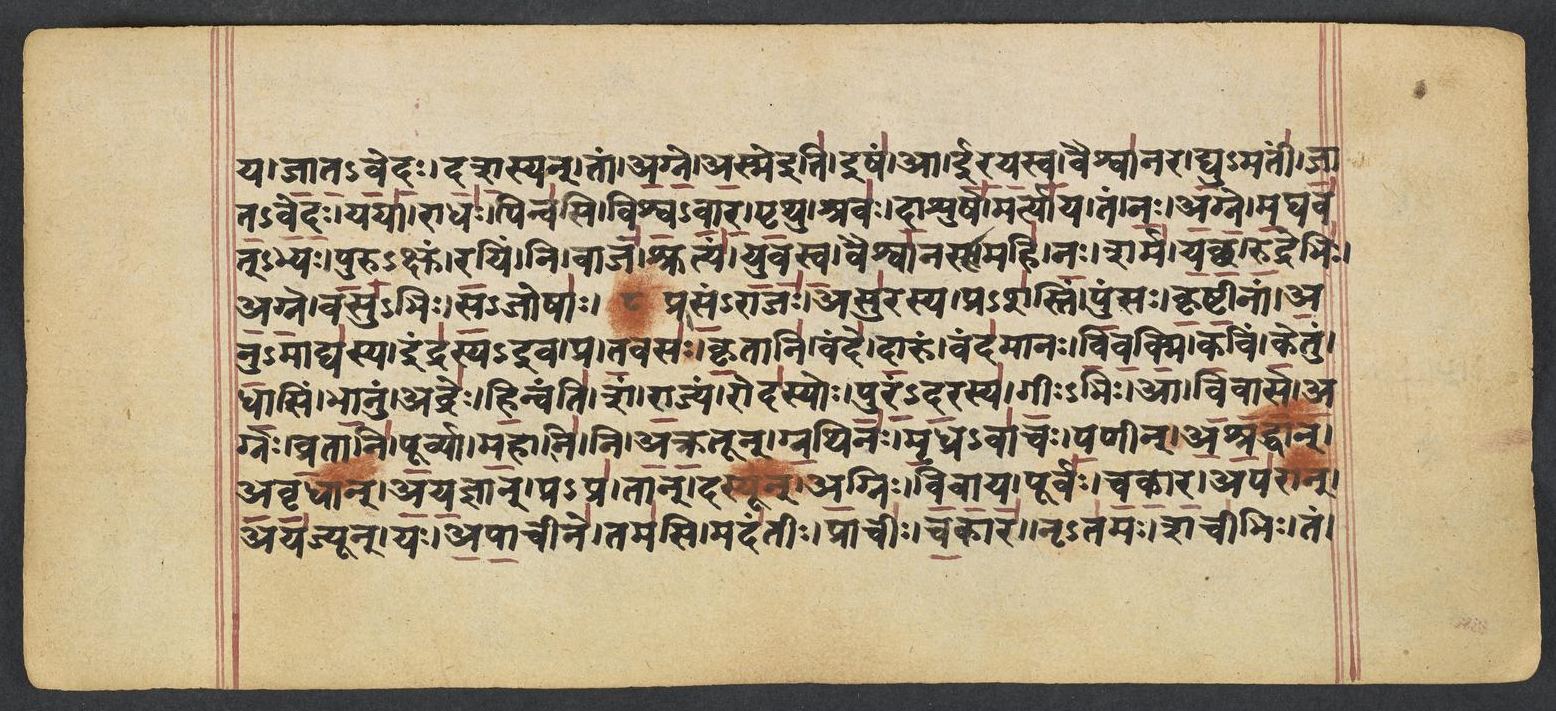
Where on the image
Penn Ms. Coll. 390 Item 41, fol. 497r (numbered 18r by the scribe) (OPenn image 497, lower leaf). Checked on the image: the Rigveda text on this page begins in RV 7.5.7 ‹-apatyāya jāta-vedaḥ daśasyan›. The next page with Rigveda text, fol. 497v (numbered 18v by the scribe), begins in RV 7.6.4 ‹īśānam vasvaḥ agnim gṛṇīṣe›. Verses 7.6.1-3 end on this page.
1pra sa̱mrājo̱ asu̍rasya̱ praśa̍stim pu̱ṁsaḥ kṛ̍ṣṭī̱nām a̍nu̱mādya̍sya | indra̍syeva̱ pra ta̱vasa̍s kṛ̱tāni̱ vande̍ dā̱ruṁ vanda̍māno vivakmi ||
2ka̱viṁ ke̱tuṁ dhā̱sim bhā̱num adre̍r hi̱nvanti̱ śaṁ rā̱jyaṁ roda̍syoḥ | pu̱ra̱ṁda̱rasya̍ gī̱rbhir ā vi̍vāse̱ 'gner vra̱tāni̍ pū̱rvyā ma̱hāni̍ ||
3ny a̍kra̱tūn gra̱thino̍ mṛ̱dhravā̍caḥ pa̱ṇīm̐r a̍śra̱ddhām̐ a̍vṛ̱dhām̐ a̍ya̱jñān | pra-pra̱ tān dasyū̍m̐r a̱gnir vi̍vāya̱ pūrva̍ś cakā̱rāpa̍rā̱m̐ aya̍jyūn ||
Compare: Padapāṭha (word-by-word text written in the manuscript; Sansknet e-text via GRETIL)
1pra | sam-rājaḥ | asurasya | pra-śastim | puṃsaḥ | kṛṣṭīnām | anu-mādyasya | indrasya-iva | pra | tavasaḥ | kṛtāni | vande | dārum | vandamānaḥ | vivakmi
2kavim | ketum | dhāsim | bhānum | adreḥ | hinvanti | śam | rājyam | rodasyoḥ | puram-darasya | gīḥ-bhiḥ | ā | vivāse | agneḥ | vratāni | pūrvyā | mahāni
3ni | akratūn | grathinaḥ | mṛdhra-vācaḥ | paṇīn | aśraddhān | avṛdhān | ayajñān | pra-pra | tān | dasyūn | agniḥ | vivāya | pūrvaḥ | cakāra | aparān | ayajyūn
1PRAISE of the Asura, high imperial Ruler, the Manly One in whom the folk shall triumph I laud his deeds who is as strong as Indra, and lauding celebrate the Fort-destroyer.
2Sage, Sign, Food, Light,– they bring him from the mountain, the blessed Sovran of the earth and heaven. I decorate with songs the mighty actions which Agni, Fort-destroyer, did aforetime.
3The foolish, faithless, rudely-speaking niggards, without belief or sacrifice or worship,– Far far away hath Agni chased those Dasyus, and, in the east, hath turned the godless westward.
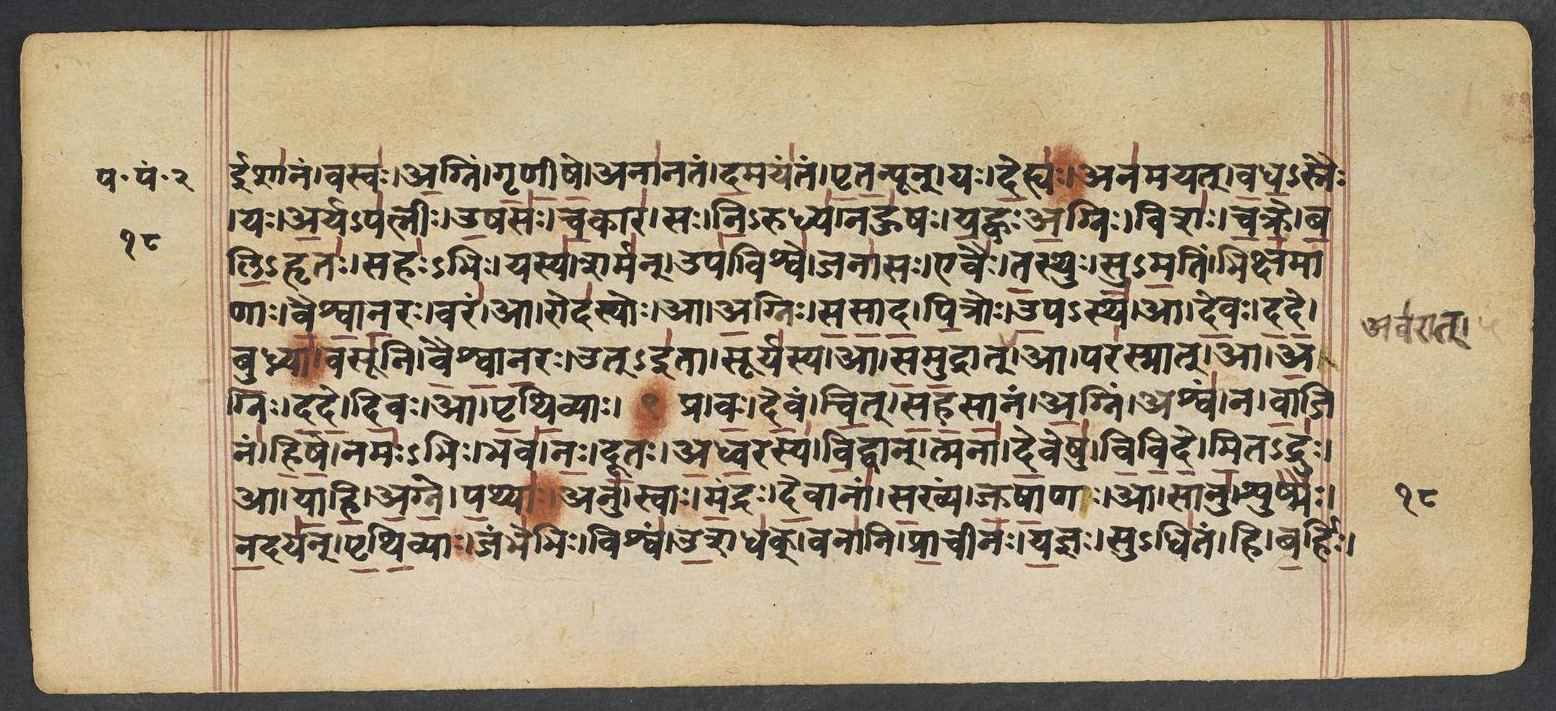
Where on the image
Penn Ms. Coll. 390 Item 41, fol. 497v (numbered 18v by the scribe) (OPenn image 498, upper leaf). Checked on the image: the Rigveda text on this page begins in RV 7.6.4 ‹īśānam vasvaḥ agnim gṛṇīṣe›. The next page with Rigveda text, fol. 498r (numbered 19r by the scribe), begins in RV 7.7.3 ‹prīṇīte agniḥ īḷitaḥ na›. Verses 7.6.4-7 end on this page; 7.6.4 begins on fol. 497r (numbered 18r by the scribe).
4yo a̍pā̱cīne̱ tama̍si̱ mada̍ntī̱ḥ prācī̍ś ca̱kāra̱ nṛta̍ma̱ḥ śacī̍bhiḥ | tam īśā̍na̱ṁ vasvo̍ a̱gniṁ gṛ̍ṇī̱ṣe 'nā̍nataṁ da̱maya̍ntam pṛta̱nyūn ||
5yo de̱hyo̱3̱̍ ana̍mayad vadha̱snair yo a̱ryapa̍tnīr u̱ṣasa̍ś ca̱kāra̍ | sa ni̱rudhyā̱ nahu̍ṣo ya̱hvo a̱gnir viśa̍ś cakre bali̱hṛta̱ḥ saho̍bhiḥ ||
6yasya̱ śarma̱nn upa̱ viśve̱ janā̍sa̱ evai̍s ta̱sthuḥ su̍ma̱tim bhikṣa̍māṇāḥ | vai̱śvā̱na̱ro vara̱m ā roda̍syo̱r āgniḥ sa̍sāda pi̱tror u̱pastha̍m ||
7ā de̱vo da̍de bu̱dhnyā̱3̱̍ vasū̍ni vaiśvāna̱ra udi̍tā̱ sūrya̍sya | ā sa̍mu̱drād ava̍rā̱d ā para̍smā̱d āgnir da̍de di̱va ā pṛ̍thi̱vyāḥ ||
Compare: Padapāṭha (word-by-word text written in the manuscript; Sansknet e-text via GRETIL)
4yaḥ | apācīne | tamasi | madantīḥ | prācīḥ | cakāra | nṛ-tamaḥ | śacībhiḥ | tam | īśānam | vasvaḥ | agnim | gṛṇīṣe | anānatam | damayantam | pṛtanyūn
5yaḥ | dehyaḥ | anamayat | vadha-snaiḥ | yaḥ | arya-patnīḥ | uṣasaḥ | cakāra | saḥ | ni-rudhya | nahuṣaḥ | yahvaḥ | agniḥ | viśaḥ | cakre | bali-hṛtaḥ | sahaḥ-bhiḥ
6yasya | śarman | upa | viśve | janāsaḥ | evaiḥ | tasthuḥ | su-matim | bhikṣamāṇāḥ | vaiśvānaraḥ | varam | ā | rodasyoḥ | ā | agniḥ | sasāda | pitroḥ | upa-stham
7ā | devaḥ | dade | budhnyā | vasūni | vaiśvānaraḥ | ut-itā | sūryasya | ā | samudrāt | avarāt | ā | parasmāt | ā | agniḥ | dade | divaḥ | ā | pṛthivyāḥ
4Him who brought eastward, manliest with his prowess, the Maids rejoicing in the western darkness, That Agni I extol, the Lord of riches, unyielding tamer of assailing foemen.
5Him who brake down the walls with deadly weapons, and gave the Mornings to anoble Husband, Young Agni, who with conquering strength subduing the tribes of Nahus made them bring their tribute.
6In whose protection all men rest by nature, desiring to enjoy his gracious favour- Agni Vaiṣvânara in his Parents, bosom hath found the choicest seat in earth and heaven.
7Vaiṣvânara the God, at the sun's setting, hath taken to himself deep-hidden treasures: Agni hath taken them from earth and heaven, from the sea under and the sea above us.
Notes
- Sanskrit: Aufrecht's edition (1877) with the Vedic accents, as entered by van Nooten and Holland (GRETIL).
- English: Ralph T. H. Griffith, The Hymns of the Rigveda (1889-1892; 2nd ed. 1896-1897), from the VedaWeb digital text; OCR slips in that text were corrected against the printed 2nd edition (data/sources/rigveda/griffith_errata.json).
- Padapāṭha (edition text): Sansknet e-text via GRETIL (CC BY-NC-SA 4.0).
Cite
Sources
- Source: Penn Ms. Coll. 390 Item 41 (undated (catalogued with Penn's 18th-19th c. Vedic manuscripts)), OPenn, Public Domain Mark + Aufrecht's accented text (GRETIL) + Griffith's English (VedaWeb) (holding institution)
- Critical edition: Aufrecht (1877), accented e-text via GRETIL
← previous · → next · v cycle view · l back to library