Rigveda 7.65: To Mitra and Varuna
Introduction
Rigveda 7.65 is a hymn of 5 verses addressed to Mitra and Varuna. It stands in book (maṇḍala) 7, the family book of Vasiṣṭha. The Rigveda is the oldest collection of Sanskrit hymns, composed in the second half of the second millennium BCE and handed down orally for many centuries before it was written down.
The manuscript shown is Penn Ms. Coll. 390 Item 41 (University of Pennsylvania), an undated paper manuscript of the padapāṭha (the word-by-word recitation text, in which every word is written separately and compounds are split) of the whole Ṛgveda in Devanāgarī, 884 leaves in fascicles, 7-9 lines to the page, accents in red; this hymn stands on fol. 534r-534v. Each section below gives the verses that end on one page; the page boundaries were read on the images (the opening words of every page), not counted out. Where the manuscript is a padapāṭha (the word-by-word recitation text), the section shows Aufrecht's continuous (saṃhitā) text first and, as the edition text, the padapāṭha of the same verses, which is the form written on the page.
How was this verified? (Provenance)
Where on the image
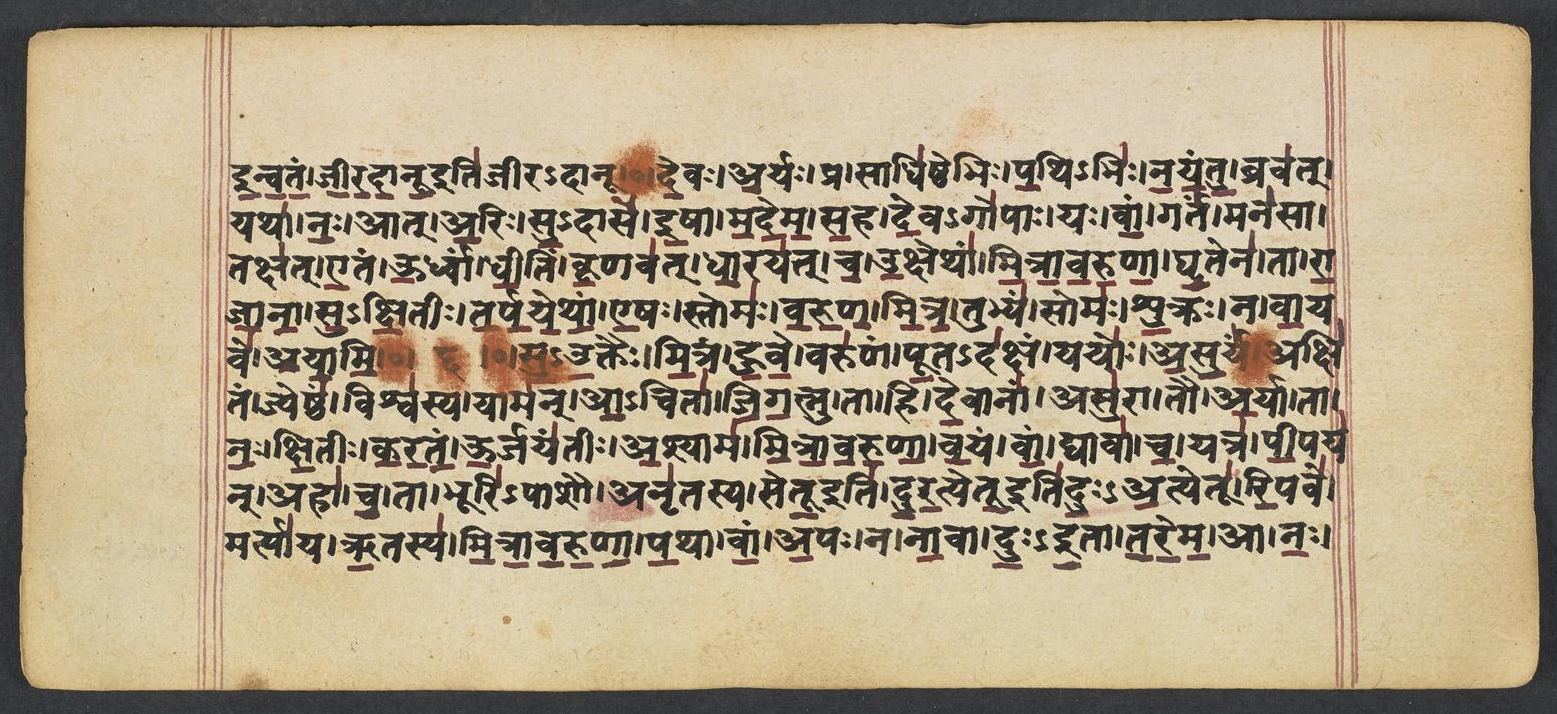
Penn Ms. Coll. 390 Item 41, fol. 534r (numbered 55r by the scribe) (OPenn image 534, lower leaf). Checked on the image: the Rigveda text on this page begins in RV 7.64.2 ‹invatam jīradānū iti jīra-dānū›. The next page with Rigveda text, fol. 534v (numbered 55v by the scribe), begins in RV 7.65.4 ‹mitrāvaruṇā havya-juṣṭim ghṛtaiḥ gavyūtim›. Verses 7.65.1-3 end on this page.
1prati̍ vā̱ṁ sūra̱ udi̍te sū̱ktair mi̱traṁ hu̍ve̱ varu̍ṇam pū̱tada̍kṣam | yayo̍r asu̱rya1̱̍m akṣi̍ta̱ṁ jyeṣṭha̱ṁ viśva̍sya̱ yāma̍nn ā̱citā̍ jiga̱tnu ||
2tā hi de̱vānā̱m asu̍rā̱ tāv a̱ryā tā na̍ḥ kṣi̱tīḥ ka̍ratam ū̱rjaya̍ntīḥ | a̱śyāma̍ mitrāvaruṇā va̱yaṁ vā̱ṁ dyāvā̍ ca̱ yatra̍ pī̱paya̱nn ahā̍ ca ||
3tā bhūri̍pāśā̱v anṛ̍tasya̱ setū̍ dura̱tyetū̍ ri̱pave̱ martyā̍ya | ṛ̱tasya̍ mitrāvaruṇā pa̱thā vā̍m a̱po na nā̱vā du̍ri̱tā ta̍rema ||
Compare: Padapāṭha (word-by-word text written in the manuscript; Sansknet e-text via GRETIL)
1prati | vām | sūre | ut-ite | su-uktaiḥ | mitram | huve | varuṇam | pūta-dakṣam | yayoḥ | asuryam | akṣitam | jyeṣṭham | viśvasya | yāman | ācitā | jigatnu
2tā | hi | devānām | asurā | tau | aryā | tā | naḥ | kṣitīḥ | karatam | ūrjayantīḥ | aśyāma | mitrāvaruṇā | vayam | vām | dyāvā | ca | yatra | pīpayan | ahā | ca
3tā | bhūri-pāśau | anṛtasya | setūiti | duratyetūitiduḥ-atyetū | ripave | martyāya | ṛtasya | mitrāvaruṇā | pathā | vām | apaḥ | na | nāvā | duḥ-itā | tarema
1WITH hymns I call you, when the Sun hath risen, Mitra, and Varuṇa whose thoughts are holy, Whose Power Divine, supreme and everlasting, comes with good heed at each man's supplication.
2For they are Asuras of Gods, the friendly make, both of you, our lands exceeding fruitful. May we obtain you, Varuṇa and Mitra, wherever Heaven and Earth and days may bless us.
3Bonds of the sinner, they bear many nooses: the wicked mortal hardly may escape them. Varuṇa-Mitra, may your path of Order bear us o'er trouble as a boat o'er waters.
Where on the image
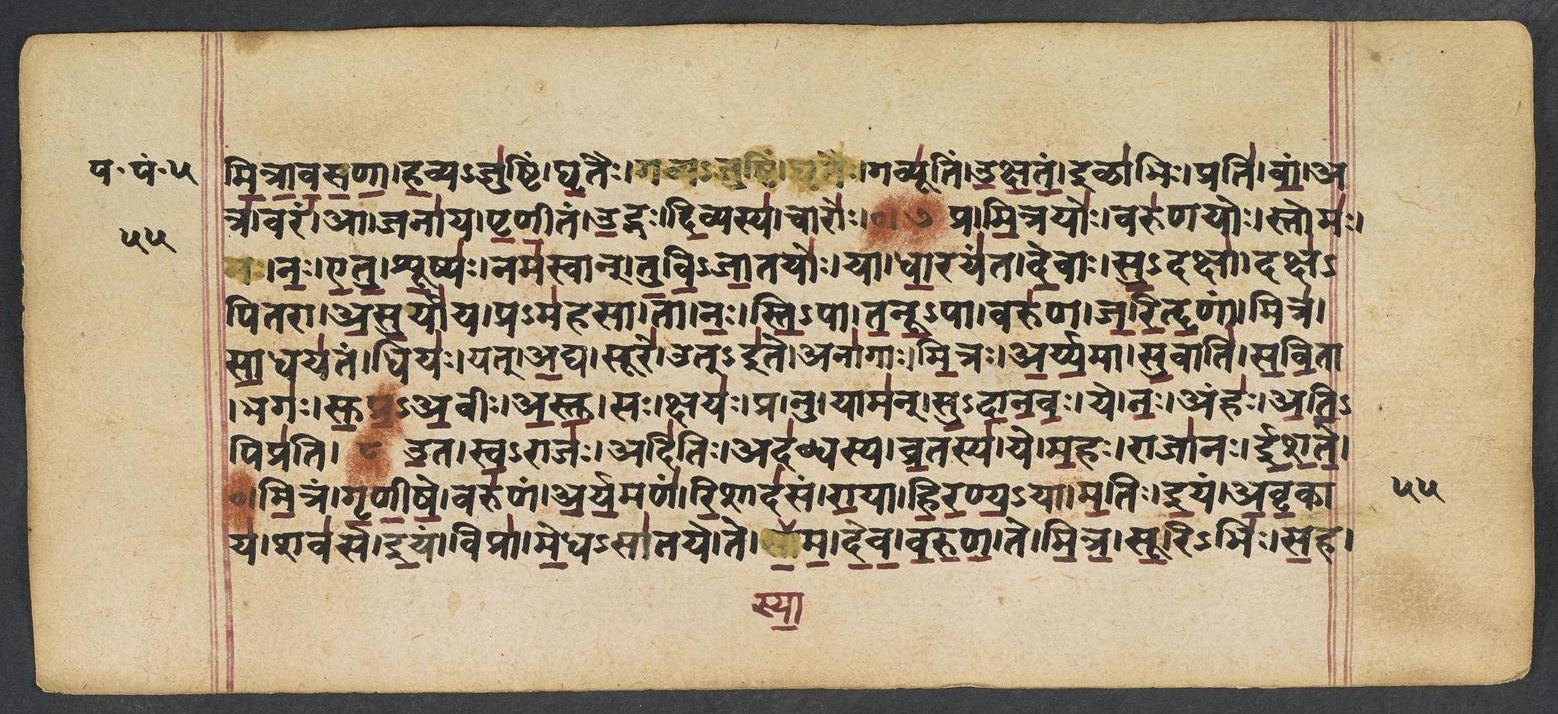
Penn Ms. Coll. 390 Item 41, fol. 534v (numbered 55v by the scribe) (OPenn image 535, upper leaf). Checked on the image: the Rigveda text on this page begins in RV 7.65.4 ‹mitrāvaruṇā havya-juṣṭim ghṛtaiḥ gavyūtim›. The next page with Rigveda text, fol. 535r (numbered 56r by the scribe), begins in RV 7.66.9 ‹iṣam svar iti svaḥ›. Verses 7.65.4-5 end on this page; 7.65.4 begins on fol. 534r (numbered 55r by the scribe).
4ā no̍ mitrāvaruṇā ha̱vyaju̍ṣṭiṁ ghṛ̱tair gavyū̍tim ukṣata̱m iḻā̍bhiḥ | prati̍ vā̱m atra̱ vara̱m ā janā̍ya pṛṇī̱tam u̱dno di̱vyasya̱ cāro̍ḥ ||
5e̱ṣa stomo̍ varuṇa mitra̱ tubhya̱ṁ soma̍ḥ śu̱kro na vā̱yave̍ 'yāmi | a̱vi̱ṣṭaṁ dhiyo̍ jigṛ̱tam pura̍ṁdhīr yū̱yam pā̍ta sva̱stibhi̱ḥ sadā̍ naḥ ||
Compare: Padapāṭha (word-by-word text written in the manuscript; Sansknet e-text via GRETIL)
4ā | naḥ | mitrāvaruṇā | havya-juṣṭim | ghṛtaiḥ | gavyūtim | ukṣatam | iḷābhiḥ | prati | vām | atra | varam | ā | janāya | pṛṇītam | udnaḥ | divyasya | cāroḥ
5eṣaḥ | stomaḥ | varuṇa | mitra | tubhyam | somaḥ | śukraḥ | na | vāyave | ayāmi | aviṣṭam | dhiyaḥ | jigṛtam | puram-dhīḥ | yūyam | pāta | svasti-bhiḥ | sadā | naḥ
4Come, taste our offering, Varuṇa and Mitra: bedew our pasture wil sweet food and fatness. Pour down in plenty here upon the people the choicest of your fair celestial water.
5To you this laud, O Varuṇa and Mitra, is offered, like bright Soma juice to Vâyu. Favour our songs of praise, wake thought and spirit. Preserve us evermore, ye Gods, with blessings.
Notes
- Sanskrit: Aufrecht's edition (1877) with the Vedic accents, as entered by van Nooten and Holland (GRETIL).
- English: Ralph T. H. Griffith, The Hymns of the Rigveda (1889-1892; 2nd ed. 1896-1897), from the VedaWeb digital text; OCR slips in that text were corrected against the printed 2nd edition (data/sources/rigveda/griffith_errata.json).
- Padapāṭha (edition text): Sansknet e-text via GRETIL (CC BY-NC-SA 4.0).
Cite
Sources
- Source: Penn Ms. Coll. 390 Item 41 (undated (catalogued with Penn's 18th-19th c. Vedic manuscripts)), OPenn, Public Domain Mark + Aufrecht's accented text (GRETIL) + Griffith's English (VedaWeb) (holding institution)
- Critical edition: Aufrecht (1877), accented e-text via GRETIL
← previous · → next · v cycle view · l back to library