Rigveda 7.8: To Agni
Introduction
Rigveda 7.8 is a hymn of 7 verses addressed to Agni. It stands in book (maṇḍala) 7, the family book of Vasiṣṭha. The Rigveda is the oldest collection of Sanskrit hymns, composed in the second half of the second millennium BCE and handed down orally for many centuries before it was written down.
The manuscript shown is Penn Ms. Coll. 390 Item 41 (University of Pennsylvania), an undated paper manuscript of the padapāṭha (the word-by-word recitation text, in which every word is written separately and compounds are split) of the whole Ṛgveda in Devanāgarī, 884 leaves in fascicles, 7-9 lines to the page, accents in red; this hymn stands on fol. 498r-498v. Each section below gives the verses that end on one page; the page boundaries were read on the images (the opening words of every page), not counted out. Where the manuscript is a padapāṭha (the word-by-word recitation text), the section shows Aufrecht's continuous (saṃhitā) text first and, as the edition text, the padapāṭha of the same verses, which is the form written on the page.
How was this verified? (Provenance)
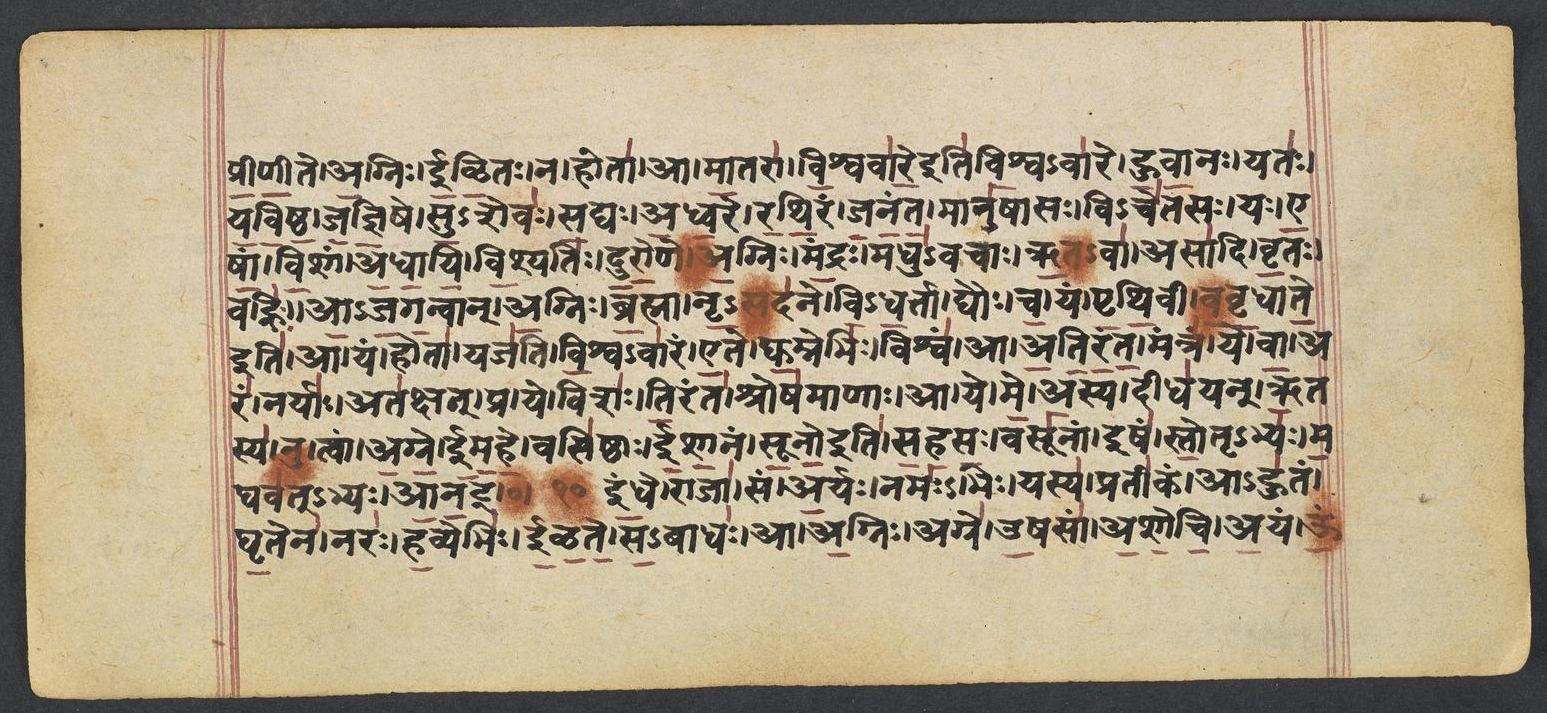
Where on the image
Penn Ms. Coll. 390 Item 41, fol. 498r (numbered 19r by the scribe) (OPenn image 498, lower leaf). Checked on the image: the Rigveda text on this page begins in RV 7.7.3 ‹prīṇīte agniḥ īḷitaḥ na›. The next page with Rigveda text, fol. 498v (numbered 19v by the scribe), begins in RV 7.8.2 ‹iti syaḥ su-mahān avedi›. Verse 7.8.1 ends on this page.
1i̱ndhe rājā̱ sam a̱ryo namo̍bhi̱r yasya̱ pratī̍ka̱m āhu̍taṁ ghṛ̱tena̍ | naro̍ ha̱vyebhi̍r īḻate sa̱bādha̱ āgnir agra̍ u̱ṣasā̍m aśoci ||
Compare: Padapāṭha (word-by-word text written in the manuscript; Sansknet e-text via GRETIL)
1indhe | rājā | sam | aryaḥ | namaḥ-bhiḥ | yasya | pratīkam | āhutam | ghṛtena | naraḥ | havyebhiḥ | īḷate | sa-bādhaḥ | ā | agniḥ | agre | uṣasām | aśoci
1THE King whose face is decked with oil is kindled with homage offered by his faithful servant. The men, the priests adore him with oblations. Agni hath shone forth when the dawn is breaking.
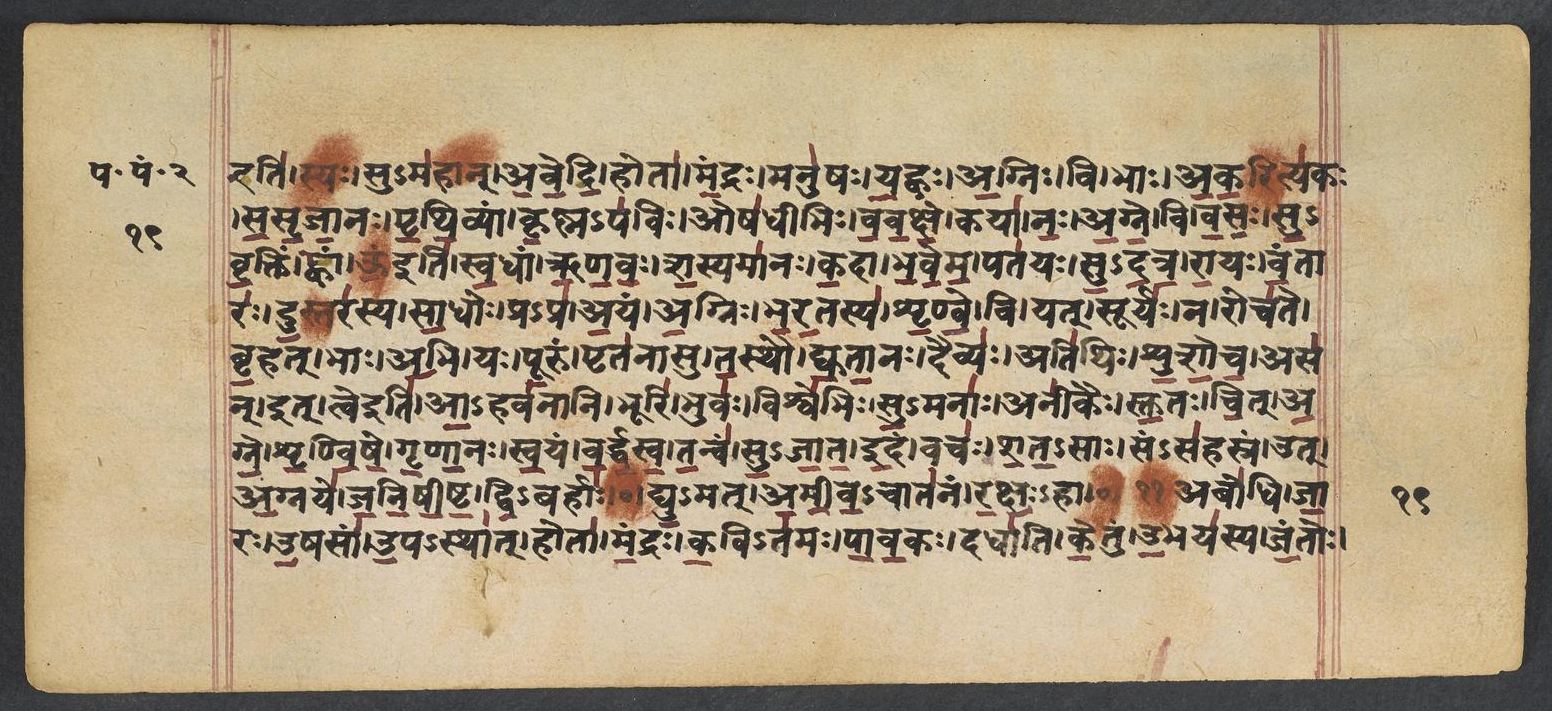
Where on the image
Penn Ms. Coll. 390 Item 41, fol. 498v (numbered 19v by the scribe) (OPenn image 499, upper leaf). Checked on the image: the Rigveda text on this page begins in RV 7.8.2 ‹iti syaḥ su-mahān avedi›. The next page with Rigveda text, fol. 499r (numbered 20r by the scribe), begins in RV 7.9.1 ‹havyā deveṣu draviṇam sukṛt-su›. Verses 7.8.2-7 end on this page; 7.8.2 begins on fol. 498r (numbered 19r by the scribe).
2a̱yam u̱ ṣya suma̍hām̐ avedi̱ hotā̍ ma̱ndro manu̍ṣo ya̱hvo a̱gniḥ | vi bhā a̍kaḥ sasṛjā̱naḥ pṛ̍thi̱vyāṁ kṛ̱ṣṇapa̍vi̱r oṣa̍dhībhir vavakṣe ||
3kayā̍ no agne̱ vi va̍saḥ suvṛ̱ktiṁ kām u̍ sva̱dhām ṛ̍ṇavaḥ śa̱syamā̍naḥ | ka̱dā bha̍vema̱ pata̍yaḥ sudatra rā̱yo va̱ntāro̍ du̱ṣṭara̍sya sā̱dhoḥ ||
4pra-prā̱yam a̱gnir bha̍ra̱tasya̍ śṛṇve̱ vi yat sūryo̱ na roca̍te bṛ̱had bhāḥ | a̱bhi yaḥ pū̱rum pṛta̍nāsu ta̱sthau dyu̍tā̱no daivyo̱ ati̍thiḥ śuśoca ||
5asa̱nn it tve ā̱hava̍nāni̱ bhūri̱ bhuvo̱ viśve̍bhiḥ su̱manā̱ anī̍kaiḥ | stu̱taś ci̍d agne śṛṇviṣe gṛṇā̱naḥ sva̱yaṁ va̍rdhasva ta̱nva̍ṁ sujāta ||
6i̱daṁ vaca̍ḥ śata̱sāḥ saṁsa̍hasra̱m ud a̱gnaye̍ janiṣīṣṭa dvi̱barhā̍ḥ | śaṁ yat sto̱tṛbhya̍ ā̱paye̱ bhavā̍ti dyu̱mad a̍mīva̱cāta̍naṁ rakṣo̱hā ||
7nū tvām a̍gna īmahe̱ vasi̍ṣṭhā īśā̱naṁ sū̍no sahaso̱ vasū̍nām | iṣa̍ṁ sto̱tṛbhyo̍ ma̱ghava̍dbhya ānaḍ yū̱yam pā̍ta sva̱stibhi̱ḥ sadā̍ naḥ ||
Compare: Padapāṭha (word-by-word text written in the manuscript; Sansknet e-text via GRETIL)
2ayam | oṃ iti | syaḥ | su-mahān | avedi | hotā | mandraḥ | manuṣaḥ | yahvaḥ | agniḥ | vi | bhāḥ | akar ity akaḥ | sasṛjānaḥ | pṛthivyām | kṛṣṇa-paviḥ | oṣadhībhiḥ | vavakṣe
3kayā | naḥ | agne | vi | vasaḥ | su-vṛktim | kām | oṃ iti | svadhām | ṛṇavaḥ | śasyamānaḥ | kadā | bhavema | patayaḥ | su-datra | rāyaḥ | vantāraḥ | dustarasya | sādhoḥ
4pra-pra | ayam | agniḥ | bharatasya | śṛṇve | vi | yat | sūryaḥ | na | rocate | bṛhat | bhāḥ | abhi | yaḥ | pūrum | pṛtanāsu | tasthau | dyutānaḥ | daivyaḥ | atithiḥ | śuśoca
5asan | it | tve iti | āhavanāni | bhūri | bhuvaḥ | viśvebhiḥ | su-manāḥ | anīkaiḥ | stutaḥ | cit | agne | śṛṇviṣe | gṛṇānaḥ | svayam | vardhasva | tanvam | su-jāta
6idam | vacaḥ | śata-sāḥ | sam-sahasram | ut | agnaye | janiṣīṣṭa | dvi-bahārḥ | śam | yat | stotṛ-bhyaḥ | āpaye | bhavāti | dyu-mat | amīva-cātanam | rakṣaḥ-hā
7nu | tvām | agne | īmahe | vasiṣṭhāḥ | īśānam | sūno iti | sahasaḥ | vasūnām | iṣam | stotṛ-bhyaḥ | maghavat-bhyaḥ | ānaṭ | yūyam | pāta | svasti-bhiḥ | sadā | naḥ
2Yea, he hath been acknowledged as most mighty, the joyous Priest of men, the youthful Agni. He, spreading o'er the earth, made light around him, and grew among the plants with blackened fellies..
3How dost thou decorate our hymn, O Agni? What power dost thou exert when thou art lauded? When, Bounteous God, may we be lords of riches, winners of precious wealth which none may conquer?
4Far famed is this the Bharata's own Agni he shineth like the Sun with lofty splendour. He who hath vanquished Pûru in the battle, the heavenly guest hath glowed in full refulgence.
5Full many oblations are in thee collected: with all thine aspects thou hast waxen gracious. Thou art already famed as praised and lauded, yet still, O nobly born, increase thy body.
6Be this my song, that winneth countless treasure, engendered with redoubled force for Agni, That, splendid, chasing sickness, slaying demons, it may delight our friend and bless the singers.
7We, the Vasishṭhas, now implore thee, Agni, O Son of Strength, the Lord of wealth and riches. Thou hast brought food to singers and to nobles. Ye Gods, preserve us evermore with blessings.
Notes
- Sanskrit: Aufrecht's edition (1877) with the Vedic accents, as entered by van Nooten and Holland (GRETIL).
- English: Ralph T. H. Griffith, The Hymns of the Rigveda (1889-1892; 2nd ed. 1896-1897), from the VedaWeb digital text; OCR slips in that text were corrected against the printed 2nd edition (data/sources/rigveda/griffith_errata.json).
- Padapāṭha (edition text): Sansknet e-text via GRETIL (CC BY-NC-SA 4.0).
Cite
Sources
- Source: Penn Ms. Coll. 390 Item 41 (undated (catalogued with Penn's 18th-19th c. Vedic manuscripts)), OPenn, Public Domain Mark + Aufrecht's accented text (GRETIL) + Griffith's English (VedaWeb) (holding institution)
- Critical edition: Aufrecht (1877), accented e-text via GRETIL
← previous · → next · v cycle view · l back to library