Rigveda 7.80: To Usas
Introduction
Rigveda 7.80 is a hymn of 3 verses addressed to Usas. It stands in book (maṇḍala) 7, the family book of Vasiṣṭha. The Rigveda is the oldest collection of Sanskrit hymns, composed in the second half of the second millennium BCE and handed down orally for many centuries before it was written down.
The manuscript shown is Penn Ms. Coll. 390 Item 41 (University of Pennsylvania), an undated paper manuscript of the padapāṭha (the word-by-word recitation text, in which every word is written separately and compounds are split) of the whole Ṛgveda in Devanāgarī, 884 leaves in fascicles, 7-9 lines to the page, accents in red; this hymn stands on fol. 542v. Each section below gives the verses that end on one page; the page boundaries were read on the images (the opening words of every page), not counted out. Where the manuscript is a padapāṭha (the word-by-word recitation text), the section shows Aufrecht's continuous (saṃhitā) text first and, as the edition text, the padapāṭha of the same verses, which is the form written on the page.
How was this verified? (Provenance)
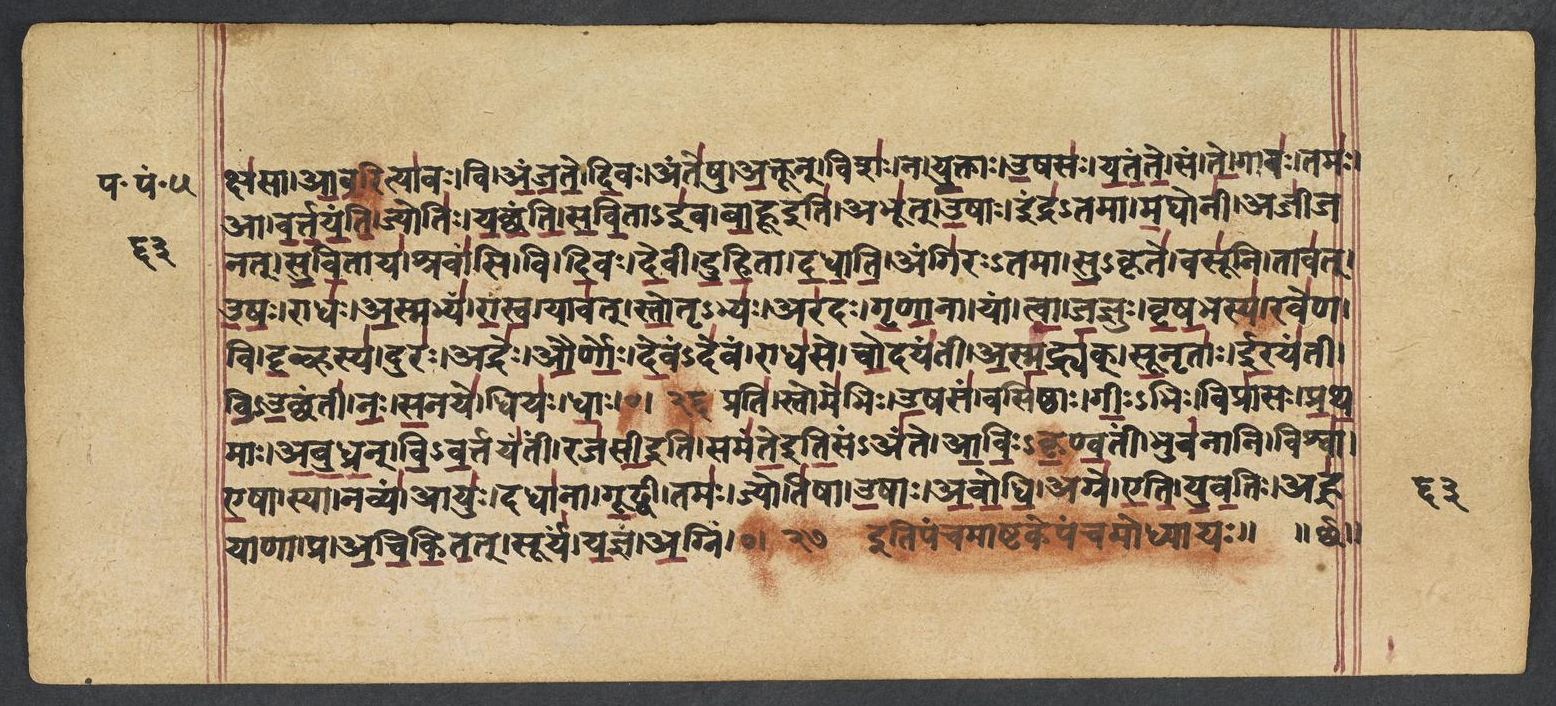
Where on the image
Penn Ms. Coll. 390 Item 41, fol. 542v (numbered 63v by the scribe) (OPenn image 543, upper leaf). Checked on the image: the Rigveda text on this page begins in RV 7.79.1 ‹-cakṣasā āvar ity āvaḥ›. The next page with Rigveda text, fol. 543r (numbered 64r by the scribe), begins in RV 7.81.1 ‹prati oṃ iti adarśi›. Verses 7.80.1-3 end on this page.
1prati̱ stome̍bhir u̱ṣasa̱ṁ vasi̍ṣṭhā gī̱rbhir viprā̍saḥ pratha̱mā a̍budhran | vi̱va̱rtaya̍ntī̱ṁ raja̍sī̱ sama̍nte āviṣkṛṇva̱tīm bhuva̍nāni̱ viśvā̍ ||
2e̱ṣā syā navya̱m āyu̱r dadhā̍nā gū̱ḍhvī tamo̱ jyoti̍ṣo̱ṣā a̍bodhi | agra̍ eti yuva̱tir ahra̍yāṇā̱ prāci̍kita̱t sūrya̍ṁ ya̱jñam a̱gnim ||
3aśvā̍vatī̱r goma̍tīr na u̱ṣāso̍ vī̱rava̍tī̱ḥ sada̍m ucchantu bha̱drāḥ | ghṛ̱taṁ duhā̍nā vi̱śvata̱ḥ prapī̍tā yū̱yam pā̍ta sva̱stibhi̱ḥ sadā̍ naḥ ||
Compare: Padapāṭha (word-by-word text written in the manuscript; Sansknet e-text via GRETIL)
1prati | stomebhiḥ | uṣasam | vasiṣṭhāḥ | gīḥ-bhiḥ | viprāsaḥ | prathamāḥ | abudhran | vivartayantīm | rajasī iti | samanteitisam-ante | āviḥ-kṛṇvatīm | bhuvanāni | viśvā
2eṣā | syā | navyam | āyuḥ | dadhānā | gūdhvī | tamaḥ | jyotiṣā | uṣāḥ | abodhi | agre | eti | yuvatiḥ | ahrayāṇā | pra | acikitat | sūryam | yajñam | agnim
3aśva-vatīḥ | go--matīḥ | naḥ | uṣasaḥ | vīra-vatīḥ | sadam | ucchantu | bhadrāḥ | ghṛtam | duhānāḥ | viśvataḥ | pra-pītāḥ | yūyam | pāta | svasti-bhiḥ | sadā | naḥ
1THE priests, Vasishṭhas, are the first awakened to welcome Ushas with their songs and praises, Who makes surrounding regions part asunder,and shows apparent all existing creatures.
2Giving fresh life when she hath hid the darkness, this Dawn hath wakened there with new-born lustre. Youthful and unrestrained she cometh forward: she hath turned thoughts to Sun and fire and worship.
3May blessed Mornings shine on us for ever, with wealth of kine, of horses, and of heroes, Streaming with all abundance, pouring fatness. Preserve us evermore, ye Gods, with blessings.
Notes
- Sanskrit: Aufrecht's edition (1877) with the Vedic accents, as entered by van Nooten and Holland (GRETIL).
- English: Ralph T. H. Griffith, The Hymns of the Rigveda (1889-1892; 2nd ed. 1896-1897), from the VedaWeb digital text; OCR slips in that text were corrected against the printed 2nd edition (data/sources/rigveda/griffith_errata.json).
- Padapāṭha (edition text): Sansknet e-text via GRETIL (CC BY-NC-SA 4.0).
Cite
Sources
- Source: Penn Ms. Coll. 390 Item 41 (undated (catalogued with Penn's 18th-19th c. Vedic manuscripts)), OPenn, Public Domain Mark + Aufrecht's accented text (GRETIL) + Griffith's English (VedaWeb) (holding institution)
- Critical edition: Aufrecht (1877), accented e-text via GRETIL
← previous · → next · v cycle view · l back to library