Rigveda 7.81: To Usas
Introduction
Rigveda 7.81 is a hymn of 6 verses addressed to Usas. It stands in book (maṇḍala) 7, the family book of Vasiṣṭha. The Rigveda is the oldest collection of Sanskrit hymns, composed in the second half of the second millennium BCE and handed down orally for many centuries before it was written down.
The manuscript shown is Penn Ms. Coll. 390 Item 41 (University of Pennsylvania), an undated paper manuscript of the padapāṭha (the word-by-word recitation text, in which every word is written separately and compounds are split) of the whole Ṛgveda in Devanāgarī, 884 leaves in fascicles, 7-9 lines to the page, accents in red; this hymn stands on fol. 543r-543v. Each section below gives the verses that end on one page; the page boundaries were read on the images (the opening words of every page), not counted out. Where the manuscript is a padapāṭha (the word-by-word recitation text), the section shows Aufrecht's continuous (saṃhitā) text first and, as the edition text, the padapāṭha of the same verses, which is the form written on the page.
How was this verified? (Provenance)
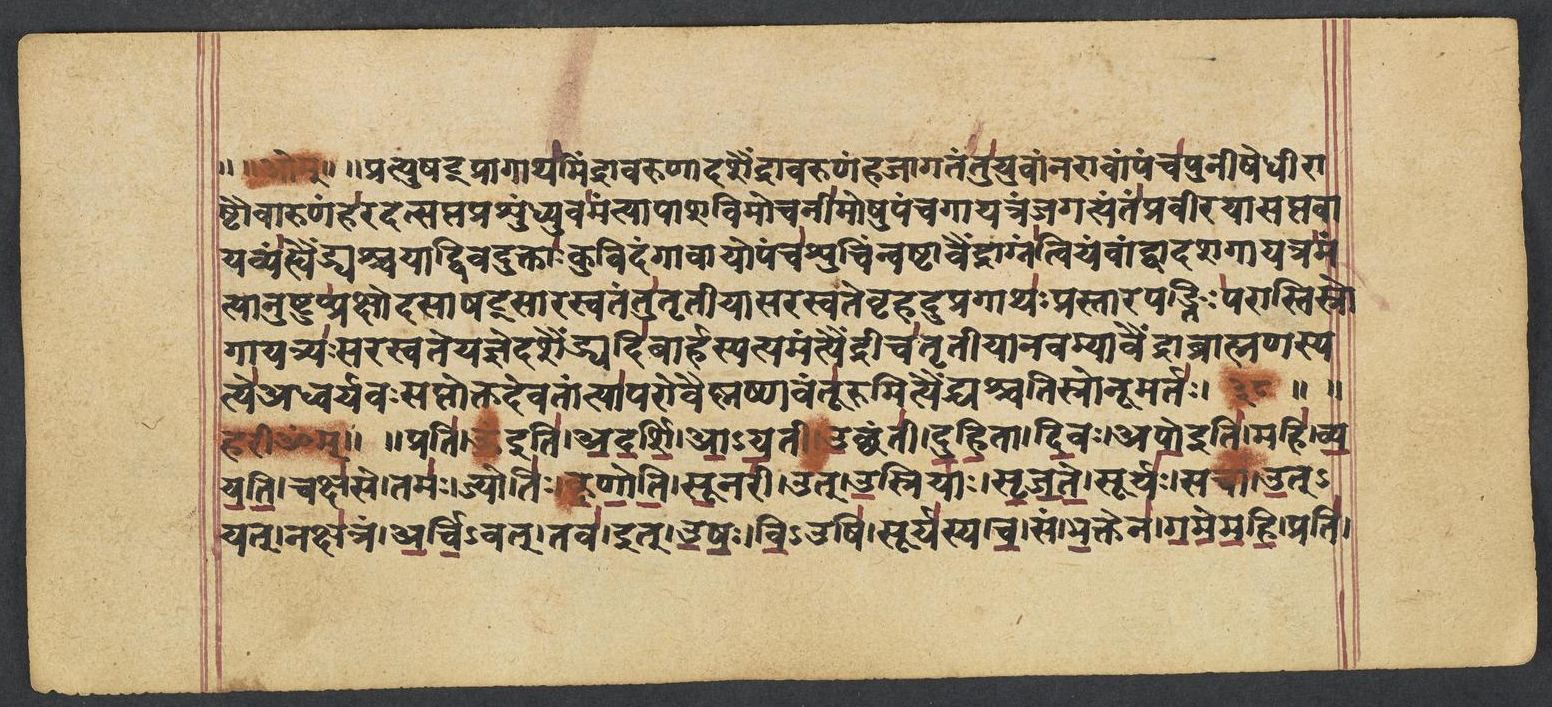
Where on the image
Penn Ms. Coll. 390 Item 41, fol. 543r (numbered 64r by the scribe) (OPenn image 543, lower leaf). Checked on the image: the Rigveda text on this page begins in RV 7.81.1 ‹prati oṃ iti adarśi›. Lines 1-6 carry the anukramaṇī for aṣṭaka 5, adhyāya 6; 7.81.1 (prati ūṃ iti adarśi āyatī) begins in line 7 after hariḥ oṃ. The next page with Rigveda text, fol. 543v (numbered 64v by the scribe), begins in RV 7.81.3 ‹tvā duhitaḥ divaḥ uṣaḥ›. Verses 7.81.1-2 end on this page.
1praty u̍ adarśy āya̱ty u1̱̍cchantī̍ duhi̱tā di̱vaḥ | apo̱ mahi̍ vyayati̱ cakṣa̍se̱ tamo̱ jyoti̍ṣ kṛṇoti sū̱narī̍ ||
2ud u̱sriyā̍ḥ sṛjate̱ sūrya̱ḥ sacā̍m̐ u̱dyan nakṣa̍tram arci̱vat | taved u̍ṣo̱ vyuṣi̱ sūrya̍sya ca̱ sam bha̱ktena̍ gamemahi ||
Compare: Padapāṭha (word-by-word text written in the manuscript; Sansknet e-text via GRETIL)
1prati | oṃ iti | adarśi | āyatī | ucchantī | duhitā | divaḥ | apo iti | mahi | vyayati | cakṣase | tamaḥ | jyotiḥ | kṛṇoti | sūnarī
2ut | usriyāḥ | sṛjate | sūryaḥ | sacā | ut-yat | nakṣatram | arci-vat | tava | it | uṣaḥ | vi-uṣi | sūryasya | ca | sam | bhaktena | gamemahi
1ADVANCING, sending forth her rays, the Daughter of the Sky is seen. Uncovering, that we may see, the mighty gloom, the friendly Lady makes the light.
2The Sun ascending, the refulgent Star, pours down his beams together with the Dawn. O Dawn, at thine arising, and the Sun's, may we attain the share allotted us.
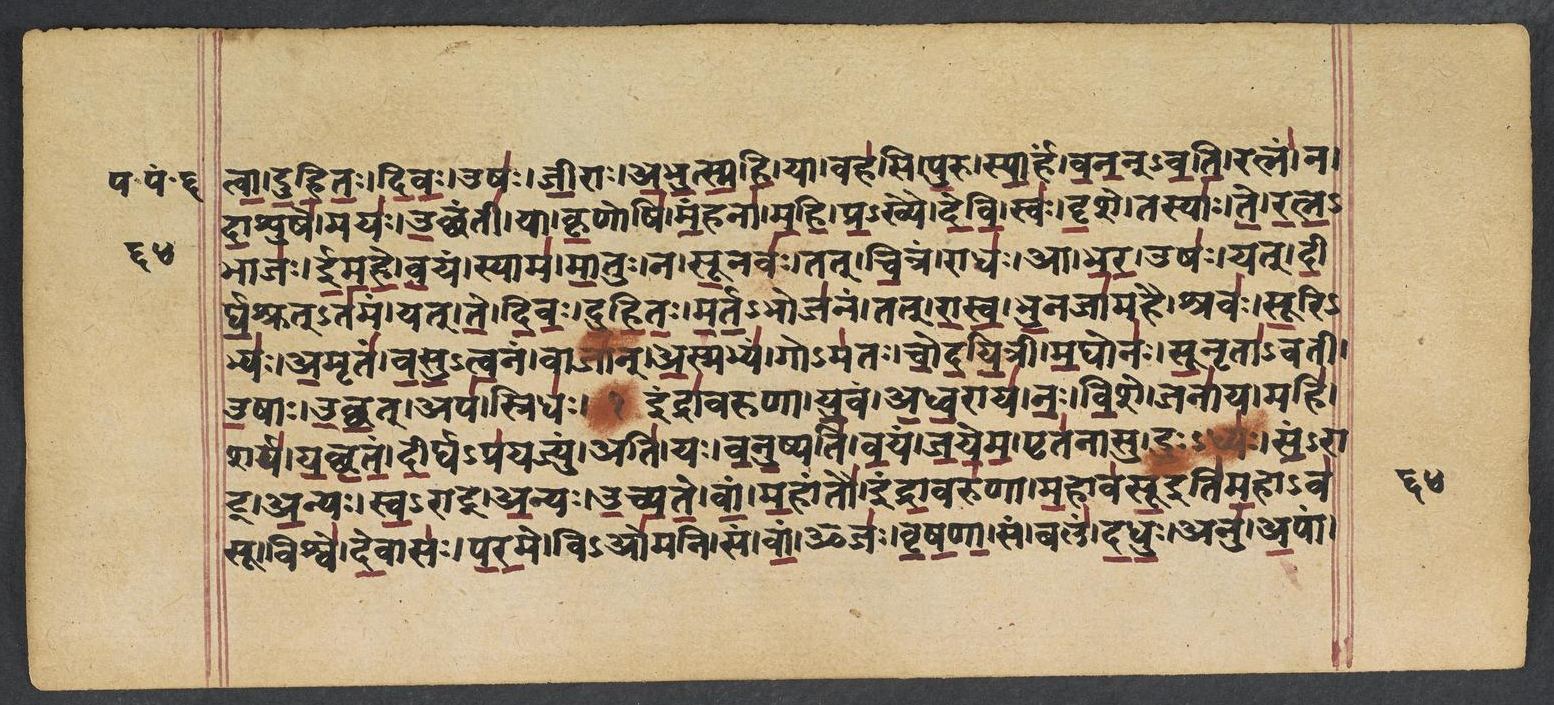
Where on the image
Penn Ms. Coll. 390 Item 41, fol. 543v (numbered 64v by the scribe) (OPenn image 544, upper leaf). Checked on the image: the Rigveda text on this page begins in RV 7.81.3 ‹tvā duhitaḥ divaḥ uṣaḥ›. The next page with Rigveda text, fol. 544r (numbered 65r by the scribe), begins in RV 7.82.3 ‹khāni atṛntam ojasā sūryam›. Verses 7.81.3-6 end on this page; 7.81.3 begins on fol. 543r (numbered 64r by the scribe).
3prati̍ tvā duhitar diva̱ uṣo̍ jī̱rā a̍bhutsmahi | yā vaha̍si pu̱ru spā̱rhaṁ va̍nanvati̱ ratna̱ṁ na dā̱śuṣe̱ maya̍ḥ ||
4u̱cchantī̱ yā kṛ̱ṇoṣi̍ ma̱ṁhanā̍ mahi pra̱khyai de̍vi̱ sva̍r dṛ̱śe | tasyā̍s te ratna̱bhāja̍ īmahe va̱yaṁ syāma̍ mā̱tur na sū̱nava̍ḥ ||
5tac ci̱traṁ rādha̱ ā bha̱roṣo̱ yad dī̍rgha̱śrutta̍mam | yat te̍ divo duhitar marta̱bhoja̍na̱ṁ tad rā̍sva bhu̱najā̍mahai ||
6śrava̍ḥ sū̱ribhyo̍ a̱mṛta̍ṁ vasutva̱naṁ vājā̍m̐ a̱smabhya̱ṁ goma̍taḥ | co̱da̱yi̱trī ma̱ghona̍ḥ sū̱nṛtā̍vaty u̱ṣā u̍ccha̱d apa̱ sridha̍ḥ ||
Compare: Padapāṭha (word-by-word text written in the manuscript; Sansknet e-text via GRETIL)
3prati | tvā | duhitaḥ | divaḥ | uṣaḥ | jīrāḥ | abhutsmahi | yā | vahasi | puru | spārham | vanan-vati | ratnam | na | dāśuṣe | mayaḥ
4ucchantī | yā | kṛṇoṣi | maṃhanā | mahi | pra-khyai | devi | svaḥ | dṛśe | tasyāḥ | te | ratna-bhājaḥ | īmahe | vayam | syāma | mātuḥ | na | sūnavaḥ
5tat | citram | rādhaḥ | ā | bhara | uṣaḥ | yat | dīrghaśrut-tamam | yat | te | divaḥ | duhi taḥ | marta-bhojanam | tat | rāsva | bhunajāmahai
6śravaḥ | sūri-bhyaḥ | amṛtam | vasu-tvanam | vājān | asmabhyam | go--mataḥ | codayitrī | maghonaḥ | sūnṛtāvatī | uṣāḥ | ucchat | apa | sridhaḥ
3Promptly we woke to welcome thee, O Ushas, Daughter of the Sky, Thee, Bounteous One, who bringest all we long to have, and to the offerer health and wealth.
4Thou, dawning, workest fain to light the great world, yea, heaven, Goddess! that it may be seen. We yearn to be thine own, Dealer of Wealth: may we be to this Mother like her sons.
5Bring us that wondrous bounty, Dawn, that shall be famed most far away. What, Child of Heaven, thou hast of nourishment for man, bestow thou on us to enjoy.
6Give to our princes opulence and immortal fame, and strength in herds of kine to us. May she who prompts the wealthy, Lady of sweet strains, may Ushas dawn our foes away.
Notes
- Sanskrit: Aufrecht's edition (1877) with the Vedic accents, as entered by van Nooten and Holland (GRETIL).
- English: Ralph T. H. Griffith, The Hymns of the Rigveda (1889-1892; 2nd ed. 1896-1897), from the VedaWeb digital text; OCR slips in that text were corrected against the printed 2nd edition (data/sources/rigveda/griffith_errata.json).
- Padapāṭha (edition text): Sansknet e-text via GRETIL (CC BY-NC-SA 4.0).
Cite
Sources
- Source: Penn Ms. Coll. 390 Item 41 (undated (catalogued with Penn's 18th-19th c. Vedic manuscripts)), OPenn, Public Domain Mark + Aufrecht's accented text (GRETIL) + Griffith's English (VedaWeb) (holding institution)
- Critical edition: Aufrecht (1877), accented e-text via GRETIL
← previous · → next · v cycle view · l back to library