Rigveda 7.96: To Sarasvati or Sarasvat
Introduction
Rigveda 7.96 is a hymn of 6 verses addressed to Sarasvati or Sarasvat. It stands in book (maṇḍala) 7, the family book of Vasiṣṭha. The Rigveda is the oldest collection of Sanskrit hymns, composed in the second half of the second millennium BCE and handed down orally for many centuries before it was written down.
The manuscript shown is Penn Ms. Coll. 390 Item 41 (University of Pennsylvania), an undated paper manuscript of the padapāṭha (the word-by-word recitation text, in which every word is written separately and compounds are split) of the whole Ṛgveda in Devanāgarī, 884 leaves in fascicles, 7-9 lines to the page, accents in red; this hymn stands on fol. 551v-552r. Each section below gives the verses that end on one page; the page boundaries were read on the images (the opening words of every page), not counted out. Where the manuscript is a padapāṭha (the word-by-word recitation text), the section shows Aufrecht's continuous (saṃhitā) text first and, as the edition text, the padapāṭha of the same verses, which is the form written on the page.
How was this verified? (Provenance)
Where on the image
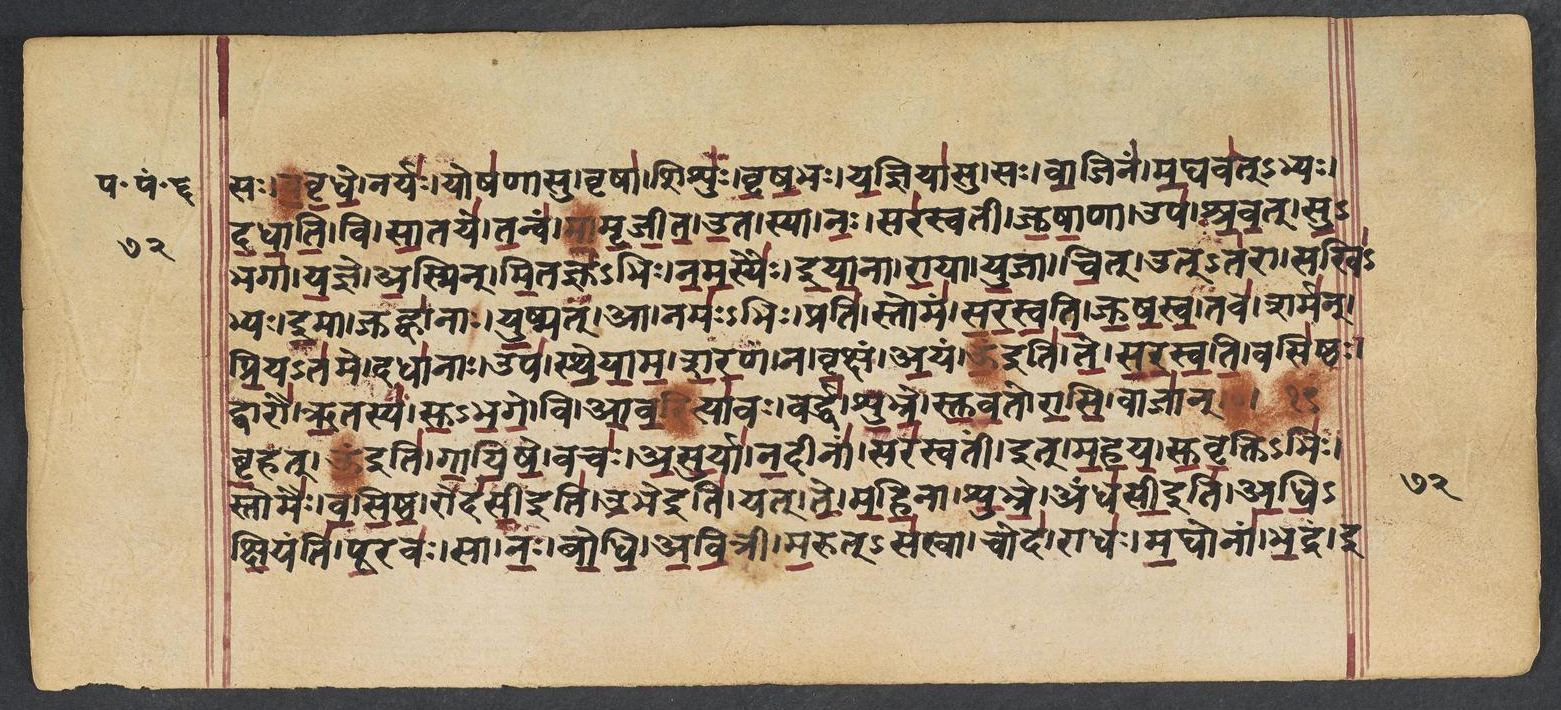
Penn Ms. Coll. 390 Item 41, fol. 551v (numbered 72v by the scribe) (OPenn image 552, upper leaf). Checked on the image: the Rigveda text on this page begins in RV 7.95.3 ‹saḥ vavṛdhe naryaḥ yoṣaṇāsu›. The next page with Rigveda text, fol. 552r (numbered 73r by the scribe), begins in RV 7.96.3 ‹-it bhadrā kṛṇavat sarasvatī›. Verses 7.96.1-2 end on this page.
1bṛ̱had u̍ gāyiṣe̱ vaco̍ 'su̱ryā̍ na̱dīnā̍m | sara̍svatī̱m in ma̍hayā suvṛ̱ktibhi̱ḥ stomai̍r vasiṣṭha̱ roda̍sī ||
2u̱bhe yat te̍ mahi̱nā śu̍bhre̱ andha̍sī adhikṣi̱yanti̍ pū̱rava̍ḥ | sā no̍ bodhy avi̱trī ma̱rutsa̍khā̱ coda̱ rādho̍ ma̱ghonā̍m ||
Compare: Padapāṭha (word-by-word text written in the manuscript; Sansknet e-text via GRETIL)
1bṛhat | oṃ iti | gāyiṣe | vacaḥ | asuryā | nadīnām | sarasvatīm | it | mahaya | su-vṛkti-bhi ḥ | stomaiḥ | vasiṣṭha | rodasī iti
2ubhe iti | yat | te | mahinā | śubhre | andhasī iti | adhi-kṣiyanti | pūravaḥ | sā | naḥ | bodhi | avitrī | marut-sakhā | coda | rādhaḥ | maghonām
1I SING a lofty song, for she is mightiest, most divine of Streams. Sarasvatî will I exalt with hymns and lauds, and, O Vasishṭha, Heaven and Earth.
2When in the fulness of their strength the Pûrus dwell, Beauteous One, on thy two grassy banks, Favour us thou who hast the Maruts for thy friends: stir up the bounty of our chiefs.
Where on the image
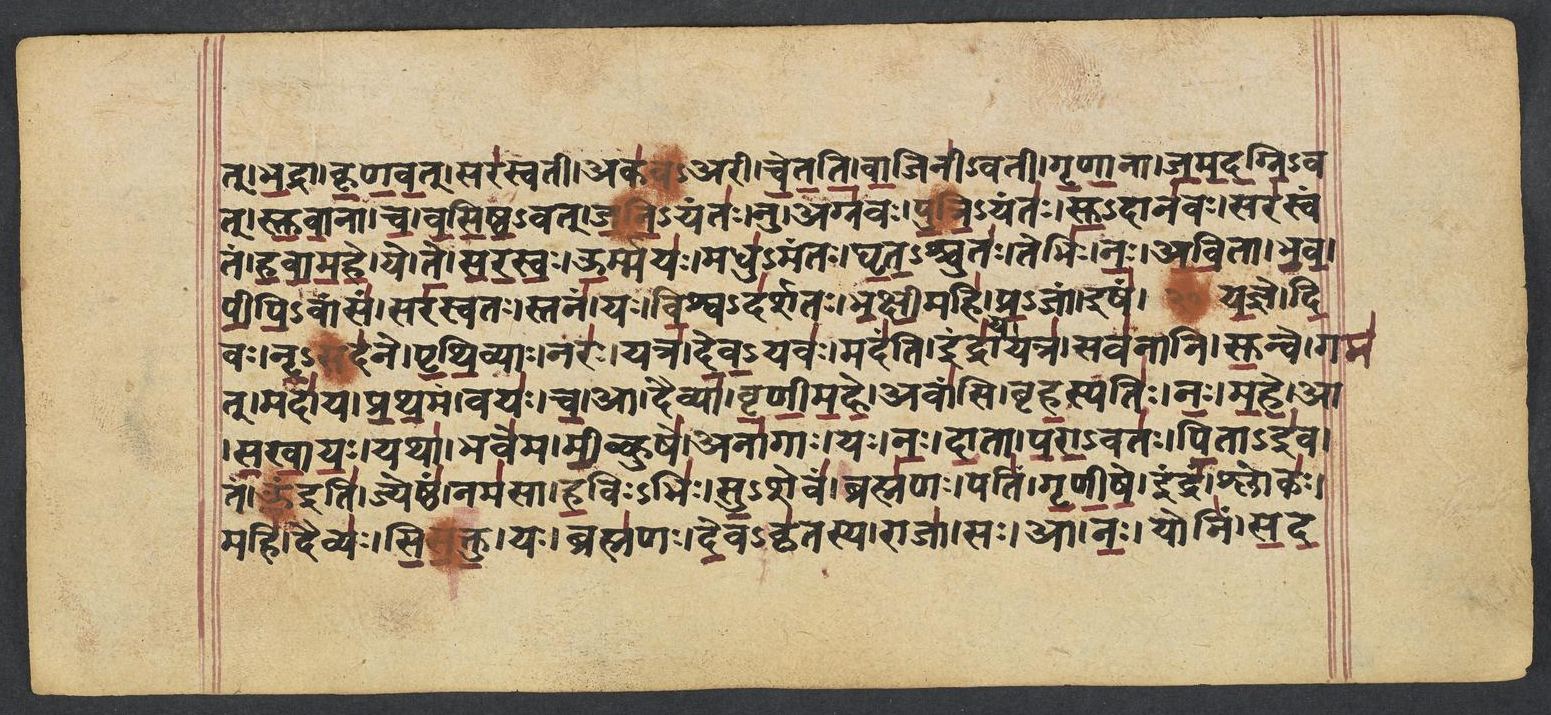
Penn Ms. Coll. 390 Item 41, fol. 552r (numbered 73r by the scribe) (OPenn image 552, lower leaf). Checked on the image: the Rigveda text on this page begins in RV 7.96.3 ‹-it bhadrā kṛṇavat sarasvatī›. The next page with Rigveda text, fol. 552v (numbered 73v by the scribe), begins in RV 7.97.4 ‹-sadatu preṣṭhaḥ bṛhaspatiḥ viśva-vāraḥ›. Verses 7.96.3-6 end on this page; 7.96.3 begins on fol. 551v (numbered 72v by the scribe).
3bha̱dram id bha̱drā kṛ̍ṇava̱t sara̍sva̱ty aka̍vārī cetati vā̱jinī̍vatī | gṛ̱ṇā̱nā ja̍madagni̱vat stu̍vā̱nā ca̍ vasiṣṭha̱vat ||
4ja̱nī̱yanto̱ nv agra̍vaḥ putrī̱yanta̍ḥ su̱dāna̍vaḥ | sara̍svantaṁ havāmahe ||
5ye te̍ sarasva ū̱rmayo̱ madhu̍manto ghṛta̱ścuta̍ḥ | tebhi̍r no 'vi̱tā bha̍va ||
6pī̱pi̱vāṁsa̱ṁ sara̍svata̱ḥ stana̱ṁ yo vi̱śvada̍rśataḥ | bha̱kṣī̱mahi̍ pra̱jām iṣa̍m ||
Compare: Padapāṭha (word-by-word text written in the manuscript; Sansknet e-text via GRETIL)
3bhadram | it | bhadrā | kṛṇavat | sarasvatī | akava-arī | cetati | vājinī-vatī | gṛṇānā | jamadagni-vat | stuvānā | ca | vasiṣṭha-vat
4janīyantaḥ | nu | agravaḥ | putri-yantaḥ | su-dānavaḥ | sarasvantam | havāmahe
5ye | te | sarasvaḥ | ūrmayaḥ | madhu-mantaḥ | ghṛta-ścutaḥ | tebhiḥ | naḥ | avitā | bhava
6pīpi-vāṃsam | sarasvataḥ | stanam | yaḥ | viśva-darśataḥ | bhakṣīmahi | pra-jām | iṣam
3So may Sarasvatî auspicious send good luck; she, rich in spoil, is never niggardly in thought, When praised in jamadagni's way and lauded as Vasishṭha lauds.
4We call upon Sarasvan, as unmarried men who long for wives, As liberal men who yearn for sons.
5Be thou our kind protector, O Sarasvan, with those waves of thine Laden with sweets and dropping oil.
6May we enjoy Sarasvan's breast, all-beautiful, that swells with streams, May we gain food and progeny.
Notes
- Sanskrit: Aufrecht's edition (1877) with the Vedic accents, as entered by van Nooten and Holland (GRETIL).
- English: Ralph T. H. Griffith, The Hymns of the Rigveda (1889-1892; 2nd ed. 1896-1897), from the VedaWeb digital text; OCR slips in that text were corrected against the printed 2nd edition (data/sources/rigveda/griffith_errata.json).
- Padapāṭha (edition text): Sansknet e-text via GRETIL (CC BY-NC-SA 4.0).
Cite
Sources
- Source: Penn Ms. Coll. 390 Item 41 (undated (catalogued with Penn's 18th-19th c. Vedic manuscripts)), OPenn, Public Domain Mark + Aufrecht's accented text (GRETIL) + Griffith's English (VedaWeb) (holding institution)
- Critical edition: Aufrecht (1877), accented e-text via GRETIL
← previous · → next · v cycle view · l back to library