Rigveda 8.11: To Agni
Introduction
Rigveda 8.11 is a hymn of 10 verses addressed to Agni. It stands in book (maṇḍala) 8, the book of the Kaṇva and Aṅgiras poets. The Rigveda is the oldest collection of Sanskrit hymns, composed in the second half of the second millennium BCE and handed down orally for many centuries before it was written down.
The manuscript shown is Penn Ms. Coll. 390 Item 41 (University of Pennsylvania), an undated paper manuscript of the padapāṭha (the word-by-word recitation text, in which every word is written separately and compounds are split) of the whole Ṛgveda in Devanāgarī, 884 leaves in fascicles, 7-9 lines to the page, accents in red; this hymn stands on fol. 577v-578r. Each section below gives the verses that end on one page; the page boundaries were read on the images (the opening words of every page), not counted out. Where the manuscript is a padapāṭha (the word-by-word recitation text), the section shows Aufrecht's continuous (saṃhitā) text first and, as the edition text, the padapāṭha of the same verses, which is the form written on the page.
How was this verified? (Provenance)
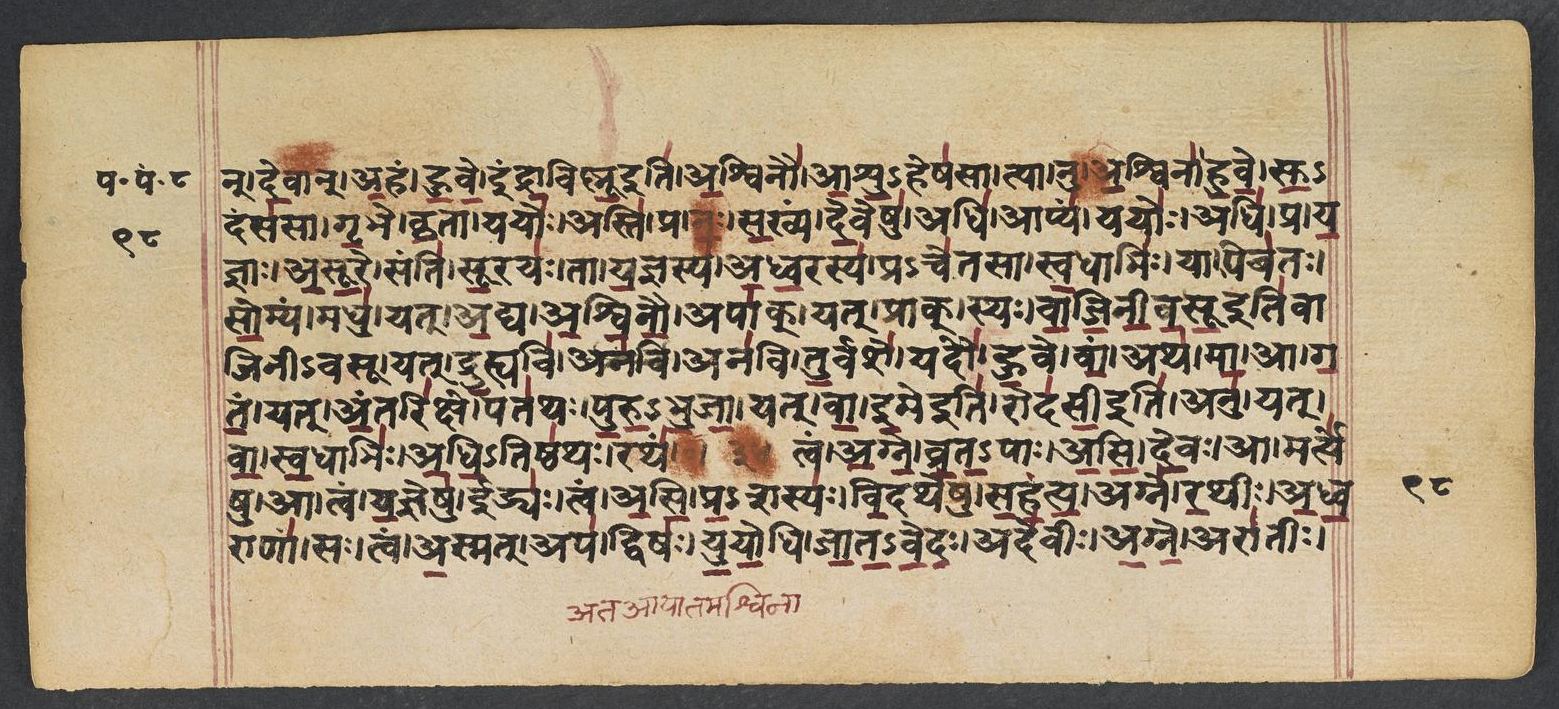
Where on the image
Penn Ms. Coll. 390 Item 41, fol. 577v (numbered 98v by the scribe) (OPenn image 578, upper leaf). Checked on the image: the Rigveda text on this page begins in RV 8.10.2 ‹-viśvān devān aham huve›. The next page with Rigveda text, fol. 578r (numbered 99r by the scribe), begins in RV 8.11.4 ‹anti cit santam aha›. Verses 8.11.1-3 end on this page.
1tvam a̍gne vrata̱pā a̍si de̱va ā martye̱ṣv ā | tvaṁ ya̱jñeṣv īḍya̍ḥ ||
2tvam a̍si pra̱śasyo̍ vi̱dathe̍ṣu sahantya | agne̍ ra̱thīr a̍dhva̱rāṇā̍m ||
3sa tvam a̱smad apa̱ dviṣo̍ yuyo̱dhi jā̍tavedaḥ | ade̍vīr agne̱ arā̍tīḥ ||
Compare: Padapāṭha (word-by-word text written in the manuscript; Sansknet e-text via GRETIL)
1tvam | agne | vrata-pāḥ | asi | devaḥ | ā | martyeṣu | ā | tvam | yajñeṣu | īḍyaḥ
2tvam | asi | pra-śasyaḥ | vidatheṣu | sahantya | agne | rathīḥ | adhvarāṇām
3saḥ | tvam | asmat | apa | dviṣaḥ | yuyodhi | jāta-vedaḥ | adevīḥ | agne | arātīḥ
1THOU Agni, God mid mortal men, art guard of sacred rites, thou art To be adored at sacrifice.
2O Mighty Agni, thou must be glorified at our festivals, Bearing our offerings to the Gods.
3O Jâtavedas Agni, fight and drive our foes afar from us, Themand their godless enmities.
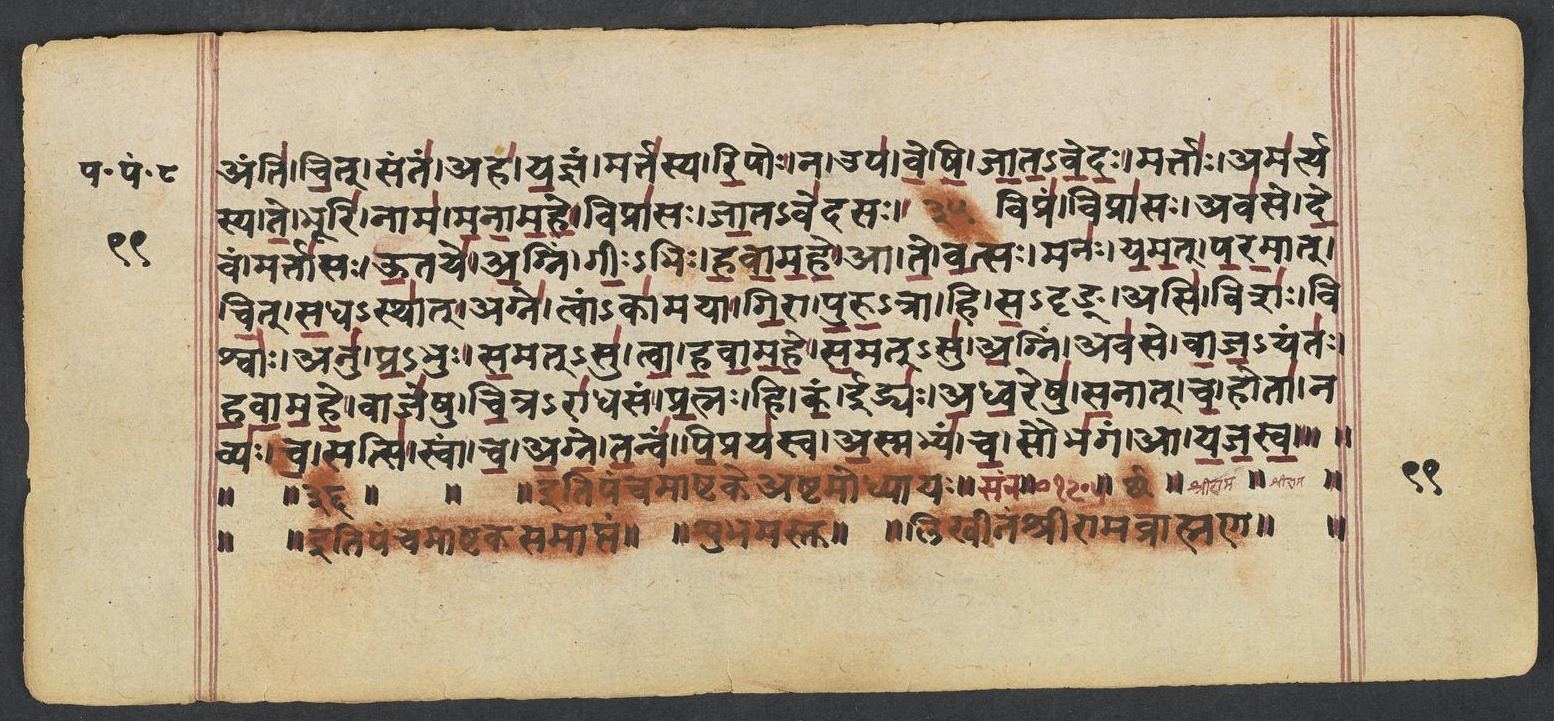
Where on the image
Penn Ms. Coll. 390 Item 41, fol. 578r (numbered 99r by the scribe) (OPenn image 578, lower leaf). Checked on the image: the Rigveda text on this page begins in RV 8.11.4 ‹anti cit santam aha›. The next page with Rigveda text, fol. 579v (numbered 1v by the scribe), begins in RV 8.12.1 ‹yaḥ indra soma-pātamaḥ madaḥ›. Verses 8.11.4-10 end on this page.
4anti̍ ci̱t santa̱m aha̍ ya̱jñam marta̍sya ri̱poḥ | nopa̍ veṣi jātavedaḥ ||
5martā̱ ama̍rtyasya te̱ bhūri̱ nāma̍ manāmahe | viprā̍so jā̱tave̍dasaḥ ||
6vipra̱ṁ viprā̱so 'va̍se de̱vam martā̍sa ū̱taye̍ | a̱gniṁ gī̱rbhir ha̍vāmahe ||
7ā te̍ va̱tso mano̍ yamat para̱māc ci̍t sa̱dhasthā̍t | agne̱ tvāṁkā̍mayā gi̱rā ||
8pu̱ru̱trā hi sa̱dṛṅṅ asi̱ viśo̱ viśvā̱ anu̍ pra̱bhuḥ | sa̱matsu̍ tvā havāmahe ||
9sa̱matsv a̱gnim ava̍se vāja̱yanto̍ havāmahe | vāje̍ṣu ci̱trarā̍dhasam ||
10pra̱tno hi ka̱m īḍyo̍ adhva̱reṣu̍ sa̱nāc ca̱ hotā̱ navya̍ś ca̱ satsi̍ | svāṁ cā̍gne ta̱nva̍m pi̱praya̍svā̱smabhya̍ṁ ca̱ saubha̍ga̱m ā ya̍jasva ||
Compare: Padapāṭha (word-by-word text written in the manuscript; Sansknet e-text via GRETIL)
4anti | cit | santam | aha | yajñam | martasya | ripoḥ | na | upa | veṣi | jāta-vedaḥ
5martāḥ | amartasya | te | bhūri | nāma | manāmahe | viprāsaḥ | jāta-vedasaḥ
6vipram | viprāsaḥ | avase | devam | martāsaḥ | ūtaye | agnim | gīḥ-bhiḥ | havāmahe
7ā | te | vatsaḥ | manaḥ | yamat | paramāt | cit | sadha-sthāt | agne | tvām-kāmayā | girā
8puru-trā | hi | sa-dṛṅ | asi | viśaḥ | viśvāḥ | anu | pra-bhuḥ | samat-su | tvā | havāmahe
9samat-su | agnim | avase | vāja-yantaḥ | havāmahe | vājeṣu | citra-rādhasam
10pratnaḥ | hi | kam | īḍyaḥ | adhvareṣu | sanāt | ca | hotā | navyaḥ | ca | satsi | svām | ca | agne | tanvam | piprayasva | asmabhyam | ca | saubhagam | ā | yajasva
4Thou, Jâtavedas, seekest not the worship of a hostile man, However nigh it be to thee.
5We sages, mortals as we are, adore the mighty name of thee, Immortal Jâtavedas' name.
6Sages, we call the Sage to help, mortals, we call the God to aid: We call on Agni with our songs.
7May Vatsa draw- thy mind away even from thy loftiest dwelling-place, Agni, with song that yearns for thee.
8Thou art the same in many a place: mid all the people thou art Lord. In fray and fight we call on thee.
9When we are seeking strength we call Agni to help us in the strife, The giver of rich gifts in war.
10Ancient, adorable at sacrifices, Priest from of old, meet for our praise, thou sittest. Fill full and satisfy thy body, Agni, and win us happiness by offering worship.
Notes
- Sanskrit: Aufrecht's edition (1877) with the Vedic accents, as entered by van Nooten and Holland (GRETIL).
- English: Ralph T. H. Griffith, The Hymns of the Rigveda (1889-1892; 2nd ed. 1896-1897), from the VedaWeb digital text; OCR slips in that text were corrected against the printed 2nd edition (data/sources/rigveda/griffith_errata.json).
- Padapāṭha (edition text): Sansknet e-text via GRETIL (CC BY-NC-SA 4.0).
Cite
Sources
- Source: Penn Ms. Coll. 390 Item 41 (undated (catalogued with Penn's 18th-19th c. Vedic manuscripts)), OPenn, Public Domain Mark + Aufrecht's accented text (GRETIL) + Griffith's English (VedaWeb) (holding institution)
- Critical edition: Aufrecht (1877), accented e-text via GRETIL
← previous · → next · v cycle view · l back to library