Rigveda 8.47: To Adityas
Introduction
Rigveda 8.47 is a hymn of 18 verses addressed to Adityas. It stands in book (maṇḍala) 8, the book of the Kaṇva and Aṅgiras poets. The Rigveda is the oldest collection of Sanskrit hymns, composed in the second half of the second millennium BCE and handed down orally for many centuries before it was written down.
The manuscript shown is Penn Ms. Coll. 390 Item 41 (University of Pennsylvania), an undated paper manuscript of the padapāṭha (the word-by-word recitation text, in which every word is written separately and compounds are split) of the whole Ṛgveda in Devanāgarī, 884 leaves in fascicles, 7-9 lines to the page, accents in red; this hymn stands on fol. 621v-623r. Each section below gives the verses that end on one page; the page boundaries were read on the images (the opening words of every page), not counted out. Where the manuscript is a padapāṭha (the word-by-word recitation text), the section shows Aufrecht's continuous (saṃhitā) text first and, as the edition text, the padapāṭha of the same verses, which is the form written on the page.
How was this verified? (Provenance)
Where on the image
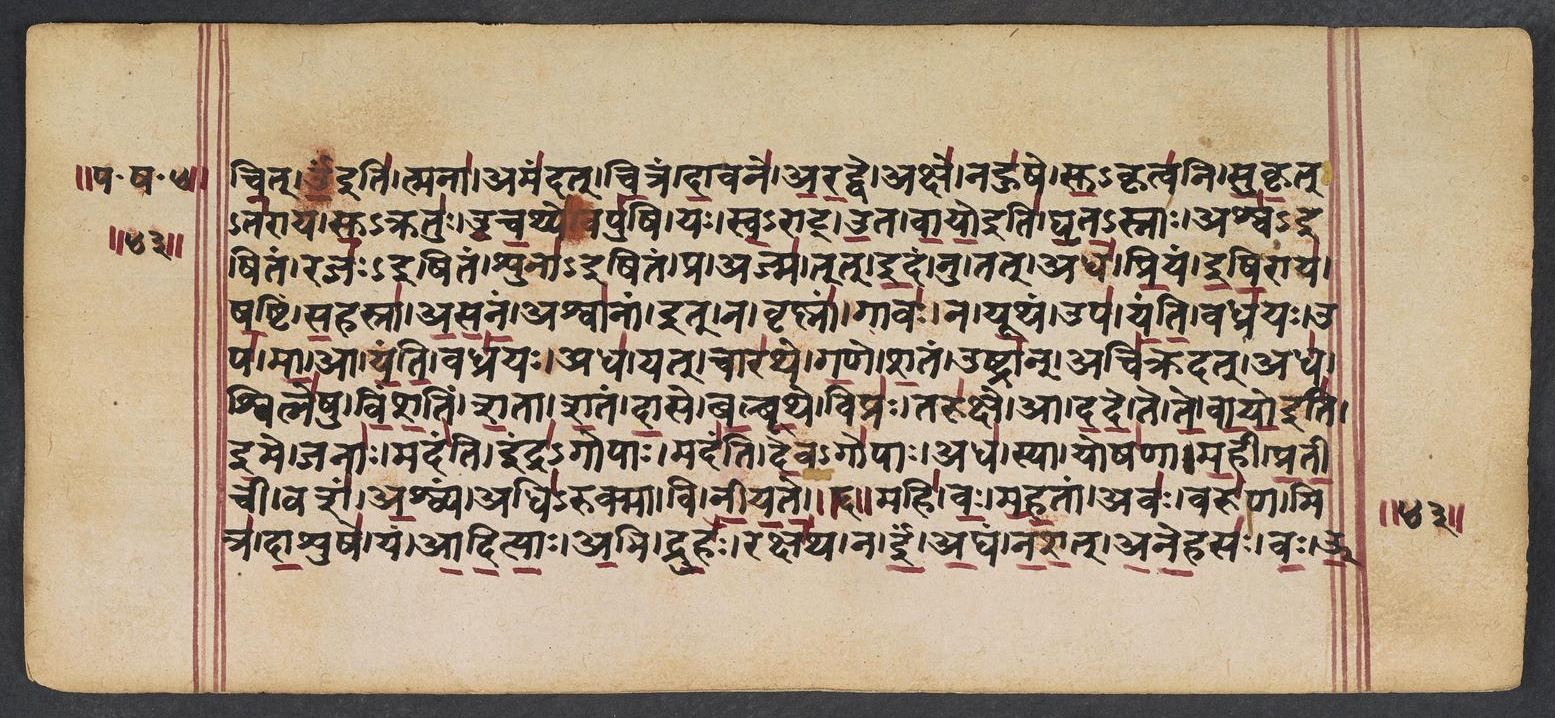
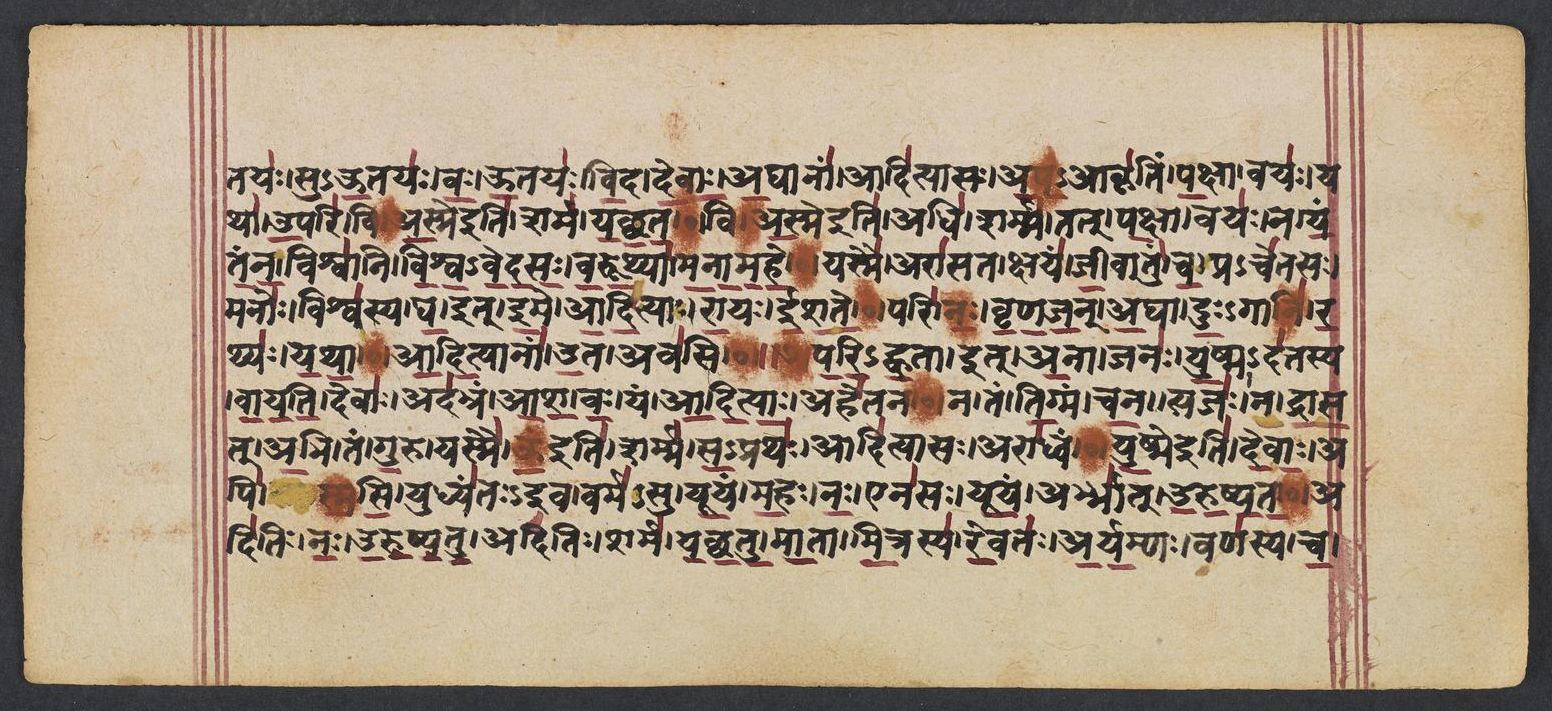
Penn Ms. Coll. 390 Item 41, fol. 622r (numbered 44r by the scribe) (OPenn image 622, lower leaf). Checked on the image: the Rigveda text on this page begins in RV 8.47.1 ‹-ūtayaḥ su-ūtayaḥ vaḥ ūtayaḥ›. The next page with Rigveda text, fol. 622v (numbered 44v by the scribe), begins in RV 8.47.10 ‹yat devāḥ śarma śaraṇam›. Verses 8.47.1-9 end on this page; 8.47.1 begins on fol. 621v (numbered 43v by the scribe).
1mahi̍ vo maha̱tām avo̱ varu̍ṇa̱ mitra̍ dā̱śuṣe̍ | yam ā̍dityā a̱bhi dru̱ho rakṣa̍thā̱ nem a̱ghaṁ na̍śad ane̱haso̍ va ū̱taya̍ḥ suū̱tayo̍ va ū̱taya̍ḥ ||
2vi̱dā de̍vā a̱ghānā̱m ādi̍tyāso a̱pākṛ̍tim | pa̱kṣā vayo̱ yatho̱pari̱ vy a1̱̍sme śarma̍ yacchatāne̱haso̍ va ū̱taya̍ḥ suū̱tayo̍ va ū̱taya̍ḥ ||
3vy a1̱̍sme adhi̱ śarma̱ tat pa̱kṣā vayo̱ na ya̍ntana | viśvā̍ni viśvavedaso varū̱thyā̍ manāmahe 'ne̱haso̍ va ū̱taya̍ḥ suū̱tayo̍ va ū̱taya̍ḥ ||
4yasmā̱ arā̍sata̱ kṣaya̍ṁ jī̱vātu̍ṁ ca̱ prace̍tasaḥ | mano̱r viśva̍sya̱ ghed i̱ma ā̍di̱tyā rā̱ya ī̍śate 'ne̱haso̍ va ū̱taya̍ḥ suū̱tayo̍ va ū̱taya̍ḥ ||
5pari̍ ṇo vṛṇajann a̱ghā du̱rgāṇi̍ ra̱thyo̍ yathā | syāmed indra̍sya̱ śarma̍ṇy ādi̱tyānā̍m u̱tāva̍sy ane̱haso̍ va ū̱taya̍ḥ suū̱tayo̍ va ū̱taya̍ḥ ||
6pa̱ri̱hvṛ̱ted a̱nā jano̍ yu̱ṣmāda̍ttasya vāyati | devā̱ ada̍bhram āśa vo̱ yam ā̍dityā̱ ahe̍tanāne̱haso̍ va ū̱taya̍ḥ suū̱tayo̍ va ū̱taya̍ḥ ||
7na taṁ ti̱gmaṁ ca̱na tyajo̱ na drā̍sad a̱bhi taṁ gu̱ru | yasmā̍ u̱ śarma̍ sa̱pratha̱ ādi̍tyāso̱ arā̍dhvam ane̱haso̍ va ū̱taya̍ḥ suū̱tayo̍ va ū̱taya̍ḥ ||
8yu̱ṣme de̍vā̱ api̍ ṣmasi̱ yudhya̍nta iva̱ varma̍su | yū̱yam ma̱ho na̱ ena̍so yū̱yam arbhā̍d uruṣyatāne̱haso̍ va ū̱taya̍ḥ suū̱tayo̍ va ū̱taya̍ḥ ||
9adi̍tir na uruṣya̱tv adi̍ti̱ḥ śarma̍ yacchatu | mā̱tā mi̱trasya̍ re̱vato̍ 'rya̱mṇo varu̍ṇasya cāne̱haso̍ va ū̱taya̍ḥ suū̱tayo̍ va ū̱taya̍ḥ ||
Compare: Padapāṭha (word-by-word text written in the manuscript; Sansknet e-text via GRETIL)
1mahi | vaḥ | mahatām | avaḥ | varuṇa | mitra | dāśuṣe | yam | ādityāḥ | abhi | druhaḥ | rakṣatha | na | īm | agham | naśat | anehasaḥ | vaḥ | ūtayaḥ | su-ūtayaḥ | vaḥ | ūtayaḥ
2vida | devāḥ | aghānām | ādityāsaḥ | apa-ākṛtim | pakṣā | vayaḥ | yathā | upari | vi | asme iti | śarma | yacchata | anehasaḥ | vaḥ | ūtayaḥ | su-ūtayaḥ | vaḥ | ūtayaḥ
3vi | asme iti | adhi | śarma | tat | pakṣā | vayaḥ | na | yantana | viśvāni | viśva-vedasaḥ | varūthyā | manāmahe | anehasaḥ | vaḥ | ūtayaḥ | su-ūtayaḥ | vaḥ | ūtayaḥ
4yasmai | arāsata | kṣayam | jīvātum | ca | pra-cetasaḥ | manoḥ | viśvasya | gha | it | ime | ādityāḥ | rāyaḥ | īśate | anehasaḥ | vaḥ | ūtayaḥ | su-ūtayaḥ | vaḥ | ūtayaḥ
5pari | naḥ | vṛṇajan | aghā | duḥ-gāṇi | rathyaḥ | yathā | syāma | it | indrasya | śarmaṇi | ādityānām | uta | avasi | anehasaḥ | vaḥ | ūtayaḥ | su-ūtayaḥ | vaḥ | ūtayaḥ
6pari-hvṛtā | it | anā | janaḥ | yuṣmādattasya | vāyati | devāḥ | adabhram | āśa | vaḥ | yam | ādityāḥ | ahetana | anehasaḥ | vaḥ | ūtayaḥ | su-ūtayaḥ | vaḥ | ūtayaḥ
7na | tam | tigmam | cana | tyajaḥ | na | drāsat | abhi | tam | guru | yasmai | oṃ iti | śarma | sa-prathaḥ | ādityāsaḥ | arādhvam | anehasaḥ | vaḥ | ūtayaḥ | su-ūtayaḥ | vaḥ | ūtayaḥ
8yuṣme iti | devāḥ | api | smasi | yudhyantaḥ-iva | varmasu | yūyam | mahaḥ | naḥ | enasaḥ | yūyam | arbhāt | uruṣyata | anehasaḥ | vaḥ | ūtayaḥ | su-ūtayaḥ | vaḥ | ūtayaḥ
9aditiḥ | naḥ | uruṣyatu | aditiḥ | śarma | yacchatu | mātā | mitrasya | revataḥ | ayarmṇaḥ | varuṇasya | ca | anehasaḥ | vaḥ | ūtayaḥ | su-ūtayaḥ | vaḥ | ūtayaḥ
1GREAT help ye give the worshipper, Varuṇa, Mitra, Mighty Ones! No sorrow ever reaches him whom ye, Âdityas, keep from harm. Yours are incomparable aids, and good the succour they afford.
2O Gods, Âdityas, well ye know the way to keep all woes afar. As the birds spread their sheltering wings, spread your protection over us.
3As the birds spread their sheltering wings let your protection cover us. We mean all shelter and defence, ye who have all things for your own.
4To whomsoever they, Most Wise, have given a home and means of life, O'er the whole riches of this man they, the Âdityas, have control.
5As drivers of the car avoid ill roads, let sorrows pass us by. May we be under Indra's guard, in the Âdityas' favouring grace.
6For verily men sink and faint through loss of wealth which ye have given. Much hath he gained from you, O Gods, whom ye, Âdityas, have approached.
7On him shall no fierce anger fall, no sore distress shall visit him, To whom, Âdityas, ye have lent your shelter that extendeth far.
8Resting in you, O Gods, we are like men who fight in coats of mail. Ye guard us from each great offence, ye guard us from each lighter fault.
9May Aditi defend us, may Aditi guard and shelter us, Mother of wealthy Mitra and of Aryaman and Varuṇa.
Where on the image
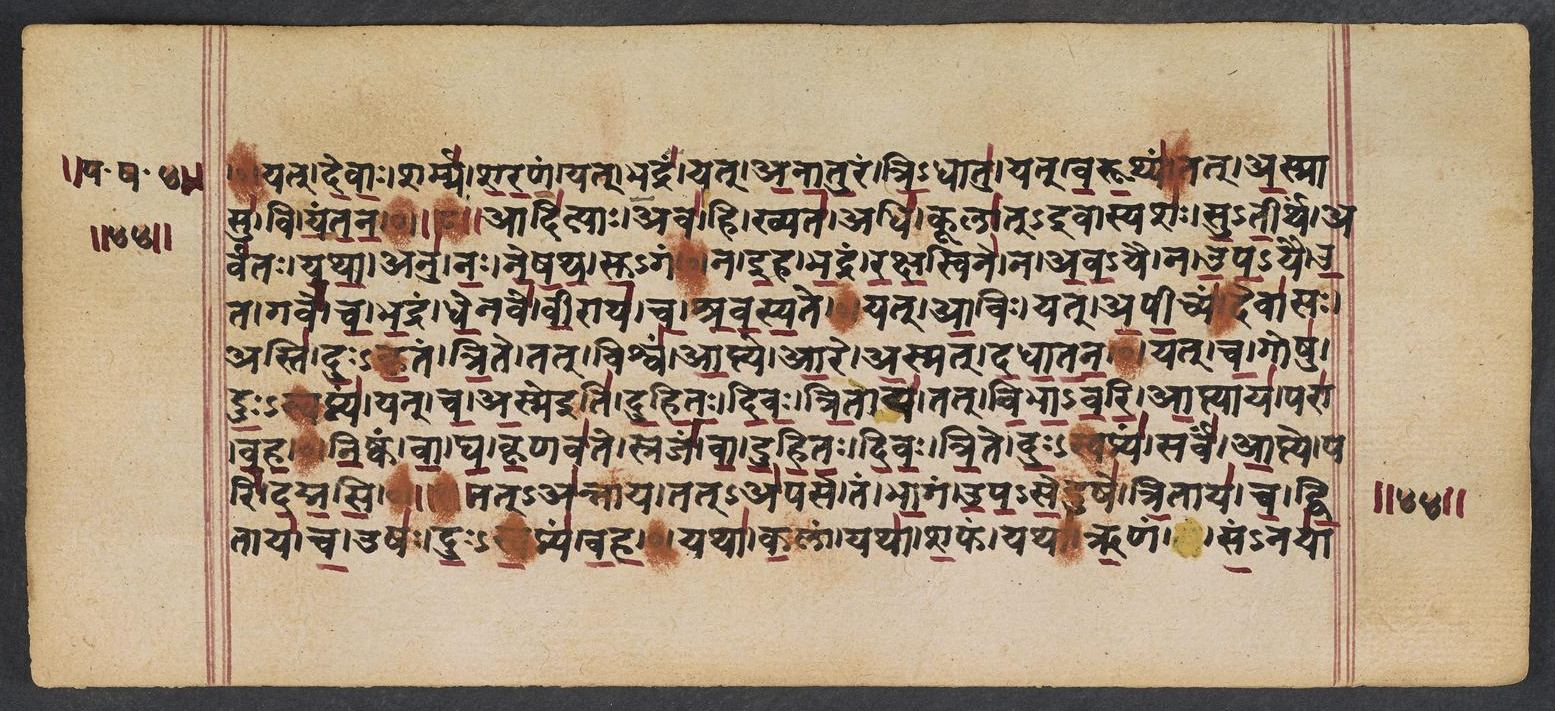
Penn Ms. Coll. 390 Item 41, fol. 622v (numbered 44v by the scribe) (OPenn image 623, upper leaf). Checked on the image: the Rigveda text on this page begins in RV 8.47.10 ‹yat devāḥ śarma śaraṇam›. The next page with Rigveda text, fol. 623r (numbered 45r by the scribe), begins in RV 8.47.17 ‹-sam-nayāmasi eva duḥ-svapnyam sarvam›. Verses 8.47.10-16 end on this page.
10yad de̍vā̱ḥ śarma̍ śara̱ṇaṁ yad bha̱draṁ yad a̍nātu̱ram | tri̱dhātu̱ yad va̍rū̱thya1̱̍ṁ tad a̱smāsu̱ vi ya̍ntanāne̱haso̍ va ū̱taya̍ḥ suū̱tayo̍ va ū̱taya̍ḥ ||
11ādi̍tyā̱ ava̱ hi khyatādhi̱ kūlā̍d iva̱ spaśa̍ḥ | su̱tī̱rtham arva̍to ya̱thānu̍ no neṣathā su̱gam a̍ne̱haso̍ va ū̱taya̍ḥ suū̱tayo̍ va ū̱taya̍ḥ ||
12neha bha̱draṁ ra̍kṣa̱svine̱ nāva̱yai nopa̱yā u̱ta | gave̍ ca bha̱draṁ dhe̱nave̍ vī̱rāya̍ ca śravasya̱te̍ 'ne̱haso̍ va ū̱taya̍ḥ suū̱tayo̍ va ū̱taya̍ḥ ||
13yad ā̱vir yad a̍pī̱cya1̱̍ṁ devā̍so̱ asti̍ duṣkṛ̱tam | tri̱te tad viśva̍m ā̱ptya ā̱re a̱smad da̍dhātanāne̱haso̍ va ū̱taya̍ḥ suū̱tayo̍ va ū̱taya̍ḥ ||
14yac ca̱ goṣu̍ du̱ṣṣvapnya̱ṁ yac cā̱sme du̍hitar divaḥ | tri̱tāya̱ tad vi̍bhāvary ā̱ptyāya̱ parā̍ vahāne̱haso̍ va ū̱taya̍ḥ suū̱tayo̍ va ū̱taya̍ḥ ||
15ni̱ṣkaṁ vā̍ ghā kṛ̱ṇava̍te̱ sraja̍ṁ vā duhitar divaḥ | tri̱te du̱ṣṣvapnya̱ṁ sarva̍m ā̱ptye pari̍ dadmasy ane̱haso̍ va ū̱taya̍ḥ suū̱tayo̍ va ū̱taya̍ḥ ||
16tada̍nnāya̱ tada̍pase̱ tam bhā̱gam u̍pase̱duṣe̍ | tri̱tāya̍ ca dvi̱tāya̱ coṣo̍ du̱ṣṣvapnya̍ṁ vahāne̱haso̍ va ū̱taya̍ḥ suū̱tayo̍ va ū̱taya̍ḥ ||
Compare: Padapāṭha (word-by-word text written in the manuscript; Sansknet e-text via GRETIL)
10yat | devāḥ | śarma | śaraṇam | yat | bhadram | yat | anāturam | tri-dhātu | yat | varūthyam | tat | asmāsu | vi | yantana | anehasaḥ | vaḥ | ūtayaḥ | su-ūtayaḥ | vaḥ | ūtayaḥ
11ādityāḥ | ava | hi | khyata | adhi | kūlāt-iva | spaśaḥ | su-tīrtham | arvataḥ | yathā | anu | naḥ | neṣatha | su-gam | anehasaḥ | vaḥ | ūtayaḥ | su-ūtayaḥ | vaḥ | ūtayaḥ
12na | iha | bhadram | rakṣasvine | na | ava-yai | na | upa-yai | uta | gave | ca | bhadram | dhenave | vīrāya | ca | śravasyate | anehasaḥ | vaḥ | ūtayaḥ | su-ūtayaḥ | vaḥ | ūtayaḥ
13yat | āviḥ | yat | apīcyam | devāsaḥ | asti | duḥ-kṛtam | trite | tat | viśvam | āptye | āre | asmat | dadhātana | anehasaḥ | vaḥ | ūtayaḥ | su-ūtayaḥ | vaḥ | ūtayaḥ
14yat | ca | goṣu | duḥ-svapnyam | yat | ca | asme iti | duhitaḥ | divaḥ | tritāya | tat | vibhāvari | āptyāya | parā | vaha | anehasaḥ | vaḥ | ūtayaḥ | su-ūtayaḥ | vaḥ | ūtayaḥ
15niṣkam | vā | gha | kṛṇavate | srajam | vā | duhitaḥ | divaḥ | trite | duḥ-svapnyam | sarvam | āptye | pari | dadmasi | anehasaḥ | vaḥ | ūtayaḥ | su-ūtayaḥ | vaḥ | ūtayaḥ
16tat-annāya | tat-apase | tam | bhāgam | upa-seduṣe | tritāya | ca | dvitāya | ca | uṣaḥ | duḥ-svapnyam | vaha | anehasaḥ | vaḥ | ūtayaḥ | su-ūtayaḥ | vaḥ | ūtayaḥ
10The shelter, Gods, that is secure, auspicious, free from malady, A sure protection, triply strong, even that do ye extend to us.
11Look down on us, Âdityas, as a guide exploring from the bank. Lead us to pleasant ways as men lead horses to an easy ford.
12Ill be it for the demons' friend to find us or come near to us. But for the milch-cow be it well, and for the man who strives for fame.
13Each evil deed made manifest, and that which is concealed, O Gods, The whole thereof remove from us to Trita Âptya far away.
14Daughter of Heaven, the dream that bodes evil to us or to our kine, Remove, O Lady of the Light, to Trita Âptya far away.
15Even if, O Child of Heaven, it make a garland or a chain of gold, The whole bad dream, whate'er it be, to Trita Âptya we consign.
16To him whose food and work is this, who comes to take his share therein, To Trita, and to Dvita, Dawn! bear thou the evil dream away.
Where on the image
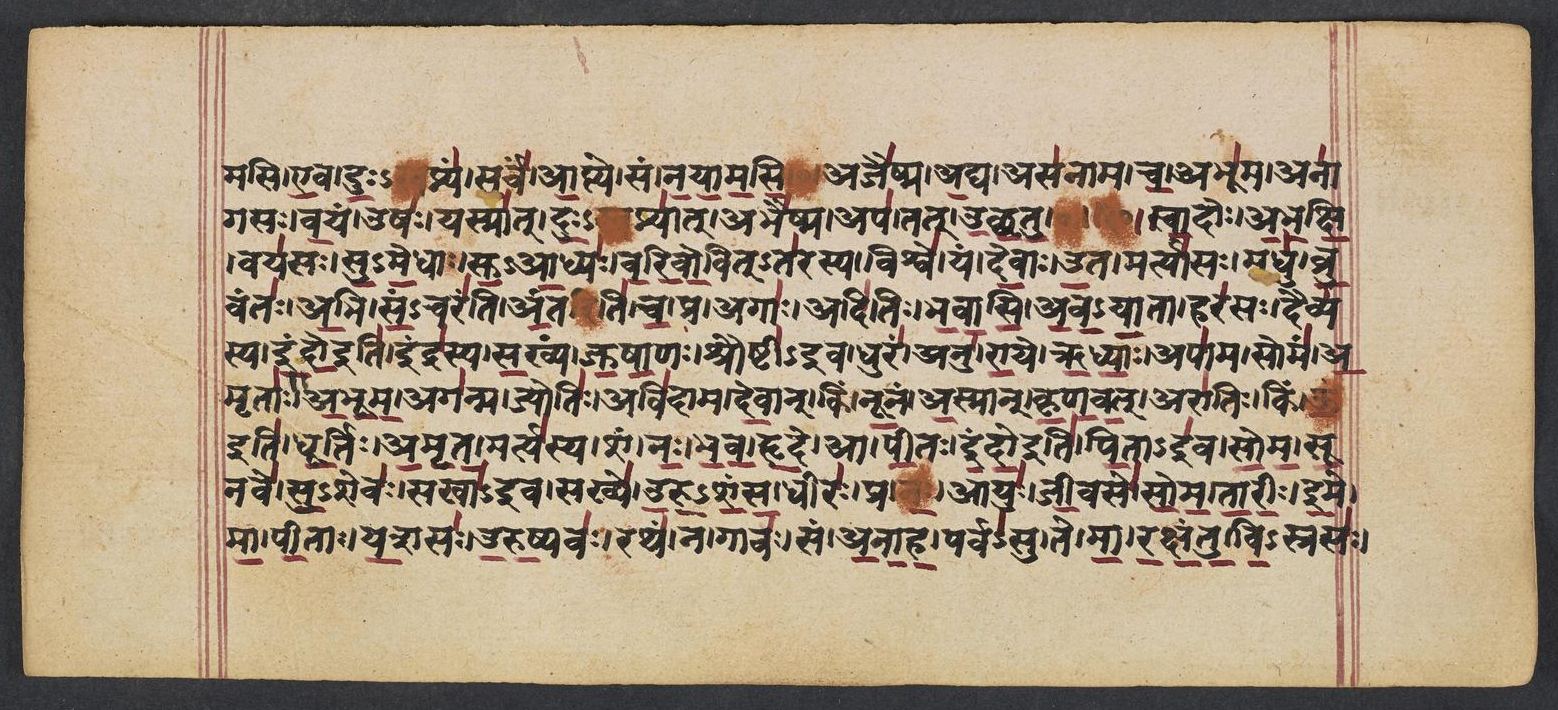
Penn Ms. Coll. 390 Item 41, fol. 623r (numbered 45r by the scribe) (OPenn image 623, lower leaf). Checked on the image: the Rigveda text on this page begins in RV 8.47.17 ‹-sam-nayāmasi eva duḥ-svapnyam sarvam›. The next page with Rigveda text, fol. 623v (numbered 45v by the scribe), begins in RV 8.48.5 ‹-caritrāt uta mā srāmāt›. Verses 8.47.17-18 end on this page; 8.47.17 begins on fol. 622v (numbered 44v by the scribe).
17yathā̍ ka̱lāṁ yathā̍ śa̱phaṁ yatha̍ ṛ̱ṇaṁ sa̱ṁnayā̍masi | e̱vā du̱ṣṣvapnya̱ṁ sarva̍m ā̱ptye saṁ na̍yāmasy ane̱haso̍ va ū̱taya̍ḥ suū̱tayo̍ va ū̱taya̍ḥ ||
18ajai̍ṣmā̱dyāsa̍nāma̱ cābhū̱mānā̍gaso va̱yam | uṣo̱ yasmā̍d du̱ṣṣvapnyā̱d abhai̱ṣmāpa̱ tad u̍cchatv ane̱haso̍ va ū̱taya̍ḥ suū̱tayo̍ va ū̱taya̍ḥ ||
Compare: Padapāṭha (word-by-word text written in the manuscript; Sansknet e-text via GRETIL)
17yathā | kalām | yathā | śapham | yathā | ṛṇam | sam-nayāmasi | eva | duḥ-svapnyam | sarvam | āptye | sam | nayāmasi | anehasaḥ | vaḥ | ūtayaḥ | su-ūtayaḥ | vaḥ | ūtayaḥ
18ajaiṣma | adya | asanāma | ca | abhūma | anāgasaḥ | vayam | uṣaḥ | yasmāt | duḥ-svapnyāt | abhaiṣma | apa | tat | ucchatu | anehasaḥ | vaḥ | ūtayaḥ | su-ūtayaḥ | vaḥ | ūtayaḥ
17As we collect the utmost debt, even the eighth and sixteenth part, So unto Âptya we transfer together all the evil dream.
18Now have we conquered and obtained, and from our trespasses are free. Shine thou away the evil dream, O Dawn, whereof we are afraid. Yours are incomparable aids, and good the succour they afford.
Notes
- Sanskrit: Aufrecht's edition (1877) with the Vedic accents, as entered by van Nooten and Holland (GRETIL).
- English: Ralph T. H. Griffith, The Hymns of the Rigveda (1889-1892; 2nd ed. 1896-1897), from the VedaWeb digital text; OCR slips in that text were corrected against the printed 2nd edition (data/sources/rigveda/griffith_errata.json).
- Padapāṭha (edition text): Sansknet e-text via GRETIL (CC BY-NC-SA 4.0).
Cite
Sources
- Source: Penn Ms. Coll. 390 Item 41 (undated (catalogued with Penn's 18th-19th c. Vedic manuscripts)), OPenn, Public Domain Mark + Aufrecht's accented text (GRETIL) + Griffith's English (VedaWeb) (holding institution)
- Critical edition: Aufrecht (1877), accented e-text via GRETIL
← previous · → next · v cycle view · l back to library