Rigveda 8.50: To Indra
Introduction
Rigveda 8.50 is a hymn of 10 verses addressed to Indra. It stands in book (maṇḍala) 8, the book of the Kaṇva and Aṅgiras poets. The Rigveda is the oldest collection of Sanskrit hymns, composed in the second half of the second millennium BCE and handed down orally for many centuries before it was written down.
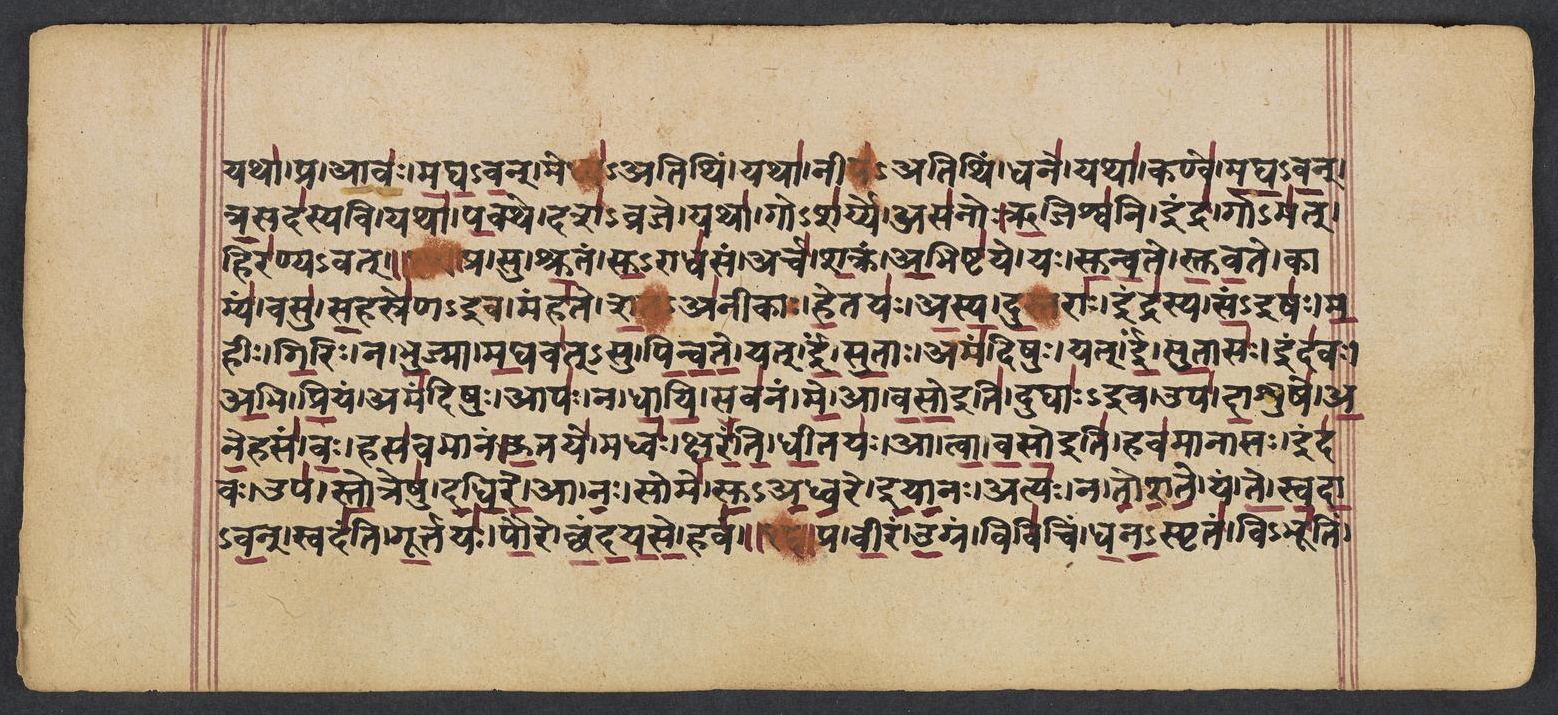
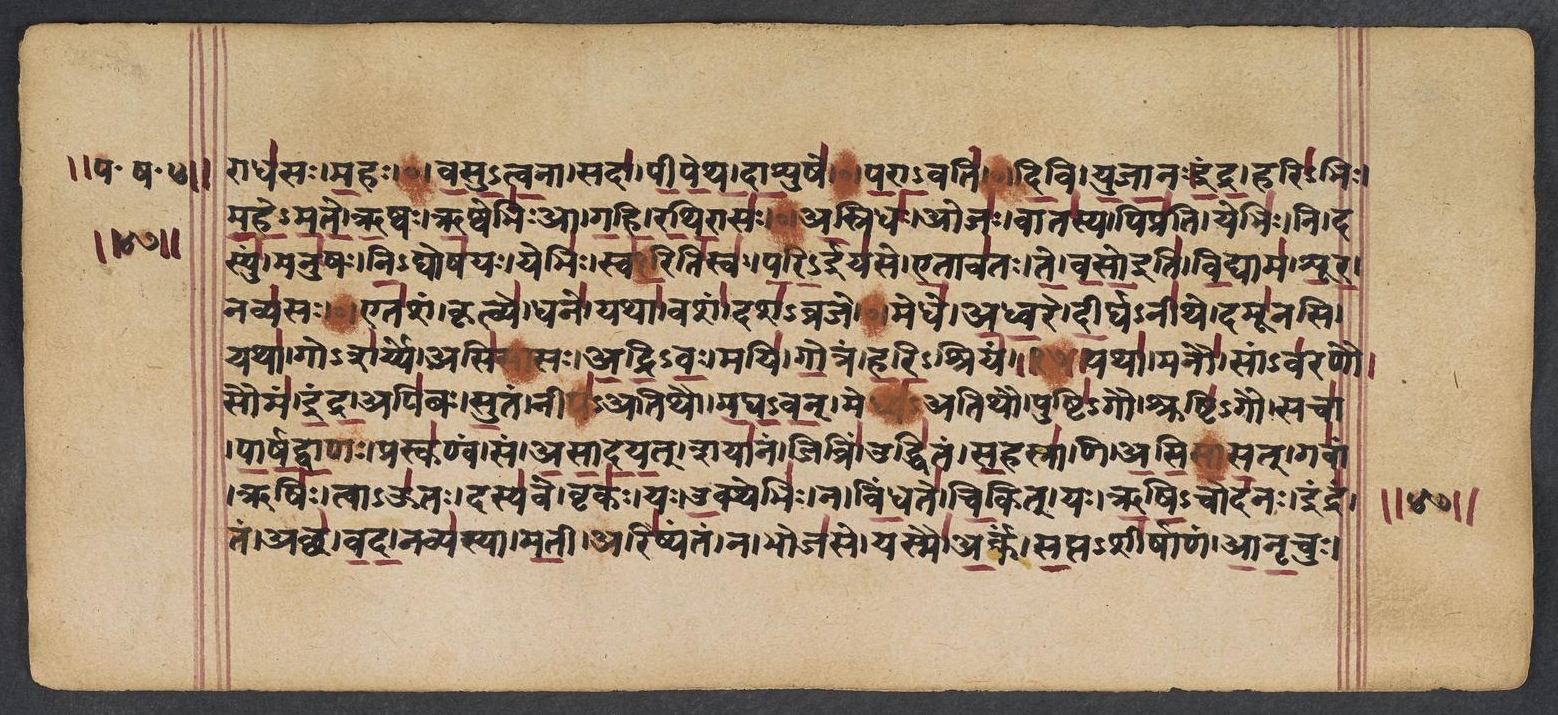
The manuscript shown is Penn Ms. Coll. 390 Item 41 (University of Pennsylvania), an undated paper manuscript of the padapāṭha (the word-by-word recitation text, in which every word is written separately and compounds are split) of the whole Ṛgveda in Devanāgarī, 884 leaves in fascicles, 7-9 lines to the page, accents in red; this hymn stands on fol. 625r-625v. Each section below gives the verses that end on one page; the page boundaries were read on the images (the opening words of every page), not counted out. Where the manuscript is a padapāṭha (the word-by-word recitation text), the section shows Aufrecht's continuous (saṃhitā) text first and, as the edition text, the padapāṭha of the same verses, which is the form written on the page.
How was this verified? (Provenance)
Where on the image
Penn Ms. Coll. 390 Item 41, fol. 625r (numbered 47r by the scribe) (OPenn image 625, lower leaf). Checked on the image: the Rigveda text on this page begins in RV 8.49.9 ‹yathā pra āvaḥ magha-van›. The next page with Rigveda text, fol. 625v (numbered 47v by the scribe), begins in RV 8.50.6 ‹-vi-bhūtim rādhasaḥ mahaḥ udrī-iva›. Verses 8.50.1-5 end on this page.
1pra su śru̱taṁ su̱rādha̍sa̱m arcā̍ śa̱kram a̱bhiṣṭa̍ye | yaḥ su̍nva̱te stu̍va̱te kāmya̱ṁ vasu̍ sa̱hasre̍ṇeva̱ maṁha̍te ||
2śa̱tānī̍kā he̱tayo̍ asya du̱ṣṭarā̱ indra̍sya sa̱miṣo̍ ma̱hīḥ | gi̱rir na bhu̱jmā ma̱ghava̍tsu pinvate̱ yad ī̍ṁ su̱tā ama̍ndiṣuḥ ||
3yad ī̍ṁ su̱tāsa̱ inda̍vo̱ 'bhi pri̱yam ama̍ndiṣuḥ | āpo̱ na dhā̍yi̱ sava̍nam ma̱ ā va̍so̱ dughā̍ i̱vopa̍ dā̱śuṣe̍ ||
4a̱ne̱hasa̍ṁ vo̱ hava̍mānam ū̱taye̱ madhva̍ḥ kṣaranti dhī̱taya̍ḥ | ā tvā̍ vaso̱ hava̍mānāsa̱ inda̍va̱ upa̍ sto̱treṣu̍ dadhire ||
5ā na̱ḥ some̍ svadhva̱ra i̍yā̱no atyo̱ na to̍śate | yaṁ te̍ svadāva̱n svada̍nti gū̱rtaya̍ḥ pau̱re cha̍ndayase̱ hava̍m ||
Compare: Padapāṭha (word-by-word text written in the manuscript; Sansknet e-text via GRETIL)
1pra | su | śrutam | su-rādhasam | arca | śakram | abhiṣṭaye | yaḥ | sunvate | stuvate | kāmyam | vasu | sahasreṇa-iva | maṃhate
2śata-anīkāḥ | hetayaḥ | asya | dustarāḥ | indrasya | sam-iṣaḥ | mahīḥ | gir iḥ | na | bhujmā | maghavat-su | pinvate | yat | īm | sutāḥ | amandiṣuḥ
3yat | īm | sutāsaḥ | indavaḥ | abhi | priyam | amandiṣuḥ | āpaḥ | na | dhāyi | savanam | me | ā | vaso iti | dughāiva | upa | dāśuṣe
4anehasam | vaḥ | havamānam | ūtaye | madhvaḥ | kṣaranti | dhītayaḥ | ā | tvā | vaso iti | havamānāsaḥ | indavaḥ | upa | stotreṣu | dadhire
5ā | naḥ | some | su-adhvare | iyānaḥ | atyaḥ | na | tośate | yam | te | svadāvan | svadanti | gūrtyaḥ | paure | chandayase | havam
1Ṣakra I praise, to win his aid, far-famed, exceeding bountiful, Who gives, as 'twere in thousands, precious wealth to him who sheds the juice and worships him.
2Arrows with hundred points, unconquerable, are this Indra's mighty arms in war. He streams on liberal worshippers like a hill with springs, when juices poured have gladdened him.
3What time the flowing Soma-drops have gladdened with their taste the Friend, Like water, gracious Lord! were my libations made, like milch-kine to the worshipper.
4To him the peerless, who is calling you to give you aid, forth flow the drops of pleasant meath. The Soma-drops which call on thee, O gracious Lord, have brought thee to our hymn of praise.
5He rushes hurrying like a steed to Soma that adorns our rite, Which hymns make sweet to thee, lover of pleasant food. The call to Paura thou dost love.
Where on the image
Penn Ms. Coll. 390 Item 41, fol. 625v (numbered 47v by the scribe) (OPenn image 626, upper leaf). Checked on the image: the Rigveda text on this page begins in RV 8.50.6 ‹-vi-bhūtim rādhasaḥ mahaḥ udrī-iva›. The next page with Rigveda text, fol. 626r (numbered 48r by the scribe), begins in RV 8.51.4 ‹-tri-dhātum ut-tame pade saḥ›. Verses 8.50.6-10 end on this page; 8.50.6 begins on fol. 625r (numbered 47r by the scribe).
6pra vī̱ram u̱graṁ vivi̍ciṁ dhana̱spṛta̱ṁ vibhū̍ti̱ṁ rādha̍so ma̱haḥ | u̱drīva̍ vajrinn ava̱to va̍sutva̱nā sadā̍ pīpetha dā̱śuṣe̍ ||
7yad dha̍ nū̱nam pa̍rā̱vati̱ yad vā̍ pṛthi̱vyāṁ di̱vi | yu̱jā̱na i̍ndra̱ hari̍bhir mahemata ṛ̱ṣva ṛ̱ṣvebhi̱r ā ga̍hi ||
8ra̱thi̱rāso̱ hara̍yo̱ ye te̍ a̱sridha̱ ojo̱ vāta̍sya̱ pipra̍ti | yebhi̱r ni dasyu̱m manu̍ṣo ni̱ghoṣa̍yo̱ yebhi̱ḥ sva̍ḥ pa̱rīya̍se ||
9e̱tāva̍tas te vaso vi̱dyāma̍ śūra̱ navya̍saḥ | yathā̱ prāva̱ eta̍śa̱ṁ kṛtvye̱ dhane̱ yathā̱ vaśa̱ṁ daśa̍vraje ||
10yathā̱ kaṇve̍ maghava̱n medhe̍ adhva̱re dī̱rghanī̍the̱ damū̍nasi | yathā̱ gośa̍rye̱ asi̍ṣāso adrivo̱ mayi̍ go̱traṁ ha̍ri̱śriya̍m ||
Compare: Padapāṭha (word-by-word text written in the manuscript; Sansknet e-text via GRETIL)
6pra | vīram | ugram | vivicim | dhana-spṛtam | vi-bhūtim | rādhasaḥ | mahaḥ | udrī-iva | vajrin | avataḥ | vasu-tvanā | sadā | pīpetha | dāśuṣe
7yat | ha | nūnam | parāvati | yat | vā | pṛthivyām | divi | yujānaḥ | indra | hari-bhiḥ | mahe--mate | ṛṣvaḥ | ṛṣvebhiḥ | ā | gahi
8rathirāsaḥ | harayaḥ | ye | te | asridhaḥ | ojaḥ | vātasya | piprati | yebhiḥ | ni | dasyum | manuṣaḥ | ni-ghoṣayaḥ | yebhiḥ | svar iti svaḥ | pari-īyase
9etāvataḥ | te | vaso iti | vidyāma | śūra | navyasaḥ | yathā | pra | āvaḥ | etaśam | kṛtvye | dhane | yathā | vaśam | daśa-vraje
10yathā | kaṇve | magha-van | medhe | adhvare | dīrgha-nīthe | damūnasi | yathā | go--śarye | asisāsaḥ | adri-vaḥ | mayi | gotram | hari-śriyam
6Praise the strong, grasping Hero, winner of the spoil, ruling supreme oer mighty wealth. Like a full spring, O Thunderer, from thy store hast thou poured on the worshipper evermore.
7Now whether thou be far away, or in the heavens, or on the earth, O Indra, mighty- thoughted, harnessing thy Bays, come Lofty with the Lofty Ones.
8The Bays who draw thy chariot, Steeds who injure none, surpass the wind's impetuous strength- With whom thou silencest the enemy of man, with whom; thou goest round the sky.
9O gracious Hero, may we learn anew to know thee as thou art: As in decisive fight thou holpest Etaṣa, or Vaṣa 'gainst Daṣavraja,
10As, Maghavan, to Kaṇva at the sacred feast, to Dîrghanîtha thine home-friend, As to Goṣarya thou, Stone-darter, gavest wealth, give me a gold-bright stall of kine.
Notes
- Sanskrit: Aufrecht's edition (1877) with the Vedic accents, as entered by van Nooten and Holland (GRETIL).
- English: Ralph T. H. Griffith, The Hymns of the Rigveda (1889-1892; 2nd ed. 1896-1897), from the VedaWeb digital text; OCR slips in that text were corrected against the printed 2nd edition (data/sources/rigveda/griffith_errata.json).
- Padapāṭha (edition text): Sansknet e-text via GRETIL (CC BY-NC-SA 4.0).
Cite
Sources
- Source: Penn Ms. Coll. 390 Item 41 (undated (catalogued with Penn's 18th-19th c. Vedic manuscripts)), OPenn, Public Domain Mark + Aufrecht's accented text (GRETIL) + Griffith's English (VedaWeb) (holding institution)
- Critical edition: Aufrecht (1877), accented e-text via GRETIL
← previous · → next · v cycle view · l back to library