Rigveda 8.73: To Asvins
Introduction
Rigveda 8.73 is a hymn of 18 verses addressed to Asvins. It stands in book (maṇḍala) 8, the book of the Kaṇva and Aṅgiras poets. The Rigveda is the oldest collection of Sanskrit hymns, composed in the second half of the second millennium BCE and handed down orally for many centuries before it was written down.
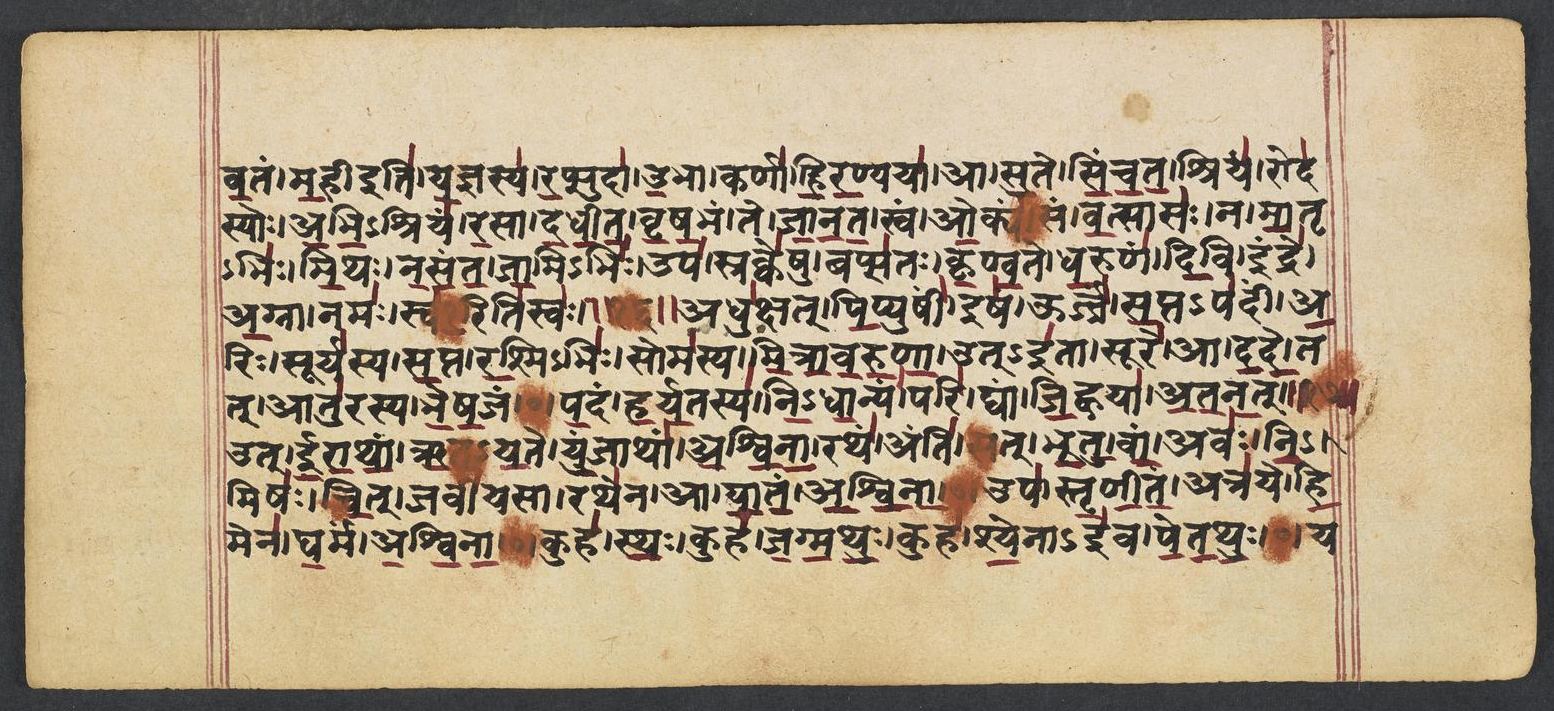
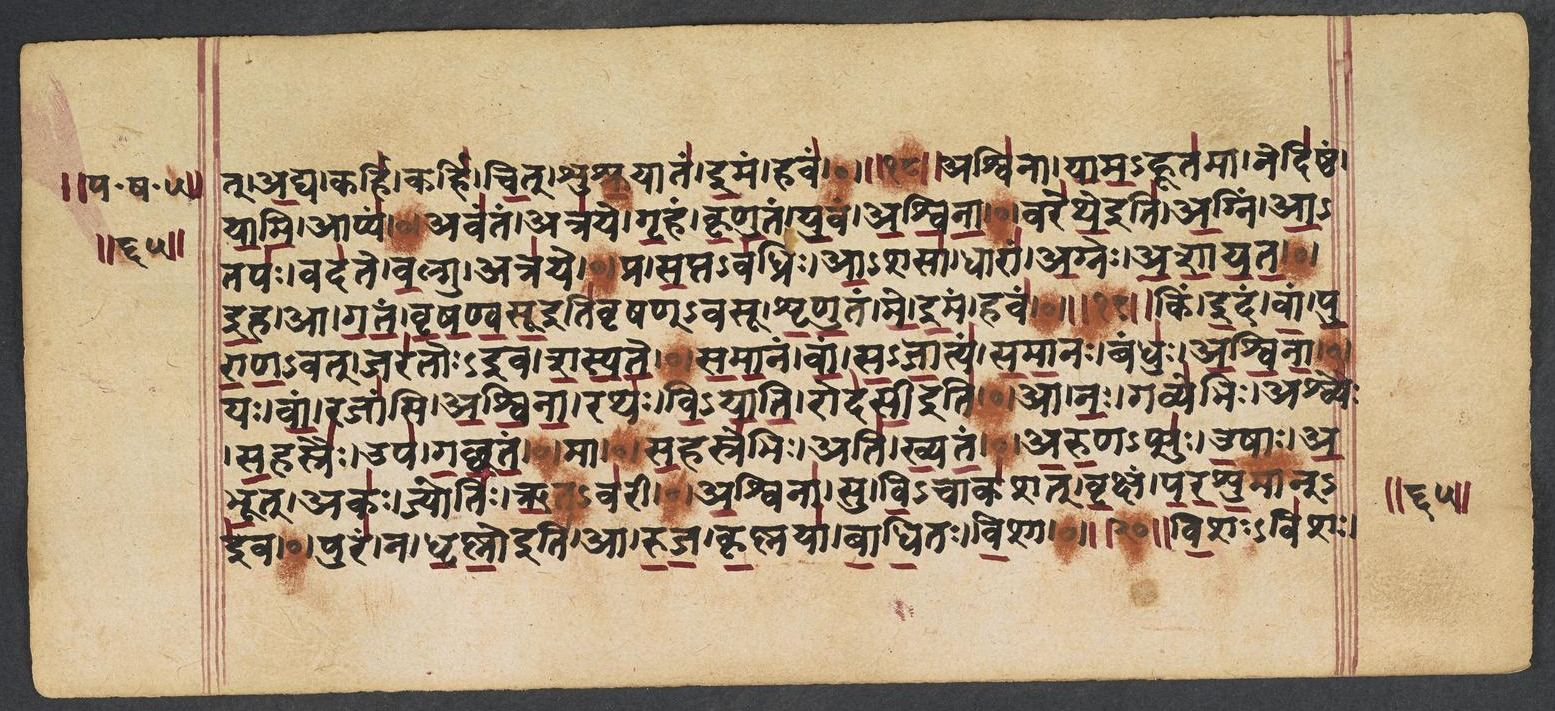
The manuscript shown is Penn Ms. Coll. 390 Item 41 (University of Pennsylvania), an undated paper manuscript of the padapāṭha (the word-by-word recitation text, in which every word is written separately and compounds are split) of the whole Ṛgveda in Devanāgarī, 884 leaves in fascicles, 7-9 lines to the page, accents in red; this hymn stands on fol. 643r-643v. Each section below gives the verses that end on one page; the page boundaries were read on the images (the opening words of every page), not counted out. Where the manuscript is a padapāṭha (the word-by-word recitation text), the section shows Aufrecht's continuous (saṃhitā) text first and, as the edition text, the padapāṭha of the same verses, which is the form written on the page.
How was this verified? (Provenance)
Where on the image
Penn Ms. Coll. 390 Item 41, fol. 643r (numbered 65r by the scribe) (OPenn image 643, lower leaf). Checked on the image: the Rigveda text on this page begins in RV 8.72.12 ‹-avatam mahī iti yajñasya›. The next page with Rigveda text, fol. 643v (numbered 65v by the scribe), begins in RV 8.73.5 ‹adya karhi karhi cit›. Verses 8.73.1-4 end on this page.
1ud ī̍rāthām ṛtāya̱te yu̱ñjāthā̍m aśvinā̱ ratha̍m | anti̱ ṣad bhū̍tu vā̱m ava̍ḥ ||
2ni̱miṣa̍ś ci̱j javī̍yasā̱ rathe̱nā yā̍tam aśvinā | anti̱ ṣad bhū̍tu vā̱m ava̍ḥ ||
3upa̍ stṛṇīta̱m atra̍ye hi̱mena̍ gha̱rmam a̍śvinā | anti̱ ṣad bhū̍tu vā̱m ava̍ḥ ||
4kuha̍ stha̱ḥ kuha̍ jagmathu̱ḥ kuha̍ śye̱neva̍ petathuḥ | anti̱ ṣad bhū̍tu vā̱m ava̍ḥ ||
Compare: Padapāṭha (word-by-word text written in the manuscript; Sansknet e-text via GRETIL)
1ut | īrāthām | ṛta-yate | yuñjāthām | aśvinā | ratham | anti | sat | bhūtu | vām | avaḥ
2nimiṣaḥ | cit | javīyasā | rathena | ā | yātam | aśvinā | anti | sat | bhūtu | vām | avaḥ
3upa | stṛṇītam | atraye | himena | gharmam | aśvinā | anti | sat | bhūtu | vām | avaḥ
4kuha | sthaḥ | kuha | jagmathuḥ | kuha | śyenāiva | petathuḥ | anti | sat | bhūtu | vām | avaḥ
1ROUSE ye for him who keeps the Law, yoke your steeds, Aṣvins, to your car Let your protecting help be near.
2Come, Aṣvins, with your car more swift than is the twinkling of an eye Let your protecting help be near.
3Aṣvins, ye overlaid with cold the fiery pit for Atri's sake: Let your protecting help be near.
4Where are ye? whither are ye gone? whither, like falcons, have ye flown? Let your protecting help be near.
Where on the image
Penn Ms. Coll. 390 Item 41, fol. 643v (numbered 65v by the scribe) (OPenn image 644, upper leaf). Checked on the image: the Rigveda text on this page begins in RV 8.73.5 ‹adya karhi karhi cit›. The next page with Rigveda text, fol. 644r (numbered 66r by the scribe), begins in RV 8.74.1 ‹vaḥ atithim vāja-yantaḥ puru-priyam›. Verses 8.73.5-18 end on this page; 8.73.5 begins on fol. 643r (numbered 65r by the scribe).
5yad a̱dya karhi̱ karhi̍ cic chuśrū̱yāta̍m i̱maṁ hava̍m | anti̱ ṣad bhū̍tu vā̱m ava̍ḥ ||
6a̱śvinā̍ yāma̱hūta̍mā̱ nedi̍ṣṭhaṁ yā̱my āpya̍m | anti̱ ṣad bhū̍tu vā̱m ava̍ḥ ||
7ava̍nta̱m atra̍ye gṛ̱haṁ kṛ̍ṇu̱taṁ yu̱vam a̍śvinā | anti̱ ṣad bhū̍tu vā̱m ava̍ḥ ||
8vare̍the a̱gnim ā̱tapo̱ vada̍te va̱lgv atra̍ye | anti̱ ṣad bhū̍tu vā̱m ava̍ḥ ||
9pra sa̱ptava̍dhrir ā̱śasā̱ dhārā̍m a̱gner a̍śāyata | anti̱ ṣad bhū̍tu vā̱m ava̍ḥ ||
10i̱hā ga̍taṁ vṛṣaṇvasū śṛṇu̱tam ma̍ i̱maṁ hava̍m | anti̱ ṣad bhū̍tu vā̱m ava̍ḥ ||
11kim i̱daṁ vā̍m purāṇa̱vaj jara̍tor iva śasyate | anti̱ ṣad bhū̍tu vā̱m ava̍ḥ ||
12sa̱mā̱naṁ vā̍ṁ sajā̱tya̍ṁ samā̱no bandhu̍r aśvinā | anti̱ ṣad bhū̍tu vā̱m ava̍ḥ ||
13yo vā̱ṁ rajā̍ṁsy aśvinā̱ ratho̍ vi̱yāti̱ roda̍sī | anti̱ ṣad bhū̍tu vā̱m ava̍ḥ ||
14ā no̱ gavye̍bhi̱r aśvyai̍ḥ sa̱hasrai̱r upa̍ gacchatam | anti̱ ṣad bhū̍tu vā̱m ava̍ḥ ||
15mā no̱ gavye̍bhi̱r aśvyai̍ḥ sa̱hasre̍bhi̱r ati̍ khyatam | anti̱ ṣad bhū̍tu vā̱m ava̍ḥ ||
16a̱ru̱ṇapsu̍r u̱ṣā a̍bhū̱d aka̱r jyoti̍r ṛ̱tāva̍rī | anti̱ ṣad bhū̍tu vā̱m ava̍ḥ ||
17a̱śvinā̱ su vi̱cāka̍śad vṛ̱kṣam pa̍raśu̱mām̐ i̍va | anti̱ ṣad bhū̍tu vā̱m ava̍ḥ ||
18pura̱ṁ na dhṛ̍ṣṇa̱v ā ru̍ja kṛ̱ṣṇayā̍ bādhi̱to vi̱śā | anti̱ ṣad bhū̍tu vā̱m ava̍ḥ ||
Compare: Padapāṭha (word-by-word text written in the manuscript; Sansknet e-text via GRETIL)
5yat | adya | karhi | karhi | cit | śuśrūyātam | imam | havam | anti | sat | bhūtu | vām | avaḥ
6aśvinā | yāma-hūtamā | nediṣṭham | yāmi | āpyam | anti | sat | bhūtu | vām | avaḥ
7avantam | atraye | gṛham | kṛṇutam | yuvam | aśvinā | anti | sat | bhūtu | vām | avaḥ
8varethe | agnim | ātapaḥ | vadate | valgu | atraye | anti | sat | bhūtu | vām | avaḥ
9pra | sapta-vadhriḥ | āśasā | dhārām | agneḥ | aśāyata | anti | sat | bhūtu | vām | avaḥ
10iha | ā | gatam | vṛṣaṇ-vasūitivṛṣaṇ-vasū | śṛṇutam | me | imam | havam | anti | sat | bhūtu | vām | avaḥ
11kim | idam | vām | purāṇa-vat | jaratoḥ-iva | śasyate | anti | sat | bhūtu | vām | avaḥ
12samānam | vām | sa-jātyam | samānaḥ | bandhuḥ | aśvinā | anti | sat | bhūtu | vām | avaḥ
13yaḥ | vām | rajāṃsi | aśvinā | rathaḥ | vi-yāti | rodasī iti | anti | sat | bhūtu | vām | avaḥ
14ā | naḥ | gavyebhiḥ | aśvyaiḥ | sahasraiḥ | upa | gacchatam | anti | sat | bhūtu | vām | avaḥ
15mā | naḥ | gavyebhiḥ | aśvyaiḥ | sahasrebhiḥ | ati | khyatam | anti | sat | bhūtu | vām | avaḥ
16aruṇa-psuḥ | uṣāḥ | abhūt | akaḥ | jyotiḥ | ṛta-varī | anti | sat | bhūtu | vām | avaḥ
17aśvinā | su | vi-cākaśat | vṛkṣam | paraśumān-iva | anti | sat | bhūtu | vām | avaḥ
18puram | na | dhṛṣṇo iti | ā | ruja | kṛṣṇayā | bādhitaḥ | viśā | anti | sat | bhūtu | vām | avaḥ
5If ye at any time this day are listening to this my call, Let your protecting help be near.
6The Aṣvins, fust to hear our prayer, for closest kinship I approach: Let your protecting help be near.
7For Atri ye, O Aṣvins, made a dwellingplace to shield him well, Let your protecting help be near.
8Ye warded off the fervent heat for Atri when he sweetly spake: Let your protecting help be near.
9Erst Saptavadbri by his prayer obtained the trenchant edge of fire: Let your protecting help be near.
10Come hither, O ye Lords of wealth, and listen to this call of mine: Let your protecting help be near.
11What is this praise told forth of you as Elders in the ancient way? Let your protecting help be near.
12One common brotherhood is yours, Aṣvins your kindred is the same: Let your protecting help be near.
13This is your chariot, Aṣvins, which speeds through the regions, earth and heaven: Let your protecting aid be near.
14Approach ye hitherward to us with thousands both of steeds and kine : Let your protecting help be near.
15Pass us not by, remember us with thousands both of kine and steeds; Let your protecting help be near.
16The purple tinted Dawn hath risen, and true to Law hath made the light: Let your protecting help be near.
17He looked upon the Aṣvins, as an axe-armed man upon a tree: Let your protecting help be near.
18By the black band encompassed round, break it down, bold one, like a fort. Let your protecting help be near.
Notes
- Sanskrit: Aufrecht's edition (1877) with the Vedic accents, as entered by van Nooten and Holland (GRETIL).
- English: Ralph T. H. Griffith, The Hymns of the Rigveda (1889-1892; 2nd ed. 1896-1897), from the VedaWeb digital text; OCR slips in that text were corrected against the printed 2nd edition (data/sources/rigveda/griffith_errata.json).
- Padapāṭha (edition text): Sansknet e-text via GRETIL (CC BY-NC-SA 4.0).
Cite
Sources
- Source: Penn Ms. Coll. 390 Item 41 (undated (catalogued with Penn's 18th-19th c. Vedic manuscripts)), OPenn, Public Domain Mark + Aufrecht's accented text (GRETIL) + Griffith's English (VedaWeb) (holding institution)
- Critical edition: Aufrecht (1877), accented e-text via GRETIL
← previous · → next · v cycle view · l back to library