Rigveda 8.76: To Indra
Introduction
Rigveda 8.76 is a hymn of 12 verses addressed to Indra. It stands in book (maṇḍala) 8, the book of the Kaṇva and Aṅgiras poets. The Rigveda is the oldest collection of Sanskrit hymns, composed in the second half of the second millennium BCE and handed down orally for many centuries before it was written down.
The manuscript shown is Penn Ms. Coll. 390 Item 41 (University of Pennsylvania), an undated paper manuscript of the padapāṭha (the word-by-word recitation text, in which every word is written separately and compounds are split) of the whole Ṛgveda in Devanāgarī, 884 leaves in fascicles, 7-9 lines to the page, accents in red; this hymn stands on fol. 645v-646r. Each section below gives the verses that end on one page; the page boundaries were read on the images (the opening words of every page), not counted out. Where the manuscript is a padapāṭha (the word-by-word recitation text), the section shows Aufrecht's continuous (saṃhitā) text first and, as the edition text, the padapāṭha of the same verses, which is the form written on the page.
How was this verified? (Provenance)
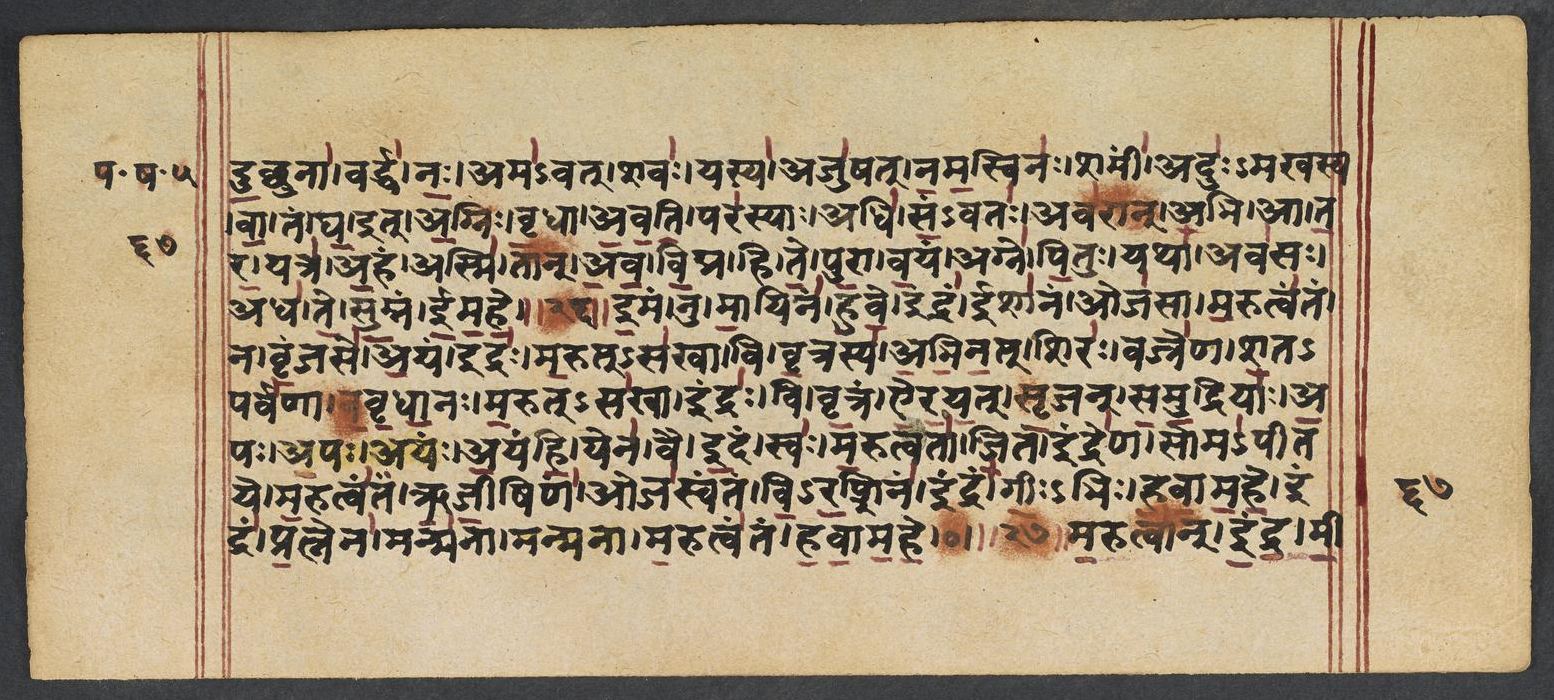
Where on the image
Penn Ms. Coll. 390 Item 41, fol. 645v (numbered 67v by the scribe) (OPenn image 646, upper leaf). Checked on the image: the Rigveda text on this page begins in RV 8.75.13 ‹ducchunā vardha naḥ ama-vat›. The next page with Rigveda text, fol. 646r (numbered 68r by the scribe), begins in RV 8.76.7 ‹-mīḍhavaḥ piba somam śatakrato›. Verses 8.76.1-6 end on this page.
1i̱maṁ nu mā̱yina̍ṁ huva̱ indra̱m īśā̍na̱m oja̍sā | ma̱rutva̍nta̱ṁ na vṛ̱ñjase̍ ||
2a̱yam indro̍ ma̱rutsa̍khā̱ vi vṛ̱trasyā̍bhina̱c chira̍ḥ | vajre̍ṇa śa̱tapa̍rvaṇā ||
3vā̱vṛ̱dhā̱no ma̱rutsa̱khendro̱ vi vṛ̱tram ai̍rayat | sṛ̱jan sa̍mu̱driyā̍ a̱paḥ ||
4a̱yaṁ ha̱ yena̱ vā i̱daṁ sva̍r ma̱rutva̍tā ji̱tam | indre̍ṇa̱ soma̍pītaye ||
5ma̱rutva̍ntam ṛjī̱ṣiṇa̱m oja̍svantaṁ vira̱pśina̍m | indra̍ṁ gī̱rbhir ha̍vāmahe ||
6indra̍m pra̱tnena̱ manma̍nā ma̱rutva̍ntaṁ havāmahe | a̱sya soma̍sya pī̱taye̍ ||
Compare: Padapāṭha (word-by-word text written in the manuscript; Sansknet e-text via GRETIL)
1imam | nu | māyinam | huve | indram | īśānam | ojasā | marutvantam | na vṛñjase
2ayam | indraḥ | marut-sakhā | vi | vṛtrasya | abhinat | śiraḥ | vajreṇa | śata-parvaṇā
3vavṛdhānaḥ | marut-sakhā | indraḥ | vi | vṛtram | airayat | sṛjan | samudriyāḥ | apaḥ
4ayam | ha | yena | vai | idam | svaḥ | marutvatā | jitam | indreṇa | soma-pītaye
5marutvantam | ṛjīṣiṇam | ojasvantam | vi-rapśinam | indram | gīḥ-bhiḥ | havāmahe
6indram | pratnena | manmanā | marutvantam | havāmahe | asya | somasya | pītaye
1NOT to forsake me, I invoke this Indra girt by Maruts, Lord Of magic power who rules with might.
2This Indra with his Marut Friends clave into pieces Vritra's head With hundred-knotted thunderbolt.
3Indra, with Marut Friends grown strong, hath rent asunder Vritra, and Released the waters of the sea.
4This is that Indra who, begirt by Maruts, won the light of heaven That he might drink the Soma juice.
5Mighty, impetuous, begirt by Maruts, him who loudly roars, Indra we invocate with songs.
6Indra begirt by Maruts we invoke after the ancient plan, That he may drink the Soma juice.
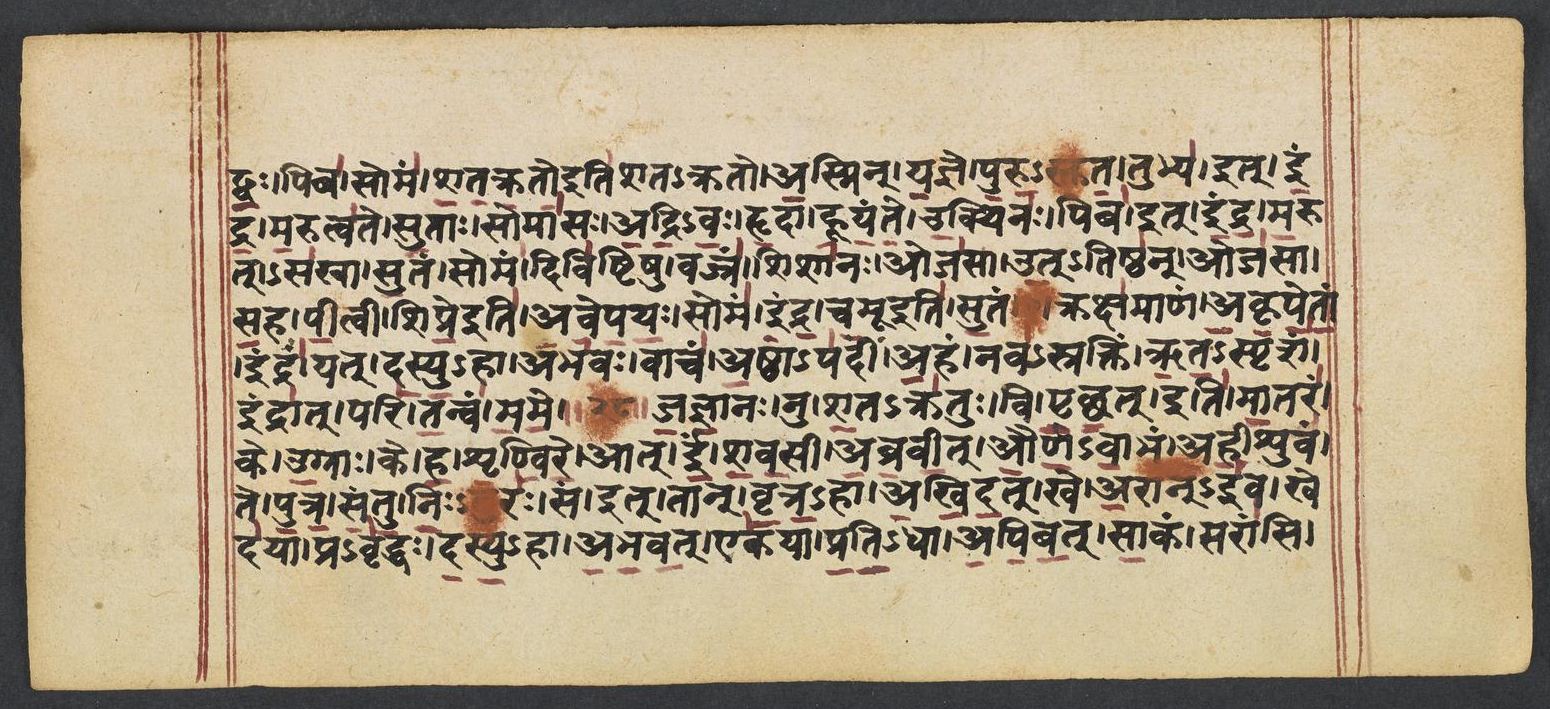
Where on the image
Penn Ms. Coll. 390 Item 41, fol. 646r (numbered 68r by the scribe) (OPenn image 646, lower leaf). Checked on the image: the Rigveda text on this page begins in RV 8.76.7 ‹-mīḍhavaḥ piba somam śatakrato›. The next page with Rigveda text, fol. 646v (numbered 68v by the scribe), begins in RV 8.77.4 ‹triṃśatam indraḥ somasya kāṇukā›. Verses 8.76.7-12 end on this page; 8.76.7 begins on fol. 645v (numbered 67v by the scribe).
7ma̱rutvā̍m̐ indra mīḍhva̱ḥ pibā̱ soma̍ṁ śatakrato | a̱smin ya̱jñe pu̍ruṣṭuta ||
8tubhyed i̍ndra ma̱rutva̍te su̱tāḥ somā̍so adrivaḥ | hṛ̱dā hū̍yanta u̱kthina̍ḥ ||
9pibed i̍ndra ma̱rutsa̍khā su̱taṁ soma̱ṁ divi̍ṣṭiṣu | vajra̱ṁ śiśā̍na̱ oja̍sā ||
10u̱ttiṣṭha̱nn oja̍sā sa̱ha pī̱tvī śipre̍ avepayaḥ | soma̍m indra ca̱mū su̱tam ||
11anu̍ tvā̱ roda̍sī u̱bhe krakṣa̍māṇam akṛpetām | indra̱ yad da̍syu̱hābha̍vaḥ ||
12vāca̍m a̱ṣṭāpa̍dīm a̱haṁ nava̍sraktim ṛta̱spṛśa̍m | indrā̱t pari̍ ta̱nva̍m mame ||
Compare: Padapāṭha (word-by-word text written in the manuscript; Sansknet e-text via GRETIL)
7marutvān | indra | mīḍhavaḥ | piba | somam | śatakrato itiśata-krato | asmin | yajñe | puru-stuta
8tubhya | it | indra | marutvate | sutāḥ | somāsaḥ | adri-vaḥ | hṛdā | hūyante | ukthinaḥ
9piba | it | indra | marut-sakhā | sutam | somam | diviṣṭiṣu | vajram | śiśānaḥ | ojasā
10ut-tiṣṭhan | ojasā | saha | pītvī | śipreiti | avepayaḥ | somam | indra | camū iti | sutam
11anu | tvā | rodasī iti | ubhe iti | krakṣamāṇam | akṛpetām | indra | yat | dasyu-hā | abhavaḥ
12vācam | aṣṭāpadīm | aham | nava-sraktim | ṛta-spṛśam | indrāt | pari | tanvam | mame
7O liberal Indra, Marut-girt, much-lauded Ṣatakratu, drink The Soma at this sacrifice.
8To thee, O Indra, Marut-girt, these Soma juices, Thunderer! Are offered from the heart with lauds.
9Drink, Indra, with thy Marut Friends, pressed Soma at the morning rites, Whetting thy thunderbolt with strength.
10Arising in thy might, thy jaws thou shookest, Indra, having quaffed The Soma which the mortar pressed.
11Indra, both worlds complained to thee when uttering thy fearful roar, What time thou smotest Dasyus dead.
12From Indra have I measured out a song eight-footed with nine parts, Delicate, faithful to the Law.
Notes
- Sanskrit: Aufrecht's edition (1877) with the Vedic accents, as entered by van Nooten and Holland (GRETIL).
- English: Ralph T. H. Griffith, The Hymns of the Rigveda (1889-1892; 2nd ed. 1896-1897), from the VedaWeb digital text; OCR slips in that text were corrected against the printed 2nd edition (data/sources/rigveda/griffith_errata.json).
- Padapāṭha (edition text): Sansknet e-text via GRETIL (CC BY-NC-SA 4.0).
Cite
Sources
- Source: Penn Ms. Coll. 390 Item 41 (undated (catalogued with Penn's 18th-19th c. Vedic manuscripts)), OPenn, Public Domain Mark + Aufrecht's accented text (GRETIL) + Griffith's English (VedaWeb) (holding institution)
- Critical edition: Aufrecht (1877), accented e-text via GRETIL
← previous · → next · v cycle view · l back to library