Rigveda 8.79: To Soma
Introduction
Rigveda 8.79 is a hymn of 9 verses addressed to Soma. It stands in book (maṇḍala) 8, the book of the Kaṇva and Aṅgiras poets. The Rigveda is the oldest collection of Sanskrit hymns, composed in the second half of the second millennium BCE and handed down orally for many centuries before it was written down.
The manuscript shown is Penn Ms. Coll. 390 Item 41 (University of Pennsylvania), an undated paper manuscript of the padapāṭha (the word-by-word recitation text, in which every word is written separately and compounds are split) of the whole Ṛgveda in Devanāgarī, 884 leaves in fascicles, 7-9 lines to the page, accents in red; this hymn stands on fol. 647v-648r. Each section below gives the verses that end on one page; the page boundaries were read on the images (the opening words of every page), not counted out. Where the manuscript is a padapāṭha (the word-by-word recitation text), the section shows Aufrecht's continuous (saṃhitā) text first and, as the edition text, the padapāṭha of the same verses, which is the form written on the page.
How was this verified? (Provenance)
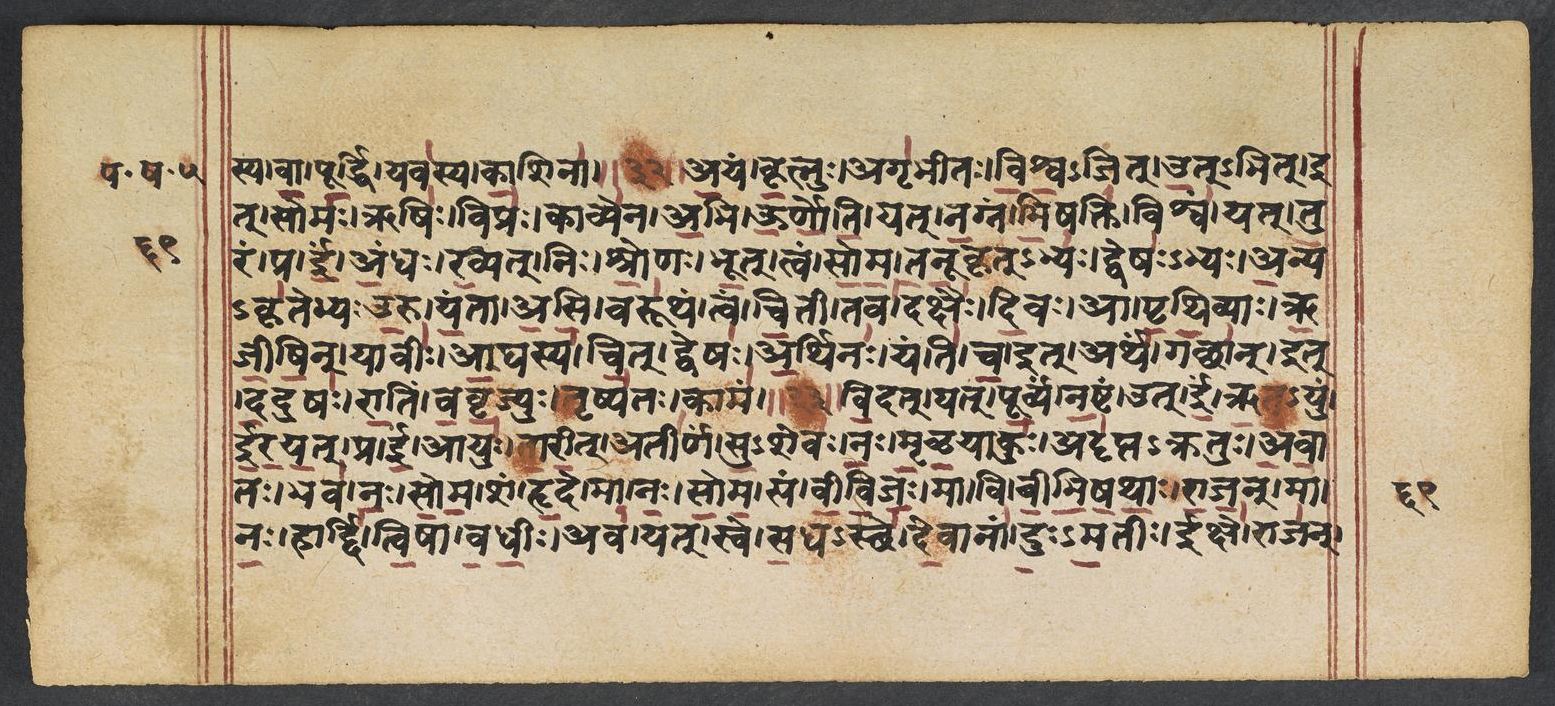
Where on the image
Penn Ms. Coll. 390 Item 41, fol. 647v (numbered 69v by the scribe) (OPenn image 648, upper leaf). Checked on the image: the Rigveda text on this page begins in RV 8.78.10 ‹-sam-bhṛtasya vā pūrdhi yavasya›. The next page with Rigveda text, fol. 648r (numbered 70r by the scribe), begins in RV 8.79.9 ‹apa dviṣaḥ sedha mīḍhavaḥ›. Verses 8.79.1-8 end on this page.
1a̱yaṁ kṛ̱tnur agṛ̍bhīto viśva̱jid u̱dbhid it soma̍ḥ | ṛṣi̱r vipra̱ḥ kāvye̍na ||
2a̱bhy ū̍rṇoti̱ yan na̱gnam bhi̱ṣakti̱ viśva̱ṁ yat tu̱ram | prem a̱ndhaḥ khya̱n niḥ śro̱ṇo bhū̍t ||
3tvaṁ so̍ma tanū̱kṛdbhyo̱ dveṣo̍bhyo̱ 'nyakṛ̍tebhyaḥ | u̱ru ya̱ntāsi̱ varū̍tham ||
4tvaṁ ci̱ttī tava̱ dakṣai̍r di̱va ā pṛ̍thi̱vyā ṛ̍jīṣin | yāvī̍r a̱ghasya̍ ci̱d dveṣa̍ḥ ||
5a̱rthino̱ yanti̱ ced artha̱ṁ gacchā̱n id da̱duṣo̍ rā̱tim | va̱vṛ̱jyus tṛṣya̍ta̱ḥ kāma̍m ||
6vi̱dad yat pū̱rvyaṁ na̱ṣṭam ud ī̍m ṛtā̱yum ī̍rayat | prem āyu̍s tārī̱d atī̍rṇam ||
7su̱śevo̍ no mṛḻa̱yāku̱r adṛ̍ptakratur avā̱taḥ | bhavā̍ naḥ soma̱ śaṁ hṛ̱de ||
8mā na̍ḥ soma̱ saṁ vī̍vijo̱ mā vi bī̍bhiṣathā rājan | mā no̱ hārdi̍ tvi̱ṣā va̍dhīḥ ||
Compare: Padapāṭha (word-by-word text written in the manuscript; Sansknet e-text via GRETIL)
1ayam | kṛtnuḥ | agṛbhītaḥ | viśva-jit | ut-bhit | it | somaḥ | ṛṣiḥ | vipraḥ | kāvyena
2abhi | ūrṇoti | yat | nagnam | bhiṣakti | viśvam | yat | turam | pra | īm | andhaḥ | khyat | niḥ | śroṇaḥ | bhūt
3tvam | soma | tanūkṛt-bhyaḥ | dveṣaḥ-bhyaḥ | anya-kṛtebhyaḥ | uru | yantā | asi | varūtham
4tvam | cittī | tava | dakṣaiḥ | divaḥ | ā | pṛthivyāḥ | ṛjīṣin | yāvīḥ | aghasya | cit | dveṣaḥ
5arthinaḥ | yanti | ca | it | artham | gacchān | it | daduṣaḥ | rātim | vavṛjyuḥ | tṛṣyataḥ | kāmam
6vidat | yat | pūrvyam | naṣṭam | ut | īm | ṛta-yum | īrayat | pra | īm | āyuḥ | tārīt | atīrṇam
7su-śevaḥ | naḥ | mṛḷayākuḥ | adṛpta-kratuḥ | avātaḥ | bhava | naḥ | soma | śam | hṛde
8mā | naḥ | soma | sam | vīvijaḥ | mā | vi | bībhiṣathā | rājan | mā | naḥ | hārdi | tviṣā | vadhīḥ
1THIS here is Soma, ne'er restrained, active, all-conquering bursting forth, Rishi and Sage by sapience,
2All that is bare he covers o'er, all that is sick he medicines; The blind man sees, the cripple walks.
3Thou, Soma, givest wide defence against the hate of alien men, Hatreds that waste and weaken us.
4Thou by thine insight and thy skill, Impetuous One, from heaven and earth Drivest the sinner's enmity.
5When to their task they come with zeal, may they obtain the Giver's grace, And satisfy his wish who thirsts.
6So may he find what erst was lost, so may be speed the pious man, And lengthen his remaining life.
7Gracious, displaying tender love, unconquered, gentle in thy thoughts, Be sweet, O Soma, to our heart.
8O Soma, terrify us not; strike us not with alarm, O King: Wound not our heart with dazzling flame.
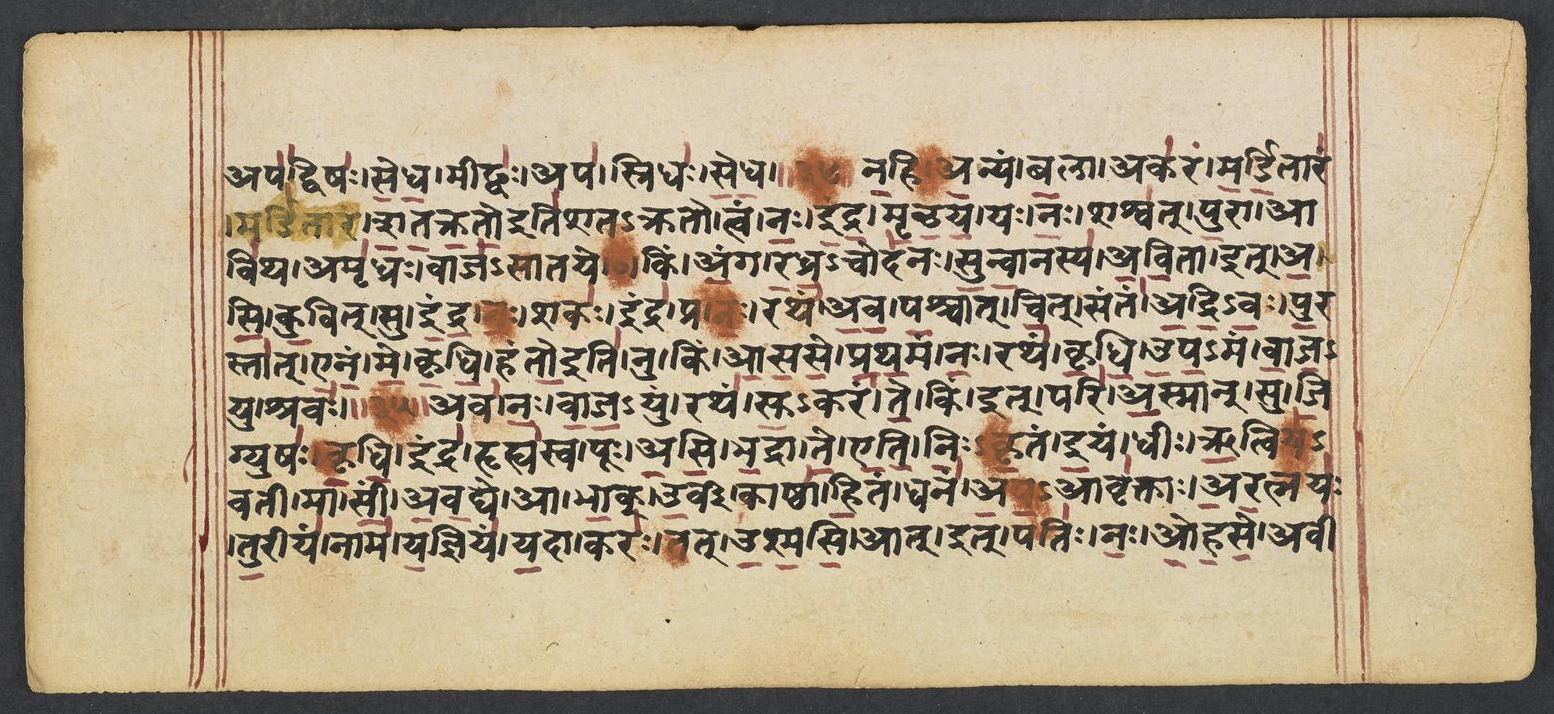
Where on the image
Penn Ms. Coll. 390 Item 41, fol. 648r (numbered 70r by the scribe) (OPenn image 648, lower leaf). Checked on the image: the Rigveda text on this page begins in RV 8.79.9 ‹apa dviṣaḥ sedha mīḍhavaḥ›. The next page with Rigveda text, fol. 648v (numbered 70v by the scribe), begins in RV 8.80.10 ‹-avīvṛdhat vaḥ amṛtāḥ amandīt›. Verse 8.79.9 ends on this page; 8.79.9 begins on fol. 647v (numbered 69v by the scribe).
9ava̱ yat sve sa̱dhasthe̍ de̱vānā̍ṁ durma̱tīr īkṣe̍ | rāja̱nn apa̱ dviṣa̍ḥ sedha̱ mīḍhvo̱ apa̱ sridha̍ḥ sedha ||
Compare: Padapāṭha (word-by-word text written in the manuscript; Sansknet e-text via GRETIL)
9ava | yat | sve | sadha-sthe | devānām | duḥ-matīḥ | īkṣe | rājan | apa | dviṣaḥ | sedha | mīḍhavaḥ | apa | sridhaḥ | sedha
9When in my dwelling-place I see the wicked enemies of Gods, King, chase their hatred far away, thou Bounteous One, dispel our foes.
Notes
- Sanskrit: Aufrecht's edition (1877) with the Vedic accents, as entered by van Nooten and Holland (GRETIL).
- English: Ralph T. H. Griffith, The Hymns of the Rigveda (1889-1892; 2nd ed. 1896-1897), from the VedaWeb digital text; OCR slips in that text were corrected against the printed 2nd edition (data/sources/rigveda/griffith_errata.json).
- Padapāṭha (edition text): Sansknet e-text via GRETIL (CC BY-NC-SA 4.0).
Cite
Sources
- Source: Penn Ms. Coll. 390 Item 41 (undated (catalogued with Penn's 18th-19th c. Vedic manuscripts)), OPenn, Public Domain Mark + Aufrecht's accented text (GRETIL) + Griffith's English (VedaWeb) (holding institution)
- Critical edition: Aufrecht (1877), accented e-text via GRETIL
← previous · → next · v cycle view · l back to library