Rigveda 8.91: To Indra
Introduction
Rigveda 8.91 is a hymn of 7 verses addressed to Indra. It stands in book (maṇḍala) 8, the book of the Kaṇva and Aṅgiras poets. The Rigveda is the oldest collection of Sanskrit hymns, composed in the second half of the second millennium BCE and handed down orally for many centuries before it was written down.
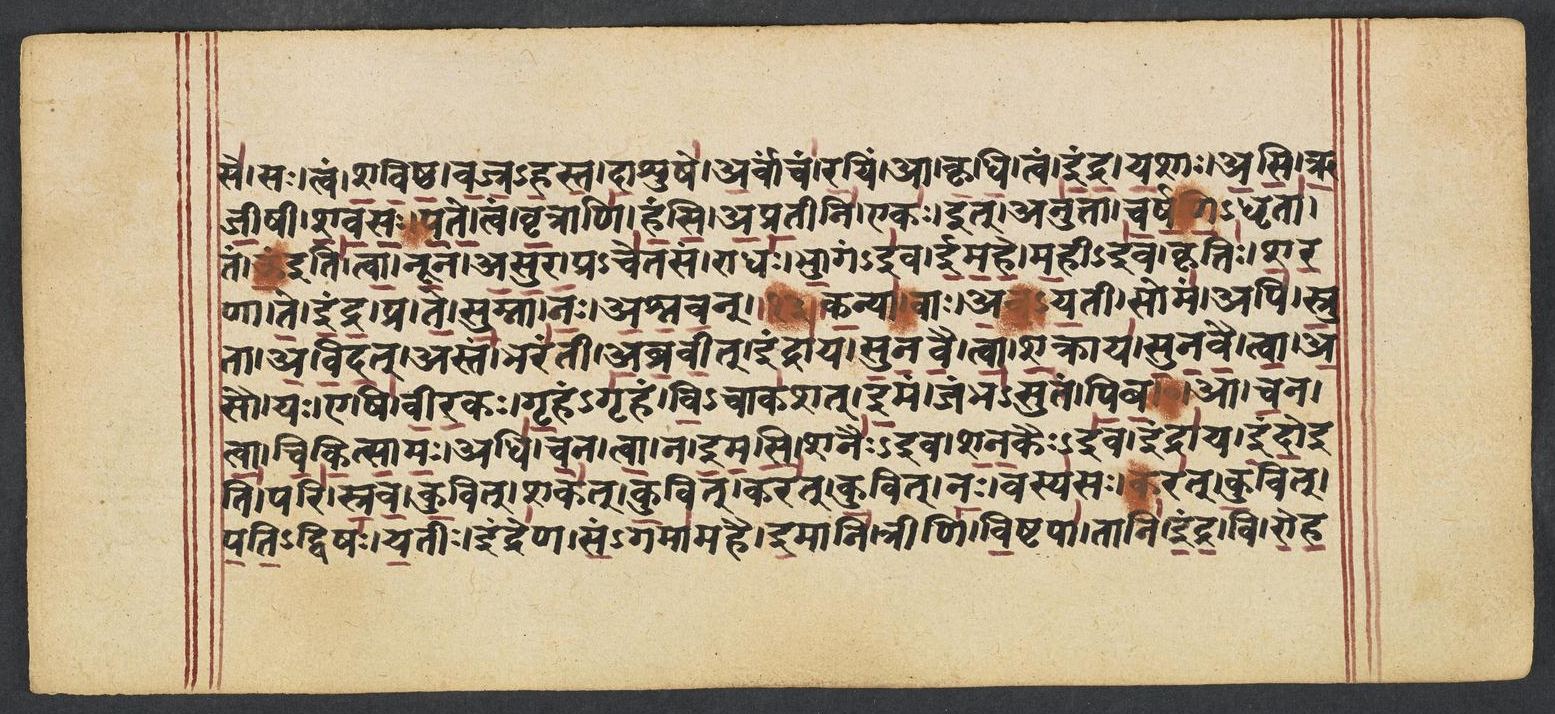
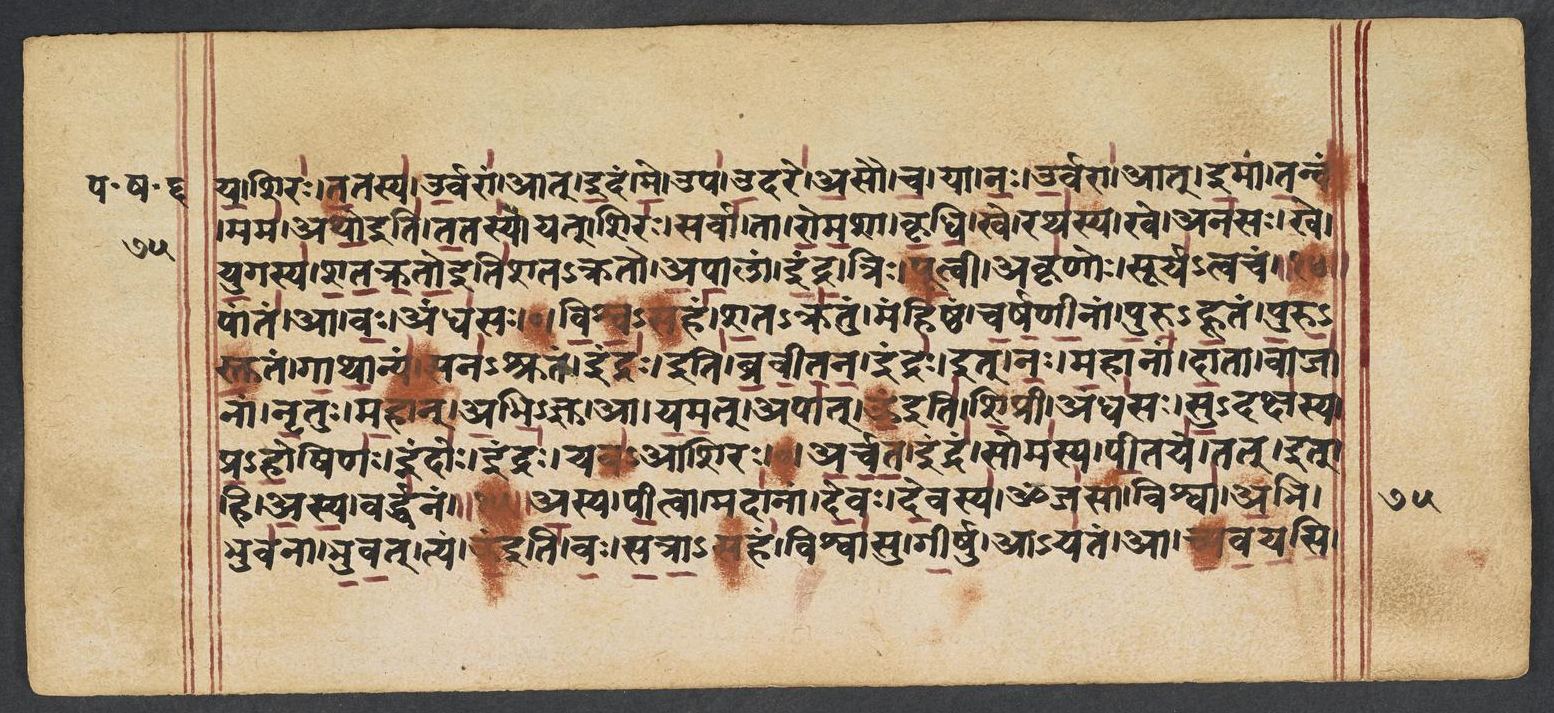
The manuscript shown is Penn Ms. Coll. 390 Item 41 (University of Pennsylvania), an undated paper manuscript of the padapāṭha (the word-by-word recitation text, in which every word is written separately and compounds are split) of the whole Ṛgveda in Devanāgarī, 884 leaves in fascicles, 7-9 lines to the page, accents in red; this hymn stands on fol. 653r-653v. Each section below gives the verses that end on one page; the page boundaries were read on the images (the opening words of every page), not counted out. Where the manuscript is a padapāṭha (the word-by-word recitation text), the section shows Aufrecht's continuous (saṃhitā) text first and, as the edition text, the padapāṭha of the same verses, which is the form written on the page.
How was this verified? (Provenance)
Where on the image
Penn Ms. Coll. 390 Item 41, fol. 653r (numbered 75r by the scribe) (OPenn image 653, lower leaf). Checked on the image: the Rigveda text on this page begins in RV 8.90.4 ‹-ni-ṛñjase saḥ tvam śaviṣṭha›. The next page with Rigveda text, fol. 653v (numbered 75v by the scribe), begins in RV 8.91.5 ‹śiraḥ tatasya urvarām āt›. Verses 8.91.1-4 end on this page.
1ka̱nyā̱3̱̍ vār a̍vāya̱tī soma̱m api̍ sru̱tāvi̍dat | asta̱m bhara̍nty abravī̱d indrā̍ya sunavai tvā śa̱krāya̍ sunavai tvā ||
2a̱sau ya eṣi̍ vīra̱ko gṛ̱haṁ-gṛ̍haṁ vi̱cāka̍śad | i̱maṁ jambha̍sutam piba dhā̱nāva̍ntaṁ kara̱mbhiṇa̍m apū̱pava̍ntam u̱kthina̍m ||
3ā ca̱na tvā̍ cikitsā̱mo 'dhi̍ ca̱na tvā̱ nema̍si | śanai̍r iva śana̱kair i̱vendrā̍yendo̱ pari̍ srava ||
4ku̱vic chaka̍t ku̱vit kara̍t ku̱vin no̱ vasya̍sa̱s kara̍t | ku̱vit pa̍ti̱dviṣo̍ ya̱tīr indre̍ṇa sa̱ṁgamā̍mahai ||
Compare: Padapāṭha (word-by-word text written in the manuscript; Sansknet e-text via GRETIL)
1kanyā | vāḥ | āva-yatī | somam | api | srutā | avidat | astam | bharantī | abravīt | indrāya | sunavai | tvā | śakrāya | sunavai | tvā
2asau | yaḥ | eṣi | vīrakaḥ | gṛham-gṛham | vi-cākaśat | imam | jambha-sutam | piba | dhānāvantam | karambhiṇam | apūpa-vantam | ukthinam
3ā | cana | tvā | cikitsāmaḥ | adhi | cana | tvā | na | imasi | śanaiḥ-iva | śanakaiḥ-iva | indrāya | indo iti | pari | srava
4kuvit | śakat | kuvit | karat | kuvit | naḥ | vasyasaḥ | karat | kuvit | pati-dviṣaḥ | yatīḥ | indreṇa | sam-gamāmahai
1DOWN to the stream a maiden came, and found the Soma by the way. Bearing it to her home she said, For Indra will I press thee out, for Ṣakra will I press thee out.
2Thou roaming yonder, little man, beholding every house in turn, Drink thou this Soma pressed with teeth, accompanied with grain and curds, with cake of meal and song of praise.
3Fain would we learn to know thee well, nor yet can we attain to thee. Still slowly and in gradual drops, O Indu, unto Indra flow.
4Will he not help and work for us? Will he not make us wealthier? Shall we not, hostile to our lord, unite ourselves to Indra now?
Where on the image
Penn Ms. Coll. 390 Item 41, fol. 653v (numbered 75v by the scribe) (OPenn image 654, upper leaf). Checked on the image: the Rigveda text on this page begins in RV 8.91.5 ‹śiraḥ tatasya urvarām āt›. The next page with Rigveda text, fol. 654r (numbered 76r by the scribe), begins in RV 8.92.7 ‹ūtaye›. Verses 8.91.5-7 end on this page; 8.91.5 begins on fol. 653r (numbered 75r by the scribe).
5i̱māni̱ trīṇi̍ vi̱ṣṭapā̱ tānī̍ndra̱ vi ro̍haya | śira̍s ta̱tasyo̱rvarā̱m ād i̱dam ma̱ upo̱dare̍ ||
6a̱sau ca̱ yā na̍ u̱rvarād i̱māṁ ta̱nva1̱̍m mama̍ | atho̍ ta̱tasya̱ yac chira̱ḥ sarvā̱ tā ro̍ma̱śā kṛ̍dhi ||
7khe ratha̍sya̱ khe 'na̍sa̱ḥ khe yu̱gasya̍ śatakrato | a̱pā̱lām i̍ndra̱ triṣ pū̱tvy akṛ̍ṇo̱ḥ sūrya̍tvacam ||
Compare: Padapāṭha (word-by-word text written in the manuscript; Sansknet e-text via GRETIL)
5imāni | trīṇi | viṣṭapā | tāni | indra | vi | rohaya | śiraḥ | tatasya | urvarām | āt | idam | me | upa | udare
6asau | ca | yā | naḥ | urvarā | āt | imām | tanvam | mama | atho iti | tatasya | yat | śiraḥ | sarvā | tā | romaśā | kṛdhi
7khe | rathasya | khe | anasaḥ | khe | yugasya | śatakrato itiśata-krato | apālām | indra | triḥ | pūtvī | akṛṇoḥ | sūrya-tvacam
5O Indra, cause to sprout again three places, these which I declare,– My father's head, his cultured field, and this the part below my waist.
6Make all of these grow crops of hair, yon cultivated field of ours, My body, and my father's head.
7Cleansing Apâlâ, Indra! thrice, thou gavest sunlike skin to her, Drawn, Ṣatakratu! through the hole of car, of wagon, and of yoke.
Notes
- Sanskrit: Aufrecht's edition (1877) with the Vedic accents, as entered by van Nooten and Holland (GRETIL).
- English: Ralph T. H. Griffith, The Hymns of the Rigveda (1889-1892; 2nd ed. 1896-1897), from the VedaWeb digital text; OCR slips in that text were corrected against the printed 2nd edition (data/sources/rigveda/griffith_errata.json).
- Padapāṭha (edition text): Sansknet e-text via GRETIL (CC BY-NC-SA 4.0).
Cite
Sources
- Source: Penn Ms. Coll. 390 Item 41 (undated (catalogued with Penn's 18th-19th c. Vedic manuscripts)), OPenn, Public Domain Mark + Aufrecht's accented text (GRETIL) + Griffith's English (VedaWeb) (holding institution)
- Critical edition: Aufrecht (1877), accented e-text via GRETIL
← previous · → next · v cycle view · l back to library