Rigveda 8.98: To Indra
Introduction
Rigveda 8.98 is a hymn of 12 verses addressed to Indra. It stands in book (maṇḍala) 8, the book of the Kaṇva and Aṅgiras poets. The Rigveda is the oldest collection of Sanskrit hymns, composed in the second half of the second millennium BCE and handed down orally for many centuries before it was written down.
The manuscript shown is Penn Ms. Coll. 390 Item 41 (University of Pennsylvania), an undated paper manuscript of the padapāṭha (the word-by-word recitation text, in which every word is written separately and compounds are split) of the whole Ṛgveda in Devanāgarī, 884 leaves in fascicles, 7-9 lines to the page, accents in red; this hymn stands on fol. 661v-662r. Each section below gives the verses that end on one page; the page boundaries were read on the images (the opening words of every page), not counted out. Where the manuscript is a padapāṭha (the word-by-word recitation text), the section shows Aufrecht's continuous (saṃhitā) text first and, as the edition text, the padapāṭha of the same verses, which is the form written on the page.
How was this verified? (Provenance)
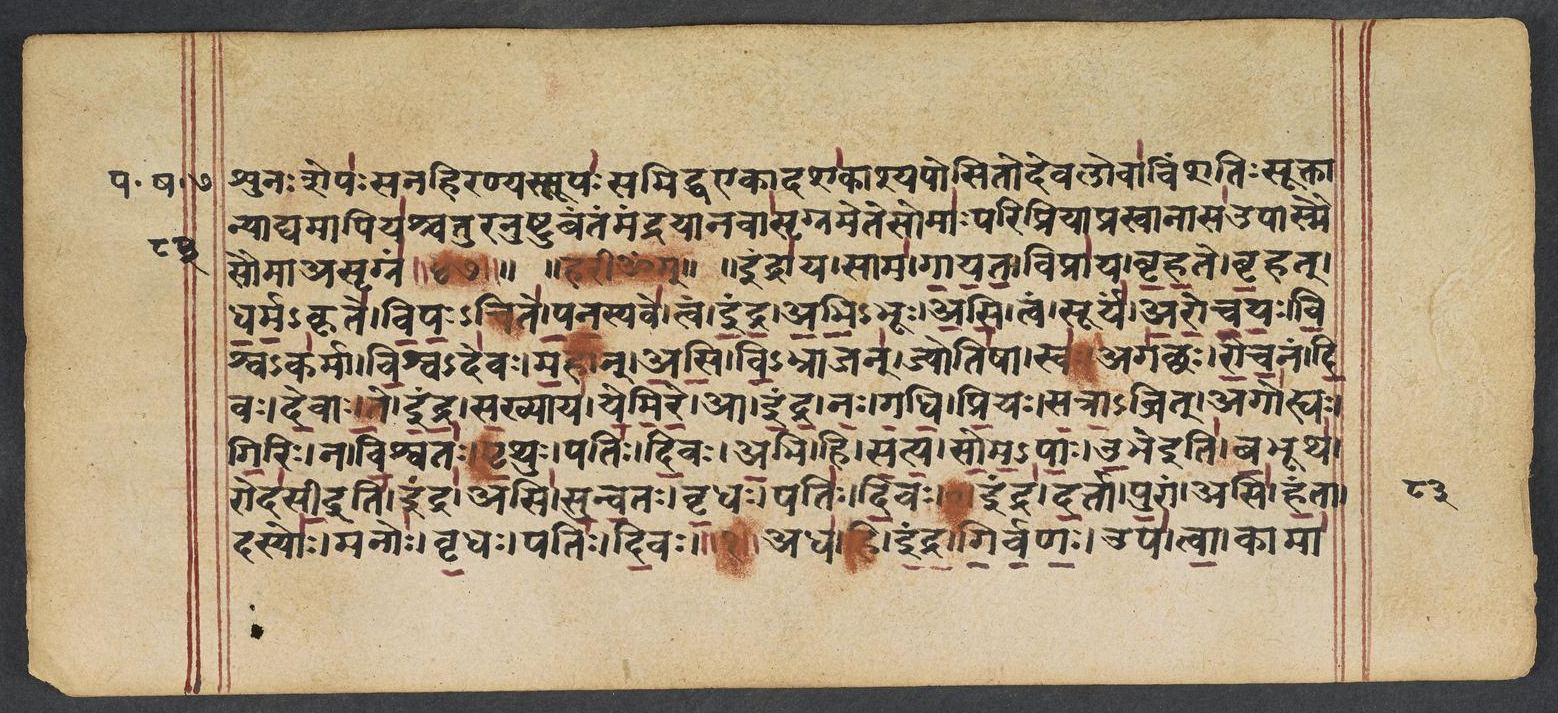
Where on the image
Penn Ms. Coll. 390 Item 41, fol. 661v (numbered 83v by the scribe) (OPenn image 662, upper leaf). Checked on the image: the Rigveda text on this page begins in RV 8.98.1 ‹indrāya sāma gāyata viprāya›. Lines 1-3 end the anukramaṇī; 8.98.1 (indrāya sāma gāyata) begins in line 3. The next page with Rigveda text, fol. 662r (numbered 84r by the scribe), begins in RV 8.98.7 ‹mahaḥ sasṛjmahe ut eva›. Verses 8.98.1-6 end on this page.
1indrā̍ya̱ sāma̍ gāyata̱ viprā̍ya bṛha̱te bṛ̱hat | dha̱rma̱kṛte̍ vipa̱ścite̍ pana̱syave̍ ||
2tvam i̍ndrābhi̱bhūr a̍si̱ tvaṁ sūrya̍m arocayaḥ | vi̱śvaka̍rmā vi̱śvade̍vo ma̱hām̐ a̍si ||
3vi̱bhrāja̱ñ jyoti̍ṣā̱ sva1̱̍r aga̍ccho roca̱naṁ di̱vaḥ | de̱vās ta̍ indra sa̱khyāya̍ yemire ||
4endra̍ no gadhi pri̱yaḥ sa̍trā̱jid ago̍hyaḥ | gi̱rir na vi̱śvata̍s pṛ̱thuḥ pati̍r di̱vaḥ ||
5a̱bhi hi sa̍tya somapā u̱bhe ba̱bhūtha̱ roda̍sī | indrāsi̍ sunva̱to vṛ̱dhaḥ pati̍r di̱vaḥ ||
6tvaṁ hi śaśva̍tīnā̱m indra̍ da̱rtā pu̱rām asi̍ | ha̱ntā dasyo̱r mano̍r vṛ̱dhaḥ pati̍r di̱vaḥ ||
Compare: Padapāṭha (word-by-word text written in the manuscript; Sansknet e-text via GRETIL)
1indrāya | sāma | gāyata | viprāya | bṛhate | bṛhat | dharma-kṛte | vipaḥ-cite | panasyave
2tvam | indra | abhi-bhūḥ | asi | tvam | sūryam | arocayaḥ | viśva-karmā | viśva-devaḥ | mahān | asi
3vi-bhrājan | jyotiṣā | svaḥ | agacchaḥ | rocanam | divaḥ | devāḥ | te | indra | sakhyāya | yemire
4ā | indra | naḥ | gadhi | priyaḥ | satrājit | agohyaḥ | giriḥ | na | viśvataḥ | pṛthuḥ | patiḥ | divaḥ
5abhi | hi | satya | soma-pāḥ | ubhe iti | babhūtha | rodasī iti | / indra | asi | sunvataḥ | vṛdhaḥ | patiḥ | divaḥ
6tvam | hi | śaśvatīnām | indra | dartā | purām | asi | hantā | dasyoḥ | manoḥ | vṛdhaḥ | patiḥ | divaḥ
1To Indra sing a Sâma hymn, a lofty song to Lofty Sage, To him who guards the Law, inspired, and fain for praise.
2Thou, Indra, art the Conqueror: thou gavest splendour to the Sun. Maker of all things, thou art Mighty and All-God.
3Radiant with light thou wentest to the sky, the luminous realm of heaven. ne Deities, Indra strove to win thee for their Friend.
4Come unto us, O Indra, dear, still conquering, unconcealable, Vast as a mountain spread on all sides, Lord of Heaven.
5O truthful Soma-drinker, thou art mightier than both the worlds. Thou strengthenest him who pours libation, Lord of Heaven.
6For thou art he, O Indra, who stormeth all castles of the foe, Slayer of Dasyus, man's Supporter, Lord of Heaven.
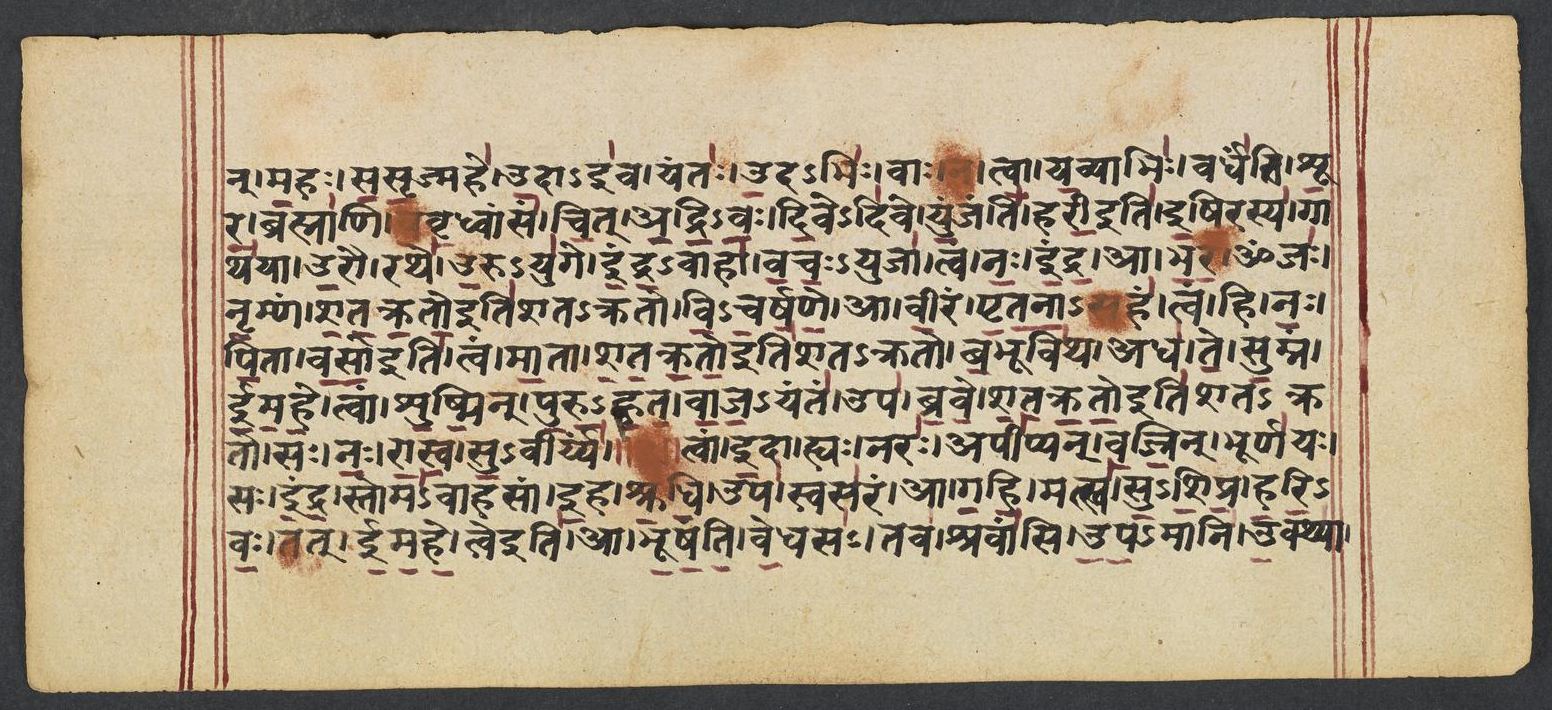
Where on the image
Penn Ms. Coll. 390 Item 41, fol. 662r (numbered 84r by the scribe) (OPenn image 662, lower leaf). Checked on the image: the Rigveda text on this page begins in RV 8.98.7 ‹mahaḥ sasṛjmahe ut eva›. The next page with Rigveda text, fol. 662v (numbered 84v by the scribe), begins in RV 8.99.2 ‹suteṣu indra girvaṇaḥ›. Verses 8.98.7-12 end on this page; 8.98.7 begins on fol. 661v (numbered 83v by the scribe).
7adhā̱ hī̍ndra girvaṇa̱ upa̍ tvā̱ kāmā̍n ma̱haḥ sa̍sṛ̱jmahe̍ | u̱deva̱ yanta̍ u̱dabhi̍ḥ ||
8vār ṇa tvā̍ ya̱vyābhi̱r vardha̍nti śūra̱ brahmā̍ṇi | vā̱vṛ̱dhvāṁsa̍ṁ cid adrivo di̱ve-di̍ve ||
9yu̱ñjanti̱ harī̍ iṣi̱rasya̱ gātha̍yo̱rau ratha̍ u̱ruyu̍ge | i̱ndra̱vāhā̍ vaco̱yujā̍ ||
10tvaṁ na̍ i̱ndrā bha̍ra̱m̐ ojo̍ nṛ̱mṇaṁ śa̍takrato vicarṣaṇe | ā vī̱ram pṛ̍tanā̱ṣaha̍m ||
11tvaṁ hi na̍ḥ pi̱tā va̍so̱ tvam mā̱tā śa̍takrato ba̱bhūvi̍tha | adhā̍ te su̱mnam ī̍mahe ||
12tvāṁ śu̍ṣmin puruhūta vāja̱yanta̱m upa̍ bruve śatakrato | sa no̍ rāsva su̱vīrya̍m ||
Compare: Padapāṭha (word-by-word text written in the manuscript; Sansknet e-text via GRETIL)
7adha | hi | indra | girvaṇaḥ | upa | tvā | kāmān | mahaḥ | sasṛjmahe | ut | eva | yantaḥ | uda-bhiḥ
8vāḥ | na | tvā | yavyābhiḥ | vardhanti | śūra | brahmāṇi | vavṛdhvāṃsam | cit | adri--vaḥ | dive--dive
9yuñjanti | harī iti | iṣirasya | gāthayā | urau | rathe | uru-yuge | indra-vāhā | vacaḥ-yujā
10tvam | naḥ | indra | ā | bhara | ojaḥ | nṛmṇam | śatakrato itiśata-krato | vi-carṣaṇe | ā | vīram | pṛtanāsaham
11tvam | hi | naḥ | pitā | vaso iti | tvam | matā | śatakrato itiśata-krato | babhūvitha | adha | te | sumnam | īmahe
12tvām | śuṣmin | puru-hūta | vājayantam | upa | bruve | śatakrato itiśata-krato | saḥ | naḥ | rāsva | su-vīryam
7Now have we, Indra, Friend of Song, sent our great wishes forth to thee, Coming like floods that follow floods.
8As rivers swell the ocean, so, Hero, our prayers increase thy might. Though of thyself, O Thunderer, waxing day by day.
9With holy song they bind to the broad wide-yoked car the Bay Steeds of the rapid God, Bearers of Indra, yoked by word.
10O Indra, bring great strength to us, bring valour, Ṣatakratu, thou most active, bring A hero conquering in war.
11For, gracious Ṣatakratu, thou hast ever been a Mother and a Sire to us, So now for bliss we pray to thee.
12To thee, Strong, Much-invoked, who showest forth thy strength, O Ṣatakratu, do I speak: So grant thou us heroic strength.
Notes
- Sanskrit: Aufrecht's edition (1877) with the Vedic accents, as entered by van Nooten and Holland (GRETIL).
- English: Ralph T. H. Griffith, The Hymns of the Rigveda (1889-1892; 2nd ed. 1896-1897), from the VedaWeb digital text; OCR slips in that text were corrected against the printed 2nd edition (data/sources/rigveda/griffith_errata.json).
- Padapāṭha (edition text): Sansknet e-text via GRETIL (CC BY-NC-SA 4.0).
Cite
Sources
- Source: Penn Ms. Coll. 390 Item 41 (undated (catalogued with Penn's 18th-19th c. Vedic manuscripts)), OPenn, Public Domain Mark + Aufrecht's accented text (GRETIL) + Griffith's English (VedaWeb) (holding institution)
- Critical edition: Aufrecht (1877), accented e-text via GRETIL
← previous · → next · v cycle view · l back to library