Rigveda 9.107: To Soma
Introduction
Rigveda 9.107 is a hymn of 26 verses addressed to Soma. It stands in book (maṇḍala) 9, the hymns to Soma Pavamāna. The Rigveda is the oldest collection of Sanskrit hymns, composed in the second half of the second millennium BCE and handed down orally for many centuries before it was written down.
The manuscript shown is Penn Ms. Coll. 390 Item 41 (University of Pennsylvania), an undated paper manuscript of the padapāṭha (the word-by-word recitation text, in which every word is written separately and compounds are split) of the whole Ṛgveda in Devanāgarī, 884 leaves in fascicles, 7-9 lines to the page, accents in red; this hymn stands on fol. 735v-737v. Each section below gives the verses that end on one page; the page boundaries were read on the images (the opening words of every page), not counted out. Where the manuscript is a padapāṭha (the word-by-word recitation text), the section shows Aufrecht's continuous (saṃhitā) text first and, as the edition text, the padapāṭha of the same verses, which is the form written on the page.
How was this verified? (Provenance)
Where on the image
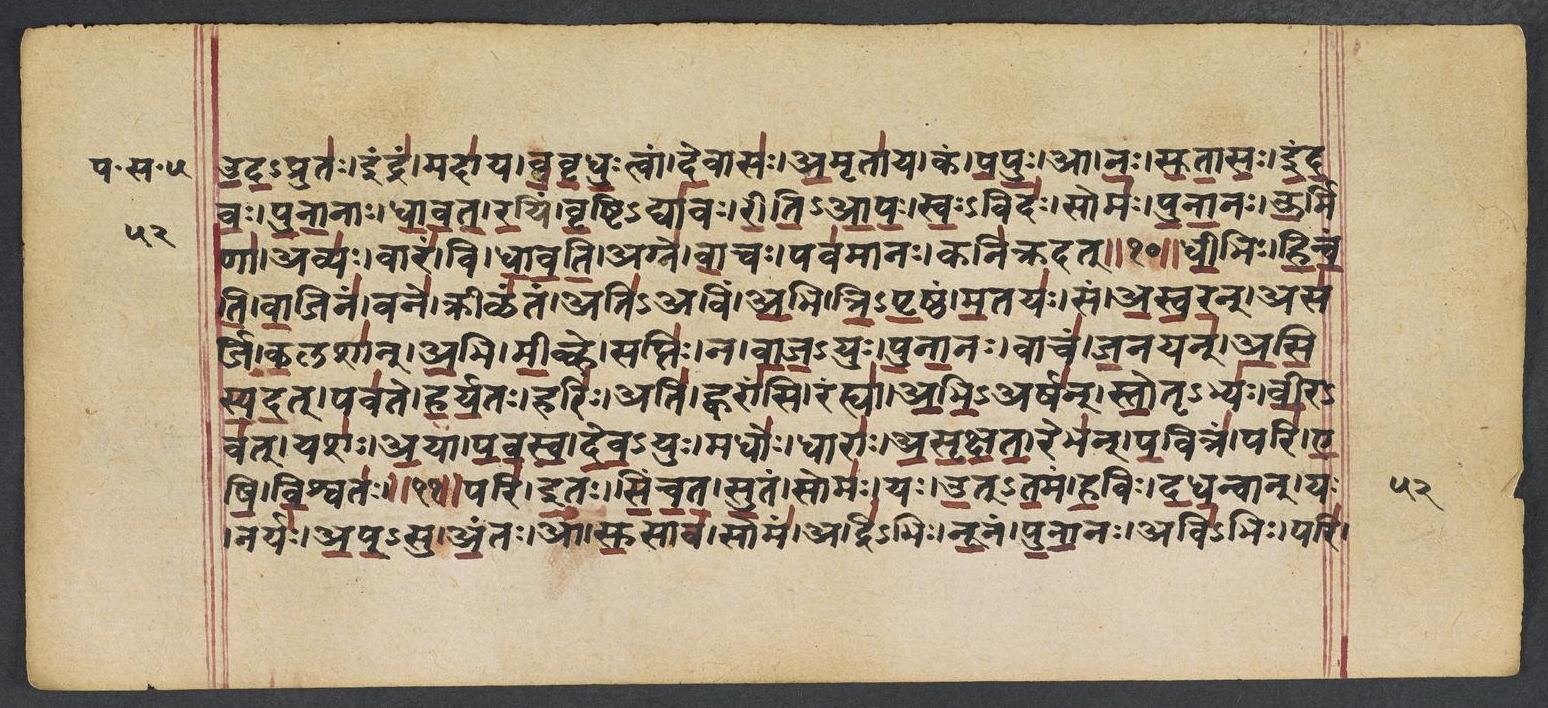
Penn Ms. Coll. 390 Item 41, fol. 735v (numbered 52v by the scribe) (OPenn image 736, upper leaf). Checked on the image: the Rigveda text on this page begins in RV 9.106.8 ‹uda-prutaḥ indram madāya vavṛdhuḥ›. The next page with Rigveda text, fol. 736r (numbered 53r by the scribe), begins in RV 9.107.2 ‹srava adabdhaḥ surabhim-taraḥ sute›. Verse 9.107.1 ends on this page.
1parī̱to ṣi̍ñcatā su̱taṁ somo̱ ya u̍tta̱maṁ ha̱viḥ | da̱dha̱nvām̐ yo naryo̍ a̱psv a1̱̍ntar ā su̱ṣāva̱ soma̱m adri̍bhiḥ ||
Compare: Padapāṭha (word-by-word text written in the manuscript; Sansknet e-text via GRETIL)
1pari | itaḥ | siñcata | sutam | somaḥ | yaḥ | ut-tamam | haviḥ | dadhanvān | yaḥ | naryaḥ | ap-su | antaḥ | ā | susāva | somam | adri-bhiḥ
1HENCE sprinkle forth the juice effused,. Soma, the best of sacred gifts, Who, friend of man, hath run amid the water-streams. He hath pressed Soma out with stones.
Where on the image
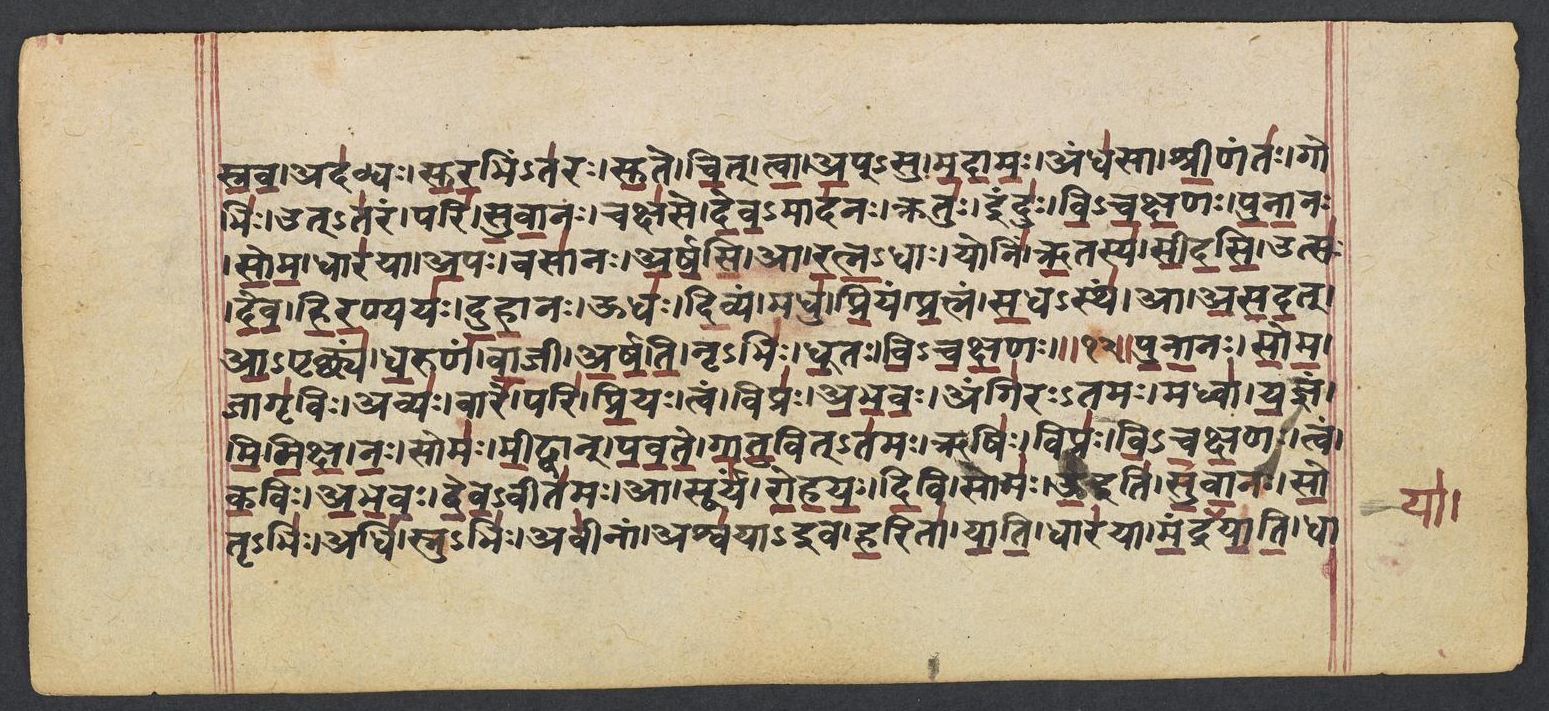
Penn Ms. Coll. 390 Item 41, fol. 736r (numbered 53r by the scribe) (OPenn image 736, lower leaf). Checked on the image: the Rigveda text on this page begins in RV 9.107.2 ‹srava adabdhaḥ surabhim-taraḥ sute›. The next page with Rigveda text, fol. 736v (numbered 53v by the scribe), begins in RV 9.107.8 ‹-dhārayā›. Verses 9.107.2-7 end on this page; 9.107.2 begins on fol. 735v (numbered 52v by the scribe).
2nū̱nam pu̍nā̱no 'vi̍bhi̱ḥ pari̍ sra̱vāda̍bdhaḥ sura̱bhiṁta̍raḥ | su̱te ci̍t tvā̱psu ma̍dāmo̱ andha̍sā śrī̱ṇanto̱ gobhi̱r utta̍ram ||
3pari̍ suvā̱naś cakṣa̍se deva̱māda̍na̱ḥ kratu̱r indu̍r vicakṣa̱ṇaḥ ||
4pu̱nā̱naḥ so̍ma̱ dhāra̍yā̱po vasā̍no arṣasi | ā ra̍tna̱dhā yoni̍m ṛ̱tasya̍ sīda̱sy utso̍ deva hira̱ṇyaya̍ḥ ||
5du̱hā̱na ūdha̍r di̱vyam madhu̍ pri̱yam pra̱tnaṁ sa̱dhastha̱m āsa̍dat | ā̱pṛcchya̍ṁ dha̱ruṇa̍ṁ vā̱jy a̍rṣati̱ nṛbhi̍r dhū̱to vi̍cakṣa̱ṇaḥ ||
6pu̱nā̱naḥ so̍ma̱ jāgṛ̍vi̱r avyo̱ vāre̱ pari̍ pri̱yaḥ | tvaṁ vipro̍ abha̱vo 'ṅgi̍rastamo̱ madhvā̍ ya̱jñam mi̍mikṣa naḥ ||
7somo̍ mī̱ḍhvān pa̍vate gātu̱vitta̍ma̱ ṛṣi̱r vipro̍ vicakṣa̱ṇaḥ | tvaṁ ka̱vir a̍bhavo deva̱vīta̍ma̱ ā sūrya̍ṁ rohayo di̱vi ||
Compare: Padapāṭha (word-by-word text written in the manuscript; Sansknet e-text via GRETIL)
2nūnam | punānaḥ | avi-bhiḥ | pari | srava | adabdhaḥ | surabhim-taraḥ | sute | cit | tvā | ap-su | mādāmaḥ | andhasā | śrīṇantaḥ | gobhiḥ | ut-taram
3pari | suvānaḥ | cakṣase | deva-mādanaḥ | kratuḥ | induḥ | vi-cakṣaṇaḥ
4punānaḥ | soma | dhārayā | apaḥ | vasānaḥ | arṣasi | ā | ratna-dhāḥ | yonim | ṛtasya | sīdasi | utsaḥ | deva | hiraṇyayaḥ
5duhānaḥ | ūdhaḥ | divyam | madhu | priyam | pratnam | sadha-stham | ā | asadat | āpṛcchyam | dharuṇam | vājī | arṣati | nṛ-bhiḥ | dhūtaḥ | vi-cakṣaṇaḥ
6punānaḥ | soma | jāgṛviḥ | avyaḥ | vāre | pari | priyaḥ | tvam | vipraḥ | abhavaḥ | aṅgiraḥ-tamaḥ | madhvā | yajñam | mimikṣa | naḥ
7somaḥ | mīḍhavān | pavate | gātuvit-tamaḥ | ṛṣiḥ | vipraḥ | vi-cakṣaṇaḥ | tvam | kaviḥ | abhavaḥ | deva-vītamaḥ | ā | sūryam | rohayaḥ | divi
2Now, being purified, flow hither through the fleece inviolate and most odorous. We gladden thee in waters when thou art effused, blending thee still with juice and milk.
3Pressed out for all to see, delighting Gods, Indu, Far-sighted One, is mental power.
4Cleansing thee, Soma, in thy stream, thou flowest in a watery robe: Giver of wealth, thou sittest in the place of Law, O God, a fountain made of gold.
5Milking the heavenly udder for dear meath, he hath sat in the ancient gatheringplace. Washed by the men, the Strong Farseeing One streams forth nutriti us food that all desire.
6O Soma, while they cleanse thee, dear and watchful in the sheep's long wool, Thou hast become a Singer most like Angiras: thou madest Sûrya mount to heaven.
7Bountiful, best of furtherers, Soma floweth on, R̥ishi and Singer, keen of sight. Thou hast become a Sage most welcome to the Gods: thou madest Sûrya mount to heaven.
Where on the image
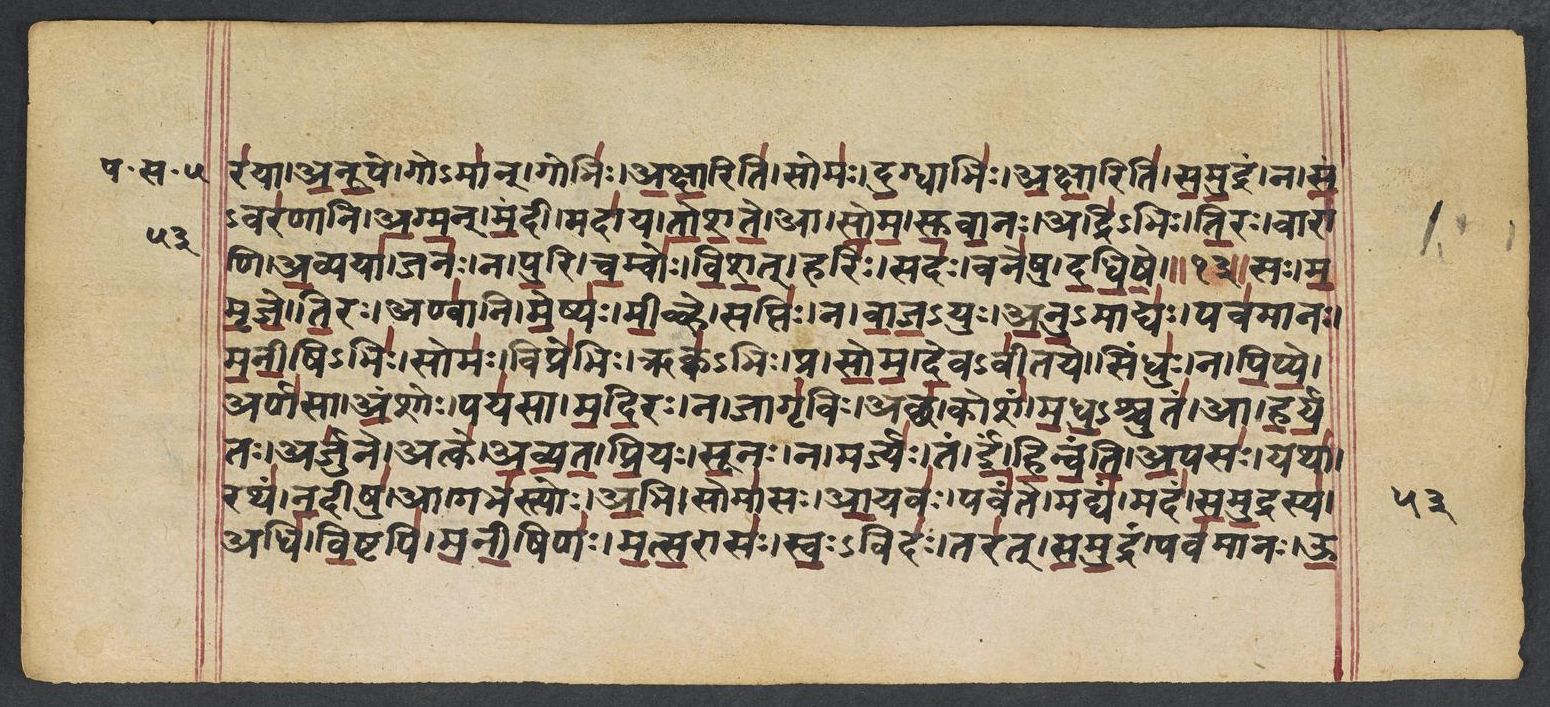
Penn Ms. Coll. 390 Item 41, fol. 736v (numbered 53v by the scribe) (OPenn image 737, upper leaf). Checked on the image: the Rigveda text on this page begins in RV 9.107.8 ‹-dhārayā›. The next page with Rigveda text, fol. 737r (numbered 54r by the scribe), begins in RV 9.107.15 ‹-ūrmiṇā rājā devaḥ ṛtam›. Verses 9.107.8-14 end on this page; 9.107.8 begins on fol. 736r (numbered 53r by the scribe).
8soma̍ u ṣuvā̱ṇaḥ so̱tṛbhi̱r adhi̱ ṣṇubhi̱r avī̍nām | aśva̍yeva ha̱ritā̍ yāti̱ dhāra̍yā ma̱ndrayā̍ yāti̱ dhāra̍yā ||
9a̱nū̱pe gomā̱n gobhi̍r akṣā̱ḥ somo̍ du̱gdhābhi̍r akṣāḥ | sa̱mu̱draṁ na sa̱ṁvara̍ṇāny agman ma̱ndī madā̍ya tośate ||
10ā so̍ma suvā̱no adri̍bhis ti̱ro vārā̍ṇy a̱vyayā̍ | jano̱ na pu̱ri ca̱mvo̍r viśa̱d dhari̱ḥ sado̱ vane̍ṣu dadhiṣe ||
11sa mā̍mṛje ti̱ro aṇvā̍ni me̱ṣyo̍ mī̱ḻhe sapti̱r na vā̍ja̱yuḥ | a̱nu̱mādya̱ḥ pava̍māno manī̱ṣibhi̱ḥ somo̱ vipre̍bhi̱r ṛkva̍bhiḥ ||
12pra so̍ma de̱vavī̍taye̱ sindhu̱r na pi̍pye̱ arṇa̍sā | a̱ṁśoḥ paya̍sā madi̱ro na jāgṛ̍vi̱r acchā̱ kośa̍m madhu̱ścuta̍m ||
13ā ha̍rya̱to arju̍ne̱ atke̍ avyata pri̱yaḥ sū̱nur na marjya̍ḥ | tam ī̍ṁ hinvanty a̱paso̱ yathā̱ ratha̍ṁ na̱dīṣv ā gabha̍styoḥ ||
14a̱bhi somā̍sa ā̱yava̱ḥ pava̍nte̱ madya̱m mada̍m | sa̱mu̱drasyādhi̍ vi̱ṣṭapi̍ manī̱ṣiṇo̍ matsa̱rāsa̍ḥ sva̱rvida̍ḥ ||
Compare: Padapāṭha (word-by-word text written in the manuscript; Sansknet e-text via GRETIL)
8somaḥ | oṃ iti | suvānaḥ | sotṛ-bhiḥ | adhi | snu-bhiḥ | avīnām | aśvayā-iva | haritā | yāti | dhārayā | mandrayā | yāti | dhārayā
9anūpe | go-mān | gobhiḥ | akṣāriti | somaḥ | dugdhābhiḥ | akṣāriti | samudram | na | sam-varaṇāni | agman | mandī | madāya | tośate
10ā | soma | suvānaḥ | adri-bhiḥ | tiraḥ | vārāṇi | avyayā | janaḥ | na | puri | camvoḥ | viśat | hariḥ | sadaḥ | vaneṣu | dadhiṣe
11saḥ | mamṛje | tiraḥ | aṇvāni | meṣyaḥ | mīḷhe | saptiḥ | na | vāja-yuḥ | anu-mādyaḥ | pavamānaḥ | manīṣi-bhiḥ | somaḥ | viprebhiḥ | ṛkva-bhiḥ
12pra | soma | deva-vītaye | sindhuḥ | na | pipye | arṇasā | aṃśoḥ | payasā | madi raḥ | na | jāgṛviḥ | acchā | kośam | madhu-ścutam
13ā | haryataḥ | arjune | atke | avyata | priyaḥ | sūnuḥ | na | marjyaḥ | tam | īm | hinvanti | apasaḥ | yathā | ratham | nadīṣu | ā | gabhastyoḥ
14abhi | somāsaḥ | āyavaḥ | pavante | madyam | madam | samudrasya | adhi | viṣṭapi | manīṣiṇaḥ | matsarāsaḥ | svaḥ-vidaḥ
8Pressed out by pressers, Soma goes over the fleecy backs of sheep, Goes, even as with a mare, in tawnycoloured stream, goes in exhilarating stream.
9Down to the water-Soma, rich in kine hath flowed with cows, with cows that have been milked. They have approached the mixing-vessel as a sea: the cheerer streams for the carouse.
10Effused by stones, O Soma, and urged through the long wool of the sheep, Thou, entering the saucers as a man the fort, gold-hued hast settled in the wood.
11He beautifies himself through the sheep's long fine wool, like an impetuous steed in war, Even Soma Pavamâna who shall be the joy of sages and of holy bards.
12O Soma,– for the feast of Gods, river-like he hath swelled with surge, With the stalk's juice, exhilarating, resting not, into the vat that drops with meath.
13Like a dear son who must be decked, the Lovely One hath clad him in a shining robe. Men skilful at their work drive him forth, like a car, into the rivers from their bands.
14The living drops of Soma juice pour, as they flow, the gladdening drink, Intelligent drops above the basin of the sea, exhilarating, finding light.
Where on the image
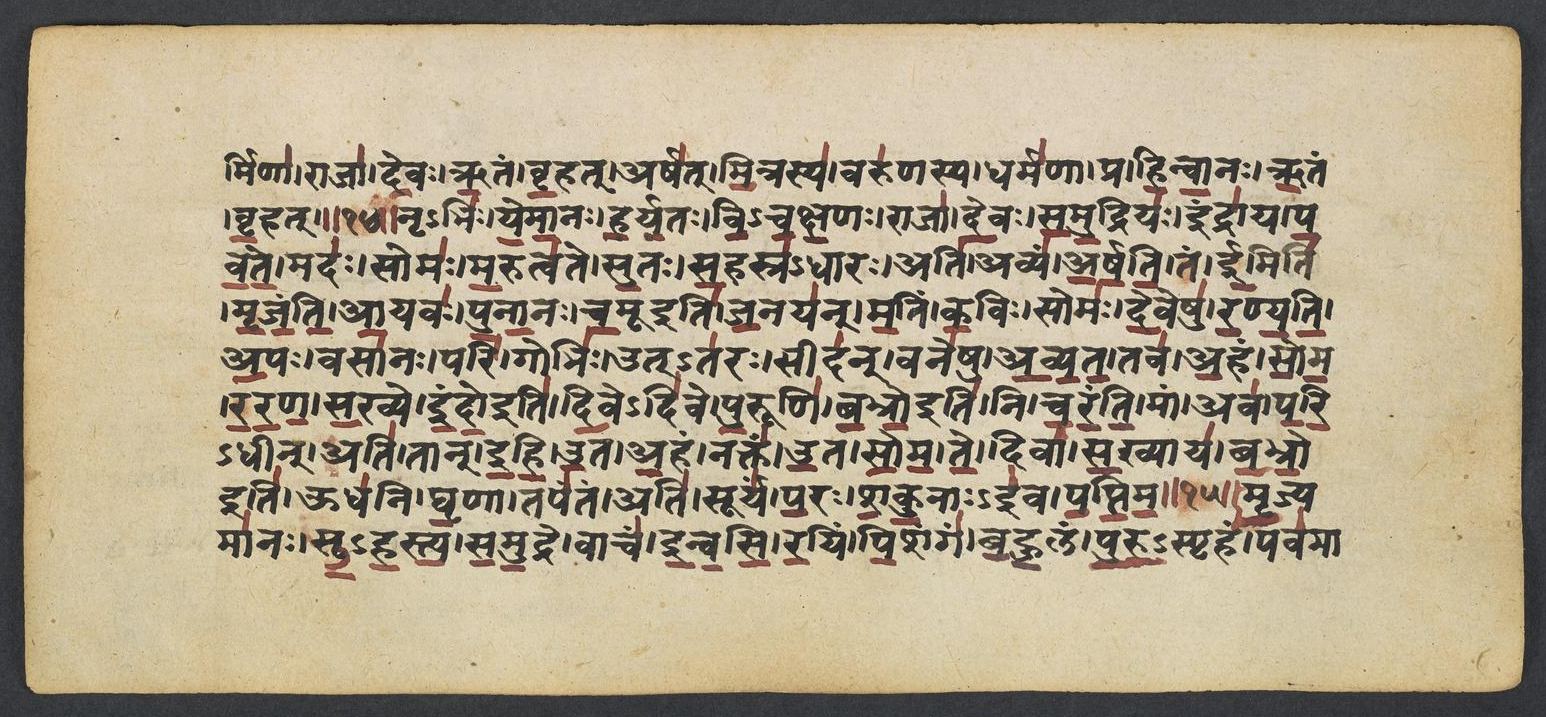
Penn Ms. Coll. 390 Item 41, fol. 737r (numbered 54r by the scribe) (OPenn image 737, lower leaf). Checked on the image: the Rigveda text on this page begins in RV 9.107.15 ‹-ūrmiṇā rājā devaḥ ṛtam›. The next page with Rigveda text, fol. 737v (numbered 54v by the scribe), begins in RV 9.107.21 ‹-pavamāna abhi arṣasi›. Verses 9.107.15-20 end on this page; 9.107.15 begins on fol. 736v (numbered 53v by the scribe).
15tara̍t samu̱dram pava̍māna ū̱rmiṇā̱ rājā̍ de̱va ṛ̱tam bṛ̱hat | arṣa̍n mi̱trasya̱ varu̍ṇasya̱ dharma̍ṇā̱ pra hi̍nvā̱na ṛ̱tam bṛ̱hat ||
16nṛbhi̍r yemā̱no ha̍rya̱to vi̍cakṣa̱ṇo rājā̍ de̱vaḥ sa̍mu̱driya̍ḥ ||
17indrā̍ya pavate̱ mada̱ḥ somo̍ ma̱rutva̍te su̱taḥ | sa̱hasra̍dhāro̱ aty avya̍m arṣati̱ tam ī̍ mṛjanty ā̱yava̍ḥ ||
18pu̱nā̱naś ca̱mū ja̱naya̍n ma̱tiṁ ka̱viḥ somo̍ de̱veṣu̍ raṇyati | a̱po vasā̍na̱ḥ pari̱ gobhi̱r utta̍ra̱ḥ sīda̱n vane̍ṣv avyata ||
19tavā̱haṁ so̍ma rāraṇa sa̱khya i̍ndo di̱ve-di̍ve | pu̱rūṇi̍ babhro̱ ni ca̍ranti̱ mām ava̍ pari̱dhīm̐r ati̱ tām̐ i̍hi ||
20u̱tāhaṁ nakta̍m u̱ta so̍ma te̱ divā̍ sa̱khyāya̍ babhra̱ ūdha̍ni | ghṛ̱ṇā tapa̍nta̱m ati̱ sūrya̍m pa̱raḥ śa̍ku̱nā i̍va paptima ||
Compare: Padapāṭha (word-by-word text written in the manuscript; Sansknet e-text via GRETIL)
15tarat | samudram | pavamānaḥ | ūrmiṇā | rājā | devaḥ | ṛtam | bṛhat | arṣat | mitrasya | varuṇasya | dharmaṇā | pra | hinvānaḥ | ṛtam | bṛhat
16nṛ-bhiḥ | yemānaḥ | haryataḥ | vi-cakṣaṇaḥ | rājā | devaḥ | samudriyaḥ
17indrāya | pavate | madaḥ | somaḥ | marutvate | sutaḥ | sahasra-dhāraḥ | ati | avyam | arṣati | tam | īm iti | mṛjanti | āyavaḥ
18punānaḥ | camū iti | janayan | matim | kaviḥ | somaḥ | deveṣu | raṇyati | apaḥ | vasānaḥ | pari | gobhiḥ | ut-taraḥ | sīdan | vaneṣu | avyata
19tava | aham | soma | raraṇa | sakhye | indo iti | dive-dive | purūṇi | babhro iti | ni | caranti | mām | ava | pari-dhīn | ati | tān | ihi
20uta | aham | naktam | uta | soma | te | divā | sakhyāya | babhro iti | ūdhani | ghṛṇā | tapantam | ati | sūryam | paraḥ | śakunāḥ-iva | paptima
15May Pavamâna, King and God, speed with his wave over the sea the lofty rite: May he by Mitra's and by Varuṇa's decree flow furthering the lofty rite.
16Far-seeing, lovely, guided by the men, the God whose home is in the sea-
17Soma, the gladdening juice, flows pressed for Indra with his Marut host: He hastens o'er the fleece with all his thousand streams: men make him bright and beautiful.
18Purified in the bowl and gendering the hymn, wise Soma joys among the Gods. Robed in the flood, the Mighty One hath clad himself with milk and settled in the vats.
19O Soma, Indu, every day thy friendship hath been my delight. Many fiends follow me; help me, thou Tawny-hued; pass on beyond these barriers.
20Close to thy bosom am I, Soma, day and night. O Tawny-hued, for friendship sake. Sûrya himself refulgent with his glow have we o'ertaken in his course like birds.
Where on the image
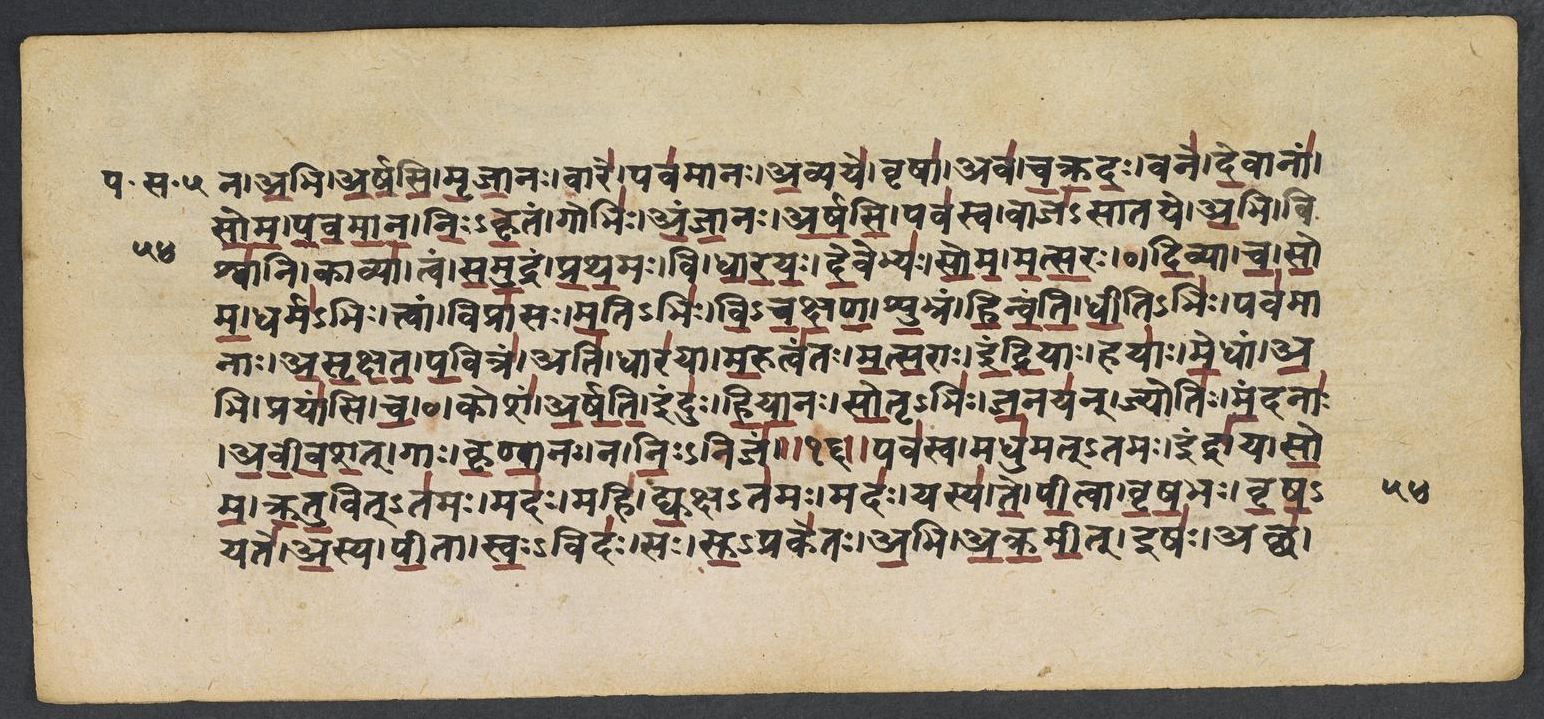
Penn Ms. Coll. 390 Item 41, fol. 737v (numbered 54v by the scribe) (OPenn image 738, upper leaf). Checked on the image: the Rigveda text on this page begins in RV 9.107.21 ‹-pavamāna abhi arṣasi›. The next page with Rigveda text, fol. 738r (numbered 55r by the scribe), begins in RV 9.108.2 ‹vājam na etaśaḥ›. Verses 9.107.21-26 end on this page; 9.107.21 begins on fol. 737r (numbered 54r by the scribe).
21mṛ̱jyamā̍naḥ suhastya samu̱dre vāca̍m invasi | ra̱yim pi̱śaṅga̍m bahu̱lam pu̍ru̱spṛha̱m pava̍mānā̱bhy a̍rṣasi ||
22mṛ̱jā̱no vāre̱ pava̍māno a̱vyaye̱ vṛṣāva̍ cakrado̱ vane̍ | de̱vānā̍ṁ soma pavamāna niṣkṛ̱taṁ gobhi̍r añjā̱no a̍rṣasi ||
23pava̍sva̱ vāja̍sātaye̱ 'bhi viśvā̍ni̱ kāvyā̍ | tvaṁ sa̍mu̱dram pra̍tha̱mo vi dhā̍rayo de̱vebhya̍ḥ soma matsa̱raḥ ||
24sa tū pa̍vasva̱ pari̱ pārthi̍va̱ṁ rajo̍ di̱vyā ca̍ soma̱ dharma̍bhiḥ | tvāṁ viprā̍so ma̱tibhi̍r vicakṣaṇa śu̱bhraṁ hi̍nvanti dhī̱tibhi̍ḥ ||
25pava̍mānā asṛkṣata pa̱vitra̱m ati̱ dhāra̍yā | ma̱rutva̍nto matsa̱rā i̍ndri̱yā hayā̍ me̱dhām a̱bhi prayā̍ṁsi ca ||
26a̱po vasā̍na̱ḥ pari̱ kośa̍m arṣa̱tīndu̍r hiyā̱naḥ so̱tṛbhi̍ḥ | ja̱naya̱ñ jyoti̍r ma̱ndanā̍ avīvaśa̱d gāḥ kṛ̍ṇvā̱no na ni̱rṇija̍m ||
Compare: Padapāṭha (word-by-word text written in the manuscript; Sansknet e-text via GRETIL)
21mṛjyamānaḥ | su-hastya | samudre | vācam | invasi | rayim | piśaṅgam | bahulam | puru-spṛham | pavamāna | abhi | arṣasi
22mṛjānaḥ | vāre | pavamānaḥ | avyaye | vṛṣā | ava | cakradaḥ | vane | devānām | soma | pavamāna | niḥ-kṛtam | gobhiḥ | añjānaḥ | arṣasi
23pavasva | vāja-sātaye | abhi | viśvāni | kāvyā | tvam | samudram | prathamaḥ | vi | dhārayaḥ | devebhyaḥ | soma | matsaraḥ
24saḥ | tu | pavasva | pari | pārthivam | rajaḥ | divyā | ca | soma | dharma-bhiḥ | tvām | viprāsaḥ | mati-bhiḥ | vi-cakṣaṇa | śubhram | hinvanti | dhīti-bhiḥ
25pavamānāḥ | asṛkṣata | pavitram | ati | dhārayā | marutvantaḥ | matsarāḥ | indriyāḥ | hayāḥ | medhām | abhi | prayāṃsi | ca
26apaḥ | vasānaḥ | pari | kośam | arṣati | induḥ | hiyānaḥ | sotṛ-bhiḥ | janayan | jyotiḥ | mandanāḥ | avīvaśat | gāḥ | kṛṇvānaḥ | na | niḥ-nijam
21Deft-handcd! thou when purified liftest thy voice amid the sea. Thou, Pavamâna, makest riches flow to us, yellow, abundant, much-desifed.
22Making thee pure and bright in the sheep's long wool, thou hast bellowed, steerlike, in the wood. Thou flowest, Soma Pavamâna, balmed with milk unto the special place of Gods.
23Flow on to win us strength, flow on to lofty lore of every kind. Thou, Soma, as Exhilarator wast the first to spread the sea abroad for Gods.
24Flow to the realm of earth, flow to the realm of heaven, O Soma, in thy righteous ways. Fair art thou whom the sages, O Far-seeing One, urge onward with their songs and hymns.
25Over the cleansing sieve have flowed the Pavamânas in a stream, Girt by the Maruts, gladdening, Steeds with Indra's stiength, for wisdom and for dainty food.
26Urged onward by the pressers, clad in watery robes, Indu is speeding to the vat. He gendering light, hath made the glad Cows low, while he takes them as his garb of state.
Notes
- Sanskrit: Aufrecht's edition (1877) with the Vedic accents, as entered by van Nooten and Holland (GRETIL).
- English: Ralph T. H. Griffith, The Hymns of the Rigveda (1889-1892; 2nd ed. 1896-1897), from the VedaWeb digital text; OCR slips in that text were corrected against the printed 2nd edition (data/sources/rigveda/griffith_errata.json).
- Padapāṭha (edition text): Sansknet e-text via GRETIL (CC BY-NC-SA 4.0).
Cite
Sources
- Source: Penn Ms. Coll. 390 Item 41 (undated (catalogued with Penn's 18th-19th c. Vedic manuscripts)), OPenn, Public Domain Mark + Aufrecht's accented text (GRETIL) + Griffith's English (VedaWeb) (holding institution)
- Critical edition: Aufrecht (1877), accented e-text via GRETIL
← previous · → next · v cycle view · l back to library