Rigveda 9.78: To Soma
Introduction
Rigveda 9.78 is a hymn of 5 verses addressed to Soma. It stands in book (maṇḍala) 9, the hymns to Soma Pavamāna. The Rigveda is the oldest collection of Sanskrit hymns, composed in the second half of the second millennium BCE and handed down orally for many centuries before it was written down.
The manuscript shown is Penn Ms. Coll. 390 Item 41 (University of Pennsylvania), an undated paper manuscript of the padapāṭha (the word-by-word recitation text, in which every word is written separately and compounds are split) of the whole Ṛgveda in Devanāgarī, 884 leaves in fascicles, 7-9 lines to the page, accents in red; this hymn stands on fol. 708r-708v. Each section below gives the verses that end on one page; the page boundaries were read on the images (the opening words of every page), not counted out. Where the manuscript is a padapāṭha (the word-by-word recitation text), the section shows Aufrecht's continuous (saṃhitā) text first and, as the edition text, the padapāṭha of the same verses, which is the form written on the page.
How was this verified? (Provenance)
Where on the image
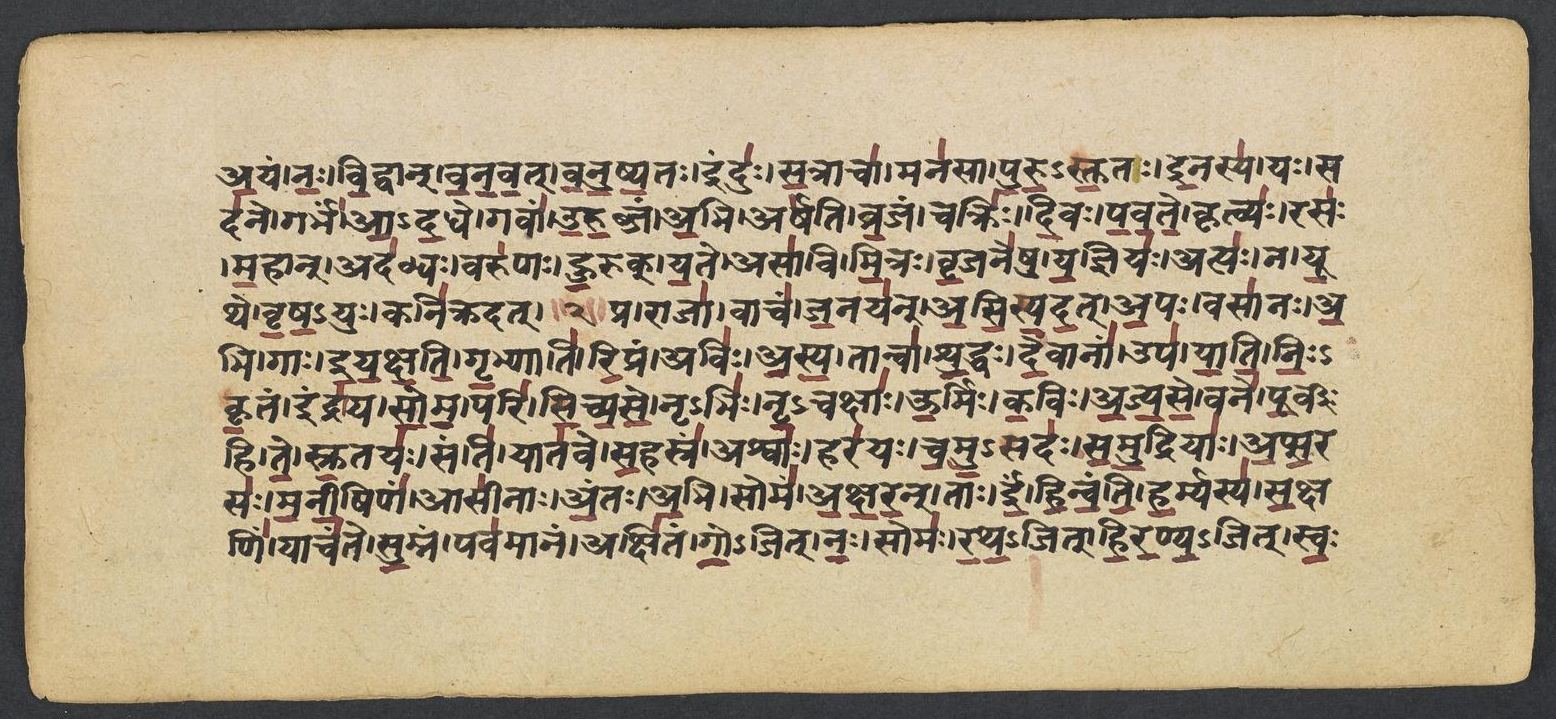
Penn Ms. Coll. 390 Item 41, fol. 708r (numbered 25r by the scribe) (OPenn image 708, lower leaf). Checked on the image: the Rigveda text on this page begins in RV 9.77.4 ‹ayam naḥ vidvān vanavat›. The next page with Rigveda text, fol. 708v (numbered 25v by the scribe), begins in RV 9.78.4 ‹-svaḥ-jit ap-jit pavate sahasra-jit›. Verses 9.78.1-3 end on this page.
1pra rājā̱ vāca̍ṁ ja̱naya̍nn asiṣyadad a̱po vasā̍no a̱bhi gā i̍yakṣati | gṛ̱bhṇāti̍ ri̱pram avi̍r asya̱ tānvā̍ śu̱ddho de̱vānā̱m upa̍ yāti niṣkṛ̱tam ||
2indrā̍ya soma̱ pari̍ ṣicyase̱ nṛbhi̍r nṛ̱cakṣā̍ ū̱rmiḥ ka̱vir a̍jyase̱ vane̍ | pū̱rvīr hi te̍ sru̱taya̱ḥ santi̱ yāta̍ve sa̱hasra̱m aśvā̱ hara̍yaś camū̱ṣada̍ḥ ||
3sa̱mu̱driyā̍ apsa̱raso̍ manī̱ṣiṇa̱m āsī̍nā a̱ntar a̱bhi soma̍m akṣaran | tā ī̍ṁ hinvanti ha̱rmyasya̍ sa̱kṣaṇi̱ṁ yāca̍nte su̱mnam pava̍māna̱m akṣi̍tam ||
Compare: Padapāṭha (word-by-word text written in the manuscript; Sansknet e-text via GRETIL)
1pra | rājā | vācam | janayan | asisyadat | apaḥ | vasānaḥ | abhi | gāḥ | iyakṣati | gṛbhṇāti | ripram | aviḥ | asya | tānvā | śuddhaḥ | devānām | upa | yāti | niḥ-kṛtam
2indrāya | soma | pari | sicyase | nṛ-bhiḥ | nṛ-cakṣāḥ | ūrmiḥ | kaviḥ | ajyase | vane | pūrvīḥ | hi | te | srutayaḥ | santi | yātave | sahasram | aśvāḥ | harayaḥ | camū-sadaḥ
3samudriyāḥ | apsarasaḥ | manīṣiṇam | āsīnāḥ | antaḥ | abhi | somam | akṣaran | tāḥ | īm | hinvanti | harmyasya | sakṣaṇim | yācante | sumnam | pavamānam | akṣitam
1RAISING his voice the King hath flowed upon his way: invested with the waters he would win the kine. The fleece retains his solid parts as though impure, and bright and cleansed he seeks the special place of Gods.
2Thou, Soma, art effused for Indra by the men, balmed in the wood as wave, Sage, Viewer of mankind. Full many are the paths whereon thou mayest go: a thousand bay steeds hast thou resting in the bowls.
3Apsarases who dwell in waters of the sea, sitting within, have flowed to Soma wise of heart. They urge the Master of the house upon his way, and to the Eternal Pavamâna pray for bliss.
Where on the image
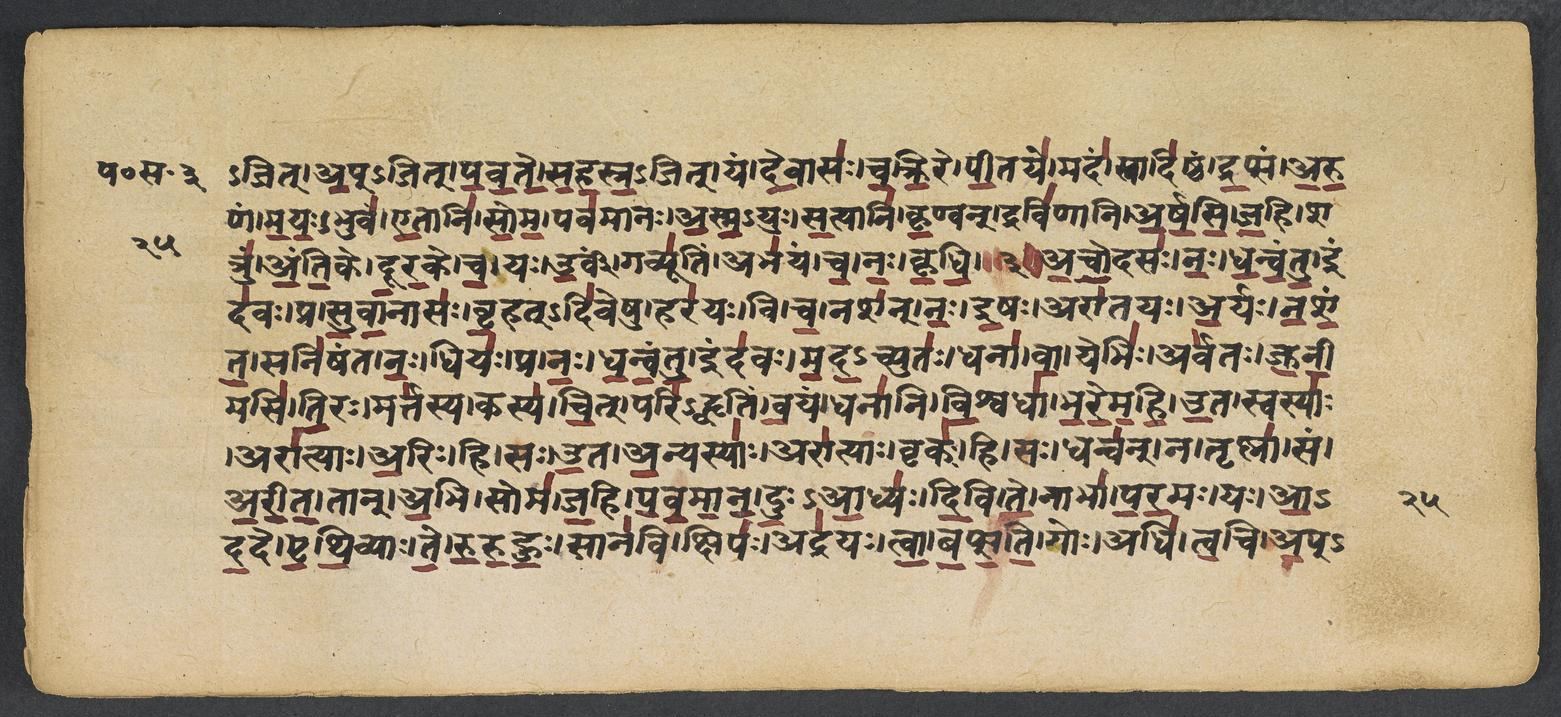
Penn Ms. Coll. 390 Item 41, fol. 708v (numbered 25v by the scribe) (OPenn image 709, upper leaf). Checked on the image: the Rigveda text on this page begins in RV 9.78.4 ‹-svaḥ-jit ap-jit pavate sahasra-jit›. The next page with Rigveda text, fol. 709r (numbered 26r by the scribe), begins in RV 9.79.4 ‹-ap-su tvā hastaiḥ duduhuḥ›. Verses 9.78.4-5 end on this page; 9.78.4 begins on fol. 708r (numbered 25r by the scribe).
4go̱jin na̱ḥ somo̍ ratha̱jid dhi̍raṇya̱jit sva̱rjid a̱bjit pa̍vate sahasra̱jit | yaṁ de̱vāsa̍ś cakri̱re pī̱taye̱ mada̱ṁ svādi̍ṣṭhaṁ dra̱psam a̍ru̱ṇam ma̍yo̱bhuva̍m ||
5e̱tāni̍ soma̱ pava̍māno asma̱yuḥ sa̱tyāni̍ kṛ̱ṇvan dravi̍ṇāny arṣasi | ja̱hi śatru̍m anti̱ke dū̍ra̱ke ca̱ ya u̱rvīṁ gavyū̍ti̱m abha̍yaṁ ca nas kṛdhi ||
Compare: Padapāṭha (word-by-word text written in the manuscript; Sansknet e-text via GRETIL)
4go-jit | naḥ | somaḥ | ratha-jit | hiraṇya-jit | svaḥ-jit | ap-jit | pavate | sahasra-jit | yam | devāsaḥ | cakrire | pītaye | madam | svādiṣṭham | drapsam | aruṇam | mayaḥ-bhuvam
5etāni | soma | pavamānaḥ | asma-yuḥ | satyāni | kṛṇvan | draviṇāni | arṣasi | jahi | śatrum | antike | dūrake | ca | yaḥ | urvīm | gavyūtim | abhayam | ca | naḥ | kṛdhi
4Soma flows on for u's as winner of the kine, winner of thousands, cars, water, and light, and gold; He whom the Gods have made a gladdening draught to drink, the drop most sweet to taste, wealbringing, red of hue.
5Soma, as Pavamâna thou, our faithful Friend, making for us these real treasures, flowest on. Slay thou the enemy both near and,far away: grant us security and ample pasturage.
Notes
- Sanskrit: Aufrecht's edition (1877) with the Vedic accents, as entered by van Nooten and Holland (GRETIL).
- English: Ralph T. H. Griffith, The Hymns of the Rigveda (1889-1892; 2nd ed. 1896-1897), from the VedaWeb digital text; OCR slips in that text were corrected against the printed 2nd edition (data/sources/rigveda/griffith_errata.json).
- Padapāṭha (edition text): Sansknet e-text via GRETIL (CC BY-NC-SA 4.0).
Cite
Sources
- Source: Penn Ms. Coll. 390 Item 41 (undated (catalogued with Penn's 18th-19th c. Vedic manuscripts)), OPenn, Public Domain Mark + Aufrecht's accented text (GRETIL) + Griffith's English (VedaWeb) (holding institution)
- Critical edition: Aufrecht (1877), accented e-text via GRETIL
← previous · → next · v cycle view · l back to library