Rigveda 9.79: To Soma
Introduction
Rigveda 9.79 is a hymn of 5 verses addressed to Soma. It stands in book (maṇḍala) 9, the hymns to Soma Pavamāna. The Rigveda is the oldest collection of Sanskrit hymns, composed in the second half of the second millennium BCE and handed down orally for many centuries before it was written down.
The manuscript shown is Penn Ms. Coll. 390 Item 41 (University of Pennsylvania), an undated paper manuscript of the padapāṭha (the word-by-word recitation text, in which every word is written separately and compounds are split) of the whole Ṛgveda in Devanāgarī, 884 leaves in fascicles, 7-9 lines to the page, accents in red; this hymn stands on fol. 708v-709r. Each section below gives the verses that end on one page; the page boundaries were read on the images (the opening words of every page), not counted out. Where the manuscript is a padapāṭha (the word-by-word recitation text), the section shows Aufrecht's continuous (saṃhitā) text first and, as the edition text, the padapāṭha of the same verses, which is the form written on the page.
How was this verified? (Provenance)
Where on the image
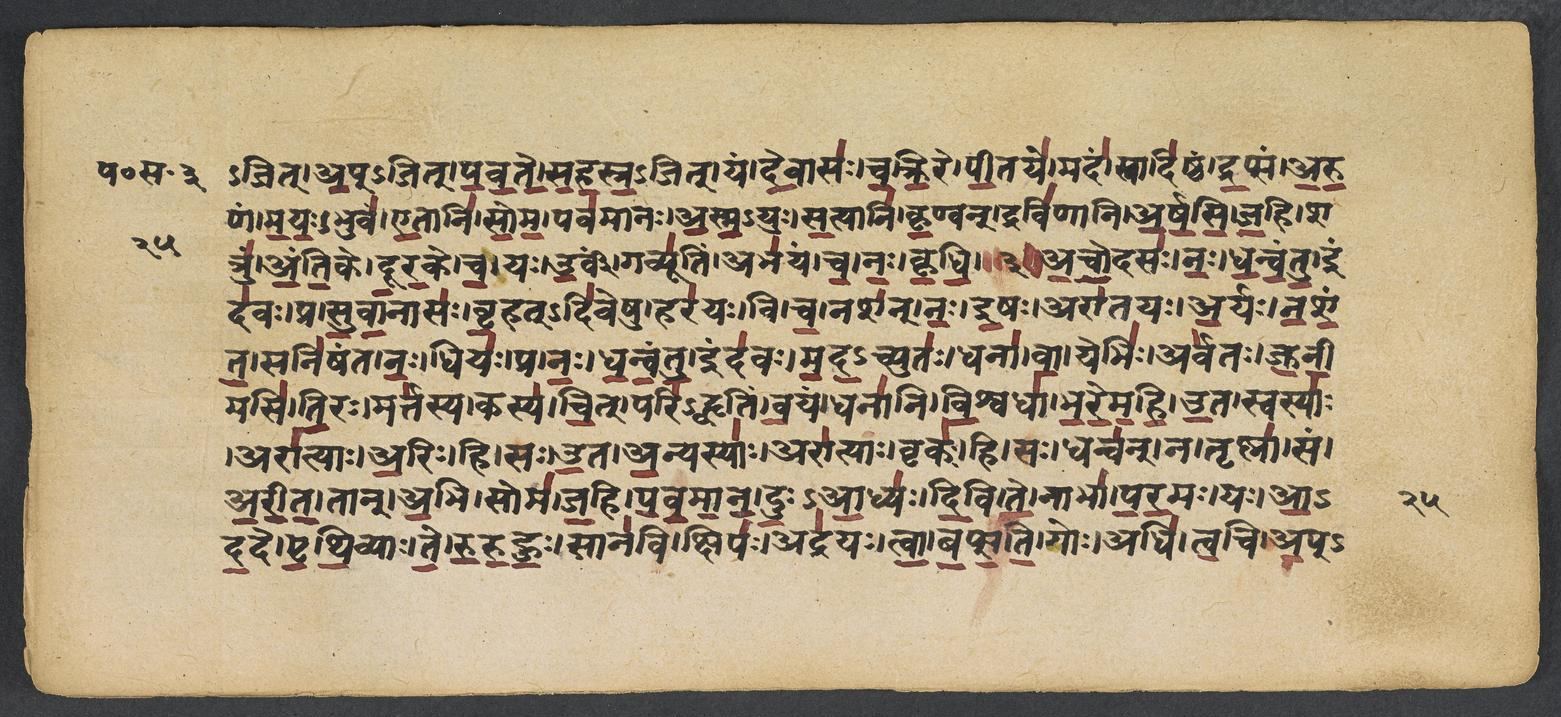
Penn Ms. Coll. 390 Item 41, fol. 708v (numbered 25v by the scribe) (OPenn image 709, upper leaf). Checked on the image: the Rigveda text on this page begins in RV 9.78.4 ‹-svaḥ-jit ap-jit pavate sahasra-jit›. The next page with Rigveda text, fol. 709r (numbered 26r by the scribe), begins in RV 9.79.4 ‹-ap-su tvā hastaiḥ duduhuḥ›. Verses 9.79.1-3 end on this page.
1a̱co̱daso̍ no dhanva̱ntv inda̍va̱ḥ pra su̍vā̱nāso̍ bṛ̱haddi̍veṣu̱ hara̍yaḥ | vi ca̱ naśa̍n na i̱ṣo arā̍tayo̱ 'ryo na̍śanta̱ sani̍ṣanta no̱ dhiya̍ḥ ||
2pra ṇo̍ dhanva̱ntv inda̍vo mada̱cyuto̱ dhanā̍ vā̱ yebhi̱r arva̍to junī̱masi̍ | ti̱ro marta̍sya̱ kasya̍ ci̱t pari̍hvṛtiṁ va̱yaṁ dhanā̍ni vi̱śvadhā̍ bharemahi ||
3u̱ta svasyā̱ arā̍tyā a̱rir hi ṣa u̱tānyasyā̱ arā̍tyā̱ vṛko̱ hi ṣaḥ | dhanva̱n na tṛṣṇā̱ sam a̍rīta̱ tām̐ a̱bhi soma̍ ja̱hi pa̍vamāna durā̱dhya̍ḥ ||
Compare: Padapāṭha (word-by-word text written in the manuscript; Sansknet e-text via GRETIL)
1acodasaḥ | naḥ | dhanvantu | indavaḥ | pra | suvānāsaḥ | bṛhat-diveṣu | harayaḥ | vi | ca | naśan | naḥ | iṣaḥ | arātayaḥ | aryaḥ | naśanta | saniṣanta | naḥ | dhiyaḥ
2pra | naḥ | dhanvantu | indavaḥ | mada-cyutaḥ | dhanā | vā | yebhiḥ | arvataḥ | junīmasi | tiraḥ | martasya | kasya | cit | pari-hvṛtim | vayam | dhanāni | viśva-dhā | bharemahi
3uta | svasyāḥ | arātyāḥ | ariḥ | hi | saḥ | uta | anyasyāḥ | arātyāḥ | vṛkaḥ | hi | saḥ | dhanvan | na | tṛṣṇā | sam | arīta | tān | abhi | soma | jahi | pavamāna | duḥ-ādhyaḥ
1SPONTANEOUS let our drops of Soma juice flow on, pressed, golden-hued, among the Gods of lofty heaven. Perish among us they who give no gifts of food! perish the godless! May our prayers obtain success.
2Forward to us the drops, distilling meath, shall flow, like riches for whose sake we urge the horses on. Beyond the crafty hindering of all mortal men may we continually bear precious wealth away.
3Yea, verily, foe of hate shown to himself is he, yea, verity, destroyer too of other hate. As thirst subdueth in the desert, conquer thou, O Soma Pavarnana, men of evil thoughts.
Where on the image
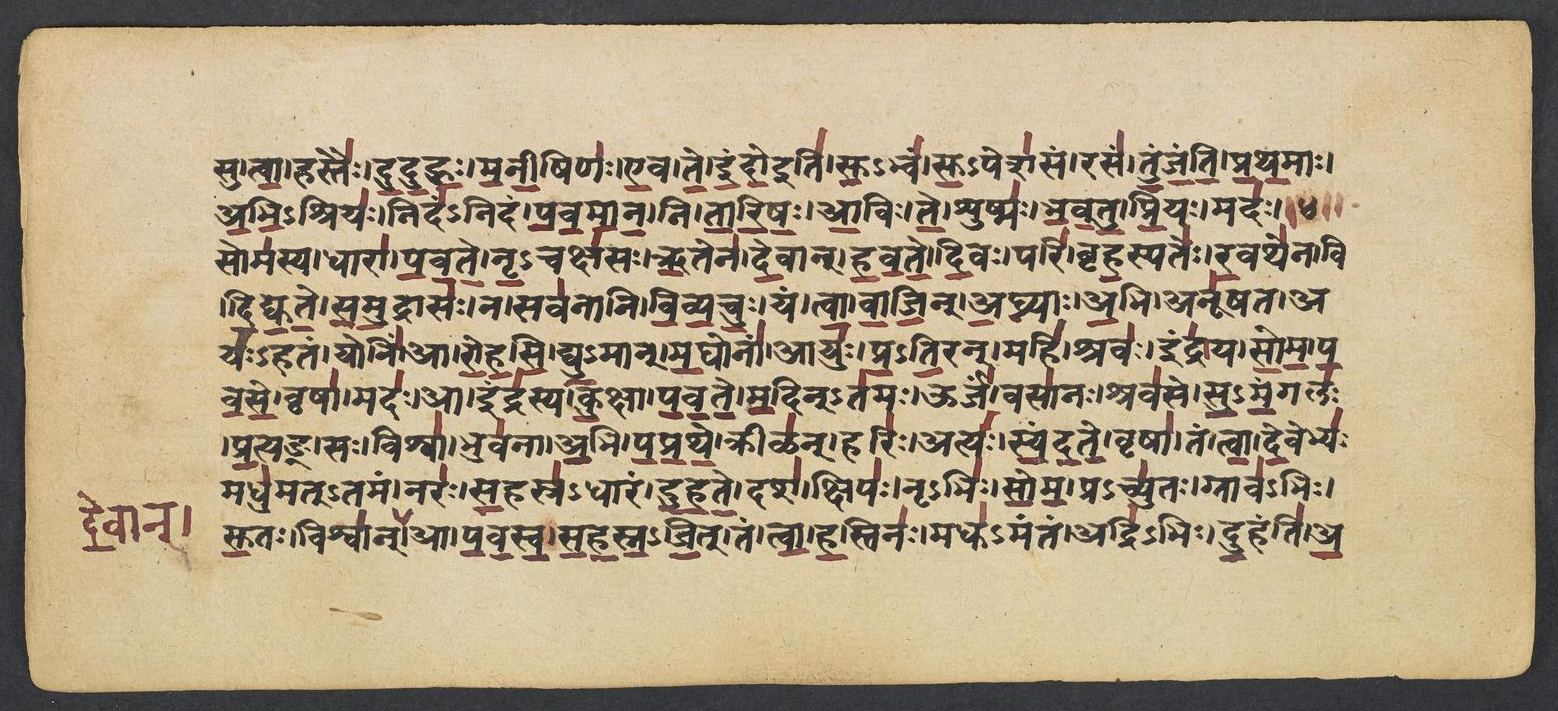
Penn Ms. Coll. 390 Item 41, fol. 709r (numbered 26r by the scribe) (OPenn image 709, lower leaf). Checked on the image: the Rigveda text on this page begins in RV 9.79.4 ‹-ap-su tvā hastaiḥ duduhuḥ›. The next page with Rigveda text, fol. 709v (numbered 26v by the scribe), begins in RV 9.80.5 ‹-ap-su vṛṣabham daśa kṣipaḥ›. Verses 9.79.4-5 end on this page; 9.79.4 begins on fol. 708v (numbered 25v by the scribe).
4di̱vi te̱ nābhā̍ para̱mo ya ā̍da̱de pṛ̍thi̱vyās te̍ ruruhu̱ḥ sāna̍vi̱ kṣipa̍ḥ | adra̍yas tvā bapsati̱ gor adhi̍ tva̱cy a1̱̍psu tvā̱ hastai̍r duduhur manī̱ṣiṇa̍ḥ ||
5e̱vā ta̍ indo su̱bhva̍ṁ su̱peśa̍sa̱ṁ rasa̍ṁ tuñjanti pratha̱mā a̍bhi̱śriya̍ḥ | nida̍ṁ-nidam pavamāna̱ ni tā̍riṣa ā̱vis te̱ śuṣmo̍ bhavatu pri̱yo mada̍ḥ ||
Compare: Padapāṭha (word-by-word text written in the manuscript; Sansknet e-text via GRETIL)
4divi | te | nābhā | paramaḥ | yaḥ | ādade | pṛthivyāḥ | te | ruruhuḥ | sānavi | kṣipaḥ | adrayaḥ | tvā | bapsati | goḥ | adhi | tvaci | ap-su | tvā | hastaiḥ | duduhuḥ | manīṣiṇaḥ
5eva | te | indo iti | su-bhvam | su-peśasam | rasam | tuñjanti | prathamāḥ | abhi-śriyaḥ | nidam-nidam | pavamāna | ni | tāriṣaḥ | āviḥ | te | śuṣmaḥ | bhavatu | priyaḥ | madaḥ
4Near kin to thee is he, raised loftiest in the heavens: upon the earth's high ridge thy scions have grown forth. The press-stones chew and crunch thee on the ox's hide: sages have milked thee with their hands into the streams.
5So do they hurry on thy strong and beauteous juice, O Indu, as the first ingredient of the draught. Bring low, thou Pavamâna, every single foe, and be thy might shown forth as sweet and gladdening drink.
Notes
- Sanskrit: Aufrecht's edition (1877) with the Vedic accents, as entered by van Nooten and Holland (GRETIL).
- English: Ralph T. H. Griffith, The Hymns of the Rigveda (1889-1892; 2nd ed. 1896-1897), from the VedaWeb digital text; OCR slips in that text were corrected against the printed 2nd edition (data/sources/rigveda/griffith_errata.json).
- Padapāṭha (edition text): Sansknet e-text via GRETIL (CC BY-NC-SA 4.0).
Cite
Sources
- Source: Penn Ms. Coll. 390 Item 41 (undated (catalogued with Penn's 18th-19th c. Vedic manuscripts)), OPenn, Public Domain Mark + Aufrecht's accented text (GRETIL) + Griffith's English (VedaWeb) (holding institution)
- Critical edition: Aufrecht (1877), accented e-text via GRETIL
← previous · → next · v cycle view · l back to library