Rigveda 9.80: To Soma
Introduction
Rigveda 9.80 is a hymn of 5 verses addressed to Soma. It stands in book (maṇḍala) 9, the hymns to Soma Pavamāna. The Rigveda is the oldest collection of Sanskrit hymns, composed in the second half of the second millennium BCE and handed down orally for many centuries before it was written down.
The manuscript shown is Penn Ms. Coll. 390 Item 41 (University of Pennsylvania), an undated paper manuscript of the padapāṭha (the word-by-word recitation text, in which every word is written separately and compounds are split) of the whole Ṛgveda in Devanāgarī, 884 leaves in fascicles, 7-9 lines to the page, accents in red; this hymn stands on fol. 709r-709v. Each section below gives the verses that end on one page; the page boundaries were read on the images (the opening words of every page), not counted out. Where the manuscript is a padapāṭha (the word-by-word recitation text), the section shows Aufrecht's continuous (saṃhitā) text first and, as the edition text, the padapāṭha of the same verses, which is the form written on the page.
How was this verified? (Provenance)
Where on the image
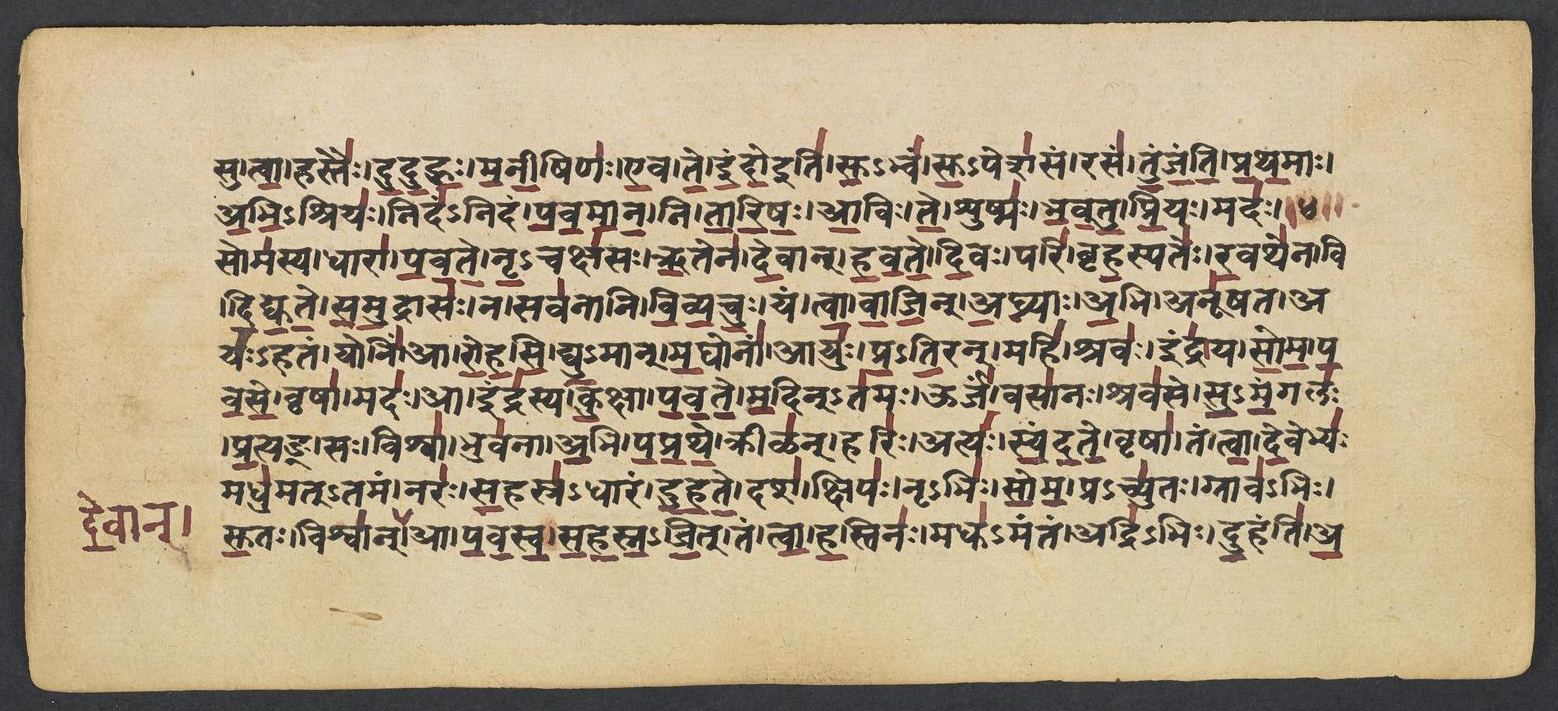
Penn Ms. Coll. 390 Item 41, fol. 709r (numbered 26r by the scribe) (OPenn image 709, lower leaf). Checked on the image: the Rigveda text on this page begins in RV 9.79.4 ‹-ap-su tvā hastaiḥ duduhuḥ›. The next page with Rigveda text, fol. 709v (numbered 26v by the scribe), begins in RV 9.80.5 ‹-ap-su vṛṣabham daśa kṣipaḥ›. Verses 9.80.1-4 end on this page.
1soma̍sya̱ dhārā̍ pavate nṛ̱cakṣa̍sa ṛ̱tena̍ de̱vān ha̍vate di̱vas pari̍ | bṛha̱spate̍ ra̱vathe̍nā̱ vi di̍dyute samu̱drāso̱ na sava̍nāni vivyacuḥ ||
2yaṁ tvā̍ vājinn a̱ghnyā a̱bhy anū̍ṣa̱tāyo̍hata̱ṁ yoni̱m ā ro̍hasi dyu̱mān | ma̱ghonā̱m āyu̍ḥ prati̱ran mahi̱ śrava̱ indrā̍ya soma pavase̱ vṛṣā̱ mada̍ḥ ||
3endra̍sya ku̱kṣā pa̍vate ma̱dinta̍ma̱ ūrja̱ṁ vasā̍na̱ḥ śrava̍se suma̱ṅgala̍ḥ | pra̱tyaṅ sa viśvā̱ bhuva̍nā̱bhi pa̍prathe̱ krīḻa̱n hari̱r atya̍ḥ syandate̱ vṛṣā̍ ||
4taṁ tvā̍ de̱vebhyo̱ madhu̍mattama̱ṁ nara̍ḥ sa̱hasra̍dhāraṁ duhate̱ daśa̱ kṣipa̍ḥ | nṛbhi̍ḥ soma̱ pracyu̍to̱ grāva̍bhiḥ su̱to viśvā̍n de̱vām̐ ā pa̍vasvā sahasrajit ||
Compare: Padapāṭha (word-by-word text written in the manuscript; Sansknet e-text via GRETIL)
1somasya | dhārā | pavate | nṛ-cakṣasaḥ | ṛtena | devān | havate | divaḥ | pari | bṛhaspateḥ | ravathena | vi | didyute | samudrāsaḥ | na | savanāni | vivyacuḥ
2yam | tvā | vājin | aghnyāḥ | abhi | anūṣatā | ayaḥ-hatam | yonim | ā | rohasi | dyu-mān | maghonām | āyuḥ | pra-tirat | mahi | śrava | indrāya | soma | pavase | vṛṣā | madaḥ
3ā | indrasya | kukṣā | pavate | madin-tamaḥ | ūrjam | vasānaḥ | śravase | su-maṅgalaḥ | pratyaṅ | saḥ | viśvā | bhuvanā | abhi | paprathe | krīḷan | hariḥ | atyaḥ | syandate | vṛṣā
4tam | tvā | devebhyaḥ | madhumat-tamam | naraḥ | sahasra-dhāram | duhate | daśa | kṣipaḥ | nṛ-bhiḥ | soma | pra-cyutaḥ | grāva-bhiḥ | sutaḥ | viśvān | devān | ā | pavasva | sahasra-jit
1ON flows the stream of Soma who beholds mankind: by everlasting Law he calls the Gods from heaven. He lightens with the roaring of Br aspati: h the lakes have not contained the pourings of juice.
2Thou, powerful Soma, thou to whom the cows have -lowed, ascendest bright with sheen, thine ironfashioned home. Thou, lengthening our princes' life and high renown, flowest for Indra as his might to gladdening drink.
3Best giver of delight, he flows to Indra's throat, robing himself in might, Auspicious One, for fame. He spreads himself abroad to meet all things that be: the vigorous Tawny Steed flows sporting on his way.
4The men, the ten swift fingers, milk thee out for Gods, even thee most rich in meath, with thousand flowing streams. Soma who winnest thousands, driven by the men, expressed with stones, bring, as thou flowest, all the Gods.
Where on the image
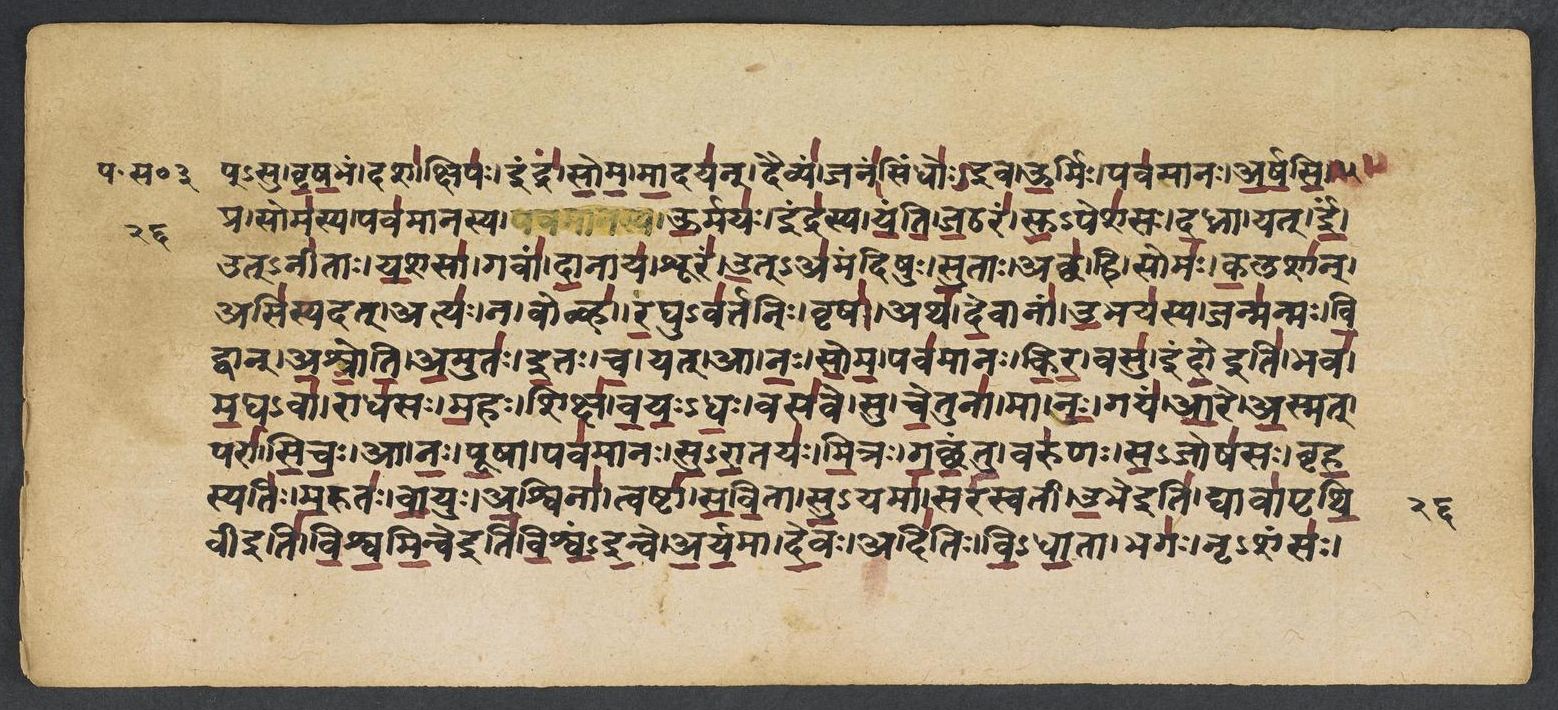
Penn Ms. Coll. 390 Item 41, fol. 709v (numbered 26v by the scribe) (OPenn image 710, upper leaf). Checked on the image: the Rigveda text on this page begins in RV 9.80.5 ‹-ap-su vṛṣabham daśa kṣipaḥ›. The next page with Rigveda text, fol. 710r (numbered 27r by the scribe), begins in RV 9.81.5 ‹uru antarikṣam viśve devāḥ›. Verse 9.80.5 ends on this page; 9.80.5 begins on fol. 709r (numbered 26r by the scribe).
5taṁ tvā̍ ha̱stino̱ madhu̍manta̱m adri̍bhir du̱hanty a̱psu vṛ̍ṣa̱bhaṁ daśa̱ kṣipa̍ḥ | indra̍ṁ soma mā̱daya̱n daivya̱ṁ jana̱ṁ sindho̍r ivo̱rmiḥ pava̍māno arṣasi ||
Compare: Padapāṭha (word-by-word text written in the manuscript; Sansknet e-text via GRETIL)
5tam | tvā | hastinaḥ | madhu-mantam | adri-bhiḥ | duhanti | ap-su | vṛṣabham | daśa | kṣipaḥ | indram | soma | mādayan | daivyam | janam | sindhoḥ-iva | ūrmiḥ | pavamānaḥ | arṣasi
5Deft-handed men with stones, the ten swift fingers, drain thee into waters, thee, the Steer enriched with sweets. Thou, Soma, gladdening Indra, and the Heavenly Host, flowest as Pavamâna like a river's wave.
Notes
- Sanskrit: Aufrecht's edition (1877) with the Vedic accents, as entered by van Nooten and Holland (GRETIL).
- English: Ralph T. H. Griffith, The Hymns of the Rigveda (1889-1892; 2nd ed. 1896-1897), from the VedaWeb digital text; OCR slips in that text were corrected against the printed 2nd edition (data/sources/rigveda/griffith_errata.json).
- Padapāṭha (edition text): Sansknet e-text via GRETIL (CC BY-NC-SA 4.0).
Cite
Sources
- Source: Penn Ms. Coll. 390 Item 41 (undated (catalogued with Penn's 18th-19th c. Vedic manuscripts)), OPenn, Public Domain Mark + Aufrecht's accented text (GRETIL) + Griffith's English (VedaWeb) (holding institution)
- Critical edition: Aufrecht (1877), accented e-text via GRETIL
← previous · → next · v cycle view · l back to library