Rigveda 9.81: To Soma
Introduction
Rigveda 9.81 is a hymn of 5 verses addressed to Soma. It stands in book (maṇḍala) 9, the hymns to Soma Pavamāna. The Rigveda is the oldest collection of Sanskrit hymns, composed in the second half of the second millennium BCE and handed down orally for many centuries before it was written down.
The manuscript shown is Penn Ms. Coll. 390 Item 41 (University of Pennsylvania), an undated paper manuscript of the padapāṭha (the word-by-word recitation text, in which every word is written separately and compounds are split) of the whole Ṛgveda in Devanāgarī, 884 leaves in fascicles, 7-9 lines to the page, accents in red; this hymn stands on fol. 709v-710r. Each section below gives the verses that end on one page; the page boundaries were read on the images (the opening words of every page), not counted out. Where the manuscript is a padapāṭha (the word-by-word recitation text), the section shows Aufrecht's continuous (saṃhitā) text first and, as the edition text, the padapāṭha of the same verses, which is the form written on the page.
How was this verified? (Provenance)
Where on the image
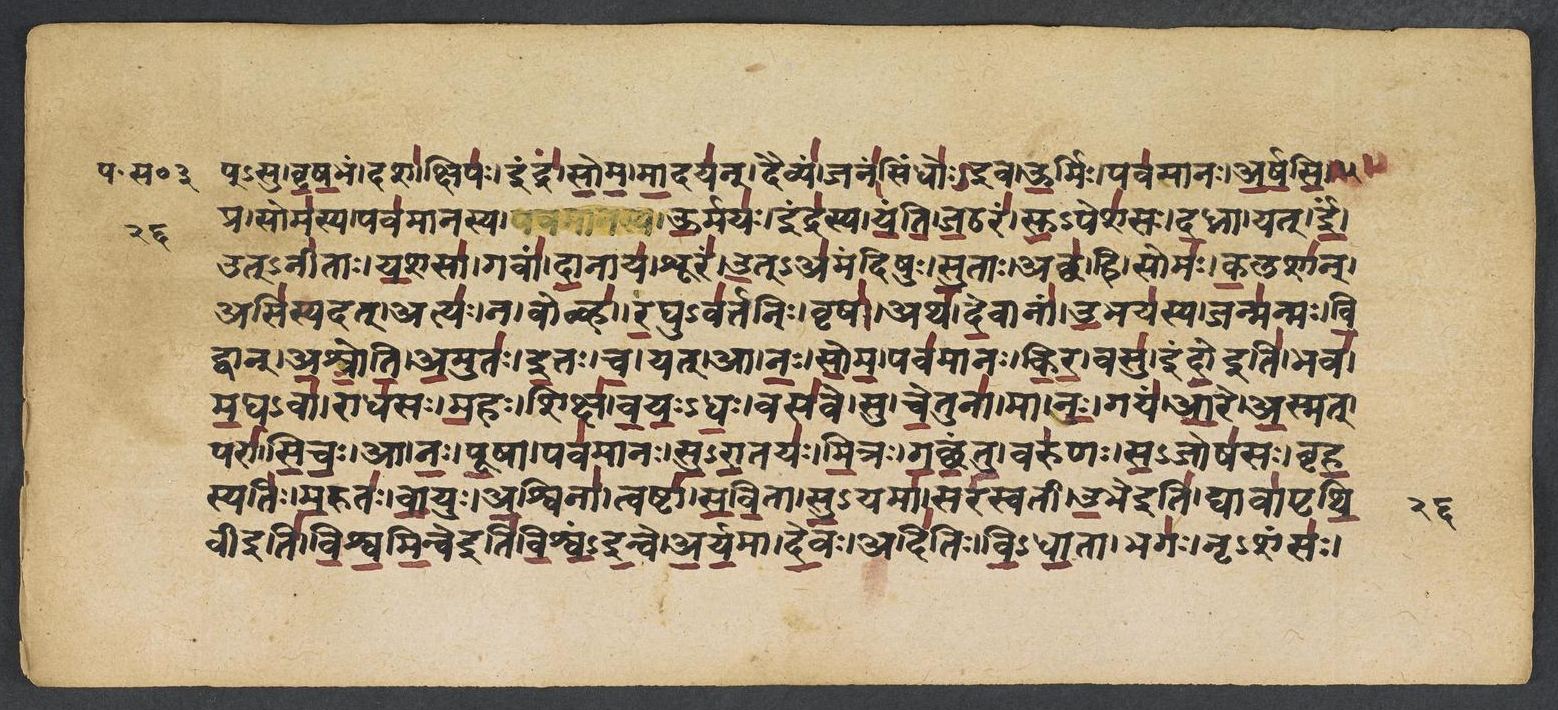
Penn Ms. Coll. 390 Item 41, fol. 709v (numbered 26v by the scribe) (OPenn image 710, upper leaf). Checked on the image: the Rigveda text on this page begins in RV 9.80.5 ‹-ap-su vṛṣabham daśa kṣipaḥ›. The next page with Rigveda text, fol. 710r (numbered 27r by the scribe), begins in RV 9.81.5 ‹uru antarikṣam viśve devāḥ›. Verses 9.81.1-4 end on this page.
1pra soma̍sya̱ pava̍mānasyo̱rmaya̱ indra̍sya yanti ja̱ṭhara̍ṁ su̱peśa̍saḥ | da̱dhnā yad ī̱m unnī̍tā ya̱śasā̱ gavā̍ṁ dā̱nāya̱ śūra̍m u̱dama̍ndiṣuḥ su̱tāḥ ||
2acchā̱ hi soma̍ḥ ka̱laśā̱m̐ asi̍ṣyada̱d atyo̱ na voḻhā̍ ra̱ghuva̍rtani̱r vṛṣā̍ | athā̍ de̱vānā̍m u̱bhaya̍sya̱ janma̍no vi̱dvām̐ a̍śnoty a̱muta̍ i̱taś ca̱ yat ||
3ā na̍ḥ soma̱ pava̍mānaḥ kirā̱ vasv indo̱ bhava̍ ma̱ghavā̱ rādha̍so ma̱haḥ | śikṣā̍ vayodho̱ vasa̍ve̱ su ce̱tunā̱ mā no̱ gaya̍m ā̱re a̱smat parā̍ sicaḥ ||
4ā na̍ḥ pū̱ṣā pava̍mānaḥ surā̱tayo̍ mi̱tro ga̍cchantu̱ varu̍ṇaḥ sa̱joṣa̍saḥ | bṛha̱spati̍r ma̱ruto̍ vā̱yur a̱śvinā̱ tvaṣṭā̍ savi̱tā su̱yamā̱ sara̍svatī ||
Compare: Padapāṭha (word-by-word text written in the manuscript; Sansknet e-text via GRETIL)
1pra | somasya | pavamānasya | ūrmayaḥ | indrasya | yanti | jaṭharam | su-peśasaḥ | dadhnā | yat | īm | ut-nītāḥ | yaśasā | gavām | dānāya | śūram | ut-amandiṣuḥ | sutāḥ
2accha | hi | somaḥ | kalaśān | asisyadat | atyaḥ | na | voḷhā | raghu-vartaniḥ | vṛṣā | atha | devānām | ubhayasya | janmanaḥ | vidvān | aśnoti | amutaḥ | itaḥ | ca | yat
3ā | naḥ | soma | pavamānaḥ | kira | vasu | indo iti | bhava | magha-vā | rādhasaḥ | mahaḥ | śikṣa | vayaḥ-dhaḥ | vasave | su | cetunā | mā | naḥ | gayam | āre | asmat | parā | sicaḥ
4ā | naḥ | pūṣā | pavamānaḥ | su-rātayaḥ | mitraḥ | gacchantu | varuṇaḥ | sa-joṣasaḥ | bṛhaspatiḥ | marutaḥ | vāyuḥ | aśvinā | tvaṣṭā | savitā | su-yamā | sarasvatī
1ONWARD to Indra's throat move, beauteously adorned, the waves of Soma as he purifies himself, When they, brought forward with the lovely curd of kine, effused, have cheered the Hero to bestow his gifts.
2Hither hath Soma flowed unto the beakers, like a chariot-horse, a stallion swift upon his way. Thus, knowing both the generations, he obtains the rights and dues of Gods from yonder and from hence.
3While thou art cleansed, O Soma, scatter wealth on us; Indu, bestow great bounty as a liberal Prince. Giver of life, with wisdom help to opulence; strew not our home possessions far away from us.
4Hither let Pûshan Pavamâna come to us, Varuṇa, Mitra, bountiful, of one accord, The Maruts, Aṣvins, Vâyu, and Br̥ihaspati, Savitar, Tvashṭar, tractable Sarasvatî.
Where on the image
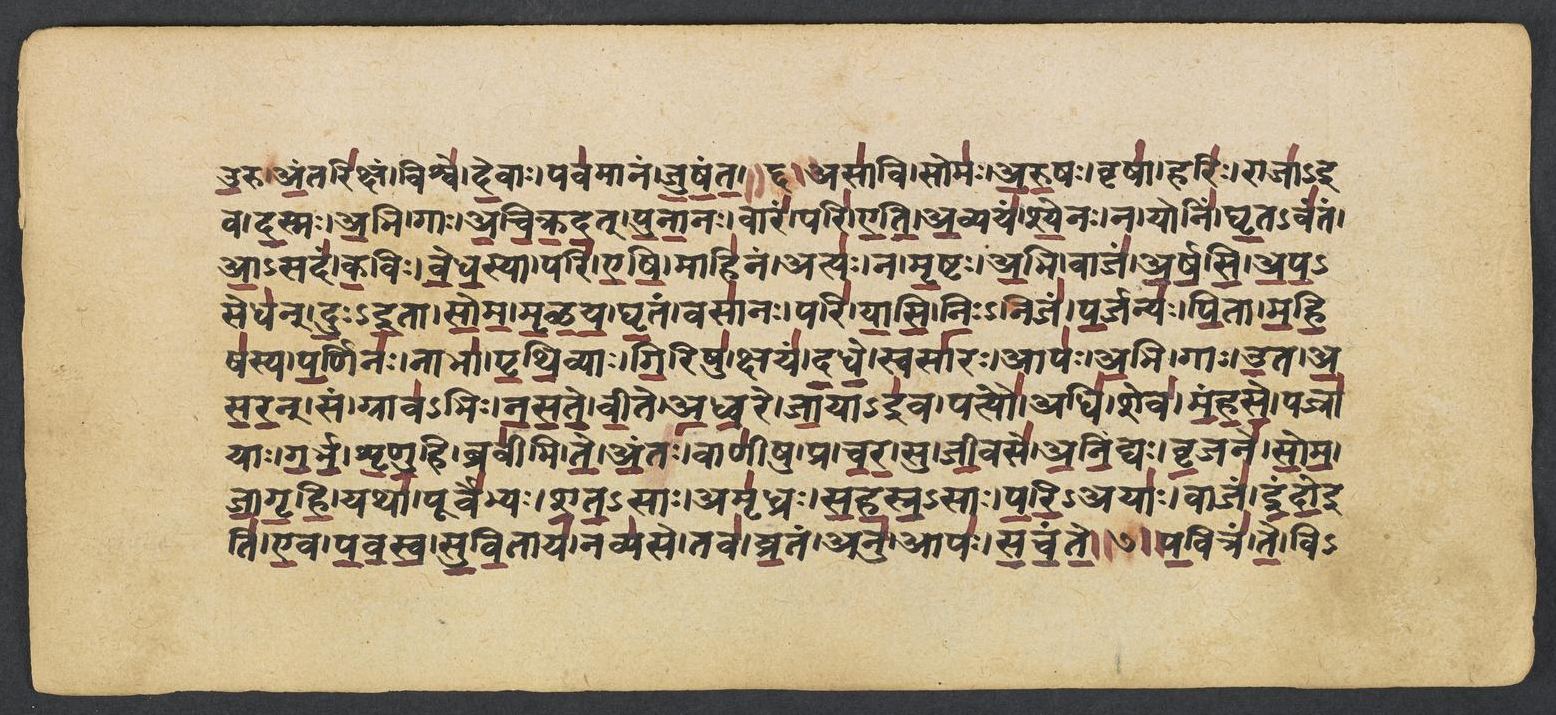
Penn Ms. Coll. 390 Item 41, fol. 710r (numbered 27r by the scribe) (OPenn image 710, lower leaf). Checked on the image: the Rigveda text on this page begins in RV 9.81.5 ‹uru antarikṣam viśve devāḥ›. The next page with Rigveda text, fol. 710v (numbered 27v by the scribe), begins in RV 9.83.1 ‹-vi-tatam brahmaṇaḥ pate pra-bhuḥ›. Verse 9.81.5 ends on this page; 9.81.5 begins on fol. 709v (numbered 26v by the scribe).
5u̱bhe dyāvā̍pṛthi̱vī vi̍śvami̱nve a̍rya̱mā de̱vo adi̍tir vidhā̱tā | bhago̱ nṛśaṁsa̍ u̱rv a1̱̍ntari̍kṣa̱ṁ viśve̍ de̱vāḥ pava̍mānaṁ juṣanta ||
Compare: Padapāṭha (word-by-word text written in the manuscript; Sansknet e-text via GRETIL)
5ubhe iti | dyāvāpṛthivī iti | viśvam-inve | aryamā | devaḥ | aditiḥ | vi-dhātā | bhagaḥ | nṛ-śaṃsaḥ | uru | antarikṣam | viśve | devāḥ | pavamānam | juṣanta
5Both Heaven and Earth, the all-invigorating Pair, Vidhâtar, Aditi, and Aryaman the God, Bhaga who blesses men, the spacious Firmament,– let all the Gods in Pavamâna take delight.
Notes
- Sanskrit: Aufrecht's edition (1877) with the Vedic accents, as entered by van Nooten and Holland (GRETIL).
- English: Ralph T. H. Griffith, The Hymns of the Rigveda (1889-1892; 2nd ed. 1896-1897), from the VedaWeb digital text; OCR slips in that text were corrected against the printed 2nd edition (data/sources/rigveda/griffith_errata.json).
- Padapāṭha (edition text): Sansknet e-text via GRETIL (CC BY-NC-SA 4.0).
Cite
Sources
- Source: Penn Ms. Coll. 390 Item 41 (undated (catalogued with Penn's 18th-19th c. Vedic manuscripts)), OPenn, Public Domain Mark + Aufrecht's accented text (GRETIL) + Griffith's English (VedaWeb) (holding institution)
- Critical edition: Aufrecht (1877), accented e-text via GRETIL
← previous · → next · v cycle view · l back to library