Rigveda 9.91: To Soma
Introduction
Rigveda 9.91 is a hymn of 6 verses addressed to Soma. It stands in book (maṇḍala) 9, the hymns to Soma Pavamāna. The Rigveda is the oldest collection of Sanskrit hymns, composed in the second half of the second millennium BCE and handed down orally for many centuries before it was written down.
The manuscript shown is Penn Ms. Coll. 390 Item 41 (University of Pennsylvania), an undated paper manuscript of the padapāṭha (the word-by-word recitation text, in which every word is written separately and compounds are split) of the whole Ṛgveda in Devanāgarī, 884 leaves in fascicles, 7-9 lines to the page, accents in red; this hymn stands on fol. 720r-720v. Each section below gives the verses that end on one page; the page boundaries were read on the images (the opening words of every page), not counted out. Where the manuscript is a padapāṭha (the word-by-word recitation text), the section shows Aufrecht's continuous (saṃhitā) text first and, as the edition text, the padapāṭha of the same verses, which is the form written on the page.
How was this verified? (Provenance)
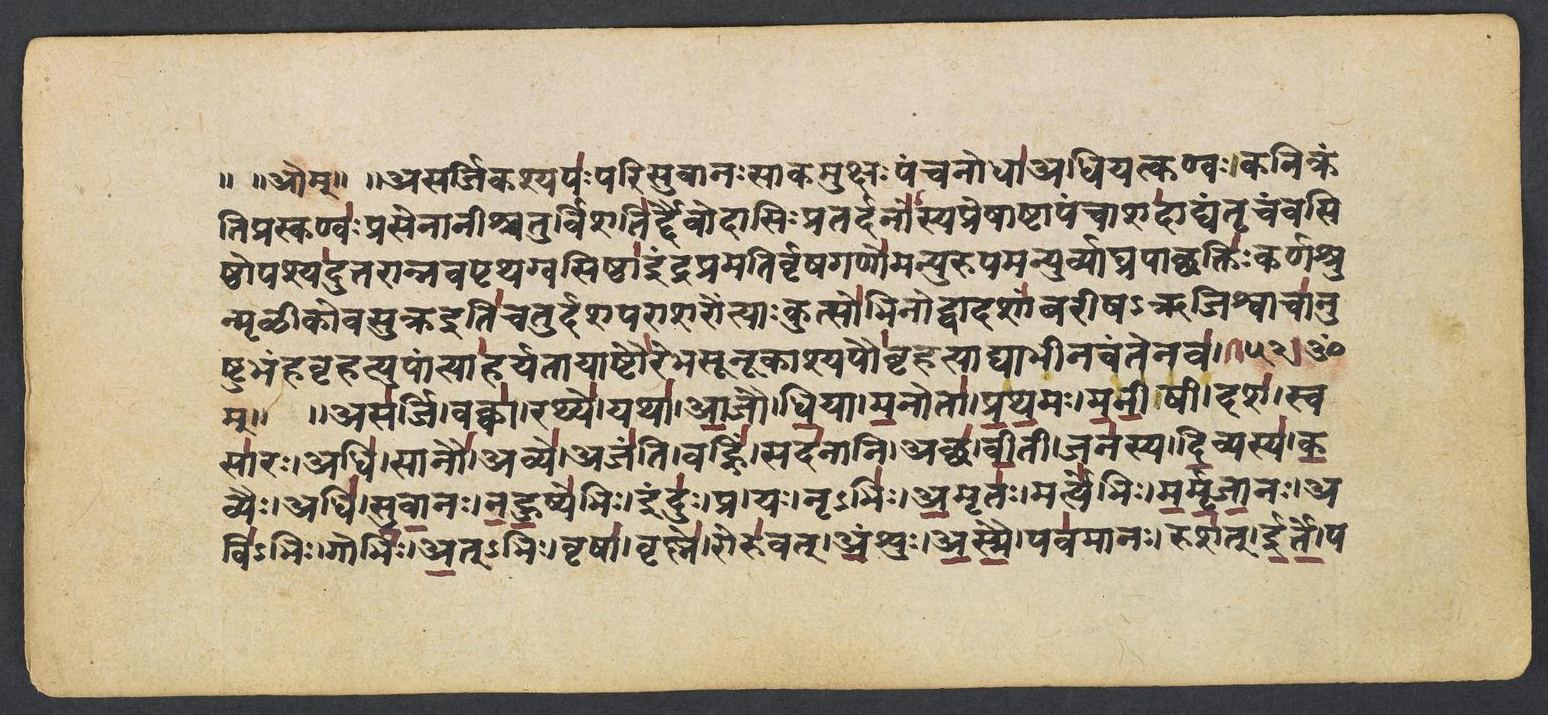
Where on the image
Penn Ms. Coll. 390 Item 41, fol. 720r (numbered 37r by the scribe) (OPenn image 720, lower leaf). Checked on the image: the Rigveda text on this page begins in RV 9.91.1 ‹asarji vakvā rathye yathā›. Lines 1-6 carry oṃ and the anukramaṇī for aṣṭaka 7, adhyāya 4; 9.91.1 (asarji vakvā rathye) begins in line 6 after oṃ. The next page with Rigveda text, fol. 720v (numbered 37v by the scribe), begins in RV 9.91.3 ‹-payaḥ goḥ sahasram ṛkvā›. Verses 9.91.1-2 end on this page.
1asa̍rji̱ vakvā̱ rathye̱ yathā̱jau dhi̱yā ma̱notā̍ pratha̱mo ma̍nī̱ṣī | daśa̱ svasā̍ro̱ adhi̱ sāno̱ avye 'ja̍nti̱ vahni̱ṁ sada̍nā̱ny accha̍ ||
2vī̱tī jana̍sya di̱vyasya̍ ka̱vyair adhi̍ suvā̱no na̍hu̱ṣye̍bhi̱r indu̍ḥ | pra yo nṛbhi̍r a̱mṛto̱ martye̍bhir marmṛjā̱no 'vi̍bhi̱r gobhi̍r a̱dbhiḥ ||
Compare: Padapāṭha (word-by-word text written in the manuscript; Sansknet e-text via GRETIL)
1asarji | vakvā | rathye | yathā | ājau | dhiyā | manotā | prathamaḥ | manīṣī | daśa | svasāraḥ | adhi | sānau | avye | ajanti | vahnim | sadanāni | accha
2vītī | janasya | divyasya | kavyaiḥ | adhi | suvānaḥ | nahuṣyebhiḥ | induḥ | pra | yaḥ | nṛ-bhiḥ | amṛtaḥ | martyebhiḥ | marmṛjānaḥ | avi-bhiḥ | gobhiḥ | at-bhiḥ
1As for a chariot-race, the skilful Speaker, Chief, Sage, Inventor, hath, with song, been started. The sisters ten upon the fleecy summit drive on the Car-horse to the resting places.
2The drop of Soma, pressed by wise Nahushyas, becomes the banquet of the Heavenly People- Indu, by hands of mortal men made beauteous, immortal, with the sheep and cows and waters.
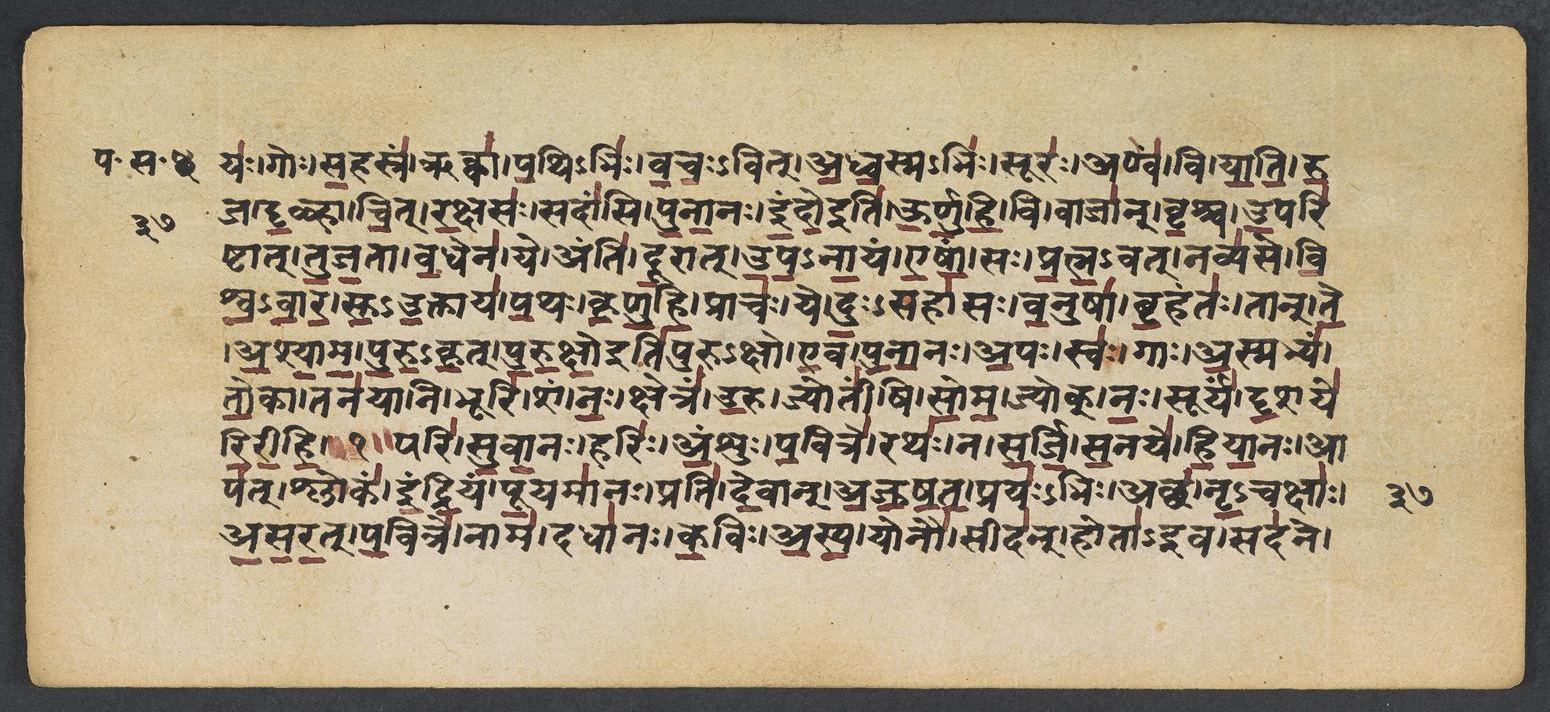
Where on the image
Penn Ms. Coll. 390 Item 41, fol. 720v (numbered 37v by the scribe) (OPenn image 721, upper leaf). Checked on the image: the Rigveda text on this page begins in RV 9.91.3 ‹-payaḥ goḥ sahasram ṛkvā›. The next page with Rigveda text, fol. 721r (numbered 38r by the scribe), begins in RV 9.92.2 ‹camūṣu upa īm agman›. Verses 9.91.3-6 end on this page; 9.91.3 begins on fol. 720r (numbered 37r by the scribe).
3vṛṣā̱ vṛṣṇe̱ roru̍vad a̱ṁśur a̍smai̱ pava̍māno̱ ruśa̍d īrte̱ payo̱ goḥ | sa̱hasra̱m ṛkvā̍ pa̱thibhi̍r vaco̱vid a̍dhva̱smabhi̱ḥ sūro̱ aṇva̱ṁ vi yā̍ti ||
4ru̱jā dṛ̱ḻhā ci̍d ra̱kṣasa̱ḥ sadā̍ṁsi punā̱na i̍nda ūrṇuhi̱ vi vājā̍n | vṛ̱ścopari̍ṣṭāt tuja̱tā va̱dhena̱ ye anti̍ dū̱rād u̍panā̱yam e̍ṣām ||
5sa pra̍tna̱van navya̍se viśvavāra sū̱ktāya̍ pa̱thaḥ kṛ̍ṇuhi̱ prāca̍ḥ | ye du̱ḥṣahā̍so va̱nuṣā̍ bṛ̱hanta̱s tām̐s te̍ aśyāma purukṛt purukṣo ||
6e̱vā pu̍nā̱no a̱paḥ sva1̱̍r gā a̱smabhya̍ṁ to̱kā tana̍yāni̱ bhūri̍ | śaṁ na̱ḥ kṣetra̍m u̱ru jyotī̍ṁṣi soma̱ jyoṅ na̱ḥ sūrya̍ṁ dṛ̱śaye̍ rirīhi ||
Compare: Padapāṭha (word-by-word text written in the manuscript; Sansknet e-text via GRETIL)
3vṛṣā | vṛṣṇe | roruvat | aṃśuḥ | asmai | pavamānaḥ | ruśat | īrte | payaḥ | goḥ | sahasram | ṛkvā | pathi-bhiḥ | vacaḥ-vit | adhvasma-bhiḥ | sūraḥ | aṇvam | vi | yāti
4rujā | dṛḷhā | cit | rakṣasaḥ | sadāṃsi | punānaḥ | indo iti | ūrṇuhi | vi | vājān | vṛśca | upariṣṭāt | tujatā | vadhena | ye | anti | dūrāt | upa-nāyam | eṣām
5saḥ | pratna-vat | navyase | viśva-vāra | su-uktāya | pathaḥ | kṛṇuhi | prācaḥ | ye | duḥ-sahāsaḥ | vanuṣā | bṛhantaḥ | tān | te | aśycāma | puru-kṛt | purukṣo itipuru-kṣo
6eva | punānaḥ | apaḥ | svaḥ | gāḥ | asmabhyam | tokā | tanayāni | bhūri | śam | naḥ | kṣetram | uru | jyotīṃṣi | soma | jyok | naḥ | sūryam | dṛśaye | rirīhi
3Steer roaring unto Steer, this Pavamâna, this juice runs to the white milk of the milch-cow. Through thousand fine hairs goes the tuneful Singer, like Sura by his fair and open pathways.
4Break down the, strong seats even of the demons: cleansing thee, Indu, robe thyself in vigour. Rend with thy swift bolt, coming from above them, those who are near and those who yet are distant.
5Prepare the forward paths in ancient manner for the new hymn, thou Giver of all bounties. Those which are high and hard for foes to conquer may we gain from thee, Active! Food-bestower!
6So purifying thee vouchsafe us waters, heaven's light, and cows, offspring and many children. Give us health, ample land, and lights, O Soma, and grant us long to look upon the sunshine.
Notes
- Sanskrit: Aufrecht's edition (1877) with the Vedic accents, as entered by van Nooten and Holland (GRETIL).
- English: Ralph T. H. Griffith, The Hymns of the Rigveda (1889-1892; 2nd ed. 1896-1897), from the VedaWeb digital text; OCR slips in that text were corrected against the printed 2nd edition (data/sources/rigveda/griffith_errata.json).
- Padapāṭha (edition text): Sansknet e-text via GRETIL (CC BY-NC-SA 4.0).
Cite
Sources
- Source: Penn Ms. Coll. 390 Item 41 (undated (catalogued with Penn's 18th-19th c. Vedic manuscripts)), OPenn, Public Domain Mark + Aufrecht's accented text (GRETIL) + Griffith's English (VedaWeb) (holding institution)
- Critical edition: Aufrecht (1877), accented e-text via GRETIL
← previous · → next · v cycle view · l back to library