Rigveda 9.92: To Soma
Introduction
Rigveda 9.92 is a hymn of 6 verses addressed to Soma. It stands in book (maṇḍala) 9, the hymns to Soma Pavamāna. The Rigveda is the oldest collection of Sanskrit hymns, composed in the second half of the second millennium BCE and handed down orally for many centuries before it was written down.
The manuscript shown is Penn Ms. Coll. 390 Item 41 (University of Pennsylvania), an undated paper manuscript of the padapāṭha (the word-by-word recitation text, in which every word is written separately and compounds are split) of the whole Ṛgveda in Devanāgarī, 884 leaves in fascicles, 7-9 lines to the page, accents in red; this hymn stands on fol. 720v-721r. Each section below gives the verses that end on one page; the page boundaries were read on the images (the opening words of every page), not counted out. Where the manuscript is a padapāṭha (the word-by-word recitation text), the section shows Aufrecht's continuous (saṃhitā) text first and, as the edition text, the padapāṭha of the same verses, which is the form written on the page.
How was this verified? (Provenance)
Where on the image
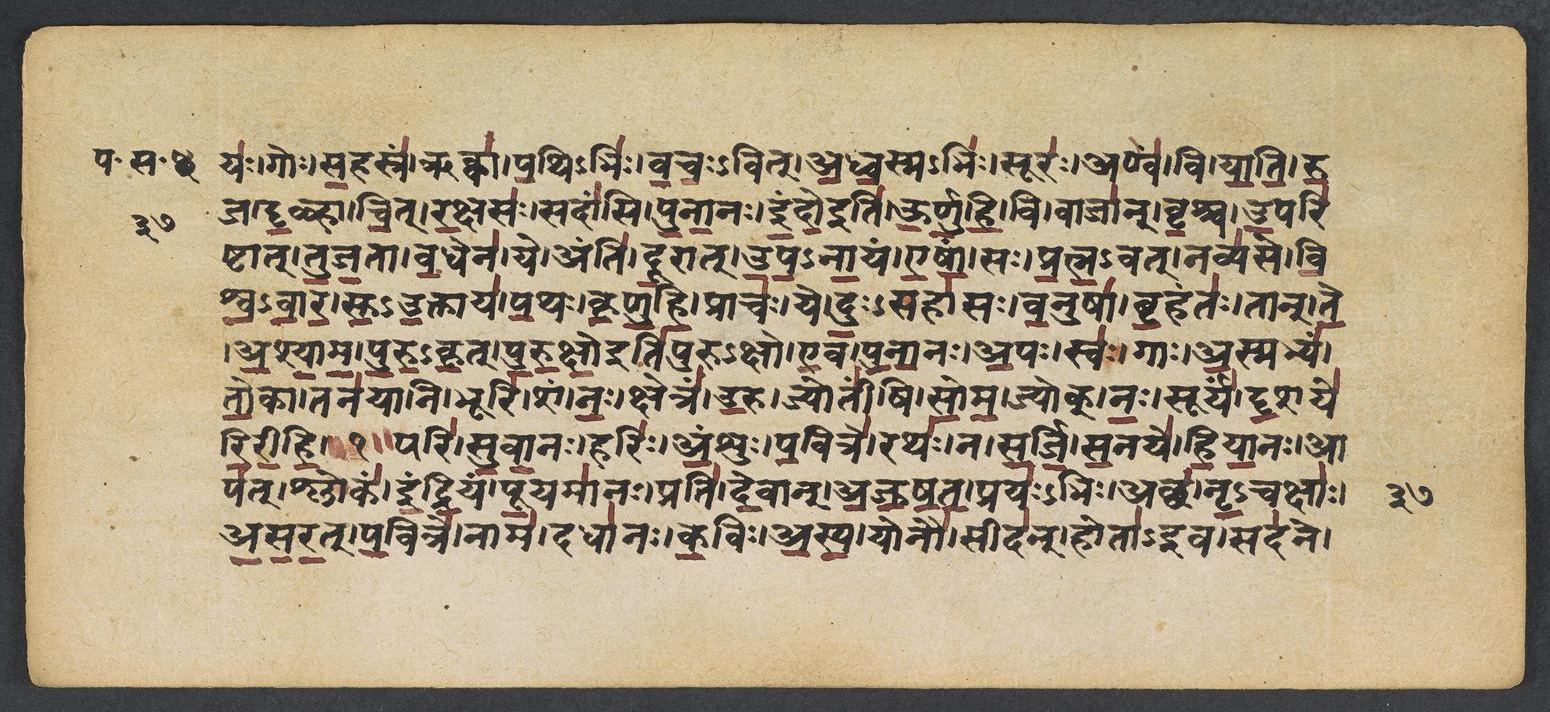
Penn Ms. Coll. 390 Item 41, fol. 720v (numbered 37v by the scribe) (OPenn image 721, upper leaf). Checked on the image: the Rigveda text on this page begins in RV 9.91.3 ‹-payaḥ goḥ sahasram ṛkvā›. The next page with Rigveda text, fol. 721r (numbered 38r by the scribe), begins in RV 9.92.2 ‹camūṣu upa īm agman›. Verse 9.92.1 ends on this page.
1pari̍ suvā̱no hari̍r a̱ṁśuḥ pa̱vitre̱ ratho̱ na sa̍rji sa̱naye̍ hiyā̱naḥ | āpa̱c chloka̍m indri̱yam pū̱yamā̍na̱ḥ prati̍ de̱vām̐ a̍juṣata̱ prayo̍bhiḥ ||
Compare: Padapāṭha (word-by-word text written in the manuscript; Sansknet e-text via GRETIL)
1pari | suvānaḥ | hariḥ | aṃśuḥ | pavitre | rathaḥ | na | sarji | sanaye | hiyānaḥ | āpat | ślokam | indriyam | pūyamānaḥ | prati | devān | ajuṣata | prayaḥ-bhiḥ
1THE gold-hued juice, poured out upon the filter, is started like a car sent forth to conquer. He hath gained song and vigour while they cleansed him, and hath rejoiced the Gods with entertainments.
Where on the image
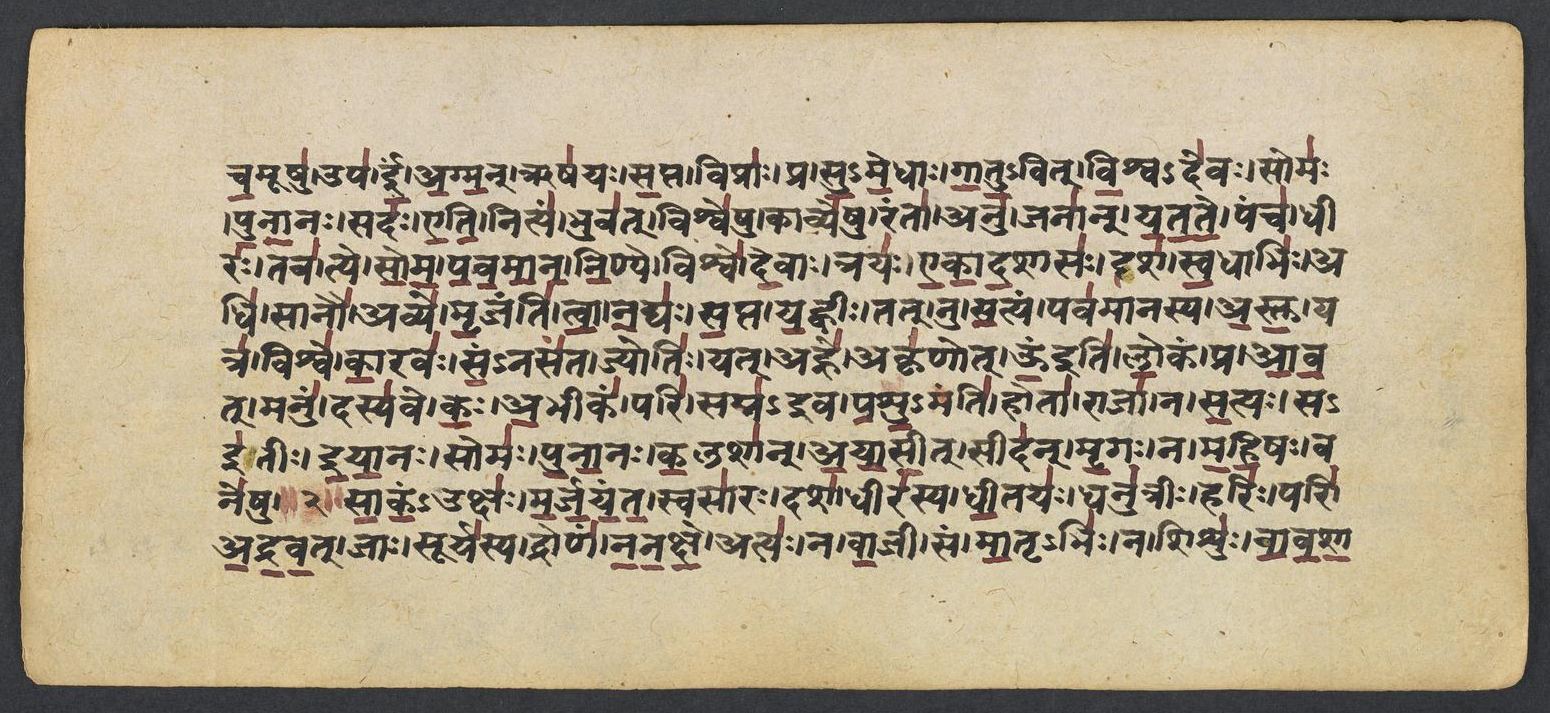
Penn Ms. Coll. 390 Item 41, fol. 721r (numbered 38r by the scribe) (OPenn image 721, lower leaf). Checked on the image: the Rigveda text on this page begins in RV 9.92.2 ‹camūṣu upa īm agman›. The next page with Rigveda text, fol. 721v (numbered 38v by the scribe), begins in RV 9.93.2 ‹-vāvaśānaḥ vṛṣā dadhanve puru-vāraḥ›. Verses 9.92.2-6 end on this page; 9.92.2 begins on fol. 720v (numbered 37v by the scribe).
2acchā̍ nṛ̱cakṣā̍ asarat pa̱vitre̱ nāma̱ dadhā̍naḥ ka̱vir a̍sya̱ yonau̍ | sīda̱n hote̍va̱ sada̍ne ca̱mūṣūpe̍m agma̱nn ṛṣa̍yaḥ sa̱pta viprā̍ḥ ||
3pra su̍me̱dhā gā̍tu̱vid vi̱śvade̍va̱ḥ soma̍ḥ punā̱naḥ sada̍ eti̱ nitya̍m | bhuva̱d viśve̍ṣu̱ kāvye̍ṣu̱ rantānu̱ janā̍n yatate̱ pañca̱ dhīra̍ḥ ||
4tava̱ tye so̍ma pavamāna ni̱ṇye viśve̍ de̱vās traya̍ ekāda̱śāsa̍ḥ | daśa̍ sva̱dhābhi̱r adhi̱ sāno̱ avye̍ mṛ̱janti̍ tvā na̱dya̍ḥ sa̱pta ya̱hvīḥ ||
5tan nu sa̱tyam pava̍mānasyāstu̱ yatra̱ viśve̍ kā̱rava̍ḥ sa̱ṁnasa̍nta | jyoti̱r yad ahne̱ akṛ̍ṇod u lo̱kam prāva̱n manu̱ṁ dasya̍ve kar a̱bhīka̍m ||
6pari̱ sadme̍va paśu̱mānti̱ hotā̱ rājā̱ na sa̱tyaḥ sami̍tīr iyā̱naḥ | soma̍ḥ punā̱naḥ ka̱laśā̍m̐ ayāsī̱t sīda̍n mṛ̱go na ma̍hi̱ṣo vane̍ṣu ||
Compare: Padapāṭha (word-by-word text written in the manuscript; Sansknet e-text via GRETIL)
2accha | nṛ-cakṣāḥ | asarat | pavitre | nāma | dadhānaḥ | kaviḥ | asya | yonau | sīdan | hotā-iva | sadane | camūṣu | upa | īm | agman | ṛṣayaḥ | sapta | viprāḥ
3pra | su-medhāḥ | gātu-vit | viśva-devaḥ | somaḥ | punānaḥ | sadaḥ | eti | nityam | bhuvat | viśveṣu | kāvyeṣu | rantā | anu | janān | yatate | pañca | dhīraḥ
4tava | tye | soma | pavamāna | niṇye | viśve | devāḥ | trayaḥ | ekādaśāsaḥ | daśa | svadhābhiḥ | adhi | sānau | avye | mṛjanti | tvā | nadyaḥ | sapta | yahvīḥ
5tat | nu | satyam | pavamānasya | astu | yatra | viśve | kāravaḥ | sam-nasanta | jyotiḥ | yat | ahne | akṛṇot | oṃ iti | lokam | pra | āvat | manum | dasyave | kaḥ | abhīkam
6par | sadma-iva | paśu-manti | hotā | rājā | na | satyaḥ | sam-itīḥ | iyānaḥ | somaḥ | punānaḥ | kalaśān | ayāsīt | sīdan | mṛgaḥ | na | mahiṣaḥ | vaneṣu
2He who beholdeth man hath reached the filter: bearing his name, the Sage hath sought his dwelling. The R̥ishis came to him, seven holy singers, when in the bowls he settled as Invoker.
3Shared by all Gods, most wise, propitious, Soma goes, while they cleanse him, to his constant station. Let him rejoice in all his lofty wisdom to the Five Tribes the Sage attains with labour.
4In thy mysterious place, O Pavamâna Soma, are all the Gods, the Thrice-Eleven. Ten on the fleecy height, themselves, self-prompted, and seven fresh rivers, brighten and adorn thee.
5Now let this be the truth of Pavamâna, there where all singers gather them together, That he hath given us room and made the daylight, hath holpen Manu and repelled the Dasyu.
6As the priest seeks the station rich in cattle, like a true King who goes to great assemblies, Soma hath sought the beakers while they cleansed him, and like a wild bull, in the wood hath settled.
Notes
- Sanskrit: Aufrecht's edition (1877) with the Vedic accents, as entered by van Nooten and Holland (GRETIL).
- English: Ralph T. H. Griffith, The Hymns of the Rigveda (1889-1892; 2nd ed. 1896-1897), from the VedaWeb digital text; OCR slips in that text were corrected against the printed 2nd edition (data/sources/rigveda/griffith_errata.json).
- Padapāṭha (edition text): Sansknet e-text via GRETIL (CC BY-NC-SA 4.0).
Cite
Sources
- Source: Penn Ms. Coll. 390 Item 41 (undated (catalogued with Penn's 18th-19th c. Vedic manuscripts)), OPenn, Public Domain Mark + Aufrecht's accented text (GRETIL) + Griffith's English (VedaWeb) (holding institution)
- Critical edition: Aufrecht (1877), accented e-text via GRETIL
← previous · → next · v cycle view · l back to library