Rigveda 9.93: To Soma
Introduction
Rigveda 9.93 is a hymn of 5 verses addressed to Soma. It stands in book (maṇḍala) 9, the hymns to Soma Pavamāna. The Rigveda is the oldest collection of Sanskrit hymns, composed in the second half of the second millennium BCE and handed down orally for many centuries before it was written down.
The manuscript shown is Penn Ms. Coll. 390 Item 41 (University of Pennsylvania), an undated paper manuscript of the padapāṭha (the word-by-word recitation text, in which every word is written separately and compounds are split) of the whole Ṛgveda in Devanāgarī, 884 leaves in fascicles, 7-9 lines to the page, accents in red; this hymn stands on fol. 721r-721v. Each section below gives the verses that end on one page; the page boundaries were read on the images (the opening words of every page), not counted out. Where the manuscript is a padapāṭha (the word-by-word recitation text), the section shows Aufrecht's continuous (saṃhitā) text first and, as the edition text, the padapāṭha of the same verses, which is the form written on the page.
How was this verified? (Provenance)
Where on the image
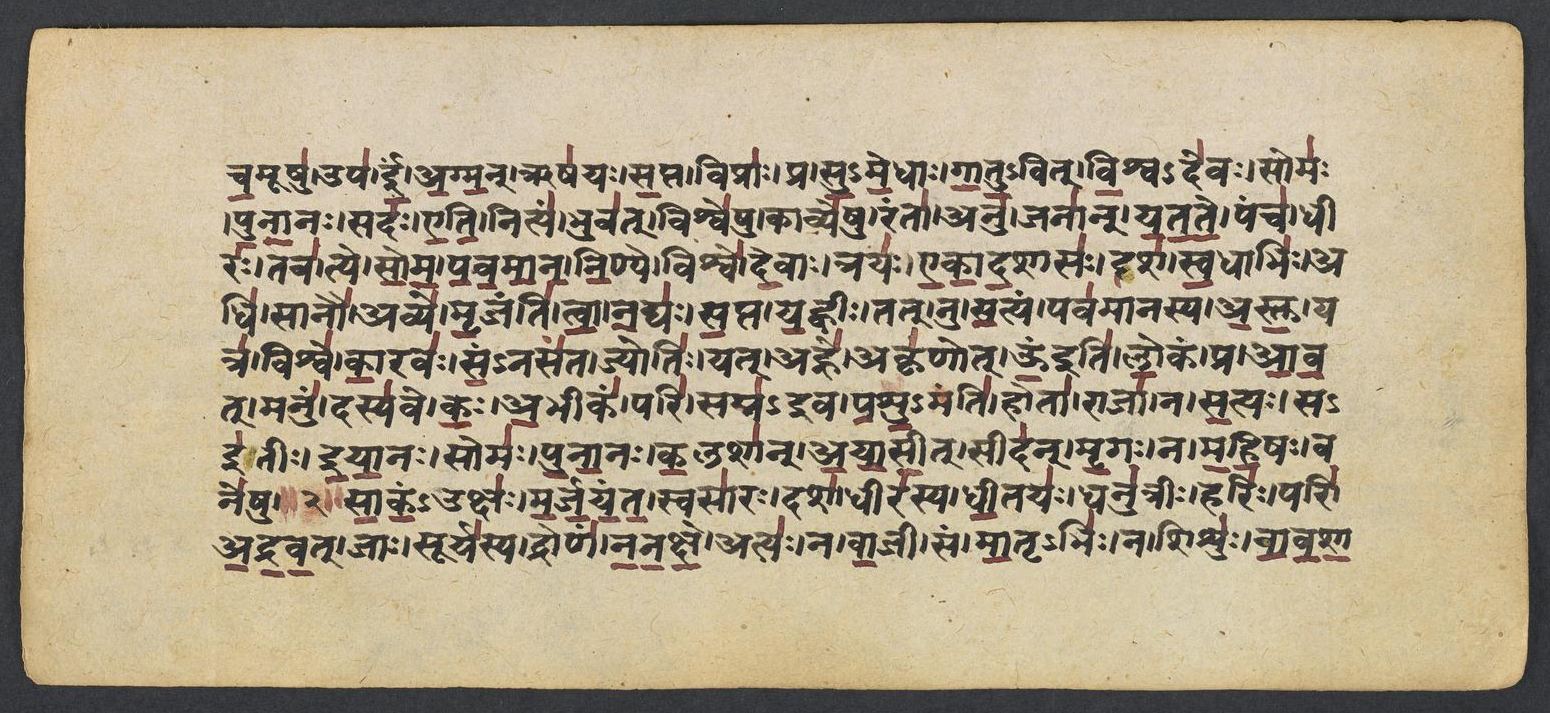
Penn Ms. Coll. 390 Item 41, fol. 721r (numbered 38r by the scribe) (OPenn image 721, lower leaf). Checked on the image: the Rigveda text on this page begins in RV 9.92.2 ‹camūṣu upa īm agman›. The next page with Rigveda text, fol. 721v (numbered 38v by the scribe), begins in RV 9.93.2 ‹-vāvaśānaḥ vṛṣā dadhanve puru-vāraḥ›. Verse 9.93.1 ends on this page.
1sā̱ka̱mukṣo̍ marjayanta̱ svasā̍ro̱ daśa̱ dhīra̍sya dhī̱tayo̱ dhanu̍trīḥ | hari̱ḥ pary a̍drava̱j jāḥ sūrya̍sya̱ droṇa̍ṁ nanakṣe̱ atyo̱ na vā̱jī ||
Compare: Padapāṭha (word-by-word text written in the manuscript; Sansknet e-text via GRETIL)
1sākam-ukṣaḥ | marjayanta | svasāraḥ | daśa | dhīrasya | dhītayaḥ | dhanutrīḥ | hariḥ | pari | adravat | jāḥ | sūryasya | droṇam | nanakṣe | atyaḥ | na | vājī
1TEN sisters, pouring out the rain together, swift-moving thinkers of the sage, adorn him. Hither hath run the gold-hued Child of Sûrya and reached the vat like a fleet vigorous courser.
Where on the image
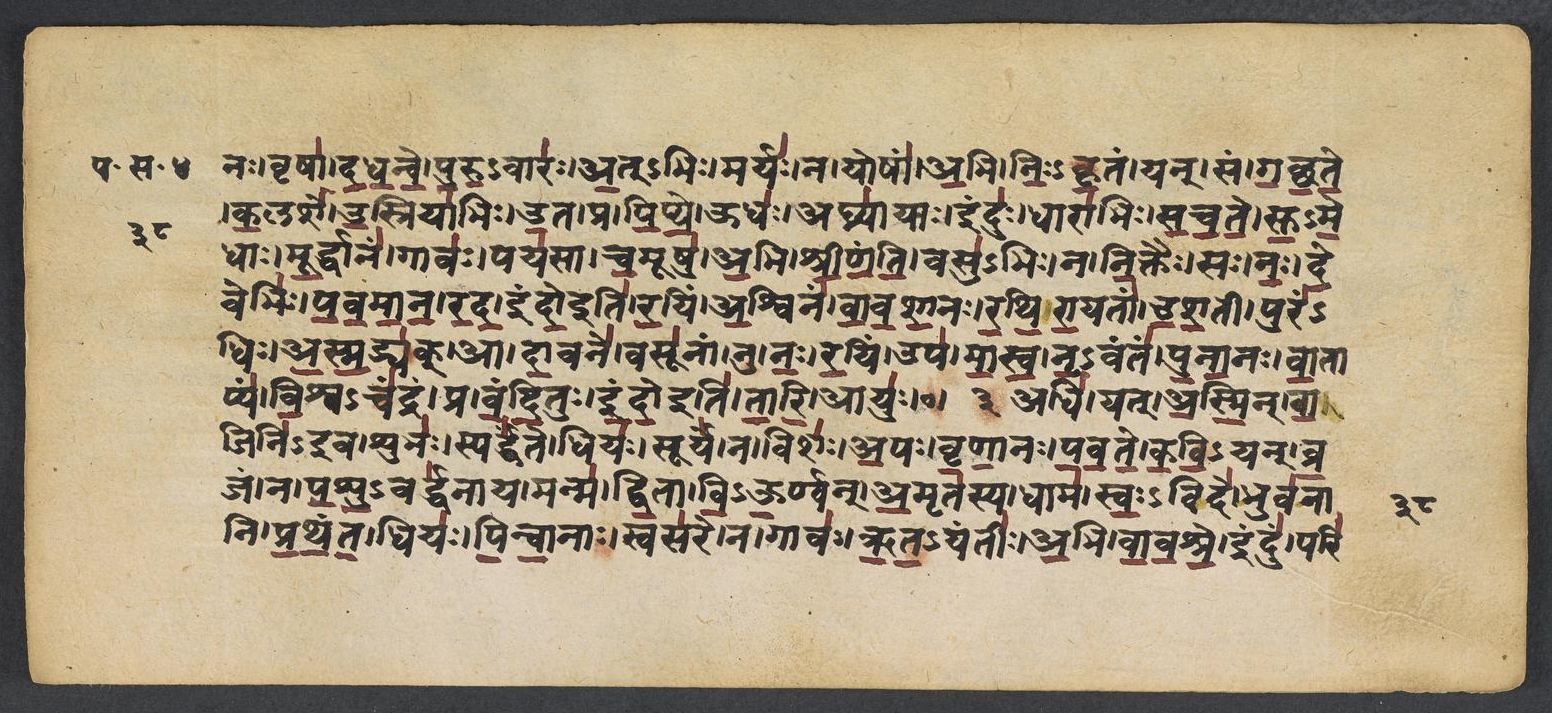
Penn Ms. Coll. 390 Item 41, fol. 721v (numbered 38v by the scribe) (OPenn image 722, upper leaf). Checked on the image: the Rigveda text on this page begins in RV 9.93.2 ‹-vāvaśānaḥ vṛṣā dadhanve puru-vāraḥ›. The next page with Rigveda text, fol. 722r (numbered 39r by the scribe), begins in RV 9.94.3 ‹yat kaviḥ kāvyā bharate›. Verses 9.93.2-5 end on this page; 9.93.2 begins on fol. 721r (numbered 38r by the scribe).
2sam mā̱tṛbhi̱r na śiśu̍r vāvaśā̱no vṛṣā̍ dadhanve puru̱vāro̍ a̱dbhiḥ | maryo̱ na yoṣā̍m a̱bhi ni̍ṣkṛ̱taṁ yan saṁ ga̍cchate ka̱laśa̍ u̱sriyā̍bhiḥ ||
3u̱ta pra pi̍pya̱ ūdha̱r aghnyā̍yā̱ indu̱r dhārā̍bhiḥ sacate sume̱dhāḥ | mū̱rdhāna̱ṁ gāva̱ḥ paya̍sā ca̱mūṣv a̱bhi śrī̍ṇanti̱ vasu̍bhi̱r na ni̱ktaiḥ ||
4sa no̍ de̱vebhi̍ḥ pavamāna ra̱dendo̍ ra̱yim a̱śvina̍ṁ vāvaśā̱naḥ | ra̱thi̱rā̱yatā̍m uśa̱tī pura̍ṁdhir asma̱drya1̱̍g ā dā̱vane̱ vasū̍nām ||
5nū no̍ ra̱yim upa̍ māsva nṛ̱vanta̍m punā̱no vā̱tāpya̍ṁ vi̱śvaśca̍ndram | pra va̍ndi̱tur i̍ndo tā̱ry āyu̍ḥ prā̱tar ma̱kṣū dhi̱yāva̍sur jagamyāt ||
Compare: Padapāṭha (word-by-word text written in the manuscript; Sansknet e-text via GRETIL)
2sam | mātṛ-bhiḥ | na | śiśuḥ | vāvaśānaḥ | vṛṣā | dadhanve | puru-vāraḥ | at-bhiḥ | maryaḥ | na | yoṣām | abhi | niḥ-kṛtam | yan | sam | gacchate | kalaśe | usriyābhiḥ
3uta | pra | pipye | ūdhaḥ | aghnyāyāḥ | induḥ | dhārābhiḥ | sacate | su-medhāḥ | mūdhārnam | gāvaḥ | payasā | camūṣu | abhi | śrīṇanti | vasu-bhiḥ | na | niktaiḥ
4saḥ | naḥ | devebhiḥ | pavamāna | rada | indo iti | rayim | aśvinam | vāvaśānaḥ | rathirāyatām | uśatī | puram-dhiḥ | asmadryak | ā | dāvane | vasūnām
5nu | naḥ | rayim | upa | māsva | nṛ-vantam | punānaḥ | vātāpyam | viśva-candram | pra | vandituḥ | indo iti | tāri | āyuḥ | prātaḥ | makṣu | dhiyāvasuḥ | jagamyāt
2Even as a youngling crying to his mothers, the bounteous Steer hath flowed along to waters. As youth to damsel, so with milk he hastens on to the. chose meeting-place, the beaker.
3Yea, swollen is the udder of the milch-cow: thither in streams goes very sapient Indu. The kine make ready, as with new-washed treasures, the Head and Chief with milk within the vessels.
4With all the Gods, O Indu Pavamâna, while thou art roaring send us wealth in horses. Hither upon her car come willing Plenty, inclined to us, to give us of her treasures.
5Now unto us mete riches, while they cleansethee, all-glorious, swelling wealth, with store of heroes. Long be his life who worships, thee, O Indu. May he, enriched with prayer, come soon and early.
Notes
- Sanskrit: Aufrecht's edition (1877) with the Vedic accents, as entered by van Nooten and Holland (GRETIL).
- English: Ralph T. H. Griffith, The Hymns of the Rigveda (1889-1892; 2nd ed. 1896-1897), from the VedaWeb digital text; OCR slips in that text were corrected against the printed 2nd edition (data/sources/rigveda/griffith_errata.json).
- Padapāṭha (edition text): Sansknet e-text via GRETIL (CC BY-NC-SA 4.0).
Cite
Sources
- Source: Penn Ms. Coll. 390 Item 41 (undated (catalogued with Penn's 18th-19th c. Vedic manuscripts)), OPenn, Public Domain Mark + Aufrecht's accented text (GRETIL) + Griffith's English (VedaWeb) (holding institution)
- Critical edition: Aufrecht (1877), accented e-text via GRETIL
← previous · → next · v cycle view · l back to library