Rigveda 9.94: To Soma
Introduction
Rigveda 9.94 is a hymn of 5 verses addressed to Soma. It stands in book (maṇḍala) 9, the hymns to Soma Pavamāna. The Rigveda is the oldest collection of Sanskrit hymns, composed in the second half of the second millennium BCE and handed down orally for many centuries before it was written down.
The manuscript shown is Penn Ms. Coll. 390 Item 41 (University of Pennsylvania), an undated paper manuscript of the padapāṭha (the word-by-word recitation text, in which every word is written separately and compounds are split) of the whole Ṛgveda in Devanāgarī, 884 leaves in fascicles, 7-9 lines to the page, accents in red; this hymn stands on fol. 721v-722r. Each section below gives the verses that end on one page; the page boundaries were read on the images (the opening words of every page), not counted out. Where the manuscript is a padapāṭha (the word-by-word recitation text), the section shows Aufrecht's continuous (saṃhitā) text first and, as the edition text, the padapāṭha of the same verses, which is the form written on the page.
How was this verified? (Provenance)
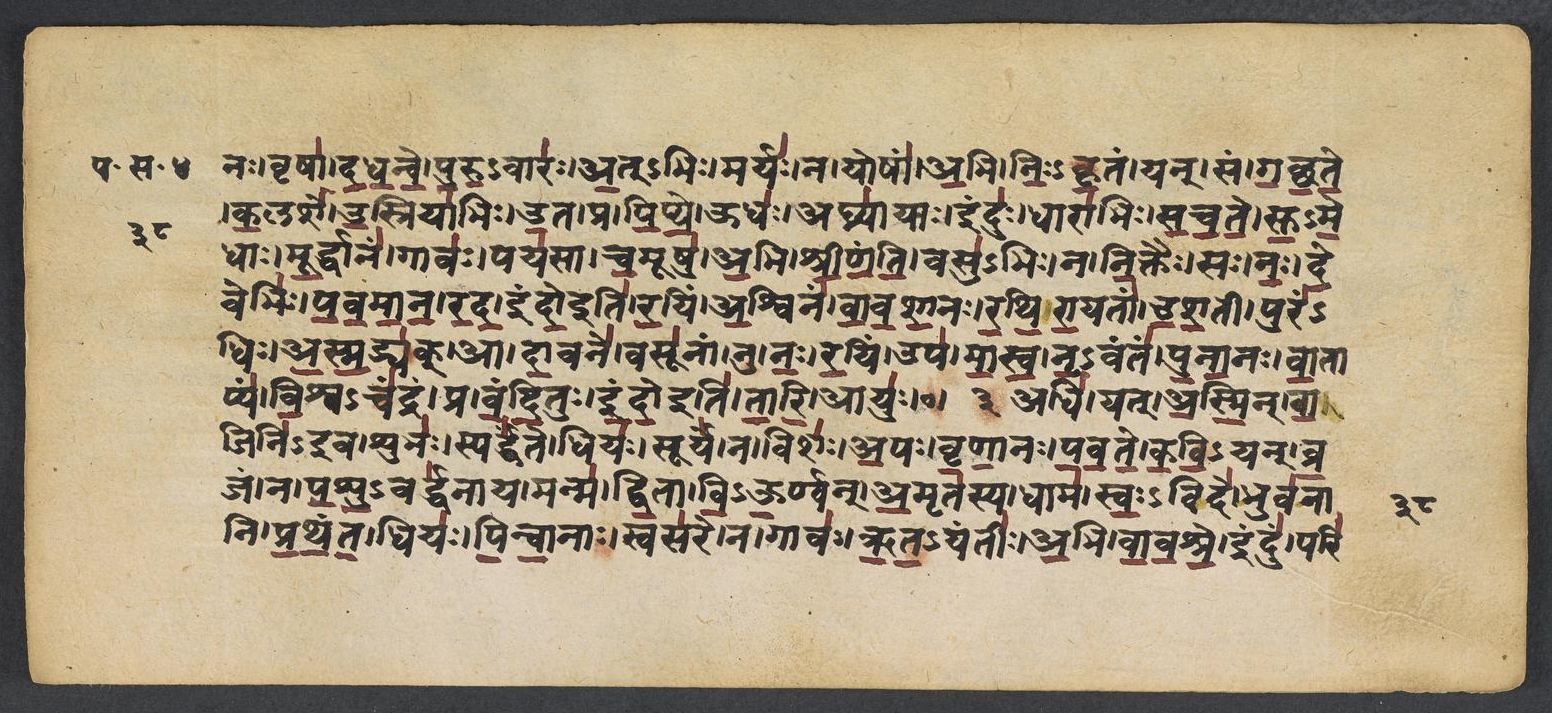
Where on the image
Penn Ms. Coll. 390 Item 41, fol. 721v (numbered 38v by the scribe) (OPenn image 722, upper leaf). Checked on the image: the Rigveda text on this page begins in RV 9.93.2 ‹-vāvaśānaḥ vṛṣā dadhanve puru-vāraḥ›. The next page with Rigveda text, fol. 722r (numbered 39r by the scribe), begins in RV 9.94.3 ‹yat kaviḥ kāvyā bharate›. Verses 9.94.1-2 end on this page.
1adhi̱ yad a̍smin vā̱jinī̍va̱ śubha̱ḥ spardha̍nte̱ dhiya̱ḥ sūrye̱ na viśa̍ḥ | a̱po vṛ̍ṇā̱naḥ pa̍vate kavī̱yan vra̱jaṁ na pa̍śu̱vardha̍nāya̱ manma̍ ||
2dvi̱tā vyū̱rṇvann a̱mṛta̍sya̱ dhāma̍ sva̱rvide̱ bhuva̍nāni prathanta | dhiya̍ḥ pinvā̱nāḥ svasa̍re̱ na gāva̍ ṛtā̱yantī̍r a̱bhi vā̍vaśra̱ indu̍m ||
Compare: Padapāṭha (word-by-word text written in the manuscript; Sansknet e-text via GRETIL)
1adhi | yat | asmin | vājini-iva | śubhaḥ | spardhante | dhiyaḥ | sūrye | na | viśaḥ | apaḥ | vṛṇānaḥ | pavate | kavi-yan | vrajam | na | paśu-vardhanāya | manma
2dvitā | vi-ūrṇvan | amṛtasya | dhāma | svaḥ-vide | bhuvanāni | prathanta | dhiyaḥ | pinvānāḥ | svasare | na | gāvaḥ | ṛta-yantīḥ | abhi | vavaśre | indum
1WHEN beauties strive for him as for a charger, then strive the songs like soldiers for the sunlight. Acting the Sage, he flows enrobed in waters and song as 'twere a stall that kine may prosper.
2The worlds expand to hirn who from aforetime found light to spread the law of life eternal. The swelling songs, like kine within the stable, in deep devotion call aloud on Indu.
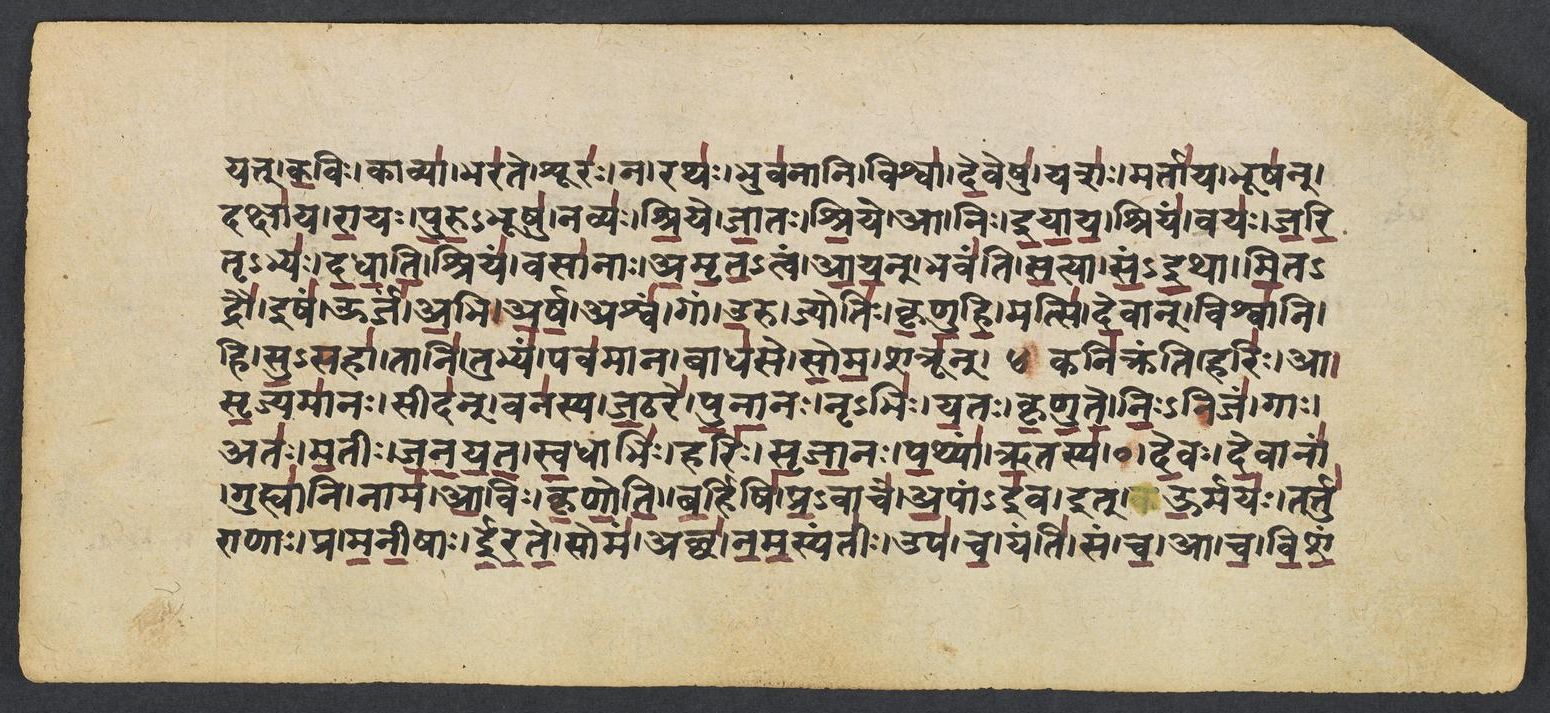
Where on the image
Penn Ms. Coll. 390 Item 41, fol. 722r (numbered 39r by the scribe) (OPenn image 722, lower leaf). Checked on the image: the Rigveda text on this page begins in RV 9.94.3 ‹yat kaviḥ kāvyā bharate›. The next page with Rigveda text, fol. 722v (numbered 39v by the scribe), begins in RV 9.95.3 ‹-viśanti uśatīḥ uśantam›. Verses 9.94.3-5 end on this page; 9.94.3 begins on fol. 721v (numbered 38v by the scribe).
3pari̱ yat ka̱viḥ kāvyā̱ bhara̍te̱ śūro̱ na ratho̱ bhuva̍nāni̱ viśvā̍ | de̱veṣu̱ yaśo̱ martā̍ya̱ bhūṣa̱n dakṣā̍ya rā̱yaḥ pu̍ru̱bhūṣu̱ navya̍ḥ ||
4śri̱ye jā̱taḥ śri̱ya ā nir i̍yāya̱ śriya̱ṁ vayo̍ jari̱tṛbhyo̍ dadhāti | śriya̱ṁ vasā̍nā amṛta̱tvam ā̍ya̱n bhava̍nti sa̱tyā sa̍mi̱thā mi̱tadrau̍ ||
5iṣa̱m ūrja̍m a̱bhy a1̱̍rṣāśva̱ṁ gām u̱ru jyoti̍ḥ kṛṇuhi̱ matsi̍ de̱vān | viśvā̍ni̱ hi su̱ṣahā̱ tāni̱ tubhya̱m pava̍māna̱ bādha̍se soma̱ śatrū̍n ||
Compare: Padapāṭha (word-by-word text written in the manuscript; Sansknet e-text via GRETIL)
3pari | yat | kaviḥ | kāvyā | bharate | śūraḥ | na | rathaḥ | bhuvanāni | viśvā | deveṣu | yaśaḥ | martāya | bhūṣan | dakṣāya | rāyaḥ | puru-bhūṣu | navyaḥ
4śriye | jātaḥ | śriye | ā | niḥ | iyāya | śriyam | vayaḥ | jaritṛ-bhyaḥ | dadhāti | śriyam | vasānāḥ | amṛta-tvam | āyan | bhavanti | satyā | sam-ithā | mita-drau
5iṣam | ūrjam | abhi | arṣa | aśvam | gām | uru | jyotiḥ | kṛṇuhi | matsi | devān | viśvāni | hi | su-sahā | tāni | tubhyam | pavamāna | bādhase | soma | śatrūn
3When the sage bears his holy wisdom round him, like a car visiting all worlds, the Hero, Becoming fame, mid Gods, unto the mortal, wealth to the skilled, worth praise mid the Ever-present,
4For glory born he hath come forth to glory: he giveth life and glory to the singers. They, clothed in glory, have become immortal. He, measured in his course, makes frays successful.
5Stream to us food and vigour, kine and horses: give us broad lights and fill thGods with rapture. All these are easy things for thee to master thou, Pavamâna Soma, quellest foemen.
Notes
- Sanskrit: Aufrecht's edition (1877) with the Vedic accents, as entered by van Nooten and Holland (GRETIL).
- English: Ralph T. H. Griffith, The Hymns of the Rigveda (1889-1892; 2nd ed. 1896-1897), from the VedaWeb digital text; OCR slips in that text were corrected against the printed 2nd edition (data/sources/rigveda/griffith_errata.json).
- Padapāṭha (edition text): Sansknet e-text via GRETIL (CC BY-NC-SA 4.0).
Cite
Sources
- Source: Penn Ms. Coll. 390 Item 41 (undated (catalogued with Penn's 18th-19th c. Vedic manuscripts)), OPenn, Public Domain Mark + Aufrecht's accented text (GRETIL) + Griffith's English (VedaWeb) (holding institution)
- Critical edition: Aufrecht (1877), accented e-text via GRETIL
← previous · → next · v cycle view · l back to library