Rigveda 9.98: To Soma
Introduction
Rigveda 9.98 is a hymn of 12 verses addressed to Soma. It stands in book (maṇḍala) 9, the hymns to Soma Pavamāna. The Rigveda is the oldest collection of Sanskrit hymns, composed in the second half of the second millennium BCE and handed down orally for many centuries before it was written down.
The manuscript shown is Penn Ms. Coll. 390 Item 41 (University of Pennsylvania), an undated paper manuscript of the padapāṭha (the word-by-word recitation text, in which every word is written separately and compounds are split) of the whole Ṛgveda in Devanāgarī, 884 leaves in fascicles, 7-9 lines to the page, accents in red; this hymn stands on fol. 730r-730v. Each section below gives the verses that end on one page; the page boundaries were read on the images (the opening words of every page), not counted out. Where the manuscript is a padapāṭha (the word-by-word recitation text), the section shows Aufrecht's continuous (saṃhitā) text first and, as the edition text, the padapāṭha of the same verses, which is the form written on the page.
How was this verified? (Provenance)
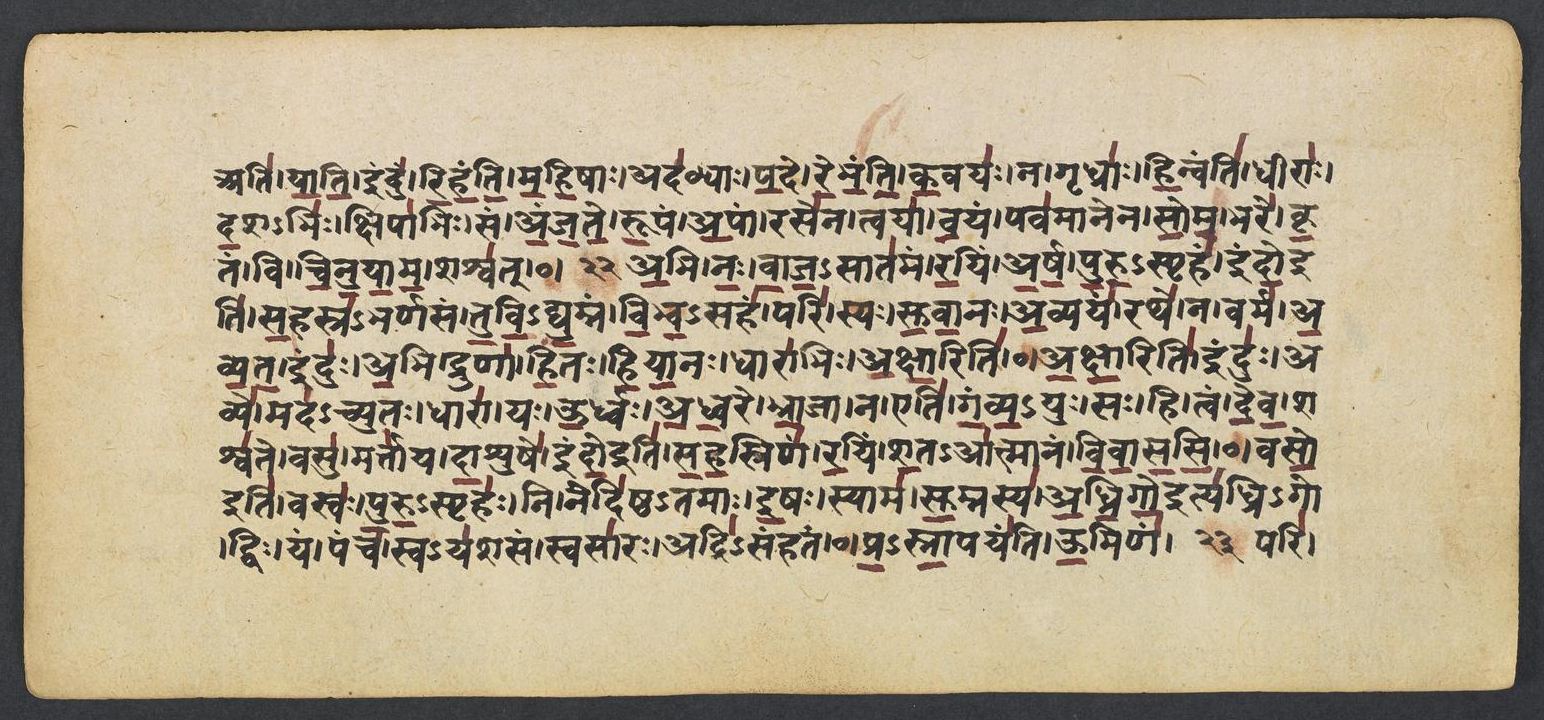
Where on the image
Penn Ms. Coll. 390 Item 41, fol. 730r (numbered 47r by the scribe) (OPenn image 730, lower leaf). Checked on the image: the Rigveda text on this page begins in RV 9.97.56 ‹ati yāti›. The next page with Rigveda text, fol. 730v (numbered 47v by the scribe), begins in RV 9.98.7 ‹tyam haryatam harim babhrum›. Verses 9.98.1-6 end on this page.
1a̱bhi no̍ vāja̱sāta̍maṁ ra̱yim a̍rṣa puru̱spṛha̍m | indo̍ sa̱hasra̍bharṇasaṁ tuvidyu̱mnaṁ vi̍bhvā̱saha̍m ||
2pari̱ ṣya su̍vā̱no a̱vyaya̱ṁ rathe̱ na varmā̍vyata | indu̍r a̱bhi druṇā̍ hi̱to hi̍yā̱no dhārā̍bhir akṣāḥ ||
3pari̱ ṣya su̍vā̱no a̍kṣā̱ indu̱r avye̱ mada̍cyutaḥ | dhārā̱ ya ū̱rdhvo a̍dhva̱re bhrā̱jā naiti̍ gavya̱yuḥ ||
4sa hi tvaṁ de̍va̱ śaśva̍te̱ vasu̱ martā̍ya dā̱śuṣe̍ | indo̍ saha̱sriṇa̍ṁ ra̱yiṁ śa̱tātmā̍naṁ vivāsasi ||
5va̱yaṁ te̍ a̱sya vṛ̍traha̱n vaso̱ vasva̍ḥ puru̱spṛha̍ḥ | ni nedi̍ṣṭhatamā i̱ṣaḥ syāma̍ su̱mnasyā̍dhrigo ||
6dvir yam pañca̱ svaya̍śasa̱ṁ svasā̍ro̱ adri̍saṁhatam | pri̱yam indra̍sya̱ kāmya̍m prasnā̱paya̍nty ū̱rmiṇa̍m ||
Compare: Padapāṭha (word-by-word text written in the manuscript; Sansknet e-text via GRETIL)
1abhi | naḥ | vāja-sātamam | rayim | arṣa | puru-spṛham | indo iti | sahasra-bharṇasam | tuvi-dyumnam | vibhva-saham
2pari | syaḥ | suvānaḥ | avyayam | rathe | na | varma | avyata | induḥ | abhi | drūṇā | hitaḥ | hiyānaḥ | dhārābhiḥ | akṣāriti
3pari | syaḥ | suvānaḥ | akṣāriti | induḥ | avye | mada-cyutaḥ | dhārā | yaḥ | ūrdhvaḥ | adhvare | bhrājā | na | eti | gavya-yuḥ
4saḥ | hi | tvam | deva | śaśvate | vasu | martāya | dāśuṣe | indo iti | sahasriṇam | rayim | śata-ātmānam | vivāsasi
5vayam | te | asya | vṛtra-han | vaso iti | vasvaḥ | puru-spṛhaḥ | ni | nediṣṭha-tamāḥ | iṣaḥ | syāma | sumnasya | adhrigo ity adhri-go
6dviḥ | yam | pañca | sva-yaśasam | svasāraḥ | adri-saṃhatam | priyam | indrasya | kāmyam | pra-snāpayanti | ūrmiṇam
1STREAM on us riches that are sought by many, best at winning strength Riches, O Indu, thousandfold, glorious, conquering the great.
2Effused, he hath, as on a car, invested him in fleecy mail: Onward hath Indu flowed in streams, impelled, surrounded by the wood.
3Effused, this Indu hath flowed on, distilling rapture, to the fleece: He goes erect, as seeking kine in stream, with light, to sacrifice.
4For thou thyself, O Indu, God, to every mortal worshipper Attractest riches thousandfold, made manifest in hundred forms.
5Good Vr̥itra-slayer, may we be still nearest to this wealth of thine Which many crave, nearest to food and happiness, Resistless One!
6Whom, bright with native splendour, crushed between the pair of pressingstones- The wavy Friend whom Indra loves-the twice-five sisters dip and bathe,
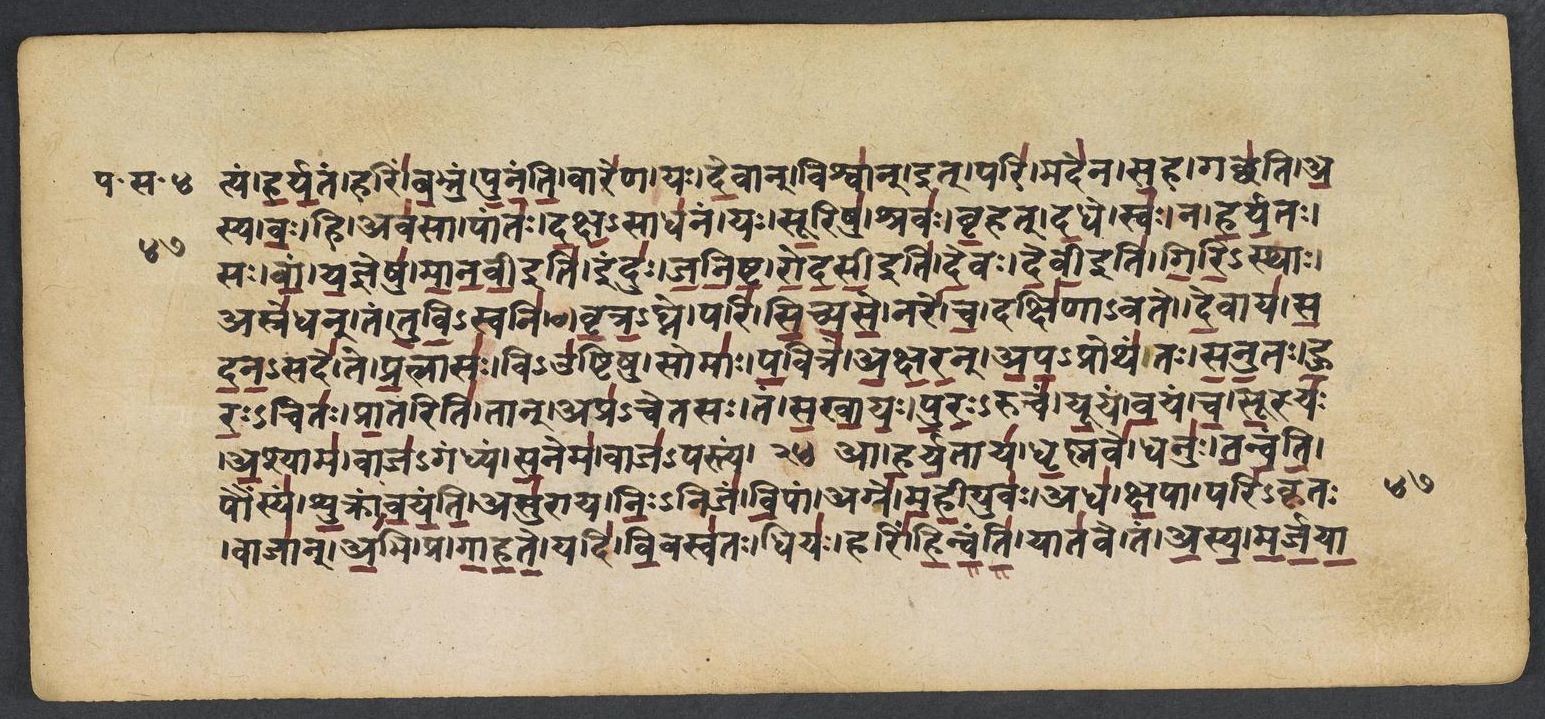
Where on the image
Penn Ms. Coll. 390 Item 41, fol. 730v (numbered 47v by the scribe) (OPenn image 731, upper leaf). Checked on the image: the Rigveda text on this page begins in RV 9.98.7 ‹tyam haryatam harim babhrum›. The next page with Rigveda text, fol. 731r (numbered 48r by the scribe), begins in RV 9.99.3 ‹-marjayāmasi madaḥ yaḥ indra-pātamaḥ›. Verses 9.98.7-12 end on this page; 9.98.7 begins on fol. 730r (numbered 47r by the scribe).
7pari̱ tyaṁ ha̍rya̱taṁ hari̍m ba̱bhrum pu̍nanti̱ vāre̍ṇa | yo de̱vān viśvā̱m̐ it pari̱ made̍na sa̱ha gaccha̍ti ||
8a̱sya vo̱ hy ava̍sā̱ pānto̍ dakṣa̱sādha̍nam | yaḥ sū̱riṣu̱ śravo̍ bṛ̱had da̱dhe sva1̱̍r ṇa ha̍rya̱taḥ ||
9sa vā̍ṁ ya̱jñeṣu̍ mānavī̱ indu̍r janiṣṭa rodasī | de̱vo de̍vī giri̱ṣṭhā asre̍dha̱n taṁ tu̍vi̱ṣvaṇi̍ ||
10indrā̍ya soma̱ pāta̍ve vṛtra̱ghne pari̍ ṣicyase | nare̍ ca̱ dakṣi̍ṇāvate de̱vāya̍ sadanā̱sade̍ ||
11te pra̱tnāso̱ vyu̍ṣṭiṣu̱ somā̍ḥ pa̱vitre̍ akṣaran | a̱pa̱protha̍ntaḥ sanu̱tar hu̍ra̱ścita̍ḥ prā̱tas tām̐ apra̍cetasaḥ ||
12taṁ sa̍khāyaḥ puro̱ruca̍ṁ yū̱yaṁ va̱yaṁ ca̍ sū̱raya̍ḥ | a̱śyāma̱ vāja̍gandhyaṁ sa̱nema̱ vāja̍pastyam ||
Compare: Padapāṭha (word-by-word text written in the manuscript; Sansknet e-text via GRETIL)
7pari | tyam | haryatam | harim | babhrum | punanti | vāreṇa | yaḥ | devān | viśvān | it | pari | madena | saha | gacchati
8asya | vaḥ | hi | avasā | pāntaḥ | dakṣa-sādhanam | yaḥ | sūriṣu | śravah | bṛhat | dadhe | svaḥ | na | haryataḥ
9saḥ | vām | yajñeṣu | mānavī iti | induḥ | janiṣṭa | rodasī iti | devaḥ | devī iti | giri-sthāḥ | asredhan | tam | tuvi-svani
10indrāya | soma | pātave | vṛtra-ghne | pari | sicyase | nare | ca | dakṣiṇāvate | devāya | sadana-sade
11te | pratnāsaḥ | vi-uṣṭiṣu | somāḥ | pavitre | akṣaran | apa-prothantaḥ | sanutaḥ | huraḥ-citaḥ | prātariti | tān | apra-cetasaḥ
12tam | sakhāyaḥ | puraḥ-rucam | yūyam | vayam | ca | sūrayaḥ | aśyāma | vāja-gandhyam | sanema | vāja-pastyam
7Him with the fleece they purify, brown, golden-hued, beloved of all, Who with exhilarating juice goes forth to all the Deities.
8Through longing for this sap of yours ye drink what brings ability, Even him who, dear as heaven's own light, gives to our princes high renown.
9Indu at holy rites produced you, Heaven and Earth, the Friends of men, Hill-haunting God the Goddesses. They bruised him where the roar was loud.
10For Vr̥itra-slaying Indra, thou, Soma, art poured that he may drink, Poured for the guerdon-giving man, poured for the God who sitteth there.
11These ancient Somas, at the break of day, have flowed into the sieve, Snorting away at early morn these foolish evil-hearted ones.
12Friends, may the princes, ye and we, obtain this Most Resplendent One. Gain him who hath the smell of strength, win him whose home is very strength.
Notes
- Sanskrit: Aufrecht's edition (1877) with the Vedic accents, as entered by van Nooten and Holland (GRETIL).
- English: Ralph T. H. Griffith, The Hymns of the Rigveda (1889-1892; 2nd ed. 1896-1897), from the VedaWeb digital text; OCR slips in that text were corrected against the printed 2nd edition (data/sources/rigveda/griffith_errata.json).
- Padapāṭha (edition text): Sansknet e-text via GRETIL (CC BY-NC-SA 4.0).
Cite
Sources
- Source: Penn Ms. Coll. 390 Item 41 (undated (catalogued with Penn's 18th-19th c. Vedic manuscripts)), OPenn, Public Domain Mark + Aufrecht's accented text (GRETIL) + Griffith's English (VedaWeb) (holding institution)
- Critical edition: Aufrecht (1877), accented e-text via GRETIL
← previous · → next · v cycle view · l back to library