Rigveda 9.99: To Soma
Introduction
Rigveda 9.99 is a hymn of 8 verses addressed to Soma. It stands in book (maṇḍala) 9, the hymns to Soma Pavamāna. The Rigveda is the oldest collection of Sanskrit hymns, composed in the second half of the second millennium BCE and handed down orally for many centuries before it was written down.
The manuscript shown is Penn Ms. Coll. 390 Item 41 (University of Pennsylvania), an undated paper manuscript of the padapāṭha (the word-by-word recitation text, in which every word is written separately and compounds are split) of the whole Ṛgveda in Devanāgarī, 884 leaves in fascicles, 7-9 lines to the page, accents in red; this hymn stands on fol. 730v-731r. Each section below gives the verses that end on one page; the page boundaries were read on the images (the opening words of every page), not counted out. Where the manuscript is a padapāṭha (the word-by-word recitation text), the section shows Aufrecht's continuous (saṃhitā) text first and, as the edition text, the padapāṭha of the same verses, which is the form written on the page.
How was this verified? (Provenance)
Where on the image
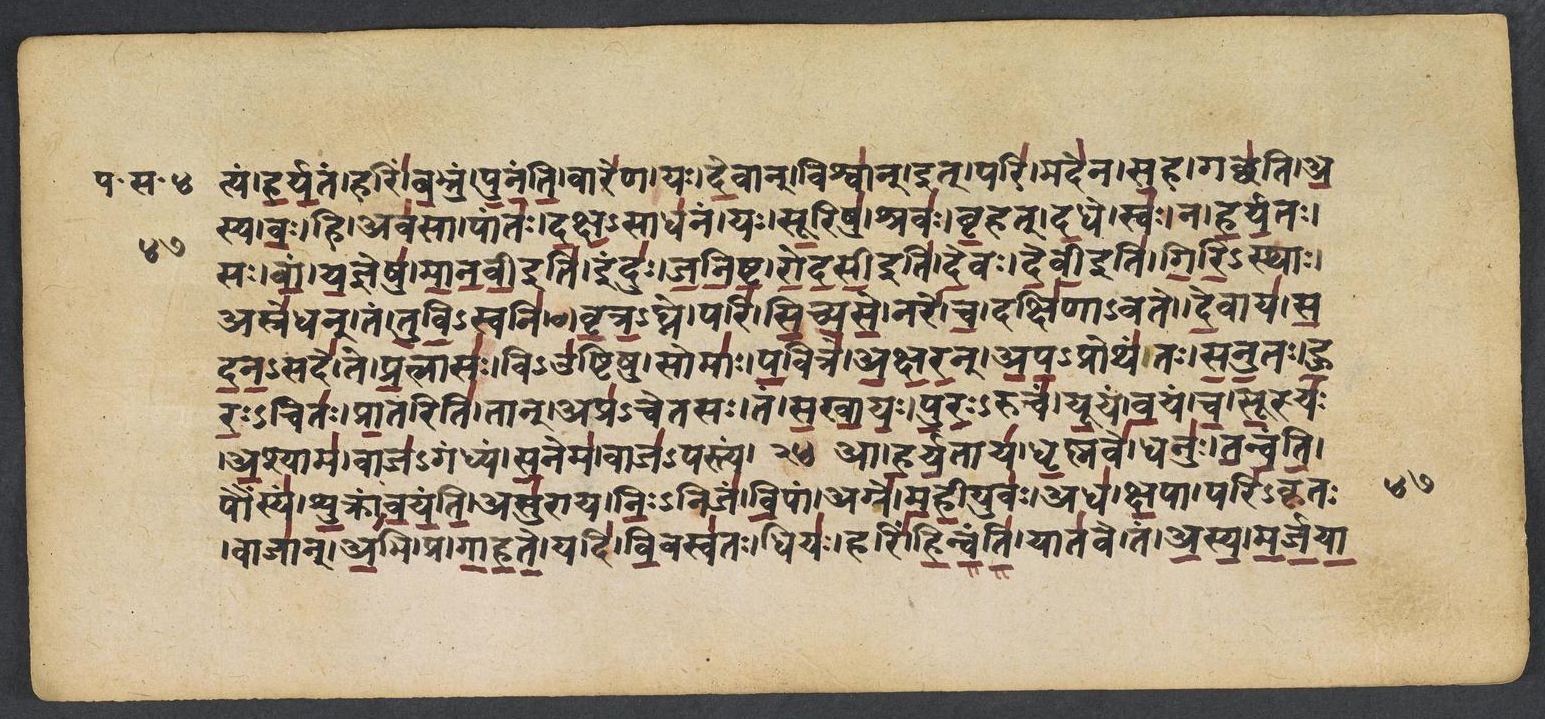
Penn Ms. Coll. 390 Item 41, fol. 730v (numbered 47v by the scribe) (OPenn image 731, upper leaf). Checked on the image: the Rigveda text on this page begins in RV 9.98.7 ‹tyam haryatam harim babhrum›. The next page with Rigveda text, fol. 731r (numbered 48r by the scribe), begins in RV 9.99.3 ‹-marjayāmasi madaḥ yaḥ indra-pātamaḥ›. Verses 9.99.1-2 end on this page.
1ā ha̍rya̱tāya̍ dhṛ̱ṣṇave̱ dhanu̍s tanvanti̱ pauṁsya̍m | śu̱krāṁ va̍ya̱nty asu̍rāya ni̱rṇija̍ṁ vi̱pām agre̍ mahī̱yuva̍ḥ ||
2adha̍ kṣa̱pā pari̍ṣkṛto̱ vājā̍m̐ a̱bhi pra gā̍hate | yadī̍ vi̱vasva̍to̱ dhiyo̱ hari̍ṁ hi̱nvanti̱ yāta̍ve ||
Compare: Padapāṭha (word-by-word text written in the manuscript; Sansknet e-text via GRETIL)
1ā | haryatāya | dhṛṣṇave | dhanuḥ | tanvanti | paiṃsyam | śukrām | vayanti | asurāya | niḥ-nijam | vipām | agre | mahīyuvaḥ
2adha | kṣapā | pari-kṛtaḥ | vājān | abhi | pra | gāhate | yadi | vivasvataḥ | dhiyaḥ | harim | hinvanti | yātave
1THEY for the Bold and Lovely One ply manly vigour like a bow: joyous, in front of songs they weave bright raiment for the Lord Divine.
2And he, made beautiful by night, dips forward into strengthening food', What time the sacrificer's thoughts speed on his way the Golden-hued.
Where on the image
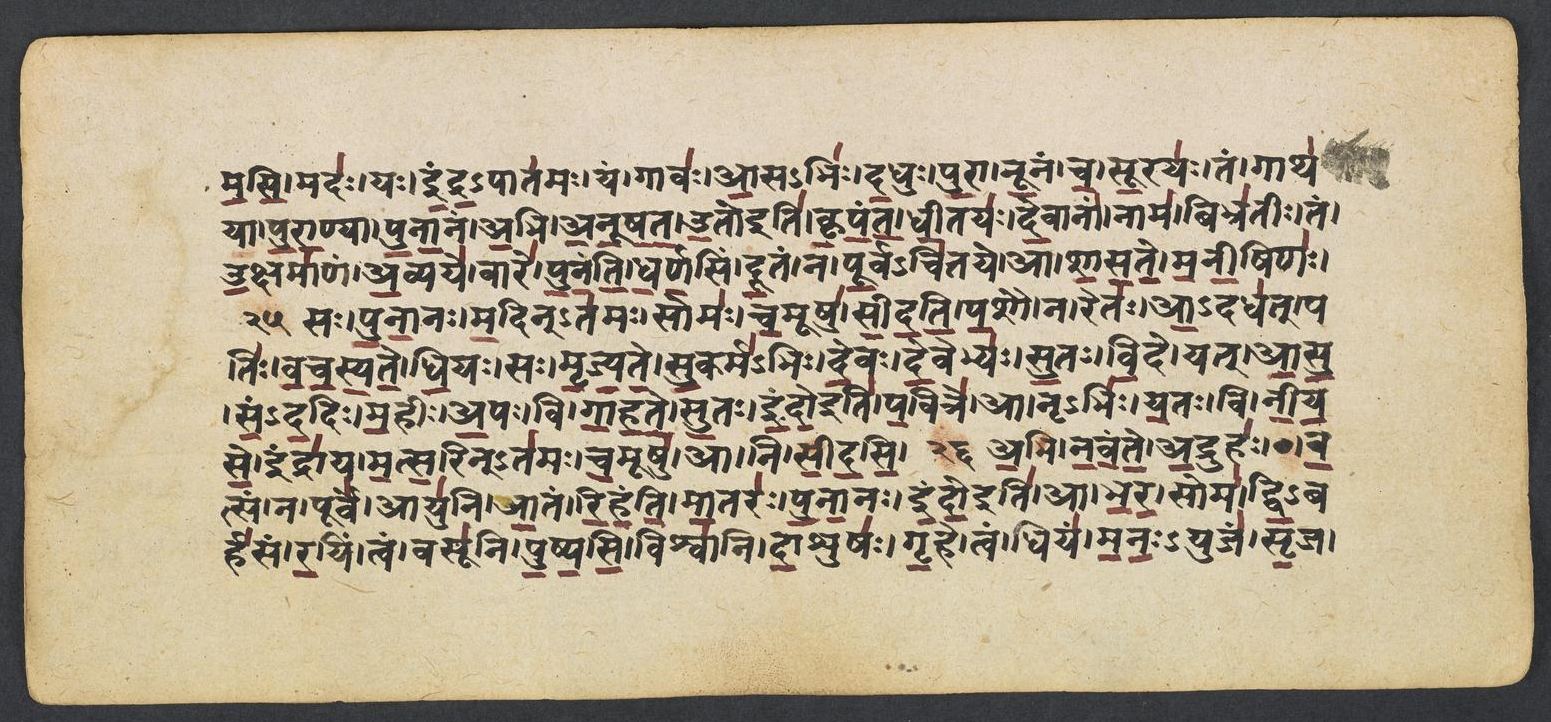
Penn Ms. Coll. 390 Item 41, fol. 731r (numbered 48r by the scribe) (OPenn image 731, lower leaf). Checked on the image: the Rigveda text on this page begins in RV 9.99.3 ‹-marjayāmasi madaḥ yaḥ indra-pātamaḥ›. The next page with Rigveda text, fol. 731v (numbered 48v by the scribe), begins in RV 9.100.3 ‹vṛṣṭim na tanyatuḥ tvam›. Verses 9.99.3-8 end on this page; 9.99.3 begins on fol. 730v (numbered 47v by the scribe).
3tam a̍sya marjayāmasi̱ mado̱ ya i̍ndra̱pāta̍maḥ | yaṁ gāva̍ ā̱sabhi̍r da̱dhuḥ pu̱rā nū̱naṁ ca̍ sū̱raya̍ḥ ||
4taṁ gātha̍yā purā̱ṇyā pu̍nā̱nam a̱bhy a̍nūṣata | u̱to kṛ̍panta dhī̱tayo̍ de̱vānā̱ṁ nāma̱ bibhra̍tīḥ ||
5tam u̱kṣamā̍ṇam a̱vyaye̱ vāre̍ punanti dharṇa̱sim | dū̱taṁ na pū̱rvaci̍ttaya̱ ā śā̍sate manī̱ṣiṇa̍ḥ ||
6sa pu̍nā̱no ma̱dinta̍ma̱ḥ soma̍ś ca̱mūṣu̍ sīdati | pa̱śau na reta̍ ā̱dadha̱t pati̍r vacasyate dhi̱yaḥ ||
7sa mṛ̍jyate su̱karma̍bhir de̱vo de̱vebhya̍ḥ su̱taḥ | vi̱de yad ā̍su saṁda̱dir ma̱hīr a̱po vi gā̍hate ||
8su̱ta i̍ndo pa̱vitra̱ ā nṛbhi̍r ya̱to vi nī̍yase | indrā̍ya matsa̱rinta̍maś ca̱mūṣv ā ni ṣī̍dasi ||
Compare: Padapāṭha (word-by-word text written in the manuscript; Sansknet e-text via GRETIL)
3tam | asya | marjayāmasi | madaḥ | yaḥ | indra-pātamaḥ | yam | gāvaḥ | āsa-bhiḥ | dadhuḥ | purā | nūnam | ca | sūrayaḥ
4tam | gāthayā | purāṇyā | punānam | abhi | anūṣata | uto iti | kṛpanta | dhītayaḥ | devānām | nāma | bibhratīḥ
5tam | ukṣamāṇam | avyaye | vāre | punanti | dharṇasim | dūtam | na | pūrva-cittaye | ā | śāsate | manīṣiṇaḥ
6saḥ | punānaḥ | madin-tamaḥ | somaḥ | camūṣu | sīdati | paśau | na | retaḥ | ādadhat | patiḥ | vacasyate | dhiyaḥ
7saḥ | mṛjyate | sukarma-bhiḥ | devaḥ | devebhyaḥ | sutaḥ | vide | yat | āsu | sam-dadiḥ | mahīḥ | apaḥ | vi | gāhate
8sutaḥ | indo iti | pavitre | ā | nṛ-bhiḥ | yataḥ | vi | nīyase | indrāya | matsarin-tamaḥ | camūṣu | ā | ni | sīdasi
3We cleanse this gladdening drink of his the juice which Indra chiefly drinks--- That which kine took into their mouths, of old, and princes take it now.
4To him, while purifying, they have raised the ancient psalm of praise: And sacred songs which bear the names of Gods have supplicated him.
5They purify him as he drops, courageous, in the fleecy sieve. Him they instruct as messenger to bear the sage's morning prayer.
6Soma, best Cheerer, takes his seat, the while they cleanse him in the bowls. He as it were impregns the cow, and babbles on, the Lord of Song.
7He is effused and beautified, a God for Gods, by skilful men. He penetrates the mighty floods collecting all he knows therein.
8Pressed, Indu, guided by the men, thou art led to the cleaning sieve. Thou, yielding Indra highest joy, takest thy seat within the bowls.
Notes
- Sanskrit: Aufrecht's edition (1877) with the Vedic accents, as entered by van Nooten and Holland (GRETIL).
- English: Ralph T. H. Griffith, The Hymns of the Rigveda (1889-1892; 2nd ed. 1896-1897), from the VedaWeb digital text; OCR slips in that text were corrected against the printed 2nd edition (data/sources/rigveda/griffith_errata.json).
- Padapāṭha (edition text): Sansknet e-text via GRETIL (CC BY-NC-SA 4.0).
Cite
Sources
- Source: Penn Ms. Coll. 390 Item 41 (undated (catalogued with Penn's 18th-19th c. Vedic manuscripts)), OPenn, Public Domain Mark + Aufrecht's accented text (GRETIL) + Griffith's English (VedaWeb) (holding institution)
- Critical edition: Aufrecht (1877), accented e-text via GRETIL
← previous · → next · v cycle view · l back to library