Sanchuniathon: the Phoenician cosmogony and the first worship (Eusebius, Praeparatio evangelica 1.10.1-8)
Introduction
Philo of Byblos, a Phoenician grammarian writing in Greek around 100 AD, claimed to have translated the Phoenician History of Sanchuniathon of Berytus, a priestly writer said to have lived before the Trojan War, who drew on the city records and the temple inscriptions of Phoenicia and on the writings of Taautus (Thoth). Philo's work survives only in the long quotations that Eusebius of Caesarea copied into book 1 of his Preparation for the Gospel (c. 313 AD), taken partly through the philosopher Porphyry. It is the fullest account of Phoenician myth in Greek, and since the discovery of the Ugaritic tablets (14th-13th c. BCE) several of its gods and stories, such as El, Dagon, the succession of divine kings and the castration of the sky god, are known to go back to Bronze Age Canaan.
The manuscript shown is Paris, Bibliothèque nationale de France, grec 451, written in 914 AD by the scribe Baanes for Arethas, archbishop of Caesarea in Cappadocia; it is the oldest manuscript of books 1-5 of the Preparation. The passage runs from fol. 204v to fol. 213v. Each section is one of Dindorf's numbered sections and points at the page(s) that carry it; the page breaks were read on the images and are recorded in each note.
This entry covers sections 1.10.1 to 1.10.8, on fols. 206v to 207v.
How was this verified? (Provenance)
Where on the image
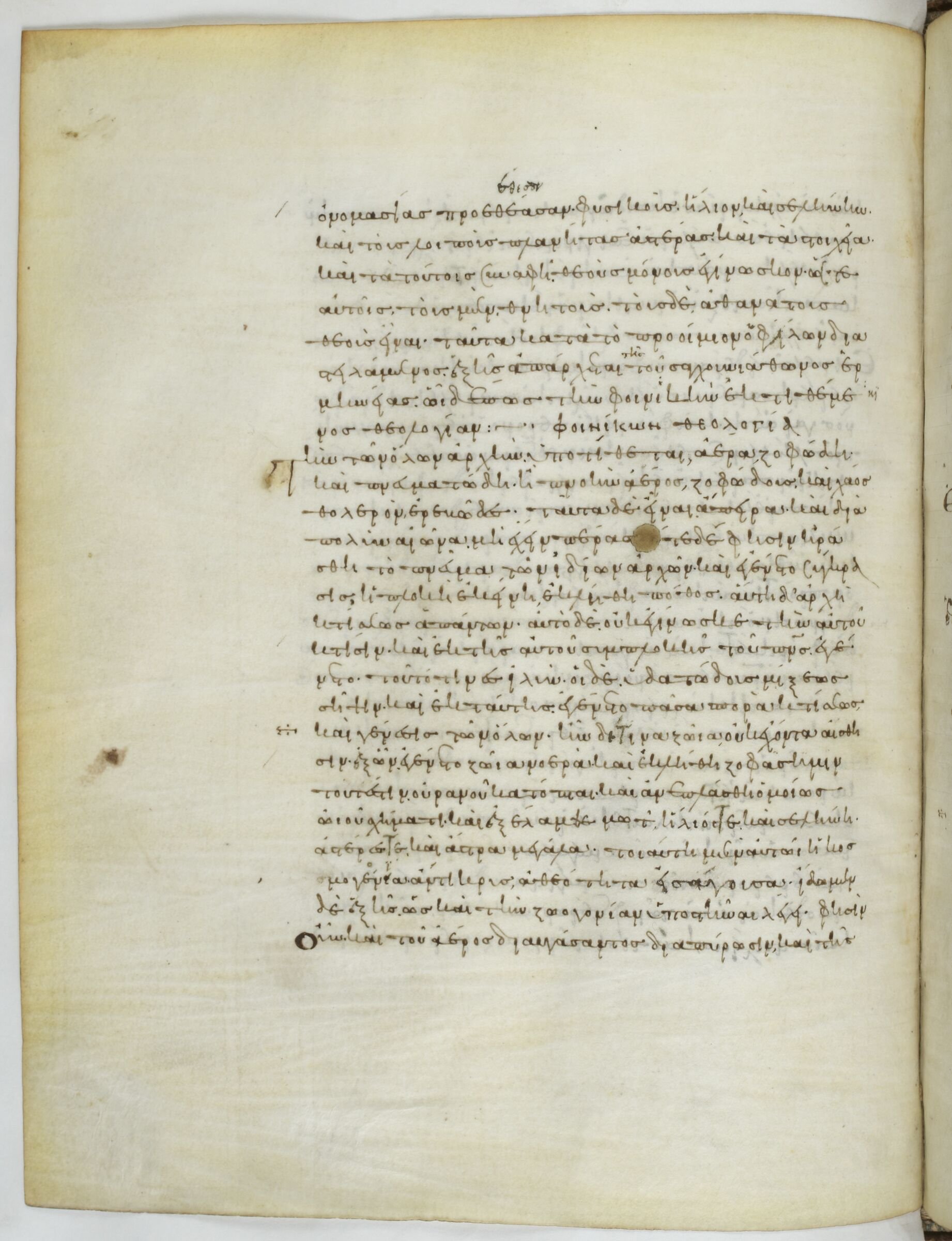
1.10.1 is on fol. 206v. Fol. 206v: begins 'ὀνομασίας ἐπέθεσαν· φυσικοὺς δὲ ἥλιον καὶ σελήνην' (1.9.29); the last line, with a large initial, starts 1.10.4 'Καὶ τοῦ ἀέρος διαυγάσαντος διὰ πύρωσιν καὶ τῆς'. Checked on the image. Viewer: https://gallica.bnf.fr/ark:/12148/btv1b84701396/f418.item
10.1“ Τὴν τῶν ὅλων ἀρχὴν ὑποτίθεται ἀέρα ζοφώδη καὶ πνευματώδη, ἢ πνοὴν ἀέρος ζοφώδους, καὶ χάος θολερὸν, ἐρεβῶδες. ταῦτα δὲ εἶναι ἄπειρα καὶ διὰ πολὺν αἰῶνα μὴ ἔχειν πέρας. ὅτε δὲ, φησὶν, ἠράσθη τὸ πνεῦμα τῶν ἰδίων ἀρχῶν καὶ ἐγένετο σύγκρασις, ἡ πλοκὴ ἐκείνη ἐκλήθη πόθος. αὕτη δὲ ἀρχὴ κτίσεως ἁπάντων. αὐτὸ δὲ οὐκ ἐγίνωσκε τὴν αὐτοῦ κτίσιν, καὶ ἐκ τῆς αὐτοῦ συμπλοκῆς τοῦ πνεύματος ἐγένετο Μώτ.
10.1'The first principle of the universe he supposes to have been air dark with cloud and wind, or rather a blast of cloudy air, and a turbid chaos dark as Erebus; and these were boundless and for long ages had no limit. But when the wind, says he, became enamoured of its own parents, and a mixture took place, that connexion was called Desire. This was the beginning of the creation of all things: but the wind itself had no knowledge of its own creation. From its connexion Môt was produced,
Where on the image
1.10.2 is on fol. 206v. Fol. 206v: begins 'ὀνομασίας ἐπέθεσαν· φυσικοὺς δὲ ἥλιον καὶ σελήνην' (1.9.29); the last line, with a large initial, starts 1.10.4 'Καὶ τοῦ ἀέρος διαυγάσαντος διὰ πύρωσιν καὶ τῆς'. Checked on the image. Viewer: https://gallica.bnf.fr/ark:/12148/btv1b84701396/f418.item
10.2τοῦτό τινές φασιν ἰλὺν, οἱ δὲ ὑδατώδους μίξεως σῆψιν. καὶ ἐκ ταύτης ἐγένετο πᾶσα σπορὰ κτίσεως καὶ γένεσις τῶν ὅλων. ἦν δέ τινα ζῷα οὐκ ἔχοντα αἴσθησιν, ἐξ ὧν ἐγένετο ζῷα νοερὰ, καὶ ἐκλήθη Ζωφασημὶν, τοῦτ’ ἔστιν οὐρανοῦ κατόπται. καὶ ἀνεπλάσθη ὁμοίως ᾠοῦ σχήματι, καὶ ἐξέλαμψε Μὼτ, ἥλιός τε καὶ σελήνη ἀστέρες τε καὶ ἄστρα μεγάλα.”
10.2which some say is mud, and others a putrescence of watery compound; and out of this came every germ of creation, and the generation of the universe. So there were certain animals which had no sensation, and out of them grew intelligent animals, and were called "Zophasemin," that is "observers of heaven"; and they were formed like the shape of an egg. Also Mot burst forth into light, and sun, and moon, and stars, and the great constellations.'
Where on the image
1.10.3 is on fol. 206v. Fol. 206v: begins 'ὀνομασίας ἐπέθεσαν· φυσικοὺς δὲ ἥλιον καὶ σελήνην' (1.9.29); the last line, with a large initial, starts 1.10.4 'Καὶ τοῦ ἀέρος διαυγάσαντος διὰ πύρωσιν καὶ τῆς'. Checked on the image. Viewer: https://gallica.bnf.fr/ark:/12148/btv1b84701396/f418.item
10.3Τοιαύτη μὲν αὐτῶν ἡ κοσμογονία, ἄντικρυς ἀθεότητα εἰσάγουσα· ἴδωμεν δὲ ἐξῆς ὡς καὶ τὴν ζωογονίαν ὑποστῆναι λέγει. φησὶν οὖν
10.3Such was their cosmogony, introducing downright atheism. But let us see next how he states the generation of animals to have arisen. He says, then:
Where on the image
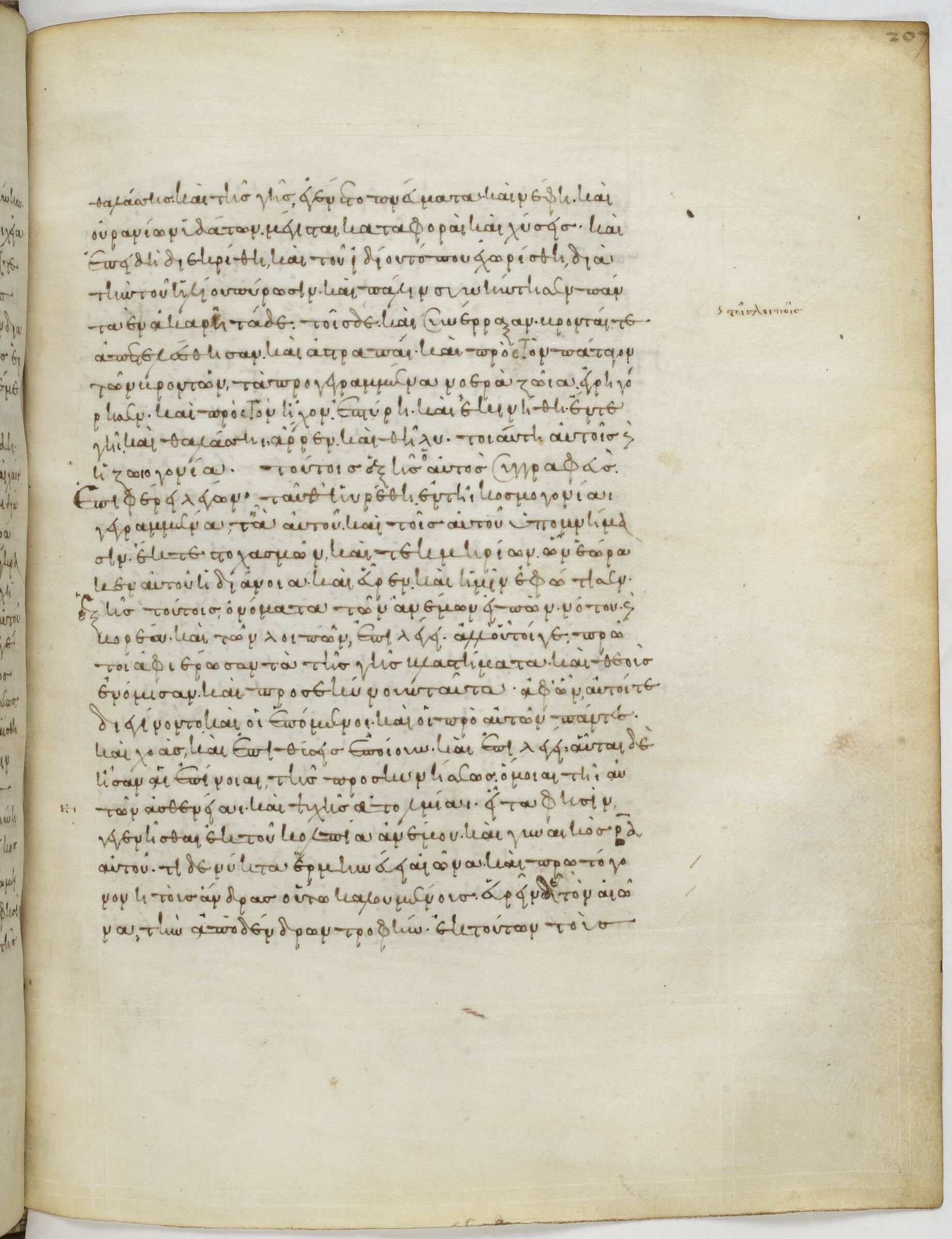
1.10.4 runs from fol. 206v to fol. 207r. Fol. 206v: begins 'ὀνομασίας ἐπέθεσαν· φυσικοὺς δὲ ἥλιον καὶ σελήνην' (1.9.29); the last line, with a large initial, starts 1.10.4 'Καὶ τοῦ ἀέρος διαυγάσαντος διὰ πύρωσιν καὶ τῆς'. Fol. 207r: begins 'θαλάσσης καὶ τῆς γῆς ἐγένετο πνεύματα καὶ νέφη' (1.10.4) and ends in 1.10.7 '...εὑρεῖν δὲ τὸν Αἰῶνα τὴν ἀπὸ δένδρων τροφήν. ἐκ τούτων τοὺς'. Checked on the image. Viewer: https://gallica.bnf.fr/ark:/12148/btv1b84701396/f418.item
10.4“Καὶ τοῦ ἀέρος διαυγάσαντος, διὰ πύρωσιν καὶ τῆς θαλάσσης καὶ τῆς γῆς ἐγένετο πνεύματα καὶ νέφη καὶ οὐρανίων ὑδάτων μέγισται καταφοραὶ καὶ χύσεις. καὶ ἐπειδὴ διεκρίθη, καὶ τοῦ ἰδίου τόπου διεχωρίσθη διὰ τὴν τοῦ ἡλίου πύρωσιν, καὶ πάντα συνήντησε πάλιν ἐν ἀέρι τάδε τοῖσδε, καὶ συνέρραξαν, βρονταί τε ἀπετελέσθησαν καὶ ἀστραπαὶ, καὶ πρὸς τὸν πάταγον τῶν βροντῶν τὰ προγεγραμμένα νοερὰ ζῷα ἐγρηγόρησεν, καὶ πρὸς τὸν ἦχον ἐπτύρη, καὶ ἐκινήθη ἔν τε γῇ καὶ θαλάσσῃ ἄρρεν καὶ θῆλυ.”
10.4'And when the air burst into light, both the sea and the land became heated, and thence arose winds and clouds, and very great downpours and floods of the waters of heaven. So after they were separated, and removed from their proper place because of the sun's heat, and all met together again in the air dashing together one against another, thunderings and lightnings were produced, and at the rattle of the thunder the intelligent animals already described woke up, and were scared at the sound, and began to move both on land and sea, male and female.'
Where on the image
1.10.5 is on fol. 207r. Fol. 207r: begins 'θαλάσσης καὶ τῆς γῆς ἐγένετο πνεύματα καὶ νέφη' (1.10.4) and ends in 1.10.7 '...εὑρεῖν δὲ τὸν Αἰῶνα τὴν ἀπὸ δένδρων τροφήν. ἐκ τούτων τοὺς'. Checked on the image. Viewer: https://gallica.bnf.fr/ark:/12148/btv1b84701396/f419.item
10.5Τοιαύτη αὐτοῖς καὶ ἡ ζωογονία. τούτοις ἐξῆς ὁ αὐτὸς συγγραφεὺς ἐπιφέρει λέγων “Ταῦθ’ ηὑρέθη ἐν τῇ κοσμογονίᾳ γεγραμμένα Τααύτου καὶ τοῖς ἐκείνου ὑπομνήμασιν, ἔκ τε στοχασμῶν καὶ τεκμηρίων ὧν ἑώρακεν αὐτοῦ ἡ διάνοια καὶ ηὗρε καὶ ἡμῖν ἐφώτισεν.”
10.5Such is their theory of the generation of animals. Next after this the same writer adds and says: 'These things were found written in the cosmogony of Taautus, and in his Commentaries, both from conjectures, and from evidences which his intellect discerned, and discovered, and made clear to us.'
Where on the image
1.10.6 is on fol. 207r. Fol. 207r: begins 'θαλάσσης καὶ τῆς γῆς ἐγένετο πνεύματα καὶ νέφη' (1.10.4) and ends in 1.10.7 '...εὑρεῖν δὲ τὸν Αἰῶνα τὴν ἀπὸ δένδρων τροφήν. ἐκ τούτων τοὺς'. Checked on the image. Viewer: https://gallica.bnf.fr/ark:/12148/btv1b84701396/f419.item
10.6Ἑξῆς τούτοις ὀνόματα τῶν ἀνέμων εἰπὼν νότου καὶ βορέου καὶ τῶν λοιπῶν ἐπιλέγει “Ἀλλ’ οὗτοί γε πρῶτοι ἀφιέρωσαν τὰ τῆς γῆς βλαστήματα καὶ θεοὺς ἐνόμισαν, καὶ προσεκύνουν ταῦτα, ἀφ’ ὧν αὐτοί τε διεγένοντο καὶ οἱ ἑπόμενοι, καὶ οἱ πρὸ αὐτῶν πάντες, καὶ χοὰς καὶ ἐπιθύσεις ἐποίουν.”
10.6Next to this, after mentioning the names of the winds Notos and Boreas and the rest, he continues: 'But these were the first who consecrated the productions of the earth, and regarded them as gods, and worshipped them as being the support of life both to themselves, and to those who were to come after them, and to all before them, and they offered to them drink-offerings and libations.'
Where on the image
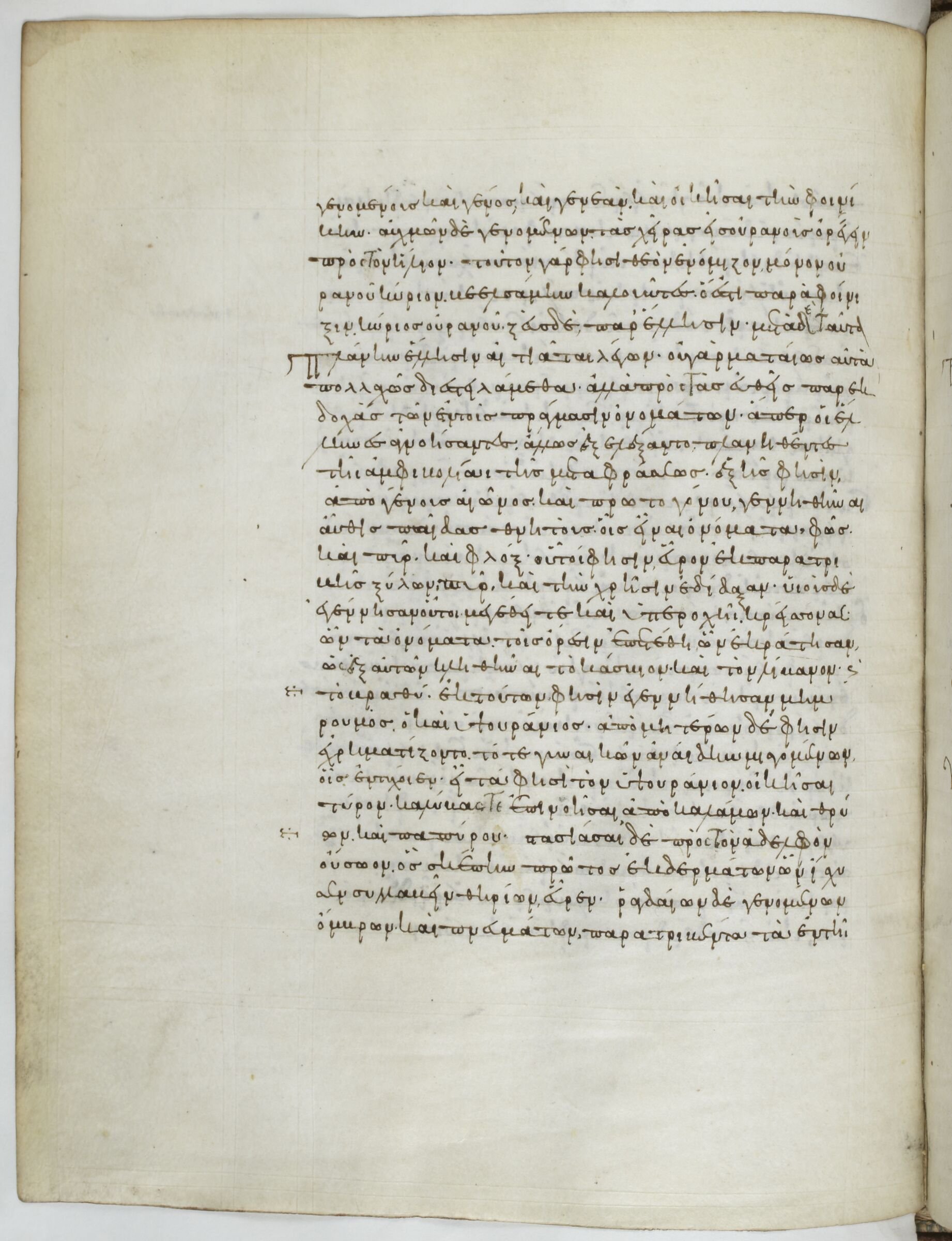
1.10.7 runs from fol. 207r to fol. 207v. Fol. 207r: begins 'θαλάσσης καὶ τῆς γῆς ἐγένετο πνεύματα καὶ νέφη' (1.10.4) and ends in 1.10.7 '...εὑρεῖν δὲ τὸν Αἰῶνα τὴν ἀπὸ δένδρων τροφήν. ἐκ τούτων τοὺς'. Fol. 207v: begins 'γενομένους' with 'Γένος καὶ Γενεὰν καὶ οἰκῆσαι τὴν Φοινίκην' (1.10.7) and ends in 1.10.10 '...ῥαγδαίων δὲ γενομένων ὄμβρων καὶ πνευμάτων παρατριβέντα τὰ ἐν τῇ'. Checked on the image. Viewer: https://gallica.bnf.fr/ark:/12148/btv1b84701396/f419.item
10.7Καὶ ἐπιλέγει “Αὗται δ’ ἦσαν αἱ ἐπίνοιαι τῆς προσκυνήσεως ὅμοιαι τῇ αὐτῶν ἀσθενείᾳ καὶ ψυχῆς ἀτολμίᾳ. εἶτά φησι γεγενῆσθαι ἐκ τοῦ Κολπία ἀνέμου καὶ γυναικὸς Βάαυτ, τοῦτο δὲ νύκτα ἑρμηνεύει, Αἰῶνα καὶ Πρωτόγονον, θνητοὺς ἄνδρας, οὕτω καλουμένους· εὑρεῖν δὲ τὸν Αἰῶνα τὴν ἀπὸ δένδρων τροφήν. ἐκ τούτων τοὺς γενομένους κληθῆναι Γένος καὶ Γενεὰν, καὶ οἰκῆσαι τὴν Φοινίκην· αὐχμῶν δὲ γενομένων τὰς χεῖρας εἰς οὐρανὸν ὀρέγειν πρὸς τὸν ἥλιον. τοῦτον γὰρ (φησὶ) θεὸν ἐνόμιζον μόνον οὐρανοῦ κύριον, Βεελσάμην καλοῦντες, ὅ ἐστι παρὰ Φοίνιξι κύριος οὐρανοῦ, Ζεὺς δὲ παρ’ Ἕλλησι.”
10.7He adds also: 'These were their notions of worship, corresponding to their own weakness, and timidity of soul. Then he says that from the wind Colpias and his wife Baau (which he translates "Night") were born Aeon and Protogonus, mortal men, so called: and that Aeon discovered the food obtained from trees. That their offspring were called Génos and Genea, and inhabited Phoenicia: and that when droughts occurred, they stretched out their hands to heaven towards the sun; for him alone (he says) they regarded as god the lord of heaven, calling him Beelsamen, which is in the Phoenician language "lord of heaven," and in Greek "Zeus."'
Where on the image
1.10.8 is on fol. 207v. Fol. 207v: begins 'γενομένους' with 'Γένος καὶ Γενεὰν καὶ οἰκῆσαι τὴν Φοινίκην' (1.10.7) and ends in 1.10.10 '...ῥαγδαίων δὲ γενομένων ὄμβρων καὶ πνευμάτων παρατριβέντα τὰ ἐν τῇ'. Checked on the image. Viewer: https://gallica.bnf.fr/ark:/12148/btv1b84701396/f420.item
10.8Μετὰ δὲ ταῦτα πλάνην Ἕλλησιν αἰτιᾶται λέγων “Οὐ γὰρ ματαίως αὐτὰ πολλαχῶς διεστειλάμεθα, ἀλλὰ πρὸς τὰς αὖθις παρεκδοχὰς τῶν ἐν τοῖς πράγμασιν ὀνομάτων, ἅπερ οἱ Ἕλληνες ἀγνοήσαντες ἄλλως ἐξεδέξαντο, πλανηθέντες τῇ ἀμφιβολίᾳ τῆς μεταφράσεως.”
10.8And after this he charges the Greeks with error, saying: 'For it is not without cause that we have explained these things in many ways, but in view of the later misinterpretations of the names in the history, which the Greeks in ignorance took in a wrong sense, being deceived by the ambiguity of the translation.'
Notes
- Greek: W. Dindorf's Teubner edition (1867), from the First1KGreek digital text, proofread against the printed pages. The manuscript's wording differs from the edition in small details; the Greek shown is the edition, not a transcription of the page.
- English: E. H. Gifford's translation (Oxford, 1903). Where a Greek section begins in the middle of an English sentence, the English is divided at the corresponding clause.
- Asterisks mark a gap that Dindorf indicates in the Greek of 1.10.36; Gifford marks it with dots.
Cite
Sources
- Source: Paris gr. 451 (Arethas codex, 914 AD) via Gallica + Dindorf Greek (First1KGreek, proofread) + Gifford English (1903) (holding institution)
- Critical edition: W. Dindorf, Eusebii Caesariensis opera I (Teubner 1867), First1KGreek, proofread
← previous · → next · v cycle view · l back to library