Book of Odes, Mao 237: Mian 緜 (Keicho-era print)
Introduction
緜 (Mian, Mao 237) is one of the Major Odes of the Kingdom (大雅 Daya) in the Book of Odes (詩經 Shijing); its subject is the ancient duke Danfu (Tai Wang) leading the Zhou people to the plain below Mount Qi and building there. With the other odes in this group it forms the Zhou court's account of how the house of Zhou rose to rule, and it was sung at the Zhou court; it is usually dated to the early Western Zhou (11th-10th century BCE).
The photographs are of a copy of the Book of Odes in the National Diet Library, Tokyo (call no. WA7-183), printed with movable type in Japan in the Keicho era (1596-1615): main text only, seven columns of seventeen characters to the page, with Japanese reading marks added by hand, and the count of stanzas and lines after each ode. In this copy the ode runs from canvas 61, left-hand page to canvas 63, right-hand page of the second volume. Each section gathers the stanzas that begin on one page and links to that page and to any page the last stanza runs onto; the page boundaries were found by reading the first characters of every column on the photographs. The Chinese is the Mao text from Wikisource. The English is James Legge's translation in Sacred Books of the East, volume 3 (1879), where this ode is The Major Odes of the Kingdom, Decade i, Ode 3; his footnotes are not reproduced.
How was this verified? (Provenance)
Where on the image
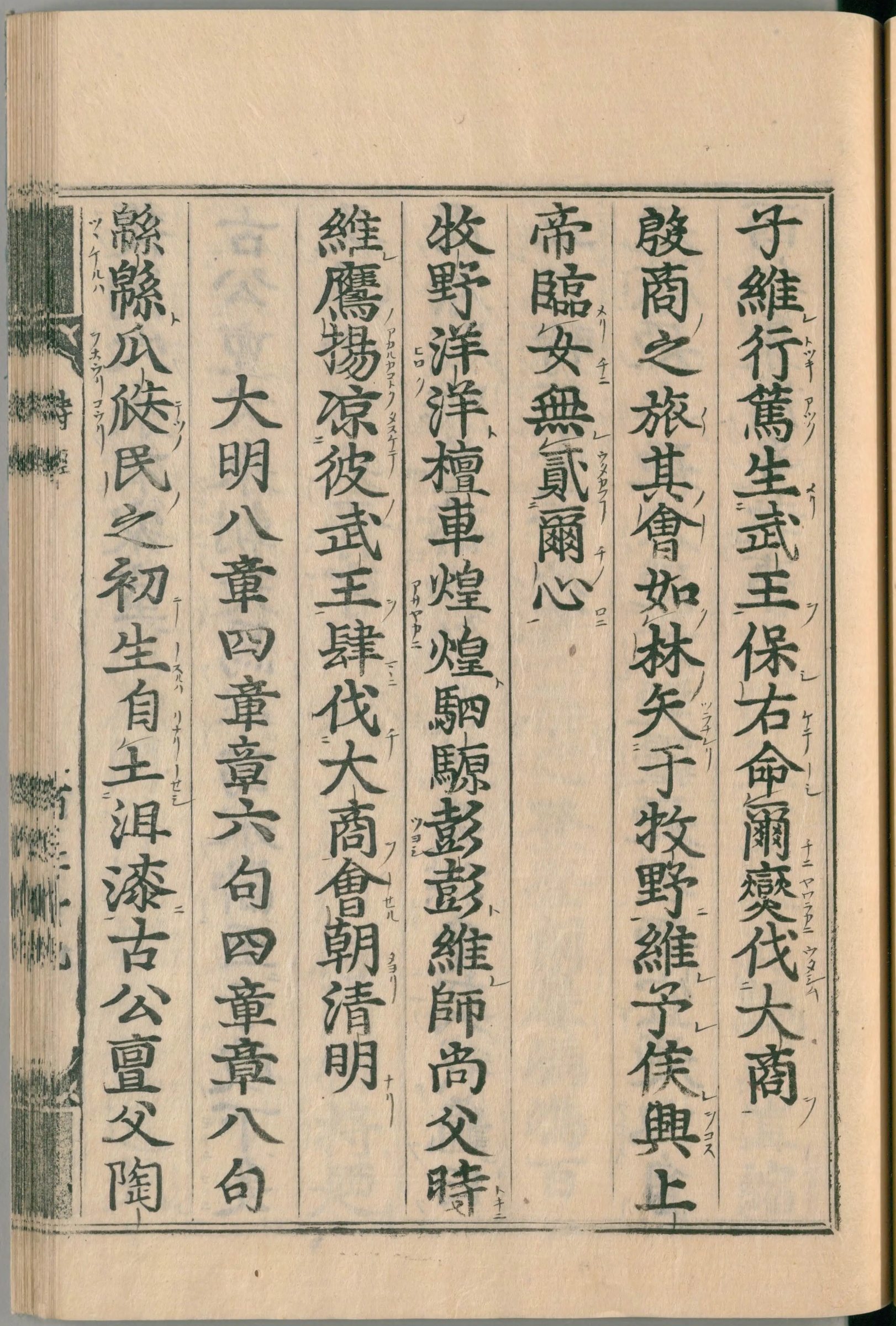
National Diet Library WA7-183, vol. [2], IIIF canvas 61, left-hand page: 7 columns of up to 17 characters, main text only, with Japanese reading marks. Checked on the image: the first column of this ode on this page begins ‹緜緜瓜瓞›. Stanza 1 opens column 7. Column 6 reads 大明八章四章章六句四章章八句 (the ode's stanza and line count). Stanza 1 runs on to canvas 62, right-hand page (first column ‹復陶穴›), where the section ends. The Chinese shown is the Wikisource Mao text, not a transcription of this print; Legge's English translates the same text.
1緜緜瓜瓞,民之初生,自土沮漆。古公亶父,陶復陶穴,未有家室。
1In long trains ever increasing grow the gourds.
When (our) people first sprang,
From the country about the Khü and the Khî,
The ancient duke Than-fû
Made for them kiln-like huts and caves,
Ere they had yet any houses.
Where on the image
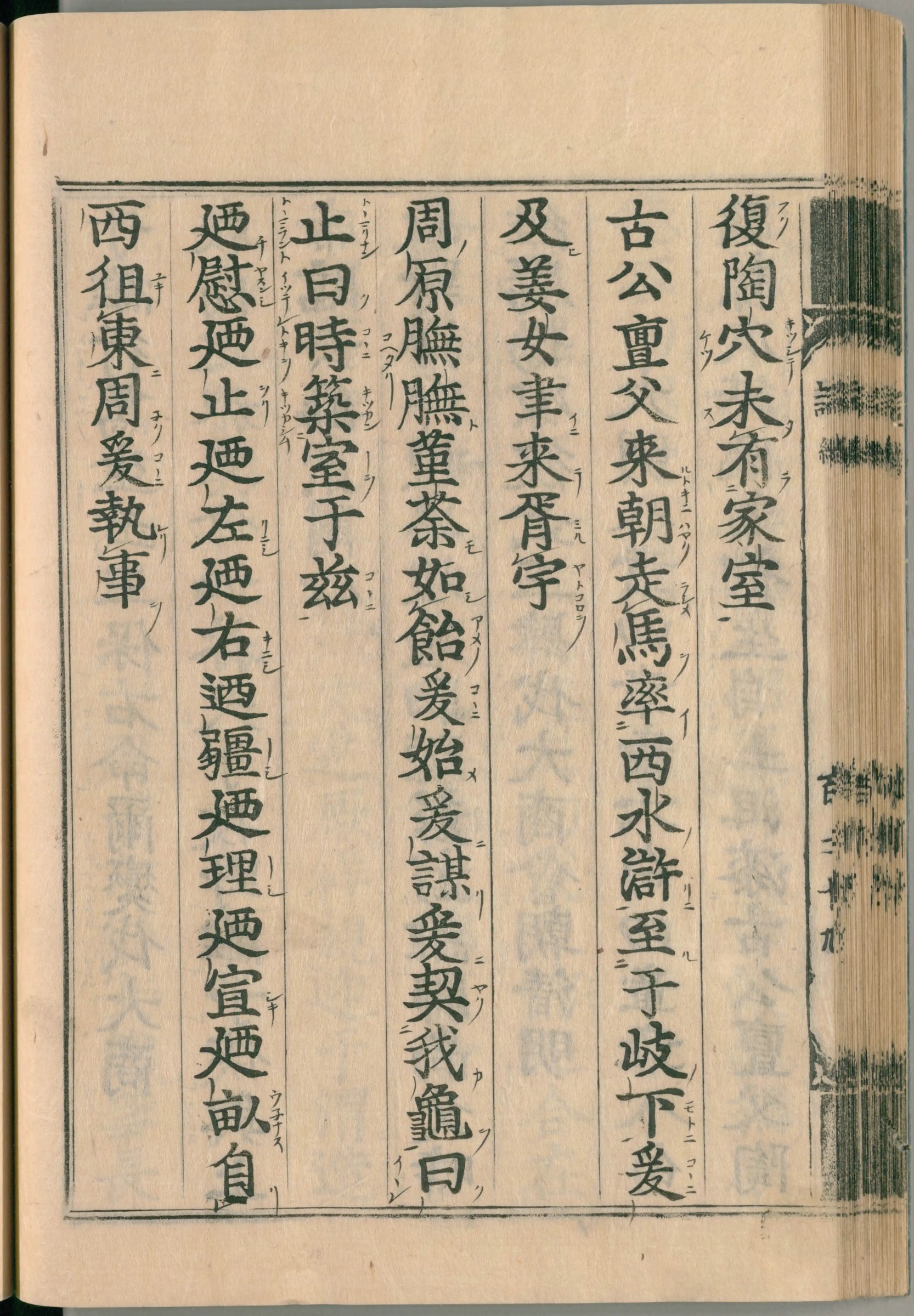
National Diet Library WA7-183, vol. [2], IIIF canvas 62, right-hand page: 7 columns of up to 17 characters, main text only, with Japanese reading marks. Checked on the image: the first column of this ode on this page begins ‹復陶穴›, the last begins ‹西徂東›. Stanza 2 opens column 2. Above it the page finishes stanza 1, shown in the previous section. The section ends on this page. The Chinese shown is the Wikisource Mao text, not a transcription of this print; Legge's English translates the same text.
2古公亶父,來朝走馬。率西水滸,至于岐下。爰及姜女,聿來胥宇。
3周原膴膴,堇荼如飴。爰始爰謀,爰契我龜。曰止曰時,築室于茲。
4廼慰廼止,廼左廼右。廼疆廼理,廼宣廼畝。自西徂東,周爰執事。
2The ancient duke Than-fû
Came in the morning, galloping his horses,
Along the banks of the western rivers,
To the foot of mount Khî;
And there he and the lady Kiang
Came and together looked out for a site.
3The plain of Kâu looked beautiful and rich,
With its violets, and sowthistles (sweet) as dumplings.
There he began by consulting (with his followers);
There he singed the tortoise-shell, (and divined).
The responses were there to stay and then;
And they proceeded there to build.
4He encouraged the people, and settled them;
Here on the left, there on the right.
He divided the ground, and subdivided it;
He dug the ditches; he defined the acres.
From the east to the west,
There was nothing which he did not take in hand.
Where on the image
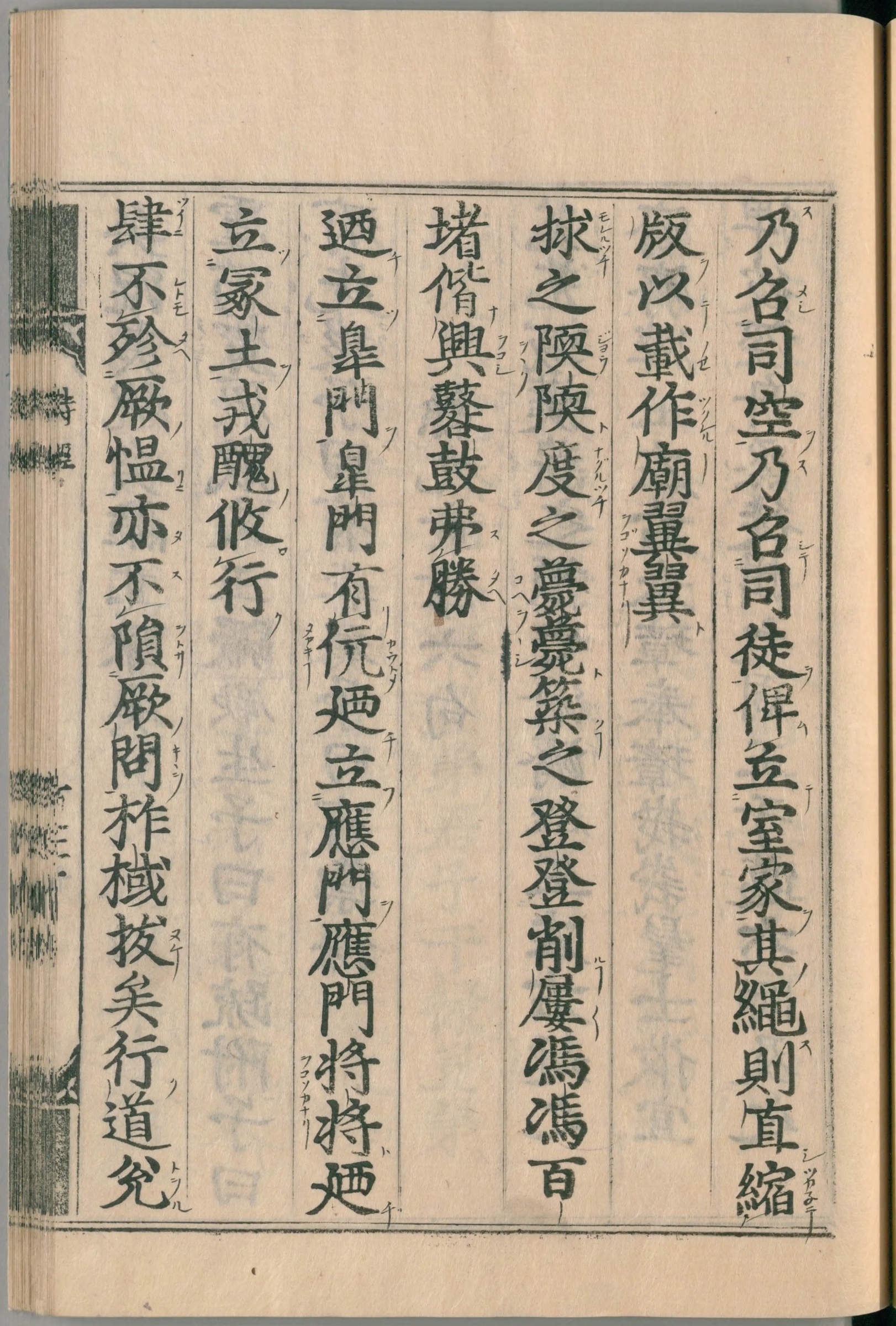
National Diet Library WA7-183, vol. [2], IIIF canvas 62, left-hand page: 7 columns of up to 17 characters, main text only, with Japanese reading marks. Checked on the image: the first column of this ode on this page begins ‹乃召司空›, the last begins ‹肆不殄›. Stanza 5 opens column 1. Stanza 8 runs on to canvas 63, right-hand page (first column ‹矣混夷›), where the section ends. The Chinese shown is the Wikisource Mao text, not a transcription of this print; Legge's English translates the same text.
5乃召司空,乃召司徒。俾立室家,其繩則直。縮版以載,作廟翼翼。
6捄之陾陾,度之薨薨。築之登登,削屢馮馮。百堵皆興,鼛鼓弗勝。
7廼立皐門,皐門有伉。廼立應門,應門將將。廼立冢土,戎醜攸行。
8肆不殄厥慍,亦不隕厥問。柞棫拔矣,行道兌矣。混夷駾矣,維其喙矣。
5He called his Superintendent of Works;
He called his Minister of Instruction;
And charged them with the rearing of the houses.
With the line they made everything straight;
They bound the frame-boards tight, so that they should rise regularly:
Uprose the ancestral temple in its solemn grandeur.
6Crowds brought the earth in baskets;
They threw it with shouts into the frames;
They beat it with responsive blows.
They pared the walls repeatedly, till they sounded strong.
Five thousand cubits of them arose together,
So that the roll of the great drums did not overpower (the noise of the builders).
7They reared the outer gate (of the palace),
Which rose in lofty state.
They set up the gate of audience,
Which rose severe and exact.
They reared the great altar to the spirits of the land,
From which all great movements should proceed.
8Thus though he could not prevent the rage of his foes,
He did not let fall his own fame.
The oaks and the buckthorns were (gradually) thinned,
And roads for travellers were opened.
The hordes of the Khwăn disappeared,
Startled and panting.
Where on the image
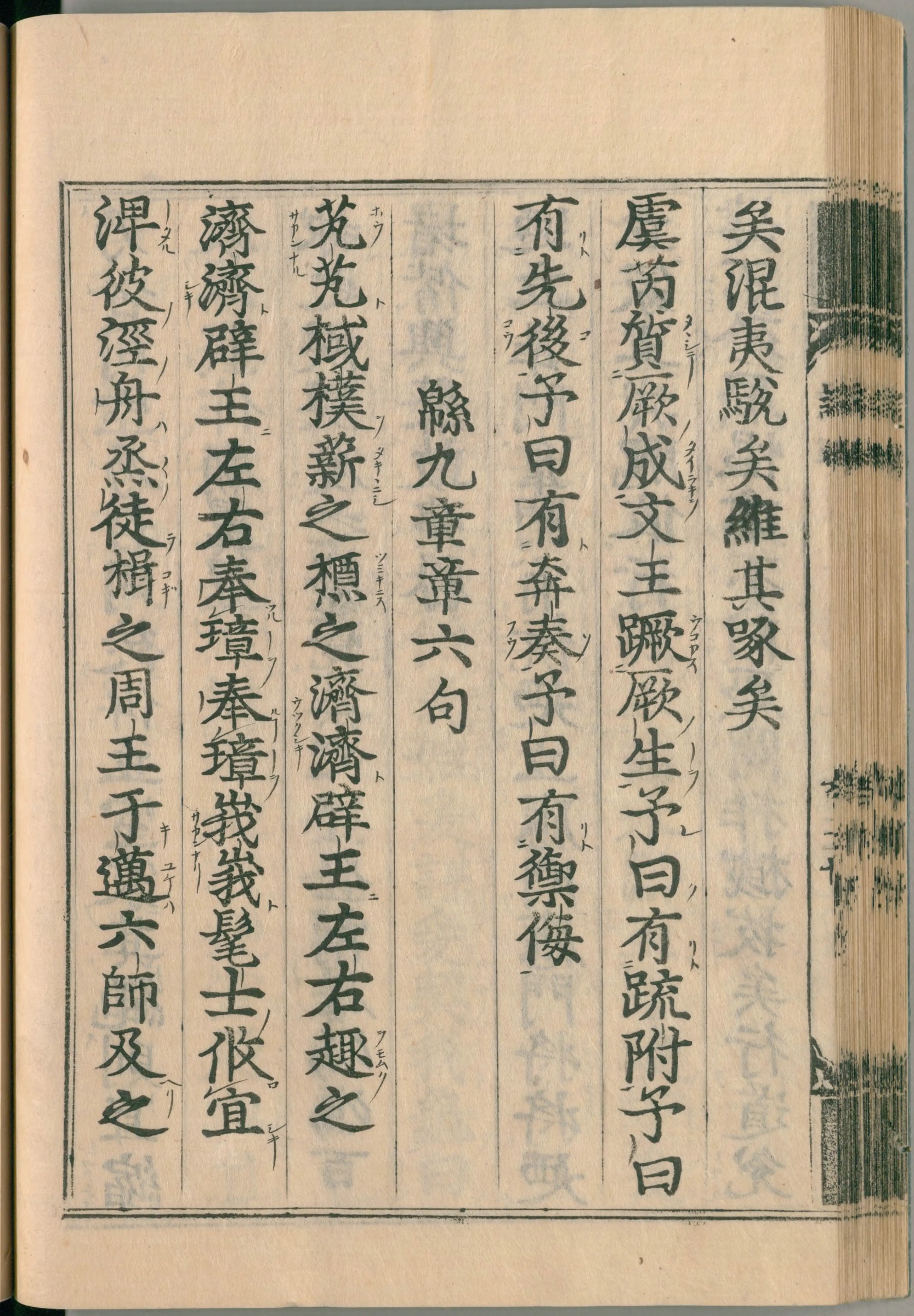
National Diet Library WA7-183, vol. [2], IIIF canvas 63, right-hand page: 7 columns of up to 17 characters, main text only, with Japanese reading marks. Checked on the image: the first column of this ode on this page begins ‹矣混夷›, the last begins ‹有先後›. Stanza 9 opens column 2. Column 4 reads 緜九章章六句 (the ode's stanza and line count). Above it the page finishes stanza 8, shown in the previous section. The section ends on this page. The Chinese shown is the Wikisource Mao text, not a transcription of this print; Legge's English translates the same text.
9虞芮質厥成,文王蹶厥生。予曰有疏附,予曰有先後。予曰有奔奏,予曰有禦侮。
9(The chiefs of) Yü and Zui were brought to an agreement
By king Wăn's stimulating their natural virtue.
Then, I may say, some came to him, previously not knowing him;
Some, drawn the last by the first;
Some, drawn by his rapid successes;
And some by his defence (of the weak) from insult.
Notes
- English: James Legge, The Shih King, Sacred Books of the East vol. 3 (1879), The Major Odes of the Kingdom, Decade i, Ode 3 (The Mien). Stanzas are numbered as in the Chinese.
- Text is taken from the validated Wikisource transcription; footnotes and lines the Wikisource editors supplied from Legge's 1871 edition are left out.
Cite
Sources
- Source: National Diet Library WA7-183 (Keicho-era movable-type print of the Shijing, vol. 2) + Wikisource Mao text + James Legge, Sacred Books of the East 3 (1879), via Wikisource (holding institution)
- Critical edition: Mao text (Wikisource)
← previous · → next · v cycle view · l back to library