Book of Odes, Mao 240: Si qi 思齊 (Keicho-era print)
Introduction
思齊 (Si qi, Mao 240) is one of the Major Odes of the Kingdom (大雅 Daya) in the Book of Odes (詩經 Shijing); its subject is Tai Ren, mother of King Wen, and the virtue of King Wen. With the other odes in this group it forms the Zhou court's account of how the house of Zhou rose to rule, and it was sung at the Zhou court; it is usually dated to the early Western Zhou (11th-10th century BCE).
The photographs are of a copy of the Book of Odes in the National Diet Library, Tokyo (call no. WA7-183), printed with movable type in Japan in the Keicho era (1596-1615): main text only, seven columns of seventeen characters to the page, with Japanese reading marks added by hand, and the count of stanzas and lines after each ode. In this copy the ode runs from canvas 64, right-hand page to canvas 64, left-hand page of the second volume. Each section gathers the stanzas that begin on one page and links to that page and to any page the last stanza runs onto; the page boundaries were found by reading the first characters of every column on the photographs. The Chinese is the Mao text from Wikisource. The English is James Legge's translation in Sacred Books of the East, volume 3 (1879), where this ode is The Major Odes of the Kingdom, Decade i, Ode 6; his footnotes are not reproduced.
How was this verified? (Provenance)
Where on the image
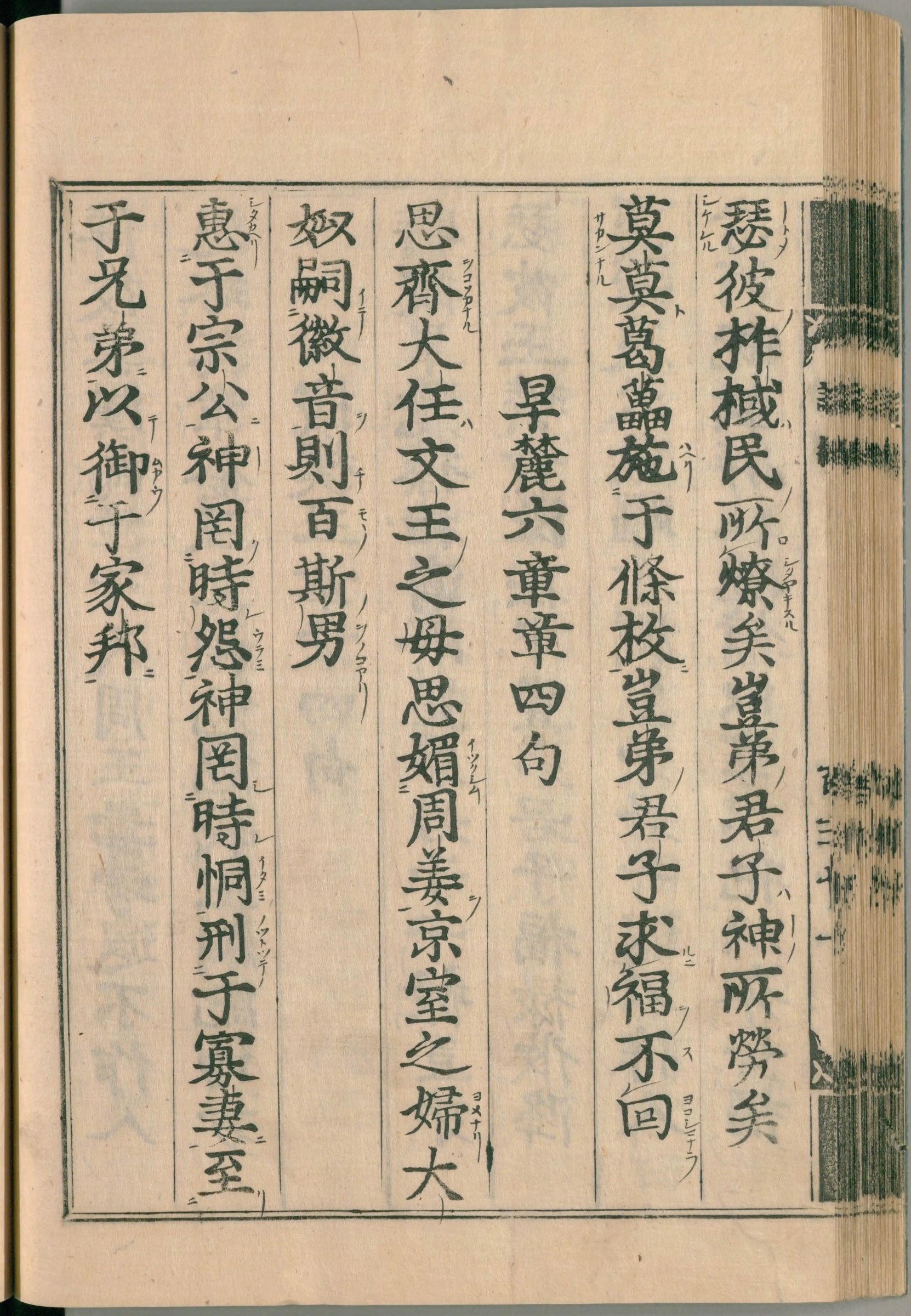
National Diet Library WA7-183, vol. [2], IIIF canvas 64, right-hand page: 7 columns of up to 17 characters, main text only, with Japanese reading marks. Checked on the image: the first column of this ode on this page begins ‹思齊大任›, the last begins ‹于兄弟›. Stanza 1 opens column 4. Column 3 reads 旱麓六章章四句 (the ode's stanza and line count). The section ends on this page. The Chinese shown is the Wikisource Mao text, not a transcription of this print; Legge's English translates the same text.
1思齊大任,文王之母,思媚周姜。京室之婦,大姒嗣徽音,則百斯男。
2惠于宗公,神罔時怨,神罔時恫。刑于寡妻,至于兄弟,以御于家邦。
1Pure and reverent was Thâi Zăn,
The mother of king Wăn.
Loving was she to Kâu Kiang;—
A wife becoming the House of Kâu.
Thâi Sze inherited her excellent fame,
And from her came a hundred sons.
2He conformed to the example of his ancestors,
And their spirits had no occasion for complaint.
Their spirits had no occasion for dissatisfaction;
And his example acted on his wife,
Extended to his brethren,
And was felt by all the clans and states.
Where on the image
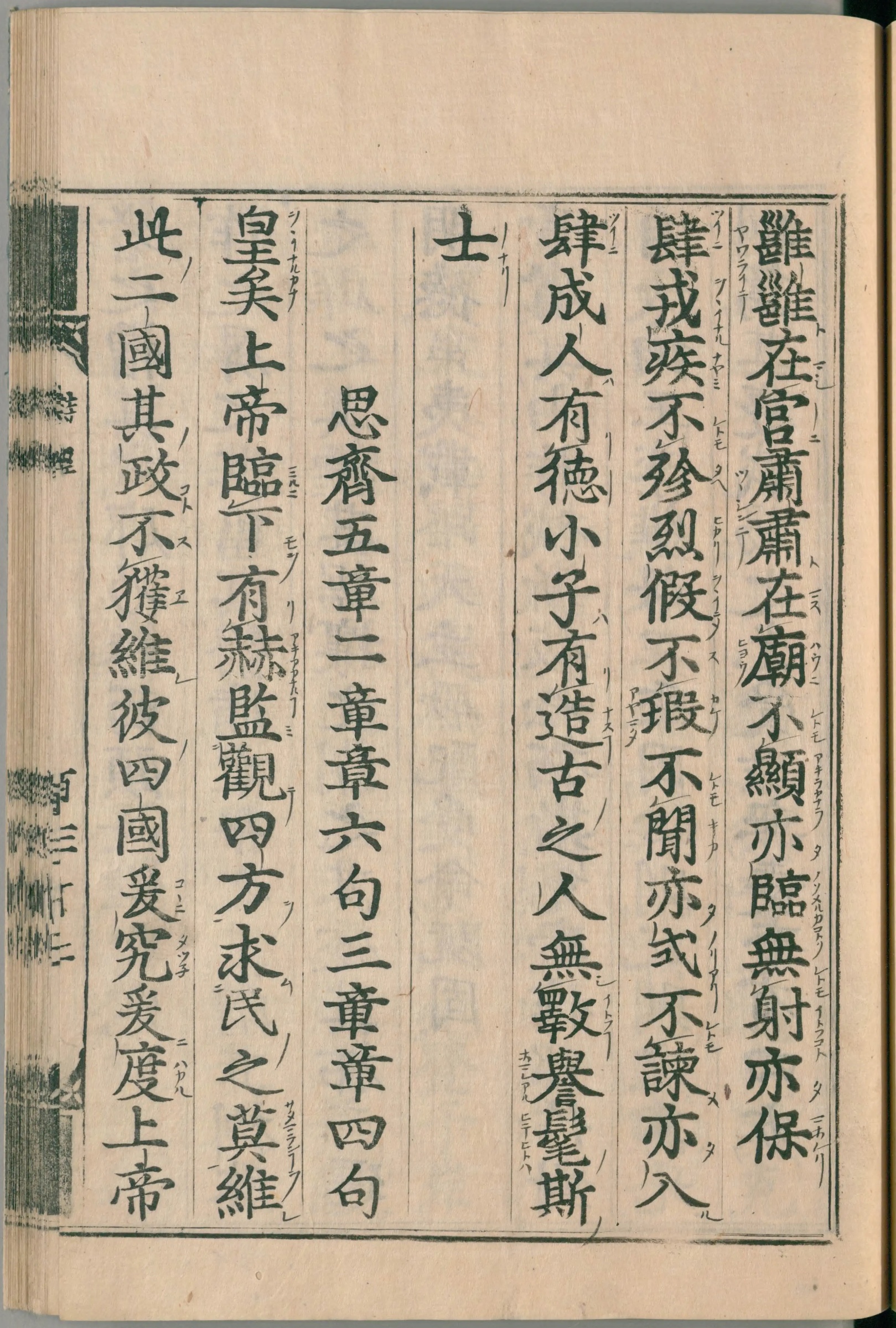
National Diet Library WA7-183, vol. [2], IIIF canvas 64, left-hand page: 7 columns of up to 17 characters, main text only, with Japanese reading marks. Checked on the image: the first column of this ode on this page begins ‹雝雝在宮›, the last begins ‹士›. Stanza 3 opens column 1. Column 5 reads 思齊五章二章章六句三章章四句 (the ode's stanza and line count). The section ends on this page. The Chinese shown is the Wikisource Mao text, not a transcription of this print; Legge's English translates the same text.
3雝雝在宮,肅肅在廟。不顯亦臨,無射亦保。
4肆戎疾不殄,烈假不瑕。不聞亦式,不諫亦入。
5肆成人有德,小子有造。古之人無斁,譽髦斯士。
3Full of harmony was he in his palace;
Full of reverence in the ancestral temple.
Unseen (by men), he still felt that he was under inspection:
Unweariedly he maintained his virtue.
4Though he could not prevent (some) great calamities,
His brightness and magnanimity were without stain.
Without previous instruction he did what was right;
Without admonition he went on (in the path of goodness).
5So, grown up men became virtuous (through him),
And young men made (constant) attainments.
(Our) ancient prince never felt weariness,
And from him were the fame and eminence of his officers.
Notes
- English: James Legge, The Shih King, Sacred Books of the East vol. 3 (1879), The Major Odes of the Kingdom, Decade i, Ode 6 (The Sze Kai). Stanzas are numbered as in the Chinese.
- Text is taken from the validated Wikisource transcription; footnotes and lines the Wikisource editors supplied from Legge's 1871 edition are left out.
Cite
Sources
- Source: National Diet Library WA7-183 (Keicho-era movable-type print of the Shijing, vol. 2) + Wikisource Mao text + James Legge, Sacred Books of the East 3 (1879), via Wikisource (holding institution)
- Critical edition: Mao text (Wikisource)
← previous · → next · v cycle view · l back to library