Book of Odes, Mao 241: Huang yi 皇矣 (Keicho-era print)
Introduction
皇矣 (Huang yi, Mao 241) is one of the Major Odes of the Kingdom (大雅 Daya) in the Book of Odes (詩經 Shijing); its subject is God choosing the Zhou house: Tai Wang, Wang Ji and King Wen's campaigns against Mi and Chong. With the other odes in this group it forms the Zhou court's account of how the house of Zhou rose to rule, and it was sung at the Zhou court; it is usually dated to the early Western Zhou (11th-10th century BCE).
The photographs are of a copy of the Book of Odes in the National Diet Library, Tokyo (call no. WA7-183), printed with movable type in Japan in the Keicho era (1596-1615): main text only, seven columns of seventeen characters to the page, with Japanese reading marks added by hand, and the count of stanzas and lines after each ode. In this copy the ode runs from canvas 64, left-hand page to canvas 66, left-hand page of the second volume. Each section gathers the stanzas that begin on one page and links to that page and to any page the last stanza runs onto; the page boundaries were found by reading the first characters of every column on the photographs. The Chinese is the Mao text from Wikisource. The English is James Legge's translation in Sacred Books of the East, volume 3 (1879), where this ode is The Major Odes of the Kingdom, Decade i, Ode 7; his footnotes are not reproduced.
How was this verified? (Provenance)
Where on the image
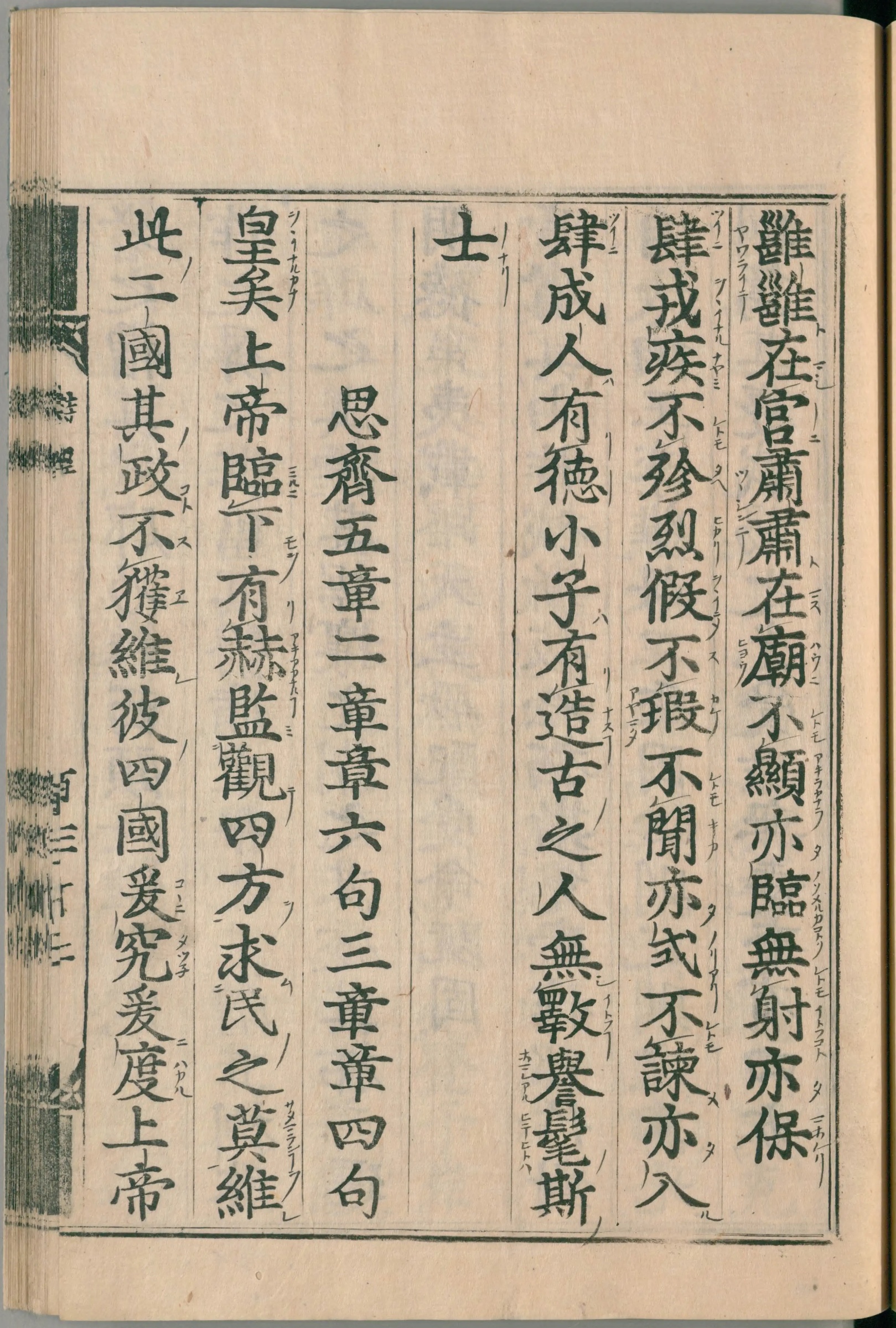
National Diet Library WA7-183, vol. [2], IIIF canvas 64, left-hand page: 7 columns of up to 17 characters, main text only, with Japanese reading marks. Checked on the image: the first column of this ode on this page begins ‹皇矣上帝›, the last begins ‹此二國›. Stanza 1 opens column 6. Column 5 reads 思齊五章二章章六句三章章四句 (the ode's stanza and line count). Stanza 1 runs on to canvas 65, right-hand page (first column ‹耆之憎›), where the section ends. The Chinese shown is the Wikisource Mao text, not a transcription of this print; Legge's English translates the same text.
1皇矣上帝,臨下有赫。監觀四方,求民之莫。
維此二國,其政不獲。維彼四國,爰究爰度。
上帝耆之,憎其式廓。乃眷西顧,此維與宅。
1Great is God,
Beholding this lower world in majesty.
He surveyed the four quarters (of the kingdom),
Seeking for some one to give establishment to the people.
Those two earlier dynasties
Had failed to satisfy him with their government;
So, throughout the various states,
He sought and considered
For one on whom he might confer the rule.
Hating all the great states,
He turned his kind regards on the west,
And there gave a settlement (to king Thâi).
Where on the image
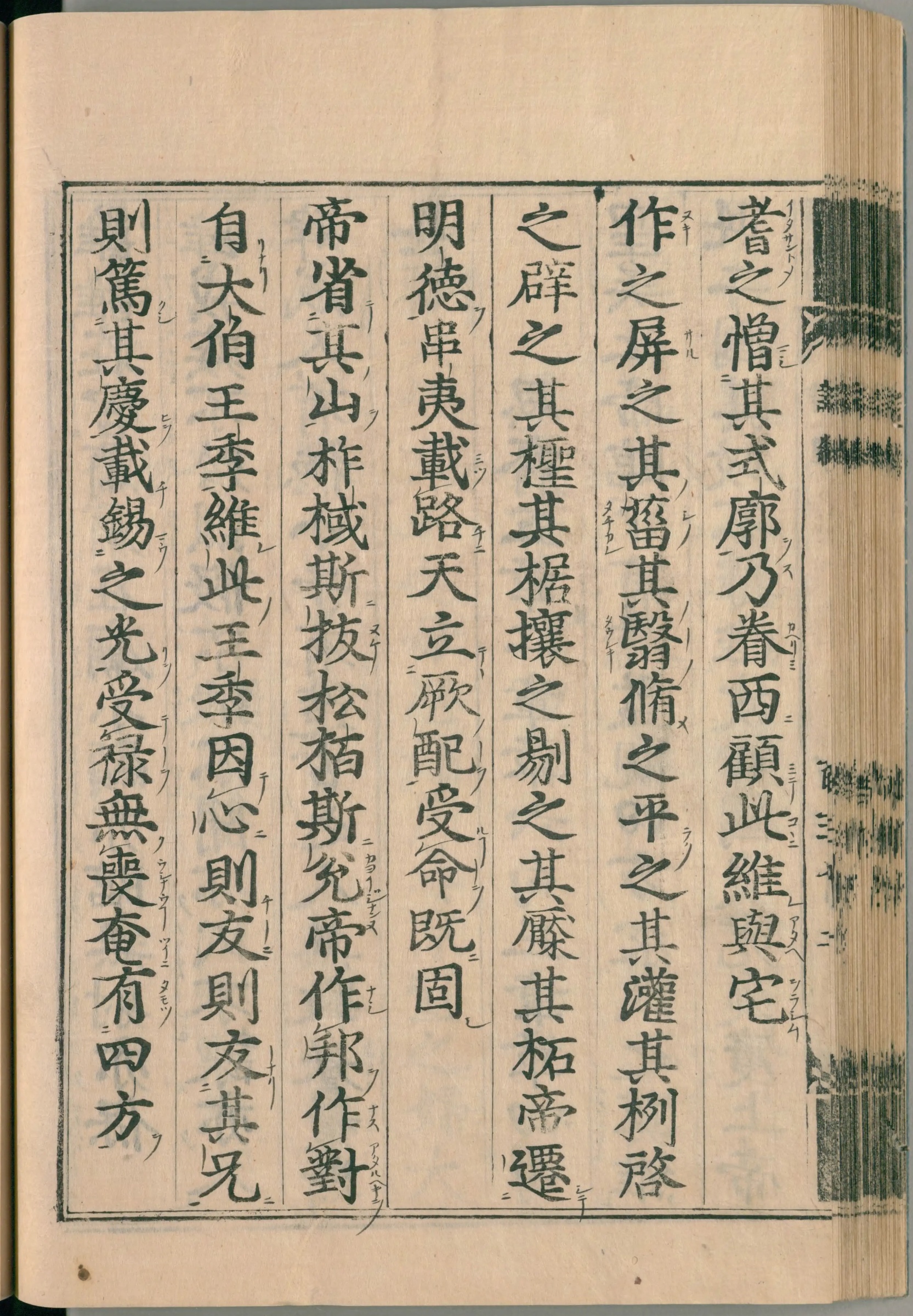
National Diet Library WA7-183, vol. [2], IIIF canvas 65, right-hand page: 7 columns of up to 17 characters, main text only, with Japanese reading marks. Checked on the image: the first column of this ode on this page begins ‹耆之憎›, the last begins ‹則篤其慶›. Stanza 2 opens column 2. Above it the page finishes stanza 1, shown in the previous section. The section ends on this page. The Chinese shown is the Wikisource Mao text, not a transcription of this print; Legge's English translates the same text.
2作之屏之,其菑其翳。脩之平之,其灌其栵。
啟之辟之,其檉其椐。攘之剔之,其檿其柘。
帝遷明德,串夷載路,天立厥配,受命既固。
3帝省其山,柞棫斯拔,松柏斯兌。
帝作邦作對。自大伯王季。
維此王季,因心則友。則友其兄,則篤其慶。
載錫之光。受祿無喪,奄有四方。
2(King Thâi) raised up and removed
The dead trunks and the fallen trees.
He dressed and regulated
The bushy clumps and the (tangled) rows.
He opened up and cleared
The tamarisk trees and the stave trees.
He hewed and thinned
The mountain mulberry trees.
God having brought about the removal thither of this intelligent ruler,
The Kwan hordes fled away.
Heaven had raised up a helpmeet for him,
And the appointment he had received was made sure.
3God surveyed the hills,
Where the oaks and the buckthorn were thinned,
And paths made through the firs and cypresses.
God, who had raised the state, raised up a proper ruler for it,—
From the time of Thâi-po and king Kî (this was done).
Now this king Kî
In his heart was full of brotherly duty.
Full of duty to his elder brother,
He gave himself the more to promote the prosperity (of the country),
And secured to him the glory (of his act).
He accepted his dignity and did not lose it,
And (ere long his family) possessed the whole kingdom.
Where on the image
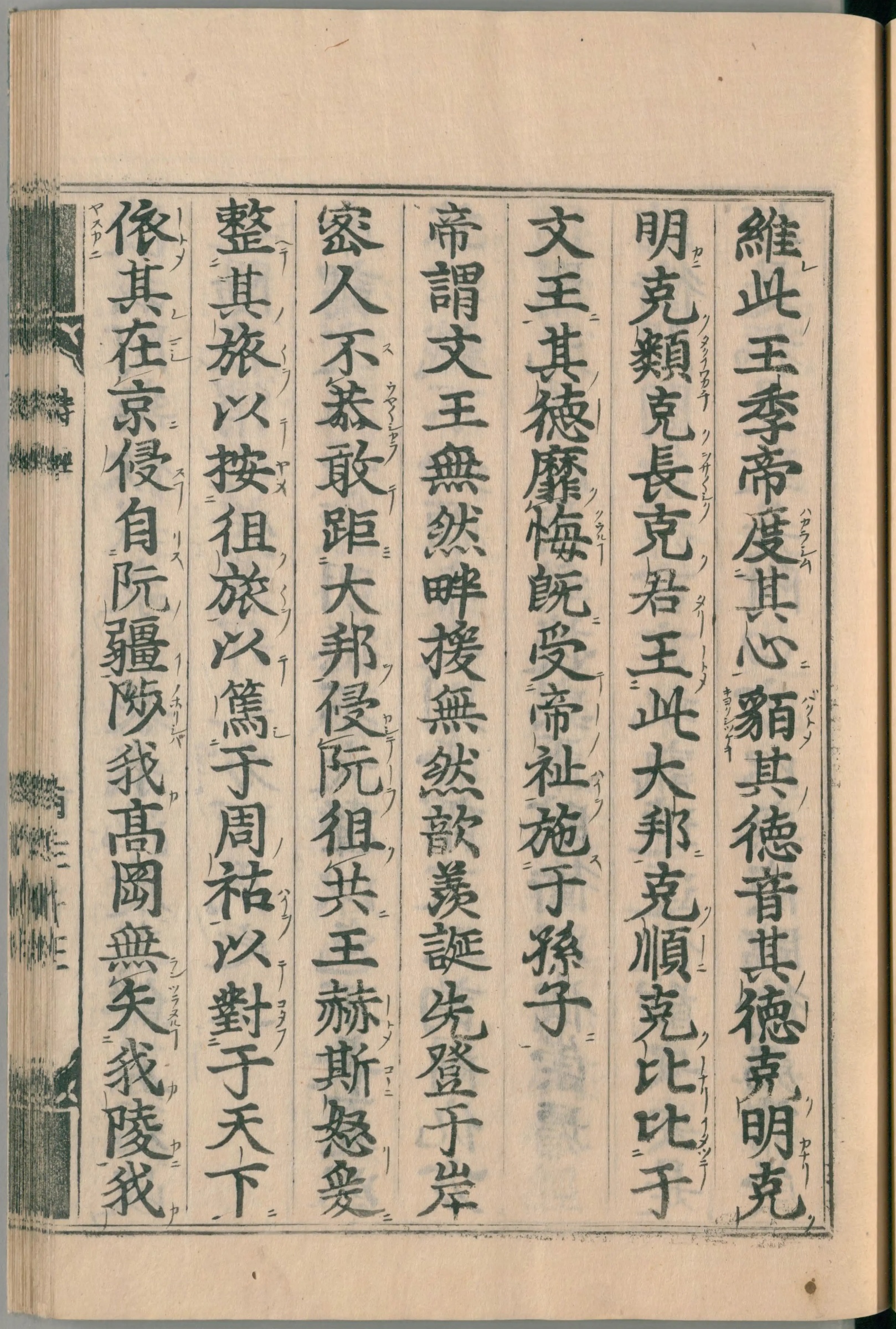
National Diet Library WA7-183, vol. [2], IIIF canvas 65, left-hand page: 7 columns of up to 17 characters, main text only, with Japanese reading marks. Checked on the image: the first column of this ode on this page begins ‹維此王季›, the last begins ‹依其在京›. Stanza 4 opens column 1. Stanza 6 runs on to canvas 66, right-hand page (first column ‹陵我阿›), where the section ends. The Chinese shown is the Wikisource Mao text, not a transcription of this print; Legge's English translates the same text.
4維此王季,帝度其心。貊其德音,其德克明。
克明克類,克長克君。王此大邦,克順克比。
比于文王,其德靡悔,既受帝祉,施于孫子。
5帝謂文王:無然畔援,無然歆羨,誕先登于岸。
密人不恭,敢距大邦,侵阮徂共。
王赫斯怒,爰整其旅,以按徂旅,以篤于周祜,以對于天下。
6依其在京,侵自阮疆,陟我高岡。
無矢我陵,我陵我阿,無飲我泉,我泉我池。
度其鮮原,居岐之陽,在渭之將,萬邦之方,下民之王。
4This king Kî
Was gifted by God with the power of judgment,
So that the fame of his virtue silently grew.
His virtue was highly intelligent,—
Highly intelligent, and of rare discrimination;
Able to lead, able to rule,
To rule over this great country;
Rendering a cordial submission, effecting a cordial union.
When (the sway) came to king Wăn,
His virtue left nothing to be dissatisfied with,
He received the blessing of God,
And it was extended to his descendants.
5God said to king Wăn,
'Be not like those who reject this and cling to that;
Be not like those who are ruled by their likings and desires;'
So he grandly ascended before others to the height (of virtue).
The people of Mî were disobedient,
Daring to oppose our great country,
And invaded Yüan, marching to Kung.
The king rose, majestic in his wrath;
He marshalled his troops,
To stop the invading foes;
To consolidate the prosperity of Kâu;
To meet the expectations of all under heaven.
6He remained quietly in the capital,
But (his troops) went on from the borders of Yüan.
They ascended our lofty ridges,
And (the enemy) arrayed no forces on our hills,
On our hills, small or large,
Nor drank at our springs,
Our springs or our pools.
He then determined the finest of the plains,
And settled on the south of Khî,
On the banks of the Wei,
The centre of all the states,
The resort of the lower people.
Where on the image
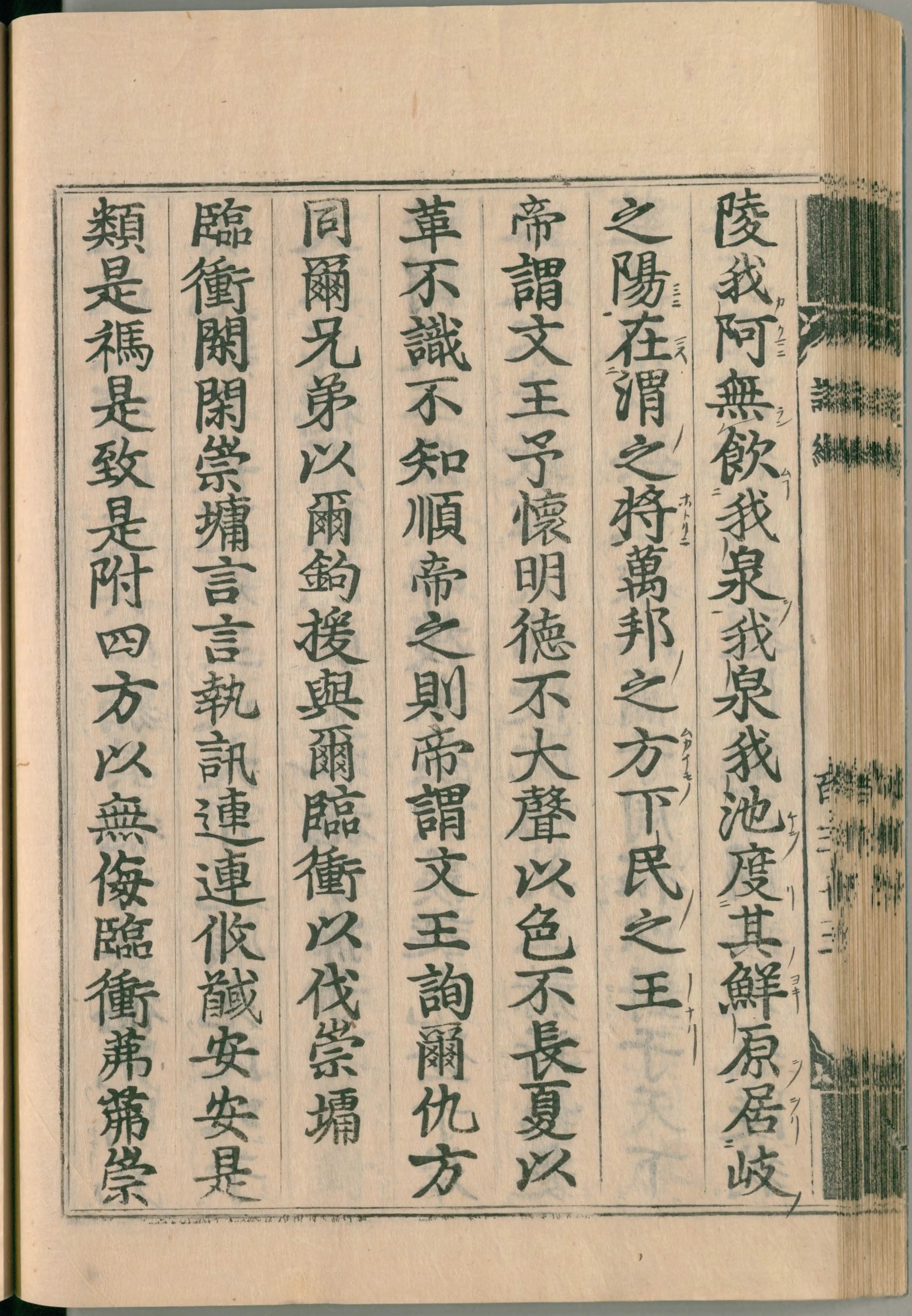
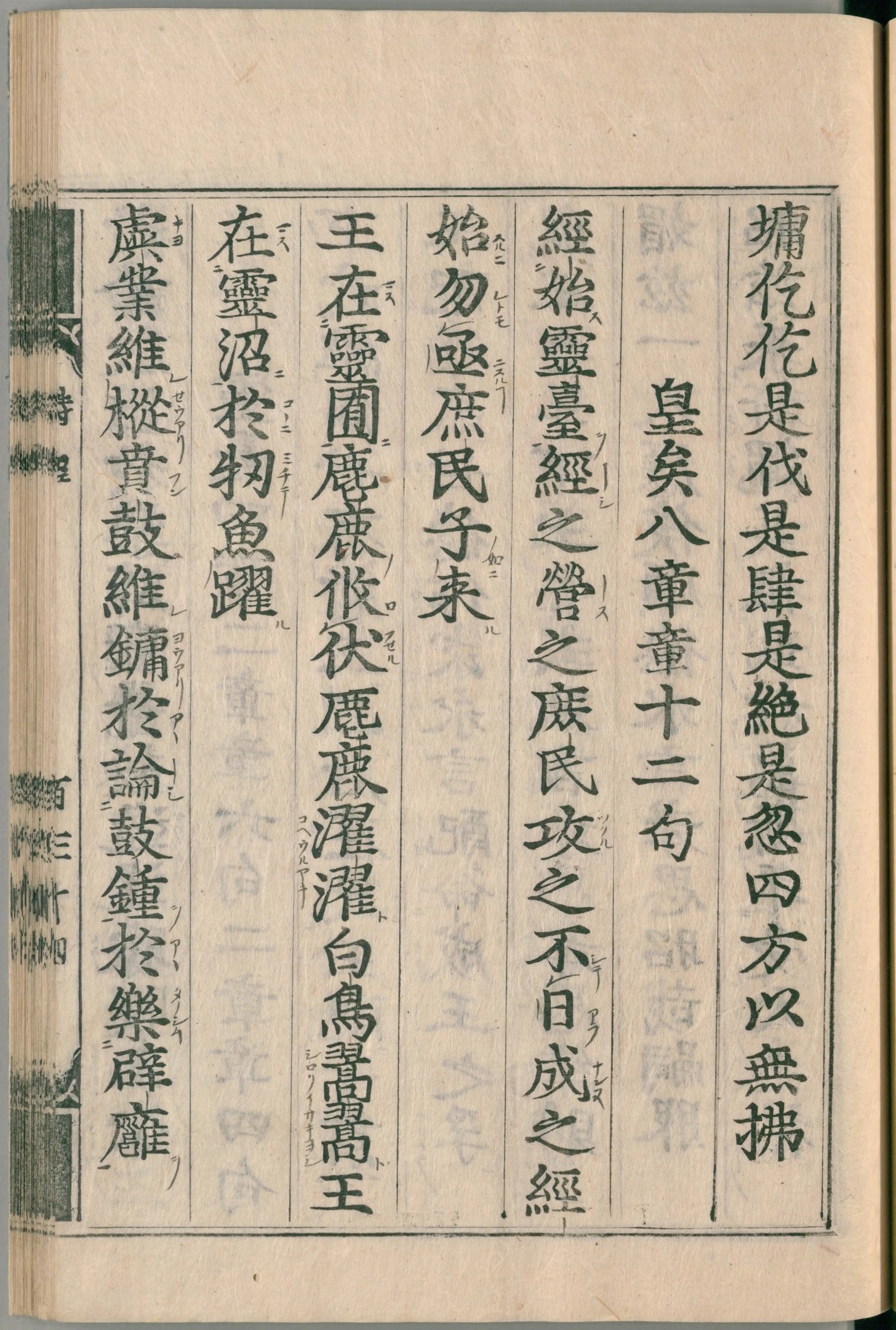
National Diet Library WA7-183, vol. [2], IIIF canvas 66, right-hand page: 7 columns of up to 17 characters, main text only, with Japanese reading marks. Checked on the image: the first column of this ode on this page begins ‹陵我阿›, the last begins ‹類是禡›. Stanza 7 opens column 3. Above it the page finishes stanza 6, shown in the previous section. Stanza 8 runs on to canvas 66, left-hand page (first column ‹墉仡仡›), where the section ends. The Chinese shown is the Wikisource Mao text, not a transcription of this print; Legge's English translates the same text.
7帝謂文王:予懷明德。不大聲以色,不長夏以革,不識不知,順帝之則。
帝謂文王:詢爾仇方。同爾兄弟,以爾鉤援,與爾臨衝,以伐崇墉。
8臨衝閑閑,崇墉言言。執訊連連,攸馘安安。是類是禡,是致是附。四方以無侮。
臨衝茀茀,崇墉仡仡。是伐是肆,是絕是忽。四方以無拂。
7God said to king Wăn,
'I am pleased with your intelligent virtue,
Not loudly proclaimed nor pourtrayed,
Without extravagance or changeableness,
Without consciousness of effort on your part,
In accordance with the pattern of God.'
God said to king Wăn,
'Take measures against the country of your foes.
Along with your brethren,
Get ready your scaling ladders,
And your engines of onfall and assault,
To attack the walls of Khung.'
8The engines of onfall and assault were (at first) gently plied,
Against the walls of Khung high and great;
Captives for the question were brought in, one after another;
The left ears (of the slain) were taken leisurely.
He had sacrificed to God and to the Father of War,
Thus seeking to induce submission,
And throughout the region none had dared to insult him.
The engines of onfall and assault were (then) vigorously plied,
Against the walls of Khung very strong.
He attacked it, and let loose all his forces;
He extinguished (its sacrifices), and made an end of its existence;
And throughout the kingdom none dared to oppose him.
Notes
- English: James Legge, The Shih King, Sacred Books of the East vol. 3 (1879), The Major Odes of the Kingdom, Decade i, Ode 7 (The Hwang I). Stanzas are numbered as in the Chinese.
- Text is taken from the validated Wikisource transcription; footnotes and lines the Wikisource editors supplied from Legge's 1871 edition are left out.
Cite
Sources
- Source: National Diet Library WA7-183 (Keicho-era movable-type print of the Shijing, vol. 2) + Wikisource Mao text + James Legge, Sacred Books of the East 3 (1879), via Wikisource (holding institution)
- Critical edition: Mao text (Wikisource)
← previous · → next · v cycle view · l back to library