Book of Odes, Mao 243: Xia wu 下武 (Keicho-era print)
Introduction
下武 (Xia wu, Mao 243) is one of the Major Odes of the Kingdom (大雅 Daya) in the Book of Odes (詩經 Shijing); its subject is King Wu as heir of the virtue of his predecessors. With the other odes in this group it forms the Zhou court's account of how the house of Zhou rose to rule, and it was sung at the Zhou court; it is usually dated to the early Western Zhou (11th-10th century BCE).
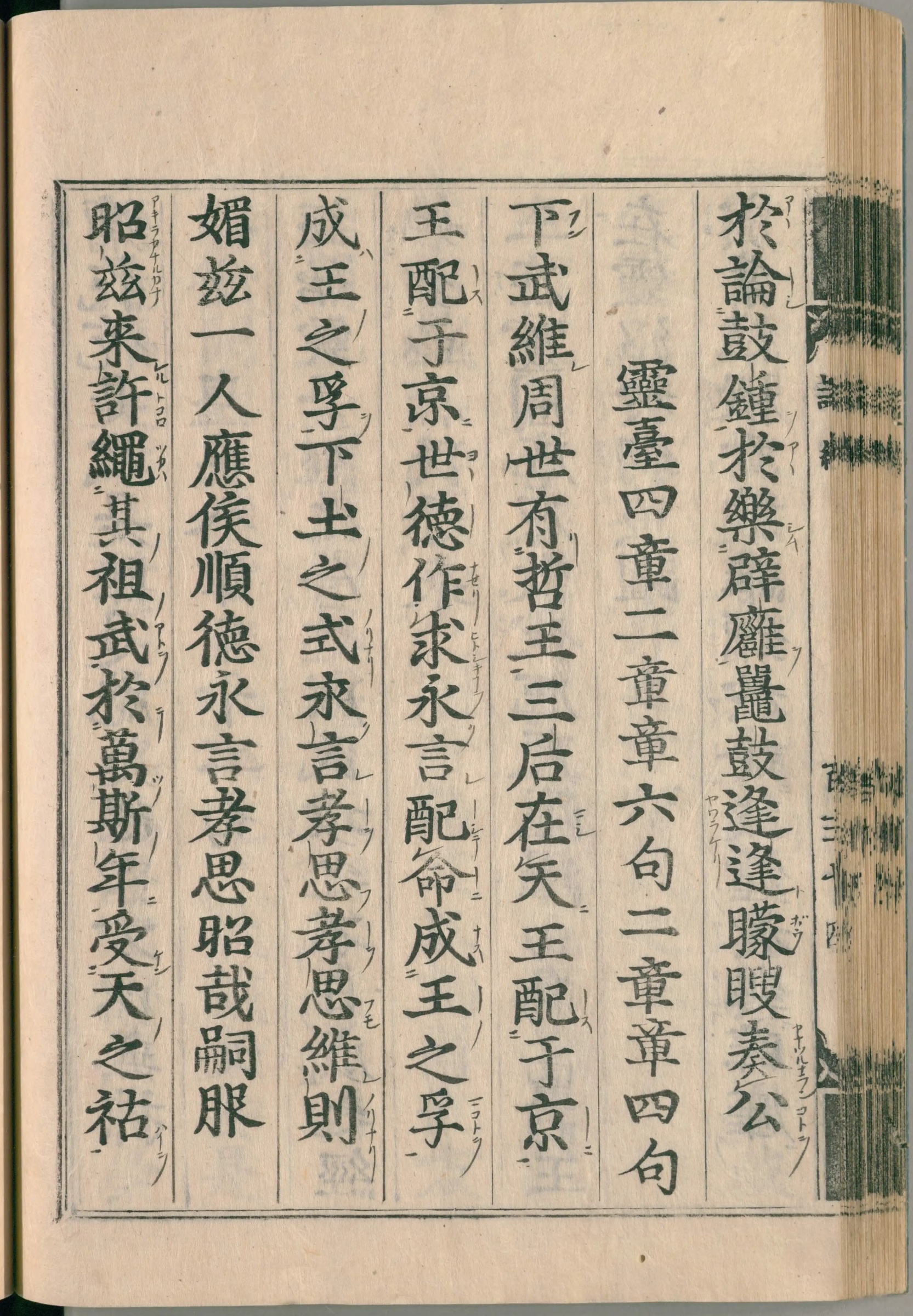
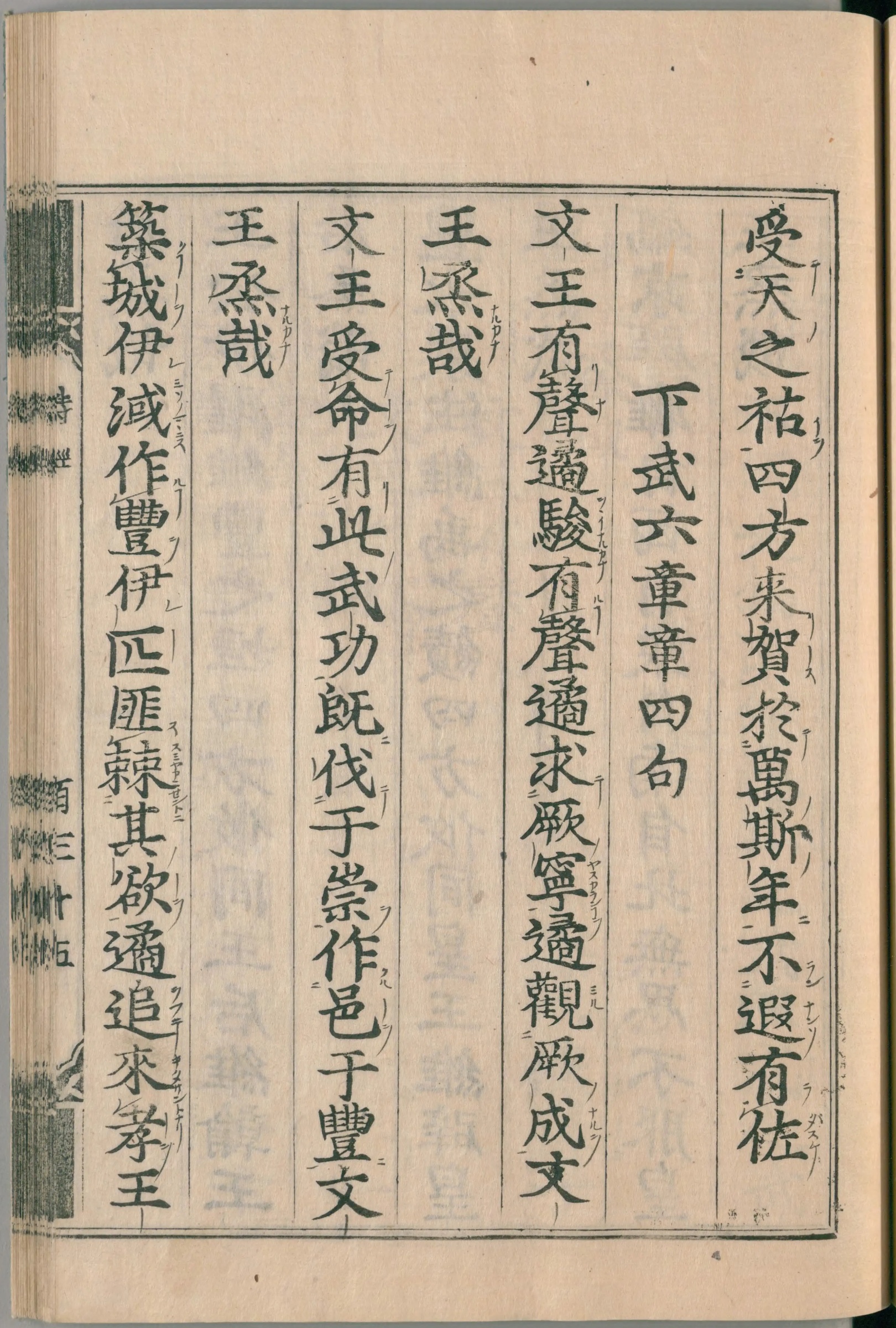
The photographs are of a copy of the Book of Odes in the National Diet Library, Tokyo (call no. WA7-183), printed with movable type in Japan in the Keicho era (1596-1615): main text only, seven columns of seventeen characters to the page, with Japanese reading marks added by hand, and the count of stanzas and lines after each ode. In this copy the ode runs from canvas 67, right-hand page to canvas 67, left-hand page of the second volume. Each section gathers the stanzas that begin on one page and links to that page and to any page the last stanza runs onto; the page boundaries were found by reading the first characters of every column on the photographs. The Chinese is the Mao text from Wikisource. The English is James Legge's translation in Sacred Books of the East, volume 3 (1879), where this ode is The Major Odes of the Kingdom, Decade i, Ode 9; his footnotes are not reproduced.
How was this verified? (Provenance)
Where on the image
National Diet Library WA7-183, vol. [2], IIIF canvas 67, right-hand page: 7 columns of up to 17 characters, main text only, with Japanese reading marks. Checked on the image: the first column of this ode on this page begins ‹下武維周›, the last begins ‹昭茲來許›. Stanza 1 opens column 3. Column 2 reads 靈臺四章二章章六句二章章四句 (the ode's stanza and line count). The section ends on this page. The Chinese shown is the Wikisource Mao text, not a transcription of this print; Legge's English translates the same text.
1下武維周,世有哲王。三后在天,王配于京。
2王配于京,世德作求。永言配命,成王之孚。
3成王之孚,下土之式。永言孝思,孝思維則。
4媚茲一人,應侯順德。永言孝思,昭哉嗣服。
5昭茲來許,繩其祖武。於萬斯年,受天之祜。
1Successors tread in the steps (of their predecessors) in our Kâu.
For generations there had been wise kings;
The three sovereigns were in heaven;
And king (Wû) was their worthy successor in his capital.
2King (Wû) was their worthy successor in his capital,
Rousing himself to seek for the hereditary virtue,
Always striving to be in accordance with the will (of Heaven);
And thus he secured the confidence due to a king.
3He secured the confidence due to a king,
And became the pattern of all below him.
Ever thinking how to be filial,
His filial mind was the model (which he supplied).
4Men loved him, the One man,
And responded (to his example) with a docile virtue.
Ever thinking how to be filial,
He brilliantly continued the doings (of his fathers).
5Brilliantly! and his posterity,
Continuing to walk in the steps of their forefathers,
For myriads of years,
Will receive the blessing of Heaven.
Where on the image
National Diet Library WA7-183, vol. [2], IIIF canvas 67, left-hand page: 7 columns of up to 17 characters, main text only, with Japanese reading marks. Checked on the image: the first column of this ode on this page begins ‹受天之祜›. Stanza 6 opens column 1. Column 2 reads 下武六章章四句 (the ode's stanza and line count). The section ends on this page. The Chinese shown is the Wikisource Mao text, not a transcription of this print; Legge's English translates the same text.
6受天之祜,四方來賀。於萬斯年,不遐有佐。
6They will receive the blessing of Heaven,
And from the four quarters (of the kingdom) will felicitations come to them.
For myriads of years
Will there not be their helpers?
Notes
- English: James Legge, The Shih King, Sacred Books of the East vol. 3 (1879), The Major Odes of the Kingdom, Decade i, Ode 9 (The Hsia Wu). Stanzas are numbered as in the Chinese.
- Text is taken from the validated Wikisource transcription; footnotes and lines the Wikisource editors supplied from Legge's 1871 edition are left out.
Cite
Sources
- Source: National Diet Library WA7-183 (Keicho-era movable-type print of the Shijing, vol. 2) + Wikisource Mao text + James Legge, Sacred Books of the East 3 (1879), via Wikisource (holding institution)
- Critical edition: Mao text (Wikisource)
← previous · → next · v cycle view · l back to library