Book of Odes, Mao 33: Xiong zhi 雄雉 (Keicho-era print)
Introduction
雄雉 (Xiong zhi, Mao 33) is ode VIII of 邶風 Bei feng ("the Airs of Bei"), the third book of the Airs of the States (國風 Guofeng), the 160 songs of the regional states that open the Book of Odes (詩經 Shijing). The Airs are generally dated to the Western and early Eastern Zhou (about the 10th to 7th century BCE). It has 4 stanzas.
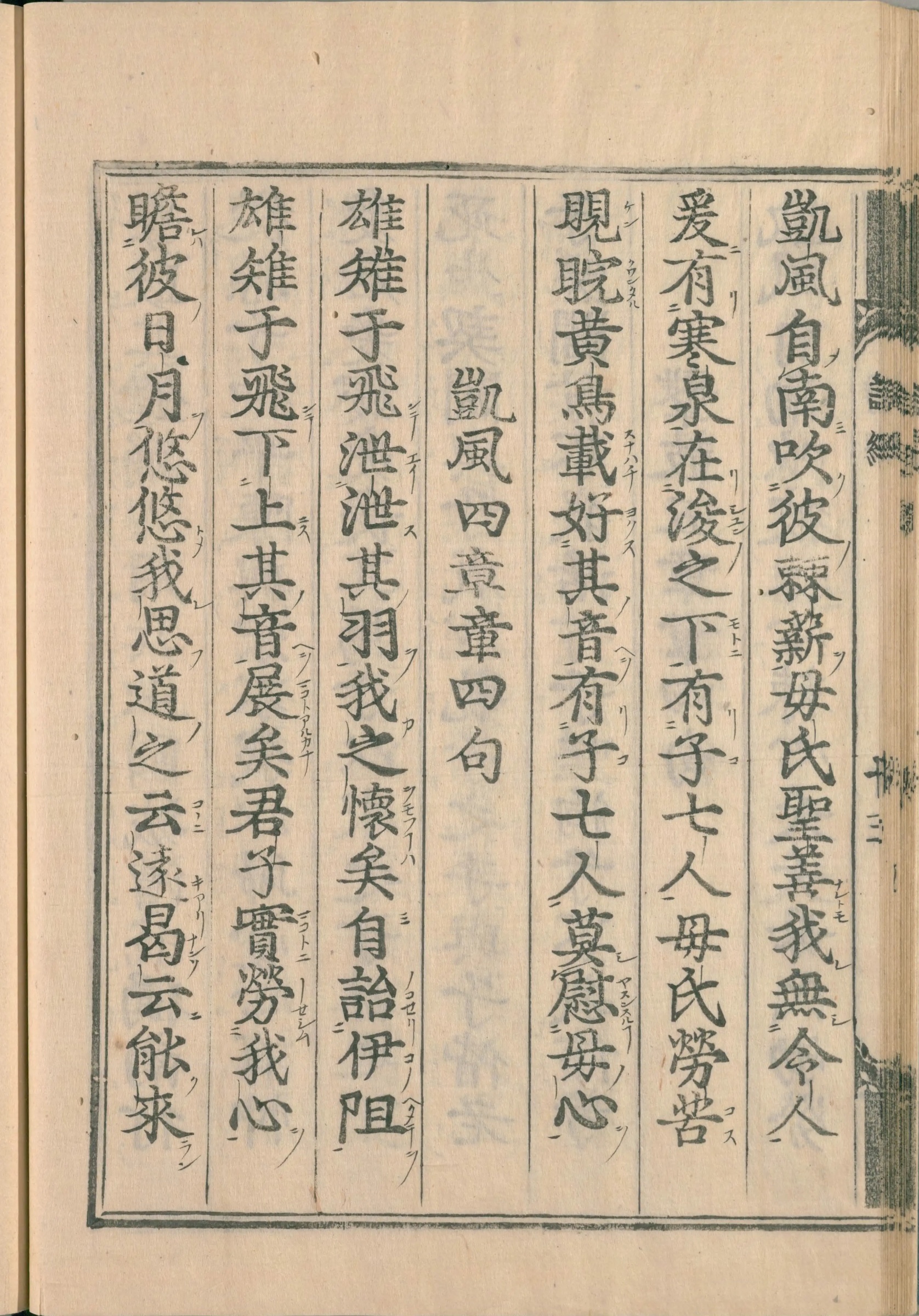
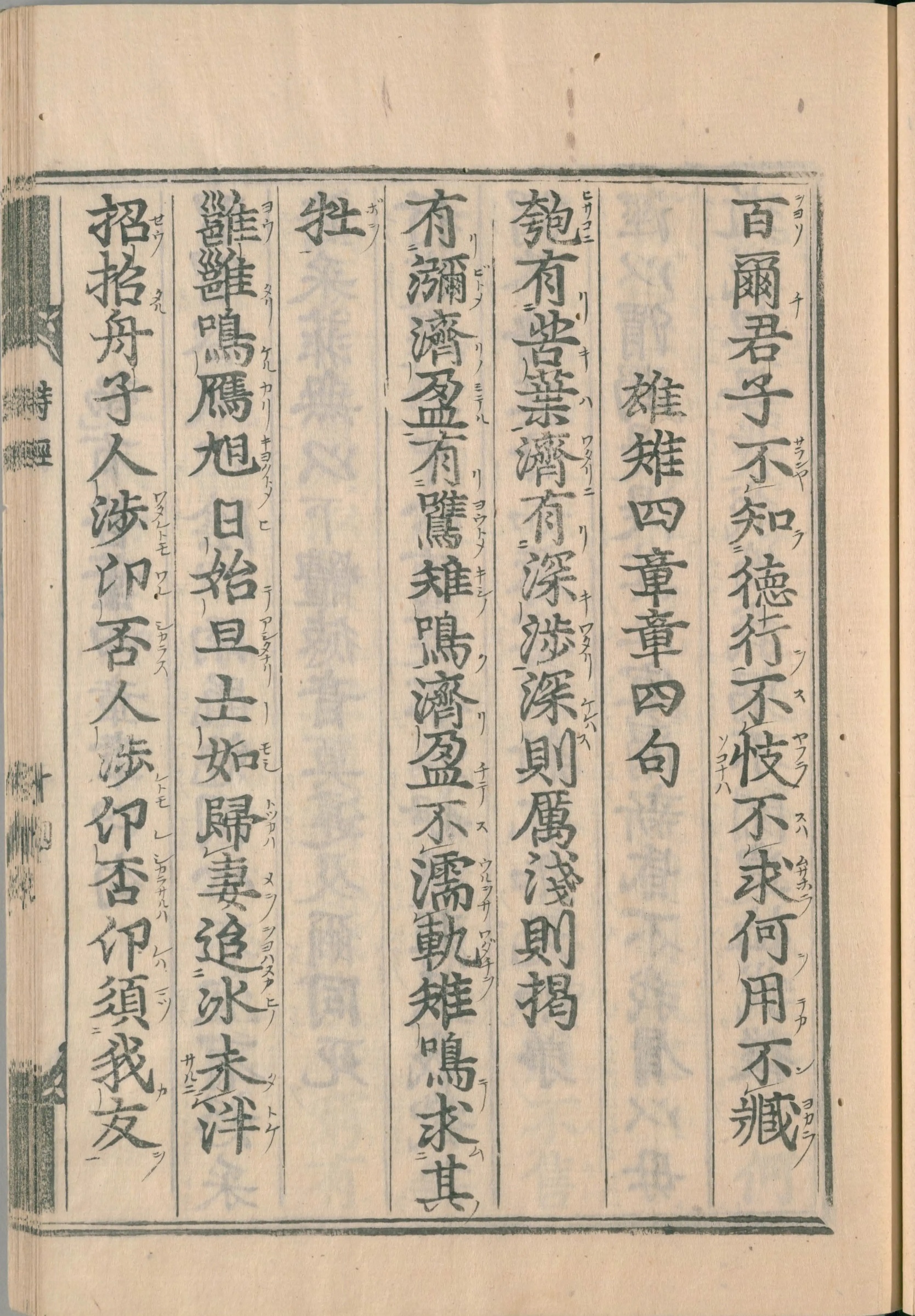
The photographs are of a copy of the Book of Odes in the National Diet Library, Tokyo (call no. WA7-183), printed with movable type in Japan in the Keicho era (1596-1615): main text only, seven columns of seventeen characters to the page, with Japanese reading marks added by hand. Each stanza begins a new column, and a line giving the count of stanzas and lines follows each ode. In this copy the ode runs from canvas 30, right-hand page to canvas 30, left-hand page of the first volume. Each section gathers the stanzas that begin on one page and links to that page and to any page the last stanza runs onto; the page boundaries were found by reading the first characters of every column on the photographs.
The Chinese is the Mao text from Wikisource. The English is James Legge's prose translation in The Chinese Classics, volume IV, part I (1871), Part I, Book 3, ode VIII (Heung che), page 51-52; his notes are not reproduced. Words in square brackets are Legge's own additions.
How was this verified? (Provenance)
Where on the image
National Diet Library WA7-183, vol. [1], IIIF canvas 30, right-hand page: 7 columns of up to 17 characters, main text only, with Japanese reading marks. Checked on the image: stanza 1 opens column 5 ‹雄雉于飛›; stanza 2 opens column 6 ‹雄雉于飛›; stanza 3 opens column 7 ‹瞻彼日月›. Other columns on this page: column 4 is the count line of 凱風 (stanzas and lines). The Chinese shown is the Wikisource Mao text, not a transcription of this print; Legge's English translates the same text.
1雄雉于飛,泄泄其羽,我之懷矣,自詒伊阻。
2雄雉于飛,下上其音,展矣君子,實勞我心。
3瞻彼日月,悠悠我思,道之云遠,曷云能來。
1The male pheasant flies away,
Lazily moving his wings.
The man of my heart!—
He has brought on us this separation.
2The pheasant has flown away,
But from below, from above, comes his voice.
Ah! the princely man!—
He afflicts my heart.
3Look at that sun and moon!
Long, long do I think.
The way is distant;
How can he come to me?
Where on the image
National Diet Library WA7-183, vol. [1], IIIF canvas 30, left-hand page: 7 columns of up to 17 characters, main text only, with Japanese reading marks. Checked on the image: stanza 4 opens column 1 ‹百爾君子›. Other columns on this page: column 2 is the count line of 雄雉 (stanzas and lines). The Chinese shown is the Wikisource Mao text, not a transcription of this print; Legge's English translates the same text.
4百爾君子,不知德行,不忮不求,何用不臧。
4All ye princely men,
Know ye not his virtuous conduct?
He hates none; he covets nothing;—
What does he which is not good?
Notes
- English: James Legge, The She King, The Chinese Classics vol. IV part I (1871), Part I, Lessons from the States, Book 3, ode VIII (Heung che). Stanzas are numbered as in Legge and the Mao text.
- Transcribed for this library from the page images: lines read alike by two OCR programs were kept, and every other line was read on the image (data/sources/shijing/legge1871/). Legge's notes are left out.
Cite
Sources
- Source: National Diet Library WA7-183 (Keicho-era movable-type print of the Shijing, vol. 1) + Wikisource Mao text + James Legge, The She King (Chinese Classics IV, 1871) (holding institution)
- Critical edition: Mao text (Wikisource)
← previous · → next · v cycle view · l back to library