Aitareya Upanishad
Introduction
The Aitareya Upanishad belongs to the Rigveda and forms chapters 4-6 of the second book of the Aitareya Aranyaka. It tells how the Self, alone in the beginning, sent forth the worlds and a cosmic person, from whose body the senses and their gods came forth; how the gods were given a place in man; how the Self entered the body through the suture of the skull; and, in its last chapter, identifies the Self with knowledge (prajnana): 'knowledge is Brahman'. Its second chapter speaks of the three births of a man.
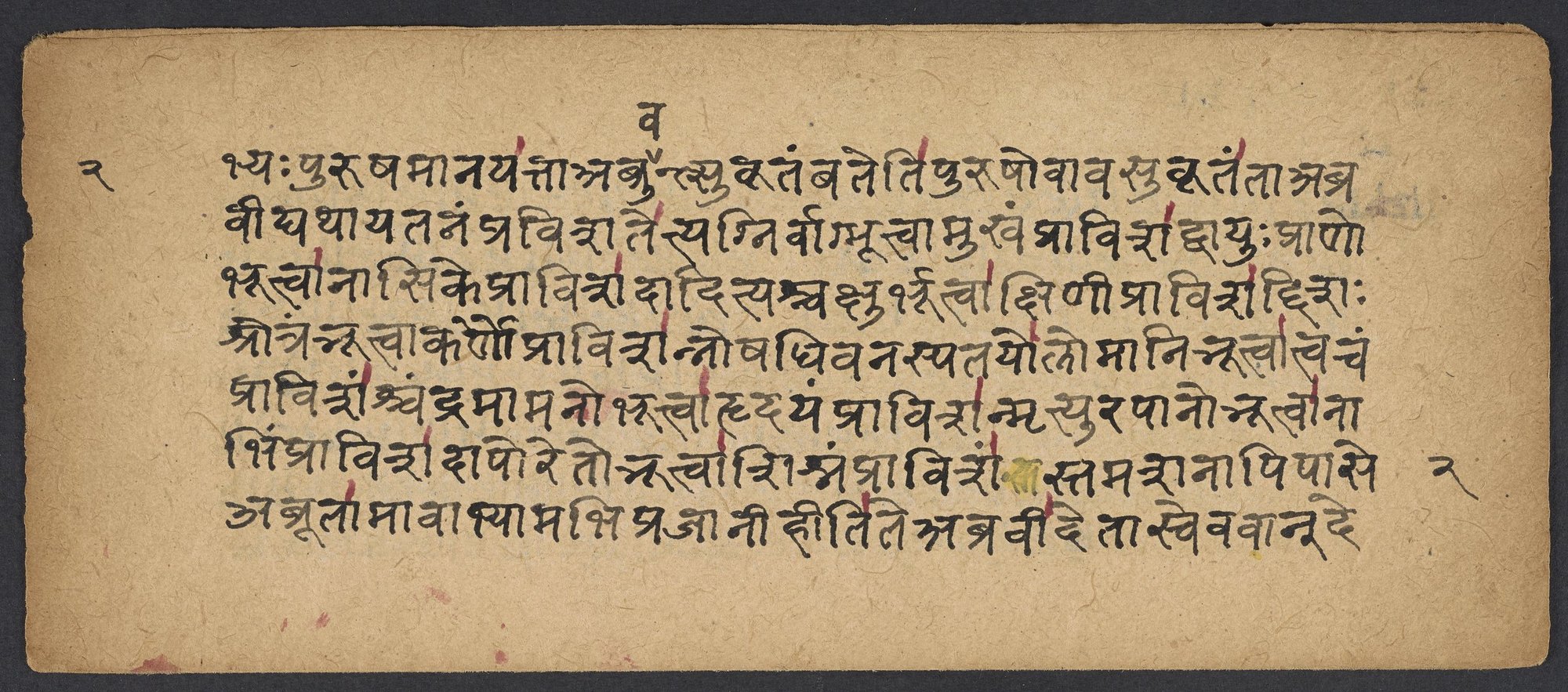
The page images come from University of Pennsylvania Libraries, Ms. Coll. 390 Item 1216, a paper manuscript of seven leaves (10 x 24 cm) written in Devanagari with red accent marks, 7 lines to a side, undated (catalogued 18th or 19th century). The scribe numbers the khandas continuously from 1 to 5 and closes with a colophon naming the text as the Aitareyopanisad of the Asvalayana school of the Rigveda. On fol. 6v he began to copy the next text, a Narayanopanisad, by mistake, then covered those six lines in yellow and finished the Aitareya.
The verse division is Samkara's (1.1.1-3.4), which Müller marks with numbers in parentheses. Each section below holds the verses that end on one page, with the pages they occupy.
How was this verified? (Provenance)
Where on the image
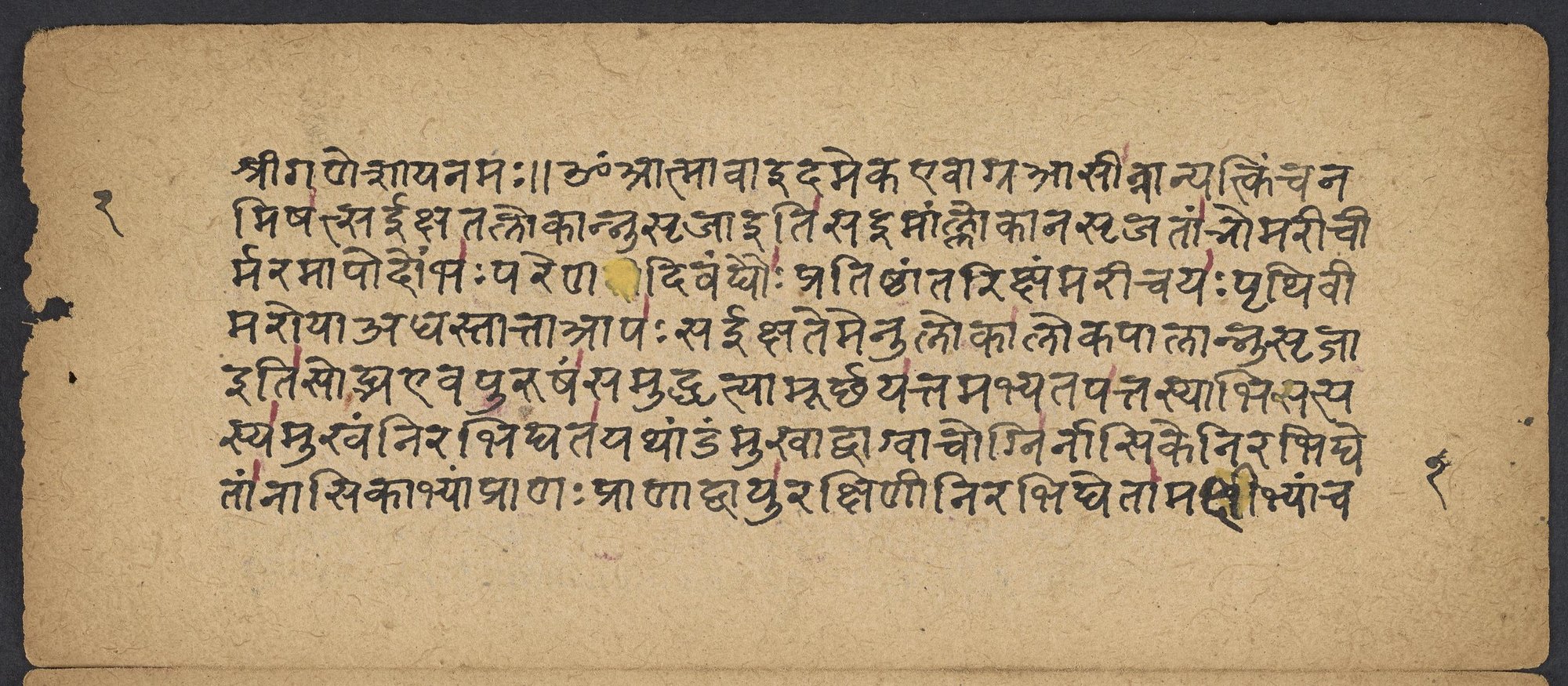
Penn Ms. Coll. 390 Item 1216, fol. 1v. fol. 1v (7 lines): after 'śrīgaṇeśāya namaḥ' 1.1.1 begins in line 1 ‹oṃ ātmā vā idam eka evāgra āsīt›; 1.1.3 ends in line 5 ‹samuddhṛtyāmūrchayat›. Checked on the image; readings logged in data/sources/upanishads/mapping_notes_1216.txt.
1.1.1ātmā vā idam eka evāgra āsīt |
nānyat kiñcana miṣat |
sa īkṣata lokān nu sṛjā iti ||
1.1.2sa imāṃl lokān asṛjatāmbho marīcīr maram āpaḥ |
ado 'mbhaḥ pareṇa divam |
dyauḥ pratiṣṭhā |
antarikṣaṃ marīcayaḥ |
pṛthivī maraḥ |
yā adhastāt tā āpaḥ ||
1.1.3sa īkṣateme nu lokāḥ |
lokapālān nu sṛjā iti |
so 'dbhya eva puruṣaṃ samuddhṛtyāmūrcchayat ||
1.1.1Adoration to the Highest Self. Hari, Om!
Verily, in the beginning all this was Self, one only; there was nothing else blinking whatsoever.
He thought: 'Shall I send forth worlds?'
1.1.2He sent forth these worlds,
Ambhas (water), Marîki (light), Mara (mortal), and Ap (water).
That Ambhas (water) is above the heaven, and it is heaven, the support. The Marîkis (the lights) are the sky. The Mara (mortal) is the earth, and the waters under the earth are the Ap world.
1.1.3He thought: 'There are these worlds; shall I send forth guardians of the worlds?'
He then formed the Purusha (the person), taking him forth from the water.
Where on the image
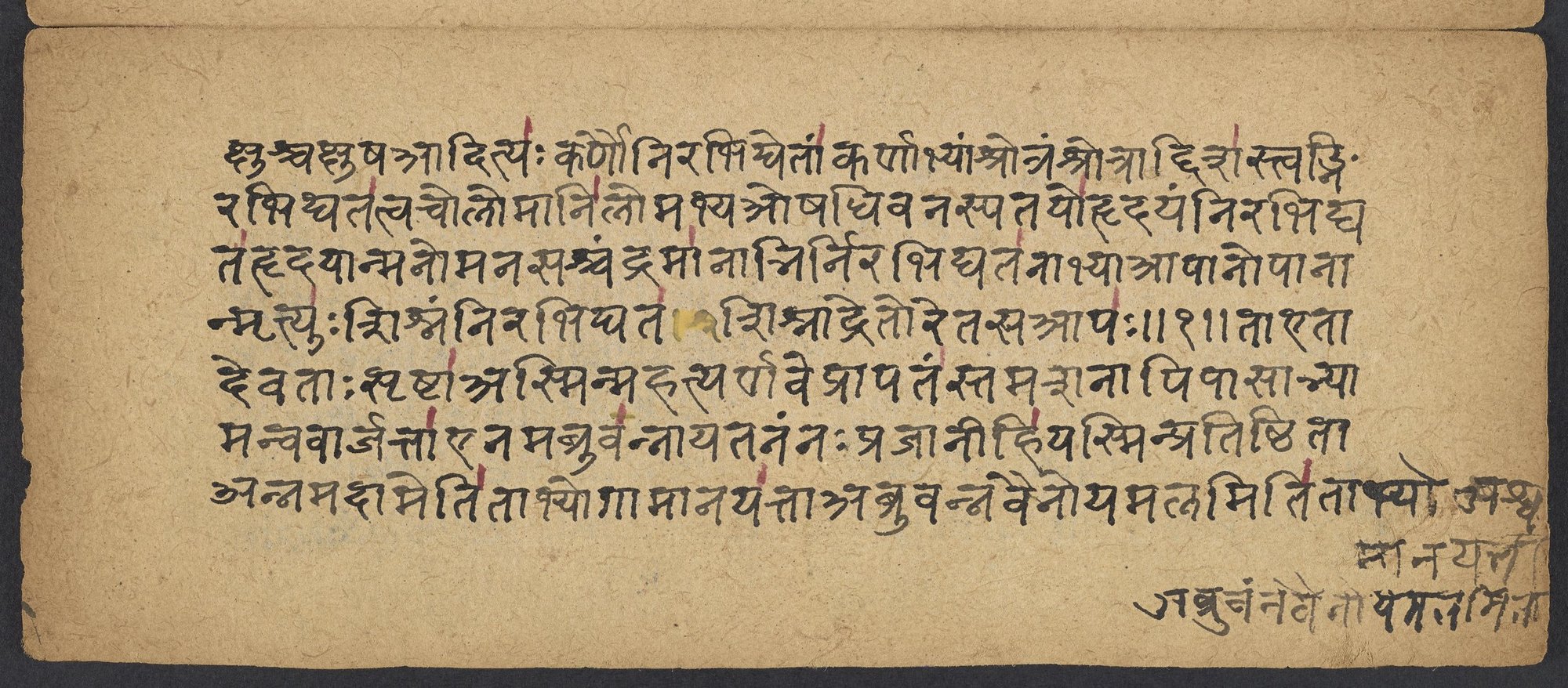
Penn Ms. Coll. 390 Item 1216, fol. 1v, fol. 2r. 1.1.4 begins at fol. 1v line 5 ‹tam abhyatapat› and ends at fol. 2r line 4 ‹retasa āpaḥ ||1||›; 1.2.1 follows to line 7 ‹annam adāmeti›; 1.2.2 begins in line 7 ‹tābhyo gām ānayat› and is completed in two lines added in the lower margin ‹... na vai no 'yam alam iti›. Checked on the image; readings logged in data/sources/upanishads/mapping_notes_1216.txt.
1.1.4tam abhyatapat |
tasyābhitaptasya mukhaṃ nirabhidyata yathāṇḍam |
mukhād vāk |
vāco 'gniḥ |
nāsike nirabhidyetām |
nāsikābhyāṃ prāṇaḥ |
prāṇād vāyuḥ |
akṣiṇī nirabhidyetām |
akṣībhyāṃ cakṣuḥ |
cakṣuṣa ādityaḥ |
karṇau nirabhidyetām |
karṇābhyāṃ śrotram |
śrotrād diśaḥ |
tvaṅ nirabhidyata |
tvaco lomāni |
lomabhya oṣadhivanaspatayaḥ |
hṛdayaṃ nirabhidyata |
hṛdayān manaḥ |
manasaś candramāḥ |
nābhir nirabhidyata |
nābhyā apānaḥ |
apānān mṛtyuḥ |
śiśnaṃ nirabhidyata |
śiśnād retaḥ |
retasa āpaḥ ||
1.2.1tā etā devatāḥ sṛṣṭā asmin mahaty arṇave prāpatan |
tam aśanāpipāsābhyām anvavārjat |
tā enam abruvann āyatanaṃ naḥ prajānīhi |
yasmin pratiṣṭhitā annam adāmeti ||
1.2.2tābhyo gām ānayat |
tā abruvan na vai no 'yam alam iti |
tābhyo 'śvam ānayat |
tā abruvan na vai no 'yam alam iti ||
1.1.4He brooded on him, and when that person had thus been brooded on, a mouth burst forth like an egg. From the mouth proceeded speech, from speech Agni (fire).
Nostrils burst forth. From the nostrils proceeded scent (prâna), from scent Vâyu (air).
Eyes burst forth. From the eyes proceeded sight, from sight Âditya (sun).
Ears burst forth. From the ears proceeded hearing, from hearing the Dis (quarters of the world).
Skin burst forth. From the skin proceeded hairs (sense of touch), from the hairs shrubs and trees.
The heart burst forth. From the heart proceeded mind, from mind Kandramas (moon).
The navel burst forth. From the navel proceeded the Apâna (the down-breathing), from Apâna death.
The generative organ burst forth. From the organ proceeded seed, from seed water.
1.2.1Those deities (devatâ), Agni and the rest, after they had been sent forth, fell into this great ocean.
Then he (the Self) besieged him, (the person) with hunger and thirst.
The deities then (tormented by hunger and thirst) spoke to him (the Self): 'Allow us a place in which we may rest and eat food.'
1.2.2He led a cow towards them (the deities). They said: 'This is not enough.' He led a horse towards them. They said: 'This is not enough.'
Where on the image
Penn Ms. Coll. 390 Item 1216, fol. 2v. fol. 2v line 1 ‹[tā]bhyaḥ puruṣam ānayat› (1.2.3) to line 6 ‹śiśnaṃ prāviśan› (end of 1.2.4). Checked on the image; readings logged in data/sources/upanishads/mapping_notes_1216.txt.
1.2.3tābhyaḥ puruṣam ānayat |
tā abruvan sukṛtaṃ bateti |
puruṣo vāva sukṛtam |
tā abravīd yathāyatanaṃ praviśateti ||
1.2.4agnir vāg bhūtvā mukhaṃ prāviśat |
vāyuḥ prāṇo bhūtvā nāsike prāviśat |
ādityaś cakṣur bhūtvākṣiṇī prāviśat |
diśaḥ śrotraṃ bhūtvā karṇau prāviśan |
oṣadhivanaspatayo lomāni bhūtvā tvacaṃ prāviśan |
candramā mano bhūtvā hṛdayaṃ prāviśat |
mṛtyur apāno bhūtvā nābhiṃ prāviśat |
āpo reto bhūtvā śiśnaṃ prāviśan ||
1.2.3He led man towards them. Then they said: 'Well done, indeed.' Therefore man is well done.
He said to them: 'Enter, each according to his place.'
1.2.4Then Agni (fire), having become speech, entered the mouth. Vâyu (air), having become scent, entered the nostrils. Âditya (sun), having become sight, entered the eyes. The Dis (regions), having become hearing, entered the ears. The shrubs and trees, having become hairs, entered the skin. Kandramas (the moon), having become mind, entered the heart. Death, having become down-breathing, entered the navel. The waters, having become seed, entered the generative organ.
Where on the image
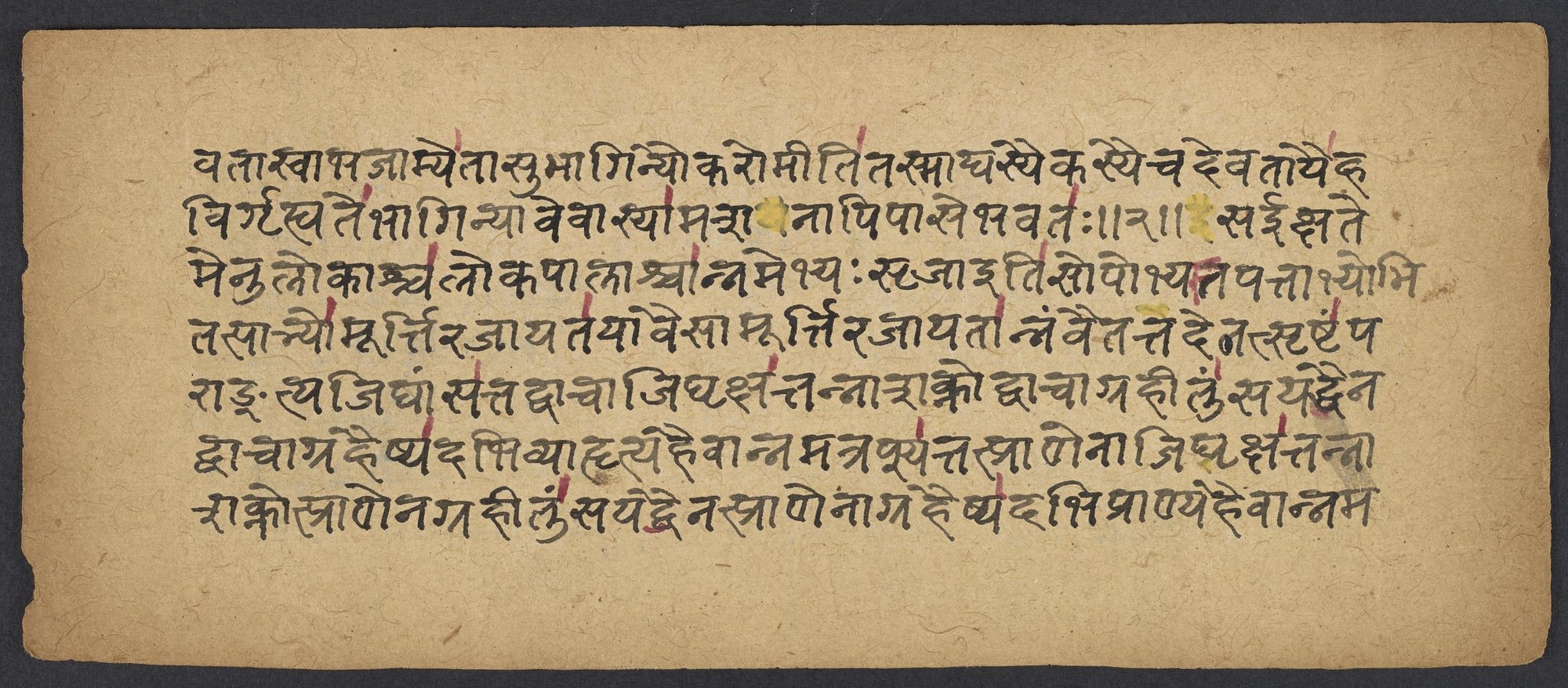
Penn Ms. Coll. 390 Item 1216, fol. 2v, fol. 3r. 1.2.5 begins at fol. 2v line 6 ‹tam aśanāpipāse› and ends at fol. 3r line 2 ‹bhavataḥ ||2||›; 1.3.1-1.3.3 follow to line 6 ‹haivānnam atrapsyat›. Checked on the image; readings logged in data/sources/upanishads/mapping_notes_1216.txt.
1.2.5tam aśanāpipāse abrūtām avābhyām abhiprajānīhīti |
te abravīd etāsv eva vāṃ devatāsv ābhajāmy etāsu bhāginyau karomīti |
tasmād yasyai kasyai ca devatāyai havir gṛhyate bhāginyāv evāsyām aśanāpipāse bhavataḥ ||
1.3.1sa īkṣateme nu lokāś ca lokapālāś ca |
annam ebhyaḥ sṛjā iti ||
1.3.2so 'po 'bhyatapat |
tābhyo 'bhitaptābhyo mūrtir ajāyata |
yā vai sā mūrtir ajāyatānnaṃ vai tat ||
1.3.3tad enat sṛṣṭaṃ parāṅ atyajighāṃsat |
tad vācājighṛkṣat |
tan nāśaknod vācā grahītum |
sa yad dhainad vācāgrahaiṣyad abhivyāhṛtya haivānnam atrapsyat ||
1.2.5Then Hunger and Thirst spoke to him (the Self): 'Allow us two (a place).' He said to them: 'I assign you to those very deities there, I make you co-partners with them.' Therefore to whatever deity an oblation is offered, hunger and thirst are co-partners in it.
1.3.1He thought: 'There are these worlds and the guardians of the worlds. Let me send forth food for them.'
1.3.2He brooded over the water. From the water thus brooded on, matter (mûrti) was born. And that matter which was born, that verily was food.
1.3.3When this food (the object matter) had thus been sent forth, it wished to flee, crying and turning away. He (the subject) tried to grasp it by speech. He could not grasp it by speech. If he had grasped it by speech, man would be satisfied by naming food.
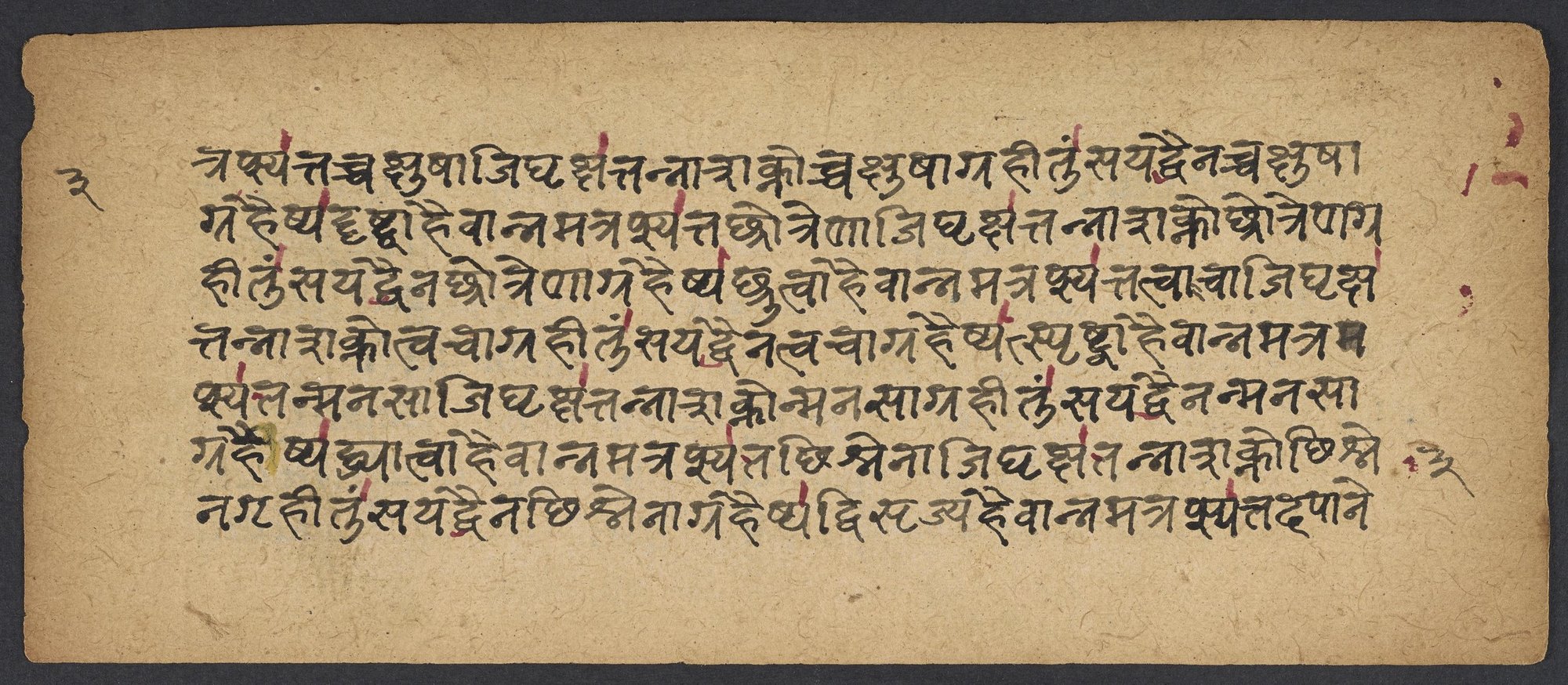
Where on the image
Penn Ms. Coll. 390 Item 1216, fol. 3r, fol. 3v. 1.3.4 begins at fol. 3r line 6 ‹tat prāṇenājighṛkṣat› and ends at fol. 3v line 1 ‹atrapsyat›; 1.3.5-1.3.9 follow to line 7. Checked on the image; readings logged in data/sources/upanishads/mapping_notes_1216.txt.
1.3.4tat prāṇenājighṛkṣat |
tan nāśaknot prāṇena grahītum |
sa yad dhainat prāṇenāgrahaiṣyad abhiprāṇya haivānnam atrapsyat ||
1.3.5tac cakṣuṣājighṛkṣat |
tan nāśaknoc cakṣuṣā grahītum |
sa yad dhainac cakṣuṣāgrahaiṣyad dṛṣṭvā haivānnam atrapsyat ||
1.3.6tac chrotreṇājighṛkṣat |
tan nāśaknoc chrotreṇa grahītum |
sa yad dhainac chrotreṇāgrahaiṣyac chrutvā haivānnam atrapsyat ||
1.3.7tat tvacājighṛkṣat |
tan nāśaknot tvacā grahītum |
sa yad dhainat tvacāgrahaiṣyat spṛṣṭvā haivānnam atrapsyat ||
1.3.8tan manasājighṛkṣat |
tan nāśaknon manasā grahītum |
sa yad dhainan manasāgrahaiṣyad dhyātvā haivānnam atrapsyat ||
1.3.9tac chiśnenājighṛkṣat |
tan nāśaknoc chiśnena grahītum |
sa yad dhainac chiśnenāgrahaiṣyad visṛjya haivānnam atrapsyat ||
1.3.4He tried to grasp it by scent (breath). He could not grasp it by scent. If he had grasped it by scent, man would be satisfied by smelling food.
1.3.5He tried to grasp it by the eye. He could not grasp it by the eye. If he had grasped it by the eye, man would be satisfied by seeing food.
1.3.6He tried to grasp it by the ear. He could not grasp it by the ear. If he had grasped it by the ear, man would be satisfied by hearing food.
1.3.7He tried to grasp it by the skin. He could not grasp it by the skin. If he had grasped it by the skin, man would be satisfied by touching food.
1.3.8He tried to grasp it by the mind. He could not grasp it by the mind. If he had grasped it by the mind, man would be satisfied by thinking food.
1.3.9He tried to grasp it by the generative organ. He could not grasp it by the organ. If he had grasped it by the organ, man would be satisfied by sending forth food.
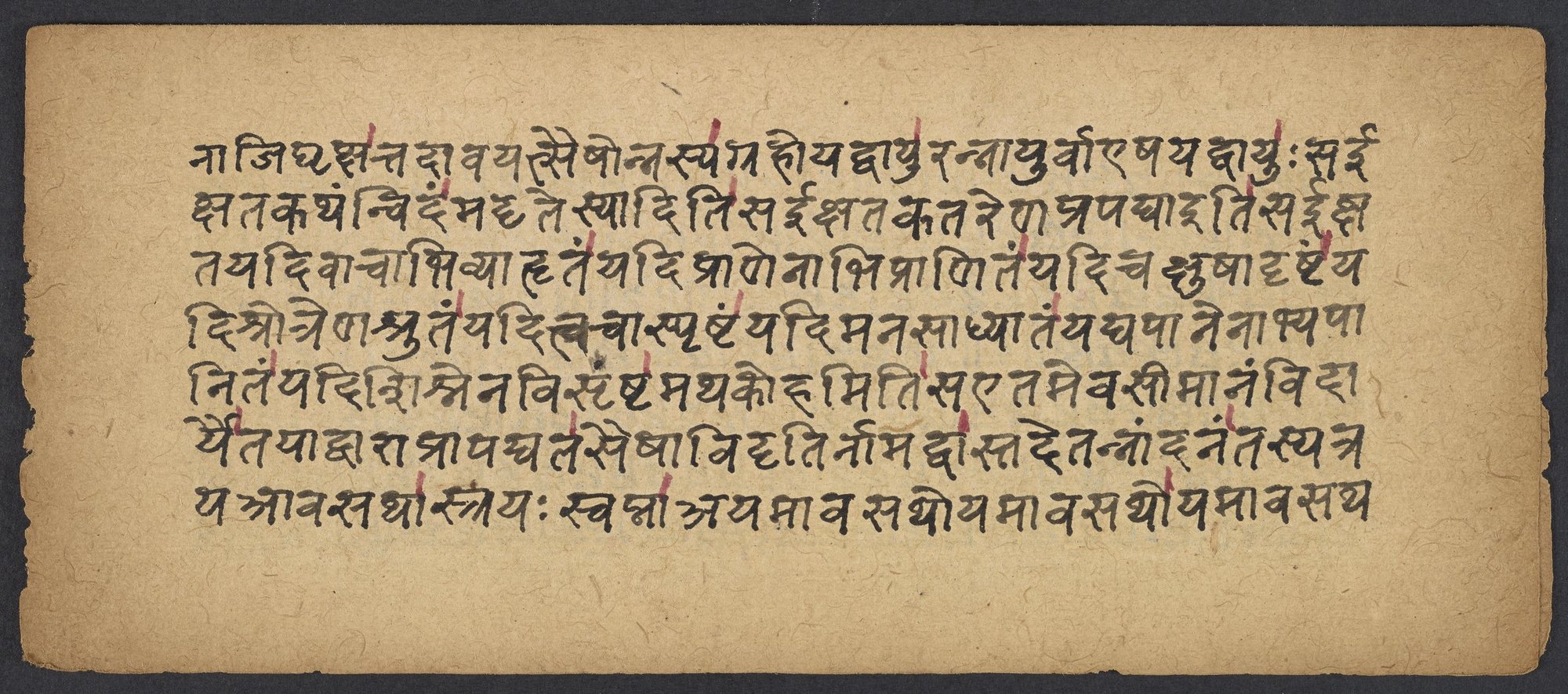
Where on the image
Penn Ms. Coll. 390 Item 1216, fol. 3v, fol. 4r. 1.3.10 begins at the end of fol. 3v line 7 ‹tad apāne-› and ends at fol. 4r line 1 ‹yad vāyuḥ›; 1.3.11 follows to line 5 ‹atha ko 'ham iti›. Checked on the image; readings logged in data/sources/upanishads/mapping_notes_1216.txt.
1.3.10tad apānenājighṛkṣat |
tad āvayat |
saiṣo 'nnasya graho yad vāyuḥ |
annāyur vā eṣa yad vāyuḥ ||
1.3.11sa īkṣata kathaṃ nv idaṃ mad ṛte syād iti |
sa īkṣata katareṇa prapadyā iti |
sa īkṣata yadi vācābhivyāhṛtaṃ yadi prāṇenābhiprāṇitaṃ yadi cakṣuṣā dṛṣṭaṃ yadi śrotreṇa śrutaṃ yadi tvacā spṛṣṭaṃ yadi manasā dhyātaṃ yady apānenābhyapānitaṃ yadi śiśnena visṛṣṭam atha ko 'ham iti ||
1.3.10He tried to grasp it by the down-breathing (the breath which helps to swallow food through the mouth and to carry it off through the rectum, the pâyvindriya). He got it.
Thus it is Vâyu (the getter) who lays hold of food, and the Vâyu is verily Annâyu (he who gives life or who lives by food).
1.3.11He thought: 'How can all this be without me?'
And then he thought: 'By what way shall I get there?'
And then he thought: 'If speech names, if scent smells, if the eye sees, if the ear hears, if the skin feels, if the mind thinks, if the off-breathing digests, if the organ sends forth, then what am I?'
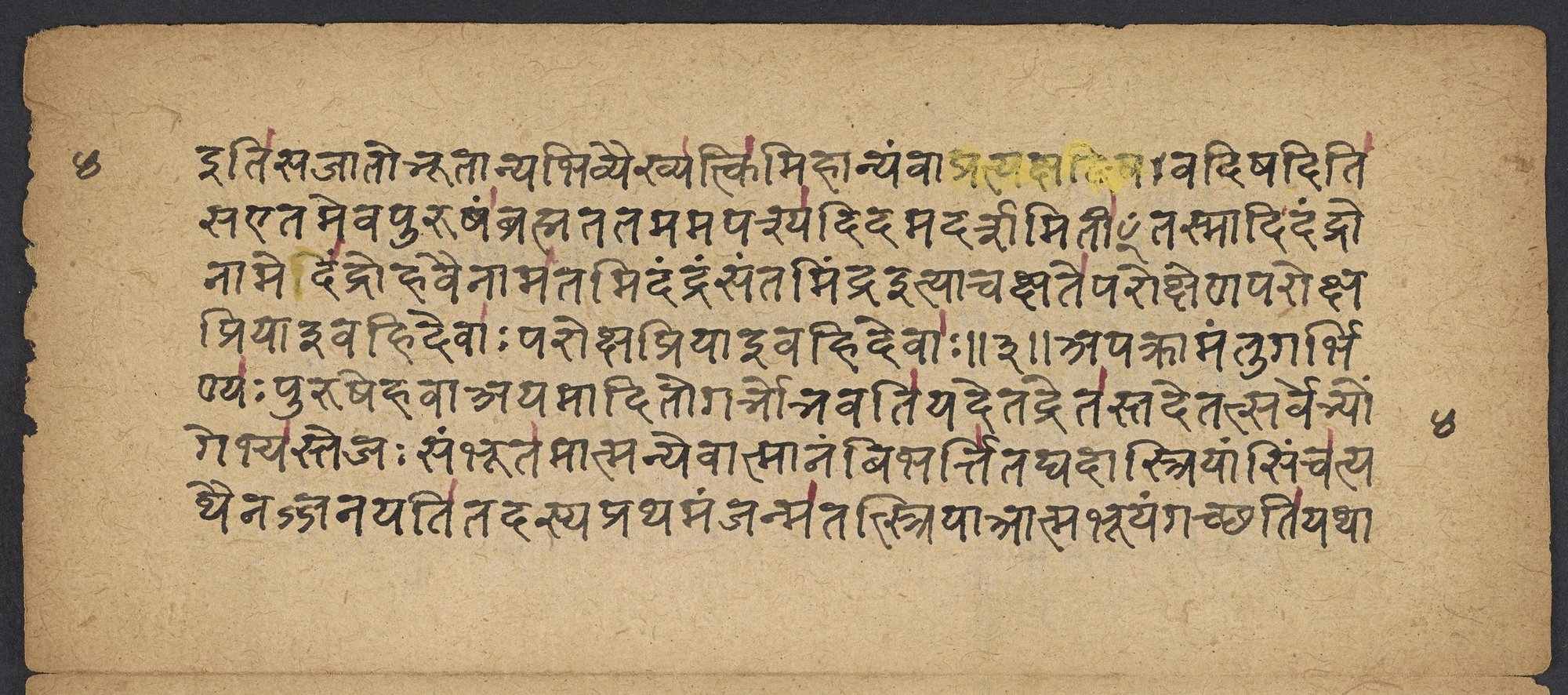
Where on the image
Penn Ms. Coll. 390 Item 1216, fol. 4r, fol. 4v. 1.3.12 begins at fol. 4r line 5 ‹sa etam eva sīmānaṃ› and ends at fol. 4v line 1 ‹iti›; 1.3.13-1.3.14 follow to line 4 ‹parokṣapriyā iva hi devāḥ ||3||›. Some words in fol. 4v line 1 are covered in yellow (a scribal correction). Checked on the image; readings logged in data/sources/upanishads/mapping_notes_1216.txt.
1.3.12sa etam eva sīmānaṃ vidāryaitayā dvārā prāpadyata |
saiṣā vidṛtir nāma dvāḥ |
tad etan nāndanam |
tasya traya āvasathās trayaḥ svapnā ayam āvasatho 'yam āvasatho 'yam āvasatha iti ||
1.3.13sa jāto bhūtāny abhivyaikhyat kim ihānyaṃ vāvadiṣad iti |
sa etam eva puruṣaṃ brahma tatamam apaśyad idam adarśam itī 3 ||
1.3.14tasmād idandro nāma |
idandro ha vai nāma |
tam idandraṃ santam indra ity ācakṣate parokṣeṇa |
parokṣapriyā iva hi devāḥ parokṣapriyā iva hi devāḥ ||
1.3.12Then opening the suture of the skull, he got in by that door.
That door is called the Vidriti (tearing asunder), the Nândana (the place of bliss).
There are three dwelling-places for him, three dreams; this dwelling-place (the eye), this dwelling-place (the throat), this dwelling-place (the heart).
1.3.13When born (when the Highest Self had entered the body) he looked through all things, in order to see whether anything wished to proclaim here another (Self). He saw this person only (himself) as the widely spread Brahman. 'I saw it,' thus he said;
1.3.14Therefore he was Idam-dra (seeing this).
Being Idamdra by name, they call him Indra mysteriously. For the Devas love mystery, yea, they love mystery.
Where on the image
Penn Ms. Coll. 390 Item 1216, fol. 4v. fol. 4v line 4: ‹apakrāmantu garbhiṇyaḥ› (Müller: 'Let the women who are with child move away!'; not in the GRETIL text), then 2.1 ‹puruṣe ha vā ayam ādito garbho bhavati› to line 7 ‹tad asya prathamaṃ janma›. Checked on the image; readings logged in data/sources/upanishads/mapping_notes_1216.txt.
2.1puruṣe ha vā ayam ādito garbho bhavati yad etad retaḥ |
tad etat sarvebhyo 'ṅgebhyas tejaḥ sambhūtam ātmany evātmānaṃ bibharti |
tad yadā striyāṃ siñcaty athainaj janayati |
tad asya prathamaṃ janma ||
2.1Let the women who are with child move away!
Verily, from the beginning he (the self) is in man as a germ, which is called seed.
This (seed), which is strength gathered from all the limbs of the body, he (the man) bears as self in his self (body). When he commits the seed to the woman, then he (the father) causes it to be born. That is his first birth.
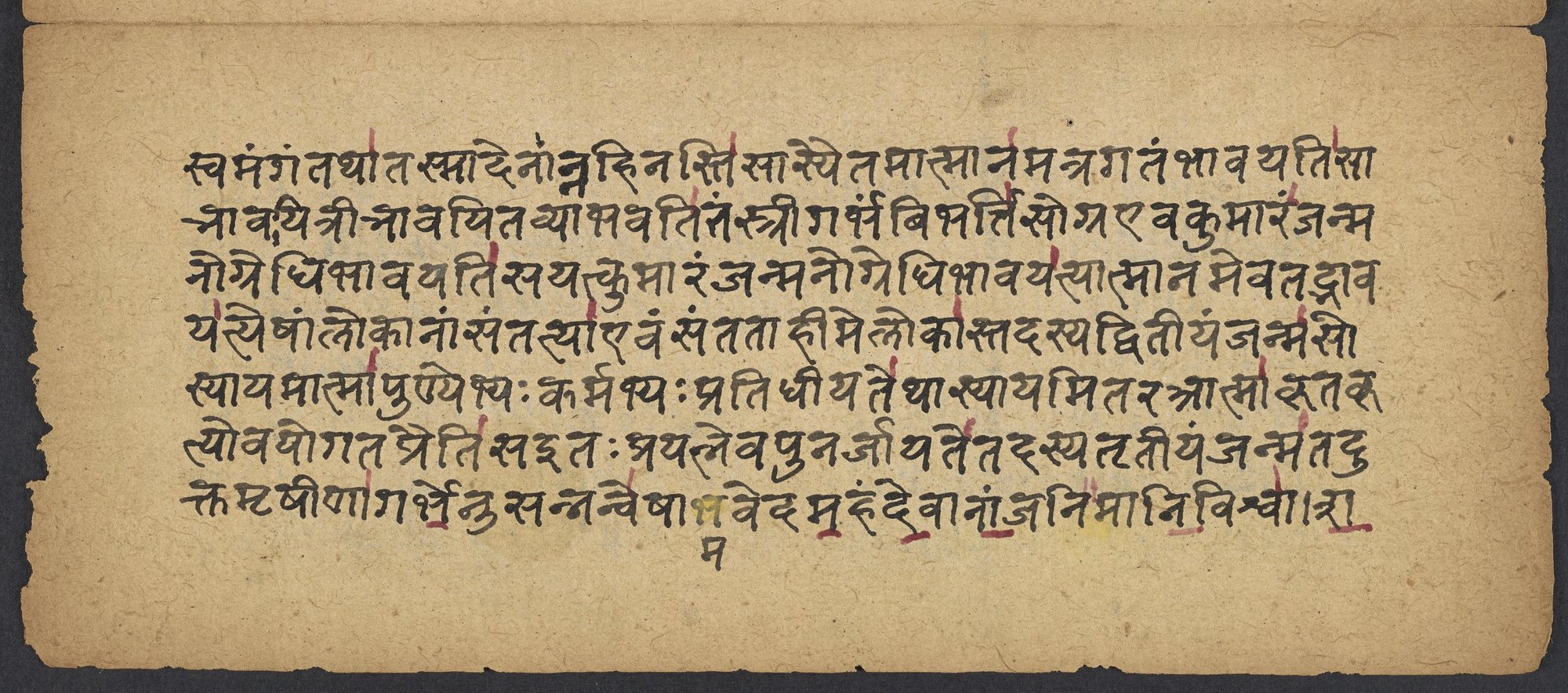
Where on the image
Penn Ms. Coll. 390 Item 1216, fol. 4v, fol. 5r. 2.2 begins at fol. 4v line 7 ‹tat striyā ātmabhūyaṃ gacchati› and ends at fol. 5r line 1 ‹bhāvayati›; 2.3-2.4 follow to line 6 ‹tad asya tṛtīyaṃ janma›. Checked on the image; readings logged in data/sources/upanishads/mapping_notes_1216.txt.
2.2tat striyā ātmabhūyaṃ gacchati yathā svam aṅgaṃ tathā |
tasmād enāṃ na hinasti |
sāsyaitam ātmānam atra gataṃ bhāvayati ||
2.3sā bhāvayitrī bhāvayitavyā bhavati |
taṃ strī garbhaṃ bibharti |
so 'gra eva kumāraṃ janmano 'gre 'dhi bhāvayati |
sa yat kumāraṃ janmano 'gre 'dhi bhāvayaty ātmānam eva tad bhāvayaty eṣāṃ lokānāṃ santatyai |
evaṃ santatā hīme lokāḥ |
tad asya dvitīyaṃ janma ||
2.4so 'syāyam ātmā puṇyebhyaḥ karmebhyaḥ pratidhīyate |
athāsyāyam itara ātmā kṛtakṛtyo vayogataḥ praiti |
sa itaḥ prayann eva punar jāyate |
tad asya tṛtīyaṃ janma ||
2.2That seed becomes the self of the woman, as if one of her own limbs. Therefore it does not injure her.
She nourishes his (her husband's) self (the son) within her.
2.3She who nourishes, is to be nourished.
The woman bears the germ. He (the father) elevates the child even before the birth, and immediately after.
When he thus elevates the child both before and after his birth, he really elevates his own self,
For the continuation of these worlds (men). For thus are these worlds continued.
This is his second birth.
2.4He (the son), being his self, is then placed in his stead for (the performance of) all good works.
But his other self (the father), having done all he has to do, and having reached the full measure of his life, departs.
And departing from hence he is born again. That is his third birth.
And this has been declared by a Rishi (Rv. IV, 27, 1):
Where on the image
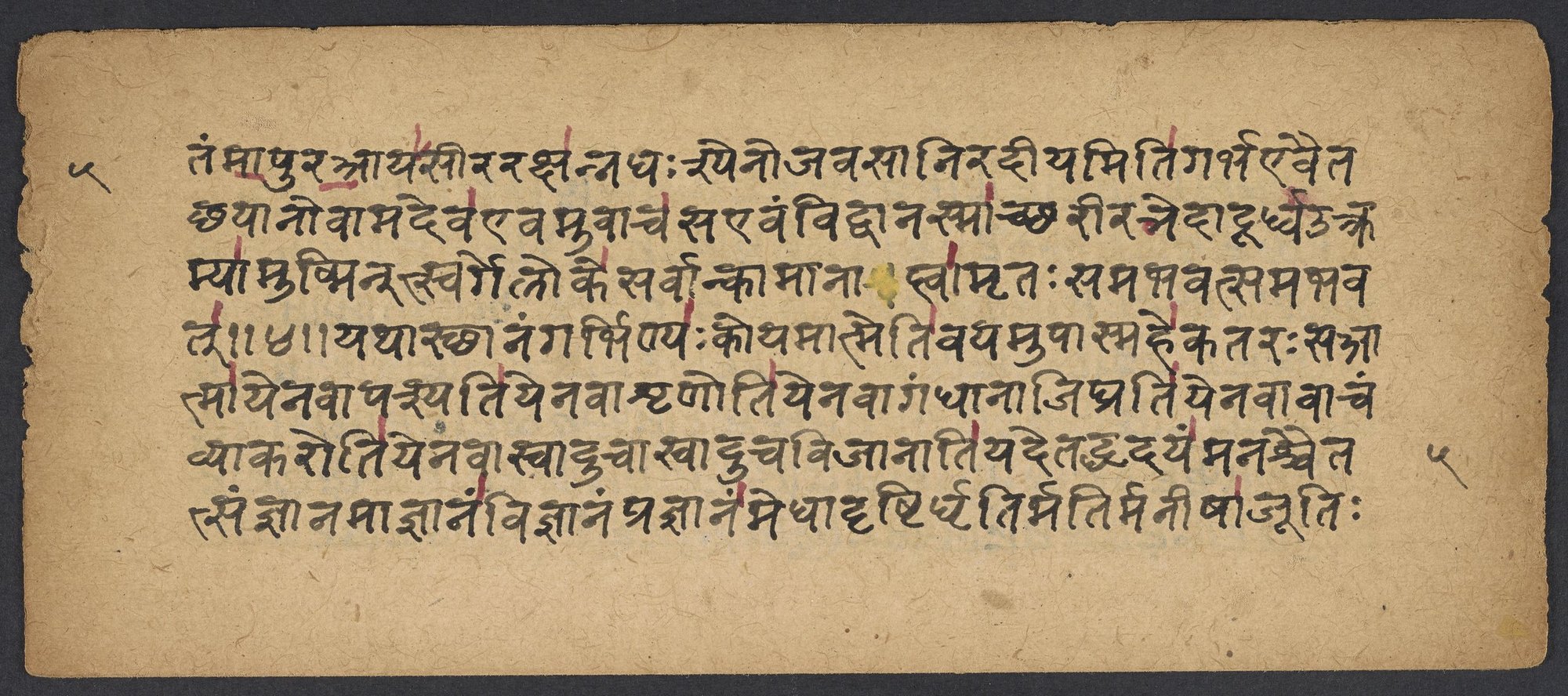
Penn Ms. Coll. 390 Item 1216, fol. 5r, fol. 5v. 2.5 begins at fol. 5r line 6 ‹tad uktam ṛṣiṇā› and ends at fol. 5v line 2 ‹vāmadeva evam uvāca›; 2.6 follows to line 4 ‹samabhavat samabhavat ||4||›; then ‹yathāsthānaṃ garbhiṇyaḥ› (Müller: 'Let the women go back to their place.'; not in the GRETIL text) and 3.1 ‹ko 'yam ātmeti› to line 6 ‹vijānāti›. Checked on the image; readings logged in data/sources/upanishads/mapping_notes_1216.txt.
2.5tad uktam ṛṣiṇā -- garbhe nu sann anv eṣām avedamahaṃ devānāṃ janimāni viśvā |
śataṃ mā pura āyasīr arakṣannadha śyeno javasā nir adīyam |
iti |
garbha evaitac chayāno vāmadeva evam uvāca ||
2.6sa evaṃ vidvān asmāc charīrabhedād ūrdhvam utkramyāmuṣmin svarge loke sarvān kāmān āptvāmṛtaḥ samabhavat samabhavat ||
3.1ko 'yam |
ātmeti vayam upāsmahe |
kataraḥ sa ātmā |
yena vā paśyati yena vā śṛṇoti yena vā gandhāñ jighrati yena vā vācaṃ vyākaroti yena vā svādu cāsvādu ca vijānāti ||
2.5'While dwelling in the womb, I discovered all the births of these Devas. A hundred iron strongholds kept me, but I escaped quickly down like a falcon.'
Vâmadeva, lying in the womb, has thus declared this.
2.6And having this knowledge he stepped forth, after this dissolution of the body, and having obtained all his desires in that heavenly world, became immortal, yea, he became immortal.
3.1Let the women go back to their place.
Who is he whom we meditate on as the Self? Which is the Self?
That by which we see (form), that by which we hear (sound), that by which we perceive smells, that by which we utter speech, that by which we distinguish sweet and not sweet,
Where on the image
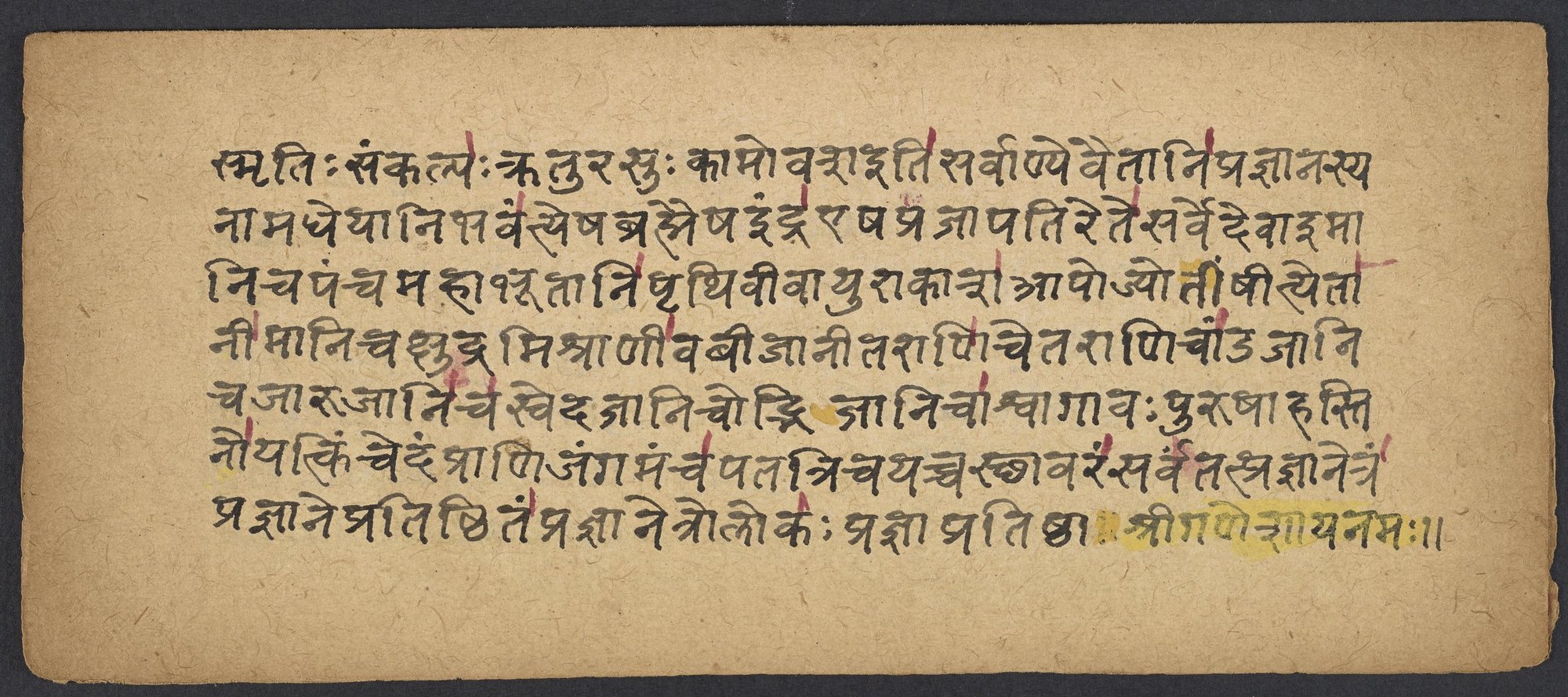
Penn Ms. Coll. 390 Item 1216, fol. 5v, fol. 6r. 3.2 begins at fol. 5v line 6 ‹yad etad dhṛdayaṃ› and ends at fol. 6r line 2 ‹nāmadheyāni bhavanti›. Checked on the image; readings logged in data/sources/upanishads/mapping_notes_1216.txt.
3.2yad etad dhṛdayaṃ manaś caitat |
sañjñānam ājñānaṃ vijñānaṃ prajñānaṃ medhā dṛṣṭir dhṛtir matir manīṣā jūtiḥ smṛtiḥ saṅkalpaḥ kratur asuḥ kāmo vaśa iti sarvāṇy evaitāni prajñānasya nāmadheyāni bhavanti ||
3.2and what comes from the heart and the mind, namely, perception, command, understanding, knowledge, wisdom, seeing, holding, thinking, considering, readiness (or suffering), remembering, conceiving, willing, breathing, loving, desiring?
No, all these are various names only of knowledge (the true Self).
Where on the image
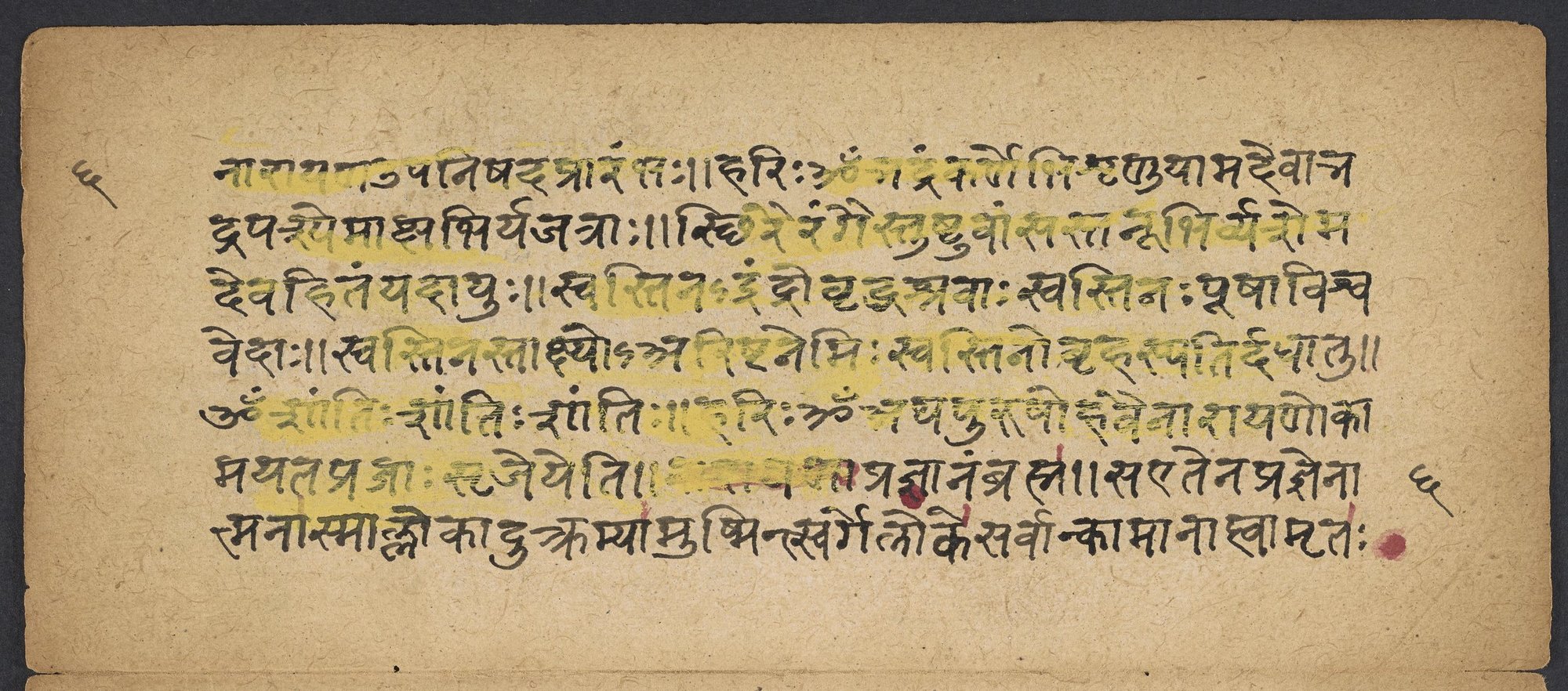
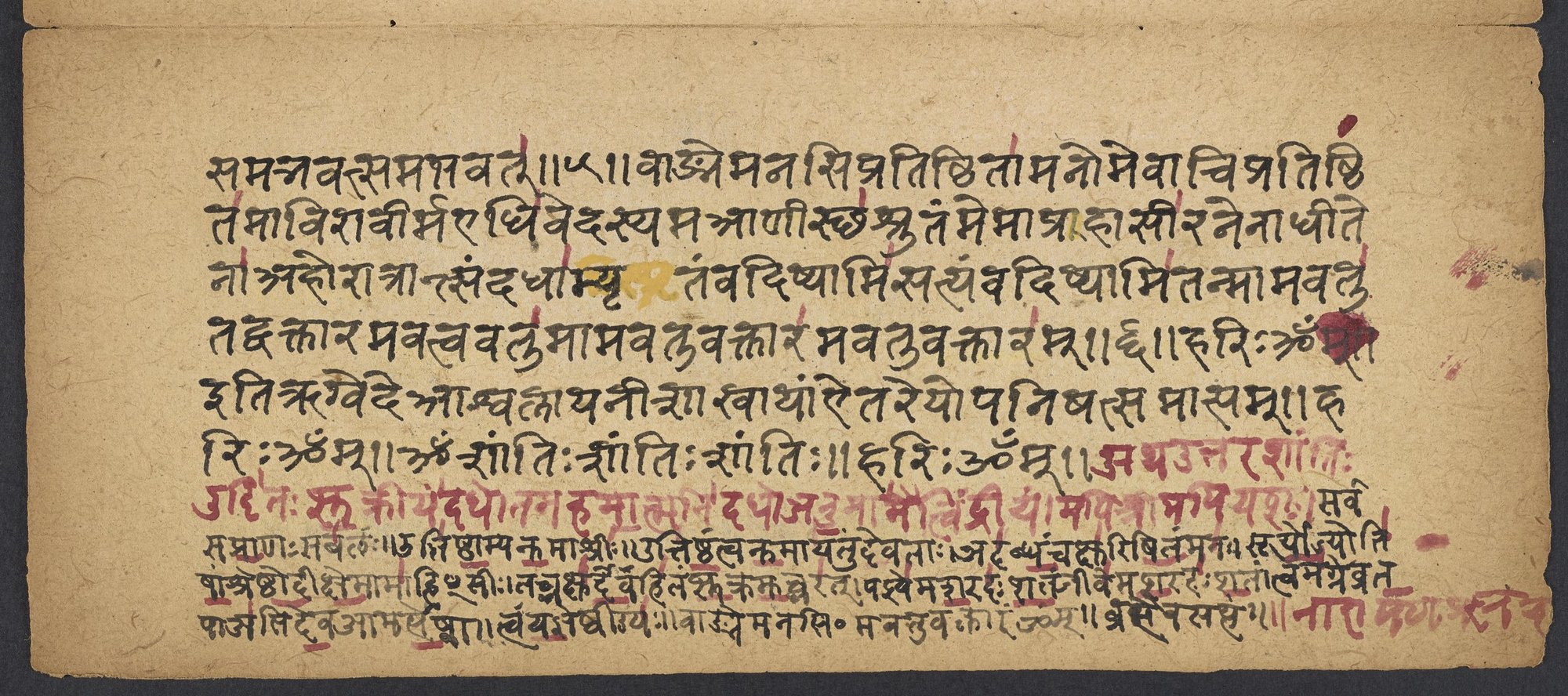
Penn Ms. Coll. 390 Item 1216, fol. 6r, fol. 6v, fol. 7r. 3.3 begins at fol. 6r line 2 ‹eṣa brahmaiṣa indra› and runs to line 7 ‹prajñā pratiṣṭhā›; fol. 6v lines 1-6 hold the opening of a Narayanopanisad copied by mistake and covered in yellow; 3.3 ends at fol. 6v line 6 ‹prajñānaṃ brahma›; 3.4 runs from line 6 ‹sa etena prajñenātmanā› to fol. 7r line 1 ‹samabhavat samabhavat ||5||›, followed by the closing prayer and the colophon. Checked on the image; readings logged in data/sources/upanishads/mapping_notes_1216.txt.
3.3eṣa brahmā |
eṣa indraḥ |
eṣa prajāpatiḥ |
ete sarve devāḥ |
imāni ca pañca mahābhūtāni pṛthivī vāyur ākāśa āpo jyotīṃṣīty etānīmāni kṣudramiśrāṇīva bījānītarāṇi cetarāṇi cāṇḍajāni ca jārujāni ca svedajāni codbhijjāni cāśvā gāvaḥ puruṣā hastino yat kiñcedam prāṇi jaṅgamaṃ ca patatri ca yac ca sthāvaram |
sarvaṃ tat prajñānetram |
prajñāne pratiṣṭhitam |
prajñānetro lokaḥ |
prajñā pratiṣṭhā |
prajñānaṃ brahma ||
3.4sa etena prajñenātmanāsmāl lokād utkramyāmuṣmin svarge loke sarvān kāmān āptvāmṛtaḥ samabhavat samabhavat ||
3.3And that Self, consisting of (knowledge), is Brahman (m.), it is Indra, it is Pragâpati. All these Devas, these five great elements, earth, air, ether, water, fire, these and those which are, as it were, small and mixed, and seeds of this kind and that kind, born from eggs, born from the womb, born from heat, born from germs, horses, cows, men, elephants, and whatsoever breathes, whether walking or flying, and what is immoveable—all that is led (produced) by knowledge (the Self).
It rests on knowledge (the Self). The world is led (produced) by knowledge (the Self). Knowledge is its cause.
Knowledge is Brahman.
3.4He (Vâmadeva), having by this conscious self stepped forth from this world, and having obtained all desires in that heavenly world, became immortal, yea, he became immortal. Thus it is, Om.
Notes
- Sanskrit: GRETIL, Aitareyopanisad with the commentary ascribed to Samkara, mula text only (input by the Sansknet project).
- English: F. Max Müller, The Upanishads part I, Sacred Books of the East 1 (1879), Aitareya-aranyaka II.4-6, pp. 237-246, transcribed for this edition from the page images of the 1879 printing (Wikimedia Commons scan of SBE vol. 1) with the archive.org OCR as a draft. Müller's paragraph numbers (after Sayana) and footnotes are left out; his parenthesized numbers for Samkara's divisions give the verse division used here. Müller places the words 'And this has been declared by a Rishi' at the end of 2.4; the Sanskrit edition begins 2.5 with them.
- Müller's opening 'Adoration to the Highest Self. Hari, Om!' and his sentences 'Let the women who are with child move away!' (before 2.1) and 'Let the women go back to their place.' (before 3.1) translate words that stand in this manuscript ('apakrāmantu garbhiṇyaḥ', fol. 4v line 4; 'yathāsthānaṃ garbhiṇyaḥ', fol. 5v line 4) but not in the GRETIL text, so the English has them while the Sanskrit shown does not.
- Müller's seventh adhyaya, the closing prayer 'My speech rests in the mind' (vāṅ me manasi), is written in the manuscript on fol. 7r but is not part of the GRETIL text and is not shown.
Cite
Sources
- Source: Penn Ms. Coll. 390 Item 1216 (OPenn, public domain) + GRETIL Sanskrit + F. Max Müller (1879) English (holding institution)
- Critical edition: GRETIL Sanskrit e-texts (Isa, Katha, Prasna, Mandukya, Aitareya, Taittiriya, Svetasvatara, Chandogya); Nirnaya Sagar edition of 1925, transcribed (Kena, Mundaka)
← previous · → next · v cycle view · l back to library