Mandukya Upanishad
Introduction
The Mandukya, the shortest of the principal Upanishads, belongs to the Atharvaveda. In twelve paragraphs it identifies the syllable Om with all that is, past, present and future, and with the self, whose four 'quarters' are waking, dreaming, deep sleep and a fourth state beyond them; the sounds a, u and m stand for the first three. Gaudapada's verse commentary on it (the Mandukya Karika) is a founding text of Advaita Vedanta.
The page images come from a single paper manuscript in the University of Pennsylvania Libraries, Ms. Coll. 390 Item 869, catalogued as 'Six early upanisads'. It has 16 leaves (13 x 27 cm) written in Devanagari, 11 to 13 lines to a side, and is undated (the library assigns it to the 18th or 19th century). It contains the Isa, Kena, Katha, Prasna, Mundaka and Mandukya Upanisads in that order; its title page names a set of ten. Leaves are numbered in the right margin of each verso and carry abbreviated titles in the upper left margin.
The Mandukya is the last text in the manuscript, on fol. 16r and 16v (the catalogue gives 15v-16v; fol. 15v carries the end of the Mundaka). Max Müller did not translate it, so the English is R. E. Hume's (1921).
How was this verified? (Provenance)
Where on the image
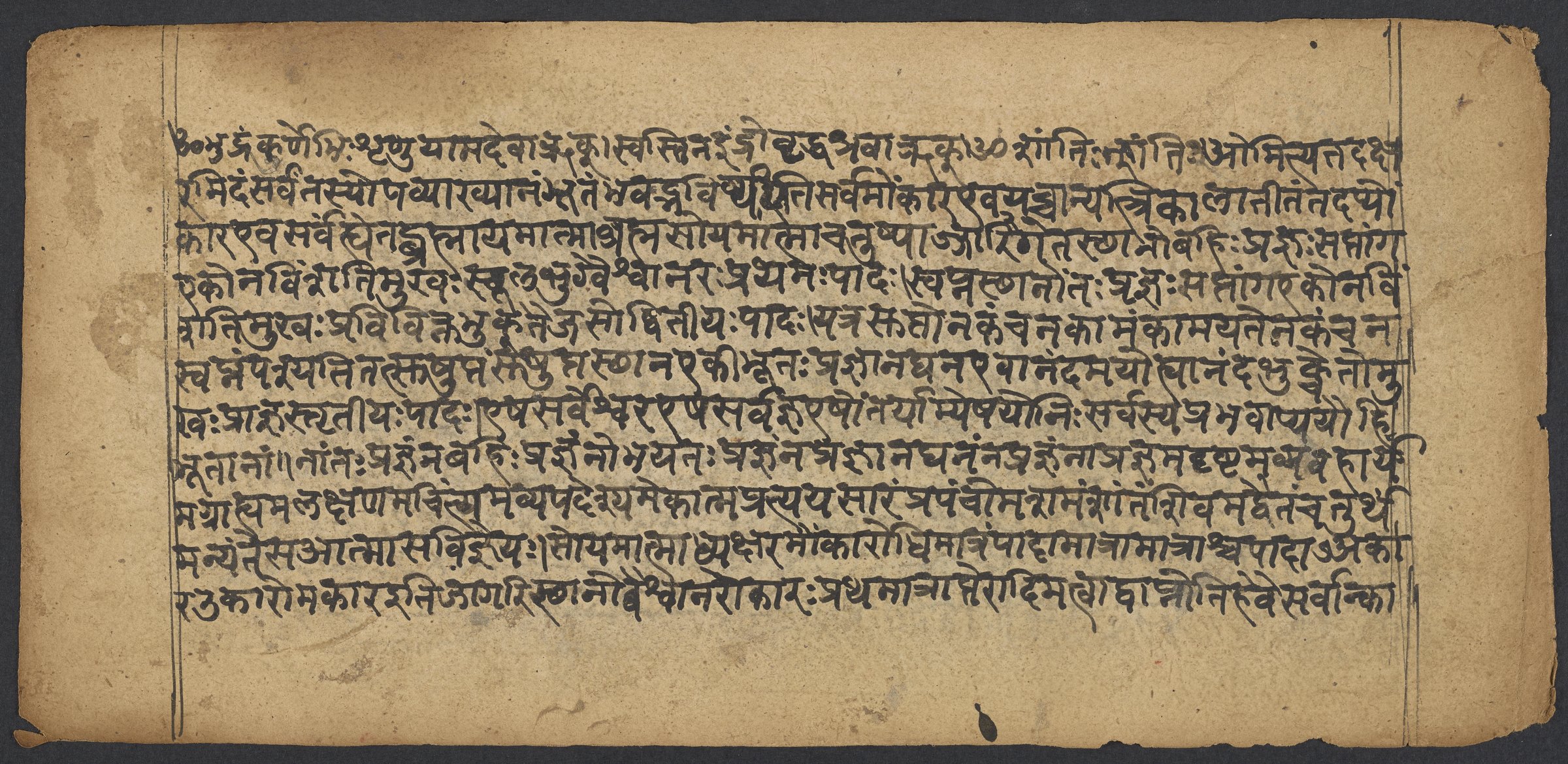
Penn Ms. Coll. 390 Item 869, fol. 16r. fol. 16r (11 lines): after the invocations 'oṃ bhadraṃ karṇebhiḥ ...' and 'svasti na indro ...' (abbreviated) and 'oṃ śāntiḥ', paragraph 1 begins in line 1 ‹om ity etad akṣaram›; paragraph 8 ends in line 11 ‹akāra ukāro makāra iti›. Checked on the image; readings logged in data/sources/upanishads/mapping_notes_869.txt.
1omityetadakṣaramidaṃ sarvaṃ tasyopavyākhyānaṃ bhūtaṃ
bhavadbhaviṣyaditi sarvamoṅkāra eva |
yaccānyattrikālātītaṃ tadapyoṅkāra eva ||
2sarvaṃ hyetad brahmāyamātmā brahma so 'yamātmā catuṣpāt ||
3jāgaritasthāno bahiḥ prajñaḥ saptāṅgaḥ
ekonaviṃśatimukhaḥ sthūlabhugvaiśvānaraḥ prathamaḥ pādaḥ ||
4svapnasthāno 'ntaḥ prajñaḥ saptāṅga ekonaviṃśatimukhaḥ
praviviktabhuktaijaso dvitīyaḥ pādaḥ ||
5yatra supto na kañcana kāmaṃ kāmayate na
kañcana svapnaṃ paśyati tatsuṣuptam |
suṣuptasthāna ekībhūtaḥ prajñānaghana evānandamayo
hyānandabhukcetomukhaḥ prājñastṛtīyaḥ pādah ||
6eṣa sarveśvara eṣa sarvajña eṣo 'ntaryāmyeṣa
yoniḥ sarvasya prabhavāpyayau hi bhūtānām
7nāntaḥ prajñaṃ na bahiḥ prajñaṃ nobhayataḥ prajñaṃ
na prajñānaghanaṃ na prajñaṃ nāprajñam |
adṛśyamavyavahāryamagrāhyamalakṣaṇamacintyamavyapa
deśyamekātmapratyayasāraṃ prapañcopaśamaṃ śāntaṃ
śivamadvaitaṃ caturthaṃ manyante sa ātmā sa vijñeyaḥ ||
8so 'yamātmādhyakṣaramoṅkāro 'dhimātraṃ
pādā mātrā mātrāśca pādā akāra ukāro makāra iti ||
1Om!—This syllable is this whole world.
Its further explanation is:—
The past, the present, the future—everything is just the word Om.
And whatever else that transcends threefold time—that, too, is just the word Om.
2For truly, everything here is Brahma; this self (ātman) is Brahma. This same self has four fourths.
3The waking state (jāgarita-sthāna), outwardly cognitive, having seven limbs, having nineteen mouths, enjoying the gross (sthūla-bhuj), the Common-to-all-men (vaiśvānara), is the first fourth.
4The dreaming state (svapna-sthāna), inwardly cognitive, having seven limbs, having nineteen mouths, enjoying the exquisite (pravivikta-bhuj), the Brilliant (taijasa), is the second fourth.
5If one asleep desires no desire whatsoever, sees no dream whatsoever, that is deep sleep (suṣupta).
The deep-sleep state (suṣupta-sthāna), unified (ekī-bhūta), just (eva) a cognition-mass (prajñāna-ghana), consisting of bliss (ānanda-maya), enjoying bliss (ānanda-bhuj), whose mouth is thought (cetas-), the Cognitional (prājña), is the third fourth.
6This is the lord of all (sarveśvara). This is the all-knowing (sarva-jña). This is the inner controller (antar-yāmin). This is the source (yoni) of all, for this is the origin and the end (prabhavāpyayau) of beings.
7Not inwardly cognitive (antaḥ-prajña), not outwardly cognitive (bahiḥ-prajña), not both-wise cognitive (ubhayataḥ-prajña), not a cognition-mass (prajñāna-ghana), not cognitive (prajña), not non-cognitive (a-prajña), unseen (a-dṛṣṭa), with which there can be no dealing (a-vyavahārya), ungraspable (a-grāhya), having no distinctive mark (a-lakṣaṇa), non-thinkable (a-cintya), that cannot be designated (a-vyapadeśya), the essence of the assurance of which is the state of being one with the Self (ekātmya-pratyaya-sāra), the cessation of development (prapañcopaśama), tranquil (śānta), benign (śiva), without a second (a-dvaita)—[such] they think is the fourth. He is the Self (Ātman). He should be discerned.
8This is the Self with regard to the word Om, with regard to its elements. The elements (mātra) are the fourths; the fourths, the elements: the letter a, the letter u, the letter m.
Where on the image
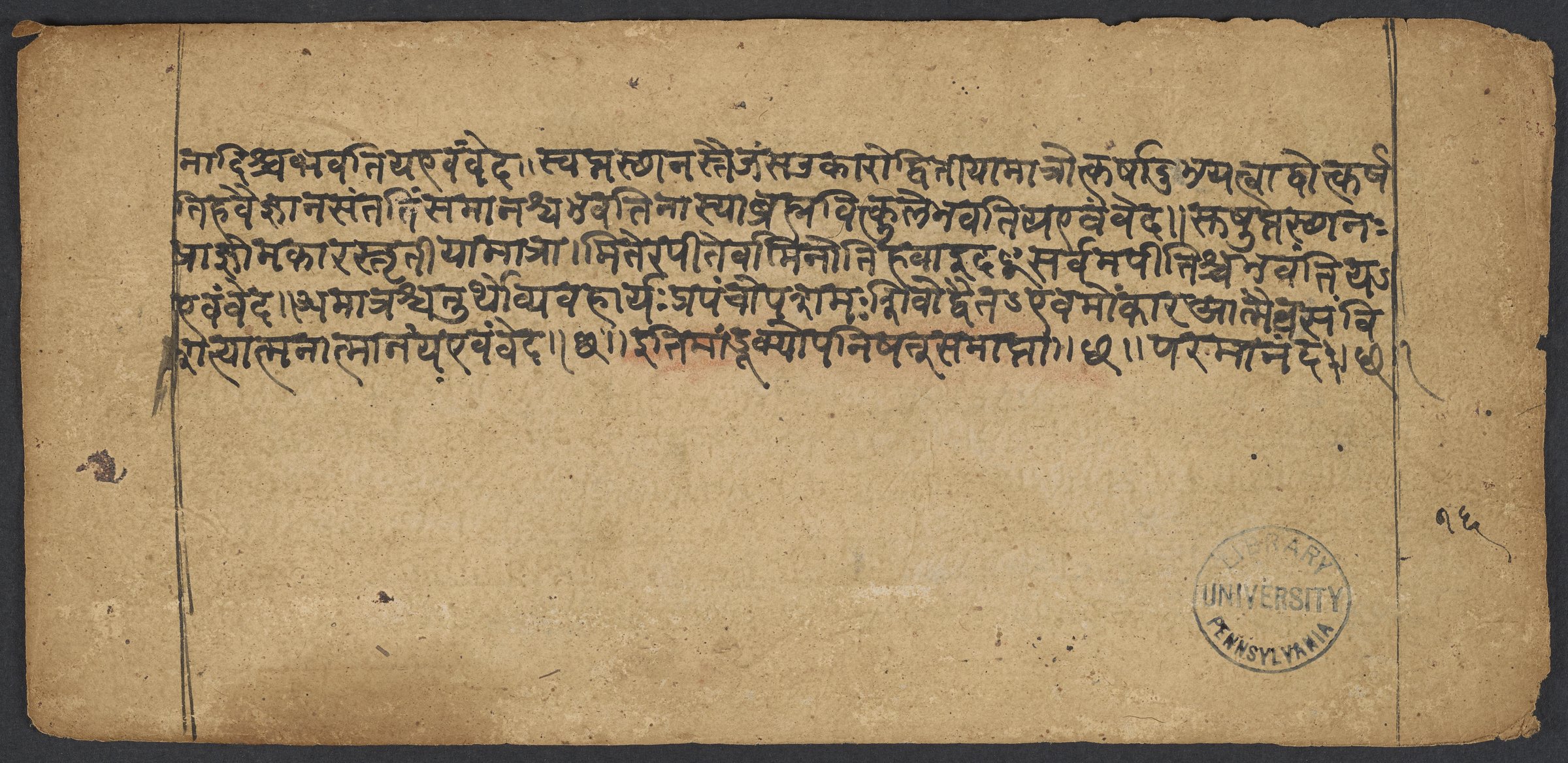
Penn Ms. Coll. 390 Item 869, fol. 16r, fol. 16v. Paragraph 9 begins at fol. 16r line 11 ‹jāgaritasthāno vaiśvānaro 'kāraḥ› and ends at fol. 16v line 1 ‹ādiś ca bhavati ya evaṃ veda›; paragraphs 10-12 follow to line 5 ‹ātmanātmānaṃ ya evaṃ veda›, then the colophon ‹iti māṇḍūkyopaniṣat samāptā paramānanda›. Checked on the image; readings logged in data/sources/upanishads/mapping_notes_869.txt.
9jāgaritasthāno vaiśvānaro 'kāraḥ prathamā
mātrāpterādimattvādvāpnoti ha vai sarvān
kāmānādiśca bhavati ya evaṃ veda ||
10svapnasthānastaijasa ukāro dvitīyā mātrotkarṣād
ubhayatvādvotkarṣati ha vai jñānasantatiṃ samānaśca
bhavati nāsyābrahmavitkule bhavati ya evaṃ veda ||
11suṣuptasthānaḥ prājño makārastṛtīyā mātrā miterapītervā
minoti ha vā idaṃ sarvamapītiśca bhavati ya evaṃ veda ||
12amātraścaturtho 'vyavahāryaḥ prapañcopaśamaḥ śivo 'dvaita
evamoṅkāra ātmaiva saṃviśatyātmanātmānaṃ ya evaṃ veda |
ya evaṃ veda ||
9The waking state, the Common-to-all-men, is the letter a, the first element, from āpti ('obtaining') or from ādimatvā ('being first').
He obtains, verily, indeed, all desires, he becomes first—he who knows this.
10The sleeping state, the Brilliant, is the letter u, the second element, from utkarṣa ('exaltation') or from ubhayatvā ('intermediateness').
He exalts, verily, indeed, the continuity of knowledge; and he becomes equal (samāna); no one ignorant of Brahma is born in the family of him who knows this.
11The deep-sleep state, the Cognitional, is the letter m, the third element, from miti ('erecting') or from apīti ('immerging').
He, verily, indeed, erects (minoti) this whole world, and he becomes its immerging—he who knows this.
12The fourth is without an element, with which there can be no dealing, the cessation of development, benign, without a second.
Thus Om is the Self (Ātman) indeed.
He who knows this, with his self enters the Self—yea, he who knows this!
Notes
- Sanskrit: GRETIL, Mandukyopanisad (alternative version), input by Jeff Samuels; line breaks are those of the GRETIL file. In paragraph 7 GRETIL reads adṛśyam where the manuscript reads adṛṣṭam.
- English: R. E. Hume, The Thirteen Principal Upanishads (Oxford University Press, 1921), pp. 391-393, transcribed from the page images of archive.org copy thirteenprincipa00hume. Hume's footnote numbers and his two editorial sub-headings are left out.
Cite
Sources
- Source: Penn Ms. Coll. 390 Item 869 (OPenn, public domain) + GRETIL Sanskrit + R. E. Hume (1921) English (holding institution)
- Critical edition: GRETIL Sanskrit e-texts (Isa, Katha, Prasna, Mandukya, Aitareya, Taittiriya, Svetasvatara, Chandogya); Nirnaya Sagar edition of 1925, transcribed (Kena, Mundaka)
← previous · → next · v cycle view · l back to library