Chandogya Upanishad, Prapathaka 1 (the udgitha and the syllable Om)
Introduction
The Chandogya Upanishad belongs to the Samaveda and is one of the two longest and oldest Upanishads. It has eight chapters (prapathakas). This entry gives chapter 1. It opens the Upanishad with meditations on the udgitha, the chanted portion of a Saman, identified with the syllable Om. It tells how the gods used the udgitha against the demons, how the priests Silaka, Caikitayana and the king Pravahana Jaivali debated the support of the Saman, how the impoverished Usasti Cakrayana challenged the priests at a royal sacrifice, and closes with the 'udgitha of the dogs' and the stobha syllables.
The page images come from University of Pennsylvania Libraries, Ms. Coll. 390 Item 945, a paper manuscript of 74 leaves (11 x 17 cm) holding the whole Chandogya Upanishad, written in Devanagari, 10 to 11 lines to a side, on blue machine-made paper with watermarks; it is undated (catalogued 18th or 19th century). The scribe numbers the khandas and closes each chapter with a colophon, but does not number paragraphs. Chapter 1 runs from fol. 1v to fol. 12r.
For every page, the first and last words were read on the image and found in the edited text; the page boundaries follow from them. Each section below holds the paragraphs that end on one page, with every page they occupy.
How was this verified? (Provenance)
Where on the image
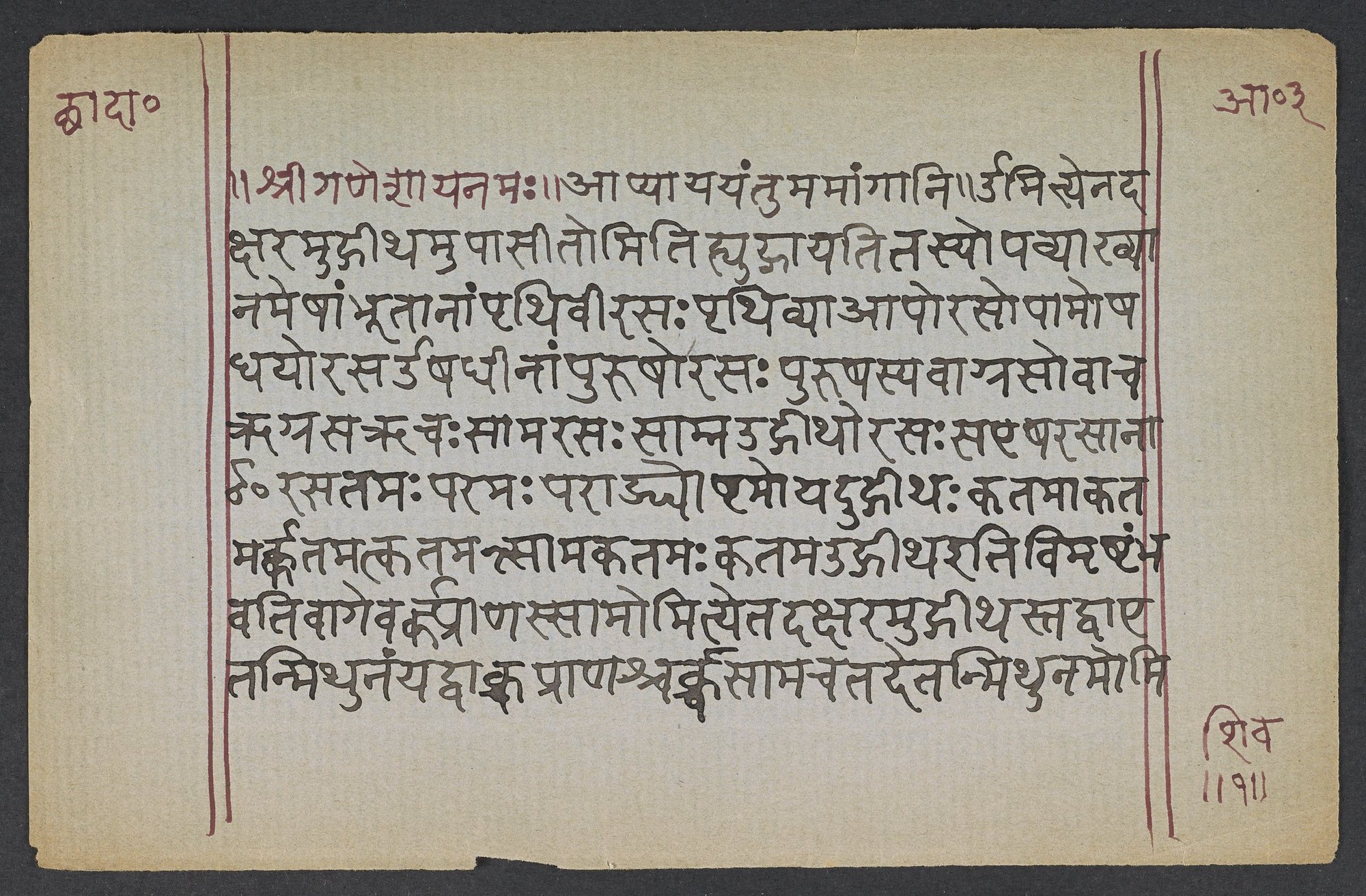
Penn Ms. Coll. 390 Item 945. fol. 1v begins ‹om ity etad akṣaram udgītham› and ends ‹prāṇaś carkca sāma ca tad etan mithunam om i› (first and last words read on the image, transliterated). Notes: fol. 1v opens with 'śrīgaṇeśāya namaḥ' and the invocation 'āpyāyantu mamāṅgāni' before 1.1.1. The words were located in the GRETIL text by string matching and the page boundaries follow from them; readings and results are stored in data/sources/upanishads/mapping_945.json.
1.1om ity etad akṣaram udgītham upāsīta |
om iti hy udgāyati |
tasyopavyākhyānam ||
1.2eṣāṃ bhūtānāṃ pṛthivī rasaḥ |
pṛthivyā āpo rasaḥ |
apām oṣadhayo rasaḥ |
oṣadhīnāṃ puruṣo rasaḥ |
puruṣasya vāg rasaḥ |
vāca ṛg rasaḥ |
ṛcaḥ sāma rasaḥ |
sāmna udgītho rasaḥ ||
1.3sa eṣa rasānāṃ rasatamaḥ paramaḥ parārdhyo 'ṣṭamo yadudgīthaḥ ||
1.4katamā katama rk katamat katamat sāma katamaḥ katama udgītha iti vimṛṣṭaṃ bhavati ||
1.5vāg evark |
prāṇaḥ sāma |
om ity etad akṣaram udgīthaḥ |
tad vā etan mithunaṃ yad vāk ca prāṇaś cark ca sāma ca ||
1.1Let a man meditate on the syllable Om, called the udgîtha; for the udgîtha (a portion of the Sâma-veda) is sung, beginning with Om. The full account, however, of Om is this:—
1.2The essence of all beings is the earth, the essence of the earth is water, the essence of water the plants, the essence of plants man, the essence of man speech, the essence of speech the Rig-veda, the essence of the Rig-veda the Sâma-veda, the essence of the Sâma-veda the udgîtha (which is Om).
1.3That udgîtha (Om) is the best of all essences, the highest, deserving the highest place, the eighth.
1.4What then is the Rik? What is the Sâman? What is the udgîtha? This is the question.
1.5The Rik indeed is speech, Sâman is breath, the udgîtha is the syllable Om. Now speech and breath, or Rik and Sâman, form one couple.
Where on the image
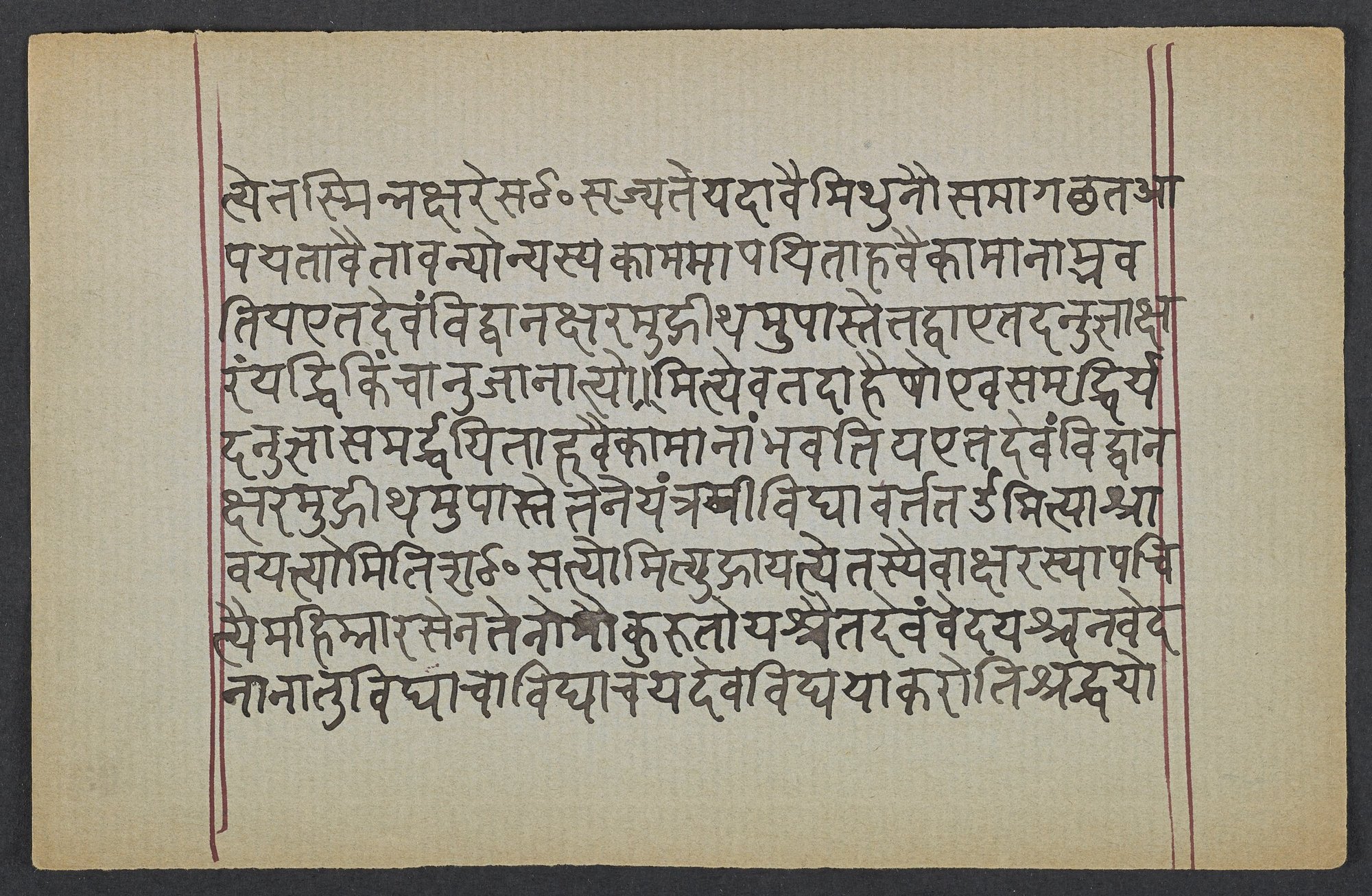
Penn Ms. Coll. 390 Item 945. fol. 1v begins ‹om ity etad akṣaram udgītham› and ends ‹prāṇaś carkca sāma ca tad etan mithunam om i›; fol. 2r begins ‹ty etasminn akṣare saṃsṛjyate yadā vai mithunau samāgacchata› and ends ‹nānā tu vidyā cāvidyā ca yad eva vidyayā karoti śraddhayo› (first and last words read on the image, transliterated). Notes: fol. 1v opens with 'śrīgaṇeśāya namaḥ' and the invocation 'āpyāyantu mamāṅgāni' before 1.1.1. The words were located in the GRETIL text by string matching and the page boundaries follow from them; readings and results are stored in data/sources/upanishads/mapping_945.json.
1.6tad etan mithunam om ity etasminn akṣare saṃsṛjyate |
yadā vai mithunau samāgacchata āpayato vai tāv anyo 'nyasya kāmam ||
1.7āpayitā ha vai kāmānāṃ bhavati ya etad evaṃ vidvān akṣaram udgītham upāste ||
1.8tad vā etad anujñākṣaram |
yad dhi kiṃcānujānāty om ity eva tad āha |
eṣo eva samṛddhir yad anujñā |
samardhayitā ha vai kāmānāṃ bhavati ya etad evaṃ vidvān akṣaram udgītham upāste ||
1.9teneyaṃ trayī vidyā vartate |
om ity āśrāvayati |
om iti śaṃsati |
om ity udgāyati |
etasyaiva akṣarasyāpacityai mahimnā rasena ||
1.6And that couple is joined together in the syllable Om. When two people come together, they fulfil each other's desire.
1.7Thus he who knowing this, meditates on the syllable (Om), the udgîtha, becomes indeed a fulfiller of desires.
1.8That syllable is a syllable of permission, for whenever we permit anything, we say Om, yes. Now permission is gratification. He who knowing this meditates on the syllable (Om), the udgîtha, becomes indeed a gratifier of desires.
1.9By that syllable does the threefold knowledge (the sacrifice, more particularly the Soma-sacrifice, as founded on the three Vedas) proceed. When the Adhvaryu priest gives an order, he says Om. When the Hotri priest recites, he says Om. When the Udgâtri priest sings, he says Om, —all for the glory of that syllable. The threefold knowledge (the sacrifice) proceeds by the greatness of that syllable (the vital breaths), and by its essence (the oblations).
Where on the image
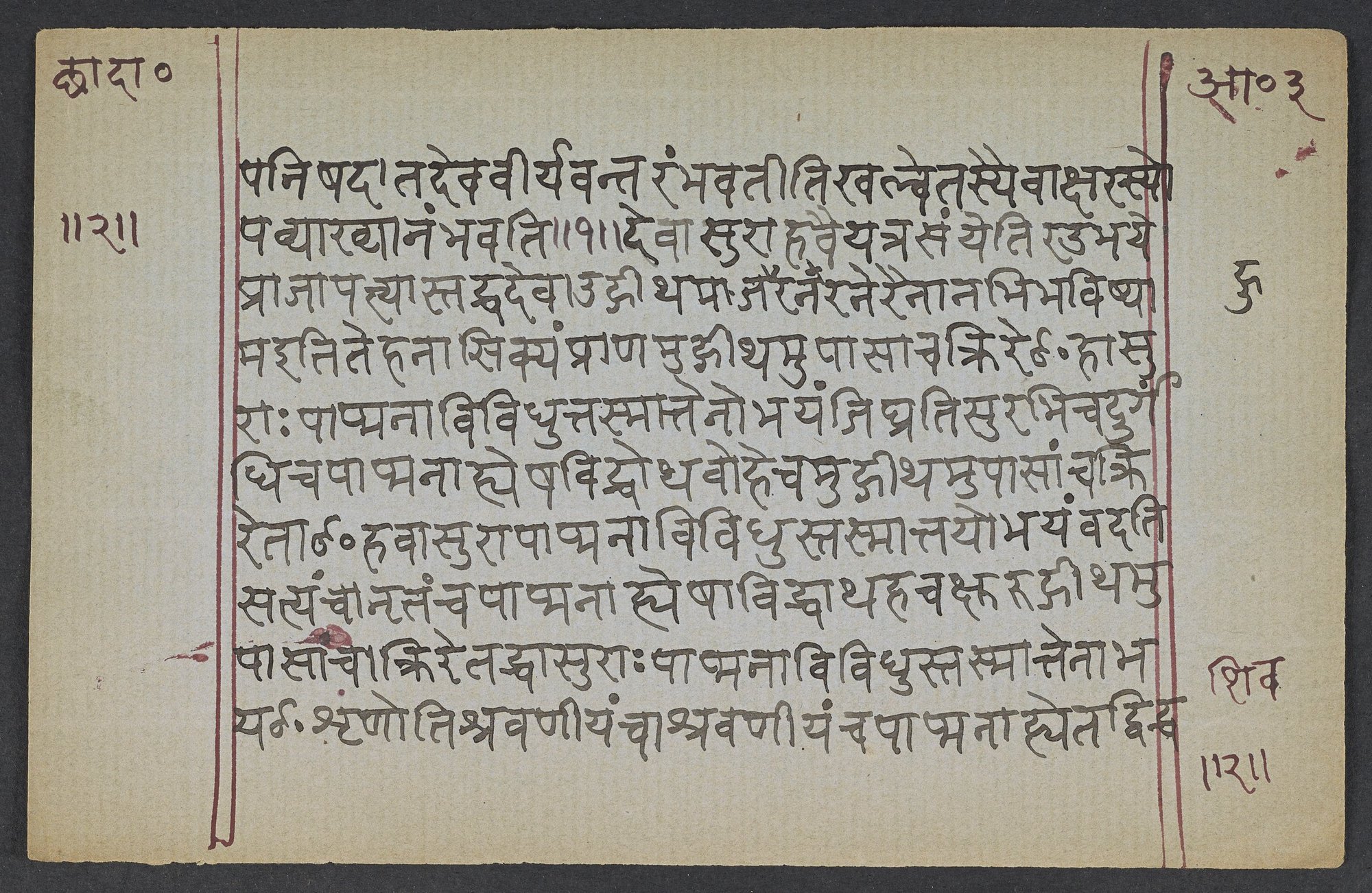
Penn Ms. Coll. 390 Item 945. fol. 2r begins ‹ty etasminn akṣare saṃsṛjyate yadā vai mithunau samāgacchata› and ends ‹nānā tu vidyā cāvidyā ca yad eva vidyayā karoti śraddhayo›; fol. 2v begins ‹paniṣadā tad eva vīryavattaraṃ bhavatīti› and ends ‹śravaṇīyaṃ cāśravaṇīyaṃ ca pāpmanā hy etad viddha› (first and last words read on the image, transliterated). The words were located in the GRETIL text by string matching and the page boundaries follow from them; readings and results are stored in data/sources/upanishads/mapping_945.json.
1.10tenobhau kurutaḥ |
yaś caitad evaṃ veda yaś ca na veda |
nānā tu vidyā cāvidyā ca |
yad eva vidyayā karoti śraddhayopaniṣadā tad eva vīryavattaraṃ bhavatīti khalv etasyaivākṣarasyopavyākhyānaṃ bhavati ||
2.1devāsurā ha vai yatra saṃyetire |
ubhaye prājāpatyās tad dha devā udgītham ājahrur anenainān abhibhaviṣyāma iti ||
2.2te ha nāsikyaṃ prāṇam udgītham upāsāṃ cakrire |
taṃ ha asurāḥ pāpmanā vividhuḥ |
tasmāt tenobhayaṃ jighrati surabhi ca durgandhi ca |
pāpmanā hy eṣa viddhaḥ ||
2.3atha ha vācam udgītham upāsāṃ cakrire |
tāṃ hāsurāḥ pāpmanā vividhuḥ |
tasmāt tayobhayaṃ vadati satyaṃ cānṛtaṃ ca |
pāpmanā hy eṣā viddhā ||
2.4atha ha cakṣur udgītham upāsāṃ cakrire |
tad dhāsurāḥ pāpmanā vividhuḥ |
tasmāt tenobhayaṃ paśyati darśanīyaṃ cādarśanīyaṃ ca |
pāpmanā hy etad viddham ||
1.10Now therefore it would seem to follow, that both he who knows this (the true meaning of the syllable Om), and he who does not, perform the same sacrifice. But this is not so, for knowledge and ignorance are different. The sacrifice which a man performs with knowledge, faith, and the Upanishad is more powerful. This is the full account of the syllable Om.
2.1Whent he Devas and Asuras struggled together, both of the race of Pragâpati, the Devas took the udgîtha (Om), thinking they would vanquish the Asuras with it.
2.2They meditated on the udgîtha (Om) as the breath (scent) in the nose, but the Asuras pierced it (the breath) with evil. Therefore we smell by the breath in the nose both what is good-smelling and what is bad-smelling. For the breath was pierced by evil.
2.3Then they meditated on the udgîtha (Om) as speech, but the Asuras pierced it with evil. Therefore we speak both truth and falsehood. For speech is pierced by evil.
2.4Then they meditated on the udgîtha (Om) as the eye, but the Asuras pierced it with evil. Therefore we see both what is sightly and unsightly. For the eye is pierced by evil.
Where on the image
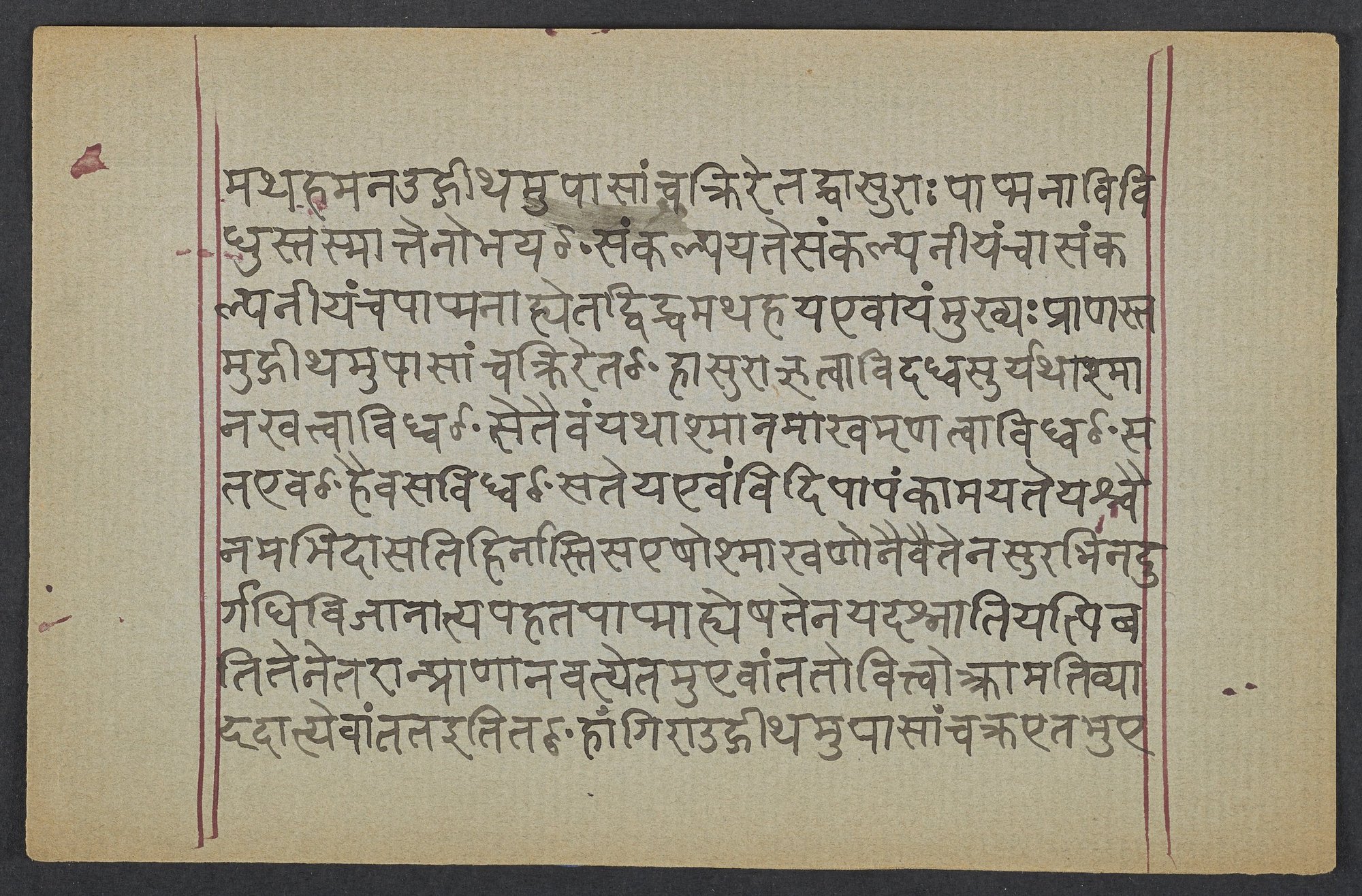
Penn Ms. Coll. 390 Item 945. fol. 2v begins ‹paniṣadā tad eva vīryavattaraṃ bhavatīti› and ends ‹śravaṇīyaṃ cāśravaṇīyaṃ ca pāpmanā hy etad viddha›; fol. 3r begins ‹m atha ha mana udgītham upāsāṃ cakrire› and ends ‹tad dhāṅgirā udgītham upāsāṃ cakra etam u› (first and last words read on the image, transliterated). The words were located in the GRETIL text by string matching and the page boundaries follow from them; readings and results are stored in data/sources/upanishads/mapping_945.json.
2.5atha ha śrotram udgītham upāsāṃ cakrire |
tad dhāsurāḥ pāpmanā vividhuḥ |
tasmāt tenobhayaṃ śṛṇoti śravaṇīyaṃ cāśravaṇīyaṃ ca |
pāpmanā hy etad viddham ||
2.6atha ha mana udgītham upāsāṃ cakrire |
tad dhāsurāḥ pāpmanā vividhuḥ |
tasmāt tenobhayaṃ saṃkalpayate saṃkalpanīyaṃ ca |
pāpmanā hy etad viddham ||
2.7atha ha ya evāyaṃ mukhyaḥ prāṇas tam udgītham upāsāṃ cakrire |
taṃ hāsurā ṛtvā vidadhvaṃsur yathāśmānam ākhaṇam ṛtvā vidhvaṃsetaivam ||
2.8evaṃ yathāśmānam ākhaṇam ṛtvā vidhvaṃsata evaṃ haiva sa vidhvaṃsate ya evaṃvidi pāpaṃ kāmayate yaś cainam abhidāsati |
sa eṣo 'śmākhaṇaḥ ||
2.9naivaitena surabhi na durgandhi vijānāti |
apahatapāpmā hy eṣaḥ |
tena yad aśnāti yat pibati tenetarān prāṇān avati |
etam u evāntato 'vittvotkrāmati |
vyādadāty evāntata iti ||
2.5Then they meditated on the udgîtha (Om) as the ear, but the Asuras pierced it with evil. Therefore we hear both what should be heard and what should not be heard. For the ear is pierced by evil.
2.6Then they meditated on the udgîtha (Om) as the mind, but the Asuras pierced it with evil. Therefore we conceive both what should be conceived and what should not be conceived. For the mind is pierced by evil.
2.7Then comes this breath (of life) in the mouth. They meditated on the udgîtha (Om) as that breath. When the Asuras came to it, they were scattered, as (a ball of earth) would be scattered when hitting a solid stone.
2.8Thus, as a ball of earth is scattered when hitting on a solid stone, will he be scattered who wishes evil to one who knows this, or who persecutes him; for he is a solid stone.
2.9By it (the breath in the mouth) he distinguishes neither what is good nor what is bad-smelling, for that breath is free from evil. What we eat and drink with it supports the other vital breaths (i. e. the senses, such as smell, &c.) When at the time of death he does not find that breath (in the mouth, through which he eats and drinks and lives), then he departs. He opens the mouth at the time of death (as if wishing to eat).
Where on the image
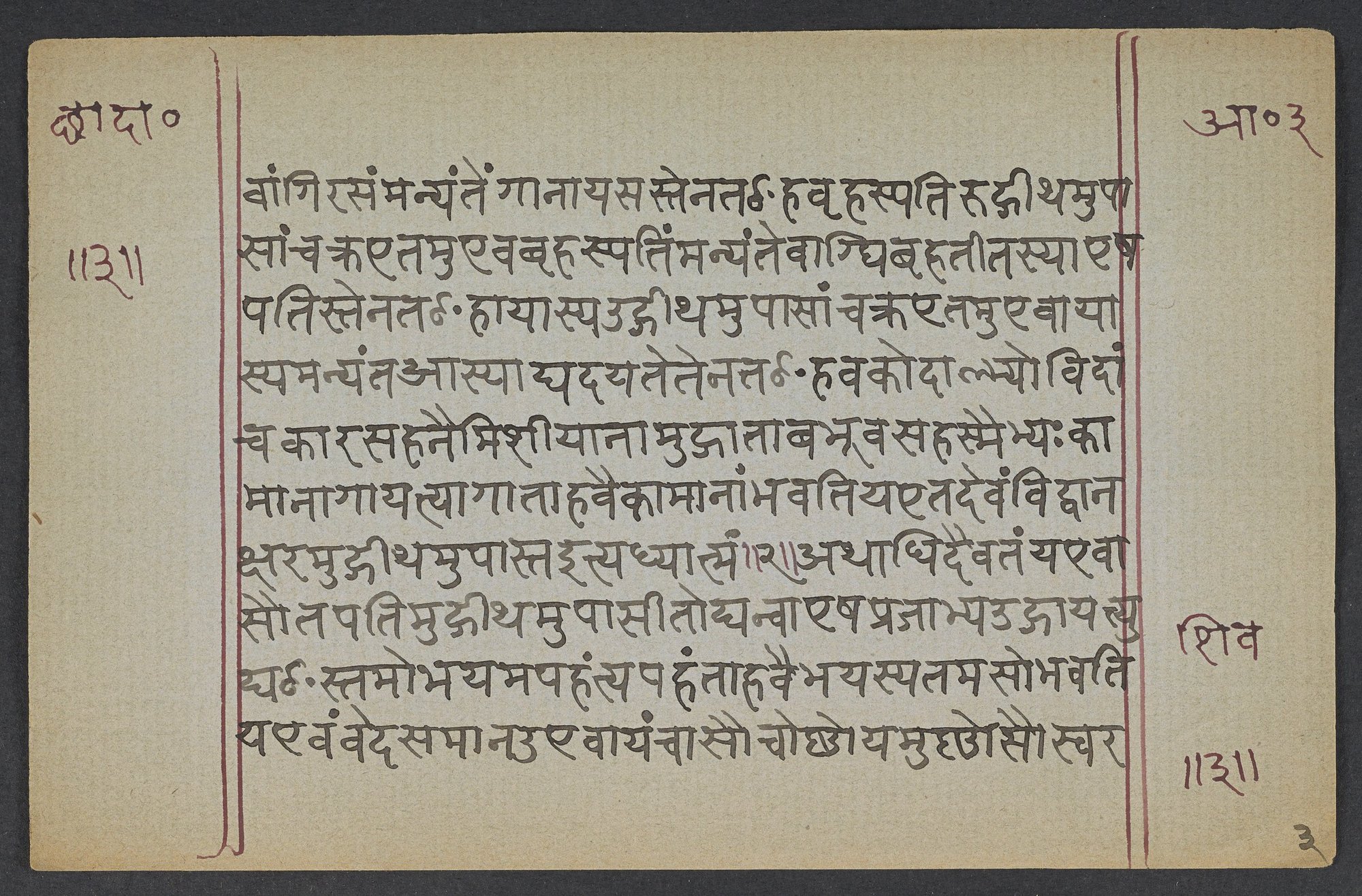
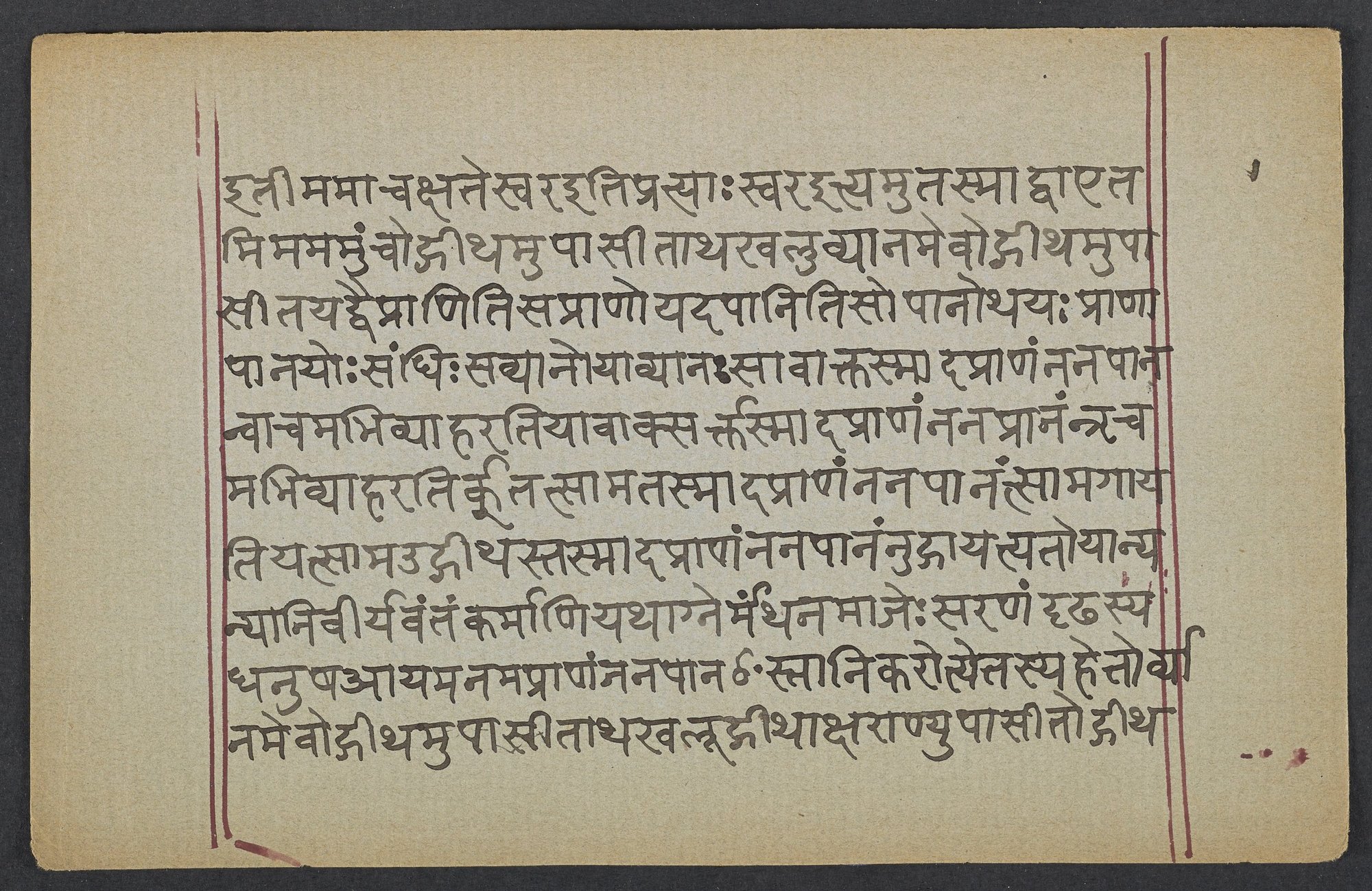
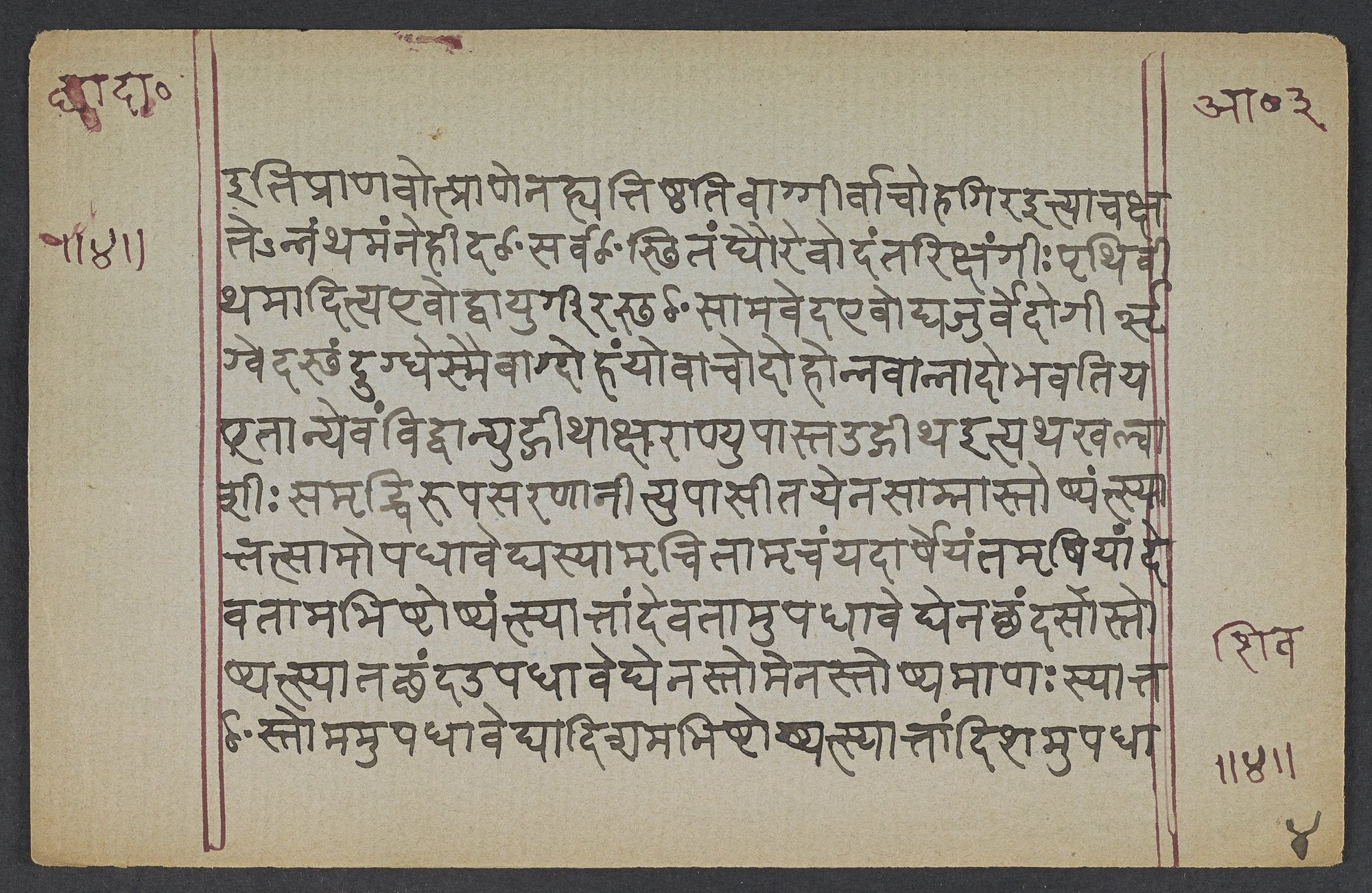
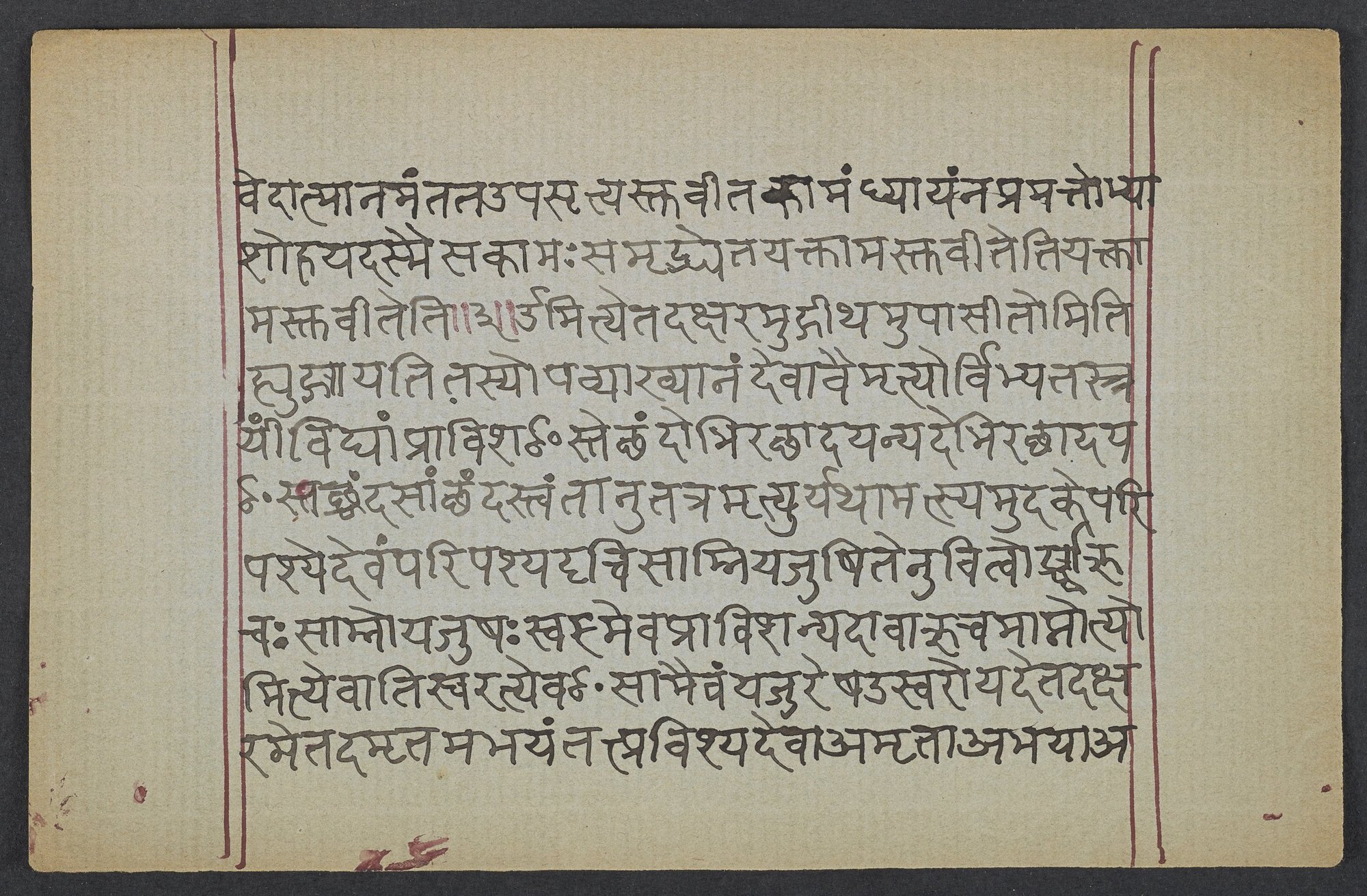
Penn Ms. Coll. 390 Item 945. fol. 3r begins ‹m atha ha mana udgītham upāsāṃ cakrire› and ends ‹tad dhāṅgirā udgītham upāsāṃ cakra etam u›; fol. 3v begins ‹evāṅgirasaṃ manyante 'ṅgānāṃ yad rasaḥ› and ends ‹samāna u evāyaṃ cāsau coṣṇo 'yam uṣṇo 'sau svara›; fol. 4r begins ‹itīmam ācakṣate svara iti pratyāsvara ity amum› and ends ‹khalūdgīthākṣarāṇy upāsītodgītha›; fol. 4v begins ‹iti prāṇa evot prāṇena hy uttiṣṭhati› and ends ‹yāṃ diśam abhiṣṭoṣyan syāt tāṃ diśam upadhā›; fol. 5r begins ‹ved ātmānam antata upasṛtya stuvīta› and ends ‹akṣaram etad amṛtam abhayaṃ tat praviśya devā amṛtā abhayā a› (first and last words read on the image, transliterated). Notes: Müller divides khanda 1.3 into paragraphs differently from the Sanskrit edition; the whole khanda is given here with his own numbers. The words were located in the GRETIL text by string matching and the page boundaries follow from them; readings and results are stored in data/sources/upanishads/mapping_945.json.
2.10taṃ hāṅgirā udgītham upāsāṃ cakre |
etam u evāṅgirasaṃ manyante 'ṅgānāṃ yad rasaḥ ||
2.11tena taṃ ha bṛhaspatir udgītham upāsāṃ cakre |
etam u eva bṛhaspatiṃ manyante |
vāg ghi bṛhatī tasyā eṣapatiḥ ||
2.12tena taṃ hāyāsya udgītham upāsāṃ cakre |
etam u evāyāsyaṃ manyante |
āsyād yad ayate ||
2.13tena taṃ ha bako dālbhyo vidāṃ cakāra |
sa ha naimiśīyānām udgātā babhūva |
sa ha smaibhyaḥ kāmān āgāyati ||
2.14āgātā ha vai kāmānāṃ bhavati ya etad evaṃ vidvān akṣaram udgītham upāste |
ity adhyātmam ||
3.1athādhidaivatam |
ya evāsau tapati tam udgītham upāsīta |
udyan vā eṣa prajābhya udgāyati |
udyaṃs tamo bhayam apahanti |
apahantā ha vai bhayasya tamaso bhavati ya evaṃ veda ||
3.2samāna u evāyaṃ cāsau ca |
uṣṇo 'yam uṣṇo 'sau |
svara itīmam ācakṣate svara iti pratyāsvara ity amum |
tasmād vā etam imam amuṃ ca udgītham upāsīta ||
3.3atha khalu vyānam evodgītham upāsīta |
yad vai prāṇiti sa prāṇaḥ |
yad apāniti so 'pānaḥ |
atha yaḥ prāṇāpānayoḥ saṃdhiḥ sa vyānaḥ |
yo vyānaḥ sā vāk |
tasmād aprāṇann anapānan vācam abhivyāharati ||
3.4yā vāk sark |
tasmād aprāṇann anapānann ṛcam abhivyāharati |
yark tat sāma |
tasmād aprāṇann anapānan sāma gāyati |
yat sāma sa udgīthaḥ |
tasmād aprānann anapānann udgāyati ||
3.5ato yāny anyāni vīryavanti karmāṇi yathāgner manthanam ājeḥ saraṇaṃ dṛḍhasya dhanuṣa āyamanam aprāṇann anapānaṃs tāni karoti |
etasya hetor vyānam evodgītham upāsīta ||
3.6atha khalūdgīthākṣarāṇy upāsīta ud-gī-tha iti |
prāṇa evot |
prāṇena hy uttiṣṭhati |
vag gīḥ |
vāco ha gira ity ācakṣate |
annaṃ tham |
anne hīdaṃ sarvaṃ sthitam ||
3.7dyaur evot |
antarikṣaṃ gīḥ |
pṛthivī tham |
āditya evot |
vāyur gīḥ |
agnis tham |
sāmaveda evot |
yajurvedo gīḥ |
ṛgvedas tham |
dugdhe 'smai vāg dohaṃ yo vāco dohaḥ |
annavān annādo bhavati |
ya etāny evaṃ vidvān udgīthākṣarāṇy upāsta ud-gī-tha iti ||
3.8atha khalv āśīḥ samṛddhiḥ |
upasaraṇānīty upāsīta |
yena sāmnā stoṣyan syāt tat sāmopadhāvet ||
3.9yasyām ṛci tām ṛcaṃ, yad ārṣeyaṃ tam ṛṣiṃ, yāṃ devatām abhiṣṭoṣyan syāt tāṃ devatām upadhāvet ||
3.10yena cchandasā stoṣyan syāt tac chanda upadhāvet |
yena stomena stoṣyamāṇaḥ syāt taṃ stomam upadhāvet ||
3.11yāṃ diśam abhiṣṭoṣyan syāt tāṃ diśam upadhāvet ||
3.12ātmānam antata upasṛtya stuvīta kāmaṃ dhyāyann apramattaḥ |
abhyāśo ha yad asmai sa kāmaḥ smṛdhyeta yatkāmaḥ stuvīteti yatkāmaḥ stuvīteti ||
4.1om ity etad akṣaram udgītham upāsīta |
om iti hy udgāyati |
tasyopavyākhyānam ||
4.2devā vai mṛtyor bibhyatas trayīṃ vidyāṃ prāviśan |
te chandobhir acchādayan |
yad ebhir acchādayaṃs tac chandasāṃ chandastvam ||
4.3tān u tatra mṛtyur yathā matsyam udake paripaśyed evaṃ paryapaśyad ṛci sāmni yajuṣi |
te nu vittvordhvā ṛcaḥ sāmno yajuṣaḥ svaram eva prāviśan ||
2.10Angiras meditated on the udgîtha (Om) as that breath, and people hold it to be Angiras, i. e. the essence of the members (angânâm rasah);
2.11Therefore Brihaspati meditated on udgîtha (Om) as that breath, and people hold it to be Brihaspati, for speech is brihatî, and he (that breath) is the lord (pati) of speech;
2.12Therefore Ayâsya meditated on the udgîtha (Om) as that breath, and people hold it to be Ayâsya, because it comes (ayati) from the mouth (âsya);
2.13Therefore Vaka Dâlbhya knew it. He was the Udgâtri (singer) of the Naimishîya-sacrificers, and by singing he obtained for them their wishes.
2.14He who knows this, and meditates on the syllable Om (the imperishable udgîtha) as the breath of life in the mouth, he obtains all wishes by singing. So much for the udgîtha (Om) as meditated on with reference to the body.
3.1Now follows the meditation on the udgîtha with reference to the gods. Let a man meditate on the udgîtha (Om) as he who sends warmth (the sun in the sky). When the sun rises it sings as Udgâtri for the sake of all creatures. When it rises it destroys the fear of darkness. He who knows this, is able to destroy the fear of darkness (ignorance).
3.2This (the breath in the mouth) and that (the sun) are the same. This is hot and that is hot. This they call svara (sound), and that they call pratyâsvara (reflected sound). Therefore let a man meditate on the udgîtha (Om) as this and that (as breath and as sun).
3.3Then let a man meditate on the udgîtha (Om) as vyâna indeed. If we breathe up, that is prâna, the up-breathing. If we breathe down, that is apâna, the down-breathing. The combination of prâna and apâna is vyâna, back-breathing or holding in of the breath. This vyâna is speech. Therefore when we utter speech, we neither breathe up nor down.
3.4Speech is Rik, and therefore when a man utters a Rik verse he neither breathes up nor down. Rik is Sâman, and therefore when a man utters a Sâman verse he neither breathes up nor down. Sâman is udgîtha, and therefore when a man sings (the udgîtha, Om) he neither breathes up nor down.
3.5And other works also which require strength, such as the production of fire by rubbing, running a race, stringing a strong bow, are performed without breathing up or down. Therefore let a man meditate on the udgîtha (Om) as vyâna.
3.6Let a man meditate on the syllables of the udgîtha, i. e. of the word udgîtha. Ut is breath (prâna), for by means of breath a man rises (uttishthati). Gî is speech, for speeches are called girah. Tha is food, for by means of food all subsists (sthita).
3.7Ut is heaven, gî the sky, tha the earth. Ut is the sun, gî the air, tha the fire. Ut is the Sâma-veda, gî the Yagur-veda, tha the Rig-veda. Speech yields the milk, which is the milk of speech itself, to him who thus knowing meditates on those syllables of the name of udgîtha, he becomes rich in food and able to eat food.
3.8Next follows the fulfilment of prayers. Let a man thus meditate on the Upasaranas, i. e. the objects which have to be approached by meditation: Let him (the Udgâtri) quickly reflect on the Sâman with which he is going to praise;
3.9Let him quickly reflect on the Rik in which that Sâman occurs; on the Rishi (poet) by whom it was seen or composed; on the Devatâ (object) which he is going to praise;
3.10On the metre in which he is going to praise; on the tune with which he is going to sing for himself;
3.11On the quarter of the world which he is going to praise. Lastly, having approached himself (his name, family, &c.) by meditation, let him sing the hymn of praise, reflecting on his desire, and avoiding all mistakes in pronunciation, &c. Quickly will the desire be then fulfilled to him, for the sake of which he may have offered his hymn of praise, yea, for which he may have offered his hymn of praise.
4.1Let a man meditate on the syllable Om, for the udgîtha is sung beginning with Om. And this is the full account of the syllable Om:—
4.2The Devas, being afraid of death, entered upon (the performance of the sacrifice prescribed in) the threefold knowledge (the three Vedas). They covered themselves with the metrical hymns. Because they covered (khad) themselves with the hymns, therefore the hymns are called khandas.
4.3Then, as a fisherman might observe a fish in the water, Death observed the Devas in the Rik, Yagus, and Sâman-(sacrifices). And the Devas seeing this, rose from the Rik, Yagus, and Sâman-sacrifices, and entered the Svara, i.e. the Om (they meditated on the Om).
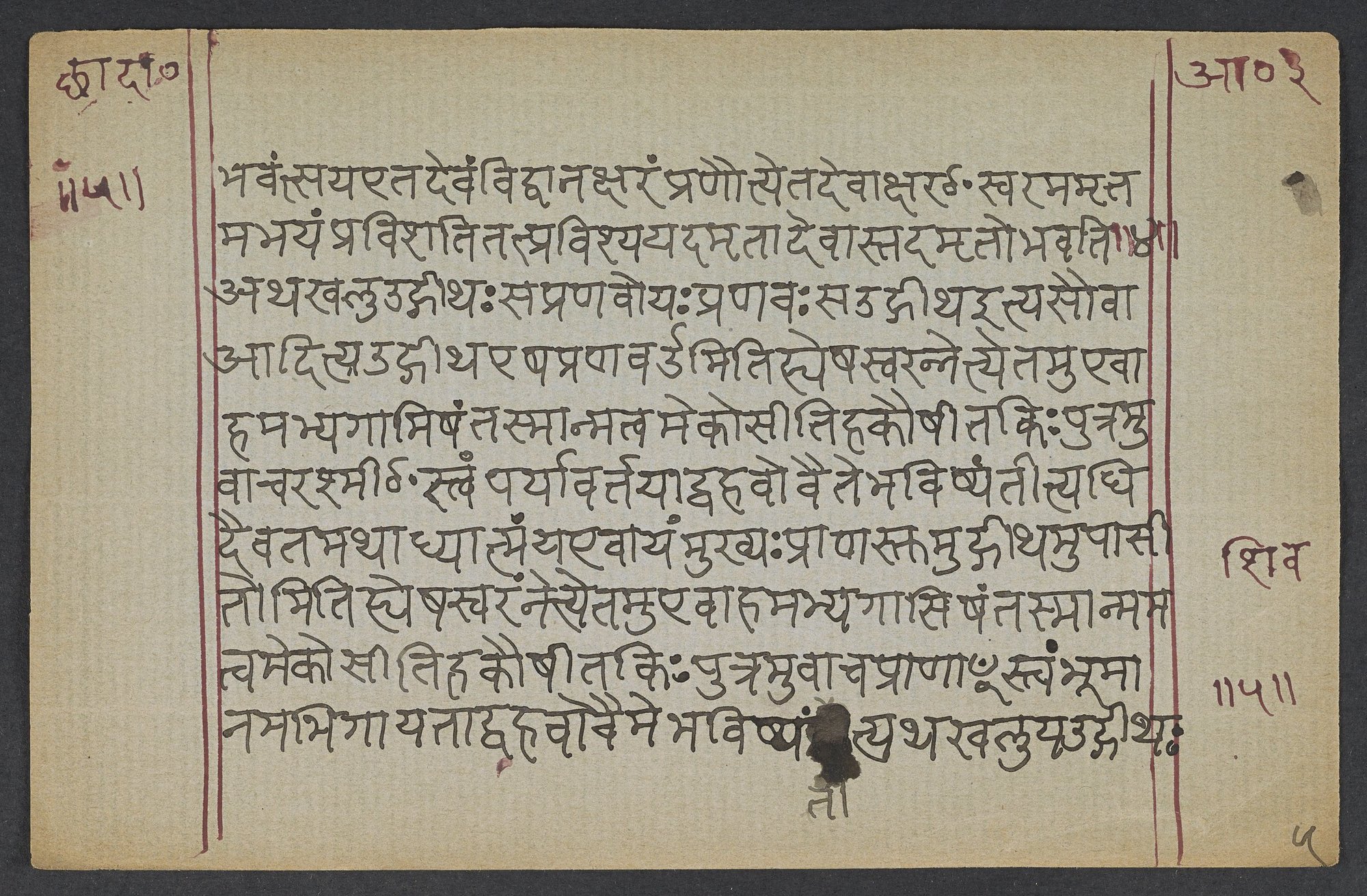
Where on the image
Penn Ms. Coll. 390 Item 945. fol. 5r begins ‹ved ātmānam antata upasṛtya stuvīta› and ends ‹akṣaram etad amṛtam abhayaṃ tat praviśya devā amṛtā abhayā a›; fol. 5v begins ‹bhavan sa ya etad evaṃ vidvān akṣaraṃ praṇauty› and ends ‹bahavo vai me bhaviṣyantīty atha khalu ya udgīthaḥ› (first and last words read on the image, transliterated). The words were located in the GRETIL text by string matching and the page boundaries follow from them; readings and results are stored in data/sources/upanishads/mapping_945.json.
4.4yadā vā ṛcam āpnoty om ity evātisvarati evaṃ sāmaivaṃ yajuḥ |
eṣa u svaro yad etad akṣaram etad amṛtam abhayam |
tat praviśya devā amṛtā abhavan ||
4.5sa ya etad evaṃ vidvān akṣaraṃ praṇauty etad evākṣaraṃ svaram amṛtam abhayaṃ praviśati |
tat praviśya yad amṛtā devās tad amṛto bhavati ||
5.1atha khalu ya udgīthaḥ sa praṇavo yaḥ praṇavaḥ sa udgītha iti |
asau vā āditya udgītha eṣa praṇavaḥ |
om iti hy eṣa svarann eti ||
5.2etam u evāham abhyagāsiṣaṃ tasmān mama tvam eko 'sīti ha kauṣītakiḥ putram uvāca |
raśmīṃs tvaṃ paryāvartayāt |
bahavo vai te bhaviṣyanti |
ity adhidaivatam ||
5.3athādhyātmam |
ya evāyaṃ mukhyaḥ prāṇas tam udgītham upāsita |
om iti hy eṣa svarann eti ||
5.4etam u evāham abhyagāsiṣaṃ tasmān mama tvam eko 'sīti ha kauṣītakiḥ putram uvāca |
prāṇāṃs tvaṃ bhūmānam abhigāyatād bahavo vai me bhaviṣyantīti ||
4.4When a man has mastered the Rig-veda, he says quite loud Om; the same, when he has mastered the Sâman and the Yagus. This Svara is the imperishable (syllable), the immortal, free from fear. Because the Devas entered it, therefore they became immortal, and free from fear.
4.5He who knowing this loudly pronounces (pranauti) that syllable, enters the same (imperishable) syllable, the Svara, the immortal, free from fear, and having entered it, becomes immortal, as the Devas are immortal.
5.1The udgîtha is the pranava, the pranava is the udgîtha. And as the udgîtha is the sun, so is the pranava, for he (the sun) goes sounding Om.
5.2'Him I sang praises to, therefore art thou my only one,' thus said Kaushîtaki to his son. 'Do thou revolve his rays, then thou wilt have many sons.' So much in reference to the Devas.
5.3Now with reference to the body. Let a man meditate on the udgîtha as the breath (in the mouth), for he goes sounding Om.
5.4'Him I sang praises to, therefore art thou my only son,' thus said Kaushîtaki to his son. 'Do thou therefore sing praises to the breath as manifold, if thou wishest to have many sons.'
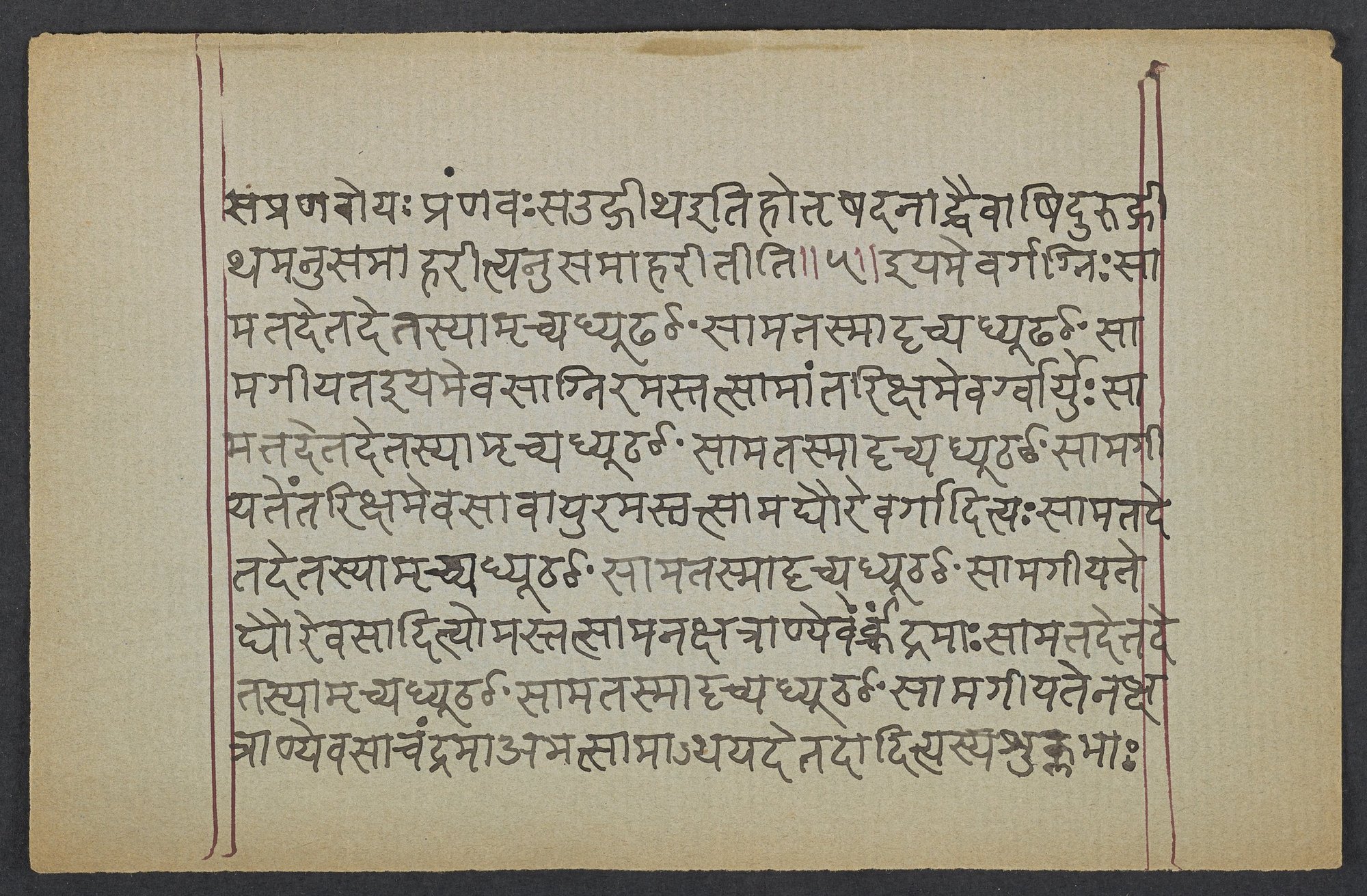
Where on the image
Penn Ms. Coll. 390 Item 945. fol. 5v begins ‹bhavan sa ya etad evaṃ vidvān akṣaraṃ praṇauty› and ends ‹bahavo vai me bhaviṣyantīty atha khalu ya udgīthaḥ›; fol. 6r begins ‹sa praṇavo yaḥ praṇavaḥ sa udgītha iti› and ends ‹amas tat sāma atha yad etad ādityasya śuklaṃ bhāḥ› (first and last words read on the image, transliterated). The words were located in the GRETIL text by string matching and the page boundaries follow from them; readings and results are stored in data/sources/upanishads/mapping_945.json.
5.5atha khalu ya udgīthaḥ sa praṇavo yaḥ praṇavaḥ sa udgītha iti |
hotṛṣadanād dha evāpi durudgītham anusamāharatīty anusamāharatīti ||
6.1iyam evark |
agniḥ sāma |
tad etad etasyām ṛcy adhyūḍhaṃ sāma |
tasmād ṛcy adhyūḍhaṃ sāma gīyate |
iyam eva sā |
agnir amaḥ |
tat sāma ||
6.2antarikṣam evark |
vāyuḥ sāma |
tad etad etasyām ṛcy adhyūḍhaṃ sāma |
tasmād ṛcy adhyūḍhaṃ sāma gīyate |
antarikṣam eva sā |
vāyur amaḥ |
tat sāma ||
6.3dyaur evark |
ādityaḥ sāma |
tad etad etasyām ṛcy adhyūḍhaṃ sāma |
tasmād ṛcy adhyūḍhaṃ sāma gīyate |
dyaur eva sā |
ādityo 'maḥ |
tat sāma ||
6.4nakṣatrāny evark |
candramāḥ sāma |
tad etad etasyām ṛcy adhyūḍhaṃ sāma |
tasmād ṛcy adhyūḍhaṃ sāma gīyate |
nakṣatrāṇy eva sā |
candramā amaḥ |
tat sāma ||
5.5He who knows that the udgîtha is the pranava, and the pranava the udgîtha, rectifies from the seat of the Hotri priest any mistake committed by the Udgâtri priest in performing the udgîtha, yea, in performing the udgîtha.
6.1The Rik (veda) is this earth, the Sâman (veda) is fire. This Sâman (fire) rests on that Rik (earth). Therefore the Sâman is sung as resting on the Rik. Sâ is this earth, ama is fire, and that makes Sâma.
6.2The Rik is the sky, the Sâman air. This Sâman (air) rests on that Rik (sky). Therefore the Sâman is sung as resting on the Rik. Sâ is the sky, ama the air, and that makes Sâma.
6.3Rik is heaven, Sâman the sun. This Sâman (sun) rests on that Rik (heaven). Therefore the Sâman is sung as resting on the Rik. Sâ is heaven, ama the sun, and that makes Sâma.
6.4Rik is the stars, Sâman the moon. This Sâman (moon) rests on that Rik (stars). Therefore the Sâman is sung as resting on the Rik. Sâ is the stars, ama the moon, and that makes Sâma.
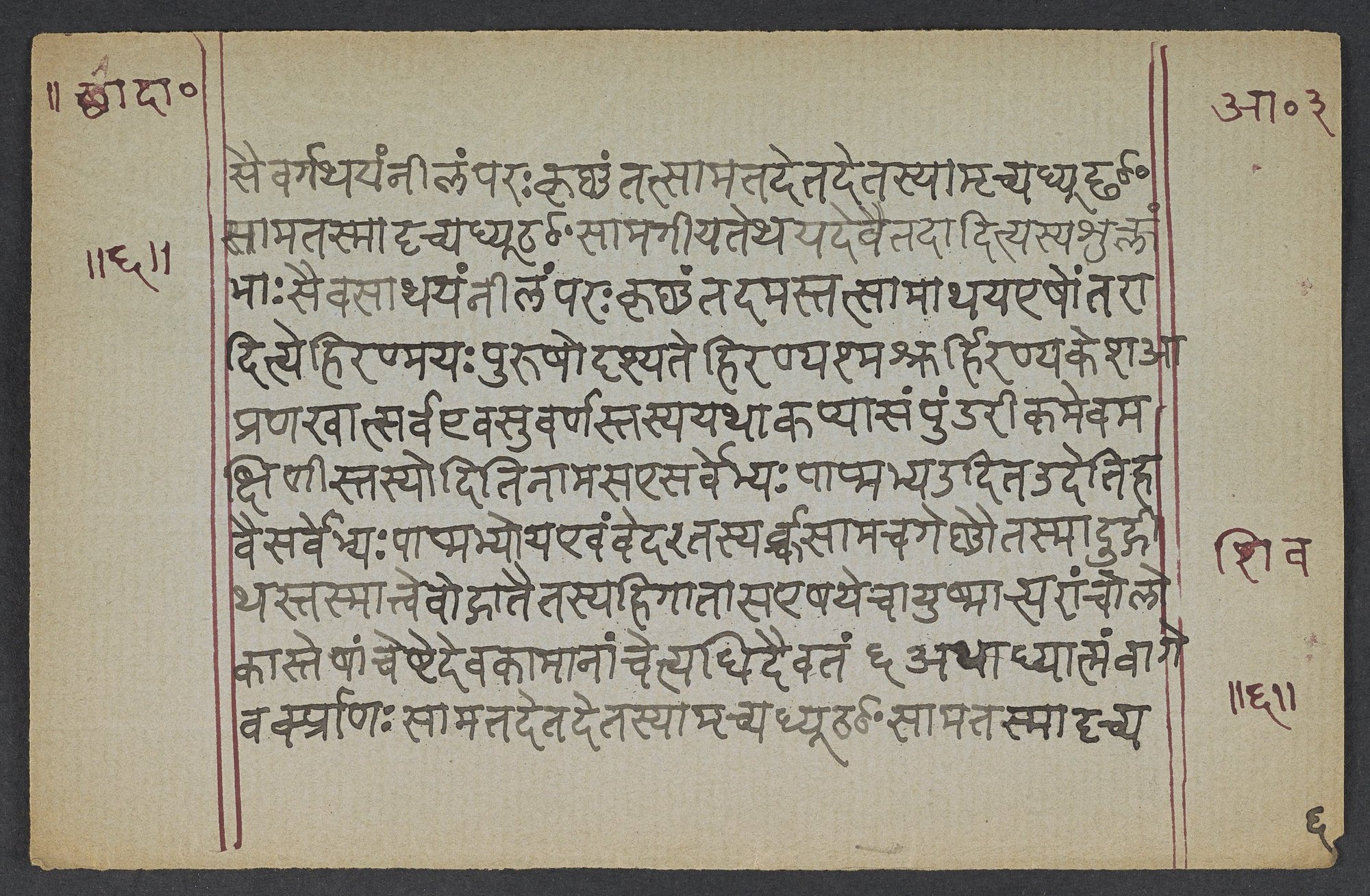
Where on the image
Penn Ms. Coll. 390 Item 945. fol. 6r begins ‹sa praṇavo yaḥ praṇavaḥ sa udgītha iti› and ends ‹amas tat sāma atha yad etad ādityasya śuklaṃ bhāḥ›; fol. 6v begins ‹saiva sātha yan nīlaṃ paraḥ kṛṣṇaṃ tat sāma› and ends ‹ity adhidaivatam athādhyātmaṃ vāg evark prāṇaḥ sāma tad etad etasyām ṛcy adhyūḍhaṃ sāma tasmād ṛcy› (first and last words read on the image, transliterated). The words were located in the GRETIL text by string matching and the page boundaries follow from them; readings and results are stored in data/sources/upanishads/mapping_945.json.
6.5atha yad etad ādityasya śuklaṃ bhāḥ saivark |
atha yan nīlaṃ paraḥkṛṣṇaṃ tat sāma |
tad etad etasyām ṛcy adhyūḍhaṃ sāma |
tasmad ṛcy adhyūḍhaṃ sāma gīyate ||
6.6atha yad evaitad ādityasya śuklaṃ bhāḥ saiva sā |
atha yan nīlaṃ paraḥkṛṣṇaṃ tad amaḥ |
tat sāma |
atha ya eṣo 'ntarāditye hiraṇmayaḥ puruṣo dṛśyate hiraṇyaśmaśrur hiraṇyakeśa ā praṇakhāt sarva eva suvarnaḥ ||
6.7tasya yathā kapyāsaṃ puṇḍarīkam evam akṣiṇī |
tasyod iti nāma |
sa eṣa sarvebhyaḥ pāpmabhya uditaḥ |
udeti ha vai sarvebhyaḥ pāpmabhyo ya evaṃ veda ||
6.8tasyark ca sāma ca geṣṇau |
tasmād udgīthaḥ |
tasmāt tv eva udgātā |
etasya hi gātā |
sa eṣa ye cāmuṣmāt parāñco lokās teṣāṃ ceṣṭa devakāmānāṃ ca |
ity adhidaivatam ||
6.5Rik is the white light of the sun, Sâman the blue exceeding darkness (in the sun). This Sâman (darkness) rests on that Rik (brightness). Therefore the Sâman is sung as resting on the Rik.
6.6Sâ is the white light of the sun, ama the blue exceeding darkness, and that makes Sâma. Now that golden person, who is seen within the sun, with golden beard and golden hair, golden altogether to the very tips of his nails,
6.7Whose eyes are like blue lotus's, his name is ut, for he has risen (udita) above all evil. He also who knows this, rises above all evil.
6.8Rik and Sâman are his joints, and therefore he is udgîtha. And therefore he who praises him (the ut) is called the Ud-gâtri (the out-singer). He (the golden person, called ut) is lord of the worlds beyond that (sun), and of all the wishes of the Devas (inhabiting those worlds). So much with reference to the Devas.
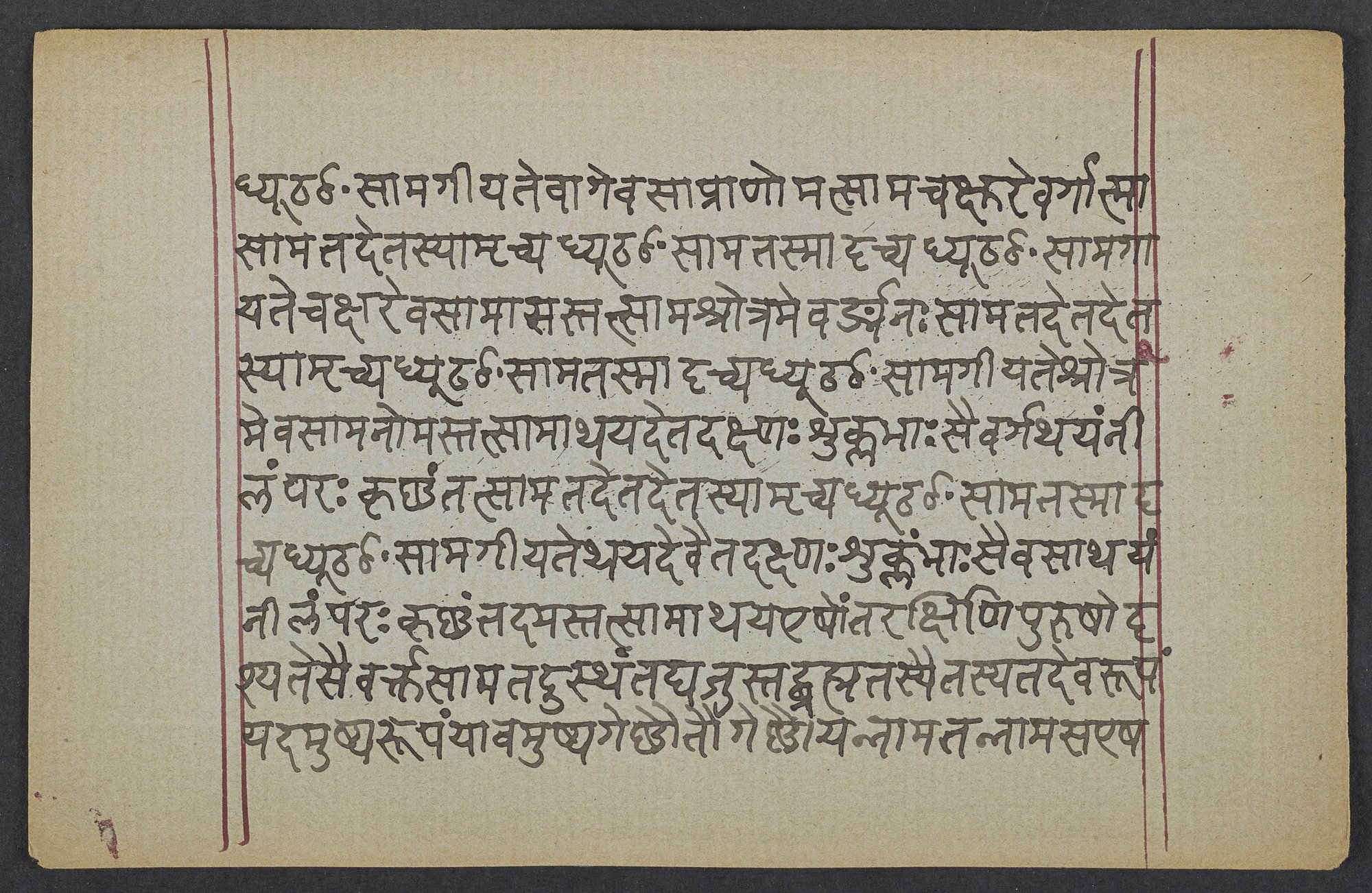
Where on the image
Penn Ms. Coll. 390 Item 945. fol. 6v begins ‹saiva sātha yan nīlaṃ paraḥ kṛṣṇaṃ tat sāma› and ends ‹ity adhidaivatam athādhyātmaṃ vāg evark prāṇaḥ sāma tad etad etasyām ṛcy adhyūḍhaṃ sāma tasmād ṛcy›; fol. 7r begins ‹adhyūḍhaṃ sāma gīyate vāg eva sā prāṇo 'mas tat sāma› and ends ‹yāv amuṣya geṣṇau tau geṣṇau yan nāma tan nāma sa eṣa› (first and last words read on the image, transliterated). The words were located in the GRETIL text by string matching and the page boundaries follow from them; readings and results are stored in data/sources/upanishads/mapping_945.json.
7.1athādhyātmam |
vāg evark |
prāṇaḥ sāma |
tad etad etasyām ṛcy adhyūḍhaṃ sāma |
tasmād ṛcy adhyūḍhaṃ sāma gīyate |
vāg eva sā |
prāṇo 'maḥ |
tat sāma ||
7.2cakṣur evark |
ātmā sāma |
tad etad etasyām ṛcy adhyūḍhaṃ sāma |
tasmād ṛcy adhyūḍhaṃ sāma gīyate |
cakṣur eva sā |
ātmāmaḥ |
tat sāma ||
7.3śrotram evark |
manaḥ sāma |
tad etad etasyām ṛcy adhyūḍhaṃ sāma |
tasmād ṛcy adhyūḍhaṃ sāma gīyate |
śrotram eva sā |
mano 'maḥ |
tat sāma ||
7.4atha yad etad akṣnaḥ śuklaṃ bhāḥ saivark |
atha yan nīlaṃ paraḥkṛṣṇaṃ tat sāma |
tad etad etasyām ṛcy adhyūḍhaṃ sāma |
tasmād ṛcy adhyūḍhaṃ sāma gīyate |
atha yad evaitad akṣṇaḥ śuklaṃ bhāḥ saiva sā |
atha yan nīlaṃ paraḥkṛṣṇaṃ tad amaḥ |
tat sāma ||
7.5atha ya eṣo 'ntar akṣiṇi puruṣo dṛśyate saivark |
tat sāma |
tad uktham |
tad yajuḥ |
tad brahma |
tasya etasya tad eva rūpaṃ yad amuṣya rūpam |
yāv amuṣya geṣṇau tau tau goṣṇau |
yan nāma tan nāma ||
7.1Now with reference to the body. Rik is speech, Sâman breath. This Sâman (breath) rests on that Rik (speech). Therefore the Sâman is sung as resting on the Rik. Sâ is speech, ama is breath, and that makes Sâma.
7.2Rik is the eye, Sâman the self. This Sâman (shadow) rests on that Rik (eye). Therefore the Sâman is sung as resting on the Rik. Sâ is the eye, ama the self, and that makes Sâma.
7.3Rik is the ear, Sâman the mind. This Sâman (mind) rests on that Rik (ear). Therefore the Sâman is sung as resting on the Rik. Sâ is the ear, ama the mind, and that makes Sâma.
7.4Rik is the white light of the eye, Sâman the blue exceeding darkness. This Sâman (darkness) rests on the Rik (brightness). Therefore the Sâman is sung as resting on the Rik. Sâ is the white light of the eye, ama the blue exceeding darkness, and that makes Sâma.
7.5Now the person who is seen in the eye, he is Rik, he is Sâman, Uktha, Yagus, Brahman. The form of that person (in the eye) is the same as the form of the other person (in the sun), the joints of the one (Rik and Sâman) are the joints of the other, the name of the one (ut) is the name of the other.
Where on the image
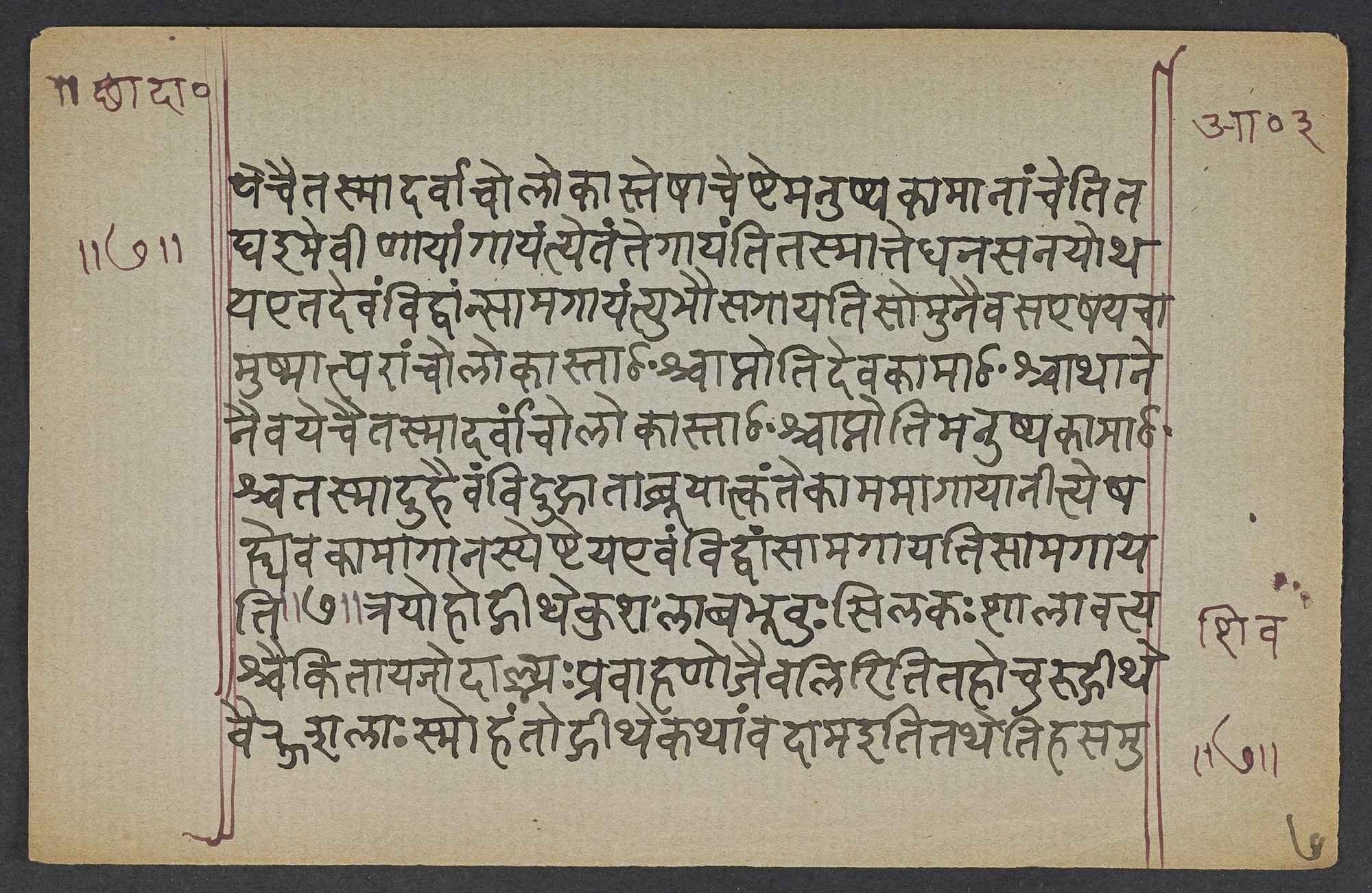
Penn Ms. Coll. 390 Item 945. fol. 7r begins ‹adhyūḍhaṃ sāma gīyate vāg eva sā prāṇo 'mas tat sāma› and ends ‹yāv amuṣya geṣṇau tau geṣṇau yan nāma tan nāma sa eṣa›; fol. 7v begins ‹ye caitasmād arvāñco lokās teṣāṃ ceṣṭe manuṣyakāmānāṃ ceti› and ends ‹kuśalāḥ smo hantodgīthe kathāṃ vadāma iti tatheti ha samu› (first and last words read on the image, transliterated). The words were located in the GRETIL text by string matching and the page boundaries follow from them; readings and results are stored in data/sources/upanishads/mapping_945.json.
7.6sa eṣa ye caitasmād arvāñco lokās teṣāṃ ceṣṭe manuṣyakāmānāṃ ceti |
tad ya ime vīṇāyāṃ gāyanty etaṃ te gāyanti |
tasmāt te dhanasanayaḥ ||
7.7atha ya etad evaṃ vidvān sāma gāyaty ubhau sa gāyati |
so 'munaiva sa eṣa ye cāmuṣmāt parāñco lokās tāṃś cāpnoti devakāmāṃś ca ||
7.8athānenaiva ye caitasmād arvāñco lokās tāṃś cāpnoti manuṣyakāmāṃś ca |
tasmād u haivaṃvid udgātā brūyāt ||
7.9kaṃ te kāmam āgāyānīti |
eṣa hy eva kāmāgānasyeṣṭe ya evaṃ vidvān sāma gāyati sāma gāyati ||
8.1trayo hodgīthe kuśalā babhūvuḥ śilakaḥ śālāvatyaś caikitāyano dālbhyaḥ pravāhaṇo jaivalir iti |
te hocur udgīthe vai kuśalāḥ smo hantodgīthe kathāṃ vadāma iti ||
7.6He is lord of the worlds beneath that (the self in the eye), and of all the wishes of men. Therefore all who sing to the vînâ (lyre), sing him, and from him also they obtain wealth.
7.7He who knowing this sings a Sâman, sings to both (the adhidaivata and adhyâtma self, the person in the sun and the person in the eye, as one and the same person). He obtains through the one, yea, he obtains the worlds beyond that, and the wishes of the Devas;
7.8And he obtains through the other the worlds beneath that, and the wishes of men. Therefore an Udgâtri priest who knows this, may say (to the sacrificer for whom he officiates);
7.9"What wish shall I obtain for you by my songs?" For he who knowing this sings a Sâman is able to obtain wishes through his song, yea, through his song.
8.1There were once three men, well-versed in udgîtha, Silaka Sâlâvatya, Kaikitâyana Dâlbhya, and Pravâhana Gaivali. They said: 'We are well-versed in udgîtha. Let us have a discussion on udgîtha.'
Where on the image
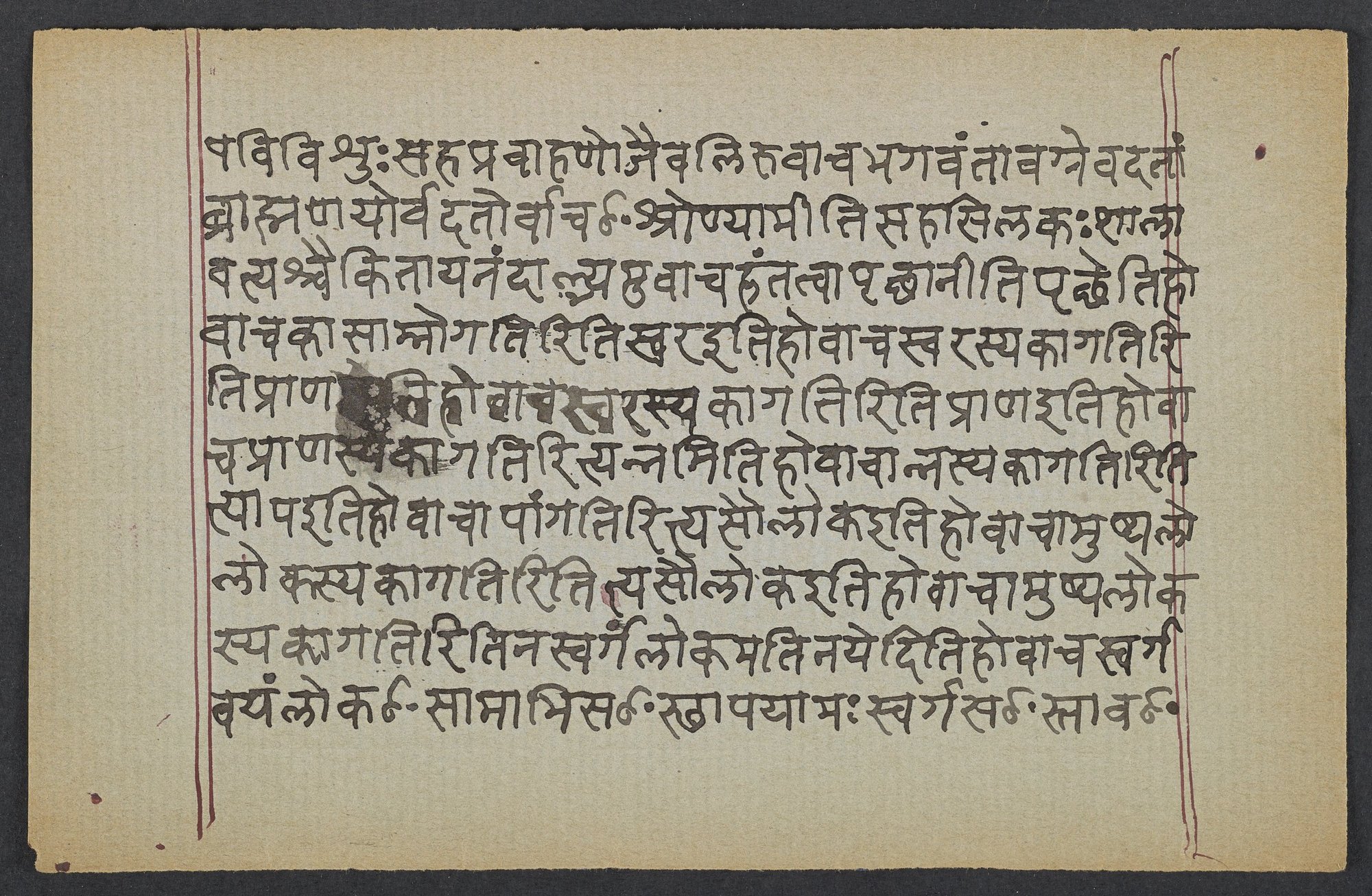
Penn Ms. Coll. 390 Item 945. fol. 7v begins ‹ye caitasmād arvāñco lokās teṣāṃ ceṣṭe manuṣyakāmānāṃ ceti› and ends ‹kuśalāḥ smo hantodgīthe kathāṃ vadāma iti tatheti ha samu›; fol. 8r begins ‹paviviśuḥ sa ha pravāhaṇo jaivalir uvāca bhagavantāv agre vadatāṃ› and ends ‹svargaṃ vayaṃ lokaṃ sāmābhisaṃsthāpayāmaḥ svargasaṃstāvaṃ› (first and last words read on the image, transliterated). The words were located in the GRETIL text by string matching and the page boundaries follow from them; readings and results are stored in data/sources/upanishads/mapping_945.json.
8.2tatheti ha samupaviviśuḥ |
sa ha prāvahaṇo jaivalir uvāca |
bhagavantāv agre vadatām |
bhrāmaṇayor vadator vācaṃ śroṣyāmīti ||
8.3sa ha śilakaḥ śālāvatyaś caikitāyanaṃ dālbhyam uvāca hanta tvā pṛcchānīti |
pṛccheti hovāca ||
8.4kā sāmno gatir iti |
svara iti hovāca |
svarasya kā gatir iti |
prāṇa iti hovāca |
annasya kā gatir iti |
annam iti hovāca |
annasya kā gatir iti |
āpa iti hovāca ||
8.2They all agreed and sat down. Then Pravâhana Gaivali said: 'Sirs, do you both speak first, for I wish to hear what two Brâhmanas have to say.'
8.3Then Silaka Sâlâvatya said to Kaikitâyana Dâlbhya: 'Let me ask you.' 'Ask,' he replied.
8.4'What is the origin of the Sâman?' 'Tone (svara),' he replied. 'What is the origin of tone?' 'Breath,' he replied. 'What is the origin of breath?' 'Food,' he replied. 'What is the origin of food?' 'Water,' he replied.
Where on the image
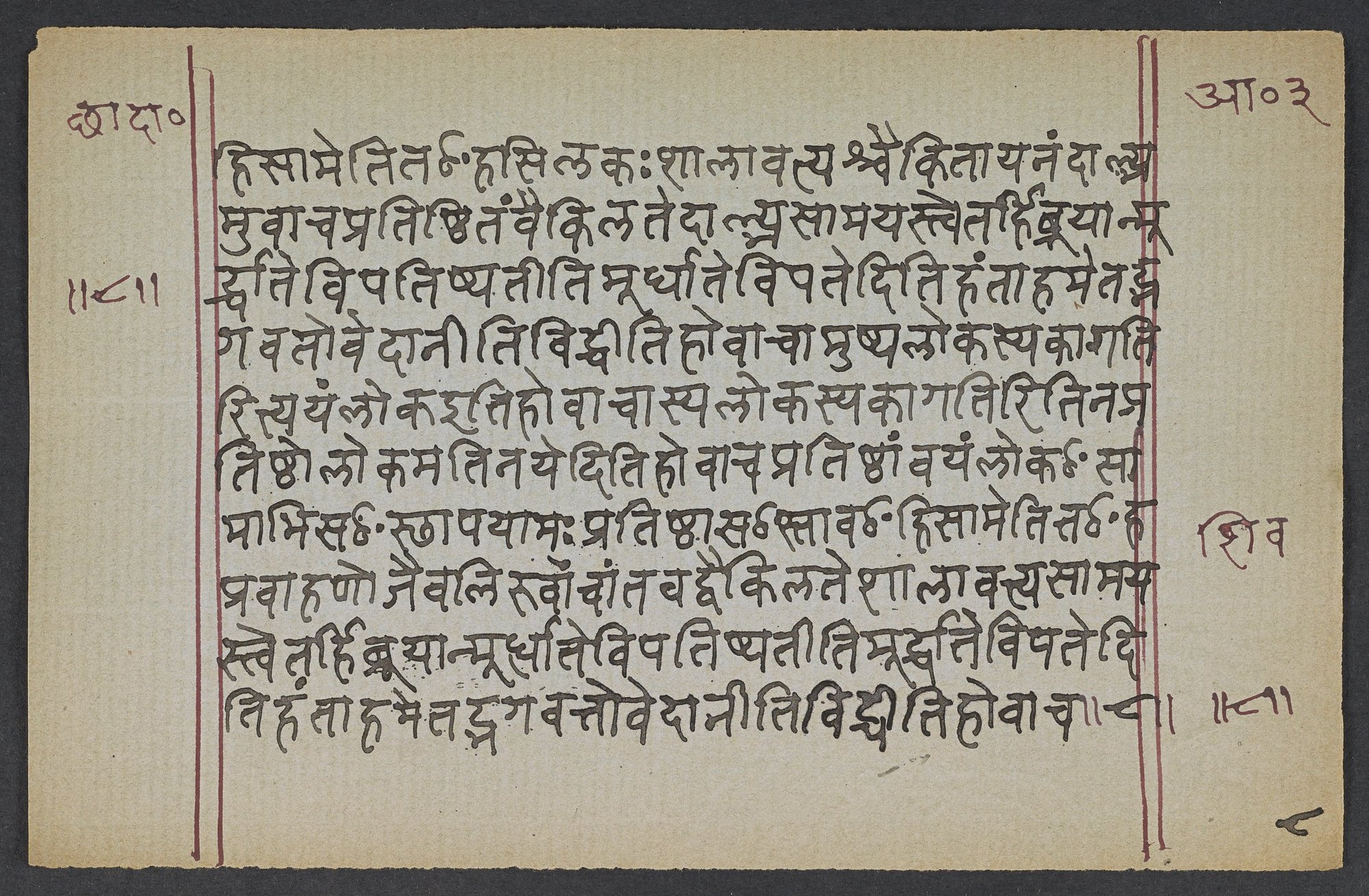
Penn Ms. Coll. 390 Item 945. fol. 8r begins ‹paviviśuḥ sa ha pravāhaṇo jaivalir uvāca bhagavantāv agre vadatāṃ› and ends ‹svargaṃ vayaṃ lokaṃ sāmābhisaṃsthāpayāmaḥ svargasaṃstāvaṃ›; fol. 8v begins ‹hi sāmeti taṃ ha śilakaḥ śālāvatyaś caikitāyanaṃ dālbhyam› and ends ‹hantāham etad bhagavatto vedānīti viddhīti hovāca› (first and last words read on the image, transliterated). The words were located in the GRETIL text by string matching and the page boundaries follow from them; readings and results are stored in data/sources/upanishads/mapping_945.json.
8.5apāṃ kā gatir iti |
asau loka iti hovāca |
amuṣya lokasya kā gatir iti |
na svargaṃ lokam atinayed iti hovāca |
svargaṃ vayaṃ lokaṃ sāmābhisaṃsthāpayāmaḥ |
svargasaṃstāvaṃ hi sāmeti ||
8.6taṃ ha śilakaḥ śālāvatyaś caikitāyanaṃ dālbhyam uvācāpratiṣṭhitaṃ vai kila te dālbhya sāma |
yas tv etarhi brūyān mūrdhā te vipatiṣyatīti mūrdhā te vipated iti ||
8.7hantāham etad bhagavatto vedānīti |
viddhīti hovāca |
amuṣya lokasya kā gatir iti |
ayaṃ loka iti hovāca |
asya lokasya kā gatir iti |
na pratiṣṭhāṃ lokam atinayed iti hovāca |
pratiṣṭhāṃ vayaṃ lokaṃ sāmābhisaṃsthāpayāmaḥ |
pratiṣṭhāsaṃstāvaṃ hi sāmeti ||
8.8taṃ ha pravāhaṇo jaivalir uvāca |
antavad vai kila te śālāvatya sāma |
yas tv etarhi brūyān mūrdhā te vipatiṣyatīti mūrdhā te vipated iti |
hantāham etad bhagavatto vedānīti |
viddhīti hovāca ||
8.5'What is the origin of water?' 'That world (heaven),' he replied. 'And what is the origin of that world?'— He replied: 'Let no man carry the Sâman beyond the world of svarga (heaven). We place (recognise) the Sâman in the world of svarga, for the Sâman is extolled as svarga (heaven).'
8.6Then said Silaka Sâlâvatya to Kaikitâyana Dâlbhya: 'O Dâlbhya, thy Sâman is not firmly established. And if any one were to say, Your head shall fall off (if you be wrong), surely your head would now fall.'
8.7'Well then, let me know this from you, Sir,' said Dâlbhya. 'Know it,' replied Silaka Sâlâvatya. 'What is the origin of that world (heaven)?' 'This world,' he replied. 'And what is the origin of this world?'— He replied: 'Let no man carry the Sâman beyond this world as its rest. We place the Sâman in this world as its rest, for the Sâman is extolled as rest.'
8.8Then said Pravâhana Gaivali to Silaka Sâlâvatya: 'Your Sâman (the earth), O Sâlâvatya, has an end. And if any one were to say, Your head shall fall off (if you be wrong), surely your head would now fall.' 'Well then, let me know this from you, Sir,' said Sâlâvatya. 'Know it,' replied Gaivali.
Where on the image
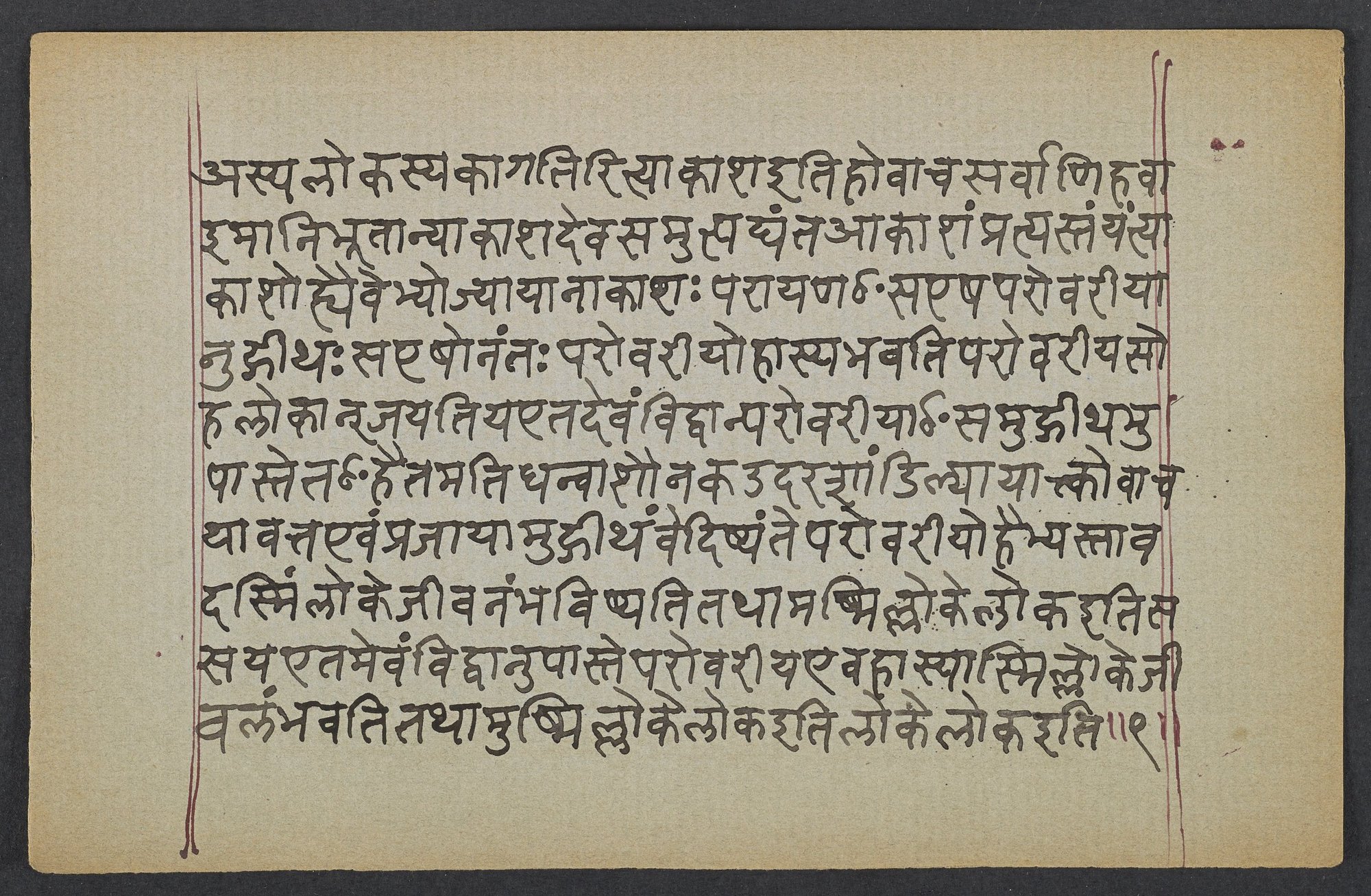
Penn Ms. Coll. 390 Item 945. fol. 9r begins ‹asya lokasya kā gatir ity ākāśa iti hovāca› and ends ‹tathāmuṣmiṃl loke loka iti loke loka iti› (first and last words read on the image, transliterated). The words were located in the GRETIL text by string matching and the page boundaries follow from them; readings and results are stored in data/sources/upanishads/mapping_945.json.
9.1asya lokasya kā gatir iti |
ākāśa iti hovāca |
sarvāṇi ha vā imāni bhūtāny ākāśād eva samutpadyante |
ākāśaṃ praty astaṃ yanti |
ākāśo hy evaibhyo jyāyān |
ākāśaḥ parāyaṇam ||
9.2sa eṣa parovarīyān udgīthaḥ |
sa eṣo 'nantaḥ |
parovarīyo hāsya bhavati parovarīyaso ha lokāñ jayati ya etad evaṃ vidvān parovarīyāṃsam udgītham upāste ||
9.3taṃ haitam atidhanvā śaunaka udaraśāṇḍilyāyoktvovāca |
yāvat ta enaṃ prajāyām udgīthaṃ vediṣyante parovarīyo haibhyas tāvad asmiṃl loke jīvanaṃ bhaviṣyati ||
9.4tathāmuṣmiṃl loke loka iti |
sa ya etam eva vidvān upāste parovarīya eva hāsyāmuṣmiṃl loke jīvanaṃ bhavati tathāmuṣmiṃl loke loka iti loke loka iti ||
9.1'What is the origin of this world?' 'Ether,' he replied. For all these beings take their rise from the ether, and return into the ether. Ether is older than these, ether is their rest.
9.2He is indeed the udgîtha (Om=Brahman), greater than great (parovarîyas), he is without end. He who knowing this meditates on the udgîtha, the greater than great, obtains what is greater than great, he conquers the worlds which are greater than great.
9.3Atidhanvan Saunaka, having taught this udgîtha to Udara-sândilya, said: 'As long as they will know in your family this udgîtha, their life in this world will be greater than great.
9.4'And thus also will be their state in the other world.' He who thus knows the udgîtha, and meditates on it thus, his life in this world will be greater than great, and also his state in the other world, yea, in the other world.
Where on the image
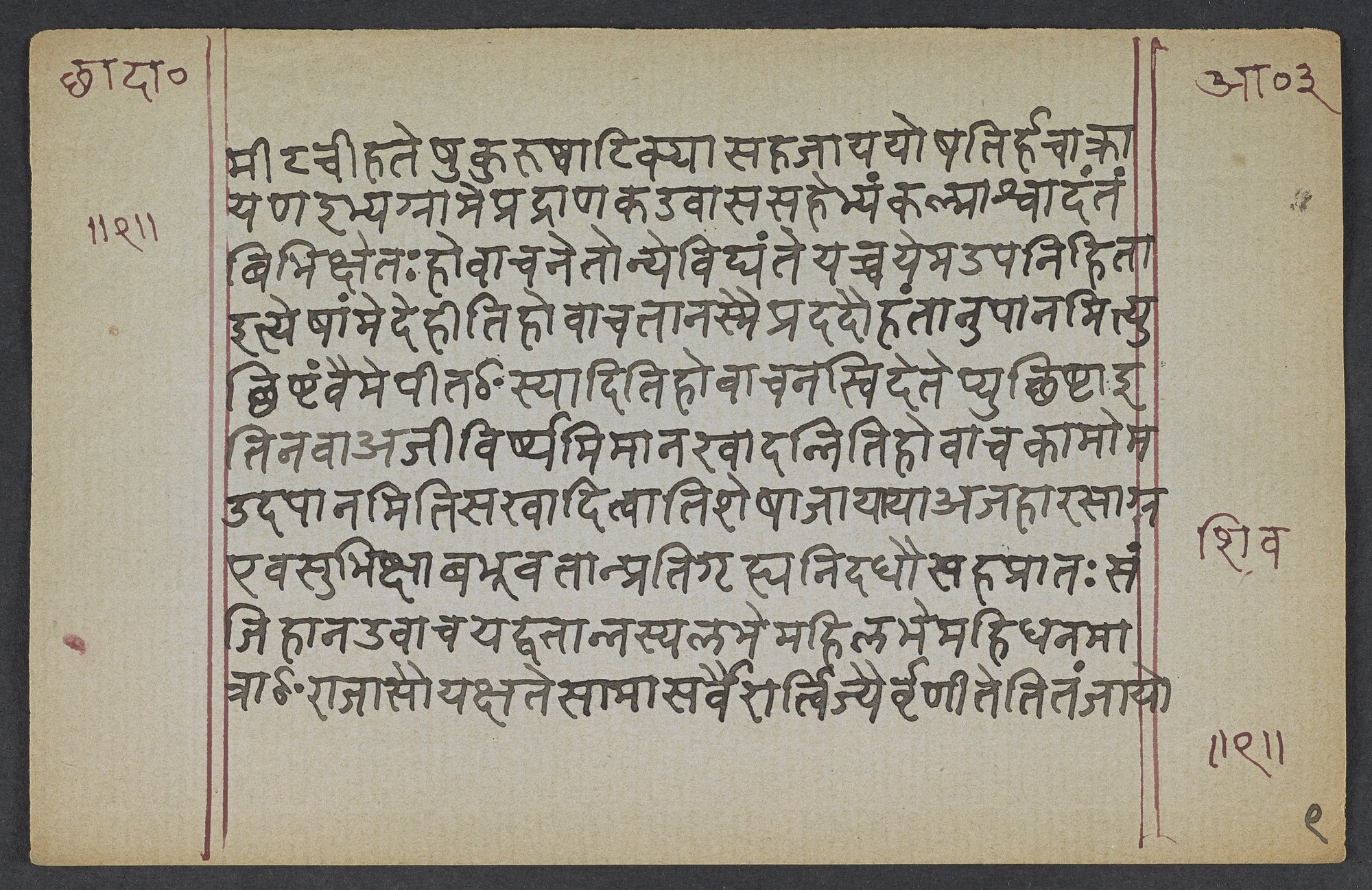
Penn Ms. Coll. 390 Item 945. fol. 9v begins ‹maṭacīhateṣu kuruṣv āṭikyā saha jāyayoṣastir ha cākrāyaṇa› and ends ‹rājāsau yakṣyate sa mā sarvair ārtvijyair vṛṇīteti taṃ jāyo› (first and last words read on the image, transliterated). The words were located in the GRETIL text by string matching and the page boundaries follow from them; readings and results are stored in data/sources/upanishads/mapping_945.json.
10.1maṭacīhateṣu kuruṣv āṭikyā saha jāyayoṣastir ha cākrāyaṇa ibhyagrāme pradrāṇaka uvāsa ||
10.2sa hebhyaṃ kulmāṣān khādantaṃ bibhikṣe |
taṃ hovāca |
neto 'nye vidyante yac ca ye ma ima upanihitā iti ||
10.3eteṣāṃ me dehīti hovāca |
tān asmai pradadau |
hantānupānam iti |
ucchiṣṭaṃ vai me pītaṃ syād iti hovāca ||
10.4na svid ete 'py ucchiṣṭā iti |
na vā ajīviṣyam imān akhādann iti hovāca |
kāmo ma udapānam iti ||
10.5sa ha khāditvātiśeṣāñ jāyāyā ājahāra |
sāgra eva subhikṣā babhūva |
tān pratigṛhya nidadhau ||
10.6sa ha prātaḥ saṃjihāna uvāca |
yad batānnasya labhemahi labhemahi dhanamātrām |
rājāsau yakṣyate |
sa mā sarvair ārtvijyair vṛṇīteti ||
10.1When the Kurus had been destroyed by (hail) stones, Ushasti Kâkrâyana lived as a beggar with his virgin wife at Ibhyagrâma.
10.2Seeing a chief eating beans, he begged of him. The chief said: 'I have no more, except those which are put away for me here.'
10.3Ushasti said: 'Give me to eat of them.' He gave him the beans, and said: 'There is something to drink also.' Then said Ushasti: 'If I drank of it, I should have drunk what was left by another, and is therefore unclean.'
10.4The chief said: 'Were not those beans also left over and therefore unclean?' 'No,' he replied; 'for I should not have lived, if I had not eaten them, but the drinking of water would be mere pleasure.'
10.5Having eaten himself, Ushasti gave the remaining beans to his wife. But she, having eaten before, took them and put them away.
10.6Rising the next morning, Ushasti said to her: 'Alas, if we could only get some food, we might gain a little wealth. The king here is going to offer a sacrifice, he should choose me for all the priestly offices.'
Where on the image
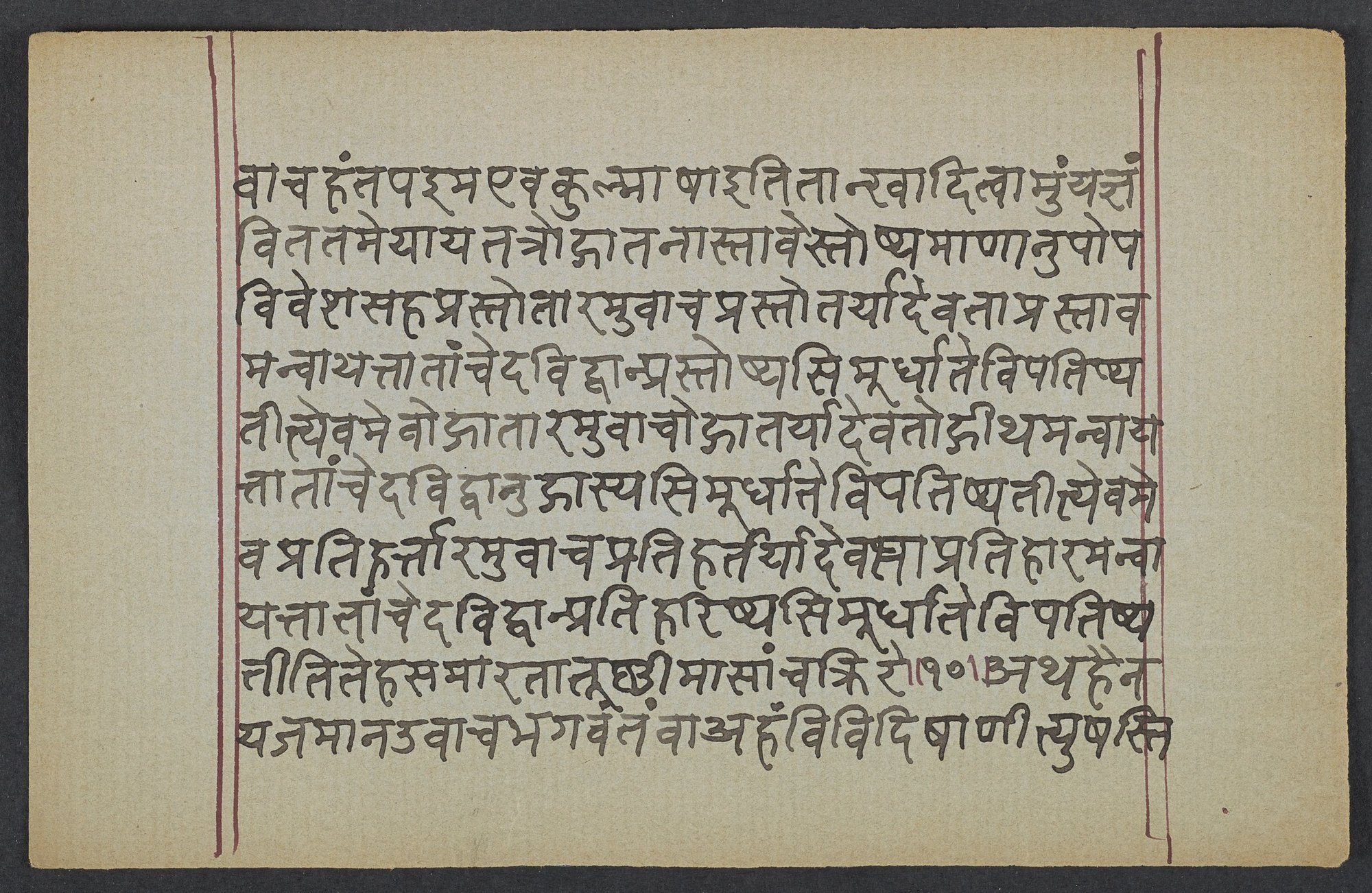
Penn Ms. Coll. 390 Item 945. fol. 9v begins ‹maṭacīhateṣu kuruṣv āṭikyā saha jāyayoṣastir ha cākrāyaṇa› and ends ‹rājāsau yakṣyate sa mā sarvair ārtvijyair vṛṇīteti taṃ jāyo›; fol. 10r begins ‹vāca hanta pata eva kulmāṣā iti tān khāditvāmuṃ yajñaṃ› and ends ‹atha hainaṃ yajamāna uvāca bhagavantaṃ vā ahaṃ vividiṣāṇīty uṣastir› (first and last words read on the image, transliterated). The words were located in the GRETIL text by string matching and the page boundaries follow from them; readings and results are stored in data/sources/upanishads/mapping_945.json.
10.7taṃ jāyovāca |
hanta pata ima eva kulmāṣā iti |
tān khāditvāmuṃ yajñaṃ vitatam eyāya ||
10.8tatrodgātḥn āstāve stoṣyamāṇān upopaviveśa |
sa ha prastotaram uvāca ||
10.9prastotar yā devatā prastāvam anvāyattā tāṃ ced avidvān prastoṣyasi mūrdhā te vipatiṣyatīti ||
10.10evam evodgātāram uvāca |
udgātar yā devatodgītham anvāyattā tāṃ ced avidvān udgāsyasi mūrdhā te vipatiṣyatīti ||
10.11evam eva pratihartāram uvāca |
pratihartar yā devatā pratihāram anvāyattā tāṃ ced avidvān pratihariṣyasi mūrdhā te vipatiṣyatīti |
te ha samāratās tūṣṇīm āsāṃ cakrire ||
10.7His wife said to him: 'Look, here are those beans of yours.' Having eaten them, he went to the sacrifice which was being performed.
10.8He went and sat down on the orchestra near the Udgâtris, who were going to sing their hymns of praise. And he said to the Prastotri (the leader):
10.9'Prastotri, if you, without knowing the deity which belongs to the prastâva (the hymns &c. of the Prastotri), are going to sing it, your head will fall off.'
10.10In the same manner he addressed the Udgâtri; 'Udgâtri, if you, without knowing the deity which belongs to the udgtîha (the hymns of the Udgâtri), are going to sing it, your head will fall off.'
10.11In the same manner he addressed the Pratihartri; 'Pratihartri, if you, without knowing the deity which belongs to the pratihâra (the hymns of the Pratihartri), are going to sing it, your head will fall off.' They stopped, and sat down in silence.
Where on the image
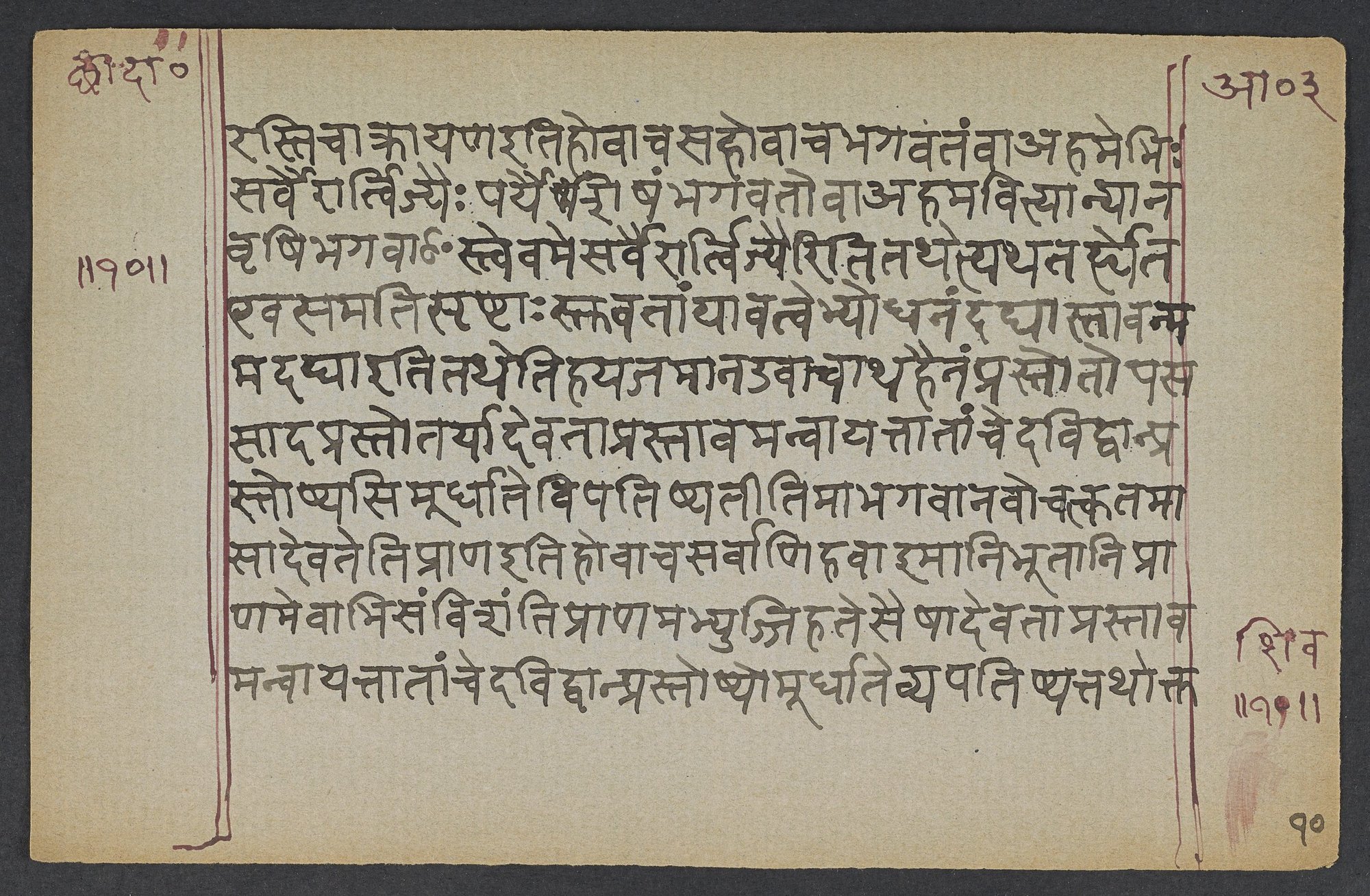
Penn Ms. Coll. 390 Item 945. fol. 10r begins ‹vāca hanta pata eva kulmāṣā iti tān khāditvāmuṃ yajñaṃ› and ends ‹atha hainaṃ yajamāna uvāca bhagavantaṃ vā ahaṃ vividiṣāṇīty uṣastir›; fol. 10v begins ‹asmi cākrāyaṇa iti hovāca sa hovāca bhagavantaṃ vā aham ebhiḥ› and ends ‹taṃ ced avidvān prastoṣyo mūrdhā te vyapatiṣyat tathokta› (first and last words read on the image, transliterated). The words were located in the GRETIL text by string matching and the page boundaries follow from them; readings and results are stored in data/sources/upanishads/mapping_945.json.
11.1atha hainaṃ yajamāna uvāca |
bhagavantaṃ vā ahaṃ vividiṣāṇīti |
uṣastir asmi cākrāyaṇa iti hovāca ||
11.2sa hovāca |
bhagavantaṃ vā aham ebhiḥ sarvair ārtvijyaiḥ paryaiṣiṣam |
bhagavato vā aham avittyānyān avṛṣi ||
11.3bhagavāṃs tv eva me sarvair ārtvijyair iti |
tatheti |
atha tarhy eta eva samatisṛṣṭāḥ stuvatām |
yāvat tv ebhyo dhanaṃ dadyās tāvan mama dadyā iti |
tatheti ha yajamāna uvāca ||
11.4atha hainaṃ prastotopasasāda |
prastotar yā devatā prastāvam anvāyattā tāṃ ced avidvān prastoṣyasi mūrdhā te vipatiṣyatīti mā bhagavān avocat |
katamā sā devateti ||
11.1Then the sacrificer said to him: 'I should like to know who you are, Sir.' He replied: 'I am Ushasti Kâkrâyana.'
11.2He said: 'I looked for you, Sir, for all these sacrificial offices, but not finding you, I chose others.'
11.3'But now, Sir, take all the sacrificial offices.' Ushasti said: "Very well; but let those, with my permission, perform the hymns of praise. Only as much wealth as you give to them, so much give to me also.' The sacrificer assented.
11.4Then the Prastotri approached him, saying: 'Sir, you said to me, "Prastotri, if you, without knowing the deity which belongs to the prastâva, are going to sing it, your head will fall off,"—which then is that deity?'
Where on the image
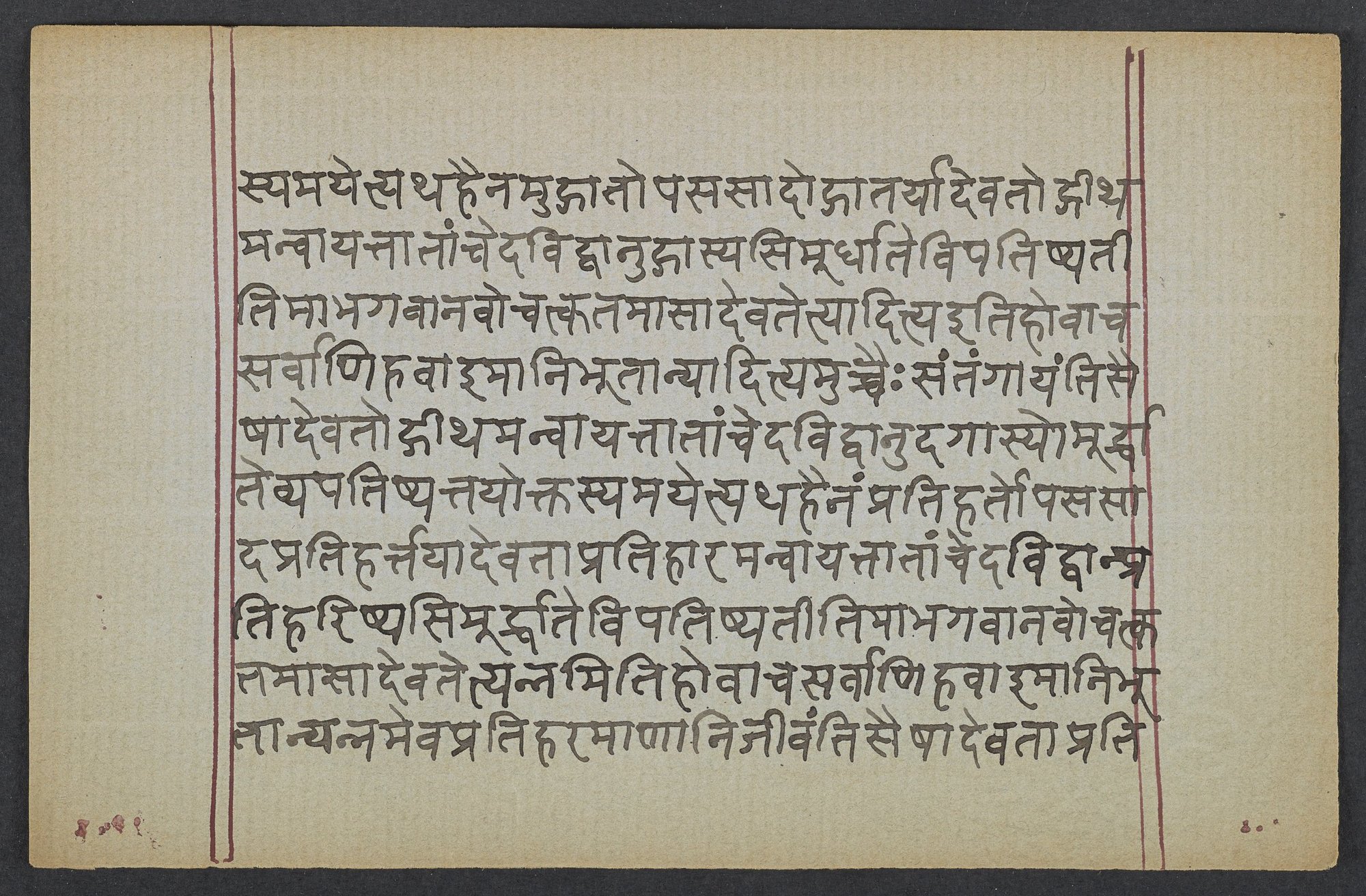
Penn Ms. Coll. 390 Item 945. fol. 10v begins ‹asmi cākrāyaṇa iti hovāca sa hovāca bhagavantaṃ vā aham ebhiḥ› and ends ‹taṃ ced avidvān prastoṣyo mūrdhā te vyapatiṣyat tathokta›; fol. 11r begins ‹sya mayeti sa atha hainam udgātopasasāda› and ends ‹annam eva pratiharamāṇāni jīvanti saiṣā devatā prati› (first and last words read on the image, transliterated). The words were located in the GRETIL text by string matching and the page boundaries follow from them; readings and results are stored in data/sources/upanishads/mapping_945.json.
11.5prāṇa iti hovāca |
sarvāṇi ha vā imāni bhūtāni prāṇam evābhisaṃviśanti |
prāṇam abhyujjihate |
saiṣā devatā prastāvam anvāyattā |
tāṃ ced avidvān prāstoṣyo mūrdhā te vipatiṣyat tathoktasya mayeti ||
11.6atha hainam udgātopasasāda |
udgātar yā devatodgītham anvāyattā tāṃ ced avidvān udgāsyasi mūrdhā te vipatiṣyatīti mā bhagavān avocat |
katamā sā devatā iti ||
11.7āditya iti hovāca |
sarvāṇi ha vā imāni bhūtāny ādityam uccaiḥ santaṃ gāyanti |
saiṣā devatodgītham anvāyattā |
tāṃ ced avidvān udagāsyo mūrdhā te vyapatiṣyat tathoktasya mayeti ||
11.8atha hainaṃ pratihartopasasāda |
pratihartar yā devatā pratihāram anvāyattā tāṃ ced avidvān pratihariṣyasi mūrdhā te vipatiṣyatīti mā bhagavān avocat |
katamā sā devateti ||
11.5He said: 'Breath (prâna). For all these beings merge into breath alone, and from breath they arise. This is the deity belonging to the prastâva. If, without knowing that deity, you had sung forth your hymns, your head would have fallen off, after you had been warned by me.'
11.6Then the Udgâtri approached him, saying: 'Sir, you said to me, "Udgâtri, if you, without knowing the deity which belongs to the udgîtha, are going to sing it, your head will fall off,"—which then is that deity?'
11.7He said: 'The sun (âditya). For all these beings praise the sun when it stands on high. This is the deity belonging to the udgîtha. If without knowing that deity, you had sung out your hymns, your head would have fallen off, after you had been warned by me.'
11.8Then the Pratihartri approached him, saying: 'Sir, you said to me, "Pratihartri, if you, without knowing the deity belonging to the pratihâra, are going to sing it, your head will fall off,"—which then is that deity?'
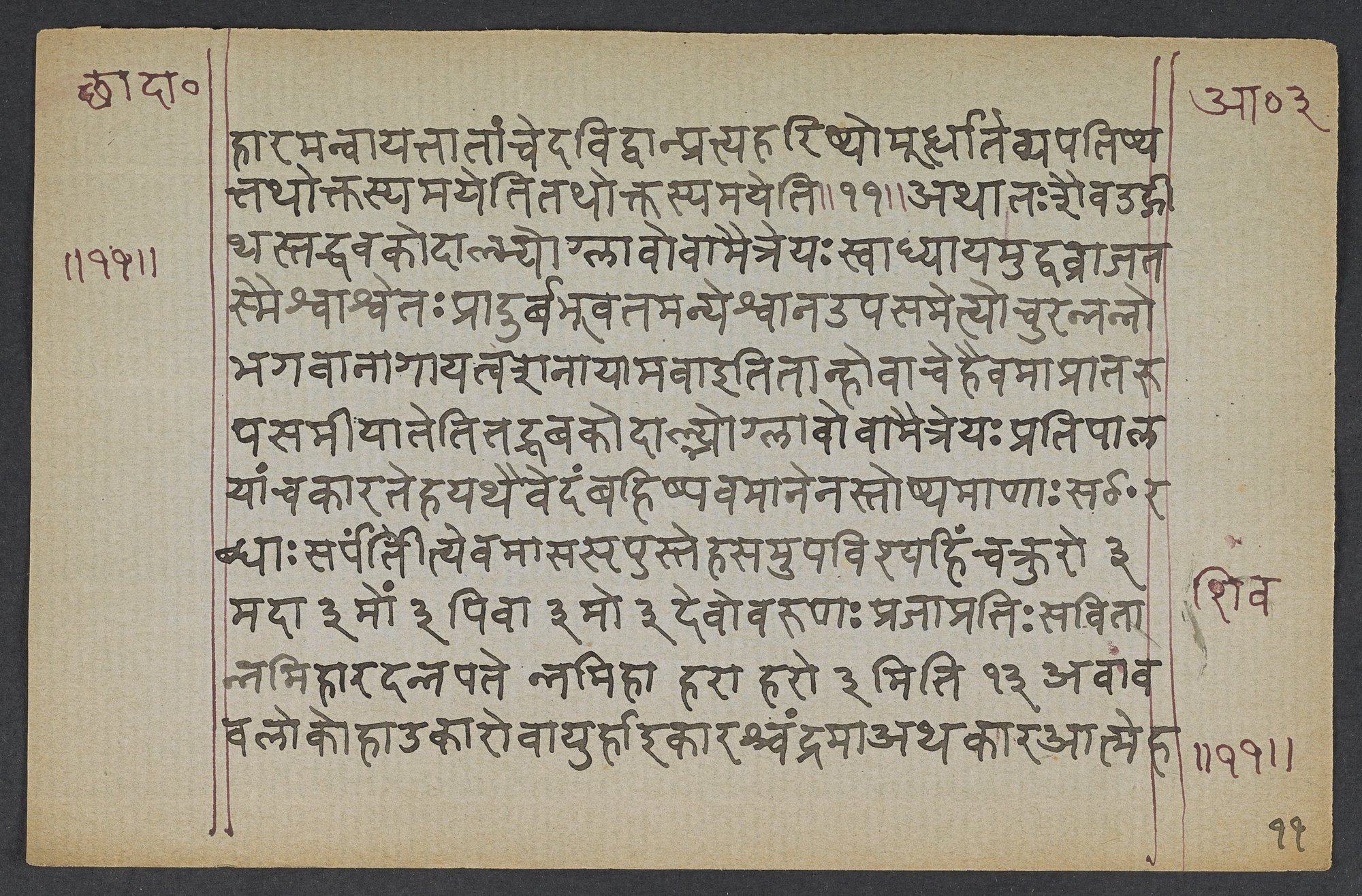
Where on the image
Penn Ms. Coll. 390 Item 945. fol. 11r begins ‹sya mayeti sa atha hainam udgātopasasāda› and ends ‹annam eva pratiharamāṇāni jīvanti saiṣā devatā prati›; fol. 11v begins ‹hāram anvāyattā tāṃ ced avidvān pratyahariṣyo mūrdhā te vyapatiṣyat› and ends ‹vāyur hāikāraś candramā athakāra ātmeha› (first and last words read on the image, transliterated). The words were located in the GRETIL text by string matching and the page boundaries follow from them; readings and results are stored in data/sources/upanishads/mapping_945.json.
11.9annam iti hovāca |
sarvāṇi ha vā imāni bhūtany annam eva pratiharamāṇāni jīvanti |
saiṣā devatā pratihāram anvāyattā |
tāṃ ced avidvān pratyahariṣyo mūrdhā te vyapatiṣyat tathoktasya mayeti tathoktasya mayeti ||
12.1athātaḥ śauva udgīthaḥ |
tad dha bako dālbhyo glāvo vā maitreyaḥ svādhyāyam udvavrāja ||
12.2tasmai śvā śvetaḥ prādur babhūva |
tam anye śvāna upasametyocuḥ |
annaṃ no bhagavān āgāyatu |
aśanāyāma vā iti ||
12.3tān hovācehaiva mā prātar upasamīyateti |
tad dha bako dālbhyo glāvo vā maitreyaḥ pratipālayāṃ cakāra ||
12.4te ha yathaivedaṃ bahiṣpavamānena stoṣyamāṇāḥ saṃrabdhāḥ sarpantīty evam āsasṛpuḥ |
te ha samupaviśya hiñ cakruḥ ||
12.5o3madā3ma |
oṃ3 pibā3ma |
oṃ3 devo varuṇaḥ prajāpatiḥ savitā2'nnam ihā2'harat |
annapate3'nnamihā2''harā2''haro3miti ||
11.9He said: 'Food (anna). For all these beings live when they partake of food. This is the deity belonging to the pratihâra. If, without knowing that deity, you had sung your hymns, your head would have fallen off, after you had been warned by me.'
12.1Now follows the udgîtha of the dogs. Vaka Dâlbhya, or, as he was also called, Glâva Maitreya, went out to repeat the Veda (in a quiet place).
12.2A white (dog) appeared before him, and other dogs gathering round him, said to him: 'Sir, sing and get us food, we are hungry.'
12.3The white dog said to them: 'Come to me to-morrow morning.' Vaka Dâlbhya, or, as he was also called, Glâva Maitreya, watched.
12.4The dogs came on, holding together, each dog keeping the tail of the preceding dog in his mouth, as the priests do when they are going to sing praises with the Vahishpavamâna hymn. After they had settled down, they began to say Hin.
12.5'Om, let us eat! Om, let us drink! Om, may the divine Varuna, Pragâpati, Savitri bring us food! Lord of food, bring hither food, bring it, Om!'
Where on the image
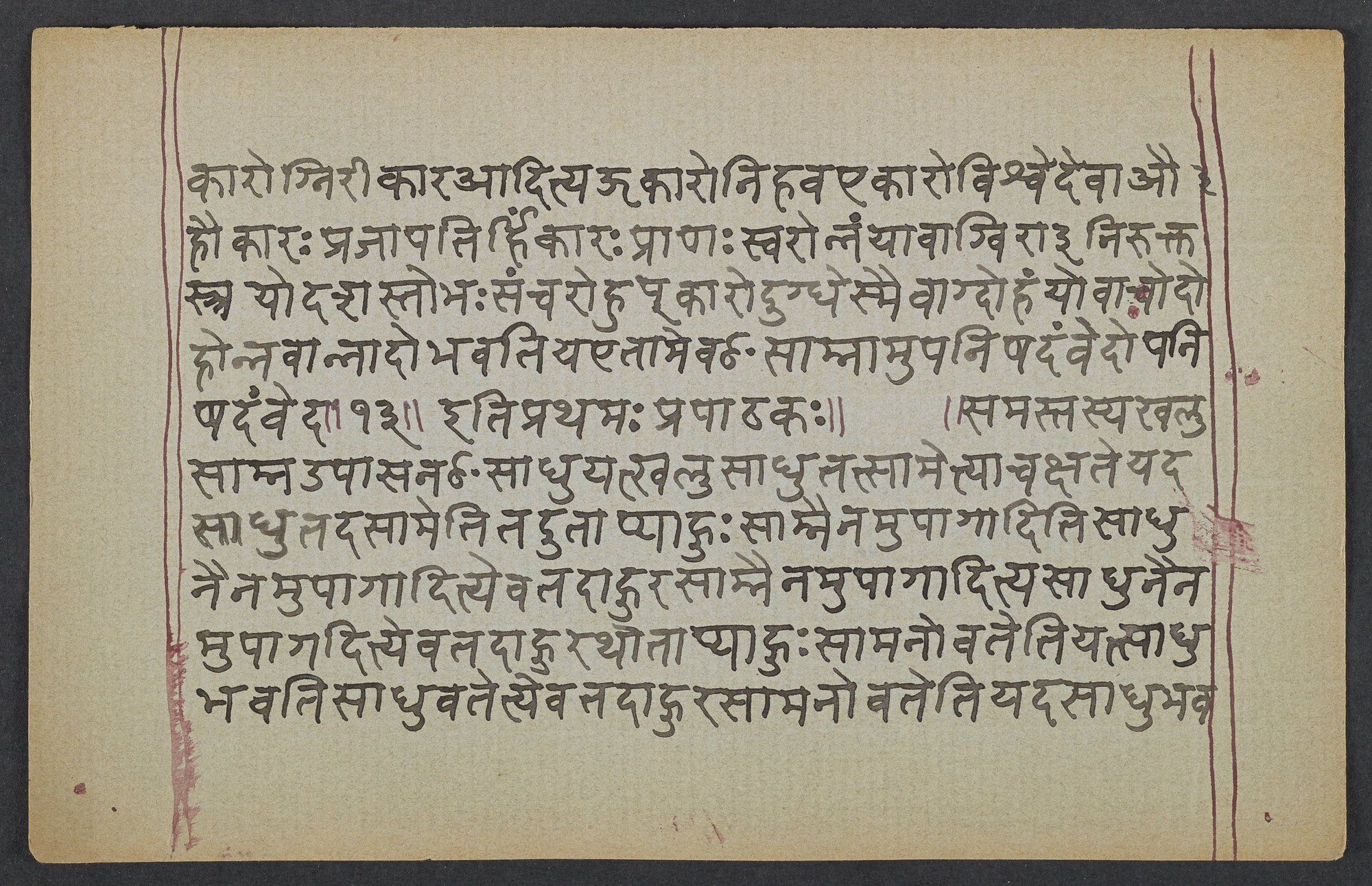
Penn Ms. Coll. 390 Item 945. fol. 11v begins ‹hāram anvāyattā tāṃ ced avidvān pratyahariṣyo mūrdhā te vyapatiṣyat› and ends ‹vāyur hāikāraś candramā athakāra ātmeha›; fol. 12r begins ‹kāro 'gnir īkāra āditya ūkāro nihava ekāro viśve devā au› and ends ‹etām evaṃ sāmnām upaniṣadaṃ vedopaniṣadaṃ veda› (first and last words read on the image, transliterated). The words were located in the GRETIL text by string matching and the page boundaries follow from them; readings and results are stored in data/sources/upanishads/mapping_945.json.
13.1ayaṃ vāva loko hāukāraḥ |
vāyur hāikāraḥ |
candramā athakāraḥ |
ātmehakāraḥ |
agnir īkāraḥ ||
13.2āditya ūkāraḥ |
nihava ekāraḥ |
viśve devā auhoyikāraḥ |
prajapatir hiṅkāraḥ |
prāṇaḥ svaraḥ |
annaṃ yā |
vāg virāṭ ||
13.3aniruktas trayodaśaḥ stobhaḥ saṃcaro huṅkāraḥ ||
13.4dugdhe 'smai vāg dohaṃ yo vāco dohaḥ |
annavān annādo bhavati |
ya etām evaṃ sāmnām upaniṣadaṃ vedopaniṣadaṃ veda ||
13.1The syllable Hâu is this world (the earth), the syllable Hâi the air, the syllable Atha the moon, the syllable Iha the self, the syllable Î is Agni, fire.
13.2The syllable Û is the sun, the syllable E is the Nihava or invocation, the syllable Auhoi is the Visve Devas, the syllable Hin is Pragâpati, Svara (tone) is breath (prâna), the syllable Yâ is food, the syllable Vâg is Virâg.
13.3The thirteenth stobha syllable, viz. the indistinct syllable Huṅ, is the Undefinable (the Highest Brahman).
13.4Speech yields the milk, which is the milk of speech itself to him who knows this Upanishad (secret doctrine) of the Sâmans in this wise. He becomes rich in food, and able to eat food,—yea, able to eat food.
Notes
- Sanskrit: GRETIL, Chandogyopanisad with the commentary ascribed to Samkara, mula text only (input by the Sansknet project). Paragraph numbers (khanda.paragraph) follow the edition. Three legacy encoding artifacts in GRETIL chapter 2 ('saptavidh.am', 'brahmavarcasy:', 'tejasvy:') are normalized.
- English: F. Max Müller, 'Khandogya-upanishad', The Upanishads part I, Sacred Books of the East 1 (1879), from the proofread English Wikisource transcription; footnotes are not reproduced. Where Müller divides a khanda into a different number of paragraphs than the Sanskrit edition, the whole khanda stands in one section and keeps his numbers. In other khandas his paragraph breaks sometimes fall a clause earlier or later than the Sanskrit ones.
- Transcription slips corrected to the printed page: 1.9.2 'udîttha' (printed udgîtha), 3.16.2 'sacrifices' (sacrificer,), 4.6.1 'toward' (towards), 7.25.1 'alt' (all); the stray heading 'Elventh Khanda' inside 2.10.6 is removed. 1.2.1 'Whent he' is a misprint in the book itself and is kept as printed.
- The manuscript readings differ from the edition in places; the Sanskrit shown is the edition text.
- fol. 1v opens with 'śrīgaṇeśāya namaḥ' and the invocation 'āpyāyantu mamāṅgāni' before 1.1.1
Cite
Sources
- Source: Penn Ms. Coll. 390 Item 945 (OPenn, public domain) + GRETIL Sanskrit + F. Max Müller (1879) English (holding institution)
- Critical edition: GRETIL Sanskrit e-texts (Isa, Katha, Prasna, Mandukya, Aitareya, Taittiriya, Svetasvatara, Chandogya); Nirnaya Sagar edition of 1925, transcribed (Kena, Mundaka)
← previous · → next · v cycle view · l back to library