Chandogya Upanishad, Prapathaka 2 (the Saman, fivefold and sevenfold)
Introduction
The Chandogya Upanishad belongs to the Samaveda and is one of the two longest and oldest Upanishads. It has eight chapters (prapathakas). This entry gives chapter 2. It treats the Saman as a whole: the fivefold and sevenfold Saman meditated on in the worlds, the rain, the waters, the seasons, the animals and the breaths, the Samans woven into the world (2.11-21), the 'three branches of law' (2.23) and the rites that win the worlds of the three daily soma pressings (2.24).
The page images come from University of Pennsylvania Libraries, Ms. Coll. 390 Item 945, a paper manuscript of 74 leaves (11 x 17 cm) holding the whole Chandogya Upanishad, written in Devanagari, 10 to 11 lines to a side, on blue machine-made paper with watermarks; it is undated (catalogued 18th or 19th century). The scribe numbers the khandas and closes each chapter with a colophon, but does not number paragraphs. Chapter 2 runs from fol. 12r to fol. 20v.
For every page, the first and last words were read on the image and found in the edited text; the page boundaries follow from them. Each section below holds the paragraphs that end on one page, with every page they occupy.
How was this verified? (Provenance)
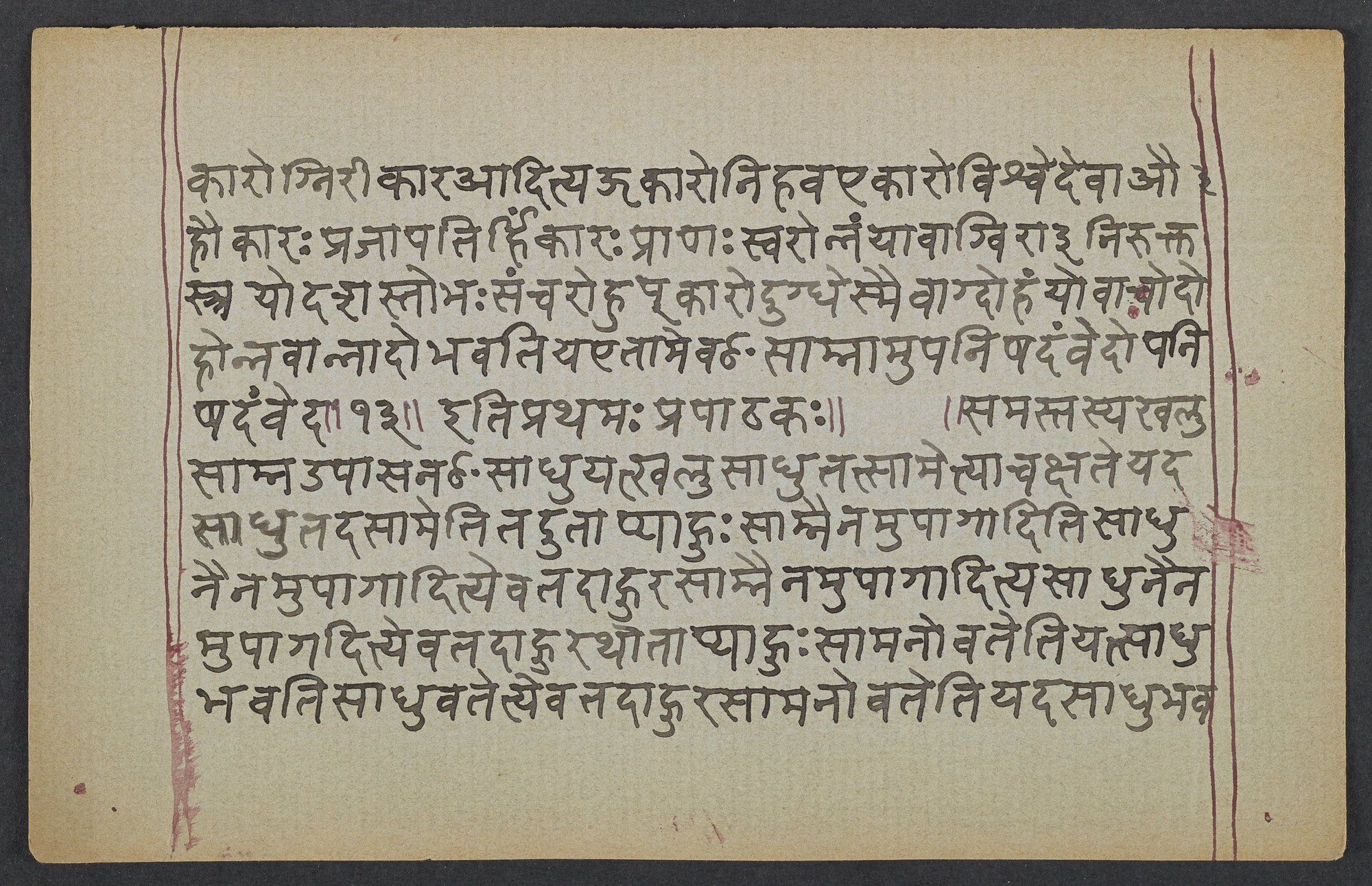
Where on the image
Penn Ms. Coll. 390 Item 945. fol. 12r begins ‹samastasya khalu sāmna upāsanaṃ sādhu› and ends ‹sāmano bateti yad asādhu bha› (first and last words read on the image, transliterated). The words were located in the GRETIL text by string matching and the page boundaries follow from them; readings and results are stored in data/sources/upanishads/mapping_945.json.
1.1samastasya khalu sāmna upāsanaṃ sādhu |
yat khalu sādhu tat sāmety ācakṣate |
yad asādhu tad asāmeti ||
1.2tad utāpy āhuḥ |
sāmnainam upāgād iti sādhunainam upāgād ity eva tad āhuḥ |
asāmnainam upāgād ity eva tad āhuḥ ||
1.1Meditation on the whole of the Sâman is good, and people, when anything is good, say it is Sâman; when it is not good, it is not Sâman.
1.2Thus they also say, he approached him with Sâman, i.e. becomingly; and he approached him without Sâman, i. e. unbecomingly.
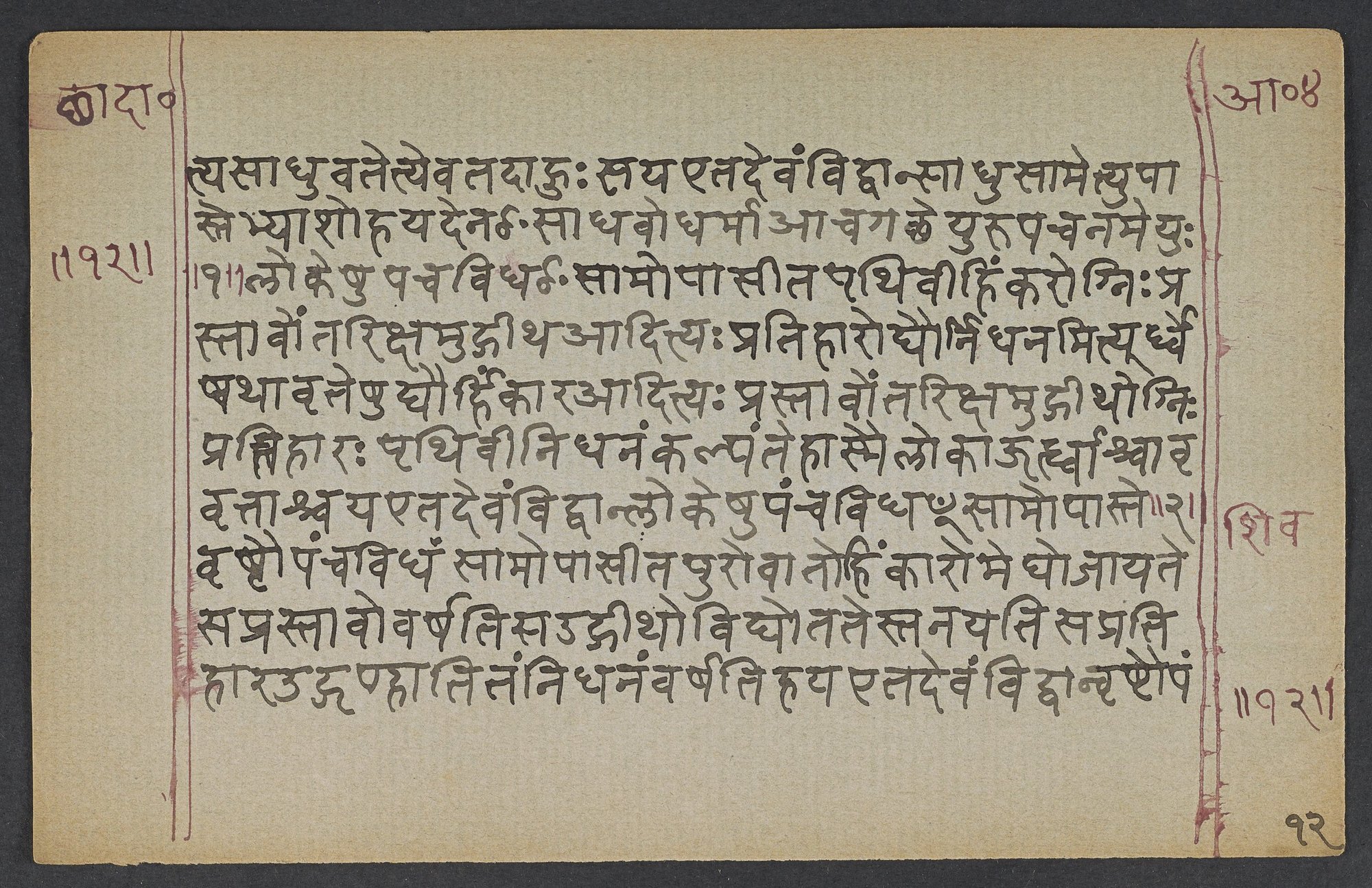
Where on the image
Penn Ms. Coll. 390 Item 945. fol. 12r begins ‹samastasya khalu sāmna upāsanaṃ sādhu› and ends ‹sāmano bateti yad asādhu bha›; fol. 12v begins ‹vaty asādhu batety eva tad āhuḥ sa ya etad evaṃ vidvān› and ends ‹nidhanaṃ varṣati ha ya etad evaṃ vidvān vṛṣṭau pañ› (first and last words read on the image, transliterated). The words were located in the GRETIL text by string matching and the page boundaries follow from them; readings and results are stored in data/sources/upanishads/mapping_945.json.
1.3athotāpy āhuḥ |
sāma no bateti yat sādhu bhavati sādhu batety eva tad āhuḥ |
asāma no bateti yad asādhu bhavaty asādhu batety eva tad āhuḥ ||
1.4sa ya etad evaṃ vidvān sādhu sāmety upāste 'bhyāśo ha yad enaṃ sādhavo dharmā ā ca gaccheyur upa ca nameyuḥ ||
2.1lokeṣu pañcavidhaṃ sāmopāsīta |
pṛthivī hiṅkāraḥ |
agniḥ prastāvaḥ |
antarikṣam udgīthaḥ |
ādityaḥ pratihāraḥ |
dyaur nidhanam |
ity ūrdhveṣu ||
2.2athāvṛtteṣu |
dyaur hiṅkāraḥ |
ādityaḥ prastāvaḥ |
antarikṣam udgīthaḥ |
agniḥ pratihāraḥ |
pṛthivī nidhanam ||
2.3kalpante hāsmai lokā ūrdhvāś cāvṛttaś ca ya etad evaṃ vidvāṃl lokeṣu pañcavidhaṃ sāmopāste ||
3.1vṛṣṭau pañcavidhaṃ sāmopāsīta |
purovāto hiṅkāraḥ |
megho jāyate sa prastāvaḥ |
varṣati sa udgīthaḥ |
vidyotate stanayati sa pratihāraḥ ||
1.3And they also say, truly this is Sâman for us, i.e. it is good for us, when it is good; and truly that is not Sâman for us, i. e. it is not good for us, when it is not good.
1.4If any one knowing this meditates on the Sâman as good, depend upon it all good qualities will approach quickly, aye, they will become his own.
2.1Let a man meditate on the fivefold Sâman as the five worlds. The hinkâra is the earth, the prastâva the fire, the udgîtha the sky, the pratihâra the sun, the nidhana heaven; so in an ascending line.
2.2In a descending line, the hinkâra is heaven, the prastâva the sun, the udgîtha the sky, the pratihâra the fire, the nidhana the earth.
2.3The worlds in an ascending and in a descending line belong to him who knowing this meditates on the fivefold Sâman as the worlds.
3.1Let a man meditate on the fivefold Sâman as rain. The hinkâra is wind (that brings the rain); the prastâva is, 'the cloud is come'; the udgîtha is, 'it rains;' the pratihâra, 'it flashes, it thunders;'
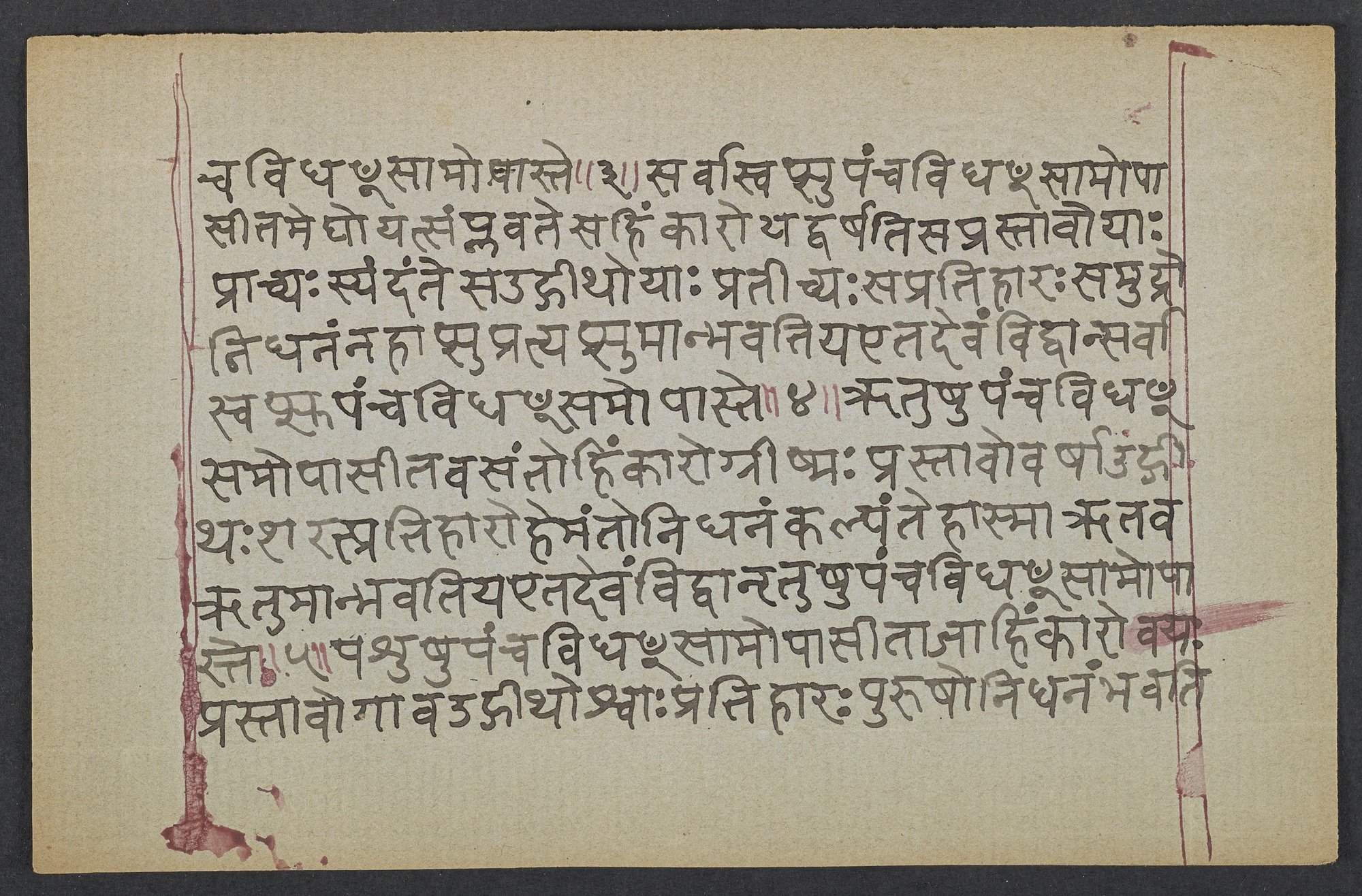
Where on the image
Penn Ms. Coll. 390 Item 945. fol. 12v begins ‹vaty asādhu batety eva tad āhuḥ sa ya etad evaṃ vidvān› and ends ‹nidhanaṃ varṣati ha ya etad evaṃ vidvān vṛṣṭau pañ›; fol. 13r begins ‹cavidhaṃ sāmopāste sarvāsv apsu pañcavidhaṃ sāmopāsīta› and ends ‹prastāvo gāva udgītho 'śvāḥ pratihāraḥ puruṣo nidhanaṃ bhavanti› (first and last words read on the image, transliterated). The words were located in the GRETIL text by string matching and the page boundaries follow from them; readings and results are stored in data/sources/upanishads/mapping_945.json.
3.2udgṛhṇāti tan nidhanaṃ varṣayati ha ya etad evaṃ vidvān vṛṣṭau pañcavidhaṃ sāmopāste ||
4.1sarvāsv apsu pañcavidhaṃ sāmopāsīta |
megho yat saṃplavate sa hiṅkāraḥ |
yad varṣati sa prastāvaḥ |
yāḥ prācyaḥ syandante sa udgīthaḥ |
yāḥ pratīcyaḥ sa pratihāraḥ |
samudro nidhanam ||
4.2na hāpsu praity apsumān bhavati ya etad evaṃ vidvān sarvāsv apsu pañcavidhaṃ sāmopāste ||
5.1ṛtuṣu pañcavidhaṃ sāmopāsīta |
vasanto hiṅkāraḥ |
grīṣmaḥ prastāvaḥ |
varṣā udgīthaḥ |
śarat pratihāraḥ |
hemanto nidhanam ||
5.2kalpante hāsmā ṛtava ṛtumān bhavati ya etad evaṃ vidvān ṛtuṣu pañcavidhaṃ sāmopāste ||
6.1paśuṣu pañcavidhaṃ sāmopāsīta |
ajā hiṅkāraḥ |
avayaḥ prastāvaḥ |
gāva udgīthaḥ |
aśvaḥ pratihāraḥ |
puruṣo nidhanam ||
3.2The nidhana is, 'it stops.' There is rain for him, and he brings rain for others who thus knowing meditates on the fivefold Sâman as rain.
4.1Let a man meditate on the fivefold Sâman in all waters. When the clouds gather, that is the hinkâra; when it rains, that is the prastâva; that which flows in the east, that is the udgîtha; that which flows in the west, that is the pratihâra; the sea is the nidhana.
4.2He does not die in water, nay, he is rich in water who knowing this meditates on the fivefold Sâman as all waters.
5.1Let a man meditate on the fivefold Sâman as the seasons. The hinkâra is spring, the prastâva summer (harvest of yava, &c), the udgîtha the rainy season, the pratihâra autumn, the nidhana winter.
5.2The seasons belong to him, nay, he is always in season (successful) who knowing this meditates on the fivefold Sâman as the seasons.
6.1Let a man meditate on the fivefold Sâman in animals. The hinkâra is goats, the prastâva sheep, the udgîtha cows, the pratihâra horses, the nidhana man.
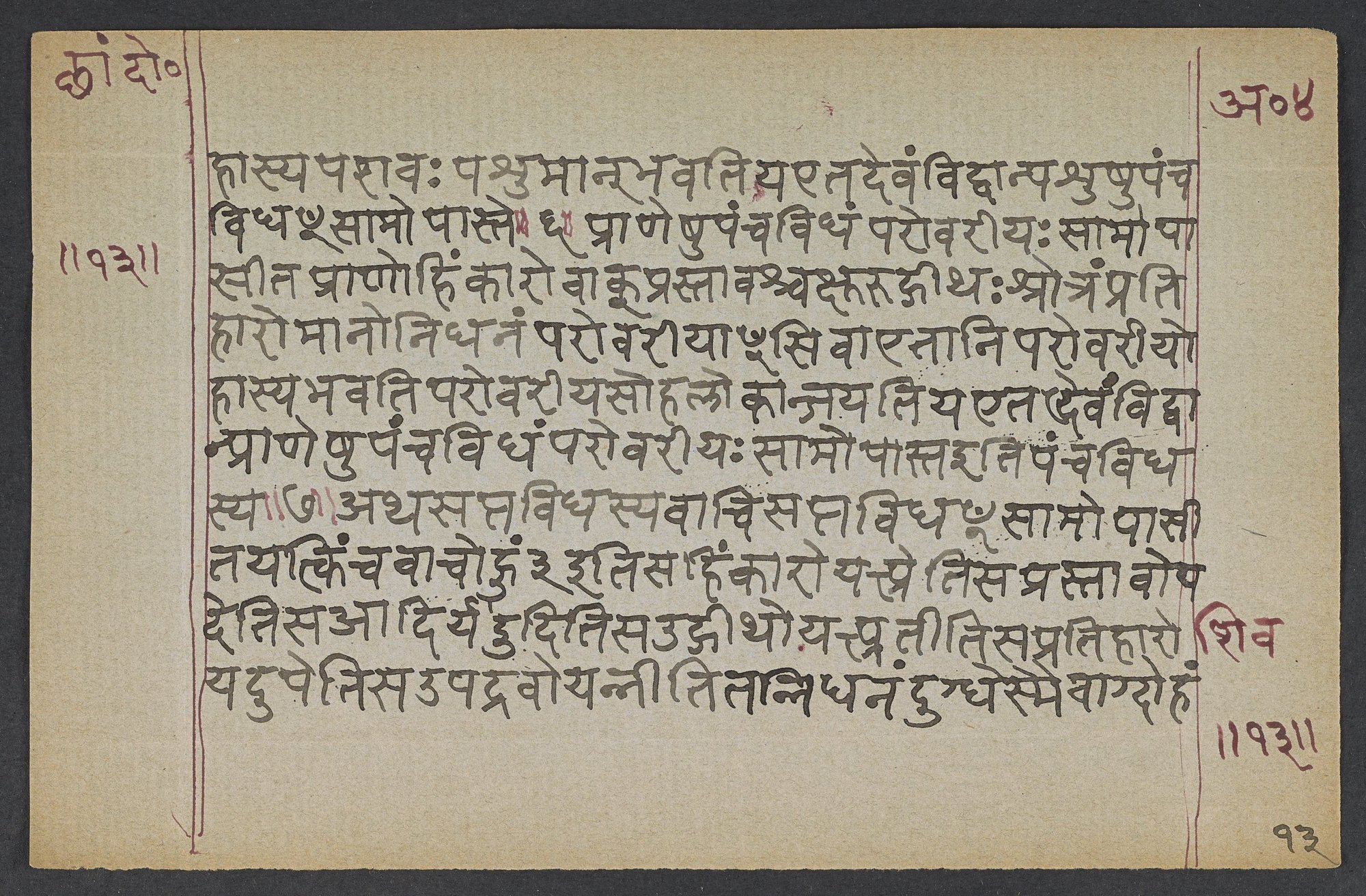
Where on the image
Penn Ms. Coll. 390 Item 945. fol. 13r begins ‹cavidhaṃ sāmopāste sarvāsv apsu pañcavidhaṃ sāmopāsīta› and ends ‹prastāvo gāva udgītho 'śvāḥ pratihāraḥ puruṣo nidhanaṃ bhavanti›; fol. 13v begins ‹hāsya paśavaḥ paśumān bhavati ya etad evaṃ vidvān paśuṣu pañca› and ends ‹tan nidhanaṃ dugdhe 'smai vāg doham› (first and last words read on the image, transliterated). The words were located in the GRETIL text by string matching and the page boundaries follow from them; readings and results are stored in data/sources/upanishads/mapping_945.json.
6.2bhavanti hāsya paśavaḥ paśumān bhavati ya etad evaṃ vidvān paśuṣu pañcavidhaṃ sāmopāste ||
7.1prāṇeṣu pañcavidhaṃ parovarīyaḥ sāmopāsīta |
prāṇo hiṅkāraḥ |
vāk prastāvaḥ |
cakṣur udgīthaḥ |
śrotraṃ pratihāraḥ |
mano nidhanam |
parovarīyāṃsi vā etāni ||
7.2parovarīyo hāsya bhavati parovarīyaso ha lokāñ jayati ya etad evaṃ vidvān prāṇeṣu pañcavidhaṃ parovarīyaḥ sāmopāste |
iti tu pañcavidhasya ||
8.1atha saptavidhasya |
vāci saptavidham sāmopāsīta |
yat kiṃca vāco hum iti sa hiṅkāraḥ |
yat preti sa prastāvaḥ |
yad eti sa ādiḥ ||
8.2yad ud iti sa udgīthaḥ |
yat pratīti sa pratihāraḥ |
yad upeti sa upadravaḥ |
yan nīti tan nidhanam ||
6.2Animals belong to him, nay, he is rich in animals who knowing this meditates on the fivefold Sâman as animals.
7.1Let a man meditate on the fivefold Sâman, which is greater than great, as the prânas (senses). The hinkâra is smell (nose), the prastâva speech (tongue), the udgîtha sight (eye), the pratihâra hearing (ear), the nidhana mind. These are one greater than the other.
7.2What is greater than great belongs to him, nay, he conquers the worlds which are greater than great, who knowing this meditates on the fivefold Sâman, which is greater than great, as the prânas (senses).
8.1Next for the sevenfold Sâman. Let a man meditate on the sevenfold Sâman in speech. Whenever there is in speech the syllable hun that is hinkâra, pra is the prastâva, â is the âdi, the first, i. e. Om,
8.2Ud is the udgîtha, pra the pratihâra, upa the upadrava, ni the nidhana.
Where on the image
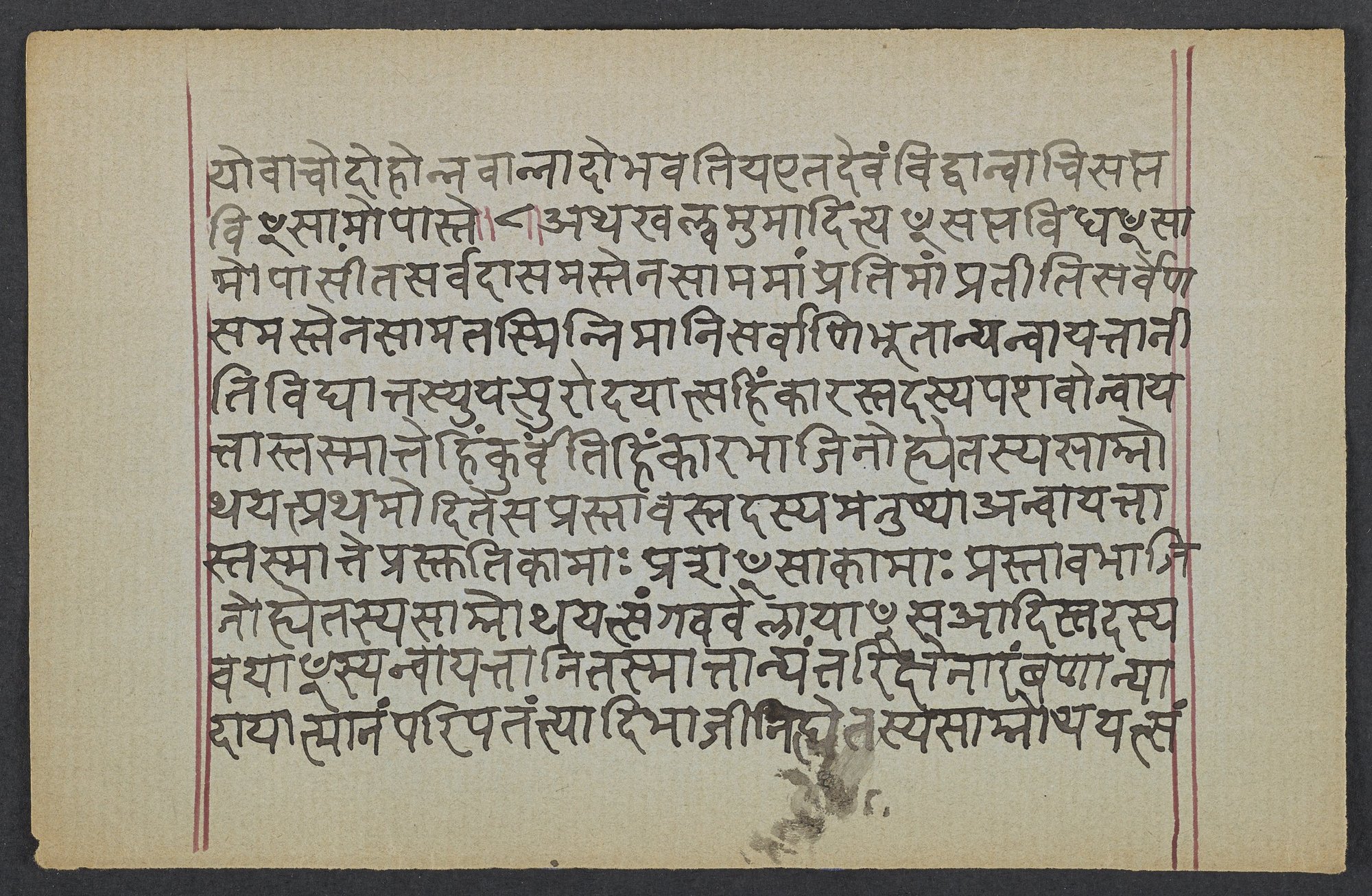
Penn Ms. Coll. 390 Item 945. fol. 13v begins ‹hāsya paśavaḥ paśumān bhavati ya etad evaṃ vidvān paśuṣu pañca› and ends ‹tan nidhanaṃ dugdhe 'smai vāg doham›; fol. 14r begins ‹yo vāco doho 'nnavān annādo bhavati ya etad evaṃ vidvān vāci saptavidhaṃ› and ends ‹ādāyātmānaṃ paripatanty ādityabhājino hy etasya sāmno 'tha yat› (first and last words read on the image, transliterated). The words were located in the GRETIL text by string matching and the page boundaries follow from them; readings and results are stored in data/sources/upanishads/mapping_945.json.
8.3dugdhe 'smai vāg dohaṃ yo vāco dohaḥ |
annavān annādo bhavati |
ya etad evaṃ vidvān vāci saptavidhaṃ sāmopāste ||
9.1atha khalv amum ādityaṃ saptavidhaṃ sāmopāsīta |
sarvadā samas tena sāma |
māṃ prati māṃ pratīti sarveṇa samas tena sāma ||
9.2tasminn imāni sarvāṇi bhūtāny anvāyattānīti vidyāt |
tasya yat purodayāt sa hiṅkāraḥ |
tad asya paśavo 'nvāyattāḥ |
tasmāt te hiṅkurvanti |
hiṅkārabhājino hy etasya sāmnaḥ ||
9.3atha yat prathamodite sa prastāvaḥ |
tad asya manuṣyā anvāyattāḥ |
tasmāt te prastutikāmāḥ praśaṃsākāmāḥ |
prastāvabhājino hy etasya sāmnaḥ ||
9.4atha yat saṃgavavelāyāṃ sa ādiḥ |
tad asya vayāṃsy anvāyattāni |
tasmāt tāny antarikṣe 'nārambhaṇāny ādāyātmānaṃ paripatanti |
ādibhājīni hy etasya sāmnaḥ ||
8.3Speech yields the milk, which is the milk of speech itself, to him who knowing this meditates on the sevenfold Sâman in speech. He becomes rich in food, and able to eat food.
9.1Let a man meditate on the sevenfold Sâman as the sun. The sun is Sâman, because he is always the same (sama); he is Sâman because he is the same, everybody thinking he looks towards me, he looks towards me.
9.2Let him know that all beings are dependent on him (the sun). What he is before his rising, that is the hinkâra. On it animals are dependent. Therefore animals say hin (before sunrise), for they share the hinkâra of that Sâman (the sun).
9.3What he is when first risen, that is the prastâva. On it men are dependent. Therefore men love praise (prastuti) and celebrity, for they share the prastâva of that Sâman.
9.4What he is at the time of the sangava, that is the âdi, the first, the Om. On it birds are dependent. Therefore birds fly about in the sky without support, holding themselves, for they share the âdi (the Om) of that Sâman.
Where on the image
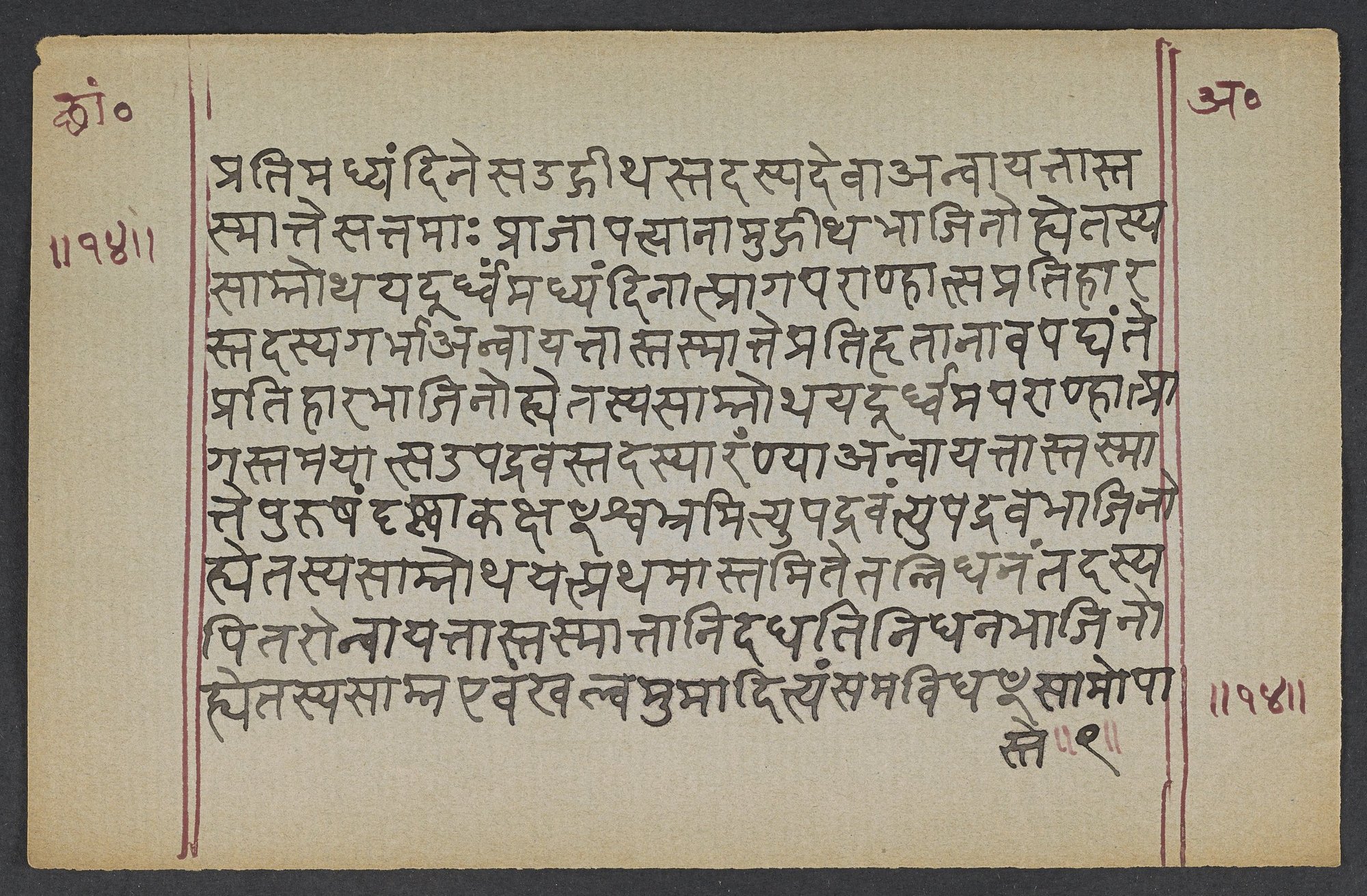
Penn Ms. Coll. 390 Item 945. fol. 14r begins ‹yo vāco doho 'nnavān annādo bhavati ya etad evaṃ vidvān vāci saptavidhaṃ› and ends ‹ādāyātmānaṃ paripatanty ādityabhājino hy etasya sāmno 'tha yat›; fol. 14v begins ‹prati madhyaṃdine sa udgīthas tad asya devā anvāyattāḥ› and ends ‹evaṃ khalv amum ādityaṃ saptavidhaṃ sāmopāste› (first and last words read on the image, transliterated). The words were located in the GRETIL text by string matching and the page boundaries follow from them; readings and results are stored in data/sources/upanishads/mapping_945.json.
9.5atha yat saṃprati madhyaṃdine sa udgīthaḥ |
tad asya devā anvāyattāḥ |
tasmāt te sattamāḥ prājāpatyānām |
udgīthabhājino hy etasya sāmnaḥ ||
9.6atha yad ūrdhvaṃ madhyaṃdināt prāg aparāhṇāt sa pratihāraḥ |
tad asya garbhā anvāyattāḥ |
tasmāt te pratihṛtā nāvapadyante |
pratihārabhājino hy etasya sāmnaḥ ||
9.7atha yad ūrdhvam aparāhṇāt prāg astam ayāt sa upadravaḥ |
tad asyāraṇyā anvāyattāḥ |
tasmāt te puruṣaṃ dṛṣṭvā kakṣaṃ śvabhram ity upadravanti |
upadravabhājino hy etasya sāmnaḥ ||
9.8atha yat prathamāstamite tan nidhanam |
tad asya pitaro 'nvāyattāḥ |
tasmāt tān nidadhati |
nidhanabhājino hy etasya sāmnaḥ |
evaṃ khalv amum ādityaṃ saptavidhaṃ sāmopāste ||
9.5What he is just at noon, that is the udgîtha. On it the Devas are dependent (because they are brilliant). Therefore they are the best of all the descendants of Pragâpati, for they share the udgîtha of that Sâman.
9.6What he is after midday and before afternoon, that is the pratihâra. On it all germs are dependent. Therefore these, having been conceived (pratihrita), do not fall, for they share the pratihâra of that Sâman.
9.7What he is after the afternoon and before sunset, that is the upadrava. On it the animals of the forest are dependent. Therefore, when they see a man, they run (upadravanti) to the forest as a safe hiding-place, for they share the upadrava of that Sâman.
9.8What he is when he first sets, that is the nidhana. On it the fathers are dependent Therefore they put them down (nidadhati), for they share the nidhana of that Sâman. Thus a man meditates on the sevenfold Sâman as the sun.
Where on the image
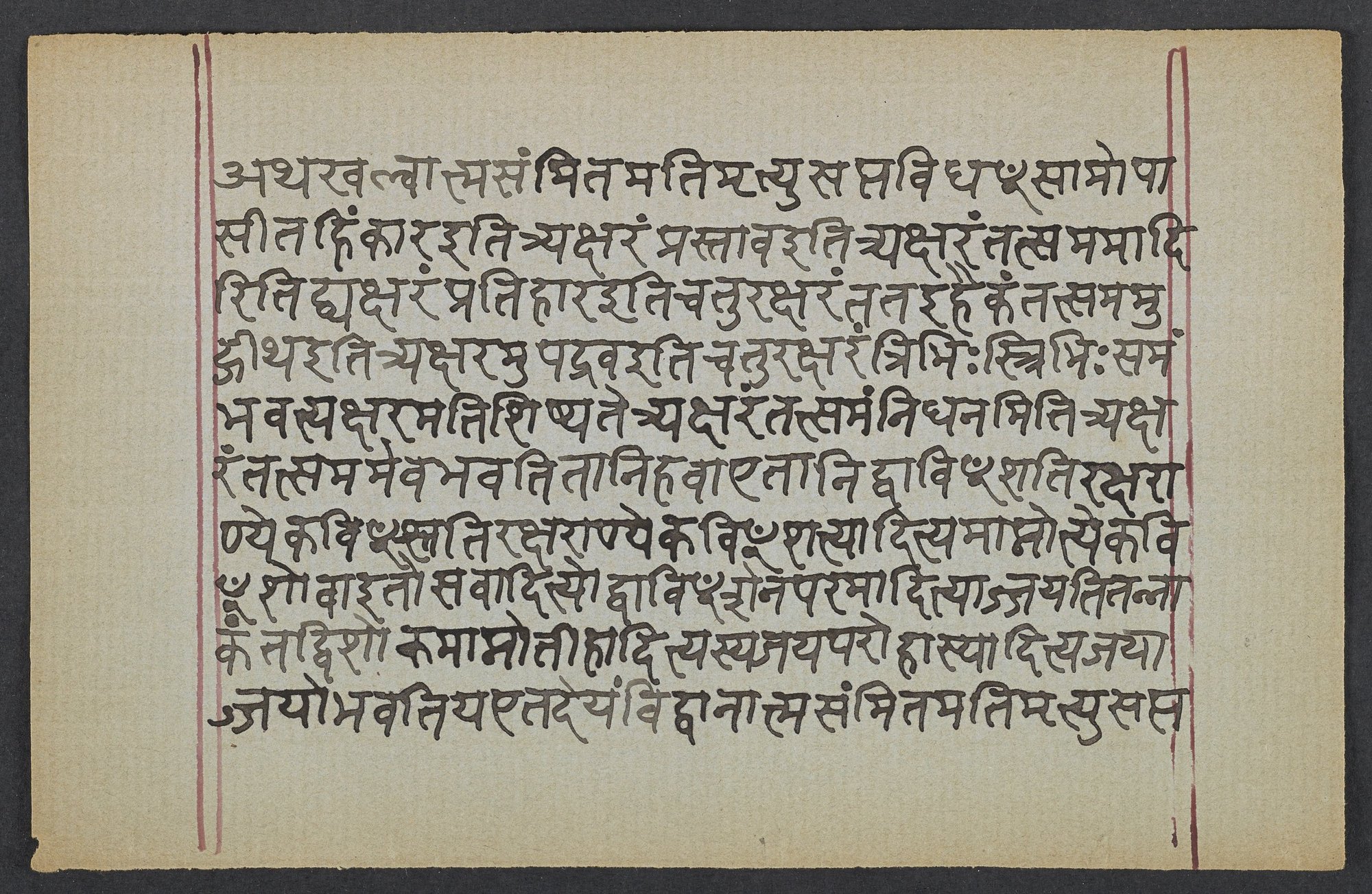
Penn Ms. Coll. 390 Item 945. fol. 15r begins ‹atha khalv ātmasaṃmitam atimṛtyu saptavidhaṃ sāmopāsīta› and ends ‹jayo bhavati ya etad evaṃ vidvān ātmasaṃmitam atimṛtyu sa› (first and last words read on the image, transliterated). The words were located in the GRETIL text by string matching and the page boundaries follow from them; readings and results are stored in data/sources/upanishads/mapping_945.json.
10.1atha khalv ātmasaṃmitam atimṛtyu saptavidhaṃ sāmopāsīta |
hiṅkāra iti tryakṣaram |
prastāva iti tryakṣaram |
tat samam ||
10.2ādir iti dvyakṣaram |
pratihāra iti caturakṣaram |
tata ihaikam |
tat samam ||
10.3udgītha iti tryakṣaram upadrava iti caturakṣaraṃ tribhis tribhiḥ samaṃ bhavati |
akṣaram atiśiṣyate tryakṣaram |
tat samam ||
10.4nidhanam iti tryakṣaram |
tat samam eva bhavati |
tāni ha vā etāni dvāviṃśatir akṣarāṇi ||
10.5ekaviṃśatyādityam āpnoti |
ekaviṃśo vā ito 'sāv ādityaḥ |
dvāviṃśena param ādityāj jayati |
tan nākam |
tad viśokam ||
10.1Next let a man meditate on the sevenfold Sâman which is uniform in itself and leads beyond death. The word hinkâra has three syllables, the word prastâva has three syllables: that is equal (sama).
10.2The word âdi (first, Om) has two syllables, the word pratihâra has four syllables. Taking one syllable from that over, that is equal (sama).
10.3The word udgîtha has three syllables, the word upadrava has four syllables. With three and three syllables it should be equal. One syllable being left over, it becomes trisyllabic. Hence it is equal.
10.4The word nidhana has three syllables, therefore it is equal. These make twenty-two syllables.
10.5With twenty-one syllables a man reaches the sun (and death), for the sun is the twenty-first from here; with the twenty-second he conquers what is beyond the sun: that is blessedness, that is freedom from grief.
Where on the image
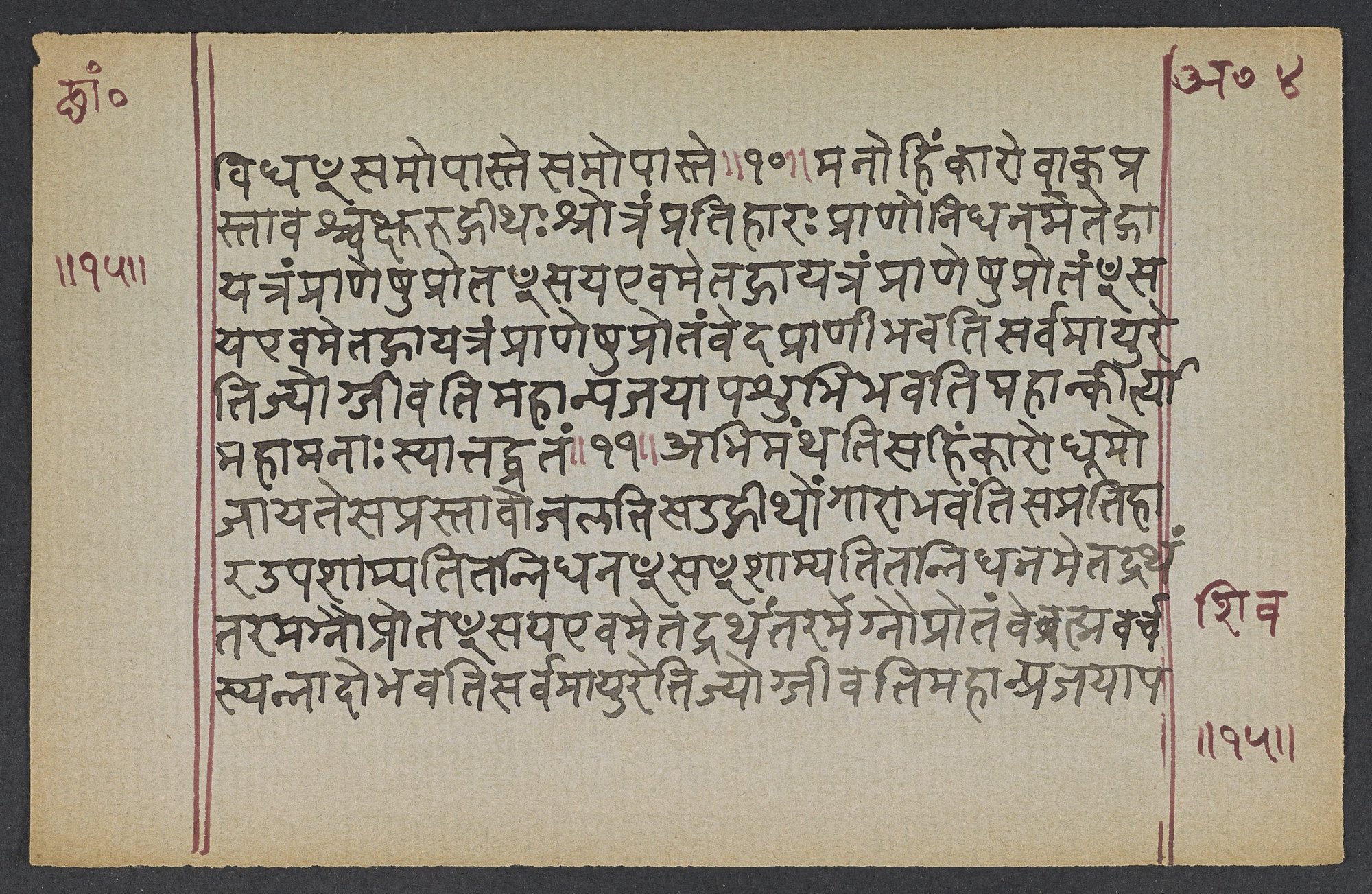
Penn Ms. Coll. 390 Item 945. fol. 15r begins ‹atha khalv ātmasaṃmitam atimṛtyu saptavidhaṃ sāmopāsīta› and ends ‹jayo bhavati ya etad evaṃ vidvān ātmasaṃmitam atimṛtyu sa›; fol. 15v begins ‹ptavidhaṃ sāmopāste sāmopāste mano hiṅkāro vāk› and ends ‹sarvam āyur eti jyog jīvati mahān prajayā pa› (first and last words read on the image, transliterated). The words were located in the GRETIL text by string matching and the page boundaries follow from them; readings and results are stored in data/sources/upanishads/mapping_945.json.
10.6āpnotīhādityasya jayam |
paro hāsyādityajayāj jayo bhavati ya etad evaṃ vidvān ātmasaṃmitam atimṛtyu saptavidhaṃ sāmopāste sāmopāste ||
11.1mano hiṅkāraḥ |
vāk prastāvaḥ |
cakṣur udgīthaḥ |
śrotraṃ pratihāraḥ |
prāṇo nidhanam |
etad gāyatraṃ prāṇeṣu protam ||
11.2sa ya evam etad gāyatraṃ prāṇeṣu protaṃ veda |
prāṇī bhavati |
sarvam āyur eti |
jyog jīvati |
mahān prajayā paśubhir bhavati |
mahān kīrtyā |
mahāmanāḥ syāt |
tad vratam ||
12.1abhimanthati sa hiṅkāraḥ |
dhūmo jāyate sa prastāvaḥ |
jvalati sa udgīthaḥ |
aṅgārā bhavanti sa pratihāraḥ |
upaśāmyati tan nidhanam |
saṃśāmyati tan nidhanam |
etad rathaṃtaram agnau protam ||
10.6He obtains here the victory over the sun (death), and there is a higher victory than the victory over the sun for him, who knowing this meditates on the sevenfold Sâman as uniform in itself, which leads beyond death, yea, which leads beyond death.
11.1The hinkâra is mind, the prastâva speech, the udgîtha sight, the pratihâra hearing, the nidhana breath. That is the Gâyatra Sâman, as interwoven in the (five) prânas.
11.2He who thus knows this Gâyatra interwoven in the prânas, keeps his senses, reaches the full life, he lives long, becomes great with children and cattle, great by fame. The rule of him who thus meditates on the Gâyatra is, "Be not high-minded."
12.1The hinkâra is, he rubs (the fire-stick); the prastâva, smoke rises; the udgîtha, it burns; the pratihâra, there are glowing coals; the nidhana, it goes down; the nidhana, it is gone out. This is the Rathantara Sâman as interwoven in fire.
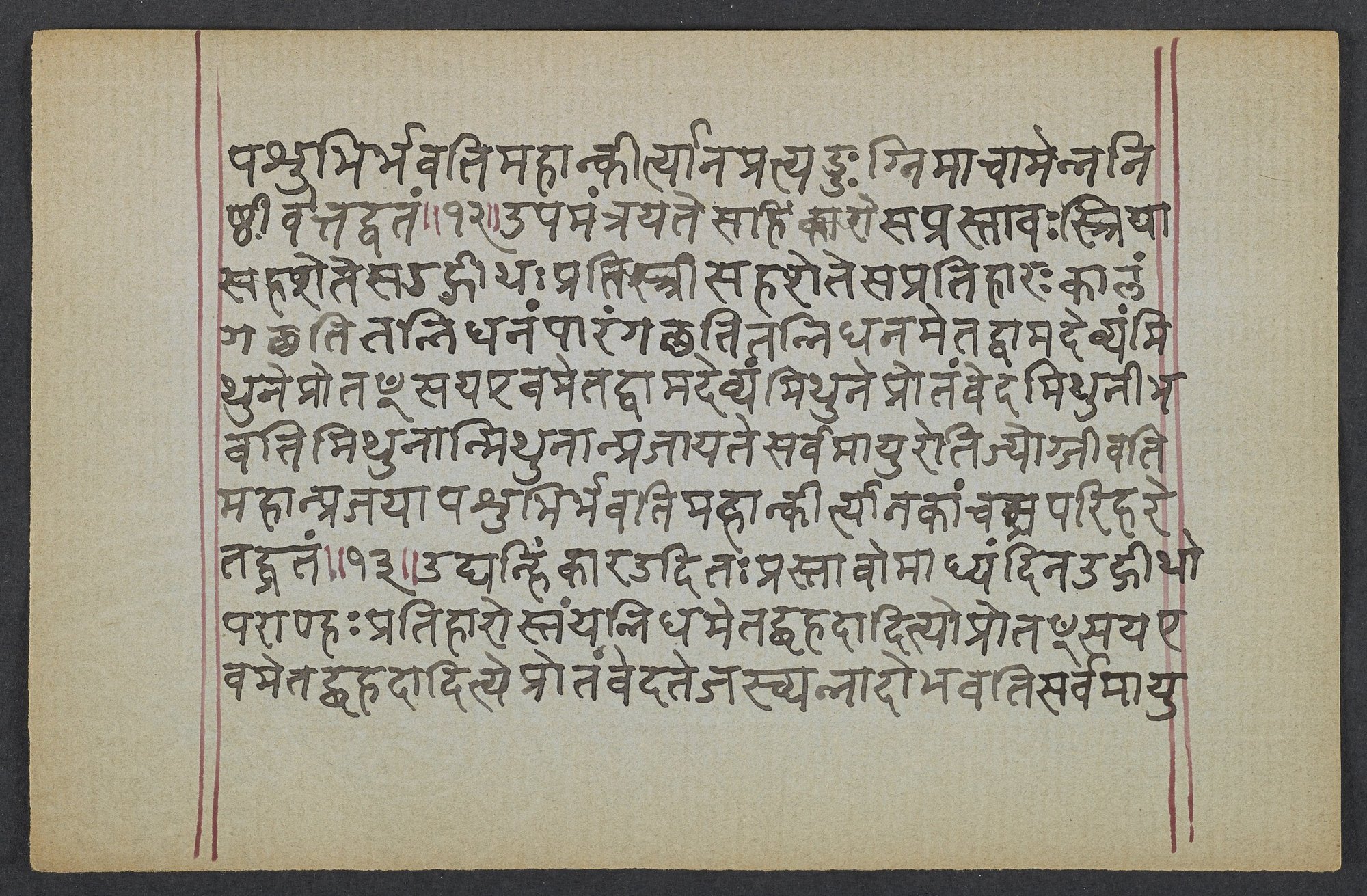
Where on the image
Penn Ms. Coll. 390 Item 945. fol. 15v begins ‹ptavidhaṃ sāmopāste sāmopāste mano hiṅkāro vāk› and ends ‹sarvam āyur eti jyog jīvati mahān prajayā pa›; fol. 16r begins ‹śubhir bhavati mahān kīrtyā na pratyaṅṅ agnim ācāmen na niṣṭhīvet› and ends ‹bṛhad āditye protaṃ veda tejasvy annādo bhavati sarvam āyu› (first and last words read on the image, transliterated). Notes: Müller divides khanda 2.13 into paragraphs differently from the Sanskrit edition; the whole khanda is given here with his own numbers. The words were located in the GRETIL text by string matching and the page boundaries follow from them; readings and results are stored in data/sources/upanishads/mapping_945.json.
12.2sa ya evam etad rathaṃtaram agnau protaṃ veda |
brahmavarcasy annādo bhavati |
sarvam āyur eti |
jyog jīvati |
mahān prajayā paśubhir bhavati |
mahān kīrtyā |
na pratyaṅṅ agnim ācāmen na niṣṭhīvet |
tad vratam ||
13.1upamantrayate sa hiṅkāraḥ |
jñapayate sa prastāvaḥ |
striyā saha śete sa udgīthaḥ |
prati strīṃ saha śete sa pratihāraḥ |
kālaṃ gacchati tan nidhanam |
pāraṃ gacchati tan nidhanam |
etad vāmadevyaṃ mithune protam ||
13.2sa ya evam etad vāmadevyaṃ mithune protaṃ veda |
mithunī bhavati |
mithunān mithunāt prajāyate |
sarvam āyur eti |
jyog jīvati |
mahān prajayā paśubhir bhavati |
mahān kīrtyā |
na kāṃcana pariharet |
tad vratam ||
14.1udyan hiṅkāraḥ |
uditaḥ prastāvaḥ |
madhyaṃdina udgīthaḥ |
aparāhṇaḥ pratihāraḥ |
astaṃ yan nidhanam |
etad bṛhad āditye protam ||
12.2He who thus knows this Rathantara interwoven in fire, becomes radiant and strong. He reaches the full life, he lives long, becomes great with children and cattle, great by fame. The rule is, 'Do not rinse the mouth or spit before the fire.'
13.1,2Next follows the Vâmadevya as interwoven in generation.
14.1Rising, the sun is the hinkâra, risen, he is the prastâva, at noon he is the udgîtha, in the afternoon he is the pratihâra, setting, he is the nidhana. That is the Brihat Sâman as interwoven in the sun.
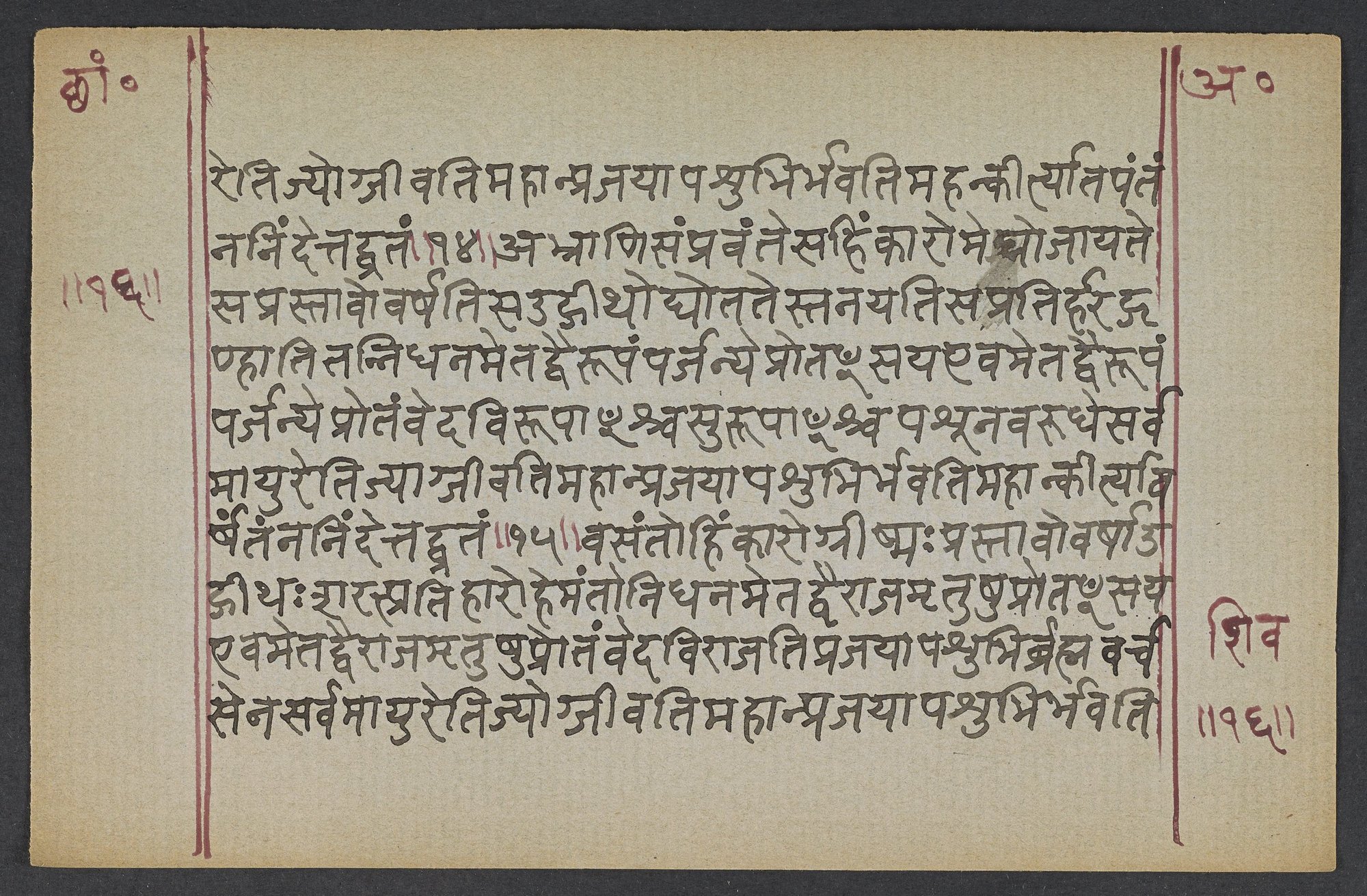
Where on the image
Penn Ms. Coll. 390 Item 945. fol. 16r begins ‹śubhir bhavati mahān kīrtyā na pratyaṅṅ agnim ācāmen na niṣṭhīvet› and ends ‹bṛhad āditye protaṃ veda tejasvy annādo bhavati sarvam āyu›; fol. 16v begins ‹r eti jyog jīvati mahān prajayā paśubhir bhavati mahān kīrtyā tapantaṃ na nindet› and ends ‹sarvam āyur eti jyog jīvati mahān prajayā paśubhir bhavati› (first and last words read on the image, transliterated). The words were located in the GRETIL text by string matching and the page boundaries follow from them; readings and results are stored in data/sources/upanishads/mapping_945.json.
14.2sa ya evam etad bṛhad āditye protaṃ veda |
tejasvy annādo bhavati |
sarvam āyur eti |
jyog jīvati |
mahān prajayā paśubhir bhavati |
mahān kīrtyā |
tapantaṃ na nindet |
tad vratam ||
15.1abhrāṇi saṃplavante sa hiṅkāraḥ |
megho jāyate sa prastāvaḥ |
varṣati sa udgīthaḥ |
vidyotate stanayati sa pratihāraḥ |
udgṛhṇāti tan nidhanam |
etad vairūpaṃ parjanye protam ||
15.2sa ya evam etad vairūpaṃ parjanye protaṃ veda |
virūpāṃś ca surūpaṃś ca paśūn avarundhe |
sarvam āyur eti |
jyog jīvati |
mahān prajayā paśubhir bhavati |
mahān kīrtyā |
varṣantaṃ na nindet |
tad vratam ||
16.1vasanto hiṅkāraḥ |
grīṣmaḥ prastāvaḥ |
varṣā udgīthaḥ |
śarat pratihāraḥ |
hemanto nidhanam |
etad vairājam ṛtuṣu protam ||
14.2He who thus knows the Brihat as interwoven in the sun, becomes refulgent and strong, he reaches the full life, he lives long, becomes great with children and cattle, great by fame. His rule is, 'Never complain of the heat of the sun.'
15.1The mists gather, that is the hinkâra; the cloud has risen, that is the prastâva; it rains, that is the udgîtha; it flashes and thunders, that is the pratihâra; it stops, that is the nidhana. That is the Vairûpa Sâman, as interwoven in Parganya, the god of rain.
15.2He who thus knows the Vairûpa as interwoven in Parganya, obtains all kinds of cattle (virûpa), he reaches the full life, he lives long, becomes great with children and cattle, great by fame. His rule is, 'Never complain of the rain.'
16.1The hinkâra is spring, the prastâva summer, the udgîtha the rainy season, the pratihâra autumn, the nidhana winter. That is the Vairâga Sâman, as interwoven in the seasons.
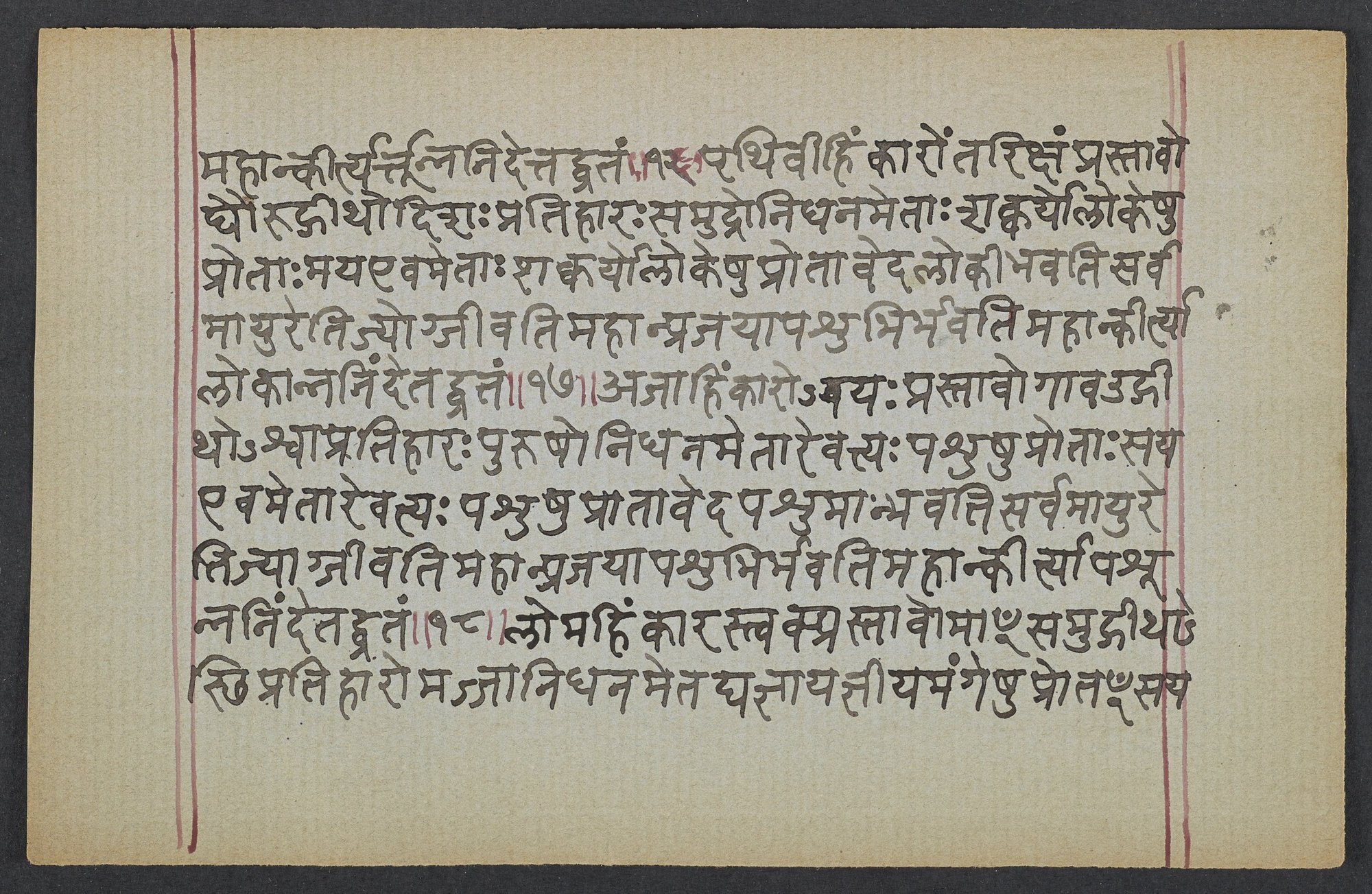
Where on the image
Penn Ms. Coll. 390 Item 945. fol. 16v begins ‹r eti jyog jīvati mahān prajayā paśubhir bhavati mahān kīrtyā tapantaṃ na nindet› and ends ‹sarvam āyur eti jyog jīvati mahān prajayā paśubhir bhavati›; fol. 17r begins ‹mahān kīrtyā lokān na nindet tad vratam pṛthivī hiṅkāraḥ› and ends ‹nidhanam etad yajñāyajñīyam aṅgeṣu protaṃ sa ya› (first and last words read on the image, transliterated). The words were located in the GRETIL text by string matching and the page boundaries follow from them; readings and results are stored in data/sources/upanishads/mapping_945.json.
16.2sa ya evam etad vairājam ṛtuṣu protaṃ veda |
virājati prajayā |
paśubhir brahmavarcasena |
sarvam āyur eti |
jyog jīvati |
mahān prajayā paśubhir bhavati |
mahān kīrtyā |
ṛtūn na nindet |
tad vratam ||
17.1pṛthivī hiṅkāraḥ |
antarikṣaṃ prastāvaḥ |
dyaur udgīthaḥ |
diśaḥ pratihāraḥ |
samudro nidhanam |
etāḥ śakvaryo lokeṣu protāḥ ||
17.2sa ya evam etāḥ śakvaryo lokeṣu protā veda |
lokī bhavati sarvam āyur eti |
jyog jīvati |
mahān prajayā paśubhir bhavati |
mahān kīrtyā |
lokān na nindet |
tad vratam ||
18.1ajā hiṅkāraḥ |
avayaḥ prastāvaḥ |
gāva udgīthaḥ |
aśvāḥ pratihāraḥ |
puruṣo nidhanam |
etā revatyaḥ paśuṣu protāḥ ||
18.2sa ya evam etā revatyaḥ paśuṣu protā veda |
paśumān bhavati |
sarvam āyur eti |
jyog jīvati |
mahān prajayā paśubhir bhavati |
mahān kīrtyā |
paśūn na nindet |
tad vratam ||
19.1loma hiṅkāraḥ |
tvak prastāvaḥ |
māṃsam udgīthaḥ |
asthi pratihāraḥ |
majjā nidhanam |
etad yajñāyajñīyam aṅgeṣu protam ||
16.2He who thus knows the Vairâga, as interwoven in the seasons, shines (virâgati) through children, cattle, and glory of countenance. He reaches the full life, he lives long, becomes great with children and cattle, great by fame. His rule is, 'Never complain of the seasons.'
17.1The hinkâra is the earth, the prastâva the sky, the udgîtha heaven, the pratihâra the regions, the nidhana the sea. These are the Sakvari Sâmans, as interwoven in the worlds.
17.2He who thus knows the Sakvaris, as interwoven in the worlds, becomes possessed, of the worlds, he reaches the full life, he lives long, becomes great with children and cattle, great by fame. His rule is, 'Never complain of the worlds.'
18.1The hinkâra is goats, the prastâva sheep, the udgîtha cows, the pratihâra horses, the nidhana man. These are the Revati Sâmans, as interwoven in animals.
18.2He who thus knows these Revatis, as interwoven in animals, becomes rich in animals, he reaches the full life, he lives long, becomes great with children and cattle, great by fame. His rule is, 'Never complain of animals.'
19.1The hinkâra is hair, the prastâva skin, the udgîtha flesh, the pratihâra bone, the nidhana marrow. That is the Yagñâyagñîya Sâman, as interwoven in the members of the body.
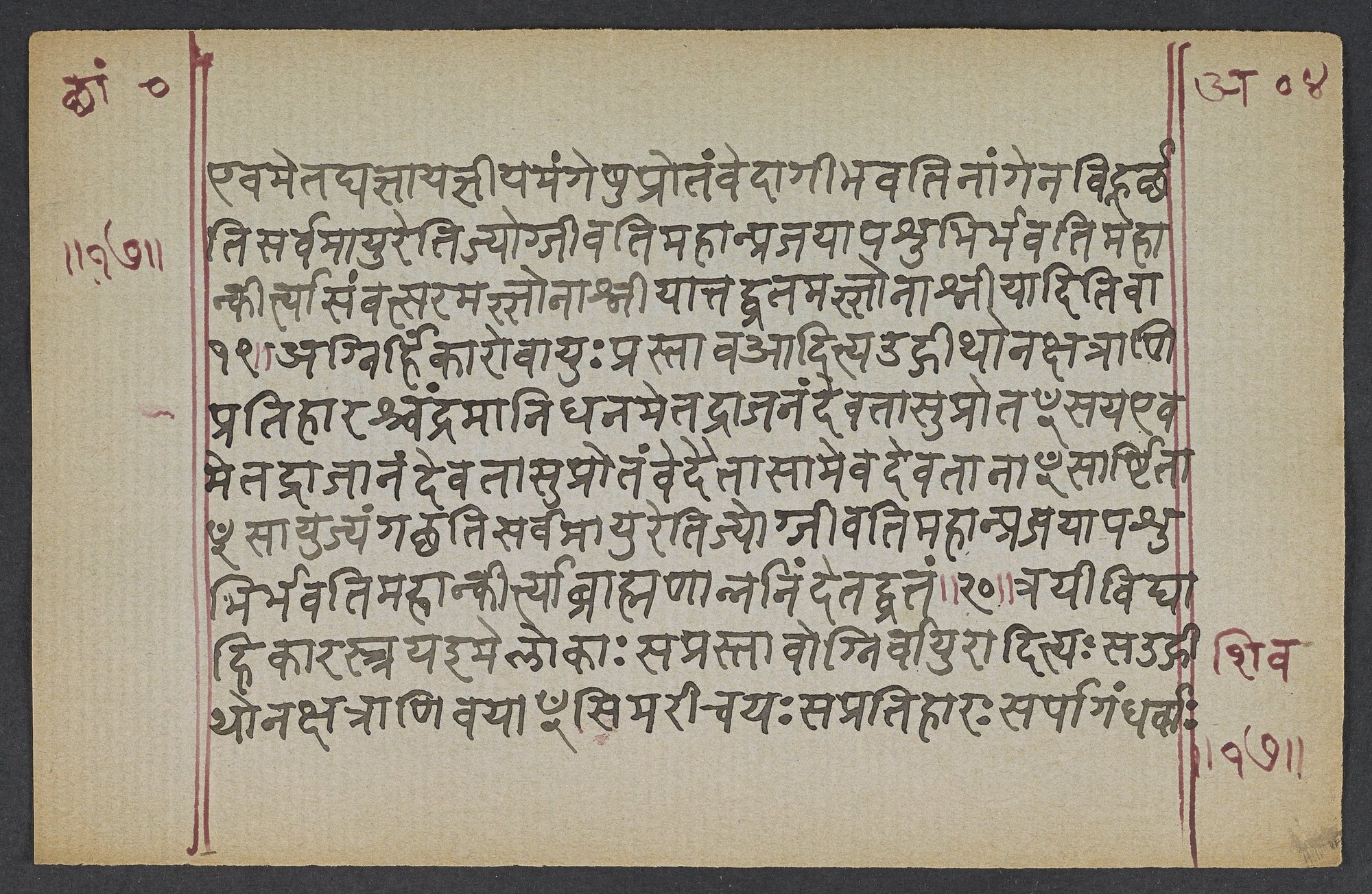
Where on the image
Penn Ms. Coll. 390 Item 945. fol. 17r begins ‹mahān kīrtyā lokān na nindet tad vratam pṛthivī hiṅkāraḥ› and ends ‹nidhanam etad yajñāyajñīyam aṅgeṣu protaṃ sa ya›; fol. 17v begins ‹evam etad yajñāyajñīyam aṅgeṣu protaṃ vedāṅgī bhavati› and ends ‹marīcayaḥ sa pratihāraḥ sarpā gandharvāḥ› (first and last words read on the image, transliterated). The words were located in the GRETIL text by string matching and the page boundaries follow from them; readings and results are stored in data/sources/upanishads/mapping_945.json.
19.2sa ya evam etad yajñāyajñīyam aṅgeṣu protaṃ veda |
aṅgī bhavati |
nāṅgena vihūrchati |
sarvam āyur eti |
jyog jīvati |
mahān prajayā paśubhir bhavati |
mahān kīrtyā |
saṃvatsaraṃ majjño nāśnīyāt |
tad vratam |
majjño nāśnīyād iti vā ||
20.1agnir hiṅkāraḥ |
vāyuḥ prastāvaḥ |
āditya udgīthaḥ |
nakṣatrāṇi pratihāraḥ |
candramā nidhanam |
etad rājanaṃ devatāsu protam ||
20.2sa ya evam etad rājanaṃ devatāsu protaṃ veda |
etāsām eva devatānāṃ salokatāṃ sarṣṭitāṃ sāyujyaṃ gacchati |
sarvam āyur eti |
jyog jīvati |
mahān prajayā paśubhir bhavati |
mahān kīrtyā |
brāhmaṇān na nindet |
tad vratam ||
19.2He who thus knows the Yagñâyagñîya, as interwoven in the members of the body, becomes possessed of strong limbs, he is not crippled in any limb, he reaches the full life, he lives long, becomes great with children and cattle, great by fame. His rule is, 'Do not eat marrow for a year,' or 'Do not eat marrow at all.'
20.1The hinkâra is fire, the prastâva air, the udgîtha the sun, the pratihâra the stars, the nidhana the moon. That is the Râgana Sâman, as interwoven in the deities.
20.2He who thus knows the Râgana, as interwoven in the deities, obtains the same world, the same happiness, the same company as the gods, he reaches the full life, he lives long, becomes great with children and cattle, great by fame. His rule is, 'Do not speak evil of the Brâhmanas.'
Where on the image
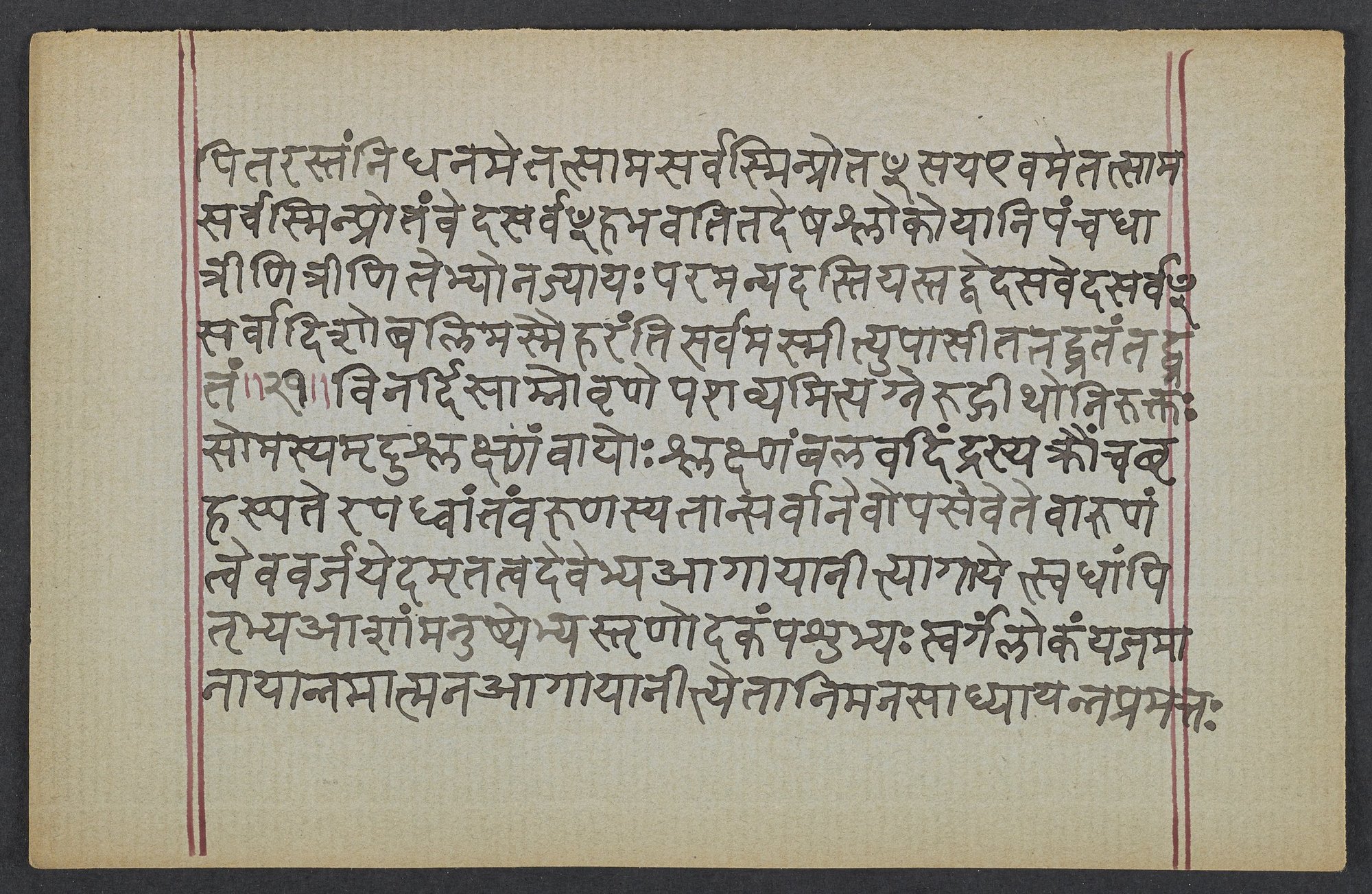
Penn Ms. Coll. 390 Item 945. fol. 17v begins ‹evam etad yajñāyajñīyam aṅgeṣu protaṃ vedāṅgī bhavati› and ends ‹marīcayaḥ sa pratihāraḥ sarpā gandharvāḥ›; fol. 18r begins ‹pitaras tan nidhanam etat sāma sarvasmin protaṃ› and ends ‹etāni manasā dhyāyann apramattaḥ› (first and last words read on the image, transliterated). The words were located in the GRETIL text by string matching and the page boundaries follow from them; readings and results are stored in data/sources/upanishads/mapping_945.json.
21.1trayī vidyā hiṅkāraḥ |
traya ime lokāḥ sa prastāvaḥ |
agnir vāyur ādityaḥ sa udgīthaḥ |
nakṣatrāṇi vayāṃsi marīcayaḥ sa pratihāraḥ |
sarpā gandharvāḥ pitaras tan nidhanam |
etat sāma sarvasmin protam ||
21.2sa ya evam etat sāma sarvasmin protaṃ veda sarvaṃ ha bhavati ||
21.3tad eṣa ślokaḥ |
yāni pañcadhā trīṇi trīṇi |
tebhyo na jyāyaḥ param anyad asti ||
21.4yas tad veda sa veda sarvam |
sarvā diśo balim asmai haranti |
sarvam asmīty upāsita |
tad vrataṃ tad vratam ||
22.1vinardi sāmno vṛṇe paśavyam ity agner udgīthaḥ |
aniruktaḥ prajāpateḥ |
niruktaḥ somasya |
mṛdu ślakṣṇaṃ vāyoḥ |
ślakṣṇaṃ balavad indrasya |
krauñcaṃ bṛhaspateḥ |
apadhvāntaṃ varuṇasya |
tān sarvān evopaseveta |
vāruṇaṃ tv eva varjayet ||
21.1The hinkâra is the threefold knowledge, the prastâva these three worlds, the udgîtha Agni (fire), Vâyu (air), and Âditya (sun), the pratihâra the stars, the birds, and the rays, the nidhana the serpents, Gandharvas, and fathers. That is the Sâman, as interwoven in everything.
21.2He who thus knows this Sâman, as interwoven in everything, he becomes everything.
21.3And thus it is said in the following verse: 'There are the fivefold three (the three kinds of sacrificial knowledge, the three worlds &c. in their fivefold form, i.e. as identified with the hinkâra, the prastâva, &c), and the other forms of the Sâman. Greater than these there is nothing else besides.'
21.4He who knows this, knows everything. All regions offer him gifts. His rule is, 'Let him meditate (on the Sâman), knowing that he is everything, yea, that he is everything.'
22.1The udgîtha, of which a poet said, I choose the deep sounding note of the Sâman as good for cattle, belongs to Agni; the indefinite note belongs to Pragâpati, the definite note to Soma, the soft and smooth note to Vâyu, the smooth and strong note to Indra, the heron-like note to Brihaspati, the dull note to Varuna. Let a man cultivate all of these, avoiding, however, that of Varuna.
Where on the image
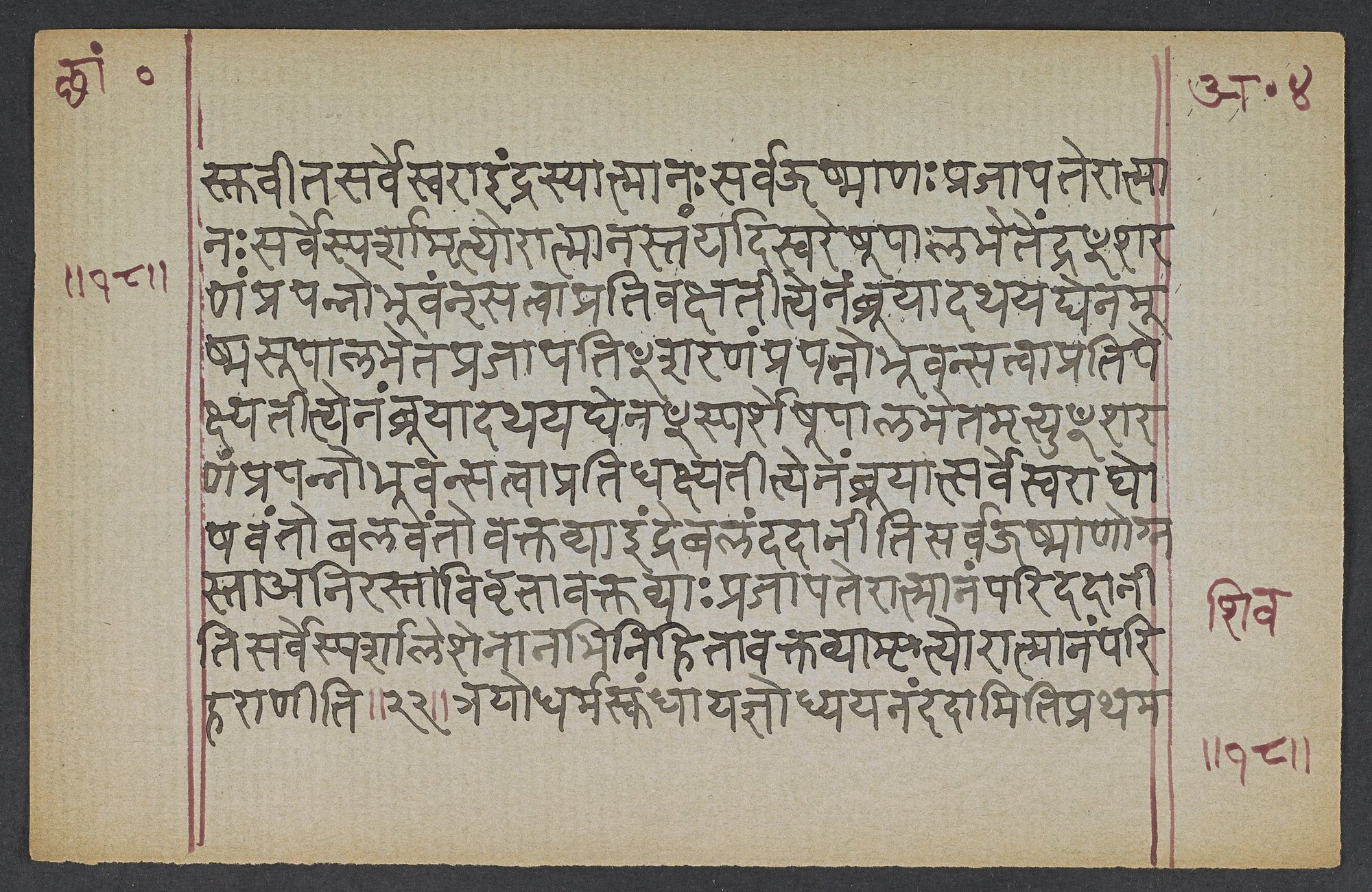
Penn Ms. Coll. 390 Item 945. fol. 18r begins ‹pitaras tan nidhanam etat sāma sarvasmin protaṃ› and ends ‹etāni manasā dhyāyann apramattaḥ›; fol. 18v begins ‹stuvīta sarve svarā indrasyātmānaḥ sarva ūṣmāṇaḥ prajāpater ātmānaḥ› and ends ‹trayo dharmaskandhā yajño 'dhyayanaṃ dānam iti prathamas› (first and last words read on the image, transliterated). The words were located in the GRETIL text by string matching and the page boundaries follow from them; readings and results are stored in data/sources/upanishads/mapping_945.json.
22.2amṛtatvaṃ devebhya āgāyānīty āgāyet |
svadhāṃ pitṛbhya āśāṃ manuṣyebhyas tṛṇodakaṃ paśubhyaḥ svargaṃ lokaṃ yajamānāyānnam ātmana āgāyānīty etāni manasā dhyāyann apramattaḥ stuvīta ||
22.3sarve svarā indrasyātmānaḥ |
sarva ūṣmāṇaḥ prajāpater ātmānaḥ |
sarve sparśā mṛtyor ātmānaḥ |
taṃ yadi svareṣūpālabheta |
indraṃ śaraṇaṃ prapanno 'bhūvaṃ sa tvā prati vakṣyatīty enaṃ brūyāt ||
22.4atha yady enam ūṣmāsūpālabheta |
prajāpatiṃ śaraṇaṃ prapanno 'bhūvaṃ sa tvā prati pekṣyatīty enaṃ brūyāt |
atha yady enaṃ sparśeṣūpālabheta |
mṛtyuṃ śaraṇaṃ prapanno 'bhūvaṃ sa tvā prati dhakṣyatīty enaṃ brūyāt ||
22.5sarve svarā ghoṣavanto balavanto vaktavyā indre balaṃ dadānīti |
sarva ūṣmāṇo 'grastā anirastā vivṛtā vaktavyāḥ prajāpater ātmānaṃ paridadānīti |
sarve sparśā leśenānabhinihitā vaktavyā mṛtyor ātmānaṃ pariharāṇīti ||
22.2Let a man sing, wishing to obtain by his song immortality for the Devas. 'May I obtain by my song oblations (svadhâ) for the fathers, hope for men, fodder and water for animals, heaven for the sacrificer, food for myself,' thus reflecting on these in his mind, let a man (Udgâtri priest) sing praises, without making mistakes in pronunciation, &c.
22.3All vowels (svara) belong to Indra, all sibilants (ûshman) to Pragâpati, all consonants (sparsa) to Mrityu (death). If somebody should reprove him for his vowels, let him say, 'I went to Indra as my refuge (when pronouncing my vowels): he will answer thee.'
22.4And if somebody should reprove him for his sibilants, let him say, 'I went to Pragâpati as my refuge: he will smash thee.' And if somebody should reprove him for his consonants, let him say, 'I went to Mrityu as my refuge: he will reduce thee to ashes.'
22.5All vowels are to be pronounced with voice (ghosha) and strength (bala), so that the Udgâtri may give strength to Indra. All sibilants are to be pronounced, neither as if swallowed (agrasta), nor as if thrown out (nirasta), but well opened (vivrita), so that the Udgâtri may give himself to Pragâpati. All consonants are to be pronounced slowly, and without crowding them together, so that the Udgâtri may withdraw himself from Mrityu.
Where on the image
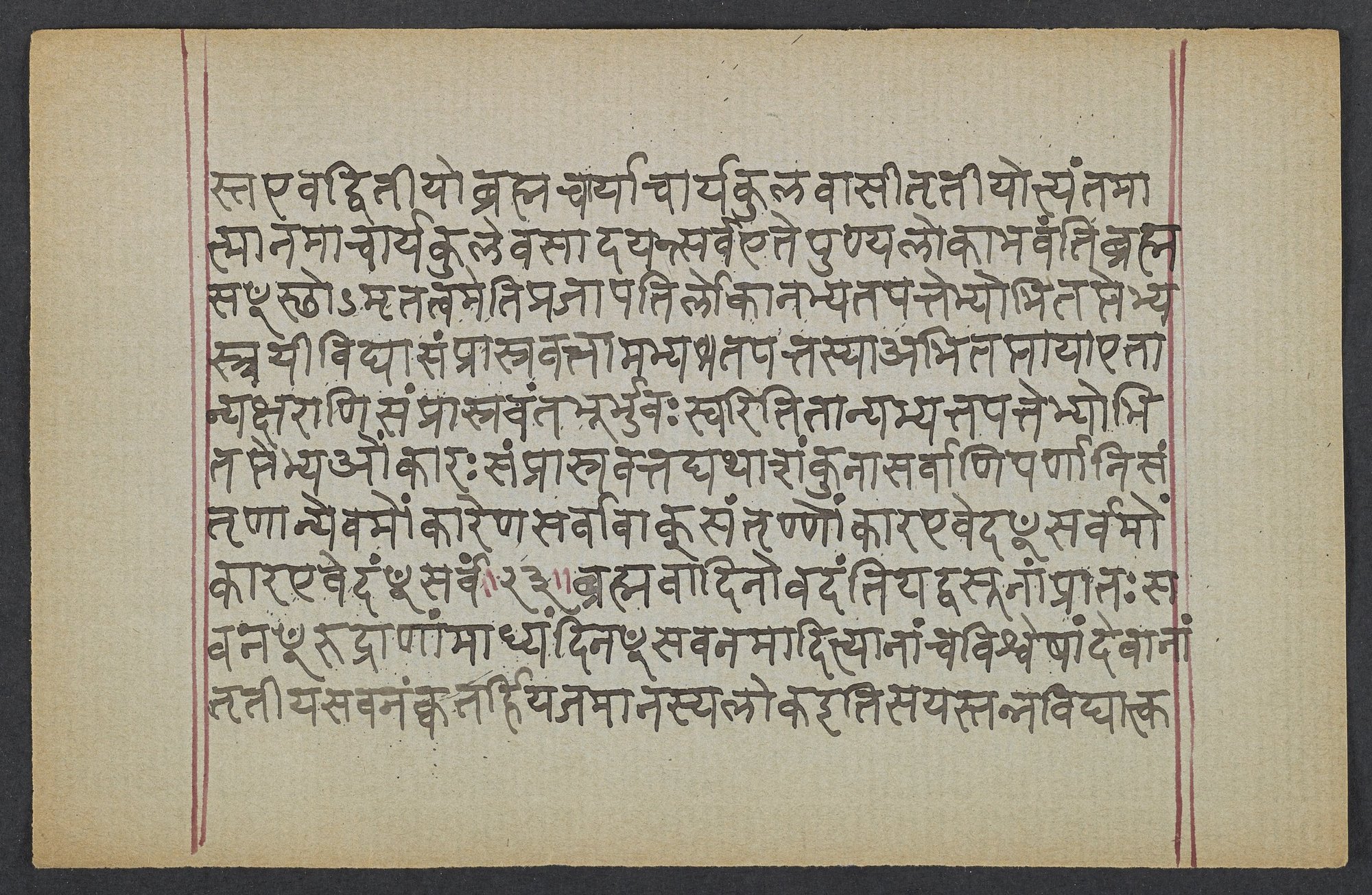
Penn Ms. Coll. 390 Item 945. fol. 18v begins ‹stuvīta sarve svarā indrasyātmānaḥ sarva ūṣmāṇaḥ prajāpater ātmānaḥ› and ends ‹trayo dharmaskandhā yajño 'dhyayanaṃ dānam iti prathamas›; fol. 19r begins ‹tapa eva dvitīyo brahmacāryācāryakulavāsī tṛtīyo› and ends ‹tṛtīyasavanaṃ kva tarhi yajamānasya loka iti sa yas taṃ na vidyāt ka› (first and last words read on the image, transliterated). Notes: Müller divides khanda 2.23 into paragraphs differently from the Sanskrit edition; the whole khanda is given here with his own numbers. The words were located in the GRETIL text by string matching and the page boundaries follow from them; readings and results are stored in data/sources/upanishads/mapping_945.json.
23.1trayo dharmaskandhāḥ |
yajño 'dhyayanaṃ dānam iti prathamaḥ |
tapa eva dvitīyaḥ |
brahmacāryācāryakulavāsī tṛtīyo 'tyantam ātmānam ācāryakule 'vasādayan |
sarva ete puṇyalokā bhavanti |
brahmasaṃstho 'mṛtatvam eti ||
23.2prajāpatir lokān abhyatapat |
tebhyo 'bhitaptebhyas trayī vidyā saṃprāsravat |
tām abhyatapat |
tasyā abhitaptāyā etāny akṣarāṇi saṃprasrvanta bhūr bhuvaḥ svar iti ||
23.3tāny abhyatapat |
tebhyo 'bhitaptebhya oṃkāraḥ saṃprāsravat |
tad yathā śaṅkunā sarvāṇi parṇāni saṃtṛṇṇāny evam oṃkāreṇa sarvā vāk saṃtṛṇṇā |
oṃkāra evedaṃ sarvam oṃkāra eva idaṃ sarvam ||
24.1brahmavādino vadanti |
yad vasūnāṃ prātaḥsavanam |
rudrāṇāṃ mādhyaṃdinaṃ savanam |
ādityānāṃ ca viśveṣāṃ ca devānāṃ tṛtīyasavanam ||
23.1There are three branches of the law. Sacrifice, study, and charity are the first,
23.2Austerity the second, and to dwell as a Brahmakârin in the house of a tutor, always mortifying the body in the house of a tutor, is the third. All these obtain the worlds of the blessed; but the Brahmasamstha alone (he who is firmly grounded in Brahman) obtains immortality.
23.3Pragâpati brooded on the worlds. From them, thus brooded on, the threefold knowledge (sacrifice) issued forth. He brooded on it, and from it, thus brooded on, issued the three syllables, Bhûh, Bhuvah, Svah.
23.4He brooded on them, and from them, thus brooded on, issued the Om. As all leaves are attached to a stalk, so is all speech (all words) attached to the Om (Brahman). Om is all this, yea, Om is all this.
24.1The teachers of Brahman (Veda) declare, as the Prâtah-savana (morning-oblation) belongs to the Vasus, the Mâdhyandina-savana (noon-libation) to the Rudras, the third Savana (evening-libation) to the Âdityas and the Visve Devas,
Where on the image
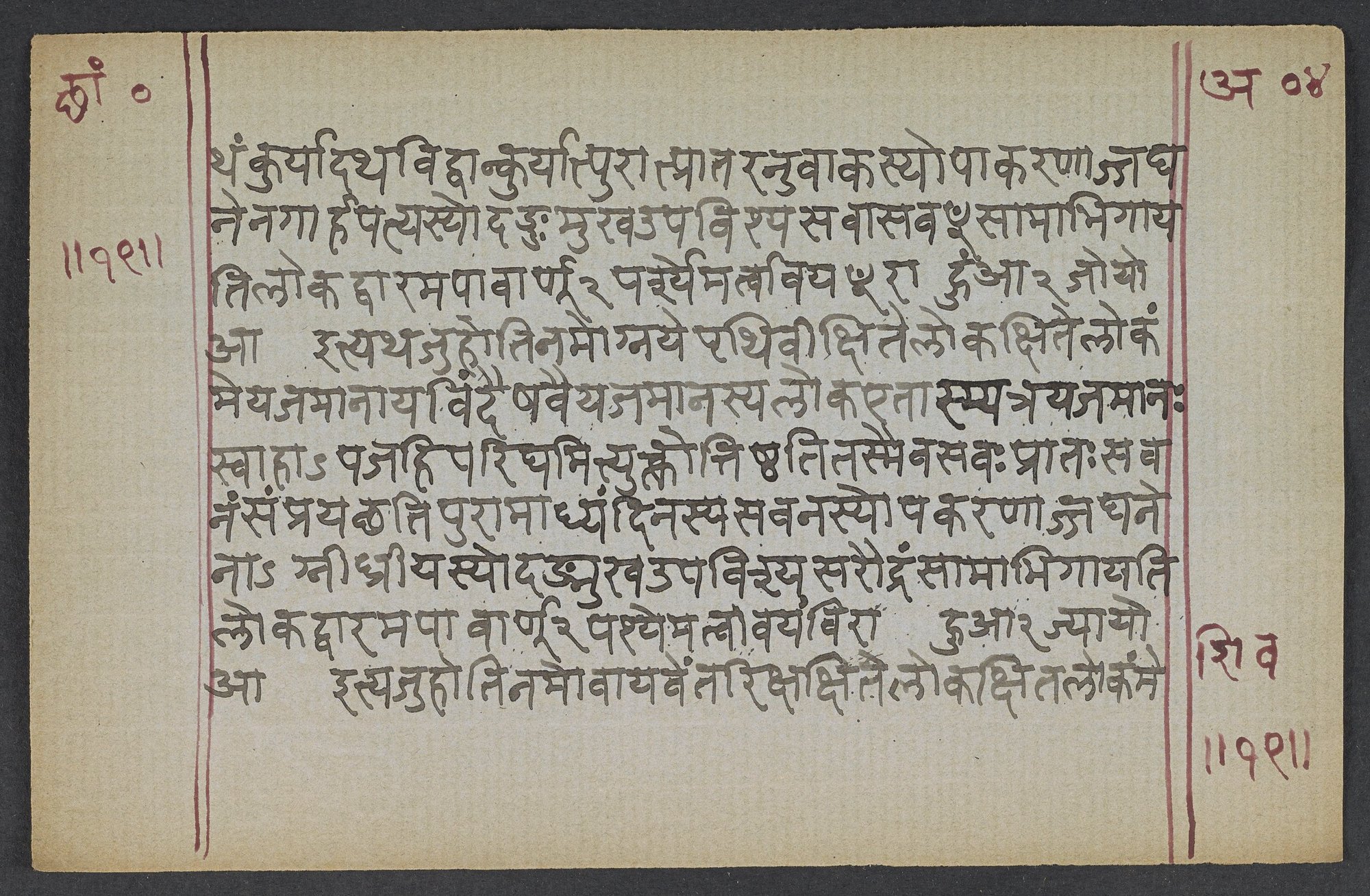
Penn Ms. Coll. 390 Item 945. fol. 19r begins ‹tapa eva dvitīyo brahmacāryācāryakulavāsī tṛtīyo› and ends ‹tṛtīyasavanaṃ kva tarhi yajamānasya loka iti sa yas taṃ na vidyāt ka›; fol. 19v begins ‹thaṃ kuryād atha vidvān kuryāt purā prātaranuvākasyopākaraṇāj jaghanena gārhapatyasya› and ends ‹namo vāyave 'ntarikṣakṣite lokakṣite lokaṃ me› (first and last words read on the image, transliterated). The words were located in the GRETIL text by string matching and the page boundaries follow from them; readings and results are stored in data/sources/upanishads/mapping_945.json.
24.2kva tarhi yajamānasya loka iti |
sa yas taṃ na vidyāt kathaṃ kuryāt |
atha vidvān kuryāt ||
24.3purā prātaranuvākasyopākaraṇāj jaghanena gārhapatyasyodāṅmukha upaviśya sa vāsavaṃ sāmābhigāyati ||
24.4lo 3 kadvāram apāvā 3 rṇū 33 |
paśyema tvā vayaṃ rā 33333 hu 3 m ā 33 jyā 3 yo 3 ā 32111 iti ||
24.5atha juhoti |
namo 'gnaye pṛthivīkṣite lokakṣite |
lokaṃ me yajamānāya vinda |
eṣa vai yajamānasya lokaḥ |
etā asmi ||
24.6atra yajamānaḥ parastād āyuṣaḥ svāhā |
apajahi parigham ity uktvottiṣṭhati |
tasmai vasavaḥ prātaḥsavanaṃ saṃprayacchanti ||
24.7purā mādhyandinasya savanasyopākaraṇāj jaghanenāgnīdhrīyasyodaṅmukha upaviśya sa raudraṃ sāmābhigāyati ||
24.8lo 3 kadvāramapāvār 3 ṇū 33 |
paśyema tvā vayaṃ vairā 33333 hu 3 m ā 33 jyā 3 yo 3 ā 32111 iti ||
24.2Where then is the world of the sacrificer? He who does not know this, how can he perform the sacrifice? He only who knows, should perform it.
24.3Before the beginning of the Prâtaranuvâka (matin-chant), the sacrificer, sitting down behind the household altar (gârhapatya), and looking towards the north, sings the Sâman, addressed to the Vasus:
24.4'Open the door of the world (the earth), let us see thee, that we may rule (on earth).'
24.5Then he sacrifices, saying: 'Adoration to Agni, who dwells on the earth, who dwells in the world! Obtain that world for me, the sacrificer! That is the world for the sacrificer!'
24.6'I (the sacrificer) shall go thither, when this life is over. Take this! (he says, in offering the libation.) Cast back the bolt!' Having said this, he rises. For him the Vasus fulfil the morning-oblation.
24.7Before the beginning of the Mâdhyandinasavana, the noon-oblation, the sacrificer, sitting down behind the Âgnidhrîya altar, and looking towards the north, sings the Sâman, addressed to the Rudras:
24.8'Open the door of the world (the sky), let us see thee, that we may rule wide (in the sky).'
Where on the image
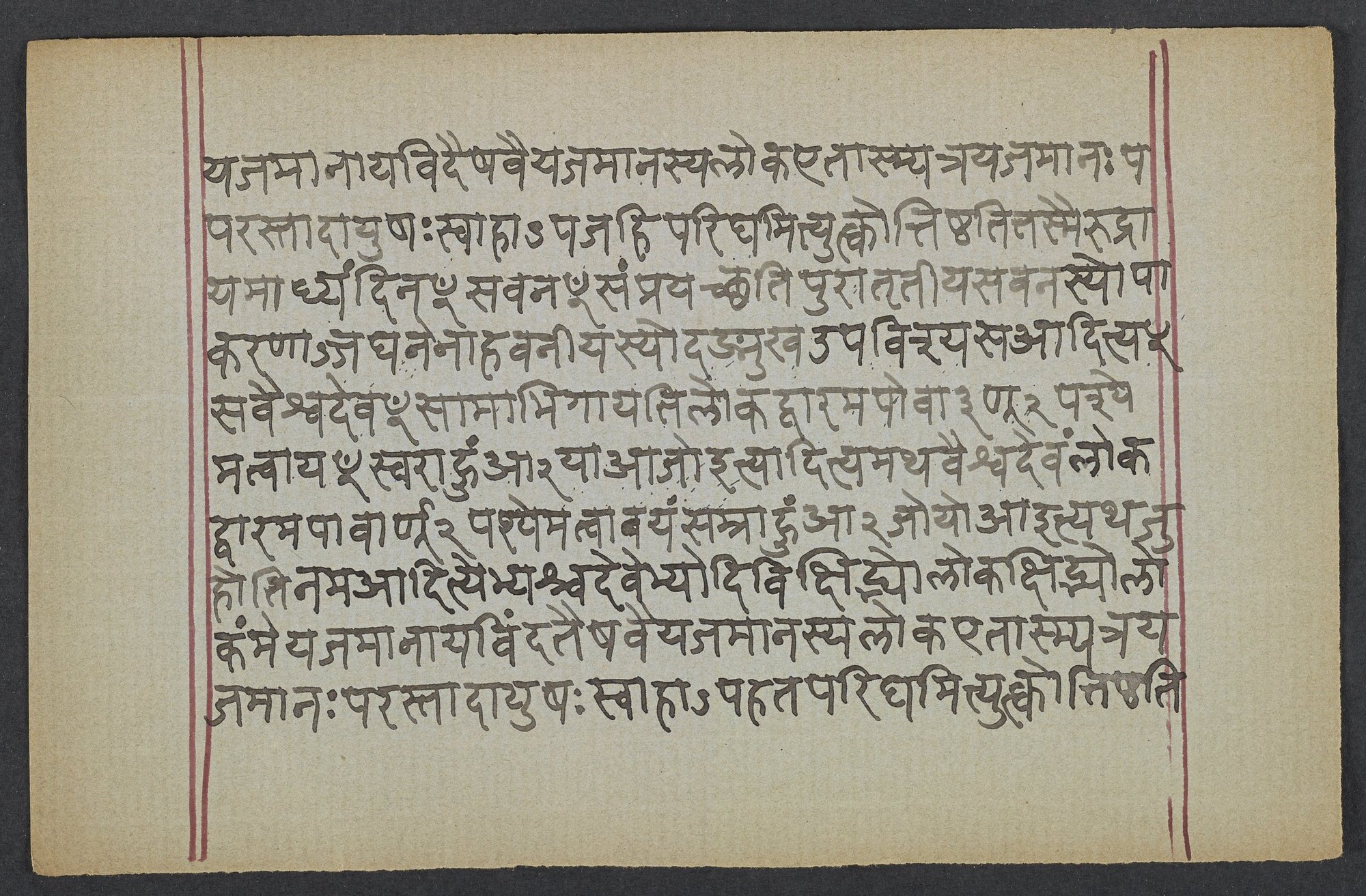
Penn Ms. Coll. 390 Item 945. fol. 19v begins ‹thaṃ kuryād atha vidvān kuryāt purā prātaranuvākasyopākaraṇāj jaghanena gārhapatyasya› and ends ‹namo vāyave 'ntarikṣakṣite lokakṣite lokaṃ me›; fol. 20r begins ‹yajamānāya vinda eṣa vai yajamānasya loka etāsmi› and ends ‹yajamānaḥ parastād āyuṣaḥ svāhāpahata parigham ity uktvottiṣṭhati› (first and last words read on the image, transliterated). The words were located in the GRETIL text by string matching and the page boundaries follow from them; readings and results are stored in data/sources/upanishads/mapping_945.json.
24.9atha juhoti |
nāmo vāyave 'ntarikṣakṣite lokakṣite |
lokaṃ me yajamānāya vinda |
eṣa vai yajamānasya lokaḥ |
etāsmi ||
24.10atra yajamānaḥ parastād āyuṣaḥ svāhā |
apajahi parigham ity uktvottiṣṭhati |
tasmai rudrā mādhyandinaṃ savanaṃ saṃprayacchanti ||
24.11purā tṛtīyasavanasyopākaraṇāj jaghanenāhavanīyasyodaṅmukha upaviśya sa ādityaṃ sa vaiśvadevaṃ sāmābhigāyati ||
24.12lo 3 kadvāramapāvā 3 rṇū33 |
paśyema tvā vayaṃ svārā 33333 hu3m, ā 33 jyā 3 yo 3 ā 32111 ity ādityam ||
24.13atha vaiśvadevam |
lo3kadvāramapāvā3rṇū33 |
paśyema tvā vayaṃ sāmrā 33333 hu3m ā 33 jyā 3 yo 3 ā 32111 iti ||
24.14atha juhoti |
nama ādityebhyaś ca viśvebhyaś ca devebhyo divikṣidbhyo lokakṣidbhyaḥ |
lokaṃ me yajamānāya vindata ||
24.15eṣa vai yajamānasya lokaḥ |
etāsmy atra yajamānaḥ parastād āyuṣaḥ svāhā |
apahata parigham ity uktvottiṣṭhati ||
24.9Then he sacrifices, saying: 'Adoration to Vâyu (air), who dwells in the sky, who dwells in the world. Obtain that world for me, the sacrificer! That is the world Tor the sacrificer!'
24.10'I (the sacrificer) shall go thither, when this life is over. Take this! Cast back the bolt!' Having said this, he rises. For him the Rudras fulfil the noon-oblation.
24.11Before the beginning of the third oblation, the sacrificer, sitting down behind the Âhavanîya altar, and looking towards the north, sings the Sâman, addressed to the Âdityas and Visve Devas:
24.12'Open the door of the world (the heaven), let us see thee, that we may rule supreme (in heaven).' This is addressed to the Âdityas.
24.13Next the Sâman addressed to the Visve Devas: 'Open the door of the world (heaven), let us see thee, that we may rule supreme (in heaven).'
24.14Then he sacrifices, saying: 'Adoration to the Âdityas and to the Visve Devas, who dwell in heaven, who dwell in the world. Obtain that world for me, the sacrificer!'
24.15'That is the world for the sacrificer! I (the sacrificer) shall go thither, when this life is over. Take this! Cast back the bolt!' Having said this, he rises.
Where on the image
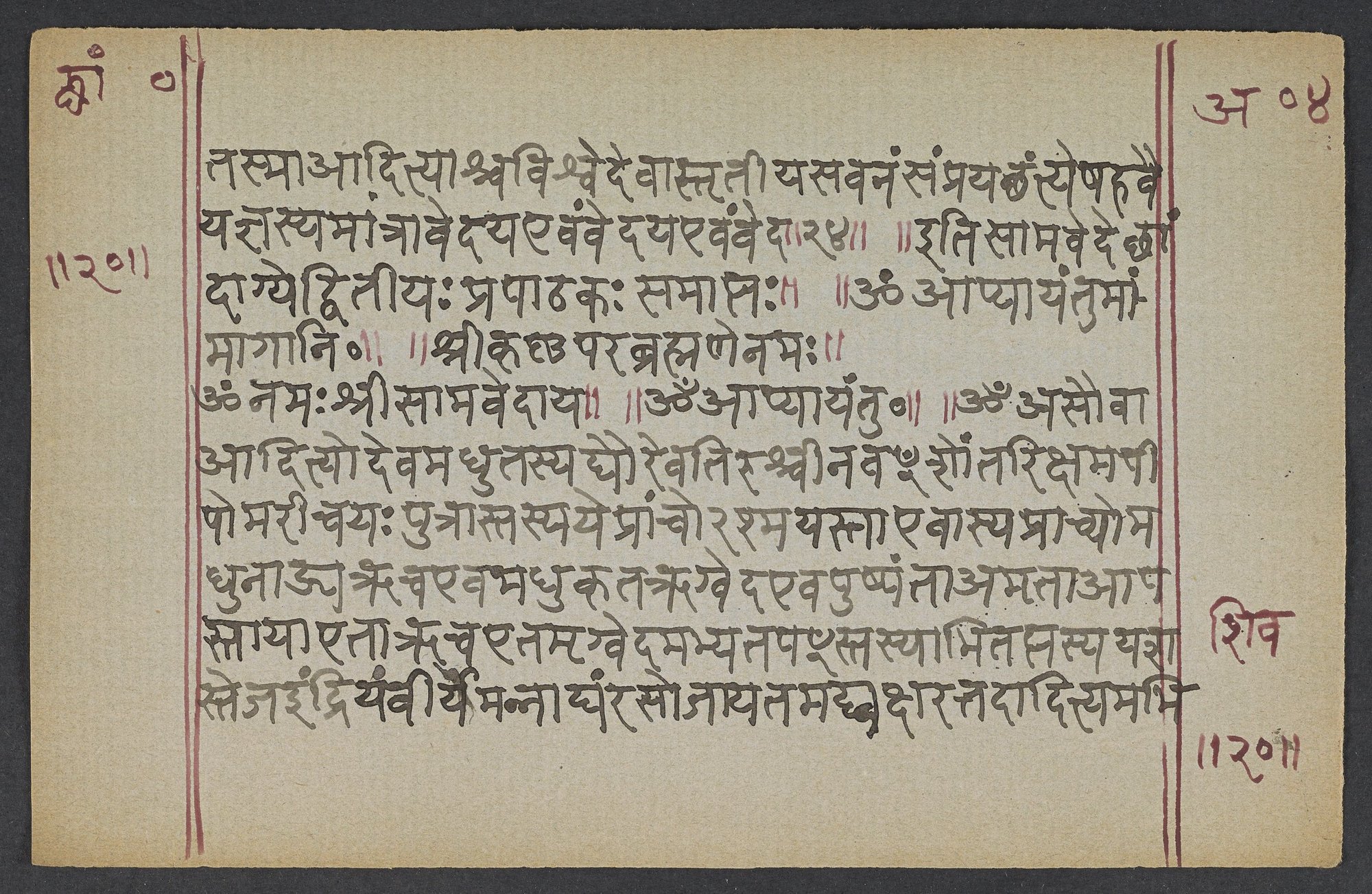
Penn Ms. Coll. 390 Item 945. fol. 20v begins ‹tasmā ādityāś ca viśve ca devās tṛtīyasavanaṃ saṃprayacchanty eṣa ha vai› and ends ‹yajñasya mātrāṃ veda ya evaṃ veda› (first and last words read on the image, transliterated). The words were located in the GRETIL text by string matching and the page boundaries follow from them; readings and results are stored in data/sources/upanishads/mapping_945.json.
24.16tasmā ādityāś ca viśve ca devās tṛtīyasavanaṃ saṃprayacchanti |
eṣa ha vai yajñasya mātrāṃ veda ya evaṃ veda ya evaṃ veda ||
24.16For him the Âdityas and the Visve Devas fulfil the third oblation. He who knows this, knows the full measure of the sacrifice, yea, he knows it.
Notes
- Sanskrit: GRETIL, Chandogyopanisad with the commentary ascribed to Samkara, mula text only (input by the Sansknet project). Paragraph numbers (khanda.paragraph) follow the edition. Three legacy encoding artifacts in GRETIL chapter 2 ('saptavidh.am', 'brahmavarcasy:', 'tejasvy:') are normalized.
- English: F. Max Müller, 'Khandogya-upanishad', The Upanishads part I, Sacred Books of the East 1 (1879), from the proofread English Wikisource transcription; footnotes are not reproduced. Where Müller divides a khanda into a different number of paragraphs than the Sanskrit edition, the whole khanda stands in one section and keeps his numbers. In other khandas his paragraph breaks sometimes fall a clause earlier or later than the Sanskrit ones.
- Transcription slips corrected to the printed page: 1.9.2 'udîttha' (printed udgîtha), 3.16.2 'sacrifices' (sacrificer,), 4.6.1 'toward' (towards), 7.25.1 'alt' (all); the stray heading 'Elventh Khanda' inside 2.10.6 is removed. 1.2.1 'Whent he' is a misprint in the book itself and is kept as printed.
- The manuscript readings differ from the edition in places; the Sanskrit shown is the edition text.
Cite
Sources
- Source: Penn Ms. Coll. 390 Item 945 (OPenn, public domain) + GRETIL Sanskrit + F. Max Müller (1879) English (holding institution)
- Critical edition: GRETIL Sanskrit e-texts (Isa, Katha, Prasna, Mandukya, Aitareya, Taittiriya, Svetasvatara, Chandogya); Nirnaya Sagar edition of 1925, transcribed (Kena, Mundaka)
← previous · → next · v cycle view · l back to library