Svetasvatara Upanishad
Introduction
The Svetasvatara Upanishad belongs to the Black Yajurveda and is named after the sage Svetasvatara, who is said in its last chapter to have taught it. In six chapters (adhyayas) of verse it asks what the cause of the world is, and answers with a personal god, Rudra or Siva, the lord who rules nature (prakriti) as a magician rules his art (maya) and who is known in the heart through meditation and yoga. Its second chapter gives the earliest description of yogic practice in the Upanishads; its last verses speak of devotion (bhakti) to God and to the teacher. Several verses are shared with the Katha and Mundaka Upanishads and with the Vedic hymns.
The page images come from University of Pennsylvania Libraries, Ms. Coll. 390 Item 1203, a paper manuscript of nine leaves (11 x 25 cm) in Devanagari, 9 lines to a side, undated (catalogued 18th or 19th century). Mistakes are blacked out and a few omitted words are added in the margins. The scribe numbers most verses and closes each adhyaya with a colophon; his numbers run behind the edition's in some chapters, so the verses were identified by their words. He abbreviates four verses that occur elsewhere (3.14, 3.15, 4.6, 4.8) to their first and last words. Each section below holds the verses of one adhyaya that end on one page; a verse that begins on the previous page is shown with both pages.
How was this verified? (Provenance)
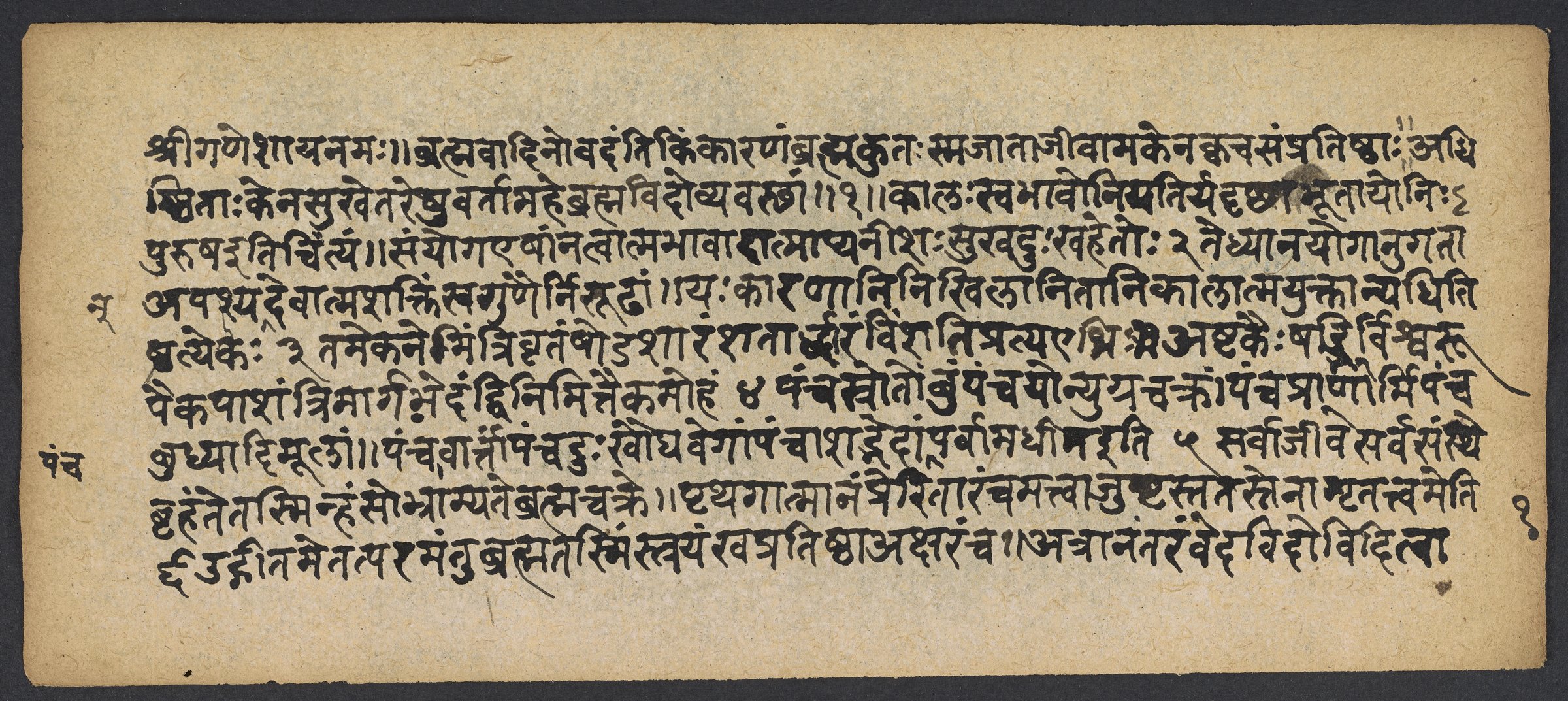
Where on the image
Penn Ms. Coll. 390 Item 1203, fol. 1v. fol. 1v (9 lines): line 1 ‹śrīgaṇeśāya namaḥ || brahmavādino vadanti kiṃkāraṇaṃ brahma›; 1.6 ends at the end of line 8 ‹tenāmṛtatvam eti›, numbered ‹6› at the start of line 9. Checked on the image; readings logged in data/sources/upanishads/mapping_notes_1203.txt.
1.1kiṃkāraṇaṃ brahma kutaḥ sma jātā jīvāmaḥ kena kva ca saṃpratiṣṭhāḥ
adhiṣṭhitāḥ kena sukhetareṣu vartāmahe brahmavido vyavasthām //
1.2kālaḥ svabhāvo niyatir yadṛcchā bhūtāni yoniḥ puruṣeti cintyam
saṃyoga eṣāṃ na tv ātmabhāvād ātmā hy anīśaḥ sukhaduḥkhahetoḥ //
1.3te dhyānayogānugatā apaśyan devātmaśaktiṃ svaguṇair nigūḍhām
yaḥ kāraṇāni nikhilāni tāni kālātmayuktāny adhitiṣṭhaty ekaḥ //
1.4tam ekanemiṃ trivṛtaṃ ṣoḍaśāntaṃ śatārdhāraṃ viṃśatipratyarābhiḥ
aṣṭakaiḥ ṣaḍbhir viśvarūpaikapāśaṃ trimārgabhedaṃ dvinimittaikamoham //
1.5pañcasroto'mbuṃ pañcayonyugravaktrāṃ pañcaprāṇormiṃ pañcabuddhyādimūlāṃ
pañcāvartāṃ pañcaduḥkhaughavegāṃ pañcāśadbhedāṃ pañcaparvām adhīmaḥ //
1.6sarvājīve sarvasaṃsthe bṛhante tasmin haṃso bhrāmyate brahmacakre
pṛthag ātmānaṃ preritāraṃ ca matvā juṣṭas tatas tenāmṛtatvam eti //
1.1The Brahma-students say: Is Brahman the cause? Whence are we born? Whereby do we live, and whither do we go? O ye who know Brahman, (tell us) at whose command we abide, whether in pain or in pleasure?
1.2Should time, or nature, or necessity, or chance, or the elements be considered as the cause, or he who is called the person (purusha, vigñânâtmâ)? It cannot be their union either, because that is not self-dependent, and the self also is powerless, because there is (independent of him) a cause of good and evil.
1.3The sages, devoted to meditation and concentration, have seen the power belonging to God himself, hidden in its own qualities (guna). He, being one, superintends all those causes, time, self, and the rest.
1.4We meditate on him who (like a wheel) has one felly with three tires, sixteen ends, fifty spokes, with twenty counter-spokes, and six sets of eight; whose one rope is manifold, who proceeds on three different roads, and whose illusion arises from two causes.
1.5We meditate on the river whose water consists of the five streams, which is wild and winding with its five springs, whose waves are the five vital breaths, whose fountain head is the mind, the course of the five kinds of perceptions. It has five whirlpools, its rapids are the five pains; it has fifty kinds of suffering, and five branches.
1.6In that vast Brahma-wheel, in which all things live and rest, the bird flutters about, so long as he thinks that the self (in him) is different from the mover (the god, the lord). When he has been blessed by him, then he gains immortality.
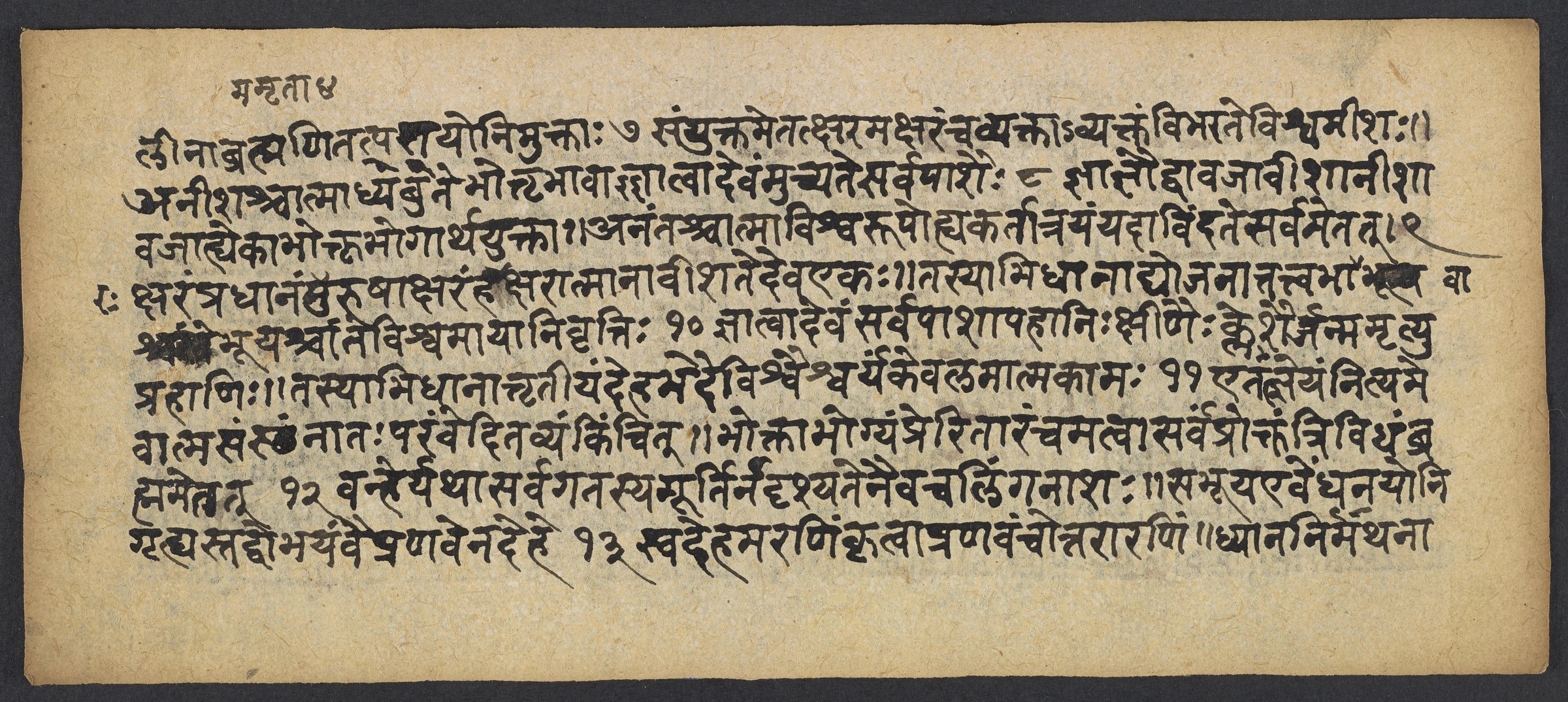
Where on the image
Penn Ms. Coll. 390 Item 1203, fol. 1v, fol. 2r. 1.7 begins at fol. 1v line 9 ‹udgītam etat paramaṃ tu brahma› and ends at fol. 2r line 1 ‹tatparā yonimuktāḥ 7›; 1.8-1.13 follow to line 9 ‹praṇavena dehe 13›. A word omitted in 1.7 is added in the upper margin of fol. 2r. Checked on the image; readings logged in data/sources/upanishads/mapping_notes_1203.txt.
1.7udgītam etat paramaṃ tu brahma tasmiṃs trayaṃ svapratiṣṭhākṣaraṃ ca
atrāntaraṃ brahmavido viditvā līnā brahmaṇi tatparā yonimuktāḥ //
1.8saṃyuktam etat kṣaram akṣaraṃ ca vyaktāvyaktaṃ bharate viśvam īśaḥ
anīśaś cātmā badhyate bhoktṛbhāvāj jñātvā devaṃ mucyate sarvapāśaiḥ //
1.9jñājñau dvāv ajāv īśanīśāv ajā hy ekā bhoktṛbhogārthayuktā
anantaś cātmā viśvarūpo hy akartā trayaṃ yadā vindate brahmam etat //
1.10kṣaraṃ pradhānam amṛtākṣaraṃ haraḥ kṣarātmānāv īśate deva ekaḥ
tasyābhidhyānād yojanāt tattvabhāvād bhūyaś cānte viśvamāyānivṛttiḥ //
1.11jñātvā devaṃ sarvapāśāpahāniḥ kṣīnaiḥ kleśair janmamṛtyuprahāṇiḥ
tasyābhidhyānāt tṛtīyaṃ dehabhede viśvaiśvaryaṃ kevala āptakāmaḥ //
1.12etaj jñeyaṃ nityam evātmasaṃsthaṃ nātaḥ paraṃ veditavyaṃ hi kiṃcit
bhoktā bhogyaṃ preritāraṃ ca matvā sarvaṃ proktaṃ trividhaṃ brahmam etat //
1.13vahner yathā yonigatasya mūrtir na dṛśyate naiva ca liṅganāśaḥ
sa bhūya evendhanayonigṛhyas tadvobhayaṃ vai praṇavena dehe //
1.7But what is praised (in the Upanishads) is the Highest Brahman, and in it there is the triad. The Highest Brahman is the safe support, it is imperishable. The Brahma-students, when they have known what is within this (world), are devoted and merged in the Brahman, free from birth.
1.8The Lord (îsa) supports all this together, the perishable and the imperishable, the developed and the undeveloped. The (living) self, not being a lord, is bound, because he has to enjoy (the fruits of works); but when he has known the god (deva), he is freed from all fetters.
1.9There are two, one knowing (îsvara), the other not-knowing (gîva), both unborn, one strong, the other weak; there is she, the unborn, through whom each man receives the recompense of his works; and there is the infinite Self (appearing) under all forms, but himself inactive. When a man finds out these three, that is Brahma.
1.10That which is perishable is the Pradhâna (the first), the immortal and imperishable is Hara. The one god rules the perishable (the pradhâna) and the (living) self. From meditating on him, from joining him, from becoming one with him there is further cessation of all illusion in the end.
1.11When that god is known, all fetters fall off, sufferings are destroyed, and birth and death cease. From meditating on him there arises, on the dissolution of the body, the third state, that of universal lordship; but he only who is alone, is satisfied.
1.12This, which rests eternally within the self, should be known; and beyond this not anything has to be known. By knowing the enjoyer, the enjoyed, and the ruler, everything has been declared to be threefold, and this is Brahman.
1.13As the form of fire, while it exists in the under-wood, is not seen, nor is its seed destroyed, but it has to be seized again and again by means of the stick and the under-wood, so it is in both cases, and the Self has to be seized in the body by means of the pranava (the syllable Om).
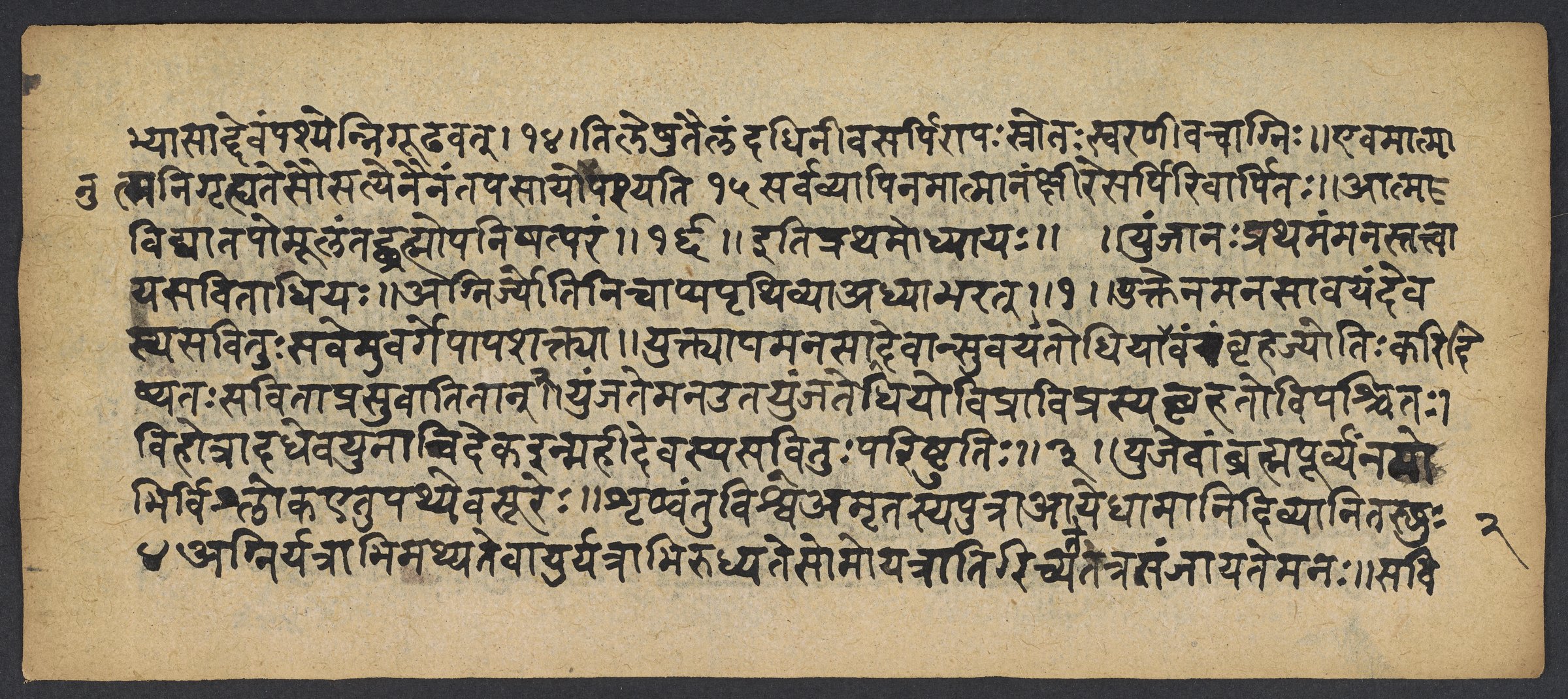
Where on the image
Penn Ms. Coll. 390 Item 1203, fol. 2r, fol. 2v. 1.14 begins at fol. 2r line 9 ‹svadeham araṇiṃ kṛtvā› and ends at fol. 2v line 1 ‹devaṃ paśyen nigūḍhavat 14›; 1.15-1.16 follow to line 3 ‹brahmopaniṣat paraṃ ||16||›, then the colophon ‹iti prathamo 'dhyāyaḥ›. Checked on the image; readings logged in data/sources/upanishads/mapping_notes_1203.txt.
1.14svadeham araṇiṃ kṛtvā praṇavaṃ cottarāraṇiṃ
dhyānanirmathanābhyāsād devaṃ paśyen nigūḍhavat //
1.15tileṣu tailaṃ dadhanīva sarpir āpaḥ srotaḥsv araṇīṣu cāgniḥ
evam ātmā ātmani gṛhyate 'sau satyenainaṃ tapasā yo 'nupaśyati //
1.16sarvavyāpinam ātmānaṃ kṣīre sarpir ivārpitam
ātmavidyātapomūlaṃ tad brahmopaniṣatparaṃ tad brahmopaniṣatparam //
1.14By making his body the under-wood, and the syllable Om the upper-wood, man, after repeating the drill of meditation, will perceive the bright god, like the spark hidden in the wood.
1.15As oil in seeds, as butter in cream, as water in (dry) river-beds, as fire in wood, so is the Self seized within the self, if man looks for him by truthfulness and penance;
1.16(If he looks) for the Self that pervades everything, as butter is contained in milk, and the roots whereof are self-knowledge and penance. That is the Brahman taught by the Upanishad.
Where on the image
Penn Ms. Coll. 390 Item 1203, fol. 2v. fol. 2v line 3: 2.1 begins ‹yuñjānaḥ prathamaṃ manas tattvāya›; 2.6 ends in line 9 ‹tatra saṃjāyate manaḥ›. From here the scribe's verse numbers run behind those of the edition. Checked on the image; readings logged in data/sources/upanishads/mapping_notes_1203.txt.
2.1yuñjānaḥ prathamaṃ manas tatvāya savitā dhiyaḥ
agner jyotir nicāyya pṛthivyā adhy ābharat //
2.2yuktena manasā vayaṃ devasya savituḥ save
suvargeyāya śaktyā % //
2.3yuktvāya manasā devān suvar yato dhiyā divaṃ
bṛhaj jyotiḥ kariṣyataḥ savitā prasuvāti tān //
2.4yuñjate mana uta yuñjate dhiyo viprā viprasya bṛhato vipaścitaḥ
vi hotrā dadhe vayunāvid eka in mahī devasya savituḥ pariṣṭutiḥ //
2.5yuje vāṃ brahma pūrvyaṃ namobhir vi śloka etu pathyeva sūreḥ
śṛṇvanti viśve amṛtasya putrā ā ye dhāmāni diviyāni tasthuḥ //
2.6agnir yatrābhimathyate vāyur yatrādhirudhyate
somo yatrātiricyate tatra saṃjāyate manaḥ //
2.1Savitri (the sun), having first collected his mind and expanded his thoughts, brought Agni (fire), when he had discovered his light, above the earth.
2.2With collected minds we are at the command of the divine Savitri, that we may obtain blessedness.
2.3May Savitri, after he has reached with his mind the gods as they rise up to the sky, and with his thoughts (has reached) heaven, grant these gods to make a great light to shine.
2.4The wise sages of the great sage collect their mind and collect their thoughts. He who alone knows the law (Savitri) has ordered the invocations; great is the praise of the divine Savitri.
2.5Your old prayer has to be joined with praises. Let my song go forth like the path of the sun! May all the sons of the Immortal listen, they who have reached their heavenly homes.
2.6Where the fire is rubbed, where the wind is checked, where the Soma flows over, there the mind is born.
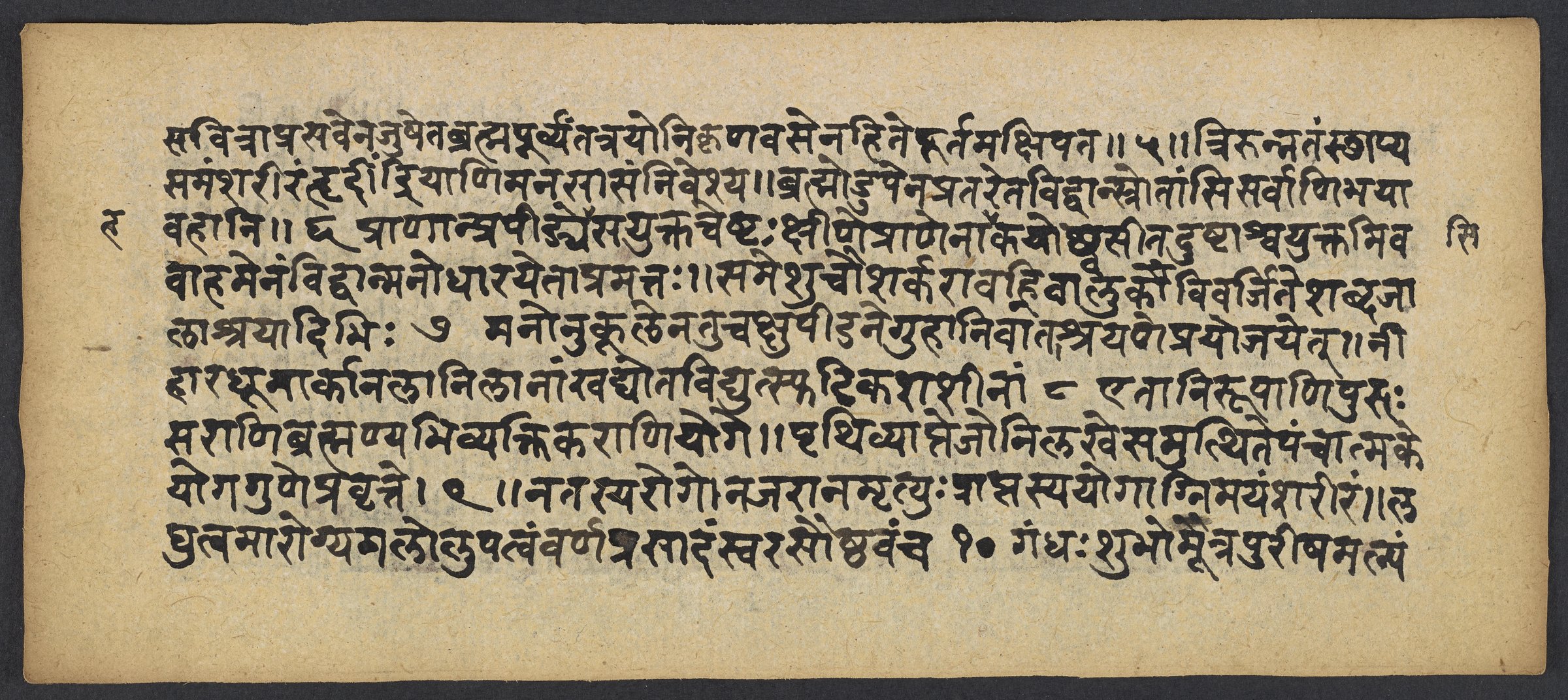
Where on the image
Penn Ms. Coll. 390 Item 1203, fol. 2v, fol. 3r. 2.7 begins at the end of fol. 2v line 9 ‹savi-› and goes on at fol. 3r line 1 ‹-trā prasavena juṣeta brahma pūrvyaṃ›, ending ‹akṣipat ||5||›; 2.8-2.12 follow to line 8 ‹yogāgnimayaṃ śarīraṃ›. Checked on the image; readings logged in data/sources/upanishads/mapping_notes_1203.txt.
2.7savitrā prasavena juṣeta brahma pūrvyam
tatra yoniṃ kṛṇavase nahi te pūrtam akṣipat //
2.8trirunnataṃ sthāpya samaṃ śarīraṃ hṛdīndriyāṇi manasā saṃniveśya
brahmoḍupena pratareta vidvān srotāṃsi sarvāṇi bhayāvahāni //
2.9prāṇān prapīḍyeha sa yuktaceṣṭaḥ kṣīne prāṇe nāsikayocchvasīta
duṣṭāśvayuktam iva vāham enaṃ vidvān mano dhārayetāpramattaḥ //
2.10same śucau śarkarāvahnivālukāvivarjite śabdajalāśrayādibhiḥ
mano'nukūle na tu cakṣupīḍane guhānivātāśrayaṇe prayojayet //
2.11nīhāradhūmārkānalānilānāṃ khadyotavidyutsphaṭikāśaśīnām
etāni rūpāṇi puraḥsarāṇi brahmaṇy abhivyaktikarāṇi yoge //
2.12pṛthvyaptejo'nilakhe samutthite pañcātmake yogaguṇe pravṛtte
na tasya rogo na jarā na mṛtyuḥ prāptasya yogāgnimayaṃ śarīram //
2.7Let us love the old Brahman by the grace of Savitri; if thou make thy dwelling there, the path will not hurt thee.
2.8If a wise man hold his body with its three erect parts (chest, neck, and head) even, and turn his senses with the mind towards the heart, he will then in the boat of Brahman cross all the torrents which cause fear.
2.9Compressing his breathings let him, who has subdued all motions, breathe forth through the nose with gentle breath. Let the wise man without fail restrain his mind, that chariot yoked with vicious horses.
2.10Let him perform his exercises in a place level, pure, free from pebbles, fire, and dust, delightful by its sounds, its water, and bowers, not painful to the eye, and full of shelters and caves.
2.11When Yoga is being performed, the forms which come first, producing apparitions in Brahman, are those of misty smoke, sun, fire, wind, fire-flies, lightnings, and a crystal moon.
2.12When, as earth, water, light, heat, and ether arise, the fivefold quality of Yoga takes place, then there is no longer illness, old age, or pain for him who has obtained a body, produced by the fire of Yoga.
Where on the image
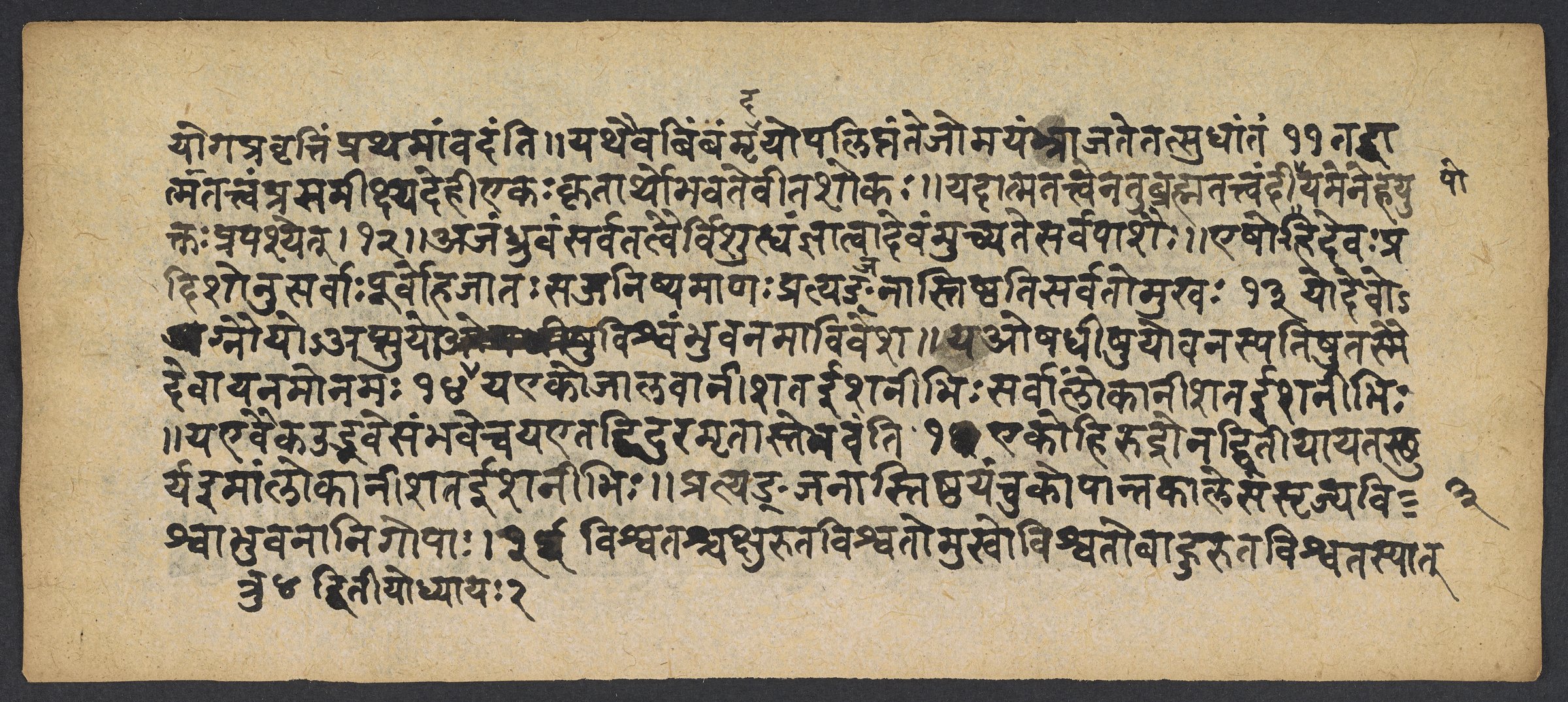
Penn Ms. Coll. 390 Item 1203, fol. 3r, fol. 3v. 2.13 begins at fol. 3r line 8 ‹laghutvam ārogyam alolupatvaṃ› and ends at fol. 3v line 1 ‹yogapravṛttiṃ prathamāṃ vadanti›; 2.14-2.17 follow to line 6 ‹tasmai devāya namo namaḥ›. The colophon of the second adhyaya is written in the lower margin of fol. 3v. Checked on the image; readings logged in data/sources/upanishads/mapping_notes_1203.txt.
2.13laghutvam ārogyam alolupatvaṃ varṇaprasādaḥ svarasauṣṭhavaṃ ca
gandhaḥ śubho mūtrapurīṣam alpaṃ yogapravṛttiṃ prathamāṃ vadanti //
2.14yathaiva bimbaṃ mṛdayopaliptaṃ tejomayaṃ bhrājate tat sudhāntam
tad vātmatattvaṃ prasamīkṣya dehī ekaḥ kṛtārtho bhavate vītaśokaḥ //
2.15yad ātmatattvena tu brahmatattvaṃ dīpopameneha yuktaḥ prapaśyet
ajaṃ dhruvaṃ sarvatattvair viśuddhaṃ jñātvā devaṃ mucyate sarvapāśaiḥ //
2.16eṣa ha devaḥ pradiśo 'nu sarvāḥ pūrvo ha jātaḥ sa u garbhe antaḥ
sa eva jātaḥ sa janiṣyamānaḥ pratyaṅ janās tiṣṭhati sarvatomukhaḥ //
2.17yo devo agnau yo apsu yo viśvaṃ bhuvanam āviveśa
ya oṣadhīṣu yo vanaspatīṣu tasmai devāya namo namaḥ //
2.13The first results of Yoga they call lightness, healthiness, steadiness, a good complexion, an easy pronunciation, a sweet odour, and slight excretions.
2.14As a metal disk (mirror), tarnished by dust, shines bright again after it has been cleaned, so is the one incarnate person satisfied and free from grief, after he has seen the real nature of the self.
2.15And when by means of the real nature of his self he sees, as by a lamp, the real nature of Brahman, then having known the unborn, eternal god, who is beyond all natures, he is freed from all fetters.
2.16He indeed is the god who pervades all regions: he is the first-born (as Hiranyagarbha), and he is in the womb. He has been born, and he will be born. He stands behind all persons, looking everywhere.
2.17The god who is in the fire, the god who is in the water, the god who has entered into the whole world, the god who is in plants, the god who is in trees, adoration be to that god, adoration!
Where on the image
Penn Ms. Coll. 390 Item 1203, fol. 3v. fol. 3v line 6: 3.1 begins ‹ya eko jālavān īśata īśanībhiḥ›; 3.2 ends in line 9 ‹viśvā bhuvanāni gopāḥ ||2||›. Checked on the image; readings logged in data/sources/upanishads/mapping_notes_1203.txt.
3.1ya eko jālavān īśata īśanībhiḥ sarvāṃl lokān īśata īśanībhiḥ
ya evaika udbhave saṃbhave ca ya etad vidur amṛtās te bhavanti //
3.2eko hi rudro na dvitīyāya tasthe ya imāṃl lokān īśata īśanībhiḥ
pratyaṅ janās tiṣṭhati saṃcukocāntakāle saṃsṛjya viśvā bhuvanāni gopāḥ //
3.1The snarer who rules alone by his powers, who rules all the worlds by his powers, who is one and the same, while things arise and exist,—they who know this are immortal.
3.2For there is one Rudra only, they do not allow a second, who rules all the worlds by his powers. He stands behind all persons, and after having created all worlds he, the protector, rolls it up at the end of time.
Where on the image
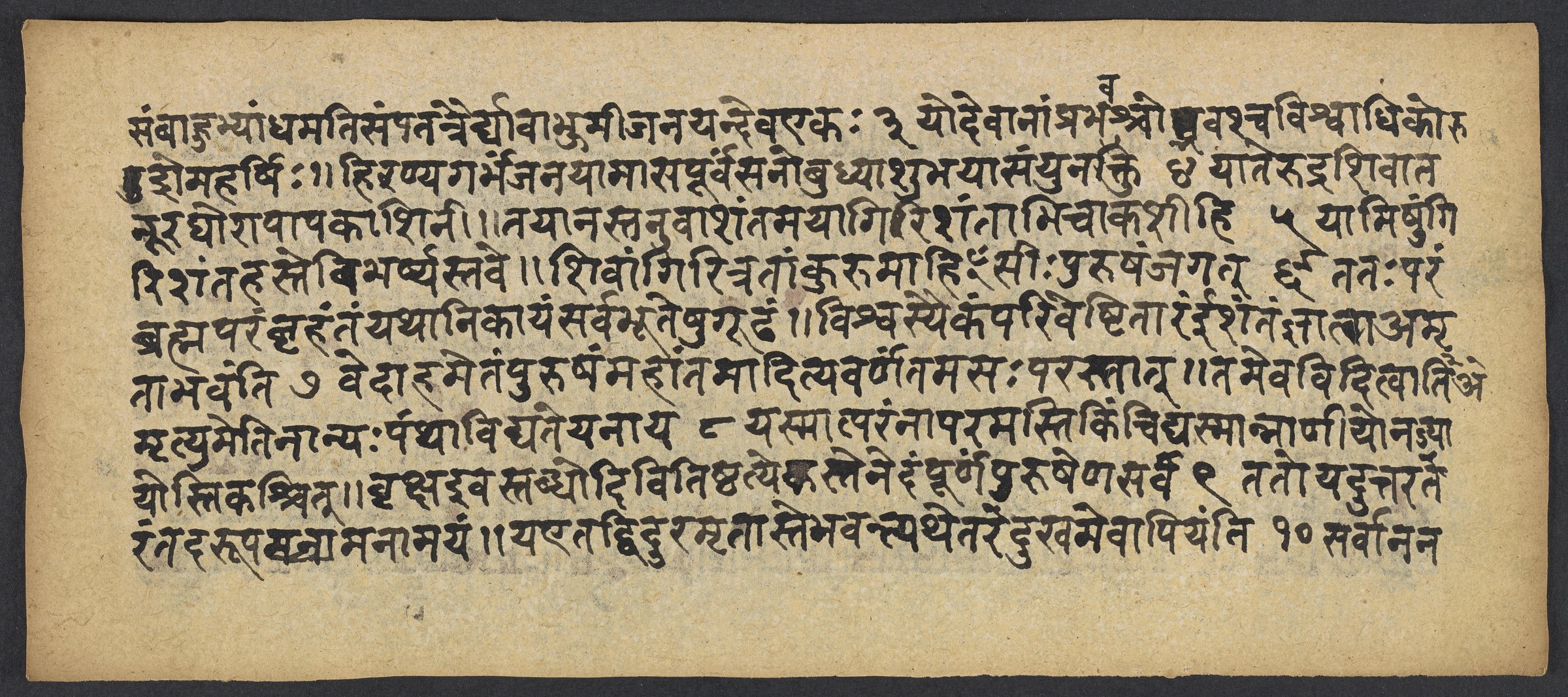
Penn Ms. Coll. 390 Item 1203, fol. 3v, fol. 4r. 3.3 begins at fol. 3v line 9 ‹viśvataś cakṣur uta viśvatomukho› and ends at fol. 4r line 1 ‹janayan deva ekaḥ 3›; 3.4-3.10 follow to line 9 ‹duḥkham evāpiyanti 10›. Checked on the image; readings logged in data/sources/upanishads/mapping_notes_1203.txt.
3.3viśvataścakṣur uta viśvatomukho viśvatobāhur uta viśvataspāt
saṃ bāhubhyāṃ dhamati saṃ patatrair dyāvābhūmī janayan deva ekaḥ //
3.4yo devānāṃ prabhavaś codbhavaś ca viśvādhipo rudro maharṣiḥ
hiraṇyagarbhaṃ janayāmāsa pūrvaṃ sa no buddhyā śubhayā saṃyunaktu //
3.5yā te rudra śivā tanūr aghorāpāpakāśinī
tayā nas tanuvā śaṃtamayā giriśantābhicākaśīhi //
3.6yām iṣuṃ giriśanta haste bibharṣy astave
śivāṃ giritra tāṃ kuru mā hiṃsīḥ puruṣaṃ jagat //
3.7tataḥ paraṃ brahma paraṃ bṛhantaṃ yathānikāyaṃ sarvabhūteṣu gūḍhaṃ
viśvasyaikaṃ pariveṣṭitāram īśaṃ taṃ jñātvāmṛtā bhavanti //
3.8vedāham etaṃ puruṣaṃ mahāntam ādityavarṇaṃ tamasaḥ parastāt
tam eva viditvāti mṛtyum eti nānyaḥ panthā vidyate 'yanāya //
3.9yasmāt paraṃ nāparam asti kiṃcid yasmān nāṇīyo na jyāyo 'sti kiṃcit
vṛkṣa iva stabdho divi tiṣṭhaty ekas tenedaṃ pūrṇaṃ puruṣeṇa sarvam //
3.10tato yad uttarataraṃ yad arūpam anāmayam
ya etad vidur amṛtās te bhavanti athetare duḥkham evāpiyanti //
3.3That one god, having his eyes, his face, his arms, and his feet in every place, when producing heaven and earth, forges them together with his arms and his wings.
3.4He, the creator and supporter of the gods, Rudra, the great seer, the lord of all, he who formerly gave birth to Hiranyagarbha, may he endow us with good thoughts.
3.5O Rudra, thou dweller in the mountains, look upon us with that most blessed form of thine which is auspicious, not terrible, and reveals no evil!
3.6O lord of the mountains, make lucky that arrow which thou, a dweller in the mountains, holdest in thy hand to shoot. Do not hurt man or beast!
3.7Those who know beyond this the High Brahman, the vast, hidden in the bodies of all creatures, and alone enveloping everything, as the Lord, they become immortal.
3.8I know that great person (purusha) of sunlike lustre beyond the darkness. A man who knows him truly, passes over death; there is no other path to go.
3.9This whole universe is filled by this person (purusha), to whom there is nothing superior, from whom there is nothing different, than whom there is nothing smaller or larger, who stands alone, fixed like a tree in the sky.
3.10That which is beyond this world is without form and without suffering. They who know it, become immortal, but others suffer pain indeed.
Where on the image
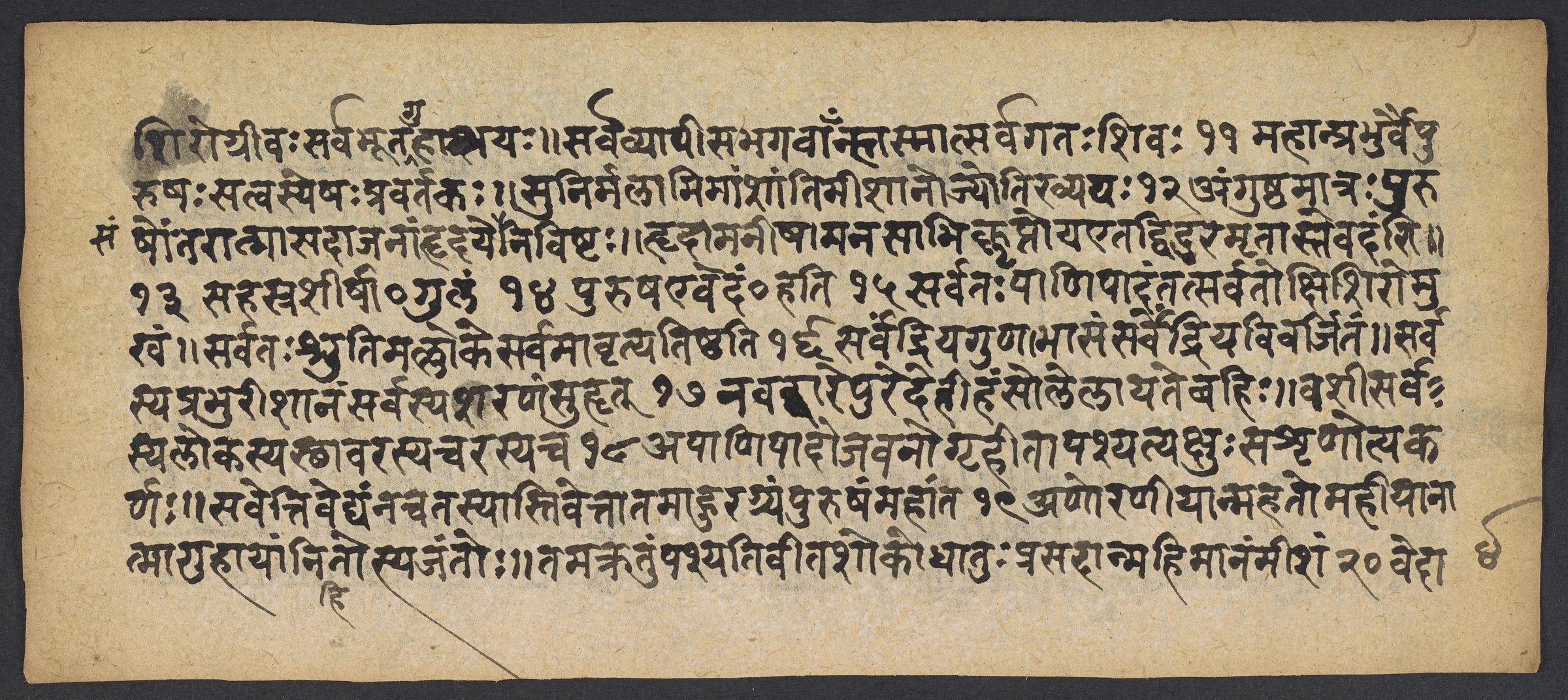
Penn Ms. Coll. 390 Item 1203, fol. 4r, fol. 4v. 3.11 begins at the end of fol. 4r line 9 ‹sarvānana-› and ends at fol. 4v line 1 ‹sarvagataḥ śivaḥ 11›; 3.12-3.20 follow to line 9 ‹prasādān mahimānam īśaṃ 20›. The scribe gives 3.14 and 3.15 only by their first and last words (line 4 ‹sahasraśīrṣā ... gulaṃ›, ‹puruṣa evedaṃ ... hati›). Checked on the image; readings logged in data/sources/upanishads/mapping_notes_1203.txt.
3.11sarvānanaśirogrīvaḥ sarvabhūtaguhāśayaḥ
sarvavyāpī sa bhagavāṃs tasmāt sarvagataḥ śivaḥ //
3.12mahān prabhur vai puruṣaḥ sattvasyaiṣa pravartakaḥ
sunirmalām imāṃ prāptim īśāno jyotir avyayaḥ //
3.13aṅguṣṭhamātraḥ puruṣo 'ntarātmā sadā janānāṃ hṛdaye saṃniviṣṭaḥ
hṛdā manīṣā manasābhikḷpto ya etad vidur amṛtās te bhavanti //
3.14sahasraśīrṣā puruṣaḥ sahasrākṣaḥ sahasrapāt
sa bhūmiṃ viśvato vṛtvā atyatiṣṭhad daśāṅgulam //
3.15puruṣa evedaṃ sarvaṃ yad bhūtaṃ yac ca bhavyam
utāmṛtatvasyeśāno yad annenātirohati //
3.16sarvataḥpāṇipādaṃ tat sarvato'kṣiśiromukhaṃ
sarvataḥśrutimal loke sarvam āvṛtya tiṣṭhati //
3.17sarvendriyaguṇābhāsaṃ sarvendriyavivarjitaṃ
sarvasya prabhum īśānaṃ sarvasya śaraṇaṃ suhṛt //
3.18navadvāre pure dehī haṃso lelāyate bahiḥ
vaśī sarvasya lokasya sthāvarasya carasya ca //
3.19apāṇipādo javano grahītā paśyaty acakṣuḥ sa śṛṇoty akarṇaḥ
sa vetti vedyaṃ na ca tasyāsti vettā tam āhur agryaṃ puruṣaṃ mahāntam //
3.20aṇor aṇīyān mahato mahīyān ātmā guhāyāṃ nihito 'sya jantoḥ
tam akratuṃ paśyati vītaśoko dhātuprasādān mahimānam īśam //
3.11That Bhagavat exists in the faces, the heads, the necks of all, he dwells in the cave (of the heart) of all beings, he is all-pervading, therefore he is the omnipresent Siva.
3.12That person (purusha) is the great lord; he is the mover of existence, he possesses that purest power of reaching everything, he is light, he is undecaying.
3.13The person (purusha), not larger than a thumb, dwelling within, always dwelling in the heart of man, is perceived by the heart, the thought, the mind; they who know it become immortal.
3.14The person (purusha) with a thousand heads, a thousand eyes, a thousand feet, having compassed the earth on every side, extends beyond it by ten fingers' breadth.
3.15That person alone (purusha) is all this, what has been and what will be; he is also the lord of immortality; he is whatever grows by food.
3.16Its hands and feet are everywhere, its eyes and head are everywhere, its ears are everywhere, it stands encompassing all in the world.
3.17Separate from all the senses, yet reflecting the qualities of all the senses, it is the lord and ruler of all, it is the great refuge of all.
3.18The embodied spirit within the town with nine gates, the bird, flutters outwards, the ruler of the whole world, of all that rests and of all that moves.
3.19Grasping without hands, hasting without feet, he sees without eyes, he hears without ears. He knows what can be known, but no one knows him; they call him the first, the great person (purusha).
3.20The Self, smaller than small, greater than great, is hidden in the heart of the creature. A man who has left all grief behind, sees the majesty, the Lord, the passionless, by the grace of the creator (the Lord).
Where on the image
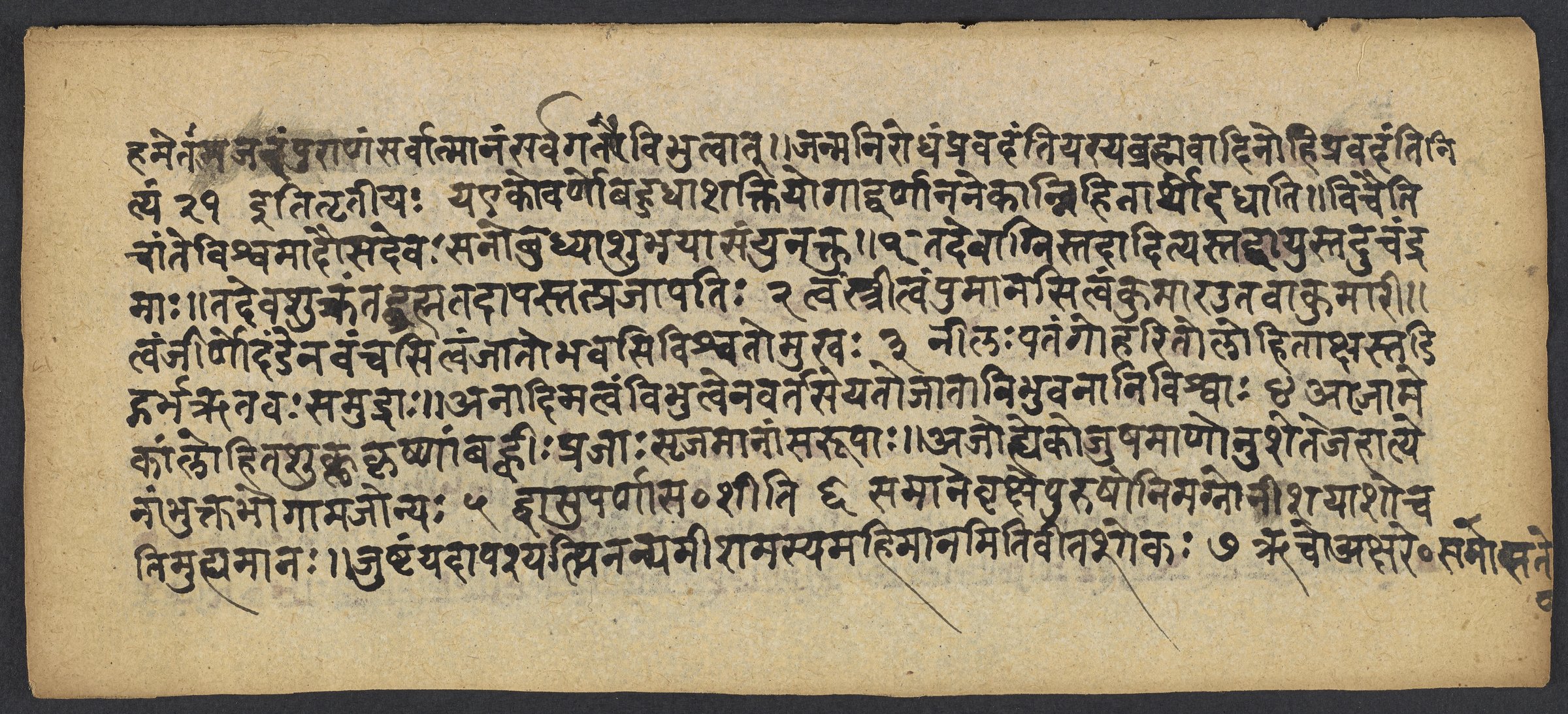
Penn Ms. Coll. 390 Item 1203, fol. 4v, fol. 5r. 3.21 begins at the end of fol. 4v line 9 ‹vedā-› and ends at fol. 5r line 2 ‹pravadanti nityaṃ 21›, followed by ‹iti tṛtīyaḥ›. Checked on the image; readings logged in data/sources/upanishads/mapping_notes_1203.txt.
3.21vedāham etam ajaraṃ purāṇaṃ sarvātmānaṃ sarvagataṃ vibhutvāt
janmanirodhaṃ pravadanti yasya brahmavādino hi pravadanti nityam //
3.21I know this undecaying, ancient one, the self of all things, being infinite and omnipresent. They declare that in him all birth is stopped, for the Brahma-students proclaim him to be eternal.
Where on the image
Penn Ms. Coll. 390 Item 1203, fol. 5r. fol. 5r line 2: 4.1 begins ‹ya eko 'varṇo bahudhā śaktiyogād›; 4.8 ends in line 9. The scribe abbreviates 4.6 (‹dvā suparṇā sa... śīti›, line 8) and 4.8 (‹ṛco akṣare ... samāsate›, line 9). Checked on the image; readings logged in data/sources/upanishads/mapping_notes_1203.txt.
4.1ya eko 'varṇo bahudhā śaktiyogād varṇān anekān nihitārtho dadhāti
vi caiti cānte viśvam ādau sa devaḥ sa no buddhyā śubhayā saṃyunaktu //
4.2tad evāgnis tad ādityas tad vāyus tad u candramāḥ
tad eva śukraṃ tad brahma tad āpas tat prajāpatiḥ //
4.3tvaṃ strī tvaṃ pumān asi tvaṃ kumāra uta vā kumārī
tvaṃ jīrṇo daṇḍena vañcasi tvaṃ jāto bhavasi viśvatomukhaḥ //
4.4nīlaḥ pataṅgo harito lohitākṣas taḍidgarbha ṛtavaḥ samudrāḥ
anādimāṃs tvaṃ vibhutvena vartase yato jātāni bhuvanāni viśvā //
4.5ajām ekāṃ lohitaśuklakṛṣṇāṃ bahvīḥ prajāḥ sṛjamānāṃ sarūpāḥ
ajo hy eko juṣamāṇo 'nuśete jahāty enāṃ bhuktabhogām ajo 'nyaḥ //
4.6dvā suparṇā sayujā sakhāyā samānaṃ vṛkṣaṃ pariṣasvajāte
tayor anyaḥ pippalaṃ svādv atty anaśnann anyo abhicākaśīti //
4.7samāne vṛkṣe puruṣo nimagno anīśayā śocati muhyamānaḥ
juṣṭaṃ yadā paśyaty anyam īśaṃ asya mahimānam iti vītaśokaḥ //
4.8ṛco akṣare parame vyoman yasmin devā adhi viśve niṣedhuḥ
yas tan na veda kim ṛcā kariṣyati ya it tad vidus ta ime samāsate //
4.1He, the sun, without any colour, who with set purpose by means of his power (sakti) produces endless colours, in whom all this comes together in the beginning, and comes asunder in the end—may he, the god, endow us with good thoughts.
4.2That (Self) indeed is Agni (fire), it is Âditya (sun), it is Vâyu (wind), it is Kandramas (moon); the same also is the starry firmament, it is Brahman (Hiranyagarbha), it is water, it is Pragâpati (Virâg).
4.3Thou art woman, thou art man; thou art youth, thou art maiden; thou, as an old man, totterest along on thy staff; thou art born with thy face turned everywhere.
4.4Thou art the dark-blue bee, thou art the green parrot with red eyes, thou art the thunder-cloud, the seasons, the seas. Thou art without beginning, because thou art infinite, thou from whom all worlds are born.
4.5There is one unborn being (female), red, white, and black, uniform, but producing manifold offspring. There is one unborn being (male) who loves her and lies by her; there is another who leaves her, while she is eating what has to be eaten.
4.6Two birds, inseparable friends, cling to the same tree. One of them eats the sweet fruit, the other looks on without eating.
4.7On the same tree man sits grieving, immersed, bewildered, by his own impotence (an-îsâ). But when he sees the other lord (îsa) contented, and knows his glory, then his grief passes away.
4.8He who does not know that indestructible being of the Rig-veda, that highest ether-like (Self) wherein all the gods reside, of what use is the Rig-veda to him? Those only who know it, rest contented.
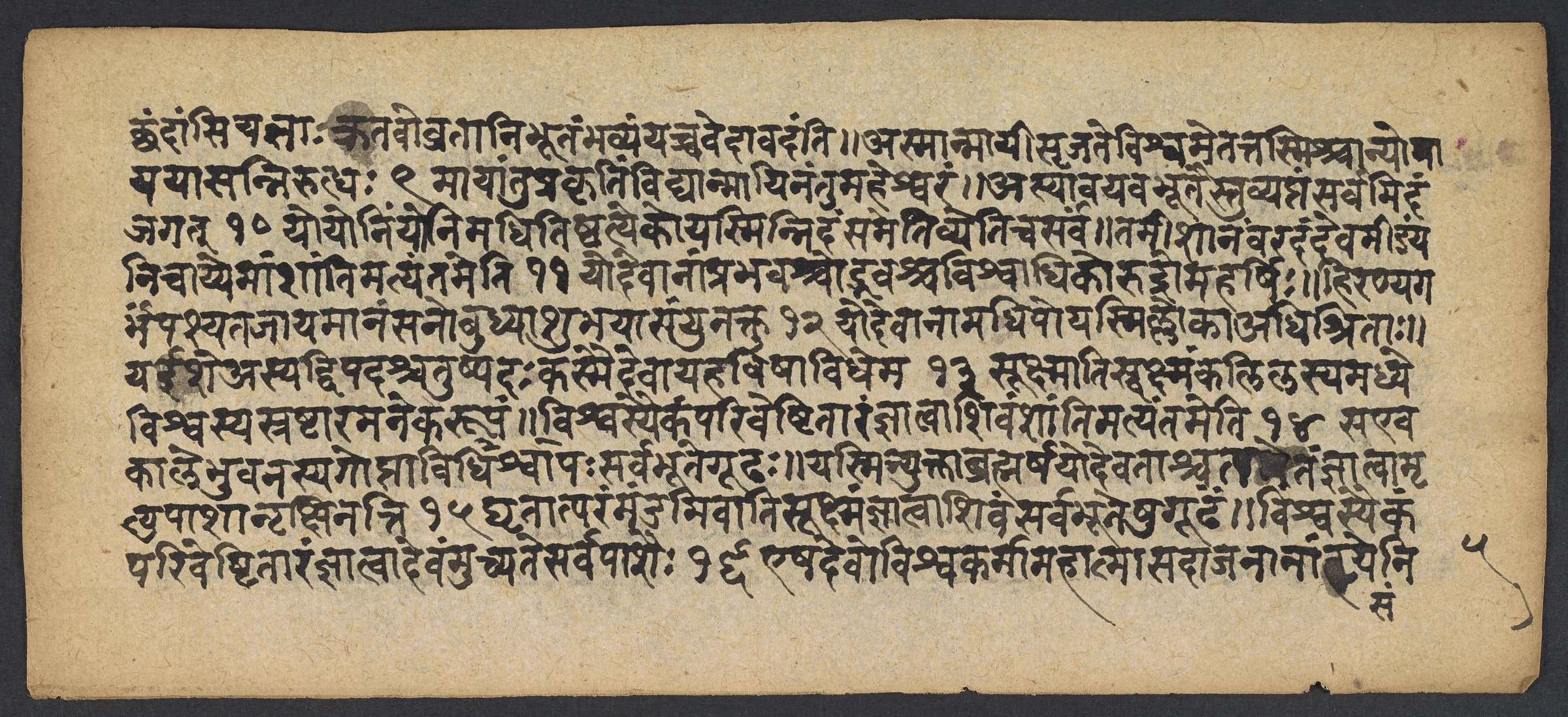
Where on the image
Penn Ms. Coll. 390 Item 1203, fol. 5v. fol. 5v (10 lines): 4.9 begins in line 1 ‹chandāṃsi yajñāḥ kratavo vratāni›; 4.16 ends in line 10 ‹mucyate sarvapāśaiḥ 16›. Checked on the image; readings logged in data/sources/upanishads/mapping_notes_1203.txt.
4.9chandāṃsi yajñāḥ kratavo vratāni bhūtaṃ bhavyaṃ yac ca vedā vadanti
asmān māyī sṛjate viśvam etat tasmiṃś cānyo māyayā saṃniruddhaḥ //
4.10māyāṃ tu prakṛtiṃ vidyān māyinaṃ tu maheśvaraṃ
tasyāvayavabhūtais tu vyāptaṃ sarvaṃ idaṃ jagat //
4.11yo yoniṃ-yonim adhitiṣṭhaty eko yasminn idaṃ saṃ ca vi caiti sarvam
tam īśānaṃ varadaṃ devam īḍyaṃ nicāyyemāṃ śāntim atyantam eti //
4.12yo devānāṃ prabhavaś codbhavaś ca viśvādhiko rudro maharṣiḥ
hiraṇyagarbhaṃ paśyata jāyamānaṃ sa no buddhyā śubhayā saṃyunaktu //
4.13yo devānām adhipo yasmiṃl lokā adhiśritāḥ
ya īśe asya dvipadaś catuṣpadaḥ kasmai devāya haviṣā vidhema //
4.14sūkṣmātisūkṣmaṃ kalilasya madhye viśvasya sraṣṭāram anekarūpaṃ
viśvasyaikaṃ pariveṣṭitāraṃ jñātvā śivaṃ śāntim atyantam eti //
4.15sa eva kāle bhuvanasya goptā viśvādhipaḥ sarvabhūteṣu gūḍhaḥ
yasmin yuktā brahmarṣayo devatāś ca tam evaṃ jñātvā mṛtyupāśāṃś chinatti //
4.16ghṛtāt paraṃ maṇḍam ivātisūkṣmaṃ jñātvā śivaṃ sarvabhūteṣu gūḍhaṃ
viśvasyaikaṃ pariveṣṭitāraṃ jñātvā devaṃ mucyate sarvapāśaiḥ //
4.9That from which the maker (mâyin) sends forth all this—the sacred verses, the offerings, the sacrifices, the panaceas, the past, the future, and all that the Vedas declare—in that the other is bound up through that mâyâ.
4.10Know then Prakriti (nature) is Mâyâ (art), and the great Lord the Mâyin (maker); the whole world is filled with what are his members.
4.11If a man has discerned him, who being one only, rules over every germ (cause), in whom all this comes together and comes asunder again, who is the lord, the bestower of blessing, the adorable god, then he passes for ever into that peace.
4.12He, the creator and supporter of the gods, Rudra, the great seer, the lord of all, who saw Hiranyagarbha being born, may he endow us with good thoughts.
4.13He who is the sovereign of the gods, he in whom all the worlds rest, he who rules over all two-footed and four-footed beings, to that god let us sacrifice an oblation.
4.14He who has known him who is more subtile than subtile, in the midst of chaos, creating all things, having many forms, alone enveloping everything, the happy one (Siva), passes into peace for ever.
4.15He also was in time the guardian of this world, the lord of all, hidden in all beings. In him the Brahmarshis and the deities are united, and he who knows him cuts the fetters of death asunder.
4.16He who knows Siva (the blessed) hidden in all beings, like the subtile film that rises from out the clarified butter, alone enveloping everything,—he who knows the god, is freed from all fetters.
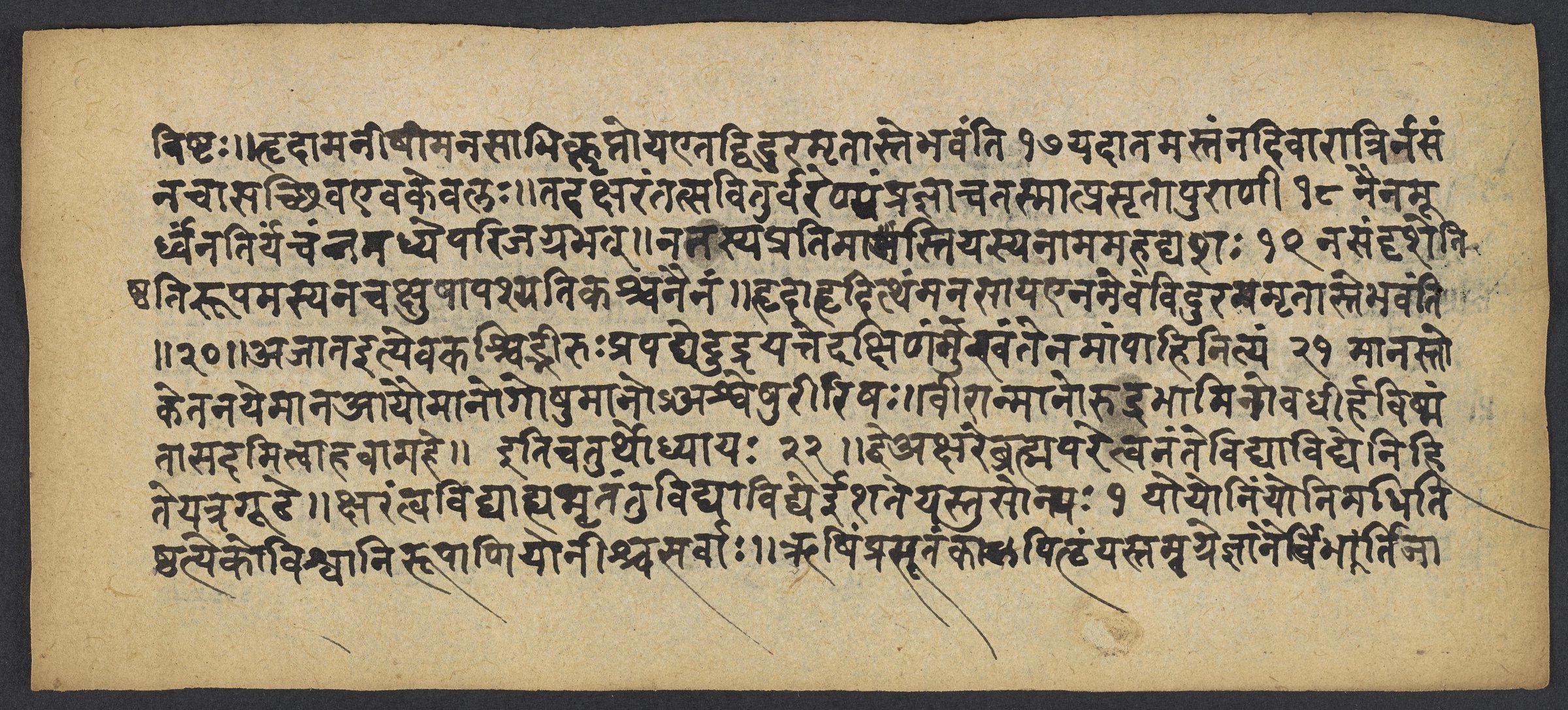
Where on the image
Penn Ms. Coll. 390 Item 1203, fol. 5v, fol. 6r. 4.17 begins at fol. 5v line 10 ‹eṣa devo viśvakarmā mahātmā› and ends at fol. 6r line 1 ‹amṛtās te bhavanti 17›; 4.18-4.22 follow to line 7 ‹sadam it tvā havāmahe›, then the colophon ‹iti caturtho 'dhyāyaḥ 22›. Checked on the image; readings logged in data/sources/upanishads/mapping_notes_1203.txt.
4.17eṣa devo viśvakarmā mahātmā sadā janānāṃ hṛdaye saṃniviṣṭaḥ
hṛdā manīṣā manasābhikḷpto ya etad vidur amṛtās te bhavanti //
4.18yadātamas tan na divā na rātrir na san na cāsac chiva eva kevalaḥ
tad akṣaraṃ tat savitur vareṇyaṃ prajñā ca tasmāt prasṛtā purāṇī //
4.19nainam ūrdhvaṃ na tiryañcaṃ na madhye parijagrabhat
na tasya pratimā asti yasya nāma mahad yaśaḥ //
4.20na saṃdṛśe tiṣṭhati rūpam asya na cakṣuṣā paśyati kaścanainaṃ
hṛdā hṛdisthaṃ manasā ya enam evaṃ vidur amṛtās te bhavanti //
4.21ajāta ity evaṃ kaścid bhīruḥ prapadyate
rudra yat dakṣiṇaṃ mukham tena māṃ pāhi nityam //
4.22mā nas toke tanaye mā na āyuṣi mā no goṣu mā no aśveṣu rīriṣaḥ
vīrān mā no rudra bhāmito vadhīr haviṣmantaḥ sadam it tvā havāmahe //
4.17That god, the maker of all things, the great Self, always dwelling in the heart of man, is perceived by the heart, the soul, the mind;—they who know it become immortal.
4.18When the light has risen, there is no day, no night, neither existence nor non-existence; Siva (the blessed) alone is there. That is the eternal, the adorable light of Savitri,—and the ancient wisdom proceeded thence.
4.19No one has grasped him above, or across, or in the middle. There is no image of him whose name is Great Glory.
4.20His form cannot be seen, no one perceives him with the eye. Those who through heart and mind know him thus abiding in the heart, become immortal.
4.21'Thou art unborn,' with these words some one comes near to thee, trembling. O Rudra, let thy gracious face protect me for ever!
4.22O Rudra! hurt us not in our offspring and descendants, hurt us not in our own lives, nor in our cows, nor in our horses! Do not slay our men in thy wrath, for, holding oblations, we call on thee always.
Where on the image
Penn Ms. Coll. 390 Item 1203, fol. 6r. fol. 6r line 7: 5.1 begins ‹dve akṣare brahmapare tv anante› and ends in line 8 ‹so 'nyaḥ›. Checked on the image; readings logged in data/sources/upanishads/mapping_notes_1203.txt.
5.1dve akṣare brahmapare tv anante vidyāvidye nihite yatra gūḍhe
kṣaraṃ tv avidyā hy amṛtaṃ tu vidyā vidyāvidye īśate yas tu so 'nyaḥ //
5.1In the imperishable and infinite Highest Brahman, wherein the two, knowledge and ignorance, are hidden, the one, ignorance, perishes, the other, knowledge, is immortal; but he who controls both, knowledge and ignorance, is another.
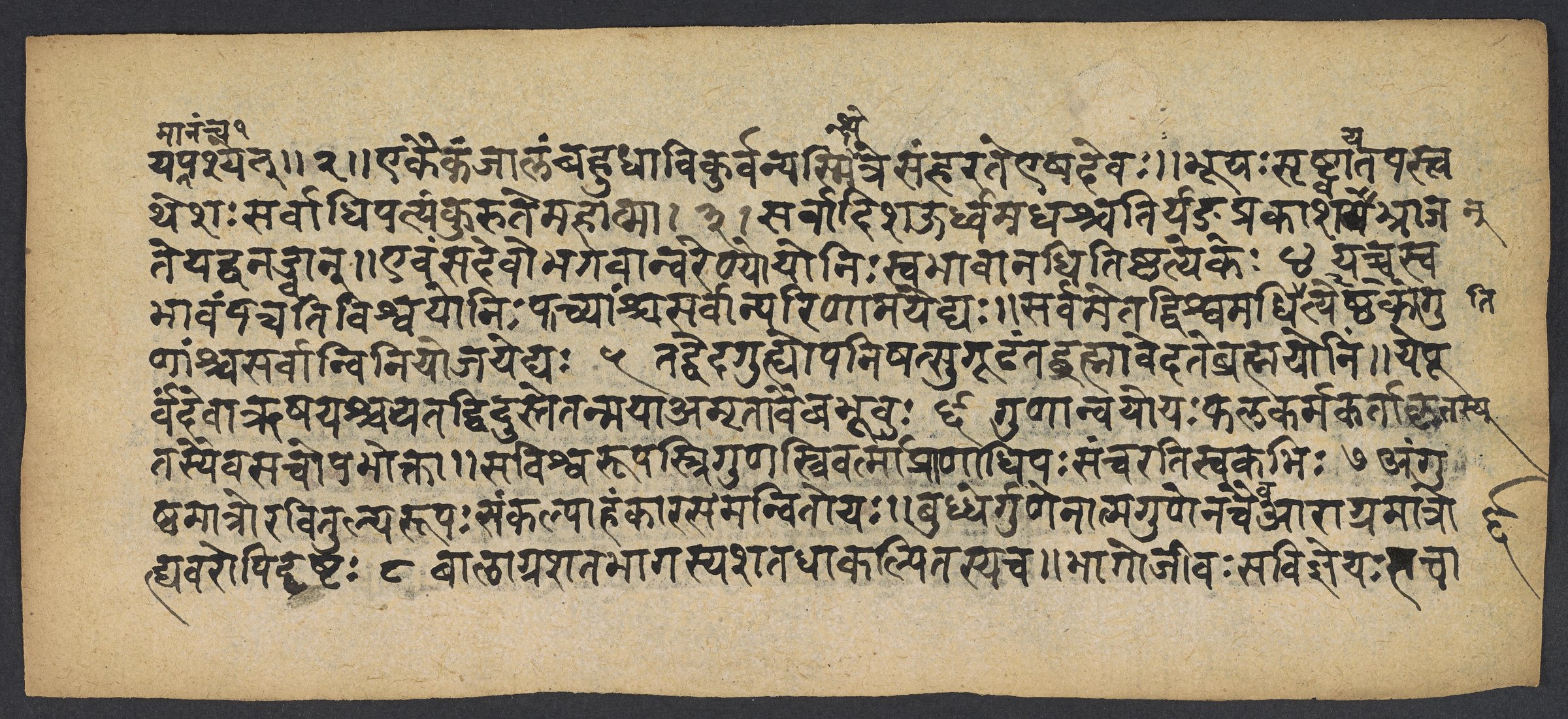
Where on the image
Penn Ms. Coll. 390 Item 1203, fol. 6r, fol. 6v. 5.2 begins at fol. 6r line 8 ‹yo yoniṃ yonim adhitiṣṭhaty eko› and ends at fol. 6v line 1 ‹jāyamānaṃ ca paśyet ||2||›; 5.3-5.8 follow to line 9 ‹aparo 'pi dṛṣṭaḥ 8›. Checked on the image; readings logged in data/sources/upanishads/mapping_notes_1203.txt.
5.2yo yoniṃ yonim adhitiṣṭhaty eko viśvāni rūpāṇi yonīś ca sarvāḥ
ṛṣiṃ prasūtaṃ kapilaṃ yas tam agre jñānair bibharti jāyamānaṃ ca paśyet //
5.3ekaikaṃ jālaṃ bahudhā vikurvann asmin kṣetre saṃharaty eṣa devaḥ
bhūyaḥ sṛṣṭvā patayas tatheśaḥ sarvādhipatyaṃ kurute mahātmā //
5.4sarvā diśa ūrdhvam adhaś ca tiryak prakāśayan bhrājate yad vānaḍvān
evaṃ sa devo bhagavān vareṇyo yonisvabhāvān adhitiṣṭhaty ekaḥ //
5.5yac ca svabhāvaṃ pacati viśvayoniḥ pācyāṃś ca sarvān pariṇāmayed yaḥ
sarvam etad viśvam adhitiṣṭhaty eko guṇāṃś ca sarvān viniyojayed yaḥ //
5.6tad vedaguhyopaniṣatsu gūḍhaṃ tad brahmā vedate brahmayoniṃ
ye pūrvaṃ devā ṛṣayaś ca tad vidus te tanmayā amṛtā vai babhūvuḥ //
5.7guṇānvayo yaḥ phalakarmakartā kṛtasya tasyaiva sa copabhoktā
sa viśvarūpas triguṇas trivartmā prāṇādhipaḥ saṃcarati svakarmabhiḥ //
5.8aṅguṣṭhamātro ravitulyarūpaḥ saṃkalpāhaṃkārasamanvito yaḥ
buddher guṇenātmaguṇena caiva ārāgramātro hy avaro 'pi dṛṣṭaḥ //
5.2It is he who, being one only, rules over every germ (cause), over all forms, and over all germs; it is he who, in the beginning, bears in his thoughts the wise son, the fiery, whom he wishes to look on while he is born.
5.3In that field in which the god, after spreading out one net after another in various ways, draws it together again, the Lord, the great Self, having further created the lords, thus carries on his lordship over all.
5.4As the car (of the sun) shines, lighting up all quarters, above, below, and across, thus does that god, the holy, the adorable, being one, rule over all that has the nature of a germ.
5.5He, being one, rules over all and everything, so that the universal germ ripens its nature, diversifies all natures that can be ripened, and determines all qualities.
5.6Brahmâ (Hiranyagarbha) knows this, which is hidden in the Upanishads, which are hidden in the Vedas, as the Brahma-germ. The ancient gods and poets who knew it, they became it and were immortal.
5.7But he who is endowed with qualities, and performs works that are to bear fruit, and enjoys the reward of whatever he has done, migrates through his own works, the lord of life, assuming all forms, led by the three Gunas, and following the three paths.
5.8That lower one also, not larger than a thumb, but brilliant like the sun, who is endowed with personality and thoughts, with the quality of mind and the quality of body, is seen small even like the point of a goad.
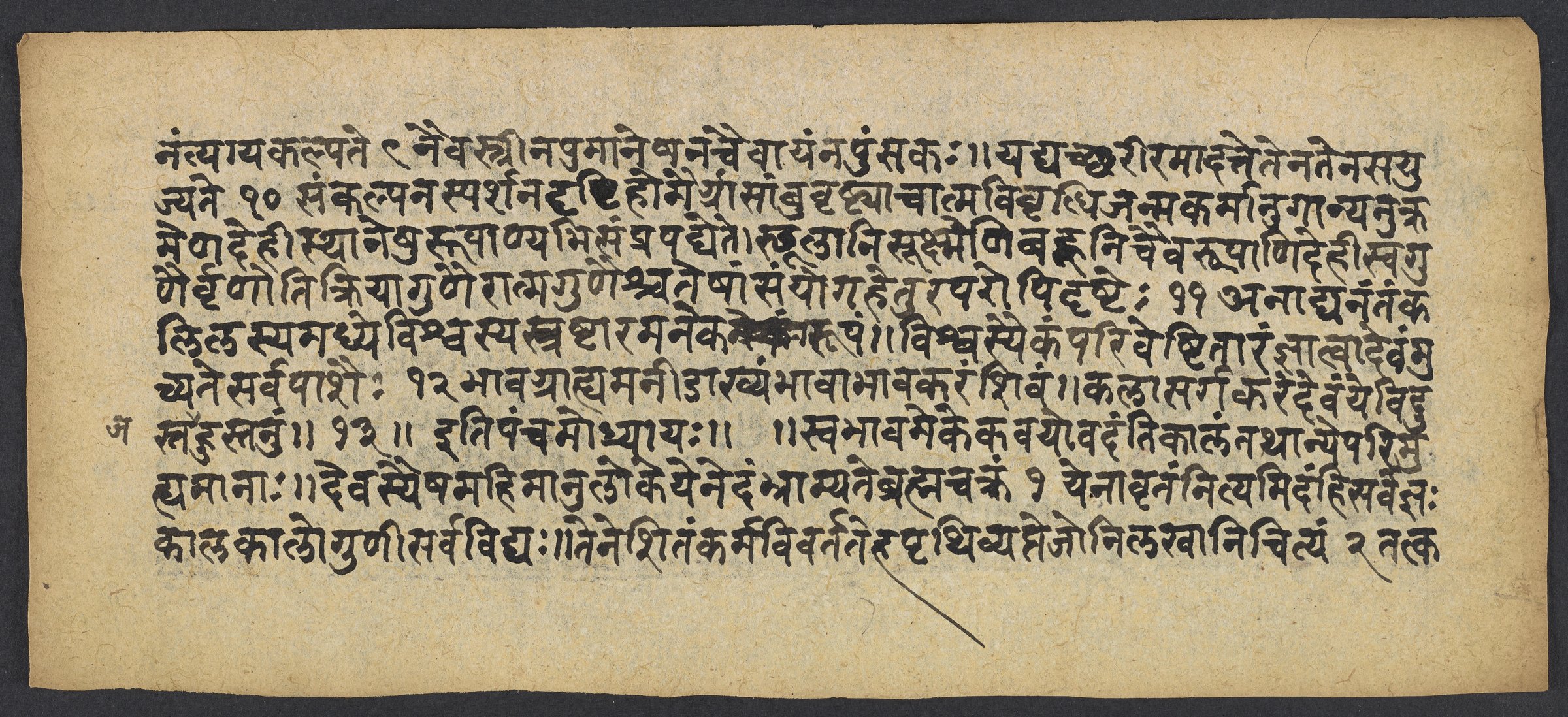
Where on the image
Penn Ms. Coll. 390 Item 1203, fol. 6v, fol. 7r. 5.9 begins at fol. 6v line 9 ‹bālāgraśatabhāgasya› and ends at fol. 7r line 1 ‹ānantyāya kalpate 9›; 5.10-5.14 follow to line 7 ‹te jahus tanuṃ ||13||›, then the colophon ‹iti pañcamo 'dhyāyaḥ›. Checked on the image; readings logged in data/sources/upanishads/mapping_notes_1203.txt.
5.9vālāgraśatabhāgasya śatadhā kalpitasya ca
bhāgo jīvaḥ sa vijñeyaḥ sa cānantyāya kalpate //
5.10naiva strī na pumān eṣa na caivāyaṃ napuṃsakaḥ
yad yac charīram ādatte tena tena sa yujyate //
5.11saṃkalpanasparśanadṛṣṭimohair grāsāmbuvṛṣṭyā cātmavivṛddhijanma
karmānugāny anukramena dehī sthāneṣu rūpāṇy abhisaṃprapadyate //
5.12sthūlāni sūkṣmāṇi bahūni caiva rūpāṇi dehī svaguṇair vṛṇoti
kriyāguṇair ātmaguṇaiś ca teṣāṃ saṃyogahetur aparo 'pi dṛṣṭaḥ //
5.13anādyanantaṃ kalilasya madhye viśvasya sraṣṭāram anekarūpaṃ
viśvasyaikaṃ pariveṣṭitāraṃ jñātvā devaṃ mucyate sarvapāśaiḥ //
5.14bhāvagrāhyam anīḍākhyaṃ bhāvābhāvakaraṃ śivaṃ
kalāsargakaraṃ devaṃ ye vidus te jahus tanum //
5.9That living soul is to be known as part of the hundredth part of the point of a hair, divided a hundred times, and yet it is to be infinite.
5.10It is not woman, it is not man, nor is it neuter; whatever body it takes, with that it is joined (only).
5.11By means of thoughts, touching, seeing, and passions the incarnate Self assumes successively in various places various forms, in accordance with his deeds, just as the body grows when food and drink are poured into it.
5.12That incarnate Self, according to his own qualities, chooses (assumes) many shapes, coarse or subtile, and having himself caused his union with them, he is seen as another and another, through the qualities of his acts, and through the qualities of his body.
5.13He who knows him who has no beginning and no end, in the midst of chaos, creating all things, having many forms, alone enveloping everything, is freed from all fetters.
5.14Those who know him who is to be grasped by the mind, who is not to be called the nest (the body), who makes existence and non-existence, the happy one (Siva), who also creates the elements, they have left the body.
Where on the image
Penn Ms. Coll. 390 Item 1203, fol. 7r. fol. 7r line 7: 6.1 begins ‹svabhāvam eke kavayo vadanti›; 6.2 ends in line 9 ‹pṛthivyaptejonilakhāni cintyaṃ 2›. Checked on the image; readings logged in data/sources/upanishads/mapping_notes_1203.txt.
6.1svabhāvam eke kavayo vadanti kālaṃ tathānye parimuhyamānāḥ
devasyaiṣa mahimā tu loke yenedaṃ bhrāmyate brahmacakram //
6.2yenāvṛtaṃ nityam idaṃ hi sarvaṃ jñaḥ kālakālo guṇī sarvavidyaḥ
teneśitaṃ karma vivartate ha pṛthivyāptejo'nilakhāni cintyam //
6.1Some wise men, deluded, speak of Nature, and others of Time (as the cause of everything); but it is the greatness of God by which this Brahma-wheel is made to turn.
6.2It is at the command of him who always covers this world, the knower, the time of time, who assumes qualities and all knowledge, it is at his command that this work (creation) unfolds itself, which is called earth, water, fire, air, and ether;
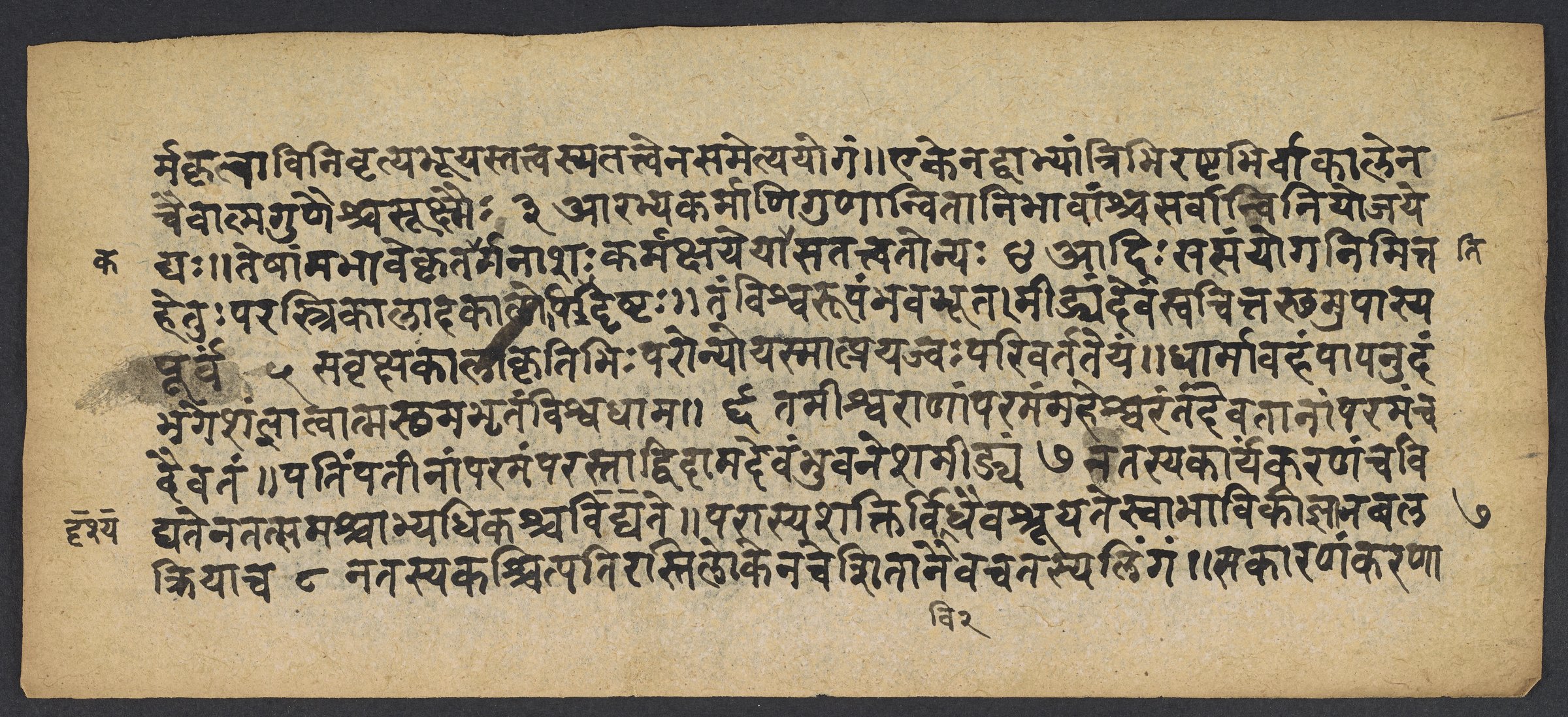
Where on the image
Penn Ms. Coll. 390 Item 1203, fol. 7r, fol. 7v. 6.3 begins at the end of fol. 7r line 9 ‹tat ka-› and goes on at fol. 7v line 1 ‹-rma kṛtvā vinivartya bhūyaḥ›; 6.4-6.8 follow to line 9 ‹jñānabalakriyā ca 8›. Checked on the image; readings logged in data/sources/upanishads/mapping_notes_1203.txt.
6.3tat karma kṛtvā vinivartya bhūyas tattvasya tattvena sametya yogam
ekena dvābhyāṃ tribhir aṣṭabhir vā kālena caivātmaguṇaiś ca sūkṣmaiḥ //
6.4ārabhya karmāṇi guṇānvitāni bhāvāṃś ca sarvān viniyojayed yaḥ
teṣām abhāve kṛtakarmanāśaḥ karmakṣaye yāti sa tattvato 'nyaḥ //
6.5ādiḥ sa saṃyoganimittahetuḥ paras trikālād akalo 'pi dṛṣṭaḥ
taṃ viśvarūpaṃ bhavabhūtam īḍyaṃ devaṃ svacittastham upāsya pūrvam //
6.6sa vṛkṣakālākṛtibhiḥ paro 'nyo yasmāt prapañcaḥ parivartate 'yaṃ
dharmāvahaṃ pāpanudaṃ bhageśaṃ jñātvātmastham amṛtaṃ viśvadhāma //
6.7tam īśvarāṇāṃ paramaṃ maheśvaraṃ taṃ devatānāṃ paramaṃ ca daivataṃ
patiṃ patīnāṃ paramaṃ parastād vidāma devaṃ bhuvaneśam īḍyam //
6.8na tasya kāryaṃ karaṇaṃ ca vidyate na tatsamaś cābhyadhikaś ca dṛśyate
parāsya śaktir vividhaiva śrūyate svābhāvikī jñānabalakriyā ca //
6.3He who, after he has done that work and rested again, and after he has brought together one essence (the self) with the other (matter), with one, two, three, or eight, with time also and with the subtile qualities of the mind,
6.4Who, after starting the works endowed with (the three) qualities, can order all things, yet when, in the absence of all these, he has caused the destruction of the work, goes on, being in truth different (from all he has produced);
6.5He is the beginning, producing the causes which unite (the soul with the body), and, being above the three kinds of time (past, present, future), he is seen as without parts, after we have first worshipped that adorable god, who has many forms, and who is the true source (of all things), as dwelling in our own mind.
6.6He is beyond all the forms of the tree (of the world) and of time, he is the other, from whom this world moves round, when one has known him who brings good and removes evil, the lord of bliss, as dwelling within the self, the immortal, the support of all.
6.7Let us know that highest great lord of lords, the highest deity of deities, the master of masters, the highest above, as god, the lord of the world, the adorable.
6.8There is no effect and no cause known of him, no one is seen like unto him or better; his high power is revealed as manifold, as inherent, acting as force and knowledge.
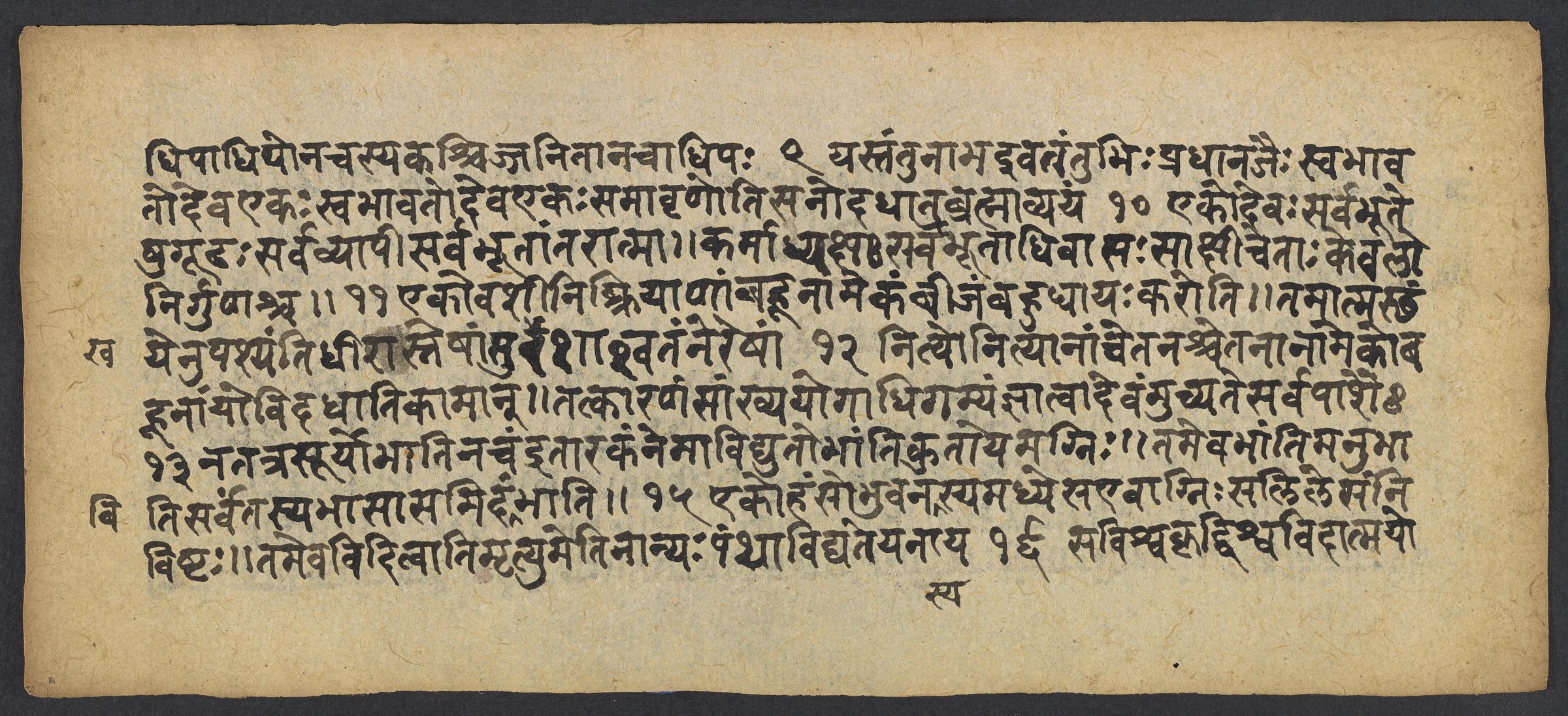
Where on the image
Penn Ms. Coll. 390 Item 1203, fol. 7v, fol. 8r. 6.9 begins at fol. 7v line 9 ‹na tasya kaścit patir asti loke› and ends at fol. 8r line 1 ‹na cādhipaḥ 9›; 6.10-6.15 follow to line 9 ‹vidyate 'yanāya›. Checked on the image; readings logged in data/sources/upanishads/mapping_notes_1203.txt.
6.9na tasya kaścit patir asti loke na ceśitā naiva ca tasya liṅgaṃ
sa kāraṇaṃ karaṇādhipādhipo na cāsya kaścij janitā na cādhipaḥ //
6.10yas tantunābha iva tantubhiḥ pradhānajaiḥ svabhāvataḥ
deva ekaḥ svam āvṛṇoti sa no dadhād brahmāpyayam //
6.11eko devaḥ sarvabhūteṣu gūḍhaḥ sarvavyāpī sarvabhūtāntarātmā
karmādhyakṣaḥ sarvabhūtādhivāsaḥ sākṣī cetā kevalo nirguṇaś ca //
6.12eko vaśī niṣkriyāṇāṃ bahūṇām ekaṃ bījaṃ bahudhā yaḥ karoti
tam ātmasthaṃ ye 'nupaśyanti dhīrās teṣāṃ sukhaṃ śāśvataṃ netareṣāṃ //
6.13nityo nityānāṃ cetanaś cetanānām eko bahūnāṃ yo vidadhāti kāmān
tat kāraṇaṃ sāṃkhyayogādhigamyaṃ jñātvā devaṃ mucyate sarvapāśaiḥ //
6.14na tatra sūryo bhāti na candratārakaṃ nemā vidyuto bhānti kuto 'yam agniḥ
tam eva bhāntam anubhāti sarvaṃ tasya bhāsā sarvam idaṃ vibhāti //
6.15eko haṃso bhuvanasyāsya madhye sa evāgniḥ salile saṃniviṣṭaḥ
tam eva viditvāti mṛtyum eti nānyaḥ panthā vidyate 'yanāya //
6.9There is no master of his in the world, no ruler of his, not even a sign of him. He is the cause, the lord of the lords of the organs, and there is of him neither parent nor lord.
6.10That only god who spontaneously covered himself, like a spider, with threads drawn from the first cause (pradhâna), grant us entrance into Brahman.
6.11He is the one God, hidden in all beings, all-pervading, the self within all beings, watching over all works, dwelling in all beings, the witness, the perceiver, the only one, free from qualities.
6.12He is the one ruler of many who (seem to act, but really do) not act; he makes the one seed manifold. The wise who perceive him within their self, to them belongs eternal happiness, not to others.
6.13He is the eternal among eternals, the thinker among thinkers, who, though one, fulfils the desires of many. He who has known that cause which is to be apprehended by Sânkhya (philosophy) and Yoga (religious discipline), he is freed from all fetters.
6.14The sun does not shine there, nor the moon and the stars, nor these lightnings, and much less this fire. When he shines, everything shines after him; by his light all this is lightened.
6.15He is the one bird in the midst of the world; he is also (like) the fire (of the sun) that has set in the ocean. A man who knows him truly, passes over death; there is no other path to go.
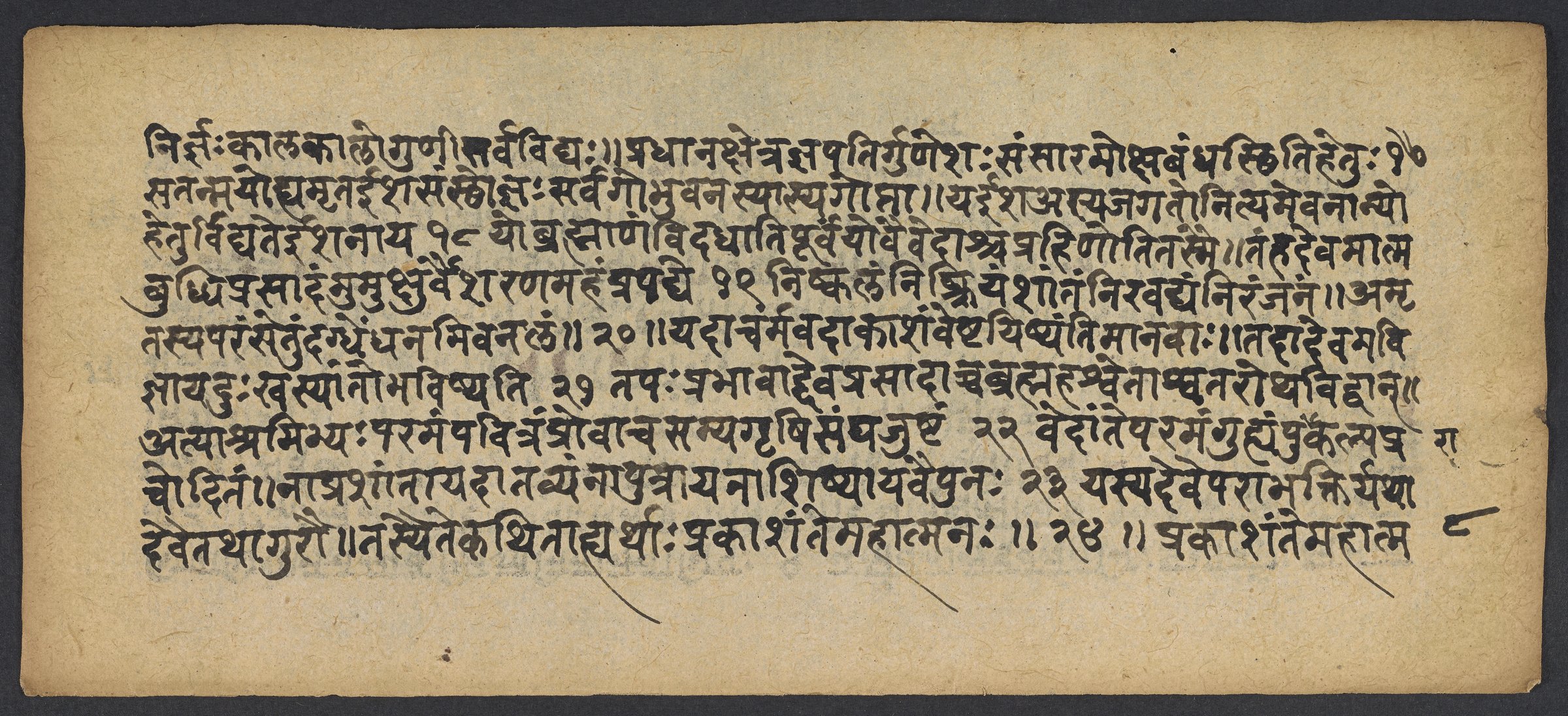
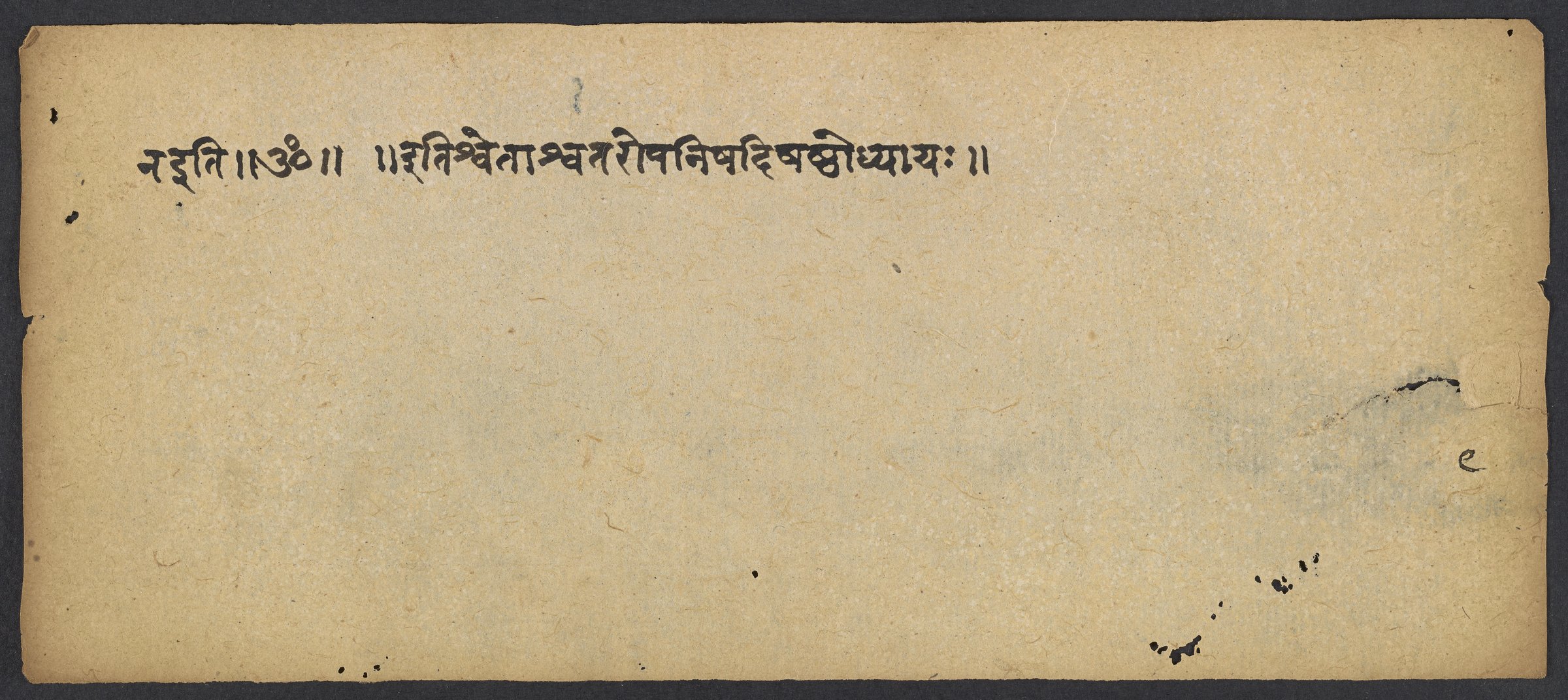
Where on the image
Penn Ms. Coll. 390 Item 1203, fol. 8r, fol. 8v, fol. 9r. 6.16 begins at fol. 8r line 9 ‹sa viśvakṛd viśvavid ātmayoniḥ› and ends at fol. 8v line 1 ‹saṃsāramokṣasthitibandhahetuḥ›; 6.17-6.23 follow to line 9 ‹prakāśante mahātmanaḥ ||24||›. The repeated closing words ‹prakāśante mahātma-› run over to fol. 9r, which has only ‹-na iti || oṃ ||› and the colophon ‹iti śvetāśvataropaniṣadi ṣaṣṭho 'dhyāyaḥ›. Checked on the image; readings logged in data/sources/upanishads/mapping_notes_1203.txt.
6.16sa viśvakṛd viśvavid ātmayonir jñaḥ kālakālo guṇī sarvavidyaḥ
pradhānakṣetrajñapatir guṇeśaḥ saṃsāramokṣasthitibandhahetuḥ //
6.17sa tanmayo hy amṛta īśasaṃstho jñaḥ sarvago bhuvanasyāsya goptā
sa īśe asya jagato nityam eva nānyo hetur vidyata īśanāya //
6.18yo brahmāṇaṃ vidadhāti pūrvaṃ yo vai vedāṃś ca prahiṇoti tasmai
taṃ ha devam ātmabuddhiprakāśaṃ mumukṣur vai śaraṇam ahaṃ prapadye //
6.19niṣkalaṃ niṣkriyaṃ śāntaṃ niravadyaṃ nirañjanam
amṛtasya paraṃ setuṃ dagdhendhanam ivānalam //
6.20yadā carmavad ākāśaṃ veṣṭayiṣyanti mānavāḥ
tadā devam avijñāya duḥkhasyānto bhaviṣyati //
6.21tapaḥprabhāvād devaprasādāt brahma ha śvetāśvataro 'tha vidvān
atyāśramibhyaḥ paramaṃ pavitraṃ provāca samyag ṛṣisaṅghajuṣṭam //
6.22vedānte paramaṃ guhyaṃ purākalpe pracoditam
nāpraśāntāya dātavyaṃ nāputrāyāśiṣyāya vā punaḥ //
6.23yasya deve parā bhaktir yathā deve tathā gurau
tasyaite kathitā hy arthāḥ prakāśante mahātmanaḥ prakāśante mahātmanaḥ //
6.16He makes all, he knows all, the self-caused, the knower, the time of time (destroyer of time), who assumes qualities and knows everything, the master of nature and of man, the lord of the three qualities (guna), the cause of the bondage, the existence, and the liberation of the world.
6.17He who has become that, he is the immortal, remaining the lord, the knower, the ever-present guardian of this world, who rules this world for ever, for no one else is able to rule it.
6.18Seeking for freedom I go for refuge to that God who is the light of his own thoughts, he who first creates Brahman (m.) and delivers the Vedas to him;
6.19Who is without parts, without actions, tranquil, without fault, without taint, the highest bridge to immortality—like a fire that has consumed its fuel.
6.20Only when men shall roll up the sky like a hide, will there be an end of misery, unless God has first been known.
6.21Through the power of his penance and through the grace of God has the wise Svetâsvatara truly proclaimed Brahman, the highest and holiest, to the best of ascetics, as approved by the company of Rishis.
6.22This highest mystery in the Vedânta, delivered in a former age, should not be given to one whose passions have not been subdued, nor to one who is not a son, or who is not a pupil.
6.23If these truths have been told to a high-minded man, who feels the highest devotion for God, and for his Guru as for God, then they will shine forth,—then they will shine forth indeed.
Notes
- Sanskrit: GRETIL, Svetasvataropanisad (input by S. H., proofread by John Manetta, after the electronic text of Sanskrit Documents), verse numbers adhyaya.verse. The opening words 'oṃ brahmavādino vadanti', which the file prints before 1.1, are not shown; the manuscript has them at the start of fol. 1v.
- Verses 3.14, 3.15, 4.6 and 4.8 are given in full in the Sanskrit and English, but the manuscript writes only their first and last words (see the scan notes).
- English: F. Max Müller, 'Svetasvatara-upanishad', The Upanishads part II, Sacred Books of the East 15 (1884), pp. 231-267. No proofread transcription exists online, so the text was transcribed for this collection from the page images of the archive.org copy p2upanishads00mluoft and checked word by word against the OCR of that copy and of a second copy (upanishads02ml); every difference was looked up on the page images (data/sources/upanishads/english/muller1884_svetasvatara.txt). Footnotes are not reproduced. Müller's verse numbers agree with the Sanskrit edition throughout.
Cite
Sources
- Source: Penn Ms. Coll. 390 Item 1203 (OPenn, public domain) + GRETIL Sanskrit + F. Max Müller (1884) English (holding institution)
- Critical edition: GRETIL Sanskrit e-texts (Isa, Katha, Prasna, Mandukya, Aitareya, Taittiriya, Svetasvatara, Chandogya); Nirnaya Sagar edition of 1925, transcribed (Kena, Mundaka)
← previous · → next · v cycle view · l back to library