Chandogya Upanishad, Prapathaka 3 (the honey of the gods; Sandilya; Ghora Angirasa)
Introduction
The Chandogya Upanishad belongs to the Samaveda and is one of the two longest and oldest Upanishads. It has eight chapters (prapathakas). This entry gives chapter 3. It contains the meditation on the sun as the honey of the gods (3.1-11), the Gayatri (3.12), the doors of the heart (3.13), Sandilya's teaching that 'all this is Brahman' and the self within the heart is smaller than a grain and greater than the worlds (3.14), the universe as a chest (3.15), man as a sacrifice (3.16), Ghora Angirasa's teaching to Krishna son of Devaki (3.17), mind and space as Brahman (3.18) and the world egg (3.19).
The page images come from University of Pennsylvania Libraries, Ms. Coll. 390 Item 945, a paper manuscript of 74 leaves (11 x 17 cm) holding the whole Chandogya Upanishad, written in Devanagari, 10 to 11 lines to a side, on blue machine-made paper with watermarks; it is undated (catalogued 18th or 19th century). The scribe numbers the khandas and closes each chapter with a colophon, but does not number paragraphs. Chapter 3 runs from fol. 20v to fol. 29v.
For every page, the first and last words were read on the image and found in the edited text; the page boundaries follow from them. Each section below holds the paragraphs that end on one page, with every page they occupy.
How was this verified? (Provenance)
Where on the image
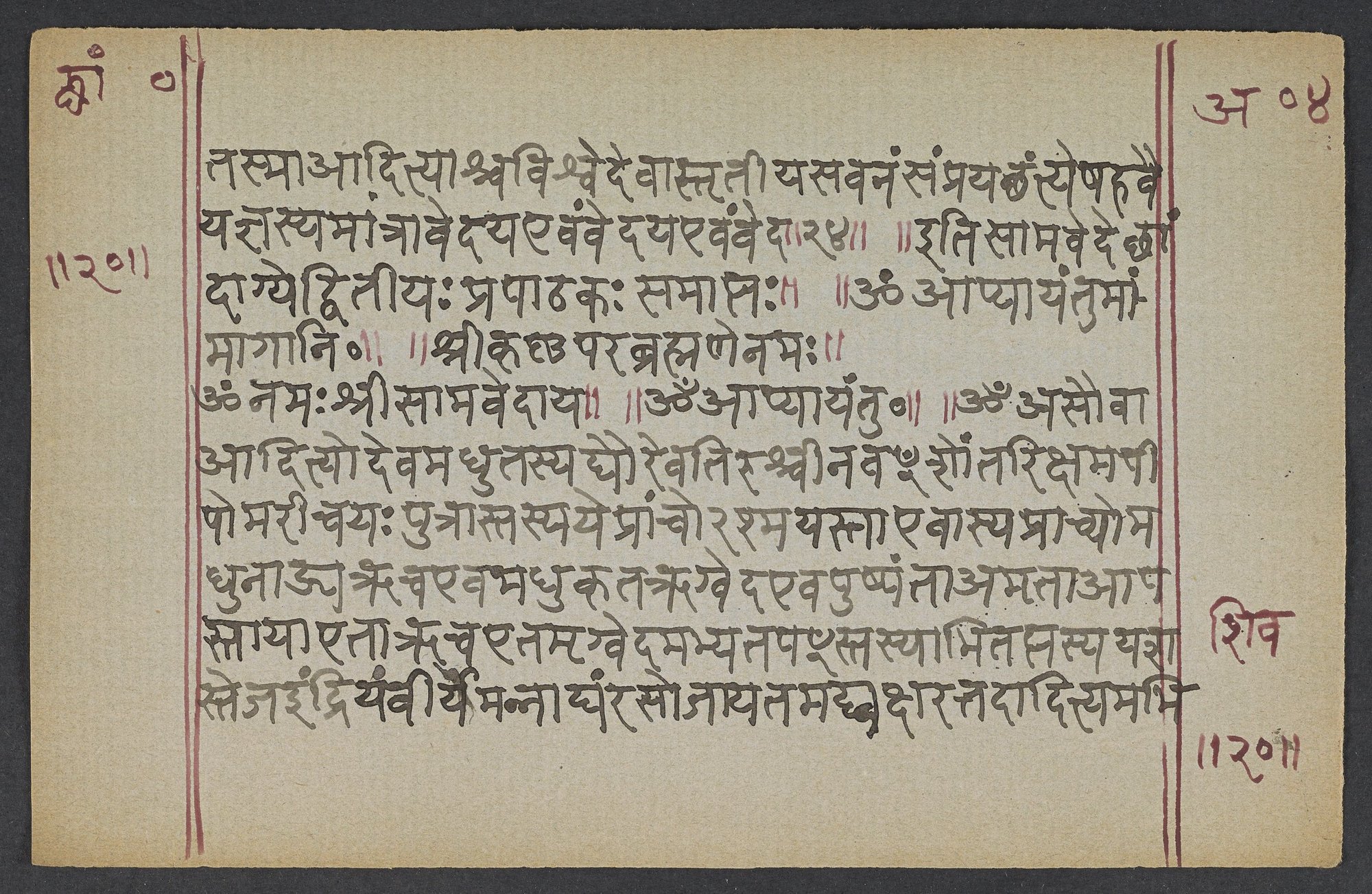
Penn Ms. Coll. 390 Item 945. fol. 20v begins ‹asau vā ādityo devamadhu tasya dyaur eva tiraścīnavaṃśaḥ› and ends ‹teja indriyaṃ vīryam annādyaṃ raso 'jāyata tad vyakṣarat tad ādityam abhi› (first and last words read on the image, transliterated). The words were located in the GRETIL text by string matching and the page boundaries follow from them; readings and results are stored in data/sources/upanishads/mapping_945.json.
1.1asau vā ādityo devamadhu |
tasya dyaur eva tiraścīnavaṃśaḥ |
antarikṣam apūpaḥ |
marīcayaḥ putrāḥ ||
1.2tasya ye prāñco raśmayas tā evāsya prācyo madhunāḍyaḥ |
ṛca eva madhukṛtaḥ |
ṛgveda eva puṣpam |
tā amṛtā āpaḥ |
tā vā etā ṛcaḥ ||
1.3etam ṛgvedam abhyatapan |
tasyābhitaptasya yaśas teja indriyaṃ vīryam annādyaṃ raso 'jāyata ||
1.1The sun is indeed the honey of the Devas. The heaven is the cross-beam (from which) the sky (hangs as) a hive, and the bright vapours are the eggs of the bees.
1.2The eastern rays of the sun are the honey-cells in front. The Rik verses are the bees, the Rig-veda (sacrifice) is the flower, the water (of the sacrificial libations) is the nectar (of the flower).
1.3Those very Rik verses then (as bees) brooded over the Rig-veda sacrifice (the flower); and from it, thus brooded on, sprang as its (nectar) essence, fame, glory of countenance, vigour, strength, and health.
Where on the image
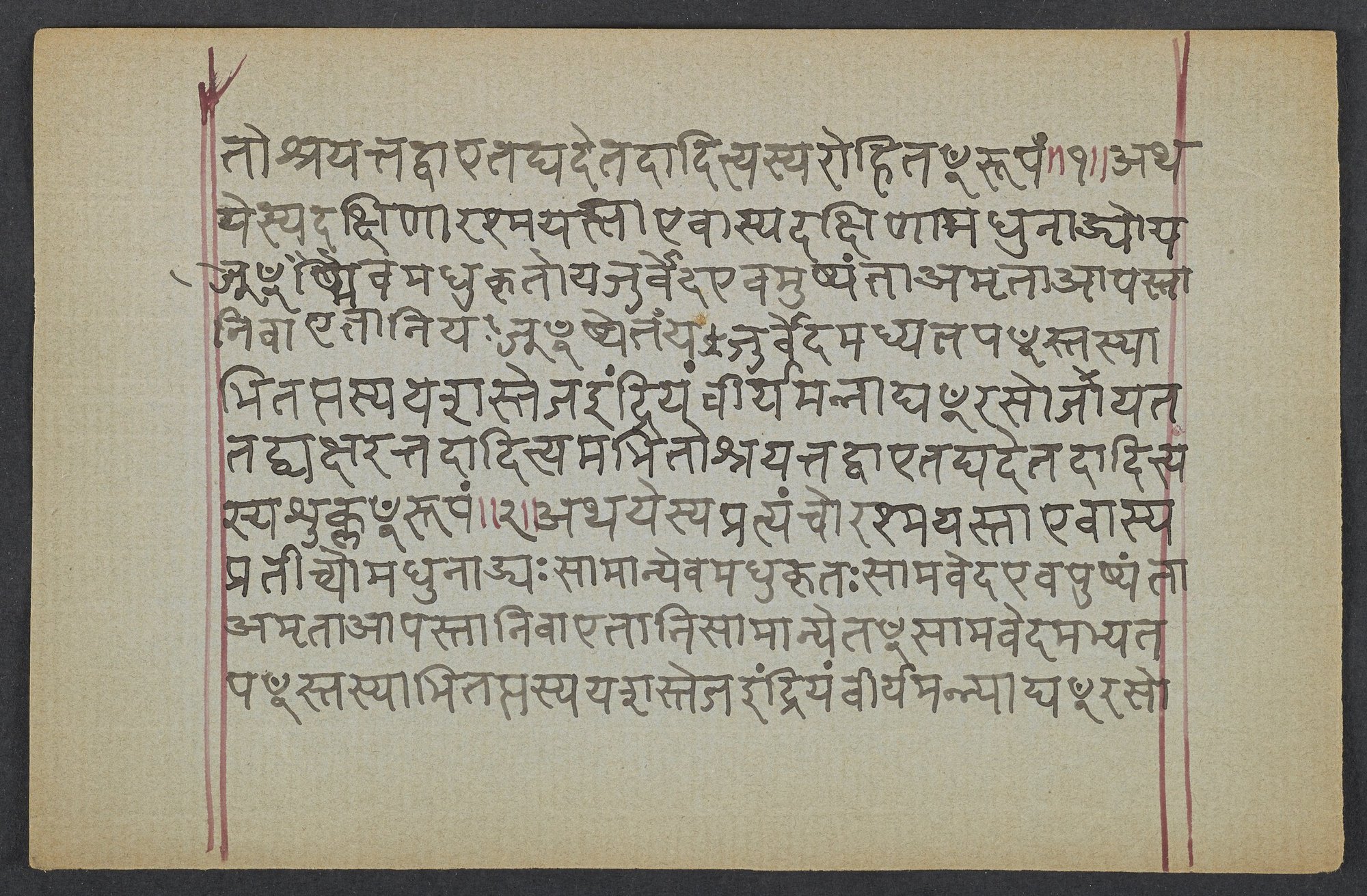
Penn Ms. Coll. 390 Item 945. fol. 20v begins ‹asau vā ādityo devamadhu tasya dyaur eva tiraścīnavaṃśaḥ› and ends ‹teja indriyaṃ vīryam annādyaṃ raso 'jāyata tad vyakṣarat tad ādityam abhi›; fol. 21r begins ‹to 'śrayat tad vā etad yad etad ādityasya rohitaṃ rūpam› and ends ‹yaśas teja indriyaṃ vīryam annādyaṃ raso› (first and last words read on the image, transliterated). The words were located in the GRETIL text by string matching and the page boundaries follow from them; readings and results are stored in data/sources/upanishads/mapping_945.json.
1.4tad vyakṣarat |
tad ādityam abhito 'śrayat |
tad vā etad yad etad ādityasya rohitaṃ rūpam ||
2.1atha ye 'sya dakṣiṇā raśmayas tā evāsya dakṣiṇā madhunāḍyaḥ |
yajūṃṣy eva madhukṛtaḥ |
yajurveda eva puṣpam |
tā amṛtā āpaḥ ||
2.2tāni vā etāni yajūṃṣy etaṃ yajurvedam abhyatapan |
tasya abhitaptasya yaśas teja indriyaṃ vīryam annādyaṃ raso 'jāyata ||
2.3tad vyakṣarat |
tad ādityam abhito 'śrayat |
tad vā etad yad etad ādityasya śuklaṃ rūpam ||
3.1atha ye 'sya pratyañco raśmāyas tā evāsya pratīcyo madhunāḍyaḥ |
sāmāny eva madhukṛtaḥ |
sāmaveda eva puṣpam |
tā amṛtā āpaḥ ||
1.4That (essence) flowed forth and went towards the sun. And that forms what we call the red (rohita) light of the rising sun.
2.1The southern rays of the sun are the honey-cells on the right. The Yagus verses are the bees, the Yagur-veda sacrifice is the flower, the water (of the sacrificial libations) is the nectar (of the flower).
2.2Those very Yagus verses (as bees) brooded over the Yagur-veda sacrifice (the flower); and from it, thus brooded on, sprang as its (nectar) essence, fame, glory of countenance, vigour, strength, and health.
2.3That flowed forth and went towards the sun. And that forms what we call the white (sukla) light of the sun.
3.1The western rays of the sun are the honey-cells behind. The Sâman verses are the bees, the Sâma-veda sacrifice is the flower, the water is the nectar.
Where on the image
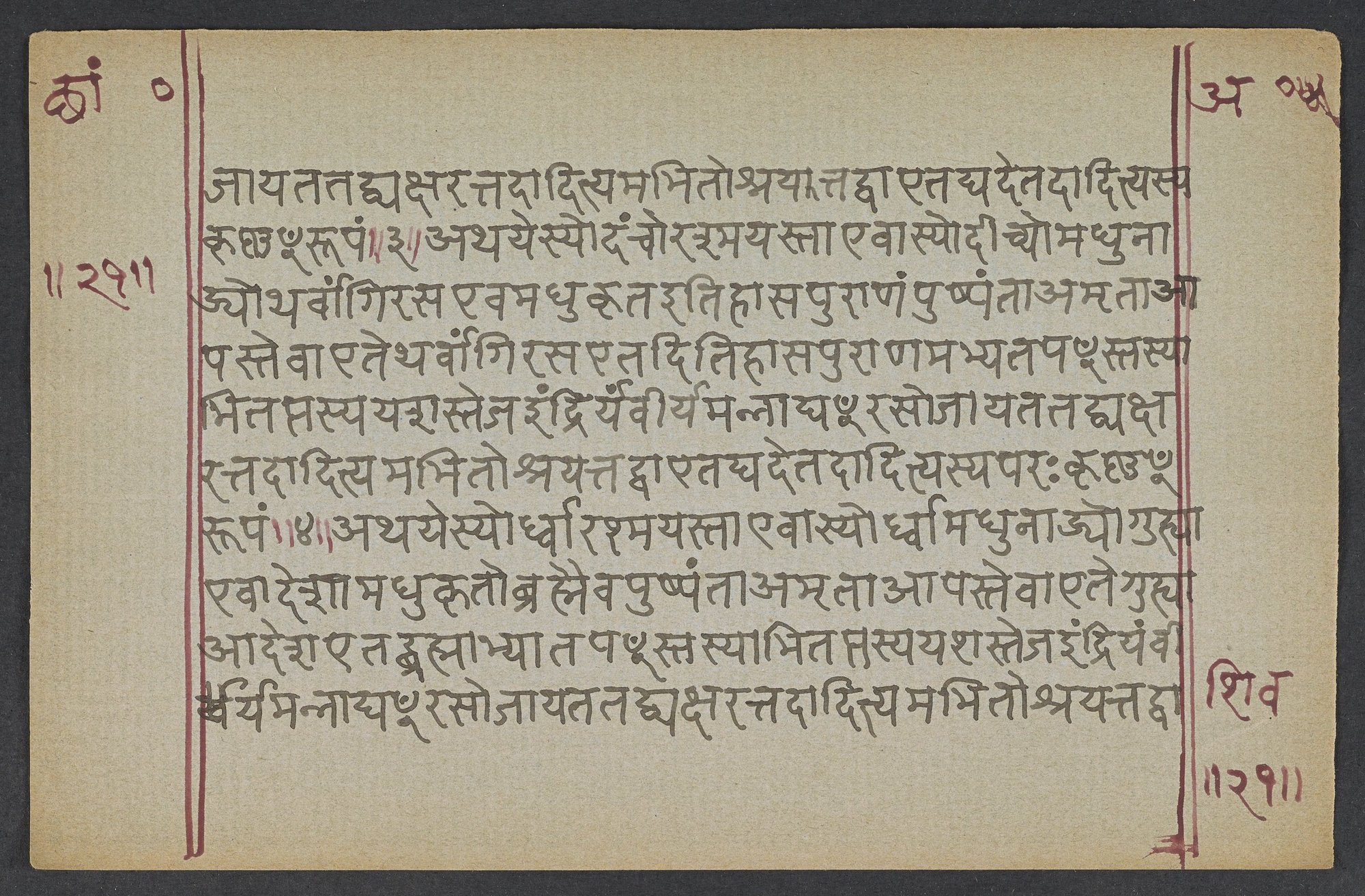
Penn Ms. Coll. 390 Item 945. fol. 21r begins ‹to 'śrayat tad vā etad yad etad ādityasya rohitaṃ rūpam› and ends ‹yaśas teja indriyaṃ vīryam annādyaṃ raso›; fol. 21v begins ‹'jāyata tad vyakṣarat tad ādityam abhito 'śrayat tad vā etad yad etad ādityasya kṛṣṇaṃ rūpam› and ends ‹vīryam annādyaṃ raso 'jāyata tad vyakṣarat tad ādityam abhito 'śrayat tad vā› (first and last words read on the image, transliterated). The words were located in the GRETIL text by string matching and the page boundaries follow from them; readings and results are stored in data/sources/upanishads/mapping_945.json.
3.2tāni vā etāni sāmāny etaṃ sāmavedam abhyatapan |
tasyābhitaptasya yaśas teja indriyaṃ vīryam annādyaṃ raso 'jāyata ||
3.3tad vyakṣarat |
tad ādityam abhito 'śrayat |
tad vā etad yad etad ādityasya kṛṣṇaṃ rūpam ||
4.1atha ye 'syodañco raśmayas tā evāsyodīcyo madhunāḍyaḥ |
atharvāṅgirasa eva madhukṛtaḥ |
itihāsapurāṇaṃ puṣpam |
tā amṛtā āpaḥ ||
4.2te vā ete 'tharvāṅgirasa etad itihāsapūrāṇam abhyatapan |
tasyābhitaptasya yaśas teja indriyāṃ vīryam annādyaṃ raso 'jāyata ||
4.3tad vyakṣarat |
tad ādityam abhito 'śrayat |
tad vā etad yad etad ādityasya paraḥkṛṣṇaṃ rūpam ||
5.1atha ye 'syordhvā raśmayas tā evāsyordhvā madhunāḍyaḥ |
guhyā evādeśā madhukṛtaḥ |
brahmaiva puṣpaṃ |
tā amṛtā āpaḥ ||
5.2te vā ete guhyā ādeśā etad brahmābhyatapan |
tasyābhitaptasya yaśas teja indriyaṃ vīryam annādyaṃ raso 'jāyata ||
3.2Those very Sâman verses (as bees) brooded over the Sâma-veda sacrifice; and from it, thus brooded on, sprang as its (nectar) essence, fame, glory of countenance, vigour, strength, and health.
3.3That flowed forth and went towards the sun. And that forms what we call the dark (krishna) light of the sun.
4.1The northern rays of the sun are the honey-cells on the left. The (hymns of the) Atharvângiras are the bees, the Itihâsa-purâna (the reading of the old stories) is the flower, the water is the nectar.
4.2Those very hymns of the Atharvângiras (as bees) brooded over the Itihâsa-purâna; and from it, thus brooded on, sprang as its (nectar) essence, fame, glory of countenance, vigour, strength, and health.
4.3That flowed forth, and went towards the sun. And that forms what we call the extreme dark (parah krishnam) light of the sun.
5.1The upward rays of the sun are the honey-cells above. The secret doctrines are the bees, Brahman (the Om) is the flower, the water is the nectar.
5.2Those secret doctrines (as bees) brooded over Brahman (the Om); and from it, thus brooded on, sprang as its (nectar) essence, fame, glory of countenance, brightness, vigour, strength, and health.
Where on the image
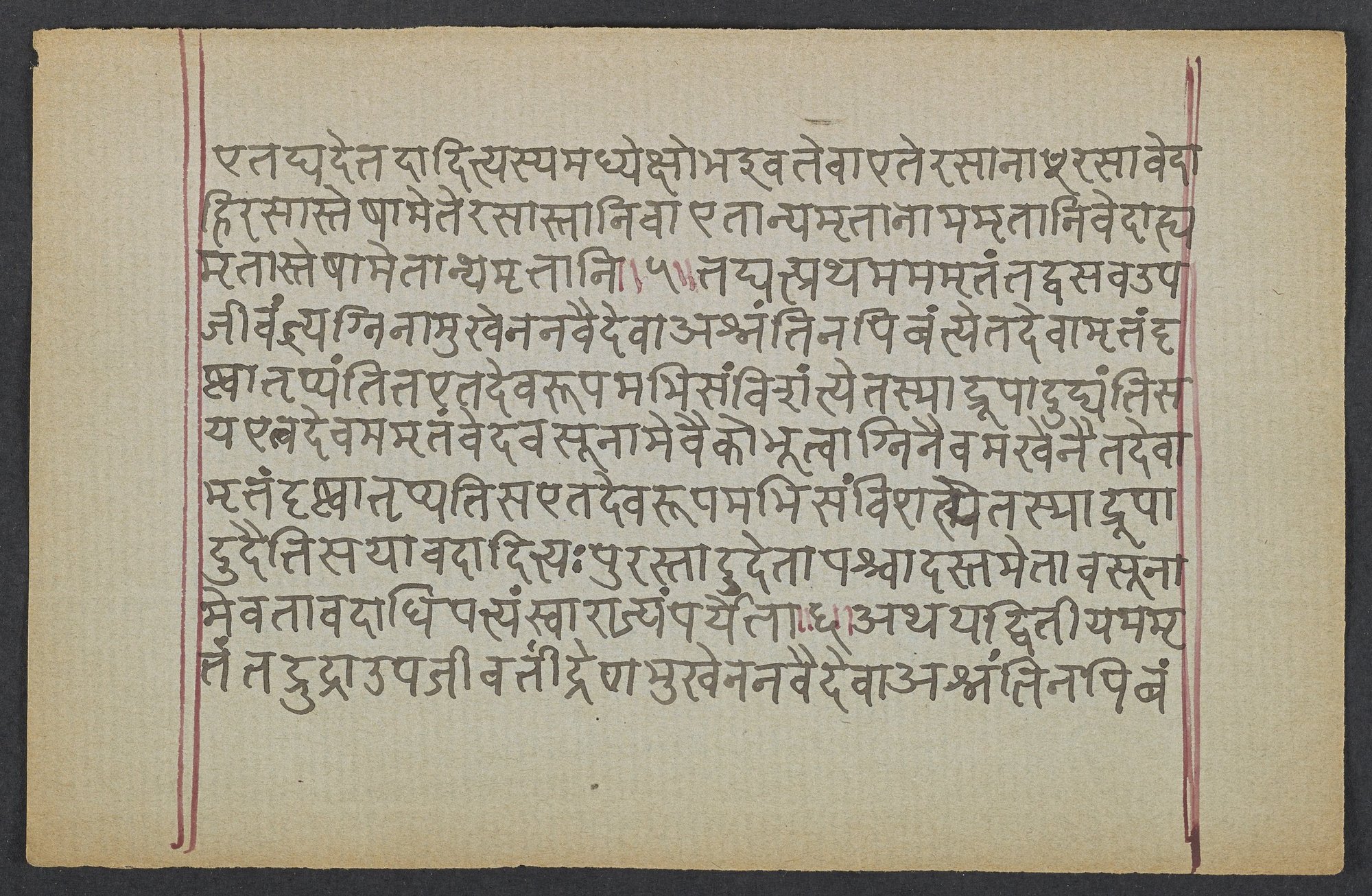
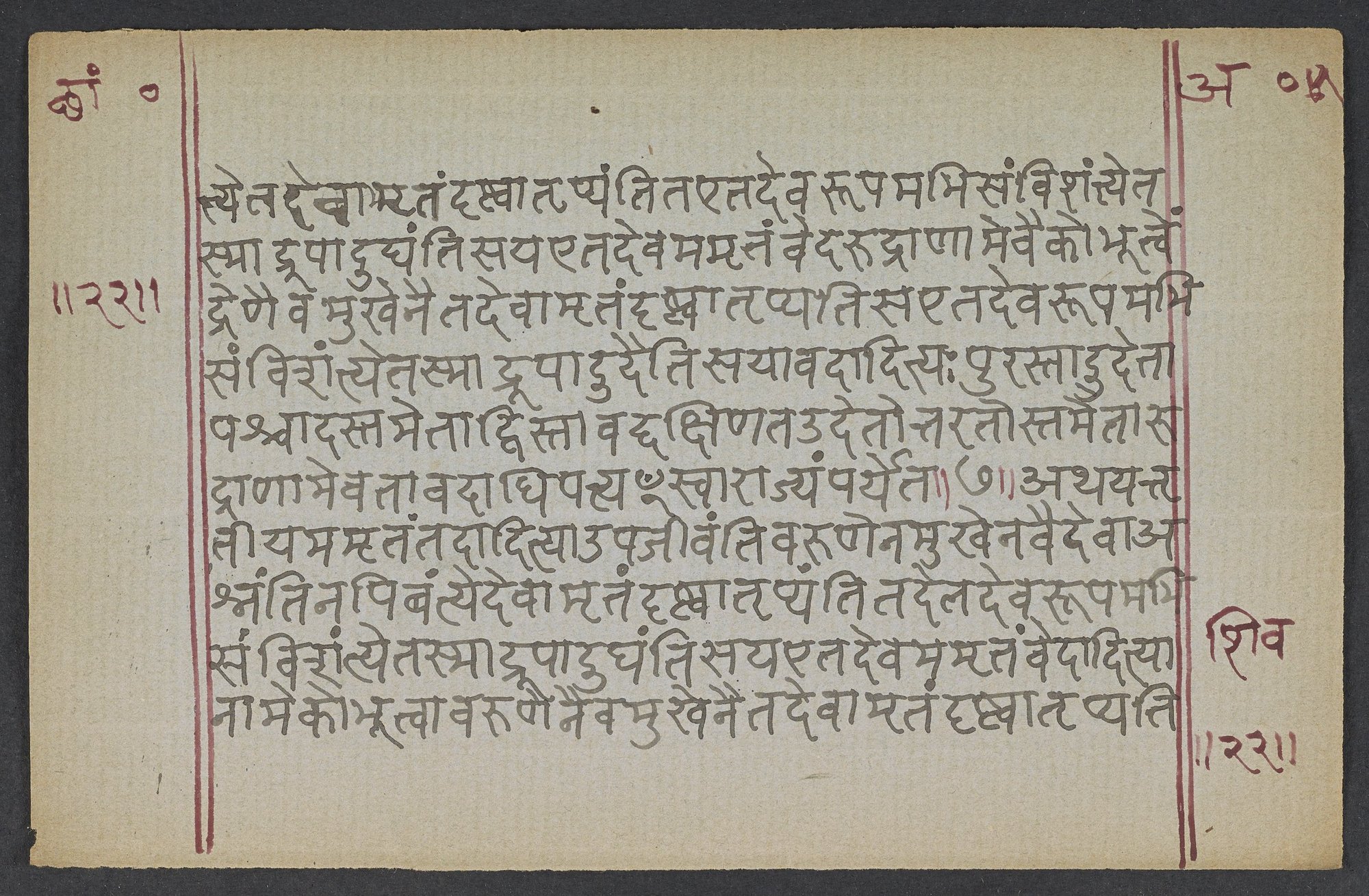
Penn Ms. Coll. 390 Item 945. fol. 21v begins ‹'jāyata tad vyakṣarat tad ādityam abhito 'śrayat tad vā etad yad etad ādityasya kṛṣṇaṃ rūpam› and ends ‹vīryam annādyaṃ raso 'jāyata tad vyakṣarat tad ādityam abhito 'śrayat tad vā›; fol. 22r begins ‹etad yad etad ādityasya madhye kṣobhata iva› and ends ‹atha yad dvitīyam amṛtaṃ tad rudrā upajīvantīndreṇa mukhena na vai devā aśnanti na pibanty› (first and last words read on the image, transliterated). The words were located in the GRETIL text by string matching and the page boundaries follow from them; readings and results are stored in data/sources/upanishads/mapping_945.json.
5.3tad vyakṣarat |
tad ādityam abhito 'śrayat |
tad vā etad yad etad ādityasya madhye kṣobhata iva ||
5.4te vā ete rasānāṃ rasāḥ |
vedā hi rasāḥ |
teṣām ete rasāḥ |
tāni vā etāny amṛtānām amṛtāni |
vedā hy amṛtāḥ |
teṣām etāny amṛtāni ||
6.1tad yat prathamam amṛtaṃ tad vasava upajīvanty agninā mukhena |
na vai devā aśnanti na pibanti |
etad evāmṛtaṃ dṛṣṭvā tṛpyanti ||
6.2ta etad eva rūpam abhisaṃviśanti |
etasmād rūpād udyanti ||
6.3sa ya etad evam amṛtaṃ veda vasūnām evaiko bhūtvāgninaiva mukhenaitad evāmṛtaṃ dṛṣṭvā tṛpyati |
sa etad eva rūpam abhisaṃviśati |
etasmād rūpād udeti ||
6.4sa yāvad ādityaḥ purastād udetā paścād astam etā vasūnām eva tāvad ādhipatyaṃ svārājyaṃ paryetā ||
5.3That flowed forth, and went towards the sun. And that forms what seems to stir in the centre of the sun.
5.4These (the different colours in the sun) are the essences of the essences. For the Vedas are essences (the best things in the world); and of them (after they have assumed the form of sacrifice) these (the colours rising to the sun) are again the essences. They are the nectar of the nectar. For the Vedas are nectar (immortal), and of them these are the nectar.
6.1On the first of these nectars (the red light, which represents fame, glory of countenance, vigour, strength, health) the Vasus live, with Agni at their head. True, the Devas do not eat or drink, but they enjoy by seeing the nectar.
6.2They enter into that (red) colour, and they rise from that colour.
6.3He who thus knows this nectar, becomes one of the Vasus, with Agni at their head, he sees the nectar and rejoices. And he, too, having entered that colour, rises again from that colour.
6.4So long as the sun rises in the east and sets in the west, so long does he follow the sovereign supremacy of the Vasus.
Where on the image
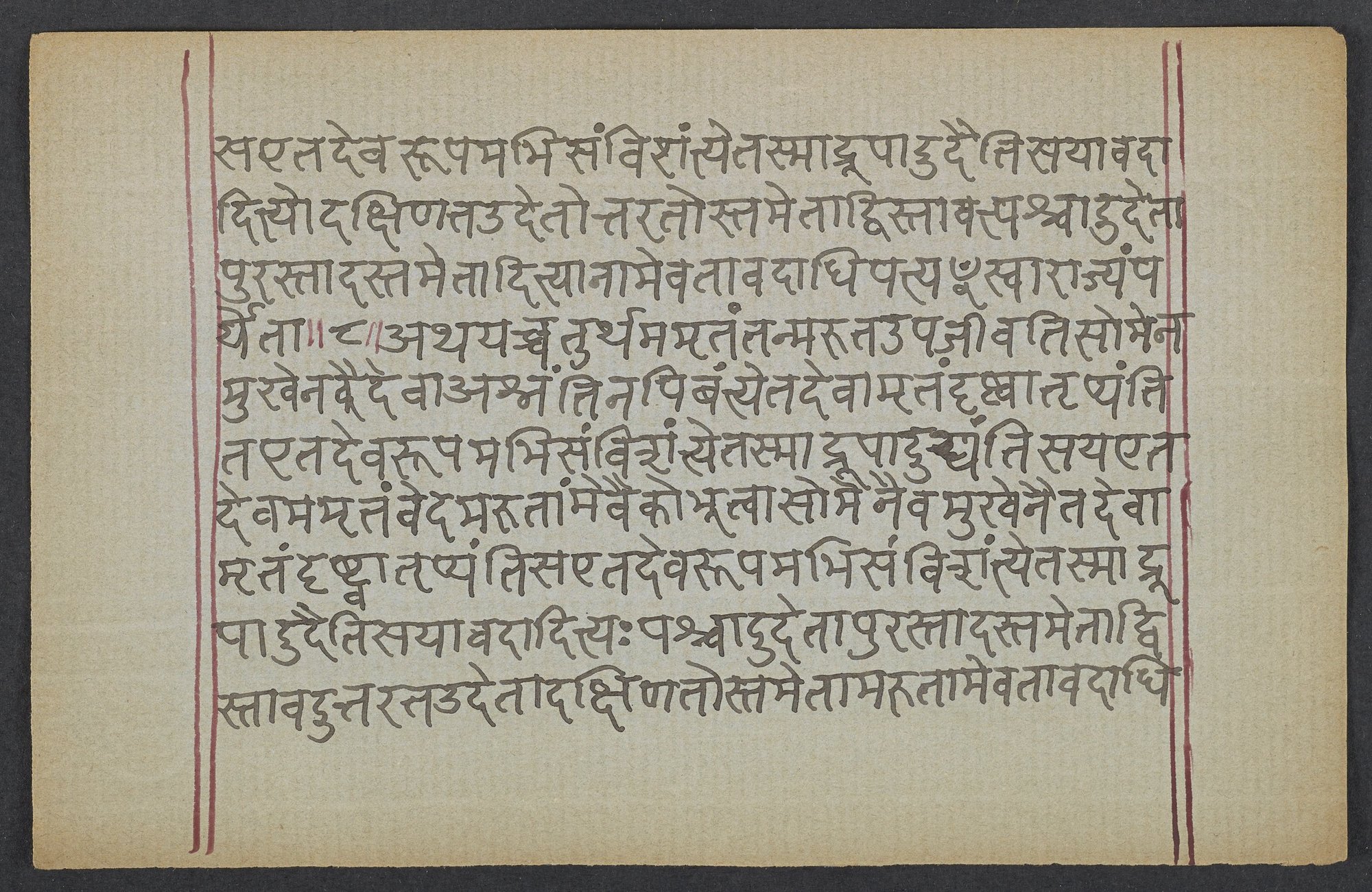
Penn Ms. Coll. 390 Item 945. fol. 22r begins ‹etad yad etad ādityasya madhye kṣobhata iva› and ends ‹atha yad dvitīyam amṛtaṃ tad rudrā upajīvantīndreṇa mukhena na vai devā aśnanti na pibanty›; fol. 22v begins ‹ty etad evāmṛtaṃ dṛṣṭvā tṛpyanti ta etad eva rūpam abhisaṃviśanty etasmād rūpād udyanti› and ends ‹nām eko bhūtvā varuṇenaiva mukhenaitad evāmṛtaṃ dṛṣṭvā tṛpyati› (first and last words read on the image, transliterated). The words were located in the GRETIL text by string matching and the page boundaries follow from them; readings and results are stored in data/sources/upanishads/mapping_945.json.
7.1atha yad dvitīyam amṛtaṃ tad rudrā upajīvantīndreṇa mukhena |
na vai devā aśnanti na pibanti |
etad evāmṛtaṃ dṛṣṭvā tṛpyanti ||
7.2ta etad eva rūpam abhisaṃviśanti |
etasmād rūpād udyanti ||
7.3sa ya etad evam amṛtaṃ veda rudrāṇām evaiko bhūtvendreṇaiva mukhenaitad evāmṛtaṃ dṛṣṭvā tṛpyati |
sa etad eva rūpam abhisaṃviśati |
etasmād rūpād udeti ||
7.4sa yāvad ādityaḥ purastād udetā paścād astam etā dvis tāvad dakṣiṇata udetottarato 'stam etā rudrāṇām eva tāvad ādhipatyaṃ svārājyaṃ paryetā ||
8.1atha yat tṛtīyam amṛtaṃ tad ādityā upajīvanti varuṇena mukhena |
na vai devā aśnanti na pibanti |
etad evāmṛtaṃ dṛṣṭvā tṛpyanti ||
8.2ta etad eva rūpam abhisaṃviśanti |
etasmād rūpād udyanti ||
7.1On the second of these nectars the Rudras live, with Indra at their head. True, the Devas do not eat or drink, but they enjoy by seeing the nectar.
7.2They enter into that white colour, and they rise from that colour.
7.3He who thus knows this nectar, becomes one of the Rudras, with Indra at their head, he sees the nectar and rejoices. And he, having entered that colour, rises again from that colour.
7.4So long as the sun rises in the east and sets in the west, twice as long does it rise in the south and set in the north; and so long does he follow the sovereign supremacy of the Rudras.
8.1On the third of these nectars the Âdityas live, with Varuna at their head. True, the Devas do not eat or drink, but they enjoy by seeing the nectar.
8.2They enter into that (dark) colour, and they rise from that colour.
Where on the image
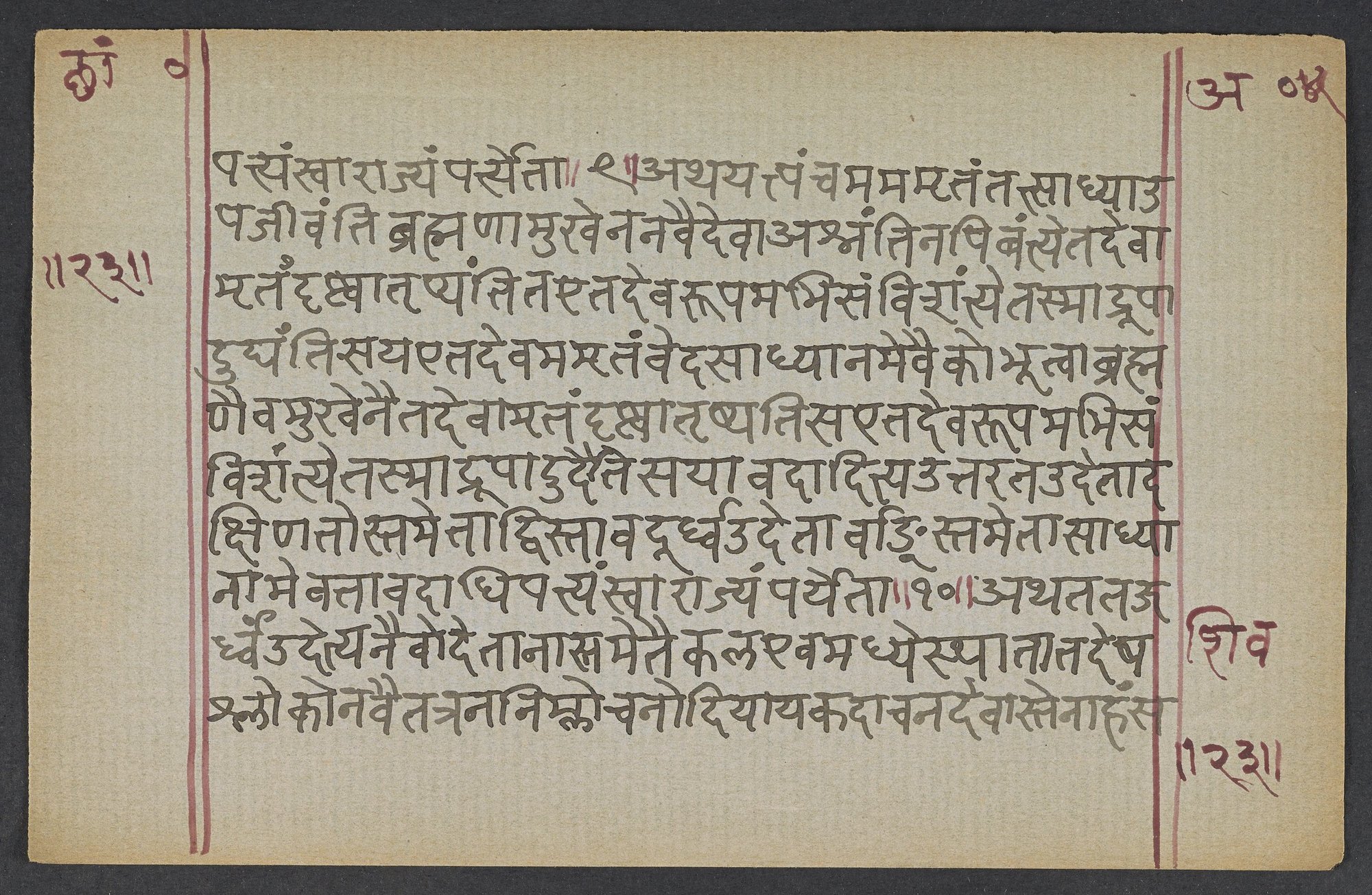
Penn Ms. Coll. 390 Item 945. fol. 22v begins ‹ty etad evāmṛtaṃ dṛṣṭvā tṛpyanti ta etad eva rūpam abhisaṃviśanty etasmād rūpād udyanti› and ends ‹nām eko bhūtvā varuṇenaiva mukhenaitad evāmṛtaṃ dṛṣṭvā tṛpyati›; fol. 23r begins ‹sa etad eva rūpam abhisaṃviśaty etasmād rūpād udeti sa yāvad ādityo dakṣiṇata udetā› and ends ‹uttarata udetā dakṣiṇato 'stam etā marutām eva tāvad ādhi› (first and last words read on the image, transliterated). The words were located in the GRETIL text by string matching and the page boundaries follow from them; readings and results are stored in data/sources/upanishads/mapping_945.json.
8.3sa ya etad evam amṛtaṃ vedādityānām evaiko bhūtvā varuṇenaiva mukhenaitad evāmṛtaṃ dṛṣṭvā tṛpyati |
sa etad eva rūpam abhisaṃviśati |
etasmād rūpād udeti ||
8.4sa yāvad ādityo dakṣiṇata udetottarato 'stam etā dvis tāvat paścād udetā purastād astam etādityānām eva tāvad ādhipatyaṃ svārājyaṃ paryetā ||
9.1atha yac caturtham amṛtaṃ tan maruta upajīvanti somena mukhena |
na vai devā aśnanti na pibanti |
etad evāmṛtaṃ dṛṣṭvā tṛpyanti ||
9.2ta etad eva rūpam abhisaṃviśanti |
etasmād rūpād udyanti ||
9.3sa ya etad evam amṛtaṃ veda marutām evaiko bhūtvā somenaiva mukhenaitad evāmṛtaṃ dṛṣṭvā tṛpyati |
sa etad eva rūpam abhisaṃviśati |
etasmād rūpād udeti ||
8.3He who thus knows this nectar, becomes one of the Âdityas, with Varuna at their head, he sees the nectar and rejoices. And he, having entered that colour, rises again from that colour.
8.4So long as the sun rises in the south and sets in the north, twice as long does it rise in the west and set in the east; and so long does he follow the sovereign supremacy of the Âdityas.
9.1On the fourth of these nectars the Maruts live, with Soma at their head. True, the Devas do not eat or drink, but they enjoy by seeing the nectar.
9.2They enter in that (very dark) colour, and they rise from that colour.
9.3He who thus knows this nectar, becomes one of the Maruts, with Soma at their head, he sees the nectar and rejoices. And he, having entered that colour, rises again from that colour.
Where on the image
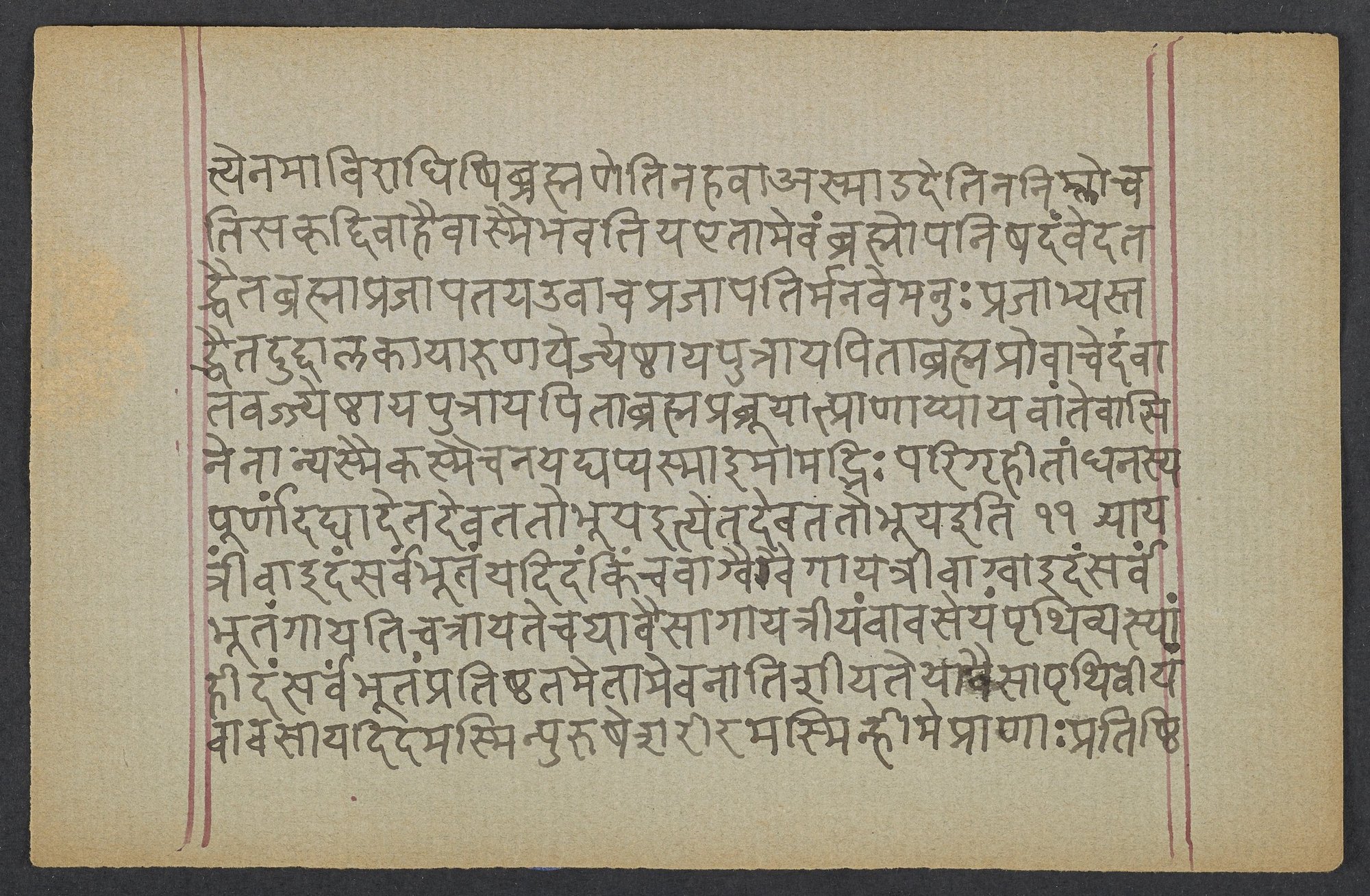
Penn Ms. Coll. 390 Item 945. fol. 23r begins ‹sa etad eva rūpam abhisaṃviśaty etasmād rūpād udeti sa yāvad ādityo dakṣiṇata udetā› and ends ‹uttarata udetā dakṣiṇato 'stam etā marutām eva tāvad ādhi›; fol. 23v begins ‹patyaṃ svārājyaṃ paryetā atha yat pañcamam amṛtaṃ tat sādhyā upajīvanti› and ends ‹ekala eva madhye sthātā tad eṣa ślokaḥ na vai tatra na nimloca nodiyāya kadācana devās tenāhaṃ›; fol. 24r begins ‹satyena mā virādhiṣi brahmaṇeti na ha vā asmā udeti› and ends ‹yad idam asmin puruṣe śarīram asmin hīme prāṇāḥ pratiṣṭhi› (first and last words read on the image, transliterated). Notes: Müller divides khanda 3.11 into paragraphs differently from the Sanskrit edition; the whole khanda is given here with his own numbers. The words were located in the GRETIL text by string matching and the page boundaries follow from them; readings and results are stored in data/sources/upanishads/mapping_945.json.
9.4sa yāvad ādityaḥ paścād udetā purastād astam etā dvis tāvad uttarata udetā dakṣiṇato 'stam etā marutām eva tāvad ādhipatyaṃ svārājyaṃ paryetā ||
10.1atha yat pañcamam amṛtaṃ tat sādhyā upajīvanti brahmaṇā mukhena |
na vai devā aśnanti na pibanti |
etad evāmṛtaṃ dṛṣṭvā tṛpyanti ||
10.2ta etad eva rūpam abhisaṃviśanti |
etasmād rūpād udyanti ||
10.3sa ya etad evam amṛtaṃ veda sādhyānām evaiko bhūtvā brahmaṇaiva mukhenaitad evāmṛtaṃ dṛṣṭvā tṛpyati |
sa etad eva rūpam abhisaṃviśati |
etasmād rūpād udeti ||
10.4sa yāvad āditya uttarata udetā dakṣiṇato 'stam etā dvis tāvad ūrdhvam udetārvāg astam etā sādhyānām eva tāvad ādhipatyaṃ svārājyaṃ paryetā ||
11.1iti chāndogyopaniṣadi tṛtīyādhyāyasyāṣṭamanavamadaśamakhaṇḍāḥ
atha tata ūrdhva udetya naivodetā nāstam etaikala eva madhye sthātā |
tad eṣa ślokaḥ ||
11.2na vai tatra na nimloca |
nodiyāya kadācana |
devās tenāhaṃ satyena |
mā virādhiṣi brahmaṇeti ||
11.3na ha vā asmā udeti na nimlocati |
sakṛd divā haivāsmai bhavati |
ya etām evaṃ brahmopaniṣadaṃ veda ||
11.4tad dhaitad brahmā prajāpataya uvāca |
prajāpatir manave |
manuḥ prajābhyaḥ |
tad dhaitad uddālakāyāruṇaye jyeṣṭhāya putrāya pitā brahma provāca ||
11.5idaṃ vāva taj jyeṣṭhāya putrāya pitā brahma prabrūyāt praṇāyyāya vāntevāsine ||
11.6nānyasmai kasmaicana |
yady apy asmā imām adbhiḥ parigṛhītāṃ dhanasya pūrṇāṃ dadyād etad eva tato bhūya iti ||
12.1gāyatrī vā idaṃ sarvaṃ bhūtaṃ yad idam kiñca |
vāg vai gāyatrī |
vāg vā idaṃ sarvaṃ bhūtaṃ gāyati ca trāyate ca ||
12.2yā vai sā gāyatrīyaṃ vāva sā yeyaṃ pṛthivī |
asyāṃ hīdaṃ sarvaṃ bhūtaṃ pratiṣṭhitam |
etām eva nātiśīyate ||
9.4So long as the sun rises in the west and sets in the east, twice as long does it rise in the north and set in the south; and so long does he follow the sovereign supremacy of the Maruts.
10.1On the fifth of these nectars the Sâdhyas live, with Brahman at their head. True, the Devas do not eat or drink, but they enjoy by seeing the nectar.
10.2They enter into that colour, and they rise from that colour.
10.3He who thus knows this nectar, becomes one of the Sâdhyas, with Brahman at their head; he sees the nectar and rejoices. And he, having entered that colour, rises again from that colour.
10.4So long as the sun rises in the north and sets in the south, twice as long does it rise above, and set below; and so long does he follow the sovereign power of the Sâdhyas.
11.1When from thence he has risen upwards, he neither rises nor sets. He is alone, standing in the centre. And on this there is this verse:
11.2'Yonder he neither rises nor sets at any time. If this is not true, ye gods, may I lose Brahman.'
11.3And indeed to him who thus knows this Brahma-upanishad (the secret doctrine of the Veda) the sun does not rise and does not set. For him there is day, once and for all;.
11.4This doctrine (beginning with III, 1, 1) Brahman (m. Hiranyagarbha) told to Pragâpati (Virâg), Pragâpati to Manu, Manu to his offspring (Ikshvâku, &c.) And the father told that (doctrine of) Brahman (n.) to Uddâlaka Âruni.
11.5A father may therefore tell that doctrine of Brahman to his eldest son, or to a worthy pupil. But no one should tell it to anybody else, even if he gave him the whole sea-girt earth, full of treasure, for this doctrine is worth more than that, yea, it is worth more.
12.1The Gâyatrî (verse) is everything whatsoever here exists. Gâyatrî indeed is speech, for speech sings forth (gâya-ti) and protects (trâya-te) everything that here exists.
12.2That Gâyatrî is also the earth, for everything that here exists rests on the earth, and does not go beyond.
Where on the image
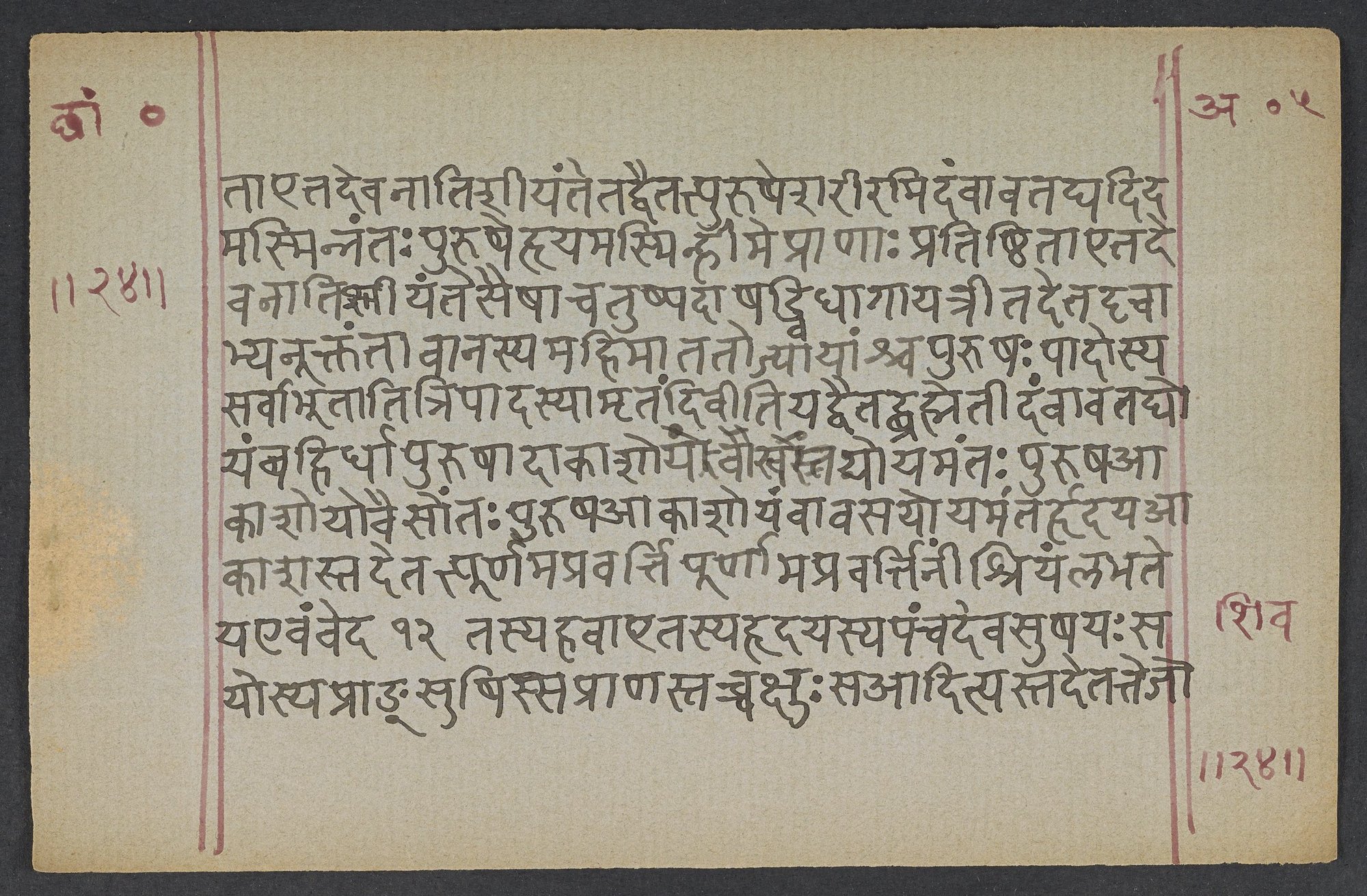
Penn Ms. Coll. 390 Item 945. fol. 24r begins ‹satyena mā virādhiṣi brahmaṇeti na ha vā asmā udeti› and ends ‹yad idam asmin puruṣe śarīram asmin hīme prāṇāḥ pratiṣṭhi›; fol. 24v begins ‹tā etad eva nātiśīyante yad vai tat puruṣe śarīram idaṃ vāva tad yad idam› and ends ‹yo 'sya prāṅ suṣiḥ sa prāṇas tac cakṣuḥ sa ādityas tad etat tejo› (first and last words read on the image, transliterated). The words were located in the GRETIL text by string matching and the page boundaries follow from them; readings and results are stored in data/sources/upanishads/mapping_945.json.
12.3yā vai sā pṛthivīyaṃ vāva sā yad idam asmin puruṣe śarīram |
asmin hīme prāṇāḥ pratiṣṭhitāḥ |
etad eva nātiśīyante ||
12.4yad vai tat puruṣe śarīram idaṃ vāva tad yad idam asminn antaḥ puruṣe hṛdayam |
asmin hīme prāṇāḥ pratiṣṭhitāḥ |
etad eva nātiśīyante ||
12.5saiṣā catuṣpadā ṣaḍvidhā gāyatrī |
tad etad ṛcābhyanūktam ||
12.6tāvān asya mahimā tato jyāyāṃś ca puruṣaḥ |
pādo 'sya sarvā bhūtāni tripād asyāmṛtaṃ divīti ||
12.7yad vai tad brahmetīdaṃ vāva tad yo 'yaṃ bahirdhā puruṣād ākāśaḥ |
yo vai sa bahirdhā puruṣād ākāśaḥ ||
12.8ayaṃ vāva sa yo 'yam antaḥ puruṣa ākāśaḥ |
yo vai so 'ntaḥ puruṣa ākāśaḥ ||
12.9ayaṃ vāva sa yo 'yam antarhṛdaya ākāśaḥ |
tad etat pūrṇam apravarti |
pūrṇam apravartinīṃ śriyaṃ labhate ya evaṃ veda ||
12.3That earth again is the body in man, for in it the vital airs (prânas, which are everything) rest, and do not go beyond.
12.4That body again in man is the heart within man, for in it the prânas (which are everything) rest, and do not go beyond.
12.5That Gâyatrî has four feet and is sixfold. And this is also declared by a Rik verse (Rig-veda X, 90, 3):—
12.6'Such is the greatness of it (of Brahman, under the disguise of Gâyatrî); greater than it is the Person (purusha). His feet are all things. The immortal with three feet is in heaven (i.e. in himself).'
12.7The Brahman which has been thus described (as immortal with three feet in heaven, and as Gâyatrî) is the same as the ether which is around us;
12.8And the ether which is around us, is the same as the ether which is within us. And the ether which is within us,
12.9That is the ether within the heart. That ether in the heart (as Brahman) is omnipresent and unchanging. He who knows this obtains omnipresent and unchangeable happiness.
Where on the image
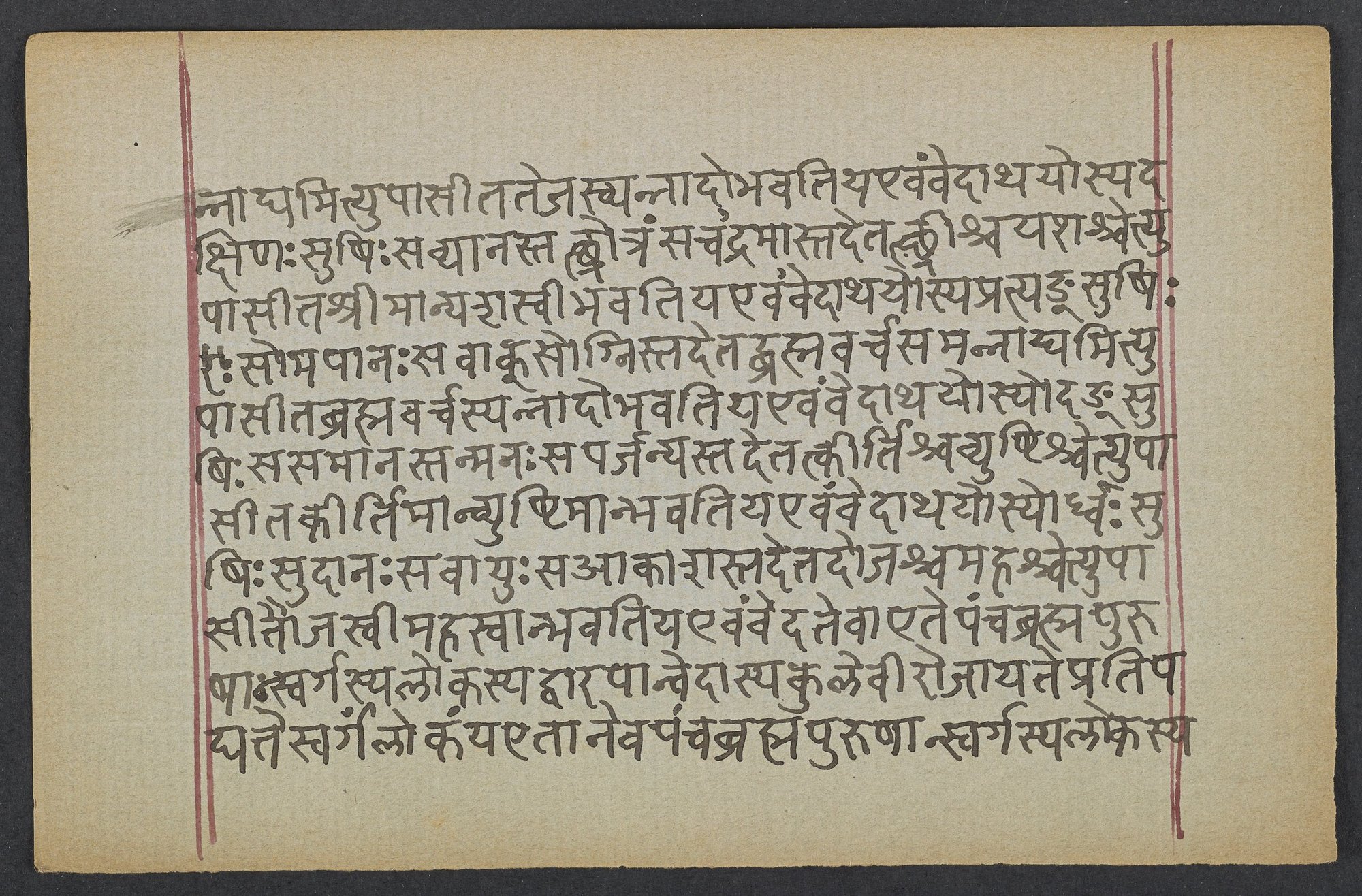
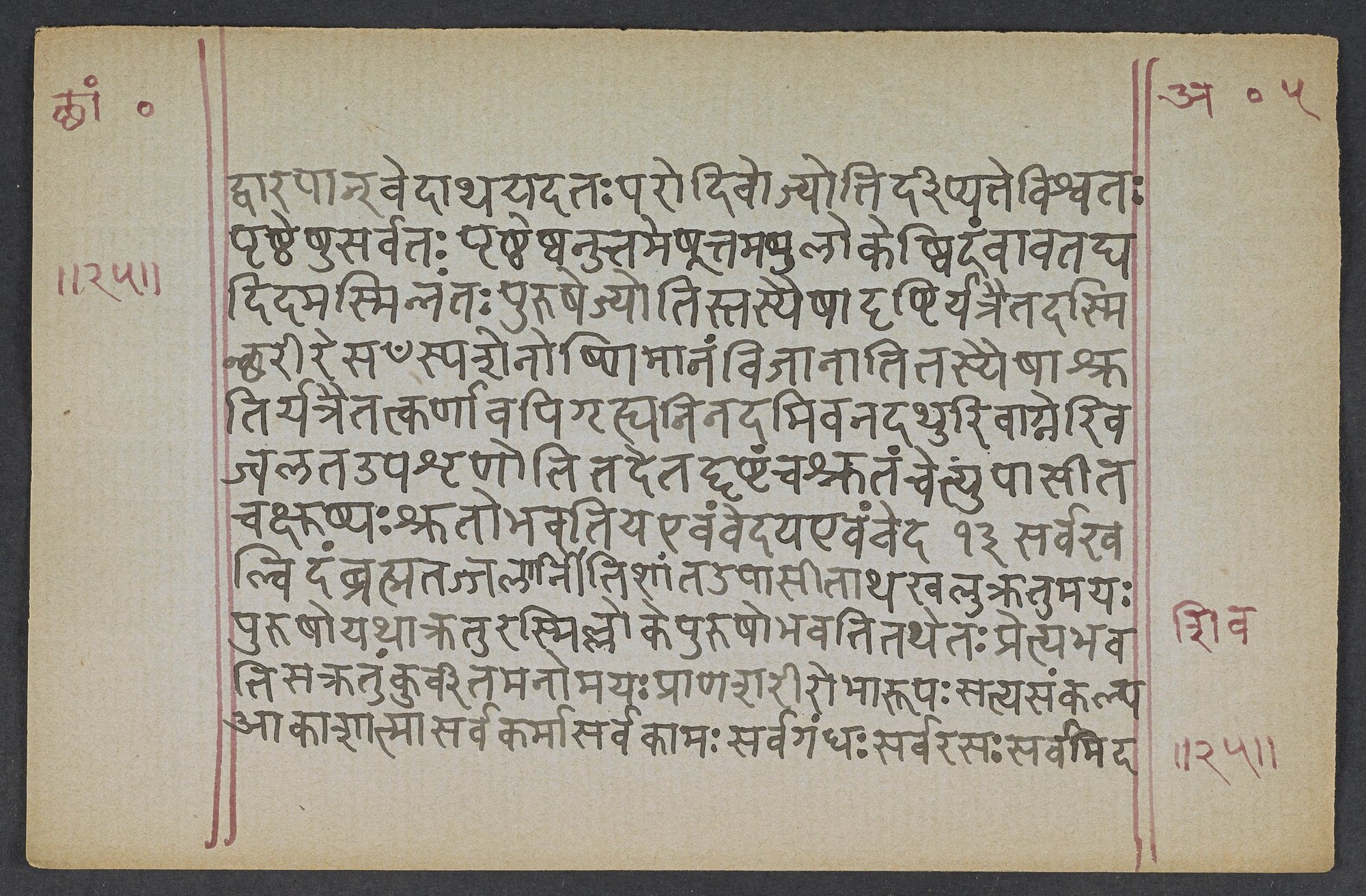
Penn Ms. Coll. 390 Item 945. fol. 24v begins ‹tā etad eva nātiśīyante yad vai tat puruṣe śarīram idaṃ vāva tad yad idam› and ends ‹yo 'sya prāṅ suṣiḥ sa prāṇas tac cakṣuḥ sa ādityas tad etat tejo›; fol. 25r begins ‹'nnādyam ity upāsīta tejasvy annādo bhavati ya evaṃ veda› and ends ‹ya etān evaṃ pañca brahmapuruṣān svargasya lokasya›; fol. 25v begins ‹dvārapān veda atha yad ataḥ paro divo jyotir dīpyate› and ends ‹ākāśātmā sarvakarmā sarvakāmaḥ sarvagandhaḥ sarvarasaḥ sarvam idam› (first and last words read on the image, transliterated). Notes: Müller divides khanda 3.13 into paragraphs differently from the Sanskrit edition; the whole khanda is given here with his own numbers. The words were located in the GRETIL text by string matching and the page boundaries follow from them; readings and results are stored in data/sources/upanishads/mapping_945.json.
13.1tasya ha vā etasya hṛdayasya pañca devasuṣayaḥ |
sa yo 'sya prāṅ suṣiḥ sa prāṇaḥ |
tac cakṣuḥ |
sa ādityaḥ |
tad etat tejo 'nnādyam ity upāsīta |
tejasvy annādo bhavati ya evaṃ veda ||
13.2atha yo 'sya dakṣiṇaḥ suṣiḥ sa vyānaḥ |
tac chrotram |
sa candramāḥ |
tad etac chrīś ca yaśaś cety upāsīta |
śrīmān yaśasvī bhavati ya evaṃ veda ||
13.3atha yo 'sya pratyaṅ suṣiḥ so 'pānaḥ |
sā vāk |
so 'gniḥ |
tad etad brahmavarcasam annādyam ity upāsīta |
brahmavarcasy annādo bhavati ya evaṃ veda ||
13.4atha yo 'syodaṅ suṣiḥ sa samānaḥ |
tan manaḥ |
sa parjanyaḥ |
tad etat kīrtiś ca vyuṣṭiś cetyupāsīta |
kīrtimān vyuṣṭimān bhavati ya evaṃ veda ||
13.5atha yo 'syordhvaḥ suṣiḥ sa udānaḥ |
sa vāyuḥ |
sa ākāśaḥ |
tad etad ojaś ca mahaś cety upāsīta |
ojasvī mahasvān bhavati ya evaṃ veda ||
13.6te vā ete pañca brahmapuruṣāḥ svargasya lokasya dvārapāḥ |
sa ya etān evaṃ pañca brahmapuruṣān svargasya lokasya dvārapān vedāsya kule vīro jāyate |
pratipadyate svargaṃ lokaṃ ya etān evaṃ pañca brahmapuruṣān svargasya lokasya dvārapān veda ||
13.7atha yad ataḥ paro divo jyotir dīpyate viśvataḥpṛṣṭheṣu sarvataḥpṛṣṭheṣv anuttameṣūttameṣu lokeṣv idaṃ vāva tad yad idam asminn antaḥ puruṣe jyotiḥ |
tasyaiṣā dṛṣṭir yatraitad asmiñ charīre saṃsparśenoṣṇimānaṃ vijānāti |
tasyaiṣā śrutir yatraitat karṇāv apigṛhya ninadam iva nadathur ivāgner iva jvalata upaśṛnoti |
tad etad dṛṣṭaṃ ca śrutaṃ cety upāsīta |
cakṣuṣyaḥ śruto bhavati ya evaṃ veda ya evaṃ veda ||
14.1sarvaṃ khalv idaṃ brahma tajjalān iti śānta upāsīta |
atha khalu kratumayaḥ puruṣo yathākratur asmiṃl loke puruṣo bhavati tathetaḥ pretya bhavati |
sa kratuṃ kurvīta ||
13.1For that heart there are five gates belonging to the Devas (the senses). The eastern gate is the Prâna (up-breathing), that is the eye, that is Âditya (the sun). Let a man meditate on that as brightness (glory of countenance) and health. He who knows, this, becomes bright and healthy.
13.2The southern gate is the Vyâna (back-breathing), that is the ear, that is the moon. Let a man meditate on that as happiness and fame. He who knows this, becomes happy and famous.
13.3The western gate is the Apâna (down-breathing), that is speech, that is Agni (fire). Let a man meditate on that as glory of countenance and health. He who knows this, becomes glorious and healthy.
13.4The northern gate is the Samâna (on-breathing), that is mind, that is Parganya (rain). Let a man meditate on that as celebrity and beauty. He who knows this, becomes celebrated and beautiful.
13.5The upper gate is the Udâna (out-breathing), that is air, that is ether. Let a man meditate on that as strength and greatness. He who knows this, becomes strong and great.
13.6These are the five men of Brahman, the door-keepers of the Svarga (heaven) world. He who knows these five men of Brahman, the door-keepers of the Svarga world, in his family a strong son is born. He who thus knows these five men of Brahman, as the door-keepers of the Svarga world, enters himself the Svarga world.
13.7Now that light which shines above this heaven, higher than all, higher than everything, in the highest world, beyond which there are no other worlds, that is the same light which is within man. And of this we have this visible proof:
13.8Namely, when we thus perceive by touch the warmth here in the body. And of it we have this audible proof: Namely, when we thus, after stopping our ears, listen to what is like the rolling of a carriage, or the bellowing of an ox, or the sound of a burning fire (within the ears). Let a man meditate on this as the (Brahman) which is seen and heard. He who knows this, becomes conspicuous and celebrated, yea, he becomes celebrated.
14.1All this is Brahman (n.) Let a man meditate on that (visible world) as beginning, ending, and breathing in it (the Brahman). Now man is a creature of will. According to what his will is in this world, so will he be when he has departed this life. Let him therefore have this will and belief:
Where on the image
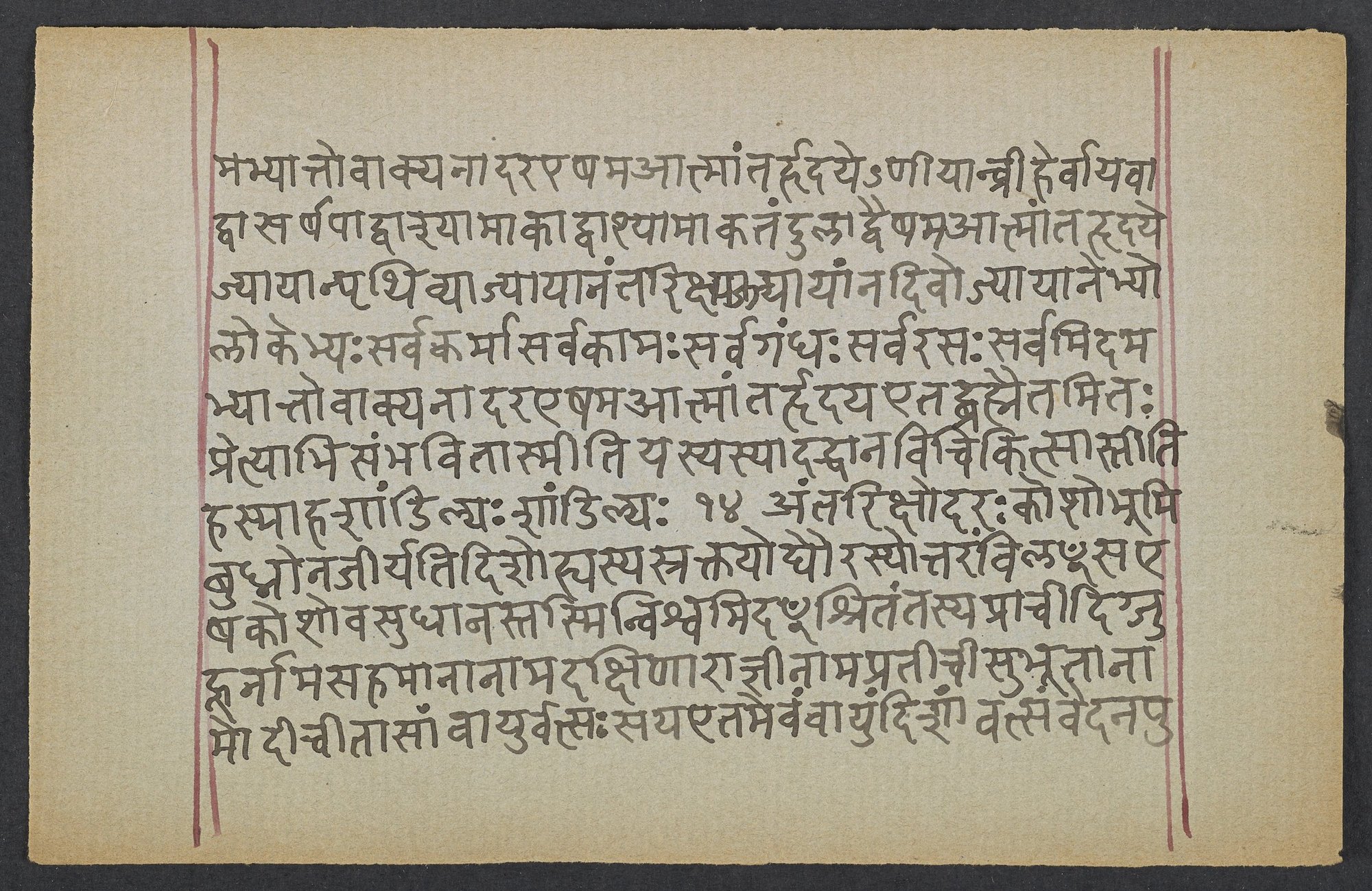
Penn Ms. Coll. 390 Item 945. fol. 25v begins ‹dvārapān veda atha yad ataḥ paro divo jyotir dīpyate› and ends ‹ākāśātmā sarvakarmā sarvakāmaḥ sarvagandhaḥ sarvarasaḥ sarvam idam›; fol. 26r begins ‹abhyātto 'vākyy anādara eṣa ma ātmāntar hṛdaye 'ṇīyān› and ends ‹sa ya etam evaṃ vāyuṃ diśāṃ vatsaṃ veda na pu› (first and last words read on the image, transliterated). The words were located in the GRETIL text by string matching and the page boundaries follow from them; readings and results are stored in data/sources/upanishads/mapping_945.json.
14.2manomayaḥ prāṇaśarīro bhārūpaḥ satyasaṃkalpa ākāśātmā sarvakarmā sarvakāmaḥ sarvagandhaḥ sarvarasaḥ sarvam idam abhyatto 'vāky anādaraḥ ||
14.3eṣa ma ātmā antarhṛdaye 'ṇīyān vrīher vā yavād vā sarṣapād vā śyāmākād vā śyāmākataṇḍulād vā |
eṣa ma ātmā antarhṛdaye jyāyān pṛthivyā jyāyān antarikṣāj jyāyān divo jyāyān ebhyo lokebhyaḥ ||
14.4sarvakarmā sarvakāmaḥ sarvagandhaḥ sarvarasaḥ sarvam idam abhyatto 'vākyanādaraḥ |
eṣa ma ātmā antarhṛdaye |
etad brahma |
etam itaḥ pretyābhisaṃbhavitā asmīti yasya syād addhā na vicikitsā asti |
iti ha smāha śāṇḍilyaḥ śāṇḍilyaḥ ||
15.1antarikṣodaraḥ kośo bhūmibudhno na jīryati |
diśo hy asya sraktayo dyaur asyottaraṃ bilam |
sa eṣa kośo vasudhānas tasmin viśvam idaṃ śritam ||
14.2The intelligent, whose body is spirit, whose form is light, whose thoughts are true, whose nature is like ether (omnipresent and invisible), from whom all works, all desires, all sweet odours and tastes proceed; he who embraces all this, who never speaks, and is never surprised,
14.3He is my self within the heart, smaller than a corn of rice, smaller than a corn of barley, smaller than a mustard seed, smaller than a canary seed or the kernel of a canary seed. He also is my self within the heart, greater than the earth, greater than the sky, greater than heaven, greater than all these worlds.
14.4He from whom all works, all desires, all sweet odours and tastes proceed, who embraces all this, who never speaks and who is never surprised, he, my self within the heart, is that Brahman (n.) When I shall have departed from hence, I shall obtain him (that Self). He who has this faith has no doubt; thus said Sândilya, yea, thus he said.
15.1The chest which has the sky for its circumference and the earth for its bottom, does not decay, for the quarters are its sides, and heaven its lid above. That chest is a treasury, and all things are within it.
Where on the image
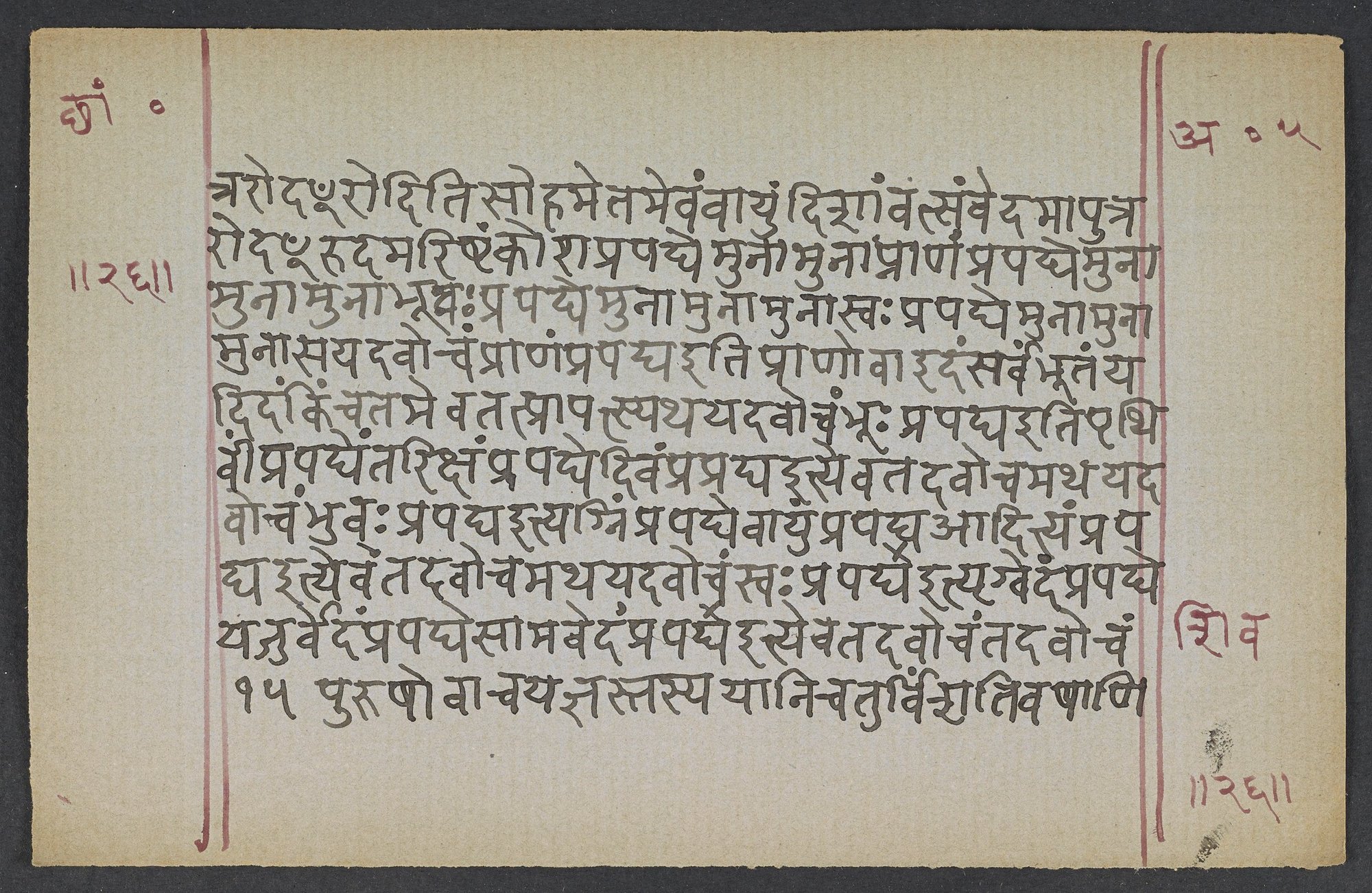
Penn Ms. Coll. 390 Item 945. fol. 26r begins ‹abhyātto 'vākyy anādara eṣa ma ātmāntar hṛdaye 'ṇīyān› and ends ‹sa ya etam evaṃ vāyuṃ diśāṃ vatsaṃ veda na pu›; fol. 26v begins ‹trarodaṃ roditi so 'ham etam evaṃ vāyuṃ diśāṃ vatsaṃ veda mā putrarodaṃ rudam› and ends ‹puruṣo vāva yajñas tasya yāni caturviṃśati varṣāṇi› (first and last words read on the image, transliterated). The words were located in the GRETIL text by string matching and the page boundaries follow from them; readings and results are stored in data/sources/upanishads/mapping_945.json.
15.2tasya prācī dig juhūr nāma |
sahamānā nāma dakṣiṇā |
rājñī nāma pratīcī |
subhūtā nāmodīcī |
tāsāṃ vāyur vatsaḥ |
sa ya etam evaṃ vāyuṃ diśāṃ vatsaṃ veda na putrarodaṃ roditi |
so 'ham etam evaṃ vāyuṃ diśāṃ vatsaṃ veda |
mā putrarodaṃ rudam ||
15.3ariṣṭaṃ kośaṃ prapadye 'munāmunāmunā |
prāṇaṃ prapadye 'munāmunāmunā |
bhūḥ prapadye 'munāmunāmunā |
bhuvaḥ prapadye 'munāmunāmunā |
svaḥ prapadye 'munāmunāmunā ||
15.4sa yad avocaṃ prāṇaṃ prapadya iti |
prāno vā idaṃ sarvaṃ bhūtaṃ yad idaṃ kiṃca |
tam eva tat prāpatsi ||
15.5atha yadavīcaṃ bhūḥ prapadya iti pṛthivīṃ prapadye 'ntarikṣaṃ prapadye divaṃ prapadya ityeva tadavocam //
15.6atha yad avocaṃ bhuvaḥ prapadya ity agniṃ prapadye vāyuṃ prapadya ādityaṃ prapadya ity eva tad avocam ||
15.7atha yad avocaṃ svaḥ prapadya ity ṛgvedaṃ prapadye yajurvedaṃ prapadye sāmavedaṃ prapadya ity eva tad avocam ||
15.2Its eastern quarter is called Guhtû, its southern Sahamânâ, its western Râgñî, its northern Subhûtâ. The child of those quarters is Vâyu, the air, and he who knows that the air is indeed the child of the quarters, never weeps for his sons. 'I know the wind to be the child of the quarters, may I never weep for my sons.'
15.3'I turn to the imperishable chest with such and such and such.' 'I turn to the Prâna (life) with such and such and such.' 'I turn to Bhûh with such and such and such.' 'I turn to Bhuvah with such and such and such.' 'I turn to Svah with su ch and such and such.'
15.4'When I said, I turn to Prâna, then Prâna means all whatever exists here — to that I turn.'
15.5'When I said, I turn to Bhûh, what I said is, I turn to the earth, the sky, and heaven.'
15.6'When I said, I turn to Bhuvah, what I said is, I turn to Agni (fire), Vâyu (air), Âditya (sun).'
15.7'When I said, I turn to Svah, what I said is, I turn to the Rig-veda, Yagur-veda, and Sâma-veda. That is what I said, yea, that is what I said.'
Where on the image
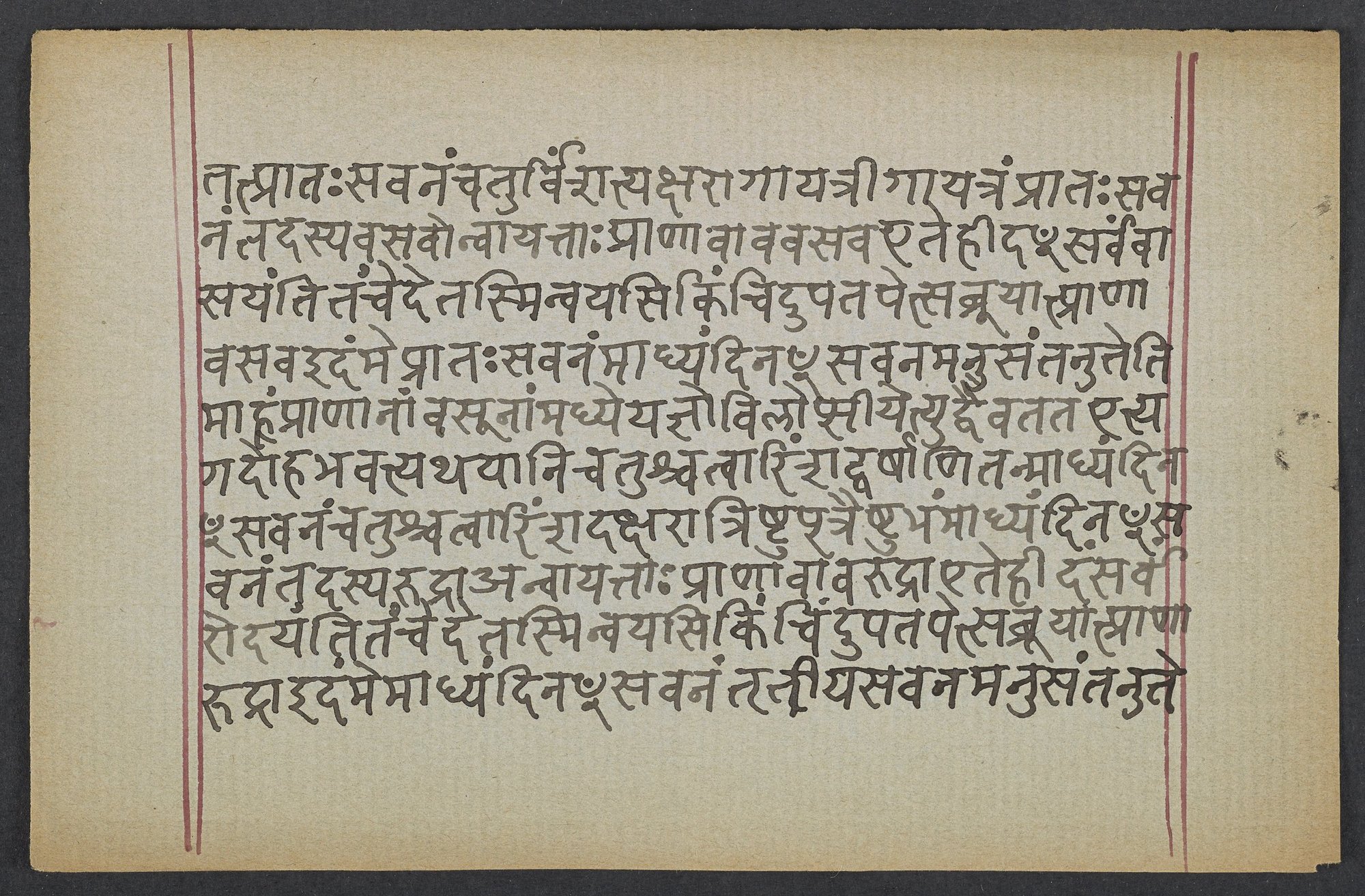
Penn Ms. Coll. 390 Item 945. fol. 26v begins ‹trarodaṃ roditi so 'ham etam evaṃ vāyuṃ diśāṃ vatsaṃ veda mā putrarodaṃ rudam› and ends ‹puruṣo vāva yajñas tasya yāni caturviṃśati varṣāṇi›; fol. 27r begins ‹tat prātaḥsavanaṃ caturviṃśatyakṣarā gāyatrī› and ends ‹rudrā idaṃ me mādhyaṃdinaṃ savanaṃ tṛtīyasavanam anusaṃtanuteti› (first and last words read on the image, transliterated). The words were located in the GRETIL text by string matching and the page boundaries follow from them; readings and results are stored in data/sources/upanishads/mapping_945.json.
16.1puruṣo vāva yajñaḥ |
tasya yāni caturviṃśativarṣāṇi tat prātaḥsavanam |
caturviṃśatyakṣarā gāyatrī |
gāyatraṃ prātaḥsavanam |
tad asya vasavo 'nvāyattāḥ |
prāṇā vāva vasavaḥ |
ete hīdaṃ sarvaṃ vāsayanti ||
16.2taṃ ced etasmin vayasi kiṃcid upatapet sa brūyāt |
prāṇā vasava idaṃ me prātaḥsavanaṃ mādhyaṃdinaṃ savanam anusaṃtanuteti māhaṃ prāṇānāṃ vasūnāṃ madhye yajño vilopsīyeti |
ud dhaiva tata ety agado ha bhavati ||
16.3atha yāni catuścatvāriṃśad varṣāṇi tan mādhyaṃdinaṃ savanam |
catuścatvāriṃśadakṣarā triṣṭup |
traiṣṭubhaṃ mādhyaṃdinaṃ savanam |
tad asya rudrā anvāyattāḥ |
prāṇā vāva rudrāḥ |
ete hīdaṃ sarvaṃ rodayanti ||
16.1Man is sacrifice. His (first) twenty-four years are the morning-libation. The Gâyatrî has twenty-four syllables, the morning-libation is offered with Gâyatrî hymns. The Vasus are connected with that part of the sacrifice. The Prânas (the five senses) are the Vasus, for they make all this to abide (vâsayanti).
16.2If anything ails him in that (early) age, let him say: 'Ye Prânas, ye Vasus, extend this my morning-libation unto the midday-libation, that I, the sacrificer, may not perish in the midst of the Prânas or Vasus.' Thus he recovers from his illness, and becomes whole.
16.3The next forty-four years are the midday-libation. The Trishtubh has forty-four syllables, the midday-libation is offered with Trishtubh hymns. The Rudras are connected with that part of it. The Prânas are the Rudras, for they make all this to cry (rodayanti).
Where on the image
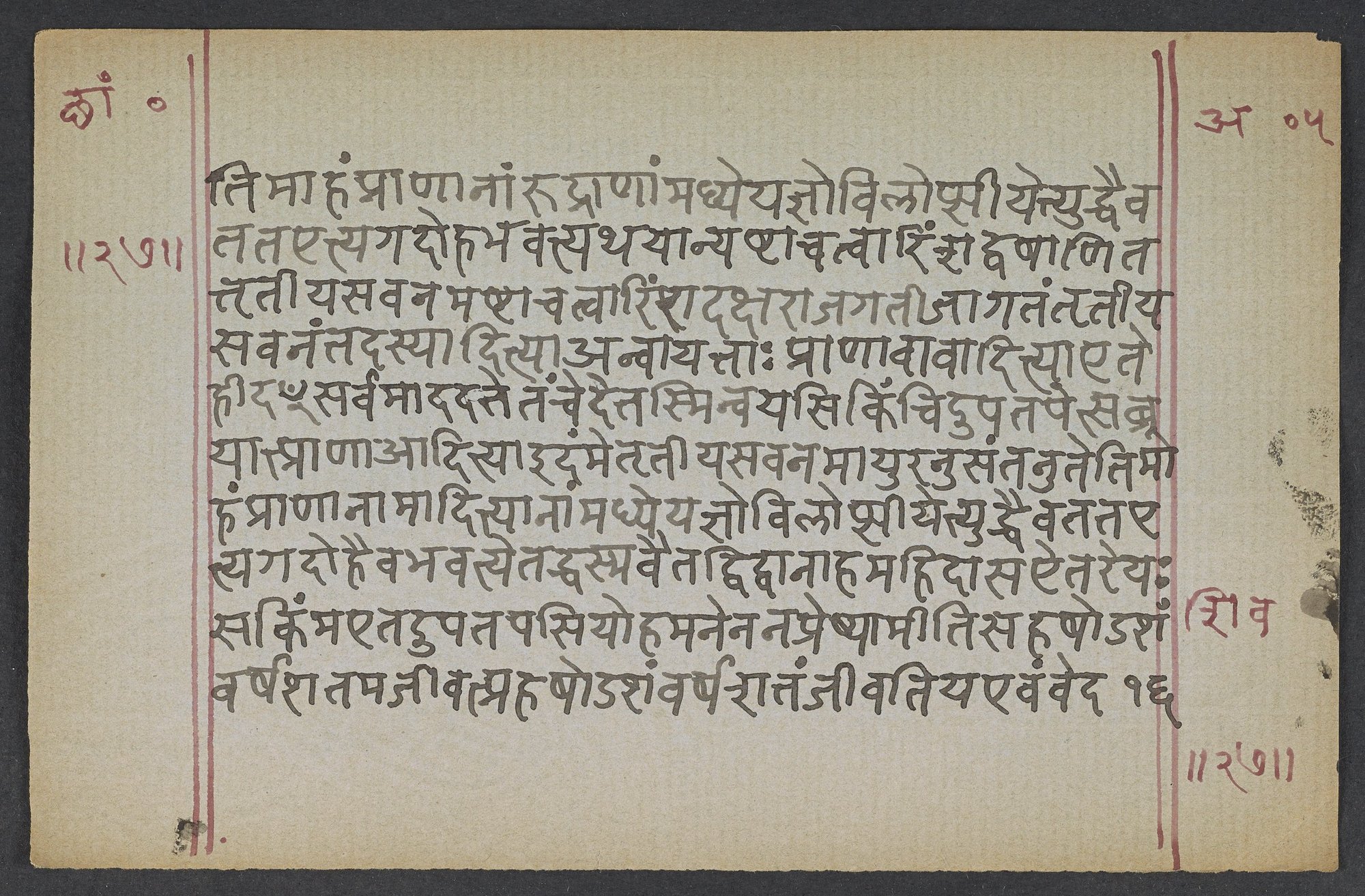
Penn Ms. Coll. 390 Item 945. fol. 27r begins ‹tat prātaḥsavanaṃ caturviṃśatyakṣarā gāyatrī› and ends ‹rudrā idaṃ me mādhyaṃdinaṃ savanaṃ tṛtīyasavanam anusaṃtanuteti›; fol. 27v begins ‹māhaṃ prāṇānāṃ rudrāṇāṃ madhye yajño vilopsīyety› and ends ‹ṣoḍaśaṃ varṣaśatam ajīvat pra ha ṣoḍaśaṃ varṣaśataṃ jīvati ya evaṃ veda› (first and last words read on the image, transliterated). The words were located in the GRETIL text by string matching and the page boundaries follow from them; readings and results are stored in data/sources/upanishads/mapping_945.json.
16.4taṃ ced etasmin vayasi kiṃcid upatapet sa brūyāt |
prāṇā rudrā idaṃ me mādhyaṃdinaṃ savanaṃ tṛtīyasavanam anusaṃtanuteti māhaṃ prāṇānāṃ rudrāṇāṃ madhye yajño vilopsīyeti |
ud dhaiva tata ety agado ha bhavati ||
16.5atha yāny aṣṭācatvāriṃśad varṣāṇi tat tṛtīyasavanam |
aṣṭācatvāriṃśadakṣarā jagatī |
jāgataṃ tṛtīyasavanam |
tad asyādityā anvāyattāḥ |
prāṇā vāvādityāḥ |
ete hīdaṃ sarvam ādadate ||
16.6taṃ ced etasmin vayasi kiṃcid upatapet sa brūyāt |
prāṇā ādityā idaṃ me tṛtīyasavanam āyur anusaṃtanuteti māhaṃ prāṇānām ādityānāṃ madhye yajño vilopsīyeti |
ud dhaiva tata ety agado haiva bhavati ||
16.7etad dha sma vai tad vidvān āha mahidāsa aitareyaḥ |
sa kiṃ ma etad upatapasi yo 'ham anena na preṣyām iti |
sa ha ṣoḍaśaṃ varṣaśatam ajīvat |
pra ha ṣoḍaśaṃ varṣaśataṃ jīvati ya evaṃ veda ||
16.4If anything ails him in that (second) age, let him say: 'Ye Prânas, ye Rudras, extend this my midday-libation unto the third libation, that I, the sacrificer, may not perish in the midst of the Prânas or Rudras.' Thus he recovers from his illness, and becomes whole.
16.5The next forty-eight years are the third libation. The Gagatî has forty-eight syllables, the third libation is offered with Gagatî hymns. The Âdityas are connected with that part of it. The Prânas are the Âdityas, for they take up all this (âdadate).
16.6If anything ails him in that (third) age, let him say: 'Ye Prânas, ye Âdityas, extend this my third libation unto the full age, that I, the sacrificer, may not perish in the midst of the Prânas or Âdityas.' Thus he recovers from his illness, and becomes whole.
16.7Mahidâsa Aitareya (the son of Itarâ), who knew this, said (addressing a disease): 'Why dost thou afflict me, as I shall not die by it?' He lived a hundred and sixteen years (i.e. 24+44+48). He, too, who knows this lives on to a hundred and sixteen years.
Where on the image
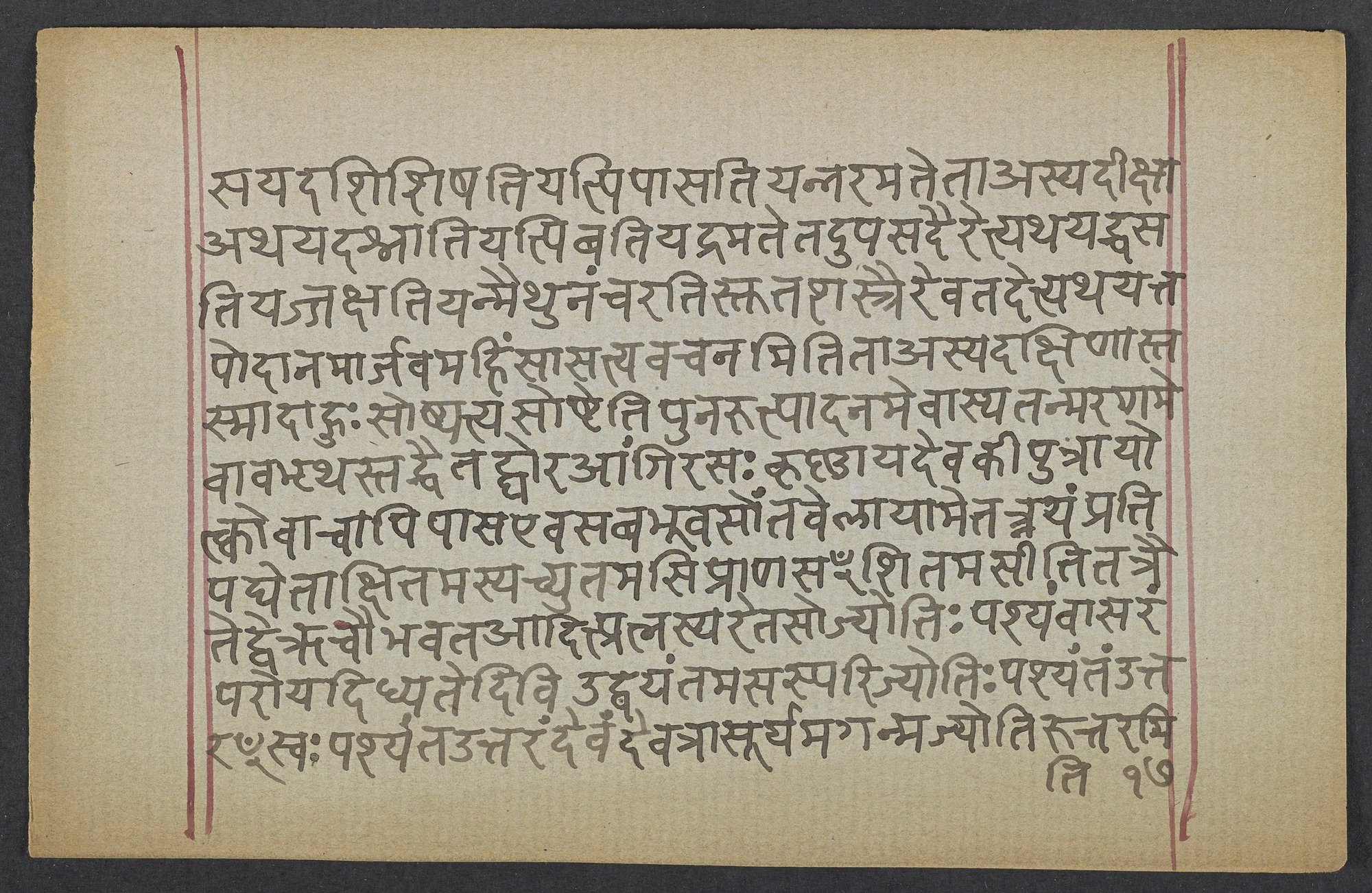
Penn Ms. Coll. 390 Item 945. fol. 28r begins ‹sa yad aśiśiṣati yat pipāsati yan na ramate tā asya dīkṣāḥ› and ends ‹svaḥ paśyanta uttaraṃ devaṃ devatrā sūryam aganma jyotir uttamam iti› (first and last words read on the image, transliterated). Notes: the manuscript closes khanda 17 with 'jyotir uttamam iti 17', without the edition's repetition of 'jyotir uttamam iti'. The words were located in the GRETIL text by string matching and the page boundaries follow from them; readings and results are stored in data/sources/upanishads/mapping_945.json.
17.1sa yad aśiśiṣati yat pipāsati yan na ramate tā asya dīkṣāḥ ||
17.2atha yad aśnāti yat pibati yad ramate tad upasadair eti ||
17.3atha yad dhasati yaj jakṣati yan maithunaṃ carati stutaśastrair eva tad eti ||
17.4atha yat tapo dānam ārjavam ahiṃsā satyavacanam iti tā asya dakṣiṇāḥ ||
17.5tasmād āhuḥ soṣyaty asoṣṭeti |
punar utpādanam evāsya tat |
maraṇam evāvabhṛthaḥ ||
17.6tad dhaitad ghora āṅgirasaḥ kṛṣṇāya devakīputrāyoktvovāca |
apipāsa eva sa babhūva |
so 'ntavelāyām etat trayaṃ pratipadyetākṣitam asy acyutam asi prāṇasaṃśitam asīti |
tatraite dve ṛcau bhavataḥ ||
17.7ādit pratnasya retasaḥ |
ud vayaṃ tamasaspari |
jyotiḥ paśyanta uttaram |
svaḥ paśyanta uttaram |
devaṃ devatrā sūryam aganma jyotir uttamam iti jyotir uttamam iti ||
17.1When a man (who is the sacrificer) hungers, thirsts, and abstains from pleasures, that is the Dikshâ (initiatory rite).
17.2When a man eats, drinks, and enjoys pleasures, he does it with the Upasadas (the sacrificial days on which the sacrificer is allowed to partake of food).
17.3When a man laughs, eats, and delights himself, he does it with the Stuta-sastras (hymns sung and recited at the sacrifices).
17.4Penance, liberality, righteousness, kindness, truthfulness, these form his Dakshinâs (gifts bestowed on priests, &c.)
17.5Therefore when they say, 'There will be a birth,' and 'there has been a birth' (words used at the Soma-sacrifice, and really meaning, 'He will pour out the Soma-juice,' and 'he has poured out the Soma-juice'), that is his new birth. His death is the Avabhritha ceremony (when the sacrificial vessels are carried away to be cleansed).
17.6Ghora Ângirasa, after having communicated this (view of the sacrifice) to Krishna, the son of Devaki— and he never thirsted again (after other knowledge)— said: "Let a man, when his end approaches, take refuge with this Triad:'Thou art the imperishable;' 'Thou art the unchangeable,' 'Thou art the edge of Prâna.' On this subject there are two Rik verses (Rig-veda VIII, 6, 30):—
17.7'Then they see (within themselves) the everpresent light of the old seed (of the world, the Sat), the highest, which is lighted in the brilliant (Brahman)." Rig-veda I, 50, 10:— 'Perceiving above the darkness (of ignorance) the higher light (in the sun), as the higher light within the heart, the bright source (of light and life) among the gods, we have reached the highest light, yea, the highest light.'
Where on the image
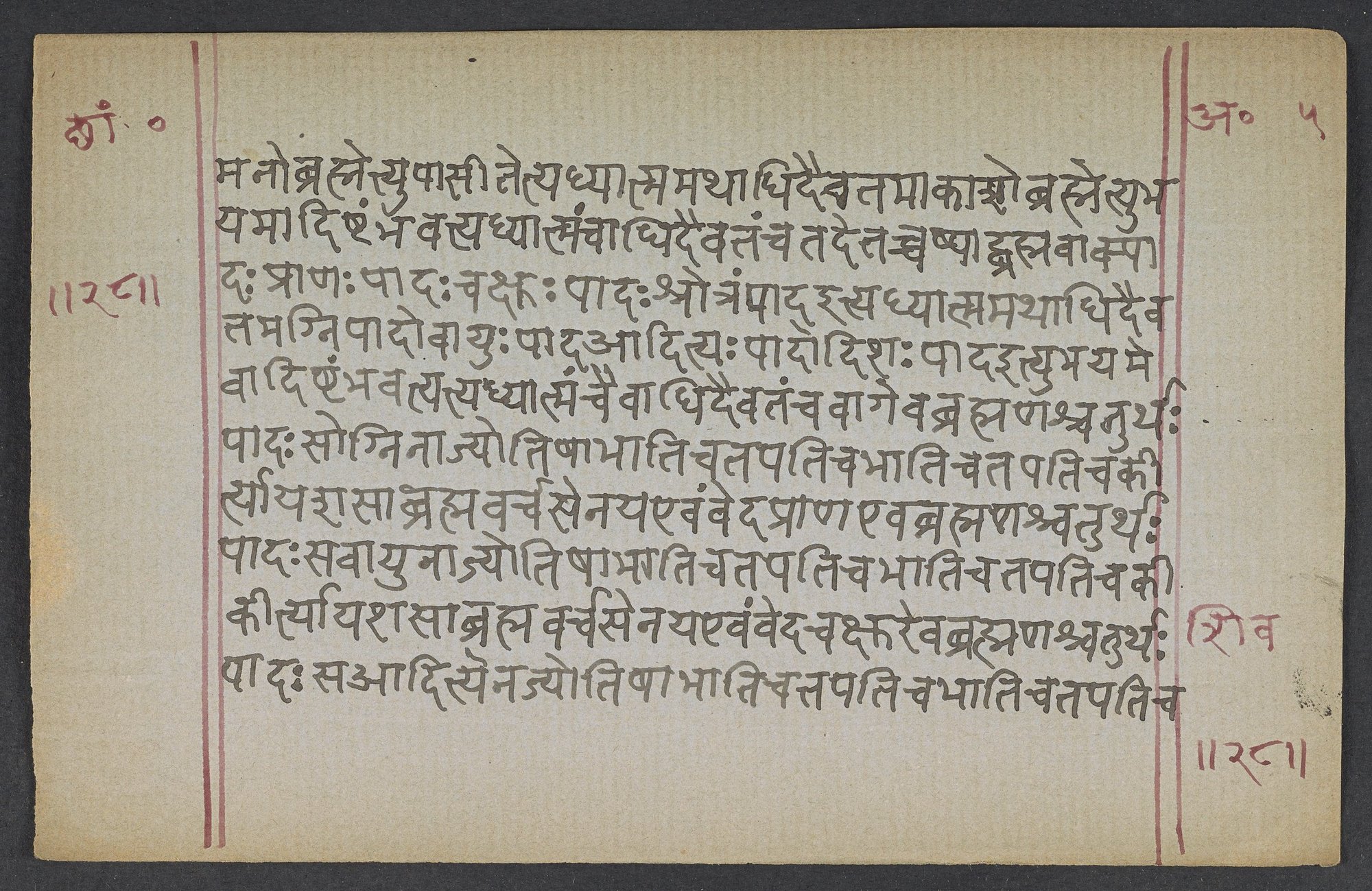
Penn Ms. Coll. 390 Item 945. fol. 28v begins ‹mano brahmety upāsītety adhyātmam athādhidaivatam ākāśo brahmeti› and ends ‹pādaḥ sa ādityena jyotiṣā bhāti ca tapati ca bhāti ca tapati ca› (first and last words read on the image, transliterated). Notes: the copyist passes from 3.18.5 'bhāti ca tapati ca' (fol. 28v, last line) to the closing words of 3.18.6 'tapati ca kīrtyā yaśasā ... ya evaṃ veda ya evaṃ veda' (fol. 29r, line 1): the end of 3.18.5 and the śrotra quarter of 3.18.6 are not on the page (an eye-skip between repeated words). The words were located in the GRETIL text by string matching and the page boundaries follow from them; readings and results are stored in data/sources/upanishads/mapping_945.json.
18.1mano brahmety upāsīta |
ity adhyātmam |
athādhidaivatam |
ākāśo brahma |
ity ubhayam ādiṣṭaṃ bhavaty adhyātmaṃ cādhidaivataṃ ca ||
18.2tad etac catuṣpād brahma |
vāk pādaḥ prāṇaḥ pādaś cakṣuḥ pādaḥ śrotraṃ pādaḥ |
ity adhyātmam |
athādhidaivatam |
agniḥ pādo vāyuḥ pāda ādityaḥ pādo diśaḥ pādaḥ |
ity ubhayam evādiṣṭaṃ bhavaty adhyātmaṃ cādhidaivataṃ ca ||
18.3vāg eva brahmaṇaś caturthaḥ pādaḥ |
so 'gninā jyotiṣā bhāti ca tapati ca |
bhāti ca tapati ca kīrtyā yaśasā brahmavarcasena ya evaṃ veda ||
18.4prāṇa eva brahmaṇaś caturthaḥ pādaḥ |
sa vāyunā jyotiṣā bhāti ca tapati ca |
bhāti ca tapati ca kīrtyā yaśasā brahmavarcasena ya evaṃ veda ||
18.5cakṣur eva brahmaṇaś caturthaḥ pādaḥ |
sa ādityena jyotiṣā bhāti ca tapati ca |
bhāti ca tapati ca kīrtyā yaśasā brahmavarcasena ya evaṃ veda ||
18.1Let a man meditate on mind as Brahman (n.), this is said with reference to the body. Let a man meditate on the ether as Brahman (n.), this is said with reference to the Devas. Thus both the meditation which has reference to the body, and the meditation which has reference to the Devas, has been taught.
18.2That Brahman (mind) has four feet (quarters). Speech is one foot, breath is one foot, the eye is one foot, the ear is one foot—so much with reference to the body. Then with reference to the gods, Agni (fire) is one foot, Vâyu (air) is one foot, Âditya (sun) is one foot, the quarters are one foot. Thus both the worship which has reference to the body, and the worship which has reference to the Devas, has been taught.
18.3Speech is indeed the fourth foot of Brahman. That foot shines with Agni (fire) as its light, and warms. He who knows this, shines and warms through his celebrity, fame, and glory of countenance.
18.4Breath is indeed the fourth foot of Brahman. That foot shines with Vâyu (air) as its light, and warms. He who knows this, shines and warms through his celebrity, fame, and glory of countenance.
18.5The eye is indeed the fourth foot of Brahman. That foot shines with Âditya (sun) as its light, and warms. He who knows this, shines and warms through his celebrity, fame, and glory of countenance.
Where on the image
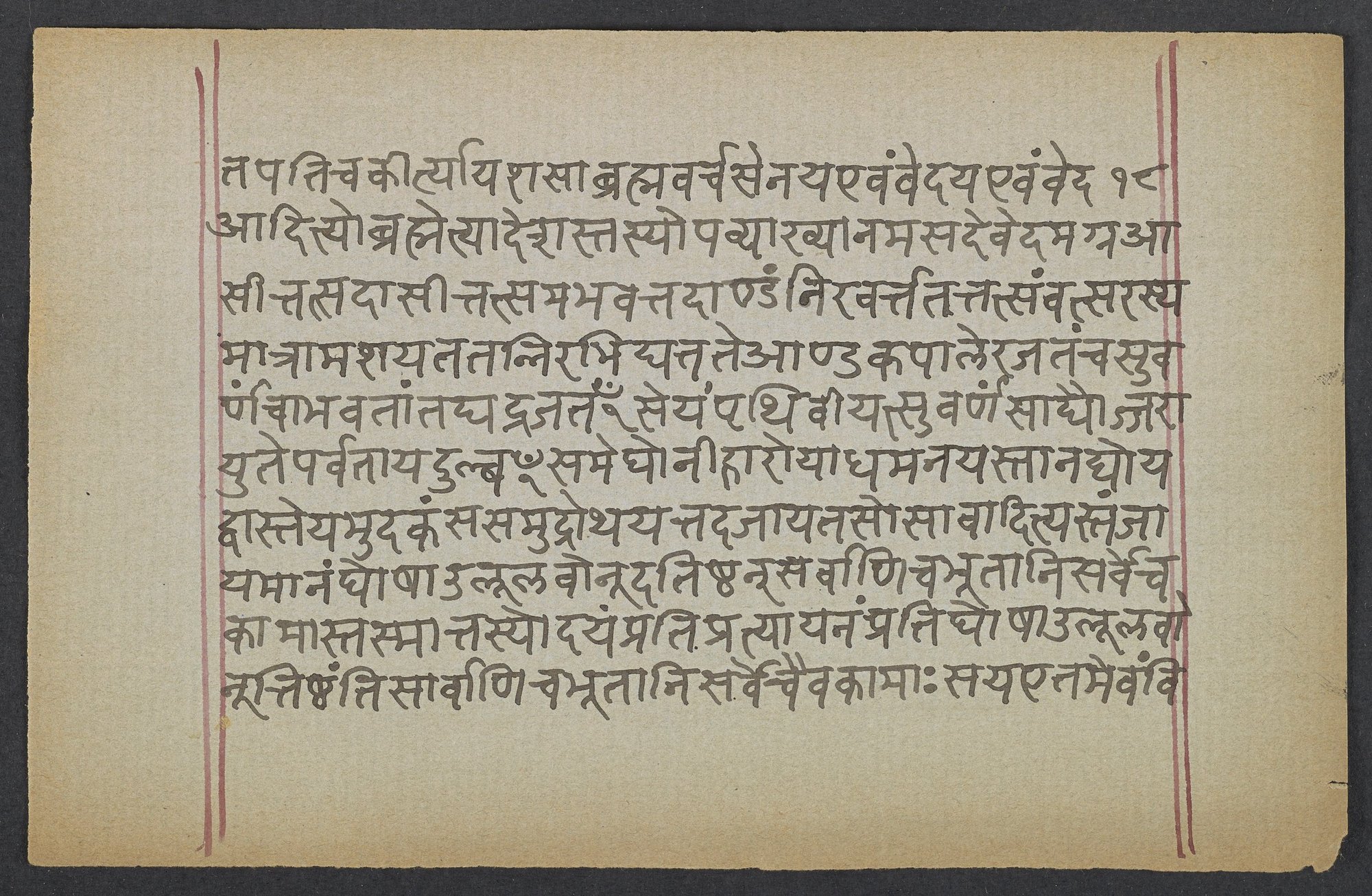
Penn Ms. Coll. 390 Item 945. fol. 29r begins ‹tapati ca kīrtyā yaśasā brahmavarcasena ya evaṃ veda ya evaṃ veda› and ends ‹sarvāṇi ca bhūtāni sarve caiva kāmāḥ sa ya etam evaṃ vi› (first and last words read on the image, transliterated). Notes: the page opens with the close of 3.18.6 ('tapati ca kīrtyā yaśasā brahmavarcasena ya evaṃ veda ya evaṃ veda'); the beginning of 3.18.6 is not in the manuscript (see fol. 28v). The words were located in the GRETIL text by string matching and the page boundaries follow from them; readings and results are stored in data/sources/upanishads/mapping_945.json.
18.6śrotram eva brahmaṇaś caturthaḥ pādaḥ |
sa digbhir jyotiṣā bhāti ca tapati ca |
bhāti ca tapati ca kīrtyā yaśasā brahmavarcasena ya evaṃ veda ya evaṃ veda ||
19.1ādityo brahmety ādeśaḥ |
tasyopavyākhyānam |
asad evedam agra āsīt |
tat sad āsīt |
tat samabhavat |
tad āṇḍaṃ niravartata |
tat saṃvatsarasya mātrām aśayata |
tan nirabhidyata |
te āṇḍakapāle rajataṃ ca suvarṇaṃ cābhavatām ||
19.2tad yad rajataṃ seyaṃ pṛthivī |
yat suvarṇaṃ sā dyauḥ |
yaj jarāyu te parvatāḥ |
yad ulbaṃ (sa) samegho nīhāraḥ |
yā dhamanayas tā nadyaḥ |
yad vāsteyam udakaṃ sa samudraḥ ||
19.3atha yat tad ajāyata so 'sāv ādityaḥ |
taṃ jāyamānaṃ ghoṣā ulūlavo 'nūdatiṣṭhant sarvāṇi ca bhūtāni sarve ca kāmāḥ |
tasmāt tasyodayaṃ prati pratyāyanaṃ prati ghoṣā ulūlavo 'nūttiṣṭhanti sarvāṇi ca bhūtāni sarve ca kāmāḥ ||
18.6The ear is indeed the fourth foot of Brahman. That foot shines with the quarters as its light, and warms. He who knows this, shines and warms through his celebrity, fame, and glory of countenance.
19.1Âditya (the sun) is Brahman, this is the doctrine, and this is the fuller account of it:— In the beginning this was non-existent. It became existent, it grew. It turned into an egg . The egg lay for the time of a year. The egg broke open. The two halves were one of silver, the other of gold.
19.2The silver one became this earth, the golden one the sky, the thick membrane (of the white) the mountains, the thin membrane (of the yoke) the mist with the clouds, the small veins the rivers, the fluid the sea.
19.3And what was born from it that was Âditya, the sun. When he was born shouts of hurrah arose, and all beings arose, and all things which they desired. Therefore whenever the sun rises and sets, shouts of hurrah arise, and all beings arise, and all things which they desire.
Where on the image
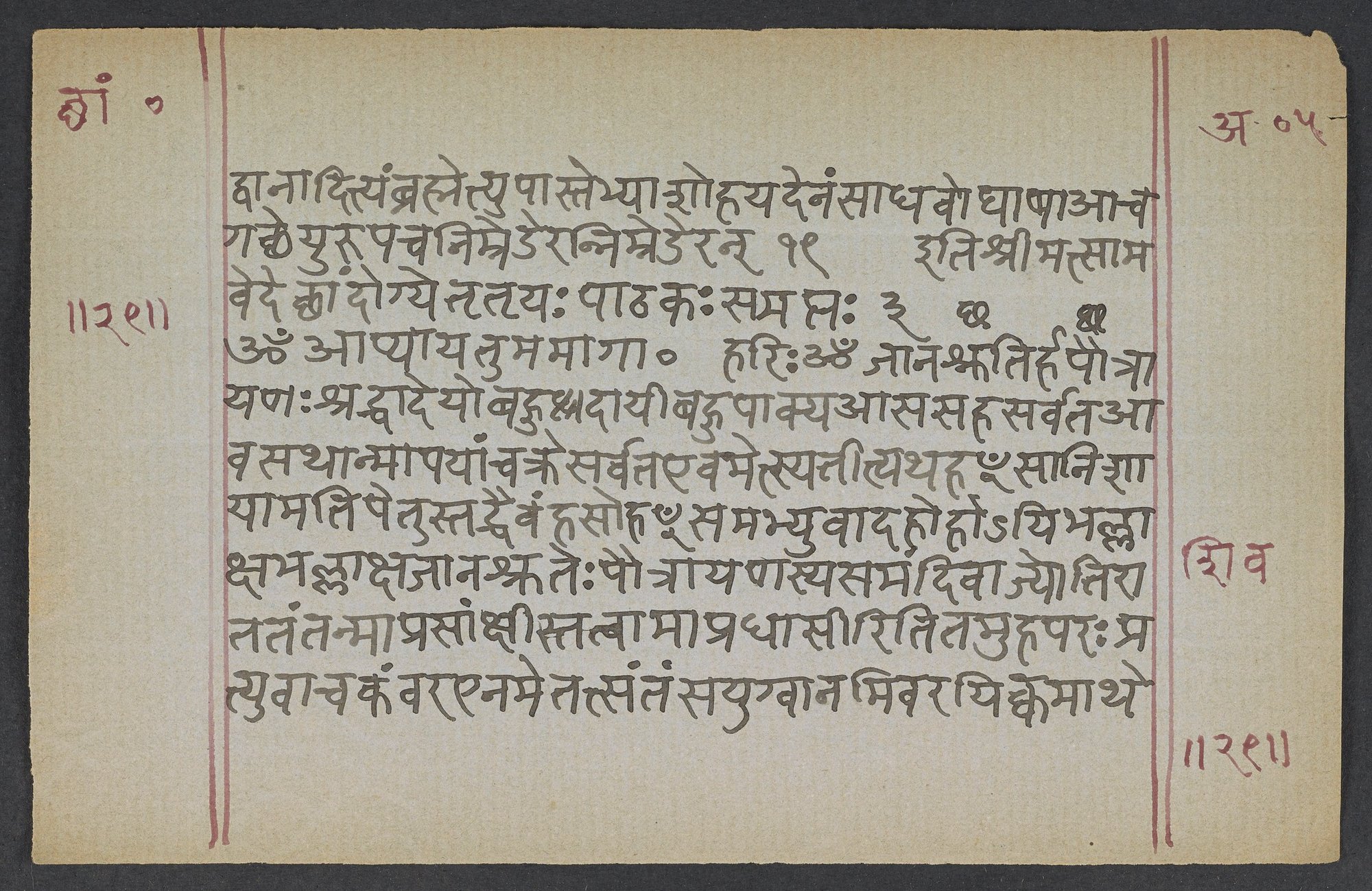
Penn Ms. Coll. 390 Item 945. fol. 29r begins ‹tapati ca kīrtyā yaśasā brahmavarcasena ya evaṃ veda ya evaṃ veda› and ends ‹sarvāṇi ca bhūtāni sarve caiva kāmāḥ sa ya etam evaṃ vi›; fol. 29v begins ‹dvān ādityaṃ brahmety upāste 'bhyāśo ha yad enaṃ sādhavo ghoṣā ā ca gaccheyur› and ends ‹upa ca nimreḍeran nimreḍeran› (first and last words read on the image, transliterated). Notes: the page opens with the close of 3.18.6 ('tapati ca kīrtyā yaśasā brahmavarcasena ya evaṃ veda ya evaṃ veda'); the beginning of 3.18.6 is not in the manuscript (see fol. 28v). The words were located in the GRETIL text by string matching and the page boundaries follow from them; readings and results are stored in data/sources/upanishads/mapping_945.json.
19.4sa ya etam evaṃ vidvān ādityaṃ brahmety upāste |
abhyāśo ha yad enaṃ sādhavo ghoṣā ā ca gaccheyur upa ca nimreḍeran nimreḍeran ||
19.4If any one knowing this meditates on the sun as Brahman, pleasant shouts will approach him and will continue, yea, they will continue.
Notes
- Sanskrit: GRETIL, Chandogyopanisad with the commentary ascribed to Samkara, mula text only (input by the Sansknet project). Paragraph numbers (khanda.paragraph) follow the edition. Three legacy encoding artifacts in GRETIL chapter 2 ('saptavidh.am', 'brahmavarcasy:', 'tejasvy:') are normalized.
- English: F. Max Müller, 'Khandogya-upanishad', The Upanishads part I, Sacred Books of the East 1 (1879), from the proofread English Wikisource transcription; footnotes are not reproduced. Where Müller divides a khanda into a different number of paragraphs than the Sanskrit edition, the whole khanda stands in one section and keeps his numbers. In other khandas his paragraph breaks sometimes fall a clause earlier or later than the Sanskrit ones.
- Transcription slips corrected to the printed page: 1.9.2 'udîttha' (printed udgîtha), 3.16.2 'sacrifices' (sacrificer,), 4.6.1 'toward' (towards), 7.25.1 'alt' (all); the stray heading 'Elventh Khanda' inside 2.10.6 is removed. 1.2.1 'Whent he' is a misprint in the book itself and is kept as printed.
- The manuscript readings differ from the edition in places; the Sanskrit shown is the edition text.
- the manuscript closes khanda 17 with 'jyotir uttamam iti 17', without the edition's repetition of 'jyotir uttamam iti'
- the copyist passes from 3.18.5 'bhāti ca tapati ca' (fol. 28v, last line) to the closing words of 3.18.6 'tapati ca kīrtyā yaśasā ... ya evaṃ veda ya evaṃ veda' (fol. 29r, line 1): the end of 3.18.5 and the śrotra quarter of 3.18.6 are not on the page (an eye-skip between repeated words)
- the page opens with the close of 3.18.6 ('tapati ca kīrtyā yaśasā brahmavarcasena ya evaṃ veda ya evaṃ veda'); the beginning of 3.18.6 is not in the manuscript (see fol. 28v)
Cite
Sources
- Source: Penn Ms. Coll. 390 Item 945 (OPenn, public domain) + GRETIL Sanskrit + F. Max Müller (1879) English (holding institution)
- Critical edition: GRETIL Sanskrit e-texts (Isa, Katha, Prasna, Mandukya, Aitareya, Taittiriya, Svetasvatara, Chandogya); Nirnaya Sagar edition of 1925, transcribed (Kena, Mundaka)
← previous · → next · v cycle view · l back to library