Chandogya Upanishad, Prapathaka 4 (Raikva; Satyakama Jabala; Upakosala)
Introduction
The Chandogya Upanishad belongs to the Samaveda and is one of the two longest and oldest Upanishads. It has eight chapters (prapathakas). This entry gives chapter 4. It tells of King Janasruti and Raikva 'with the cart' who teaches that wind and breath are the gatherers (4.1-3), of Satyakama Jabala, accepted as a student for his truthfulness and taught by a bull, the fire, a swan and a diver bird (4.4-9), of Upakosala taught by his teacher's sacred fires (4.10-15), and of the Brahman priest who mends the sacrifice (4.16-17).
The page images come from University of Pennsylvania Libraries, Ms. Coll. 390 Item 945, a paper manuscript of 74 leaves (11 x 17 cm) holding the whole Chandogya Upanishad, written in Devanagari, 10 to 11 lines to a side, on blue machine-made paper with watermarks; it is undated (catalogued 18th or 19th century). The scribe numbers the khandas and closes each chapter with a colophon, but does not number paragraphs. Chapter 4 runs from fol. 29v to fol. 38r.
For every page, the first and last words were read on the image and found in the edited text; the page boundaries follow from them. Each section below holds the paragraphs that end on one page, with every page they occupy.
How was this verified? (Provenance)
Where on the image
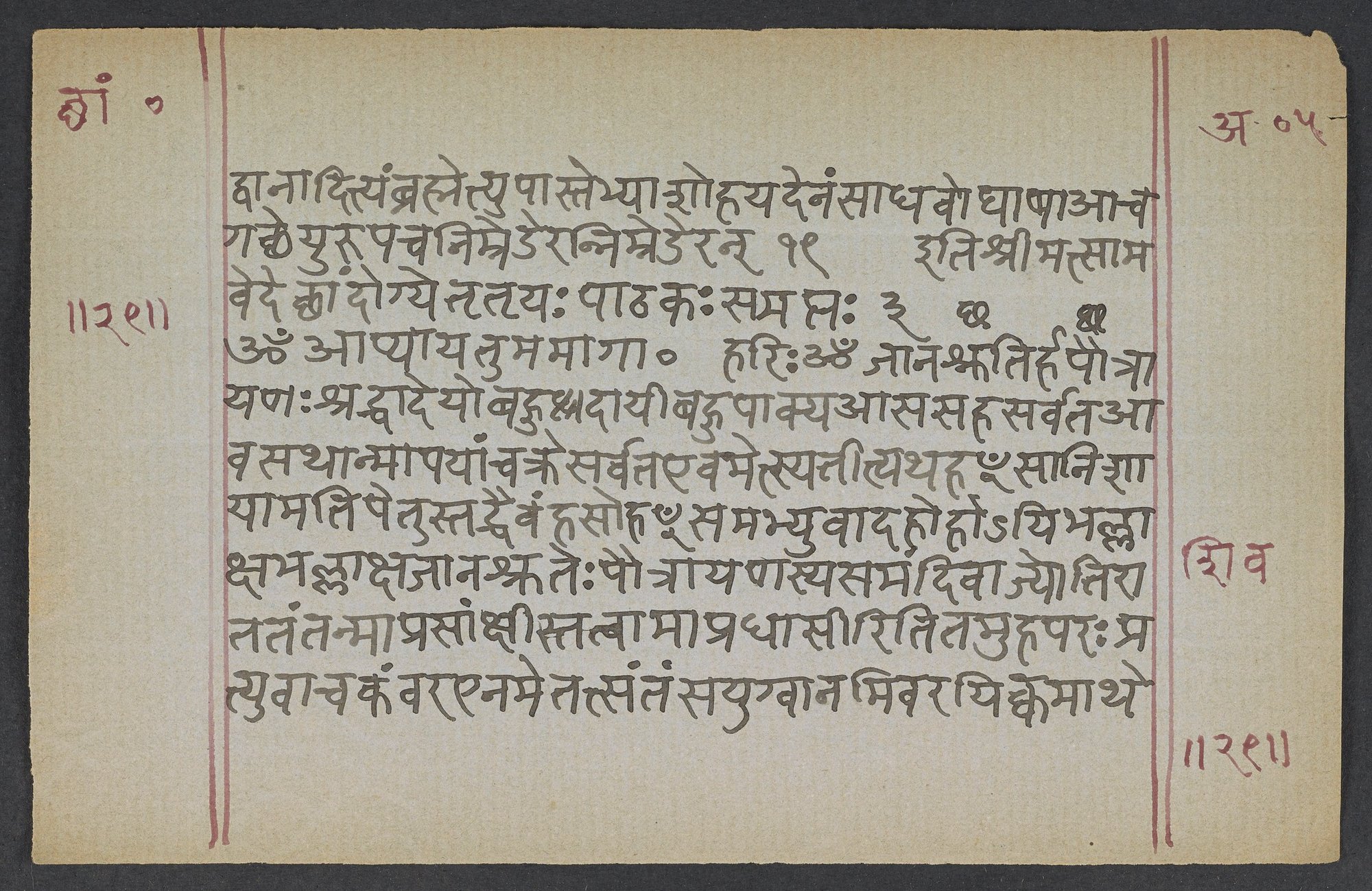
Penn Ms. Coll. 390 Item 945. fol. 29v begins ‹jānaśrutir ha pautrāyaṇaḥ śraddhādeyo bahudāyī› and ends ‹kam vara enam etat santaṃ sayugvānam iva raikvam āttha› (first and last words read on the image, transliterated). The words were located in the GRETIL text by string matching and the page boundaries follow from them; readings and results are stored in data/sources/upanishads/mapping_945.json.
1.1jānaśrutir ha pautrāyaṇaḥ śraddhādeyo bahudāyī bahupākya āsa |
sa ha sarvata āvasathān māpayāṃ cakre sarvata eva me 'nnam atsyantīti ||
1.2atha ha haṃsā niśāyām atipetuḥ |
tad dhaivaṃ haṃso haṃsam abhyuvāda |
ho ho 'yi bhallākṣa bhallākṣa jānaśruteḥ pautrāyaṇasya samaṃ divā jyotir ātataṃ tan mā prasāṅkṣīs tat tvāṃ mā pradhākṣīr iti ||
1.1There lived once upon a time Gânasruti Pautrâyana (the great-grandson of Ganasruta), who was a pious giver, bestowing much wealth upon the people, and always keeping open house. He built places of refuge everywhere, wishing that people should everywhere eat of his food.
1.2Once in the night some Hamsas (flamingoes) flew over his house, and one flamingo said to another: 'Hey, Bhallâksha, Bhallâksha (short-sighted friend). The light (glory) of Gânasruti Pautrâyana has spread like the sky. Do not go near, that it may not burn thee.'
Where on the image
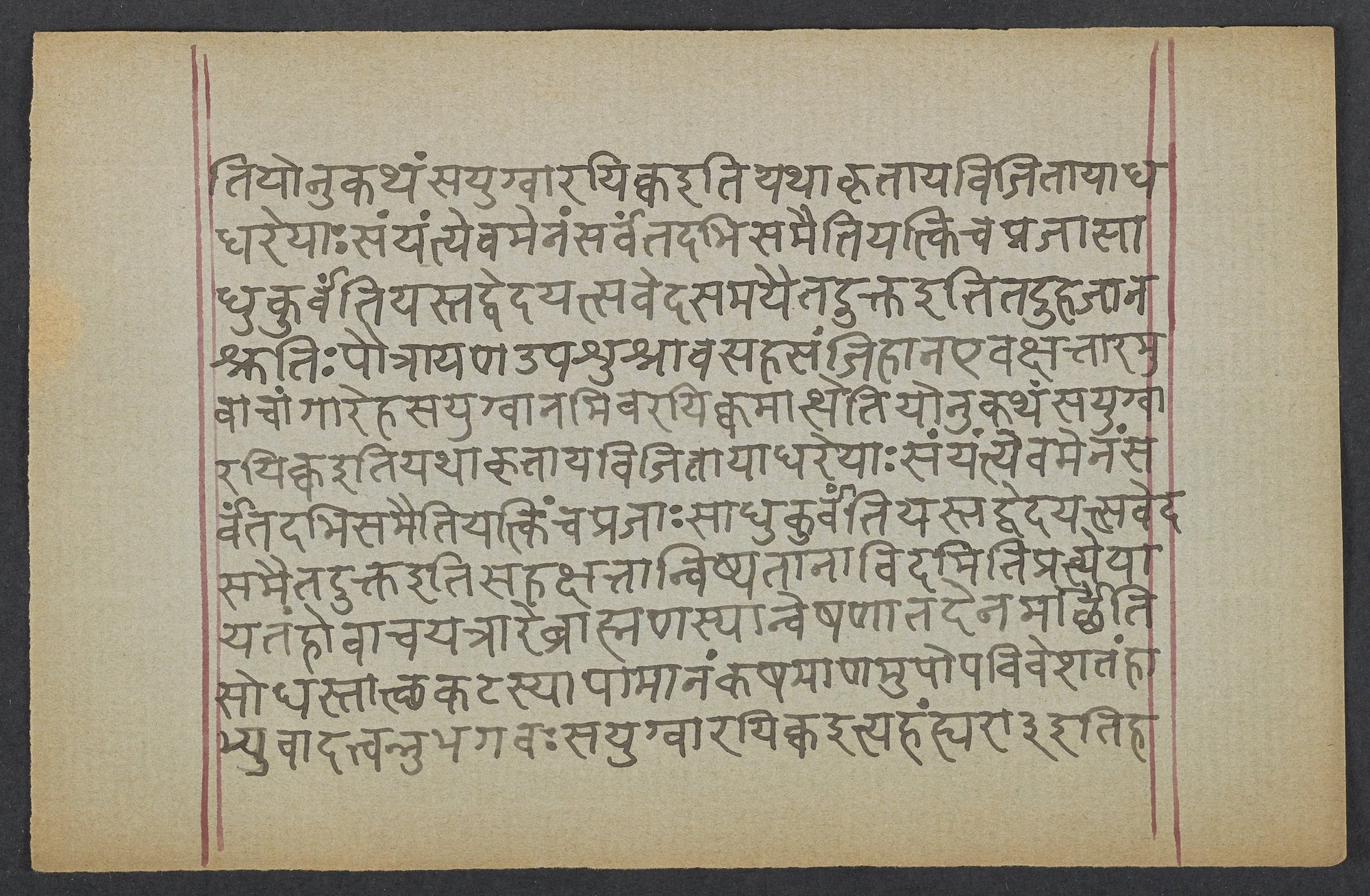
Penn Ms. Coll. 390 Item 945. fol. 29v begins ‹jānaśrutir ha pautrāyaṇaḥ śraddhādeyo bahudāyī› and ends ‹kam vara enam etat santaṃ sayugvānam iva raikvam āttha›; fol. 30r begins ‹iti yo nu kathaṃ sayugvā raikva iti› and ends ‹abhyuvāda tvaṃ nu bhagavaḥ sayugvā raikva ity ahaṃ hy arā iti ha› (first and last words read on the image, transliterated). The words were located in the GRETIL text by string matching and the page boundaries follow from them; readings and results are stored in data/sources/upanishads/mapping_945.json.
1.3tam u ha paraḥ pratyuvāca kam v ara enam etat santaṃ sayugvānam iva raikvam āttha iti |
yo nu kathaṃ sayugvā raikva iti ||
1.4yathā kṛtāya vijitāyādhareyāḥ saṃyanty evam enaṃ sarvaṃ tad abhisameti yat kiṃca prajāḥ sādhu kurvanti |
yas tad veda yat sa veda sa mayaitad ukta iti ||
1.5tad u ha jānaśrutiḥ pautrāyaṇa upaśuśrāva |
sa ha saṃjihāna eva kṣattāram uvācāṅgāre ha sayugvānam iva raikvam āttheti |
yo nu kathaṃ sayugvā raikva iti ||
1.6yathā kṛtāya vijitāyādhareyāḥ saṃyanty evam enaṃ sarvaṃ tad abhisameti yat kiṃca prajāḥ sādhu kurvanti |
yas tad veda yat sa veda sa mayaitad ukta iti ||
1.7sa ha kṣattānviṣya nāvidam iti pratyeyāya |
taṃ hovāca yatrāre brāhmaṇasyānveṣaṇā tad enam arccheti ||
1.3The other answered him: 'How can you speak of him, being what he is (a râganya, noble), as if he were like Raikva with the car?'
1.4The first replied: 'How is it with this Raikva with the car of whom thou speakest?' The other answered: 'As (in a game of dice) all the lower casts belong to him who has conquered with the Krita cast, so whatever good deeds other people perform, belong to that Raikva. He who knows what he knows, he is thus spoken of by me.
1.5Gânasruti Pautrâyana overheard this conversation, and as soon as he had risen in the morning, he said to his door keeper (kshattri): 'Friend, dost thou speak of (me, as if I were) Raikva with the car?' He replied: 'How is it with this Raikva with the car?'
1.6The king said: 'As (in a game of dice), all the lower casts belong to him who has conquered with the Krita cast, so whatever good deeds other people perform, belong to that Raikva. He who knows what he knows, he is thus spoken of by me.'
1.7The door-keeper went to look for Raikva, but returned saying, 'I found him not.' Then the king said: 'Alas! where a Brâhmana should be searched for (in the solitude of the forest), there go for him.'
Where on the image
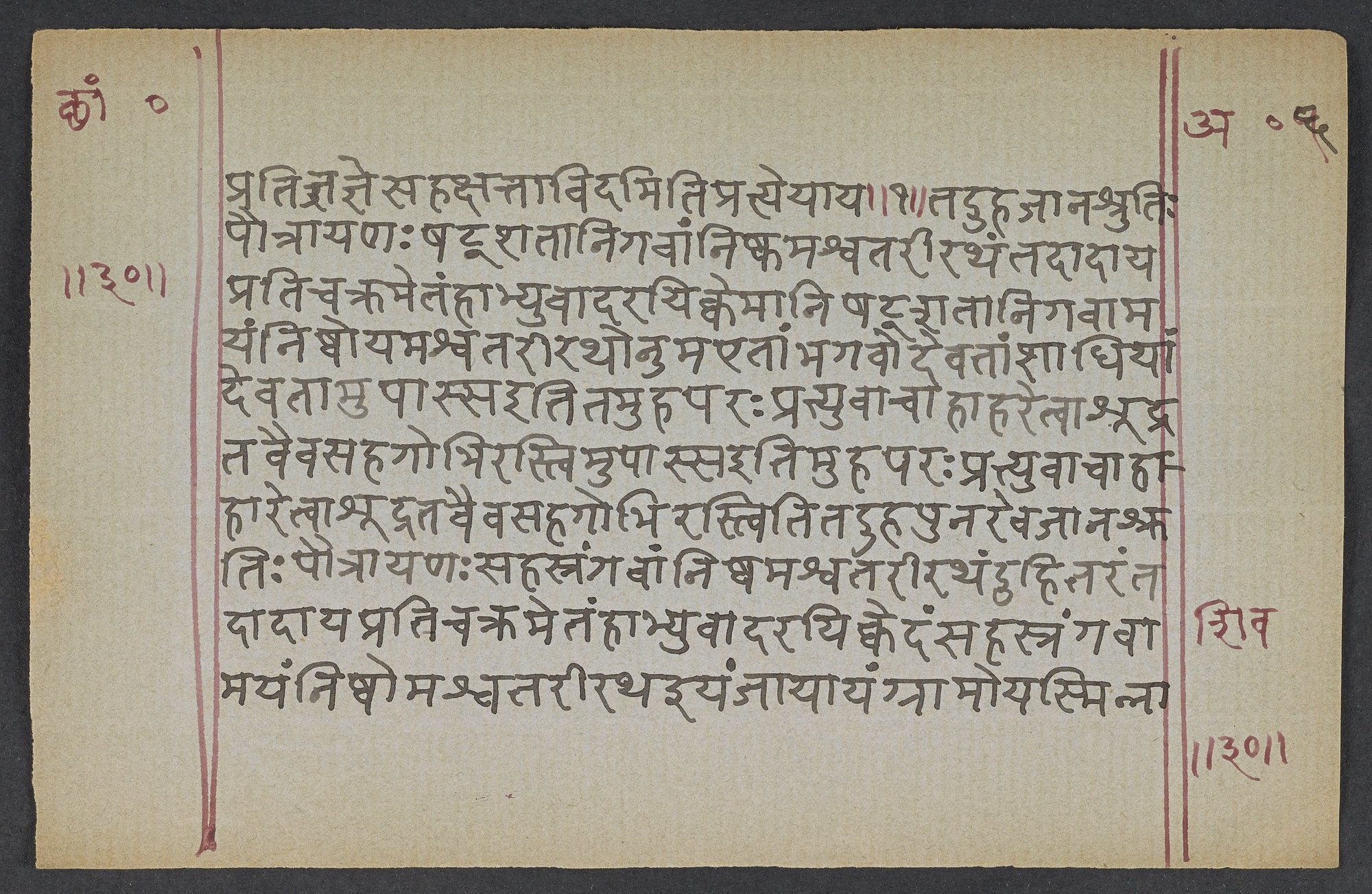
Penn Ms. Coll. 390 Item 945. fol. 30r begins ‹iti yo nu kathaṃ sayugvā raikva iti› and ends ‹abhyuvāda tvaṃ nu bhagavaḥ sayugvā raikva ity ahaṃ hy arā iti ha›; fol. 30v begins ‹pratijajñe sa ha kṣattāvidam iti pratyeyāya› and ends ‹niṣko 'yam aśvatarīratha iyaṃ jāyāyaṃ grāmo yasminn ā› (first and last words read on the image, transliterated). The words were located in the GRETIL text by string matching and the page boundaries follow from them; readings and results are stored in data/sources/upanishads/mapping_945.json.
1.8so 'dhastāc chakaṭasya pāmānaṃ kaṣamāṇam upopaviveśa |
taṃ hābhyuvāda tvaṃ nu bhagavaḥ sayugvā raikva iti |
ahaṃ hy arā 3 iti ha pratijajñe |
sa ha kṣattāvidam iti pratyeyāya ||
2.1tad u ha jānaśrutiḥ pautrāyaṇaḥ ṣaṭ śatāni gavāṃ niṣkam aśvatarīrathaṃ tad ādāya praticakrame |
taṃ hābhyuvāda ||
2.2raikvemāni ṣaṭ śatāni gavām ayaṃ niṣko 'yam aśvatarīrathaḥ |
anu ma etāṃ bhagavo devatāṃ śādhi yāṃ devatām upāssa iti ||
2.3tam u ha paraḥ pratyuvācāha hāretvā śūdra tavaiva saha gobhir astv iti |
tad u ha punar eva jānaśrutiḥ pautrāyaṇaḥ sahasraṃ gavāṃ niṣkam aśvatarīrathaṃ duhitaraṃ tad ādāya praticakrame ||
1.8The door-keeper came to a man who was lying beneath a car and scratching his sores. He addressed him, and said: 'Sir, are you Raikva with the car?' He answered: 'Here I am.' Then the door-keeper returned, and said: I have found him.'
2.1Then Gânasruti Pautrâyana took six hundred cows, a necklace, and a carriage with mules, went to Raikva and said:
2.2'Raikva, here are six hundred cows, a necklace, and a carriage with mules; teach me the deity which you worship.'
2.3The other replied: 'Fie, necklace and carriage be thine, O Sûdra, together with the cows.' Then Gânasruti Pautrâyana took again a thousand cows, a necklace, a carriage with mules, and his own daughter, and went to him.
Where on the image
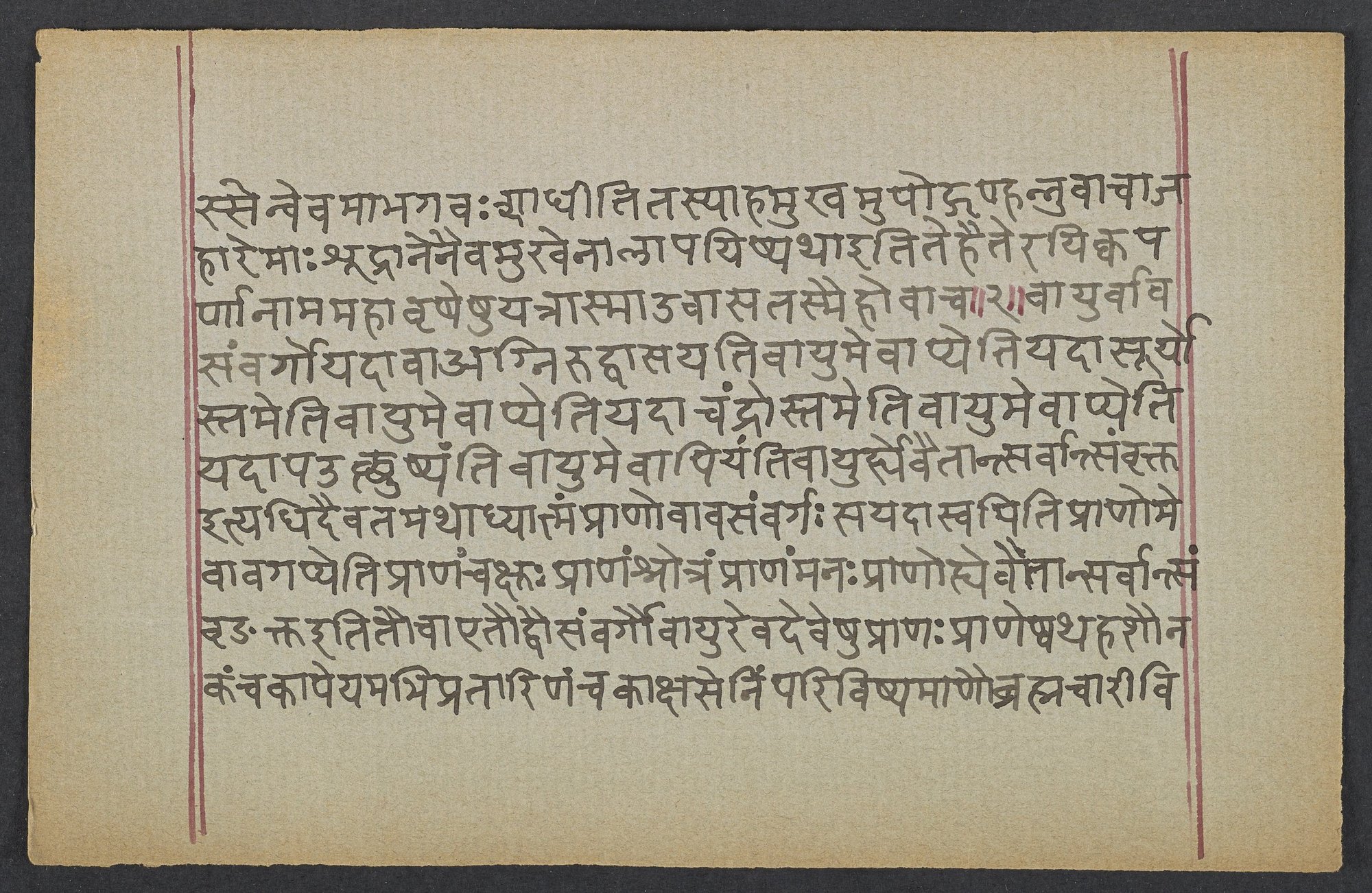
Penn Ms. Coll. 390 Item 945. fol. 30v begins ‹pratijajñe sa ha kṣattāvidam iti pratyeyāya› and ends ‹niṣko 'yam aśvatarīratha iyaṃ jāyāyaṃ grāmo yasminn ā›; fol. 31r begins ‹sse 'nv eva mā bhagavaḥ śādhīti› and ends ‹kāpeyam abhipratāriṇaṃ ca kākṣaseniṃ pariviṣyamāṇau brahmacārī bi› (first and last words read on the image, transliterated). The words were located in the GRETIL text by string matching and the page boundaries follow from them; readings and results are stored in data/sources/upanishads/mapping_945.json.
2.4taṃ hābhyuvāda |
raikvedaṃ sahasraṃ gavām ayaṃ niṣko 'yam aśvatarīratha iyaṃ jāyāyaṃ grāmo yasminn āsse 'nv eva mā bhagavaḥ śādhīti ||
2.5tasyā ha mukham upodgṛhṇann uvācājahāremāḥ śūdrānenaiva mukhenālāpayiṣyathā iti |
te haite raikvaparṇā nāma mahāvṛṣeṣu yatrāsmā uvāsa |
tasmai hovāca ||
3.1vāyur vāva saṃvargaḥ |
yadā vā agnir udvāyati vāyum evāpyeti |
yadā sūryo 'stam eti vāyum evāpyeti |
yadā candro 'stam eti vāyum evāpyeti ||
3.2yadāpa ucchuṣyanti vāyum evāpiyanti |
vāyur hy evaitān sarvān saṃvṛṅkte |
ity adhidaivatam ||
3.3athādhyātmam |
prāṇo vāva samvargaḥ |
sa yadā svapiti prāṇam eva vāg apy eti |
prāṇaṃ cakṣuḥ |
prāṇaṃ śrotram |
prāṇaṃ manaḥ |
prāṇo hy evaitān sarvān saṃvṛṅkta iti ||
3.4tau vā etau dvau samvargau |
vāyur eva deveṣu prāṇaḥ prāṇeṣu ||
2.4He said to him: 'Raikva, there are a thousand cows, a necklace, a carriage with mules, this wife, and this village in which thou dwellest. Sir, teach me!'
2.5He, opening her mouth, said: 'You have brought these (cows and other presents), O Sûdra, but only by that mouth did you make me speak.' These are the Raikva-parana villages in the country of the Mahâvrishas (mahâpunyas) where Raikva dwelt under him. And he said to him:
3.1'Air (vâyu) is indeed the end of all. For when fire goes out, it goes into air. When the sun goes down, it goes into air. When the moon goes down, it goes into air.
3.2'When water dries up, it goes into air. Air indeed consumes them all. So much with reference to the Devas.
3.3'Now with reference to the body. Breath (prâna) is indeed the end of all. When a man sleeps, speech goes into breath, so do sight, hearing, and mind. Breath indeed consumes them all.
3.4'These are the two ends, air among the Devas, breath among the senses (prâna).'
Where on the image
Penn Ms. Coll. 390 Item 945. fol. 31r begins ‹sse 'nv eva mā bhagavaḥ śādhīti› and ends ‹kāpeyam abhipratāriṇaṃ ca kākṣaseniṃ pariviṣyamāṇau brahmacārī bi›; fol. 31v begins ‹bhikṣe tasmā u ha na dadatuḥ sa hovāca mahātmanaś caturo deva ekaḥ kaḥ sa jagāra› and ends ‹jabālāṃ mātaram āmantrayāṃ cakre brahmacaryaṃ bhavati vivatsyāmi kiṃgotro› (first and last words read on the image, transliterated). The words were located in the GRETIL text by string matching and the page boundaries follow from them; readings and results are stored in data/sources/upanishads/mapping_945.json.
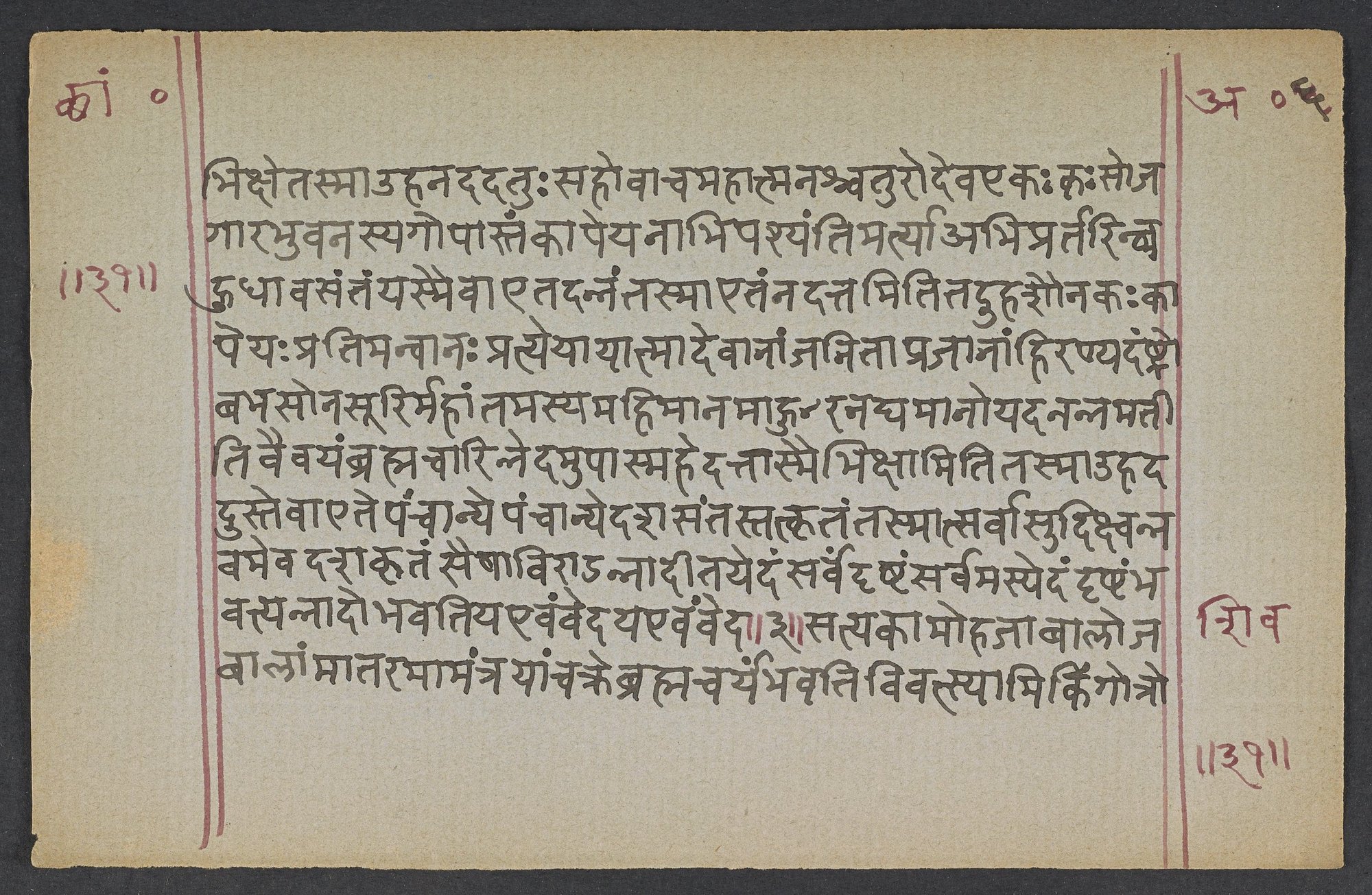
3.5atha ha śaunakaṃ ca kāpeyam abhipratāriṇaṃ ca kākṣaseniṃ pariviṣyamāṇau brahmacārī bibhikṣe |
tasmā u ha na dadatuḥ ||
3.6sa hovāca |
mahātmanaś caturo deva ekaḥ kaḥ sa jagāra bhuvanasya gopāḥ |
taṃ kāpeya nābhipaśyanti martyā abhipratārin bahudhā vasantam |
yasmai vā etad annaṃ tasmā etan na dattam iti ||
3.7tad u ha śaunakaḥ kāpeyaḥ pratimanvānaḥ pratyeyāya |
ātmā devānāṃ janitā prajānāṃ hiraṅyadaṃṣṭro babhaso 'nasūriḥ |
mahāntam asya mahimānam āhur anadyamāno yad anannam atti |
iti vai vayam brahmacārin nedam upāsmahe dattāsmai bhikṣām iti ||
3.8tasmai u ha daduḥ |
te vā ete pañcānye pañcānye daśa santas tat kṛtam |
tasmāt sarvāsu dikṣv annam eva daśa kṛtam |
saiṣā virāḍ annādī |
tayedaṃ sarvaṃ dṛṣṭam |
sarvam asya idaṃ dṛṣṭaṃ bhavaty annādo bhavati ya evaṃ veda ya evaṃ veda ||
3.5Once while Saunaka Kâpeya and Abhipratârin Kâkshaseni were being waited on at their meal, a religious student begged of them. They gave him nothing.
3.6He said; 'One god— who is he?— swallowed the four great ones, he, the guardian of the world. O Kâpeya, mortals see him not, O Abhipratârin, though he dwells in many places. He to whom this food belongs, to him it has not been given.'
3.7Saunaka Kâpeya, pondering on that speech, went to the student and said: 'He is the self of the Devas, the creator of all beings, with golden tusks, the eater, not without intelligence. His greatness is said to be great indeed, because, without being eaten, he eats even what is not food. Thus do we, O Brahmakârin, meditate on that Being.' Then he said: 'Give him food.'
3.8They gave him food. Now these five (the eater Vâyu (air), and his food, Agni (fire), Âditya (sun), Kandramas (moon), Ap (water)) and the other five (the eater Prâna (breath), and his food, speech, sight, hearing, mind) make ten, and that is the Krita. (the highest) cast (representing the ten, the eaters and the food). Therefore in all quarters those ten are food (and) Krita. (the highest cast). These are again the Virâg (of ten syllables) which eats the food. Through this all this becomes seen. He who knows this sees all this and becomes an eater of food, yea, he becomes an eater of food.
Where on the image
Penn Ms. Coll. 390 Item 945. fol. 31v begins ‹bhikṣe tasmā u ha na dadatuḥ sa hovāca mahātmanaś caturo deva ekaḥ kaḥ sa jagāra› and ends ‹jabālāṃ mātaram āmantrayāṃ cakre brahmacaryaṃ bhavati vivatsyāmi kiṃgotro›; fol. 32r begins ‹nv aham asmīti sā hainam uvāca nāham etad veda tāta yadgotras tvam asi› and ends ‹taṃ upanīya kṛśānām abalānāṃ› (first and last words read on the image, transliterated). The words were located in the GRETIL text by string matching and the page boundaries follow from them; readings and results are stored in data/sources/upanishads/mapping_945.json.
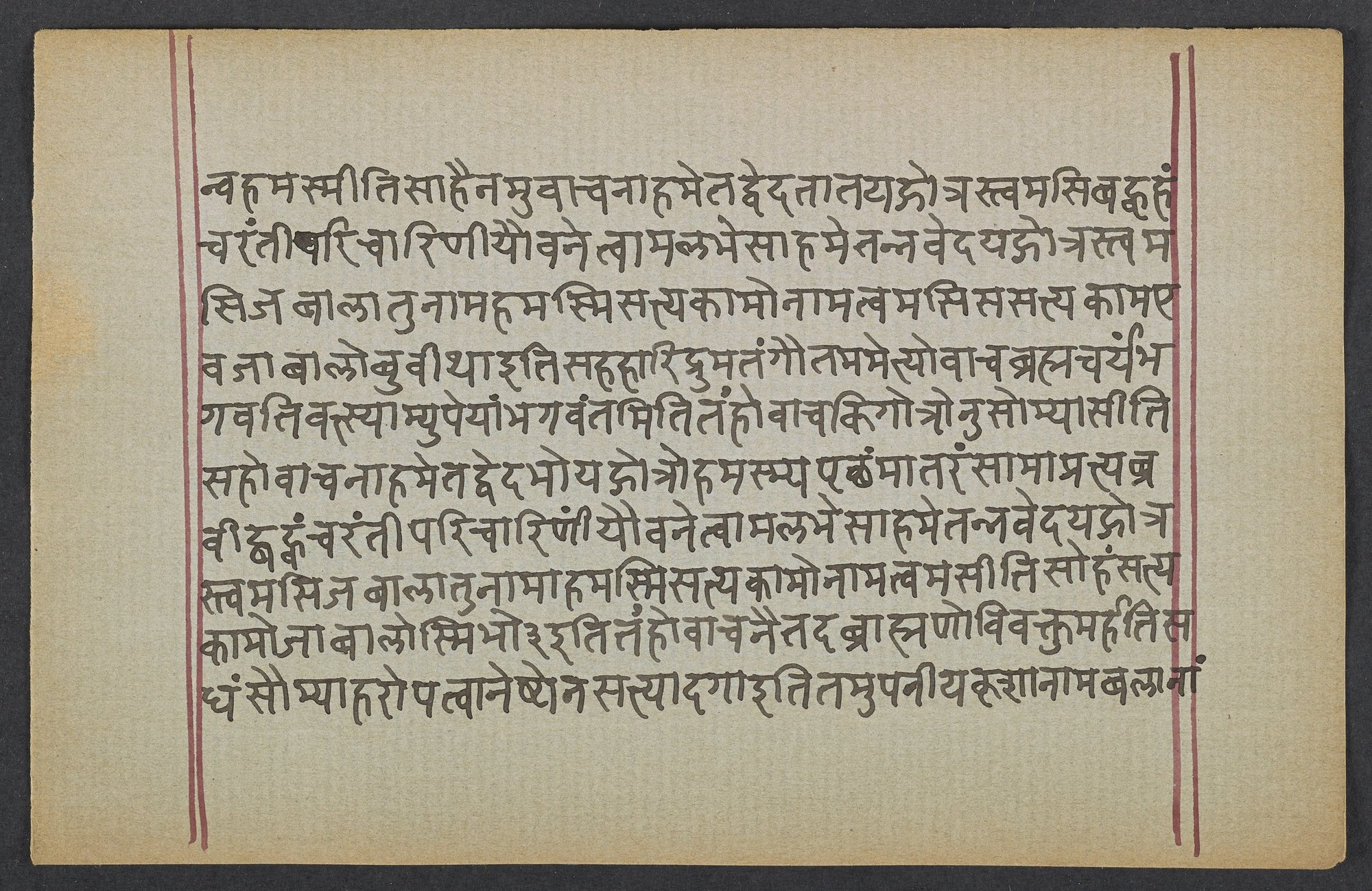
4.1satyakāmo ha jābālo jabālāṃ mātaram āmantrayāṃ cakre |
brahmacaryaṃ bhavati vivatsyāmi kiṃgotro nv aham asmīti ||
4.2sā hainam uvāca |
nāham etad veda tāta yadgotras tvam asi |
bahv aham carantī paricāriṇī yauvane tvām alabhe |
sāham etan na veda yadgotras tvam asi |
jabālā tu nāmāham asmi |
satyakāmo nāma tvam asi |
sa satyakāma eva jābālo bruvīthā iti ||
4.3sa ha hāridrumataṃ gautamam etyovāca |
brahmacaryaṃ bhagavati vatsyāmi |
upeyāṃ bhagavantam iti ||
4.4taṃ hovāca kiṃgotro nu somyāsīti |
sa hovāca |
nāham etad veda bho yadgotro 'ham asmi |
apṛcchaṃ mātaram |
sā mā pratyabravīd bahv aham carantī paricariṇī yauvane tvām alabhe |
sāham etan na veda yadgotras tvam asi |
jabālā tu nāmāham asmi |
satyakāmo nāma tvam asīti |
so 'haṃ satyakāmo jābālo 'smi bho iti ||
4.1Satyakâma, the son of Gabâlâ, addressed his mother and said: 'I wish to become a Brahmakârin (religious student), mother. Of what family am I?'
4.2She said to him: 'I do not know, my child, of what family thou art. In my youth when I had to move about much as a servant (waiting on the guests in my father's house), I conceived thee. I do not know of what family thou art. I am Gabâlâ by name, thou art Satyakâma (Philalethes). Say that thou art Satyakâma Gabâlâ.'
4.3He going to Gautama Hâridrumata said to him, 'I wish to become a Brahmakârin with you, Sir. May I come to you, Sir?'
4.4He said to him: 'Of what family are you, my friend?' He replied: 'I do not know, Sir, of what family I am. I asked my mother, and she answered: 'In my youth when I had to move about much as a servant, I conceived thee. I do not know of what family thou art. I am Gabâlâ by name, thou art Satyakâma,' I am therefore Satyakâma Gabâlâ, Sir.'
Where on the image
Penn Ms. Coll. 390 Item 945. fol. 32r begins ‹nv aham asmīti sā hainam uvāca nāham etad veda tāta yadgotras tvam asi› and ends ‹taṃ upanīya kṛśānām abalānāṃ›; fol. 32v begins ‹catuḥśatā gā nirākṛtyovācemāḥ somyānusaṃvrajeti› and ends ‹prakāśavān ity upāste agniṣ ṭe pādaṃ vakteti sa ha śvobhūte gā abhi› (first and last words read on the image, transliterated). The words were located in the GRETIL text by string matching and the page boundaries follow from them; readings and results are stored in data/sources/upanishads/mapping_945.json.
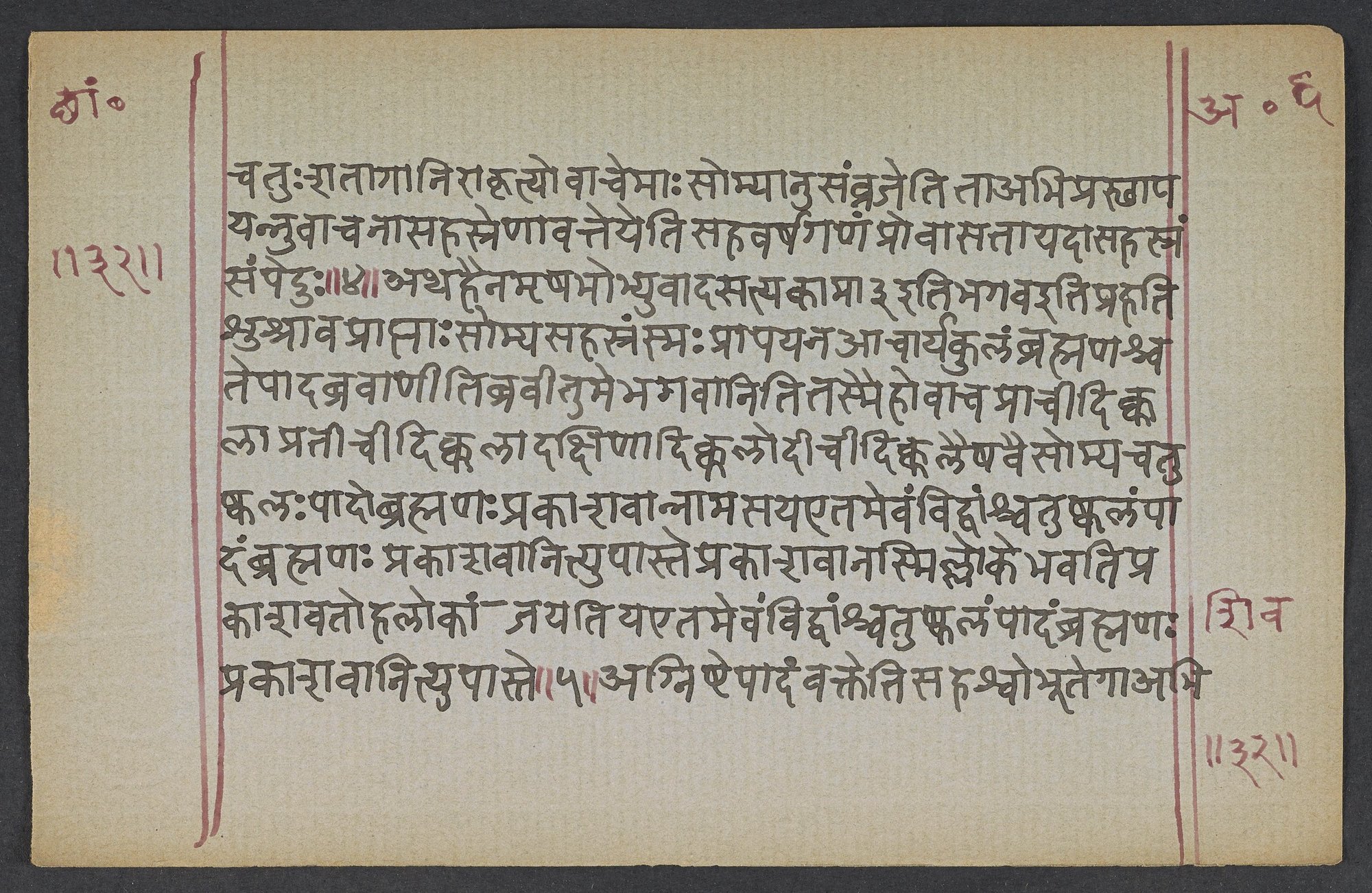
4.5taṃ hovāca |
naitad abrahmaṇo vivaktum arhati |
samidhaṃ somyāhara |
upa tvā neṣye na satyād agā iti |
tam upanīya kṛśānām abalānāṃ catuḥśatā gā nirākṛtya uvācemāḥ somyānusaṃvrajeti |
tā abhiprasthāpayann uvāca |
nāsahasreṇāvarteyeti |
sa ha varṣagaṇaṃ provāsa |
tā yadā sahasraṃ sampeduḥ ||
5.1atha hainam ṛṣabho 'bhyuvāda satyakāma 3 iti |
bhagava iti ha pratiśuśrāva |
prāptāḥ somya sahasraṃ smaḥ |
prāpaya na ācāryakulam ||
5.2brahmaṇaś ca te pādaṃ bravāṇi iti |
bravītu me bhagavān iti |
tasmai hovāca |
prācī dik kalā |
praticī dik kalā |
dakṣiṇā dik kalā |
udīcī dik kalā |
eṣa vai somya catuṣkalaḥ pādo brahmaṇaḥ prakāśavān nāma ||
5.3sa ya etam evaṃ vidvāṃś catuṣkalaṃ pādaṃ brahmaṇaḥ prakāśavān ity upāste prakāśavān asmiṃl loke bhavati |
prakāśavato ha lokāñ jayati ya etam evaṃ vidvāṃś catuṣkalaṃ pādaṃ brahmaṇaḥ prakāśavān ity upāste ||
4.5He said to him: 'No one but a true Brâhmana would thus speak out. Go and fetch fuel, friend, I shall initiate you. You have not swerved from the truth. Having initiated him, he chose four hundred lean and weak cows, and said: 'Tend these, friend.' He drove them out and said to himself, 'I shall not return unless I bring back a thousand.' He dwelt a number of years (in the forest), and when the cows had become a thousand,
5.1The bull of the herd (meant for Vâyu) said to him: 'Satyakâma!' He replied: 'Sir!' The bull said: 'We have become a thousand, lead us to the house of the teacher;
5.2'And I will declare to you one foot of Brahman.' 'Declare it, Sir,' he replied. He said to him; 'The eastern region is one quarter, the western region is one quarter, the southern region is one quarter, the northern region is one quarter. This is a foot of Brahman, consisting of the four quarters, and called Prakâsavat (endowed with splendour).'
5.3'He who knows this and meditates on the foot of Brahman, consisting of four quarters, by the name of Prakâsavat, becomes endowed with splendour in this world. He conquers the resplendent worlds, whoever knows this and meditates on the foot of Brahman, consisting of the four quarters, by the name of Prakâsavat.
Where on the image
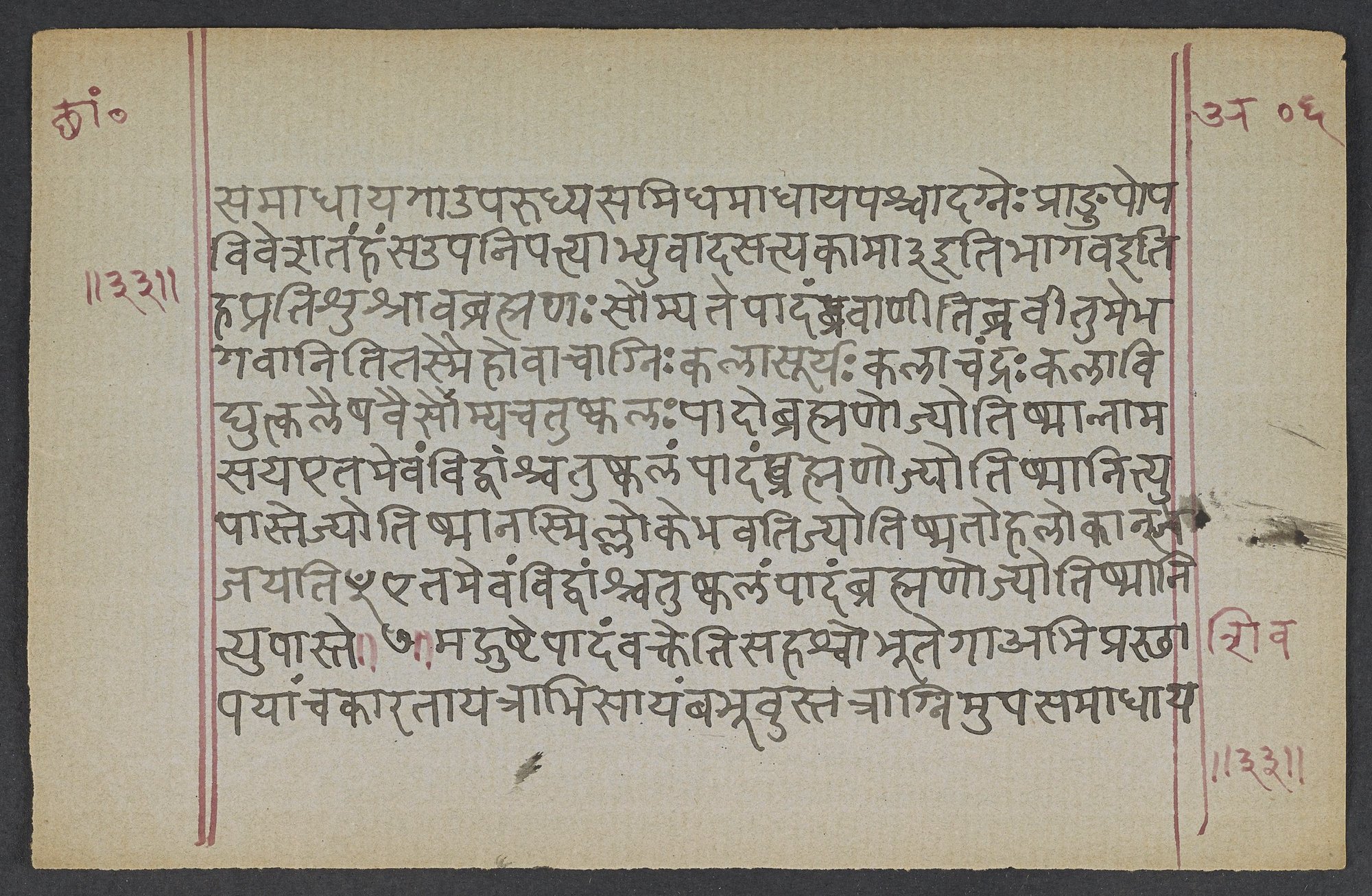
Penn Ms. Coll. 390 Item 945. fol. 32v begins ‹catuḥśatā gā nirākṛtyovācemāḥ somyānusaṃvrajeti› and ends ‹prakāśavān ity upāste agniṣ ṭe pādaṃ vakteti sa ha śvobhūte gā abhi›; fol. 33r begins ‹prasthāpayāṃ cakāra tā yatrābhisāyaṃ babhūvus tatrāgnim upasamādhāya› and ends ‹haṃsas te pādaṃ vakteti sa ha śvobhūte gā abhiprasthāpayāṃ cakāra tā yatrābhisāyaṃ babhūvus tatrāgnim up› (first and last words read on the image, transliterated). The words were located in the GRETIL text by string matching and the page boundaries follow from them; readings and results are stored in data/sources/upanishads/mapping_945.json.
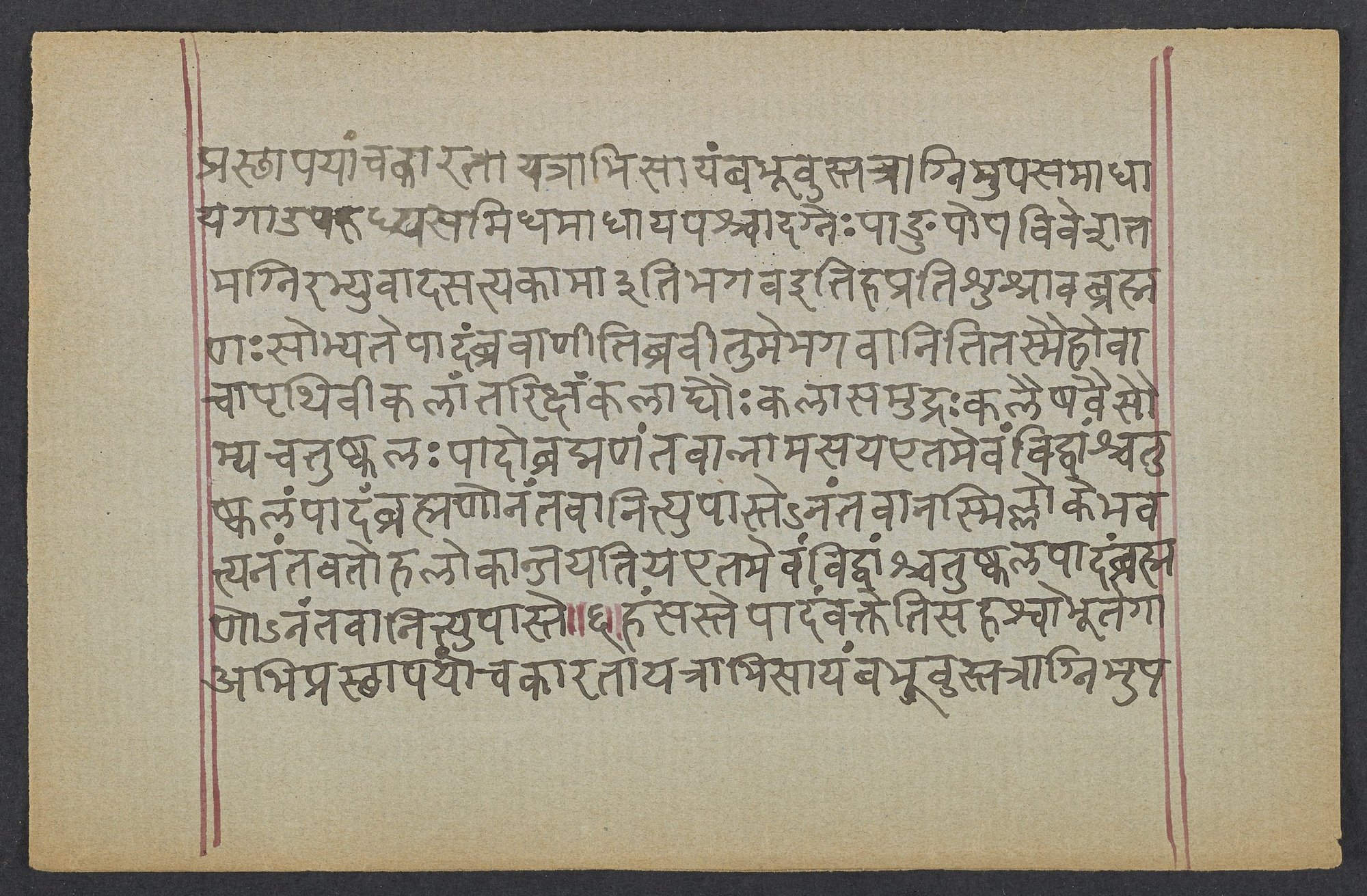
6.1agniṣṭe pādaṃ vakteti |
sa ha śvo bhūte gā abhiprasthāpayāṃ cakāra |
tā yatrābhisāyaṃ babhūvus tatrāgnim upasamādhāya gā uparudhya samidham ādhāya paścād agneḥ prāṅ upopaviveśa ||
6.2tam agnir abhyuvāda satyakāma 3 iti |
bhagava iti ha pratiśuśrāva ||
6.3brahmaṇaḥ somya te pādaṃ bravāṇīti |
bravītu me bhagavān iti |
tasmai ha uvāca |
pṛthivī kalā |
antarikṣaṃ kalā |
dyauḥ kalā |
samudraḥ kalā |
eṣa vai somya catuṣkalaḥ pādo brahmaṇo 'nantavān nāma ||
6.4sa ya etam evaṃ vidvāṃś catuṣkalaṃ pādaṃ brahmaṇo 'nantavān ity upāste 'nantavān asmiṃl loke bhavati |
anantavato ha lokāñ jayati ya etam evaṃ vidvāṃś catuṣkalaṃ pādaṃ brahmaṇo 'nantavān ity upāste ||
6.1'Agni will declare to you another foot of Brahman.' (After these words of the bull), Satyakâma, on the morrow, drove the cows (towards the house of the teacher). And when they came towards the evening, he lighted a fire, penned the cows, laid wood on the fire, and sat down behind the fire, looking to the east.
6.2Then Agni (the fire) said to him: 'Satyakâma!' He replied: 'Sir.'
6.3Agni said: 'Friend, I will declare unto you one foot of Brahman.' 'Declare it, Sir,' he replied. He said to him: 'The earth is one quarter, the sky is one quarter, the heaven is one quarter, the ocean is one quarter. This is a foot of Brahman, consisting of four quarters, and called Anantavat (endless).
6.4'He who knows this and meditates on the foot of Brahman, consisting of four quarters, by the name of Anantavat, becomes endless in this world. He conquers the endless worlds, whoever knows this and meditates on the foot of Brahman, consisting of four quarters, by the name of Anantavat.
Where on the image
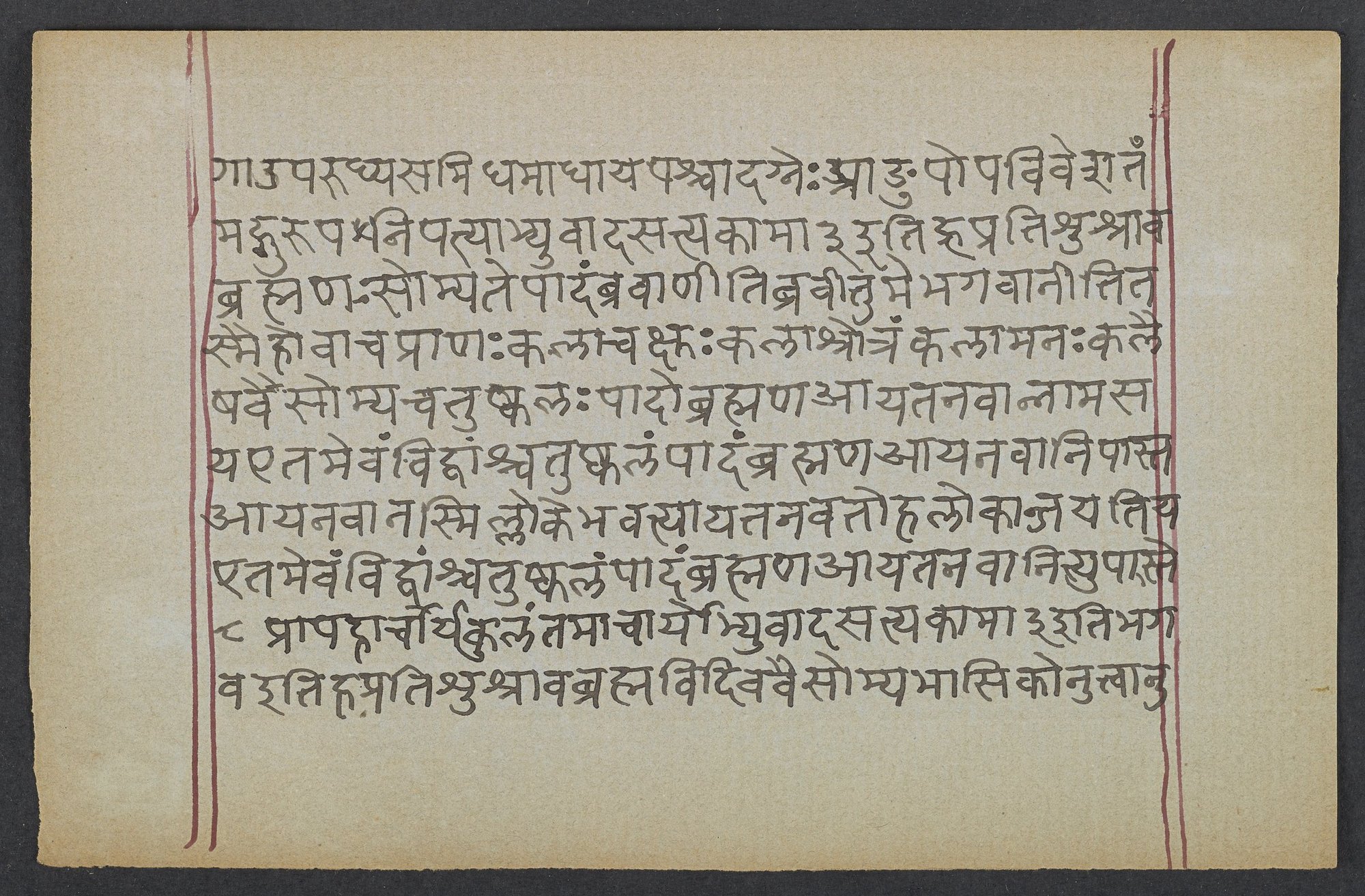
Penn Ms. Coll. 390 Item 945. fol. 33r begins ‹prasthāpayāṃ cakāra tā yatrābhisāyaṃ babhūvus tatrāgnim upasamādhāya› and ends ‹haṃsas te pādaṃ vakteti sa ha śvobhūte gā abhiprasthāpayāṃ cakāra tā yatrābhisāyaṃ babhūvus tatrāgnim up›; fol. 33v begins ‹samādhāya gā uparudhya samidham ādhāya paścād agneḥ prāṅ upopaviveśa› and ends ‹madgur ṣ ṭe pādaṃ vakteti sa ha śvobhūte gā abhiprasthāpayāṃ cakāra tā yatrābhisāyaṃ babhūvus tatrāgnim upasamādhāya› (first and last words read on the image, transliterated). The words were located in the GRETIL text by string matching and the page boundaries follow from them; readings and results are stored in data/sources/upanishads/mapping_945.json.
7.1haṃsaste pādaṃ vakteti sa ha śvobhūte gā abhiprasthāpayāñcakāra tā yatrābhisāyaṃ babhūvustatrāgnimupasamādhāyā gā uparudhya samidhamādhāya paścādagneḥ prāṅupopaviveśa //
7.2taṃ haṃsa upanipatyābhyuvāda satyakāma 3 iti bhagava iti ha pratiśuśrāva //
7.3brahmaṇaḥ somya te pādaṃ bravāṇīti |
bravītu me bhagavān iti |
tasmai hovāca |
agniḥ kalā |
sūryaḥ kalā |
candraḥ kalā |
vidyut kalā |
eṣa vai somya catuṣkalaḥ pādo brahmaṇo jyotiṣmān nāma ||
7.4sa ya etam evaṃ vidvāṃś catuṣkalaṃ pādaṃ brahmaṇo jyotiṣmān ity upāste jyotiṣmān asmiṃl loke bhavati |
jyotiṣmato ha lokāñ jayati ya etam evaṃ vidvāṃś catuṣkalaṃ pādaṃ brahmaṇo jyotiṣmān ity upāste ||
7.1'A Hamsa (flamingo, meant for the sun) will declare to you another foot of Brahman.' (After these words of Agni), Satyakâma, on the morrow, drove the cows onward. And when they came towards the evening, he lighted a fire, penned the cows, laid wood on the fire, and sat down behind the fire, looking toward the east.
7.2Then a Hamsa flew near and said to him: 'Satyakima.' He replied: 'Sir.'
7.3The Hamsa said: 'Friend, I will declare unto you one foot of Brahman.' 'Declare it, Sir,' he replied. He said to him: 'Fire is one quarter, the sun is one quarter, the moon is one quarter, lightning is one quarter. This is a foot of Brahman, consisting of four quarters, and called Gyotishmat (full of light).
7.4'He who knows this and meditates on the foot of Brahman, consisting of four quarters, by the name of Gyotishmat, becomes full of light in this world. He conquers the worlds which are full of light, whoever knows this and meditates on the foot of Brahman, consisting of four quarters, by the name of Gyotishmat.
Where on the image
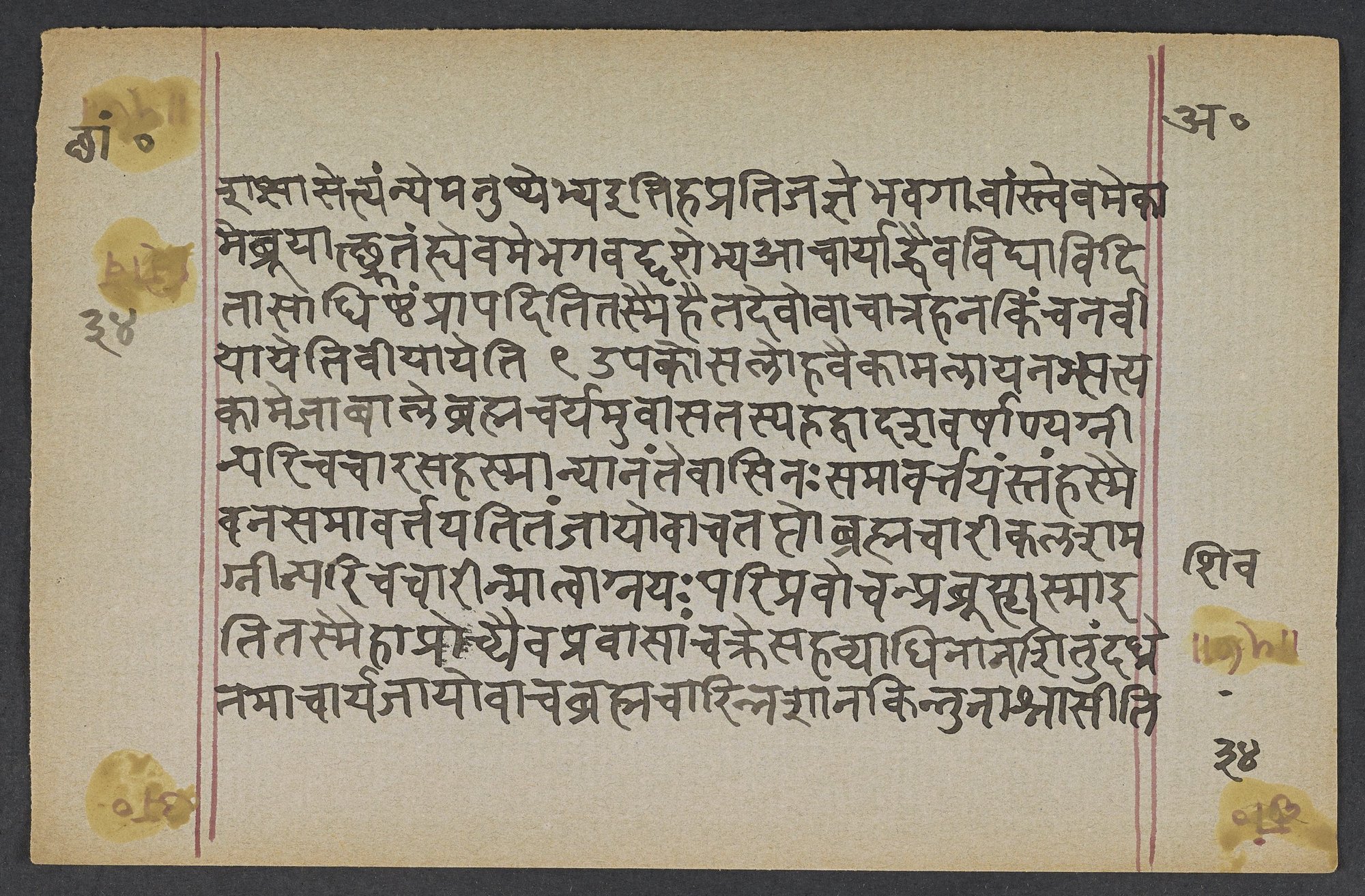
Penn Ms. Coll. 390 Item 945. fol. 33v begins ‹samādhāya gā uparudhya samidham ādhāya paścād agneḥ prāṅ upopaviveśa› and ends ‹madgur ṣ ṭe pādaṃ vakteti sa ha śvobhūte gā abhiprasthāpayāṃ cakāra tā yatrābhisāyaṃ babhūvus tatrāgnim upasamādhāya›; fol. 34r begins ‹gā uparudhya samidham ādhāya paścād agneḥ prāṅ upopaviveśa› and ends ‹brahmavid iva vai somya bhāsi ko nu tvānu› (first and last words read on the image, transliterated). Notes: Müller divides khanda 4.8 into paragraphs differently from the Sanskrit edition; the whole khanda is given here with his own numbers. The words were located in the GRETIL text by string matching and the page boundaries follow from them; readings and results are stored in data/sources/upanishads/mapping_945.json.
8.1madguṣṭe pādaṃ vakteti |
sa ha śvo bhūte gā abhiprasthāpayāṃ cakāra |
tā yatrābhisāyaṃ babhūvus tatrāgnim upasamādhāya gā uparudhya samidham ādhāya paścād agneḥ prāṅ upopaviveśa ||
8.2taṃ madgur upanipatyābhyuvāda satyakāma 3 iti |
bhagava iti ha pratiśuśrāva ||
8.3brahmaṇaḥ somya te pādaṃ bravāṇīti |
bravītu me bhagavān iti |
tasmai hovāca |
prāṇaḥ kalā |
cakṣuḥ kalā |
śrotraṃ kalā |
manaḥ kalā |
eṣa vai somya catuṣkalaḥ pādo brahmaṇa āyatanavān nāma ||
8.4sa ya etam evaṃ vidvāṃś catuṣkalaṃ pādaṃ brahmaṇa āyatanavān ity upāsta āyatanavān asmiṃl loke bhavati |
āyatanavato ha lokāñ jayati ya etam evaṃ vidvāṃś catuṣkalaṃ pādaṃ brahmaṇa āyatanavān ity upāste ||
9.1prāpa hācaryakulam |
tam ācaryo 'bhyuvāda satyakāma 3 iti |
bhagava iti ha pratiśuśrāva ||
8.1'A diver-bird (Madgu, meant for Prâna) will declare to you another foot of Brahman.' (After these words of the Hamsa), Satyakâma, on the morrow, drove the cows onward. And when they came towards the evening, he lighted a fire, penned the cows, laid wood on the fire, and sat down behind the fire, looking toward the east.
8.2Then a diver flew near and said to him: 'Satyakâma.' He replied: 'Sir.'
8.3The diver said: 'Friend, I will declare unto you one foot of Brahman.' 'Declare it, Sir,' he replied. He said to him: 'Breath is one quarter, the eye is one quarter, the ear is one quarter, the mind is one quarter. This is a foot of Brahman, consisting of four quarters, and called Âyatanavat (having a home). 'He who knows this and meditates on the foot of Brahman, consisting of four quarters, by the name of Âyatanavat, becomes possessed of a home in this world. He conquers the worlds which offer a home, whoever knows this and meditates on the foot of Brahman, consisting of four quarters, by the name of Âyatanavat.'
9.1Thus he reached the house of his teacher. The teacher said to him: 'Satyakâma.' He replied: 'Sir.'
Where on the image
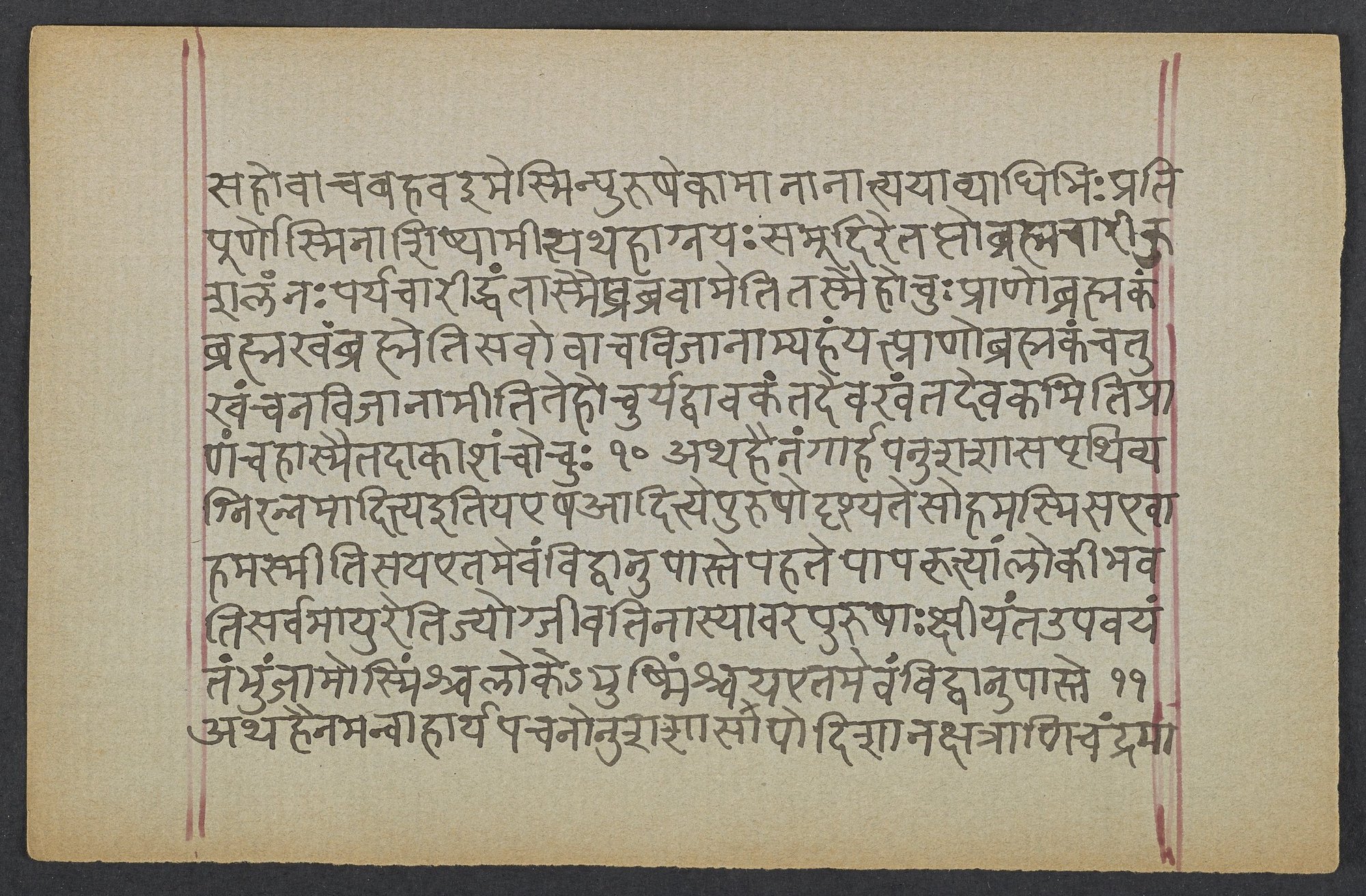
Penn Ms. Coll. 390 Item 945. fol. 34r begins ‹gā uparudhya samidham ādhāya paścād agneḥ prāṅ upopaviveśa› and ends ‹brahmavid iva vai somya bhāsi ko nu tvānu›; fol. 34v begins ‹śāsety anye manuṣyebhya iti ha pratijajñe bhagavāṃs tv eva me kāme brūyāt› and ends ‹taṃ hācāryajāyovāca brahmacārin kiṃ nu nāśnāsīti› (first and last words read on the image, transliterated). The words were located in the GRETIL text by string matching and the page boundaries follow from them; readings and results are stored in data/sources/upanishads/mapping_945.json.
9.2brahmavid iva vai somya bhāsi |
ko nu tvānuśaśāseti |
anye manuṣyebhya iti ha pratijajñe |
bhagavāṃs tv eva me kāme brūyāt ||
9.3śrutaṃ hy eva me bhagavaddṛśebhya ācāryād dhaiva vidyā viditā sādhiṣṭhaṃ prāpatīti |
tasmai ha etad eva uvāca |
atra ha na kiṃcana vīyāyeti vīyāyeti ||
10.1upakosalo ha vai kāmalāyanaḥ satyakāme jābāle brahmacāryam uvāsa |
tasya ha dvādaśa vārṣāny agnīn paricacāra |
sa ha smānyān antevāsinaḥ samāvartayaṃs taṃ ha smaiva na samāvartayati ||
10.2taṃ jāyovāca tapto brahmacārī kuśalam agnīn paricacārīt |
mā tvā agnayaḥ paripravocan |
prabrūhy asmā iti |
tasmai hāprocyaiva pravāsāṃ cakre ||
9.2The teacher said: 'Friend, you shine like one who knows Brahman. Who then has taught you?' He replied: 'Not men. But you only, Sir, I wish, should teach me;
9.3'For I have heard from men like you, Sir, that only knowledge which is learnt from a teacher (Âkârya), leads to real good.' Then he taught him the same knowledge. Nothing was left out, yea, nothing was left out.
10.1Upakosala Kâmalâyana dwelt as a Brahmakârin (religious student) in the house of Satyakâma Gâbâla. He tended his fires for twelve years. But the teacher, though he allowed other pupils (after they had learnt the sacred books) to depart to their own homes, did not allow Upakosala to depart.
10.2Then his wife said to him: 'This student, who is quite exhausted (with austerities), has carefully tended your fires. Let not the fires themselves blame you, but teach him.' The teacher, however, went away on a journey without having taught him.
Where on the image
Penn Ms. Coll. 390 Item 945. fol. 34v begins ‹śāsety anye manuṣyebhya iti ha pratijajñe bhagavāṃs tv eva me kāme brūyāt› and ends ‹taṃ hācāryajāyovāca brahmacārin kiṃ nu nāśnāsīti›; fol. 35r begins ‹sa hovāca bahava ime 'smin puruṣe kāmā nānātyayā vyādhibhiḥ pratipūrṇo 'smi nāśiṣyāmīti› and ends ‹atha hainam anvāhāryapacano 'nuśaśāsāpo diśo nakṣatrāṇi candramā› (first and last words read on the image, transliterated). The words were located in the GRETIL text by string matching and the page boundaries follow from them; readings and results are stored in data/sources/upanishads/mapping_945.json.
10.3sa ha vyādhinā anaśituṃ dadhre |
tam ācāryajāyā uvāca brahmacārinn aśāna |
kiṃ nu na aśnāsi iti |
sa ha uvāca bahava ime 'smin puruṣe kāmā nānātyāyāḥ |
vyādhībhīḥ pratipūrṇo 'smi |
na as/iṣyāmi iti ||
10.4atha hāgnayaḥ samūdire |
tapto brahmacārī kuśalaṃ naḥ paryacārīt |
hantāsmai prabravāmeti tasmai hocuḥ |
prāṇo brahma kaṃ brahma khaṃ brahmeti ||
10.5sa hovāca |
vijānāmy ahaṃ yat prāṇo brahma |
kaṃ ca tu khaṃ ca na vijānāmīti |
te hocuḥ |
yad vāva kaṃ tad eva kham |
yad eva khaṃ tad eva kam iti |
prāṇaṃ ca hāsmai tad ākāśaṃ cocuḥ ||
11.1atha hainaṃ gārhapatyo 'nuśaśāsa pṛthivy agnir annam āditya iti |
ya eṣa āditye puruṣo dṛśyate so 'ham asmi sa eva aham asmi iti ||
11.2sa ya etam evaṃ vidvān upāste |
apahate pāpakṛtyām |
lokī bhavati |
sarvam āyur eti |
jyog jīvati |
na asya avarapuruṣāḥ kṣīyante |
upa vayaṃ taṃ bhuñjāmo 'smiṃś ca loke 'muṣmiṃś ca |
ya etam evaṃ vidvān upāste ||
10.3The student from sorrow was not able to eat. Then the wife of the teacher said to him: 'Student, eat! Why do you not eat?' He said: 'There are many desires in this man here, which lose themselves in different directions. I am full of sorrows, and shall take no food.'
10.4Thereupon the fires said among themselves: 'This student, who is quite exhausted, has carefully tended us. Well, let us teach him.' They said to him:
10.5'Breath is Brahman, Ka (pleasure) is Brahman, Kha (ether) is Brahman.' He said: 'I understand that breath is Brahman, but I do not understand Ka or Kha.' They said: 'What is Ka is Kha, what is Kha is Ka.' They therefore taught him Brahman as breath, and as the ether (in the heart).
11.1After that the Gârhapatya fire taught him: 'Earth, fire, food, and the sun (these are my forms, or forms of Brahman). The person that is seen in the sun, I am he, I am he indeed.
11.2'He who knowing this meditates on him, destroys sin, obtains the world (of Agni Gârhapatya), reaches his full age, and lives long; his descendants do not perish. We guard him in this world and in the other; whosoever knowing this meditates on him.'
Where on the image
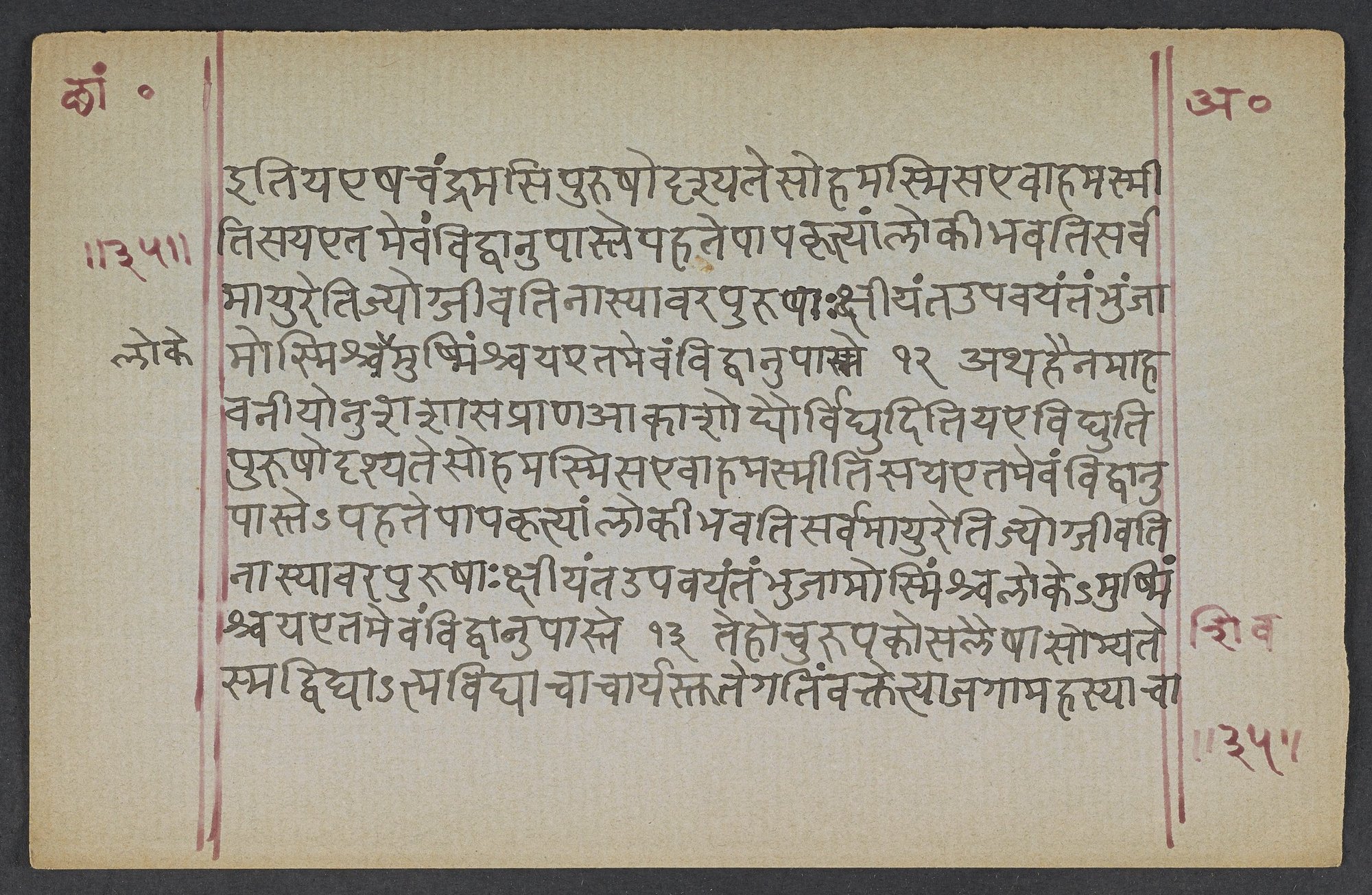
Penn Ms. Coll. 390 Item 945. fol. 35r begins ‹sa hovāca bahava ime 'smin puruṣe kāmā nānātyayā vyādhibhiḥ pratipūrṇo 'smi nāśiṣyāmīti› and ends ‹atha hainam anvāhāryapacano 'nuśaśāsāpo diśo nakṣatrāṇi candramā›; fol. 35v begins ‹iti ya eṣa candramasi puruṣo dṛśyate so 'ham asmi sa evāham asmīti› and ends ‹te hocur upakosalaiṣā somya te 'smadvidyātmavidyā cācāryas tu te gatiṃ vakteti ājagāma hāsyā› (first and last words read on the image, transliterated). The words were located in the GRETIL text by string matching and the page boundaries follow from them; readings and results are stored in data/sources/upanishads/mapping_945.json.
12.1atha ha enam anvāhāryapacano 'nuśaśāsa āpo diśo nakṣatrāṇi candramā iti |
ya eṣa candramasi puruṣo dṛṣyate so 'ham asmi sa eva aham asmi iti ||
12.2sa ya etam evaṃ vidvān upāste |
apahate pāpakṛtyām |
lokī bhavati |
sarvam āyur eti |
jyog jīvati |
na asya avarapuruṣāḥ kṣīyante |
upa vayaṃ taṃ bhuñjāmo 'smiṃś ca loke 'muṣmiṃś ca |
ya etam evaṃ vidvān upāste ||
13.1atha hainam āhavanīyo 'nuśaśāsa prāṇa ākāśo dyaur vidyud iti |
ya eṣa vidyuti puruṣo dṛśyate so 'ham asmi sa evāham asmīti ||
13.2sa ya etam evaṃ vidvān upāste |
apahate pāpakṛtyām |
lokī bhavati |
sarvam ayur eti |
jyog jīvati |
nāsyāvarapuruṣāḥ kṣīyante |
upa vayaṃ taṃ bhuñjāmo 'smiṃś ca loke 'muṣmiṃś ca |
ya etam evaṃ vidvān upāste ||
12.1Then the Anvâhârya fire taught him: 'Water, the quarters, the stars, the moon (these are my forms). The person that is seen in the moon, I am he, I am he indeed.
12.2He who knowing this meditates on him, destroys sin, obtains the world (of Agni Anvâhârya), reaches his full age, and lives long; his descendants do not perish. We guard him in this world and in the other, whosoever knowing this meditates on him.'
13.1Then the Âhavanîya fire taught him: 'Breath, ether, heaven, and lightning (these are my forms). The person that is seen in the lightning, I am he, I am he indeed.
13.2'He who knowing this meditates on him, destroys sin, obtains the world (of Agni Âhavanîya), reaches his full age, and lives long; his descendants do not perish. We guard him in this world and in the other, whosoever knowing this meditates on him.'
Where on the image
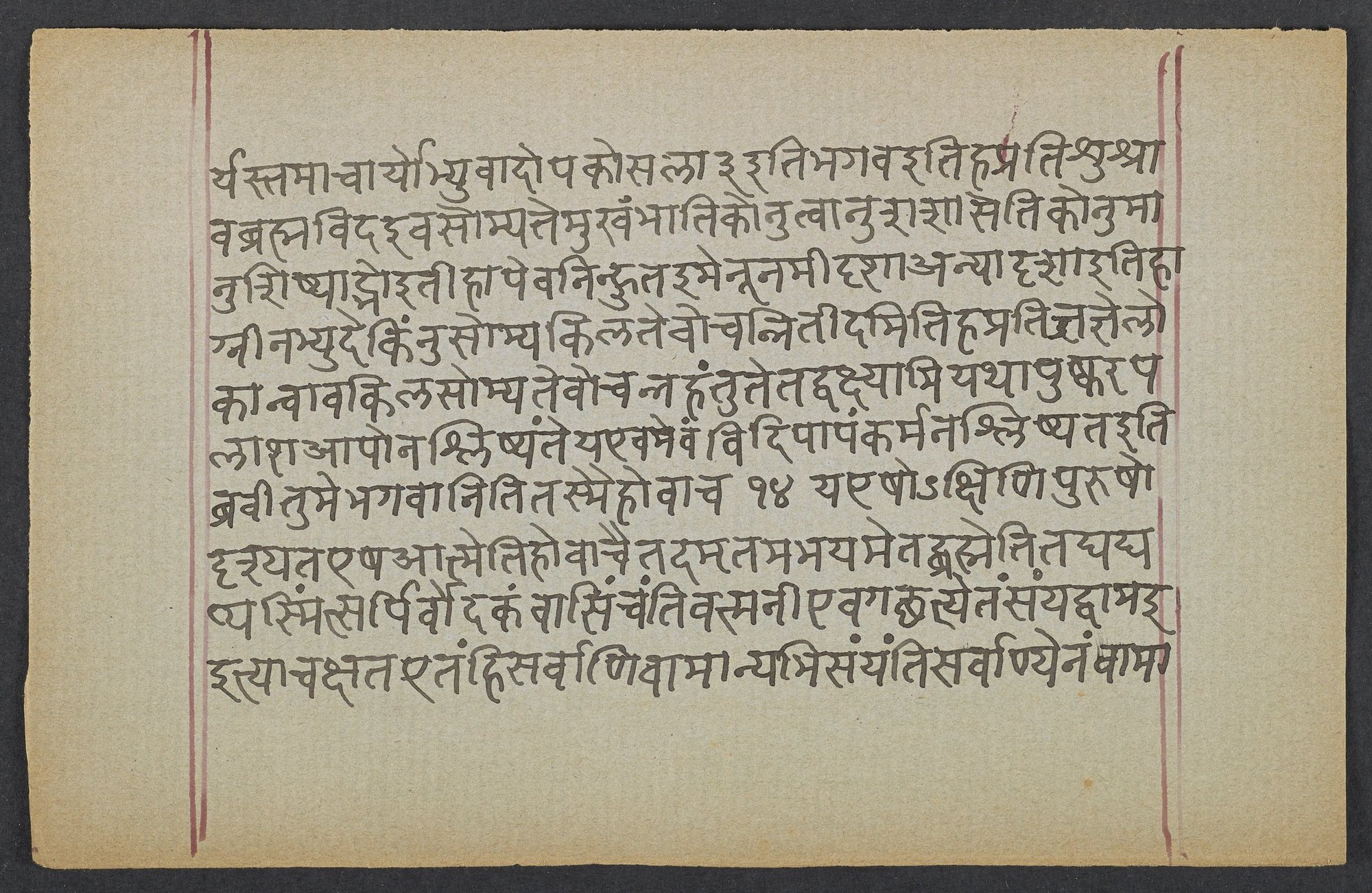
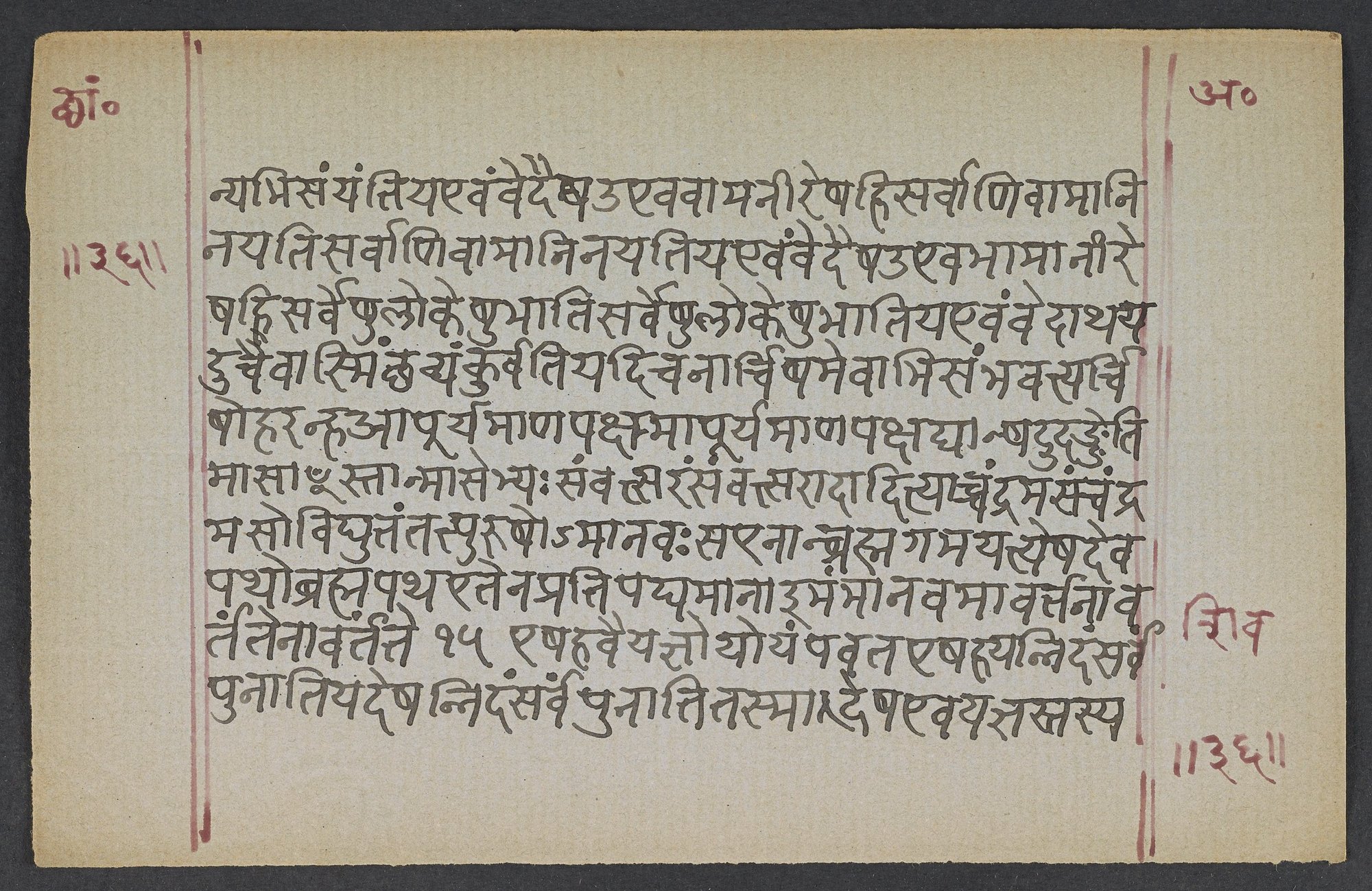
Penn Ms. Coll. 390 Item 945. fol. 35v begins ‹iti ya eṣa candramasi puruṣo dṛśyate so 'ham asmi sa evāham asmīti› and ends ‹te hocur upakosalaiṣā somya te 'smadvidyātmavidyā cācāryas tu te gatiṃ vakteti ājagāma hāsyā›; fol. 36r begins ‹cāryas tam ācāryo 'bhyuvādopakosalā iti bhagava iti ha pratiśuśrāva› and ends ‹ity ācakṣata etaṃ hi sarvāṇi vāmāny abhisaṃyanti sarvāṇy enaṃ vāmā›; fol. 36v begins ‹ny abhisaṃyanti ya evaṃ veda eṣa u eva vāmanīr eṣa hi sarvāṇi vāmāni nayati› and ends ‹eṣa ha vai yajño yo 'yaṃ pavata eṣa hīdaṃ sarvaṃ punāti yad eṣa yann idaṃ sarvaṃ punāti tasmād eṣa eva yajñas tasya› (first and last words read on the image, transliterated). Notes: Müller divides khanda 4.15 into paragraphs differently from the Sanskrit edition; the whole khanda is given here with his own numbers. The words were located in the GRETIL text by string matching and the page boundaries follow from them; readings and results are stored in data/sources/upanishads/mapping_945.json.
14.1te hocuḥ |
upakosalaiṣā somya te 'smadvidyātmavidyā ca |
ācāryas tu te gatiṃ vakteti |
ājagāma hāsyācāryaḥ |
tam ācāryo 'bhyuvādopakosala 3 iti ||
14.2bhagava iti ha pratiśuśrāva |
brahmavida iva somya mukhaṃ bhāti |
ko nu tvānuśaśāseti |
ko nu mānuśiśyād bho itīhāpeva nihnute |
ime nūnam īdṛśā anyādṛśā itīhāgnīn abhyūde |
kiṃ nu somya kila te 'vocann iti ||
14.3idam iti ha pratijajñe |
lokān vāva kila somya te 'vocan |
ahaṃ tu te tad vakṣyāmi yathā puṣkarapalāśa āpo na śliṣyanta evam evaṃvidi pāpaṃ karma na śliṣyata iti |
bravītu me bhagavān iti |
tasmai hovāca ||
15.1ya eṣo 'kṣiṇi puruṣo dṛśyata eṣa ātmeti hovāca |
etad amṛtam abhayam etad brahmeti |
tad yady apy asmin sarpir vodakaṃ vā siñcati vartmanī eva gacchati ||
15.2etaṃ saṃyadvāma ity ācakṣate |
etaṃ hi sarvāṇi vāmāny abhisaṃyanti |
sarvāṇy enaṃ vāmāny abhisaṃyanti ya evaṃ veda ||
15.3eṣa u eva vāmanīḥ |
eṣa hi sarvāṇi vāmāni nayati |
sarvāṇi vāmāni nayati ya evaṃ veda ||
15.4eṣa u eva bhāmanīḥ |
eṣa hi sarveṣu lokeṣu bhāti |
sarveṣu lokeṣu bhāti ya evaṃ veda ||
15.5atha yad u caivāsmiñ chavyaṃ kurvanti yadi ca nārciṣam evābhisaṃbhavanti |
arciṣo 'haḥ |
ahna āpūryamāṇapakṣam |
āpūryamāṇapakṣād yān ṣaḍ udaṅṅ eti māsāṃs tān |
māsebhyaḥ saṃvatsaram |
saṃvatsarād ādityam |
ādityāc candramasam |
candramaso vidyutam |
tat puruṣo 'mānavaḥ |
sa enān brahma gamayati |
eṣa devapatho brahmapathaḥ |
etena pratipadyamānā imaṃ mānavam āvartaṃ nāvartante nāvartante ||
14.1Then they all said: 'Upakosala, this is our knowledge, our friend, and the knowledge of the Self, but the teacher will tell you the way (to another life).'
14.2In time his teacher came back, and said to him: 'Upakosala.' He answered: 'Sir.' The teacher said: 'Friend, your face shines like that of one who knows Brahman. Who has taught you?' 'Who should teach me, Sir?' he said. He denies, as it were. And he said (pointing) to the fires: 'Are these fires other than fires?' The teacher said: 'What, my friend, have these fires told you?'
14.3He answered: 'This' (repeating some of what they had told him). The teacher said: 'My friend, they have taught you about the worlds, but I shall tell you this; and as water does not cling to a lotus leaf, so no evil deed clings to one who knows it.' He said: 'Sir, tell it me.'
15.1He said: 'The person that is seen in the eye, that is the Self. This is the immortal, the fearless, this is Brahman. Even though they drop melted butter or water on him, it runs away on both sides.
15.2'They call him Samyadvâma, for all blessings (vâma) go towards him (samyanti). All blessings go towards him who knows this.
15.3'He is also Vâmanî, for he leads (nayati) all blessings (vâma). He leads all blessings who knows this.
15.4'He is also Bhâmanî, for he shines (bhâti) in all worlds. He who knows this, shines in all worlds.
15.5'Now (if one who knows this, dies), whether people perform obsequies for him or no, he goes to light (arkis), from light to day, from day to the light half of the moon, from the light half of the moon to the six months during which the sun goes to the north, from the months to the year, from the year to the sun, from the sun to the moon, from the moon to the lightning. There is a person not human,
15.6'He leads them to Brahman. This is the path of the Devas, the path that leads to Brahman. Those who proceed on that path, do not return to the life of man, yea, they do not return.'
Where on the image
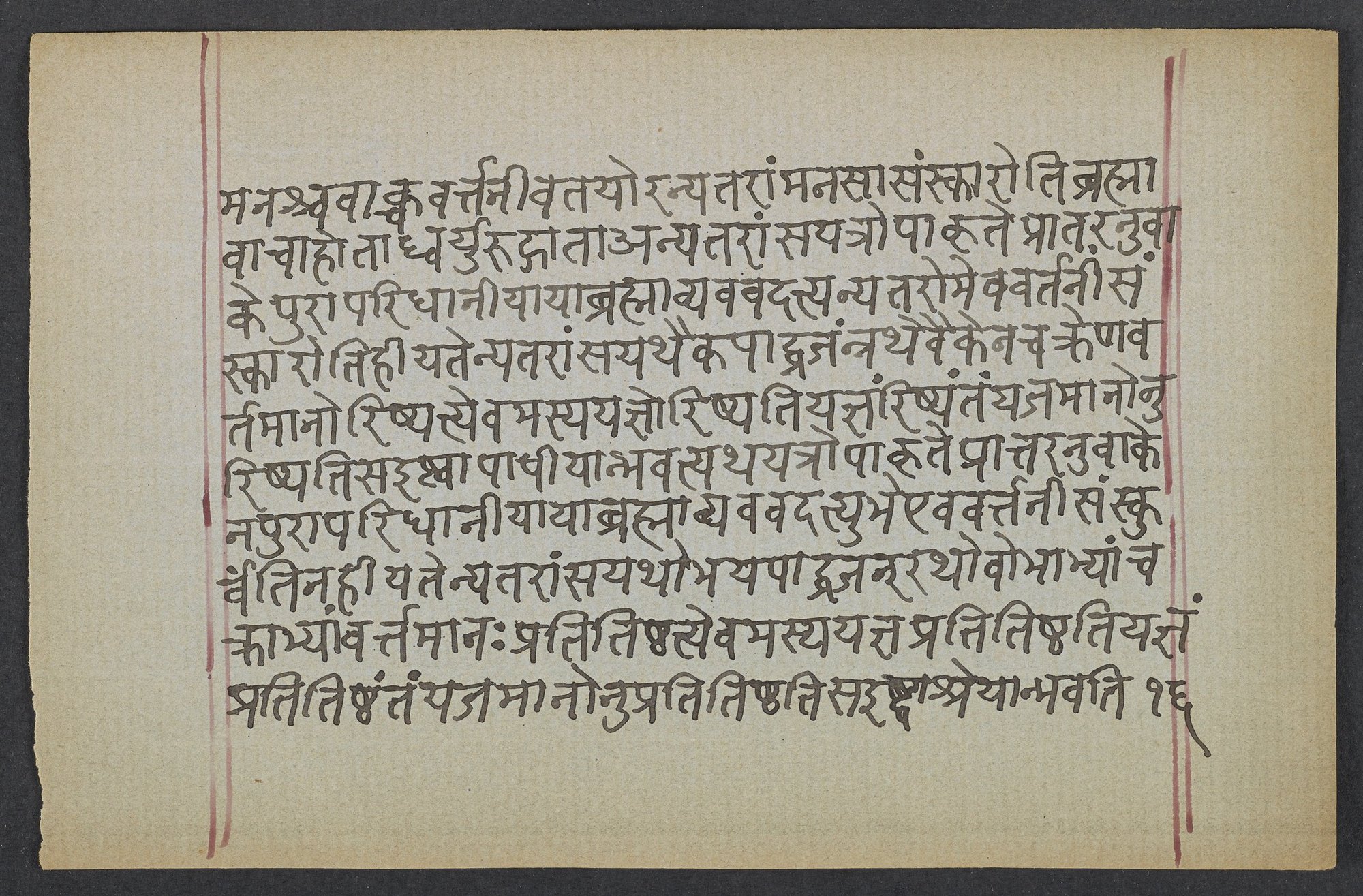
Penn Ms. Coll. 390 Item 945. fol. 36v begins ‹ny abhisaṃyanti ya evaṃ veda eṣa u eva vāmanīr eṣa hi sarvāṇi vāmāni nayati› and ends ‹eṣa ha vai yajño yo 'yaṃ pavata eṣa hīdaṃ sarvaṃ punāti yad eṣa yann idaṃ sarvaṃ punāti tasmād eṣa eva yajñas tasya›; fol. 37r begins ‹manaś ca vāk ca vartanī tayor anyatarāṃ manasā saṃskaroti brahmā› and ends ‹pratitiṣṭhantaṃ yajamāno 'nupratitiṣṭhati sa iṣṭvā śreyān bhavati› (first and last words read on the image, transliterated). The words were located in the GRETIL text by string matching and the page boundaries follow from them; readings and results are stored in data/sources/upanishads/mapping_945.json.
16.1eṣa ha vai yajño yo 'yaṃ pavate |
eṣa ha yann idaṃ sarvaṃ punāti |
yad eṣa yann idaṃ sarvaṃ punāti |
tasmād eṣa eva yajñaḥ |
tasya manaś ca vāk ca vartanī ||
16.2tayor anyatarāṃ manasā saṃskaroti brahmā |
vācā hotādhvaryur udgātānyatarām |
sa yatropākṛte prātaranuvāke purā paridhānīyāyā brahmā vyavavadati ||
16.3anyatarām eva vartanīṃ saṃskaroti |
hīyate 'nyatarā |
sa yathaikapād vrajan ratho vaikena cakreṇa vartamāno riṣyaty evam asya yajño riṣyati |
yajñaṃ riṣyantaṃ yajamāno 'nu riṣyati |
sa iṣṭvā pāpīyān bhavati ||
16.4atha yatra upākṛte prātaranuvāke na purā paridhānīyāyā brahmā vyavavadaty ubhe eva vartanī saṃskurvanti |
na hīyate 'nyatarā ||
16.5sa yathobhayapād vrajan ratho vobhābhyāṃ cakrābhyāṃ vartamānaḥ pratitiṣṭhaty evam asya yajñaḥ pratitiṣṭhati yajñaṃ pratitiṣṭhantaṃ yajamāno 'nu pratitiṣṭhati |
sa iṣṭvā śreyān bhavati ||
16.1Verily, he who purifies (Vâyu) is the sacrifice, for he (the air) moving along, purifies everything. Because moving along he purifies everything, therefore he is the sacrifice. Of that sacrifice there are two ways, by mind and by speech.
16.2The Brahman priest performs one of them in his mind, the Hotri, Adhvaryu, and Udgâtri priests perform the other by words. When the Brahman priest, after the Prâtaranuvâka ceremony has begun, but before the recitation of the Paridhânîyâ hymn, has (to break his silence and) to speak,
16.3He performs perfectly the one way only (that by words), but the other is injured. As a man walking on one foot, or a carriage going on one wheel, is injured, his sacrifice is injured, and with the injured sacrifice the sacrificer is injured; yes, having sacrificed, he becomes worse.
16.4But when after the Prâtaranuvâka ceremony has begun and before the recitation of the Paridhânlyâ hymn, the Brahman priest has not (to break his silence and) to speak, they perform both ways perfectly, and neither of them is injured.
16.5As a man walking on two legs and a carriage going on two wheels gets on, so his sacrifice gets on, and with the successful sacrifice the sacrificer gets on; yes, having sacrificed, he becomes better.
Where on the image
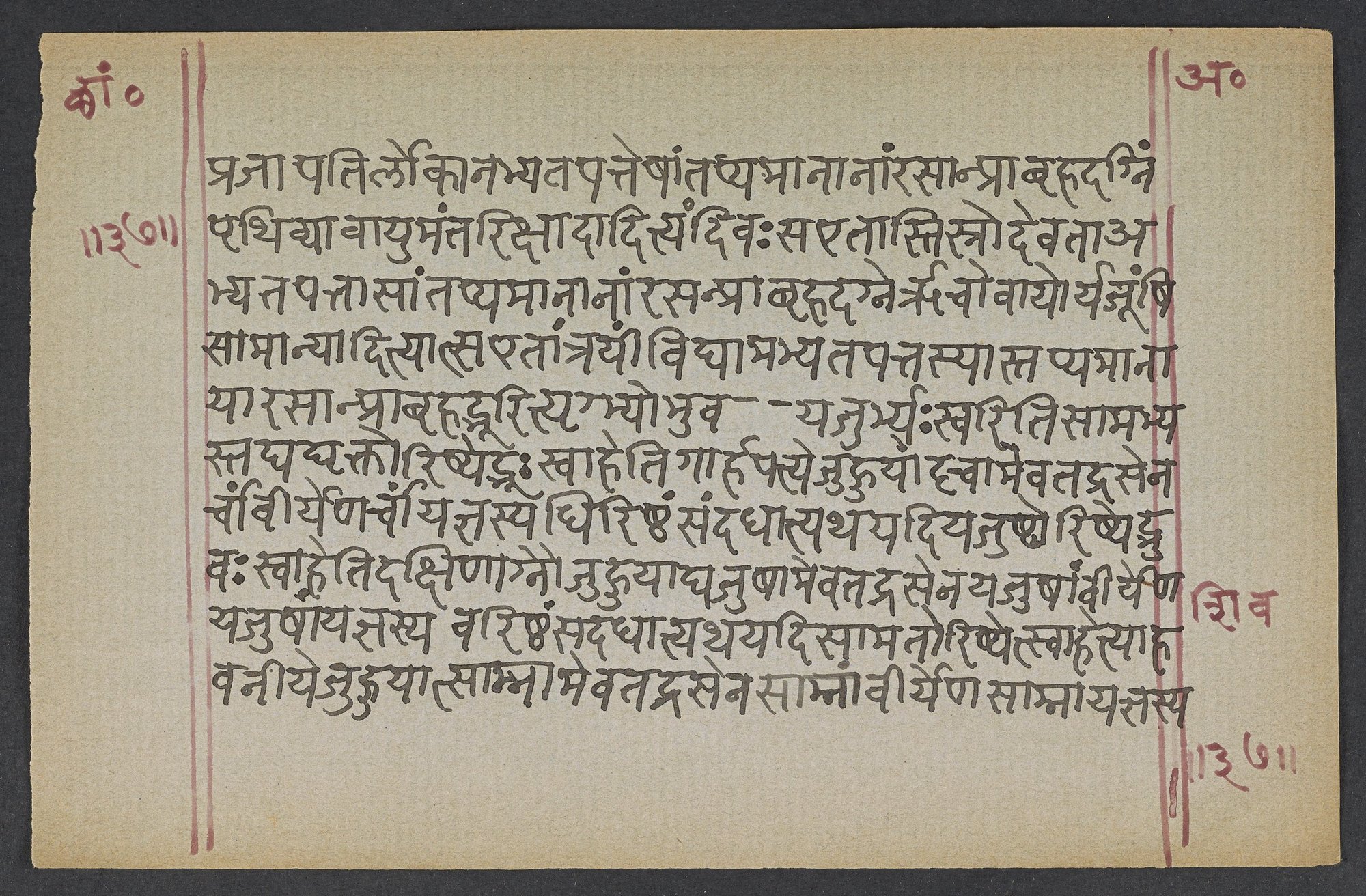
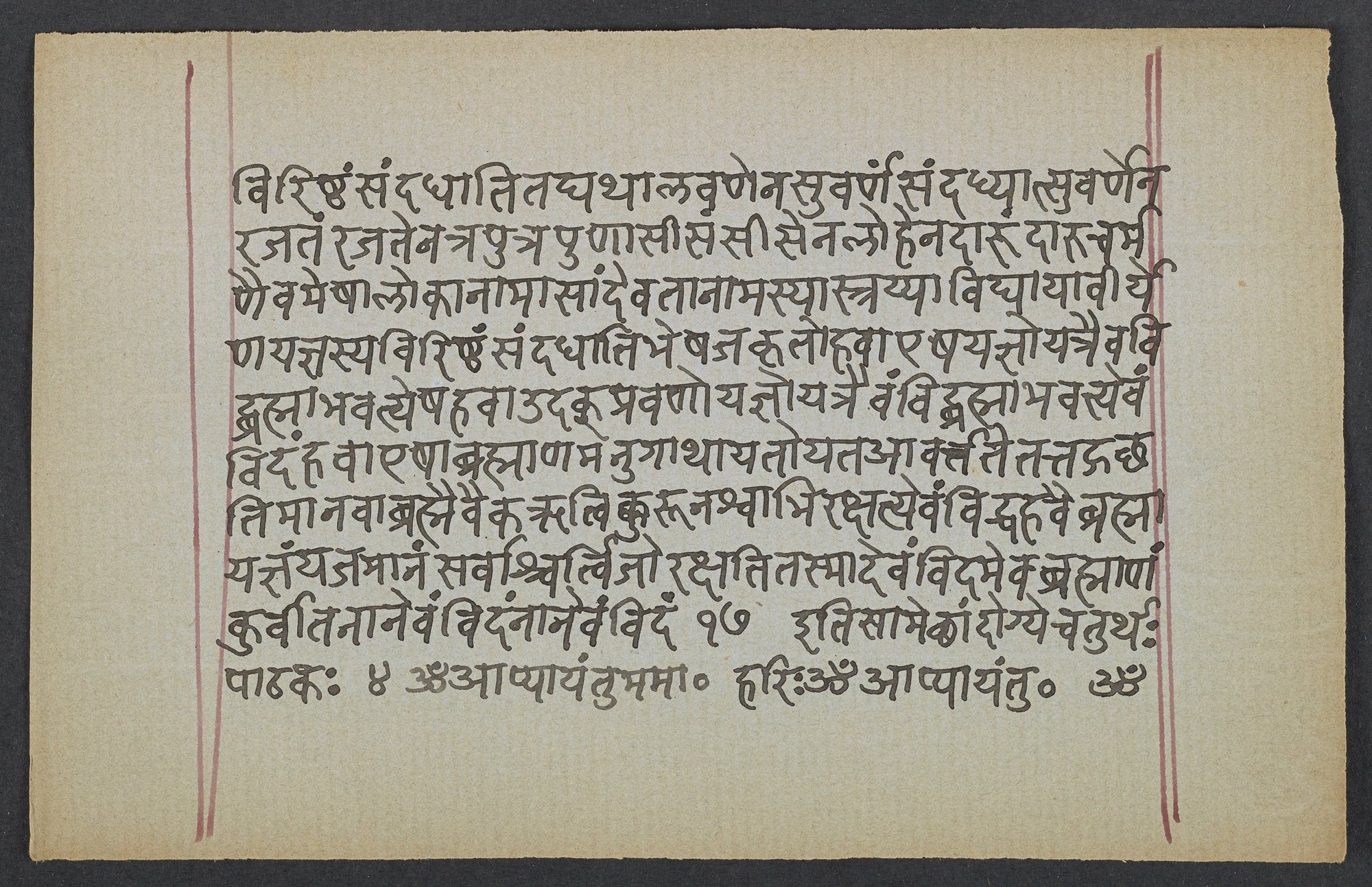
Penn Ms. Coll. 390 Item 945. fol. 37v begins ‹prajāpatir lokān abhyatapat teṣāṃ tapyamānānāṃ rasān prāvṛhad agniṃ pṛthivyā› and ends ‹sāmnām eva tad rasena sāmnāṃ vīryeṇa sāmnāṃ yajñasya›; fol. 38r begins ‹viriṣṭaṃ saṃdadhāti tad yathā lavaṇena suvarṇaṃ saṃdadhyāt› and ends ‹kurvīta nānevaṃvidaṃ nānevaṃvidam› (first and last words read on the image, transliterated). Notes: Müller divides khanda 4.17 into paragraphs differently from the Sanskrit edition; the whole khanda is given here with his own numbers. The words were located in the GRETIL text by string matching and the page boundaries follow from them; readings and results are stored in data/sources/upanishads/mapping_945.json.
17.1prajāpatir lokān abhyatapat |
teṣāṃ tapyamānānāṃ rasān prāvṛhat |
agniṃ pṛthivyāḥ |
vāyum antarikṣāt |
ādityaṃ divaḥ ||
17.2sa etās tisro devatā abhyatapat |
tāsāṃ tapyamānānāṃ rasān prāvṛhat |
agner ṛcaḥ |
vāyor yajūṃṣi |
sāmāny ādityāt ||
17.3sa etāṃ trayīṃ vidyām abhyatapat |
tasyās tapyamānāyā rasān prāvṛhat |
bhūr ity ṛgbhyaḥ |
bhuvar iti yajurbhyaḥ |
svar iti sāmabhyaḥ ||
17.4tad yady ṛkto riṣyed bhūḥ svāheti gārhapatye juhuyāt |
ṛcām eva tadrasenarcāṃ vīryeṇarcāṃ yajñasya viriṣṭaṃ saṃdadhāti ||
17.5atha yadi yajuṣṭo riṣyed bhuvaḥ svāheti dakṣiṇāgnau juhuyāt |
yajuṣām eva tadrasena yajuṣāṃ vīryeṇa yajuṣāṃ yajñasya viriṣṭaṃ saṃdadhāti ||
17.6atha yadi sāmato riṣyet svaḥ svāhety āhavanīye juhuyāt |
sāmnām eva tadrasena sāmnāṃ vīryeṇa sāmnāṃ yajñasya viriṣṭaṃ saṃdadhāti ||
17.7tad yathā lavaṇena suvarṇaṃ saṃdadhyāt |
suvarṇena rajataṃ rajatena trapu trapuṇā sīsaṃ sīsena lohaṃ lohena dāru dāru carmaṇā ||
17.8evam eṣāṃ lokānām āsāṃ devatānām asyās trayyā vidyāyā vīryeṇa yajñasya viriṣṭaṃ saṃdadhāti |
bheṣajakṛto ha vā eṣa yajño yatraivaṃvid brahmā bhavati ||
17.9eṣa ha vā udakpravaṇo yajño yatraivaṃvid brahmā bhavati |
evaṃvidaṃ ha vā eṣā brahmāṇam anu gāthā |
yato yata āvartate tat tad gacchati ||
17.10mānavaḥ |
brahmaivaika ṛtvik kurūn aśvābhirakṣati |
evaṃvid dha vai brahmā yajñaṃ yajamānaṃ sarvāṃś cartvijo 'bhirakṣati |
tasmād evaṃvidam eva brahmāṇaṃ kurvīta nānevaṃvidaṃ nānevaṃvidam ||
17.1Pragâpati brooded over the worlds, and from them thus brooded on he squeezed out the essences, Agni (fire) from the earth, Vâyu (air) from the sky, Âditya (the sun) from heaven.
17.2He brooded over these three deities, and from them thus brooded on he squeezed out the essences, the Rik verses from Agni, the Yagus verses from Vâyu, the Sâman verses from Âditya.
17.3He brooded over the threefold knowledge (the three Vedas), and from it thus brooded on he squeezed out the essences, the sacred interjection Bhûs from the Rik verses, the sacred interjection Bhuvas from the Yagus verses, the sacred interjection Svar from the Sâman verses.
17.4If the sacrifice is injured from the Rig-veda side, let him offer a libation in the Gârhapatya fire, saying, Bhûh, Svâha! Thus does he bind together and heal, by means of the essence and the power of the Rik verses themselves, whatever break the Rik sacrifice may have suffered.
17.5If the sacrifice is injured from the Yagur-veda side, let him offer a libation in the Dakshina fire, saying, Bhuvah, Svâhâ! Thus does he bind together and heal, by means of the essence and the power of the Yagus verses themselves, whatever break the Yagus sacrifice may have suffered.
17.6If the sacrifice is injured by the Sâma-veda side, let him offer a libation in the Âhavanîya fire, saying, Svah, Svâhâ! Thus does he bind together and heal, by means of the essence and the power of the Sâman verses themselves, whatever break the Sâman sacrifice may have suffered.
17.7As one binds (softens) gold by means of lavana (borax), and silver by means of gold, and tin by means of silver, and lead by means of tin, and iron (loha) by means of lead, and wood by means of iron, or also by means of leather,
17.8Thus does one bind together and heal any break in the sacrifice by means of (the Vyâhritis or sacrificial interjections which are) the essence and strength of the three worlds, of the deities, and of the threefold knowledge. That sacrifice is healed in which there is a Brahman priest who knows this.
17.9That sacrifice is inclined towards the north (in the right way) in which there is a Brahman priest who knows this. And with regard to such a Brahman priest there is the following Gâthâ: 'Wherever it falls back, thither the man goes,'— viz. the Brahman only, as one of the Ritvig priests. 'He saves the Kurus as a mare' (viz. a Brahman priest who knows this, saves the sacrifice, the sacrificer, and all the other priests). Therefore let a man make him who knows this his Brahman priest, not one who does not know it, who does not know it.
Notes
- Sanskrit: GRETIL, Chandogyopanisad with the commentary ascribed to Samkara, mula text only (input by the Sansknet project). Paragraph numbers (khanda.paragraph) follow the edition. Three legacy encoding artifacts in GRETIL chapter 2 ('saptavidh.am', 'brahmavarcasy:', 'tejasvy:') are normalized.
- English: F. Max Müller, 'Khandogya-upanishad', The Upanishads part I, Sacred Books of the East 1 (1879), from the proofread English Wikisource transcription; footnotes are not reproduced. Where Müller divides a khanda into a different number of paragraphs than the Sanskrit edition, the whole khanda stands in one section and keeps his numbers. In other khandas his paragraph breaks sometimes fall a clause earlier or later than the Sanskrit ones.
- Transcription slips corrected to the printed page: 1.9.2 'udîttha' (printed udgîtha), 3.16.2 'sacrifices' (sacrificer,), 4.6.1 'toward' (towards), 7.25.1 'alt' (all); the stray heading 'Elventh Khanda' inside 2.10.6 is removed. 1.2.1 'Whent he' is a misprint in the book itself and is kept as printed.
- The manuscript readings differ from the edition in places; the Sanskrit shown is the edition text.
Cite
Sources
- Source: Penn Ms. Coll. 390 Item 945 (OPenn, public domain) + GRETIL Sanskrit + F. Max Müller (1879) English (holding institution)
- Critical edition: GRETIL Sanskrit e-texts (Isa, Katha, Prasna, Mandukya, Aitareya, Taittiriya, Svetasvatara, Chandogya); Nirnaya Sagar edition of 1925, transcribed (Kena, Mundaka)
← previous · → next · v cycle view · l back to library