Chandogya Upanishad, Prapathaka 5 (the breath; the five fires; Asvapati and the universal self)
Introduction
The Chandogya Upanishad belongs to the Samaveda and is one of the two longest and oldest Upanishads. It has eight chapters (prapathakas). This entry gives chapter 5. It tells of the dispute of the senses and the breath (5.1-2), of Svetaketu and King Pravahana Jaivali on the five fires and the paths of the dead (5.3-10), and of King Asvapati Kaikeya teaching six learned householders the universal self, Vaisvanara, and the offering to the breaths (5.11-24).
The page images come from University of Pennsylvania Libraries, Ms. Coll. 390 Item 945, a paper manuscript of 74 leaves (11 x 17 cm) holding the whole Chandogya Upanishad, written in Devanagari, 10 to 11 lines to a side, on blue machine-made paper with watermarks; it is undated (catalogued 18th or 19th century). The scribe numbers the khandas and closes each chapter with a colophon, but does not number paragraphs. Chapter 5 runs from fol. 38v to fol. 47v.
For every page, the first and last words were read on the image and found in the edited text; the page boundaries follow from them. Each section below holds the paragraphs that end on one page, with every page they occupy. The copyist left out paragraphs 5.1.8-14 (his eye passed between repeated words); they are not shown, because no page of this manuscript carries them.
How was this verified? (Provenance)
Where on the image
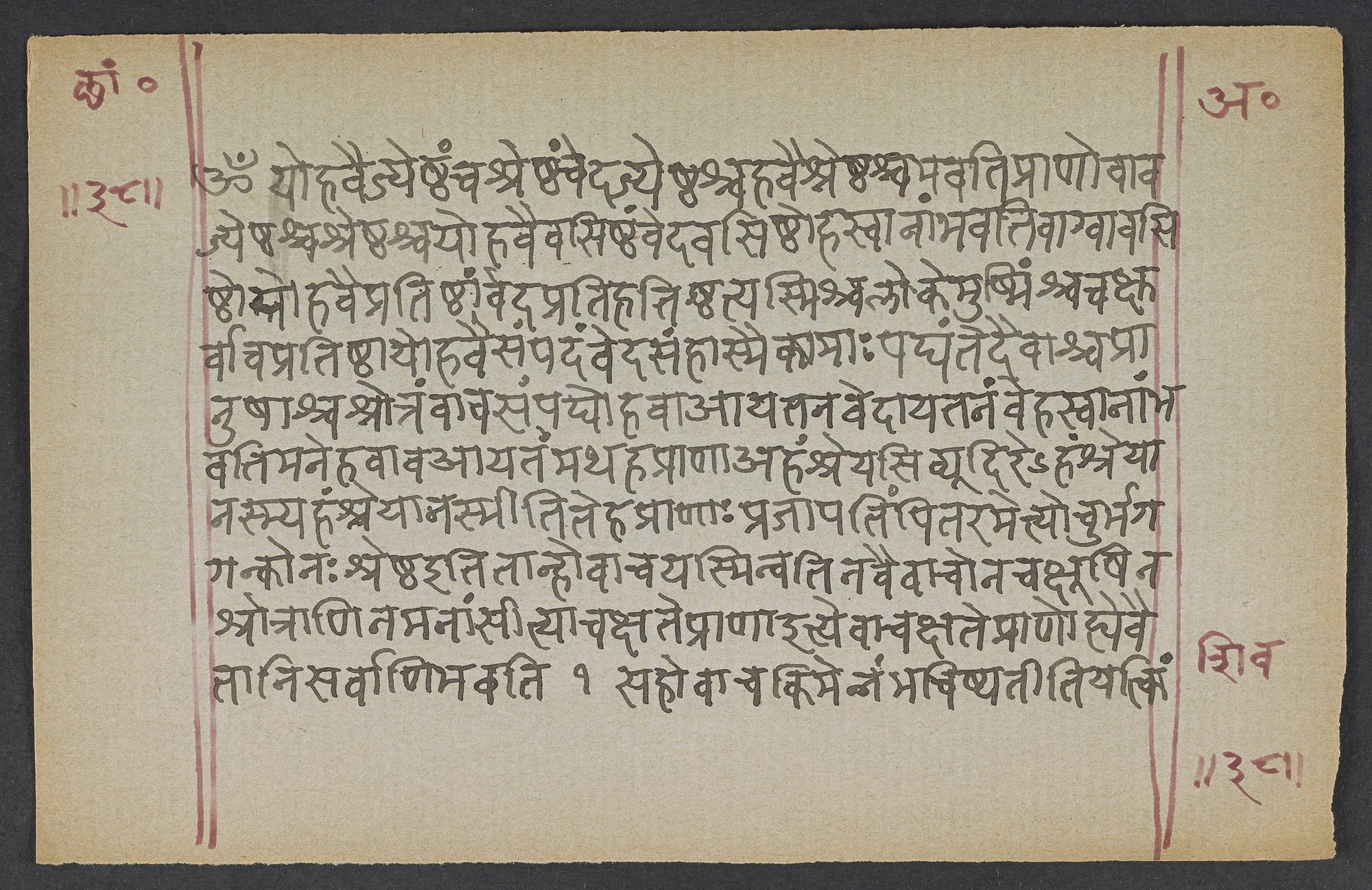
Penn Ms. Coll. 390 Item 945. fol. 38v begins ‹yo ha vai jyeṣṭhaṃ ca śreṣṭhaṃ ca veda jyeṣṭhaś ca ha vai śreṣṭhaś ca bhavati› and ends ‹sa hovāca kiṃ me 'nnaṃ bhaviṣyatīti yat kiṃ› (first and last words read on the image, transliterated). Notes: fol. 38v line 8: the copyist passes from 5.1.7 'tān hovāca yasmin va[ḥ]' (written 'yasmin vāti') directly to 5.1.15 'na vai vāco na cakṣūṃṣi ...': the rest of 5.1.7 and paragraphs 5.1.8-14 are not in this manuscript. Paragraphs 5.1.8-14 are not in this manuscript and are not shown. The words were located in the GRETIL text by string matching and the page boundaries follow from them; readings and results are stored in data/sources/upanishads/mapping_945.json.
1.1yo ha vai jyeṣṭhaṃ ca śreṣṭhaṃ ca veda jyeṣṭhaś ca ha vai śreṣṭhaś ca bhavati |
prāṇo vāva jyeṣṭhaś ca śreṣṭhaś ca ||
1.2yo ha vai vasiṣṭhaṃ veda vasiṣṭho ha svānāṃ bhavati |
vāg vāva vasiṣṭhaḥ ||
1.3yo ha vai pratiṣṭhāṃ veda prati ha tiṣṭhaty asmiṃś ca loke 'muṣmiṃś ca |
cakṣur vāva pratiṣṭhā ||
1.4yo ha vai saṃpadaṃ veda saṃ hāsmai kāmāḥ padyante daivāś ca mānuṣāś ca |
śrotraṃ vāva saṃpat ||
1.5yo ha vā āyatanaṃ vedāyatanaṃ ha svānāṃ bhavati |
mano ha vā āyatanam ||
1.6atha ha prāṇā ahaṃśreyasi vyūdire |
ahaṃ śreyān asmy ahaṃ śreyān asmīti ||
1.7te ha prāṇāḥ prajāpatiṃ pitaram etyocuḥ bhagavan ko naḥ śreṣṭha iti |
tān hovāca |
yasmin va utkrānte śarīraṃ pāpiṣṭhataram iva dṛśyeta sa vaḥ śreṣṭha iti ||
1.15na vai vāco na cakṣūṃṣi na śrotrāṇi na manāṃsīty ācakṣate |
prāṇā ity evācakṣate |
prāṇo hy evaitāni sarvāṇi bhavati ||
1.1He who knows the oldest and the best becomes himself the oldest and the best. Breath indeed is the oldest and the best.
1.2He who knows the richest, becomes himself the richest. Speech indeed is the richest.
1.3He who knows the firm rest, becomes himself firm in this world and in the next. The eye indeed is the firm rest.
1.4He who knows success, his wishes succeed, both his divine and human wishes. The ear indeed is success.
1.5He who knows the home, becomes a home of his people. The mind indeed is the home.
1.6The five senses quarrelled together, who was the best, saying, I am better, I am better.
1.7They went to their father Pragâpati and said: 'Sir, who is the best of us?' He replied: 'He by whose departure the body seems worse than worst, he is the best of you.'
1.15And people do not call them, the tongues, the eyes, the ears, the minds, but the breaths (prâna, the senses). For breath are all these.
Where on the image
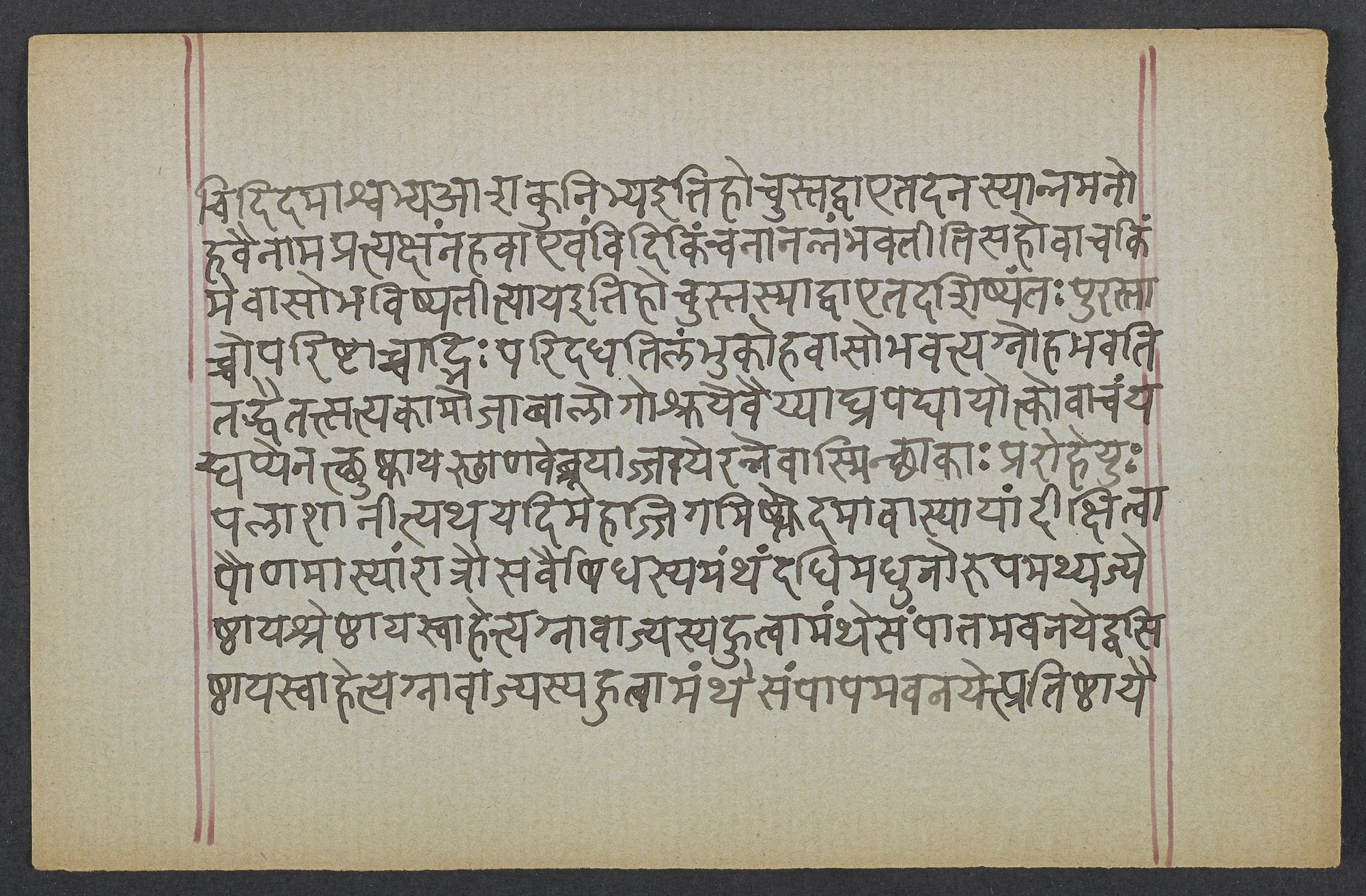
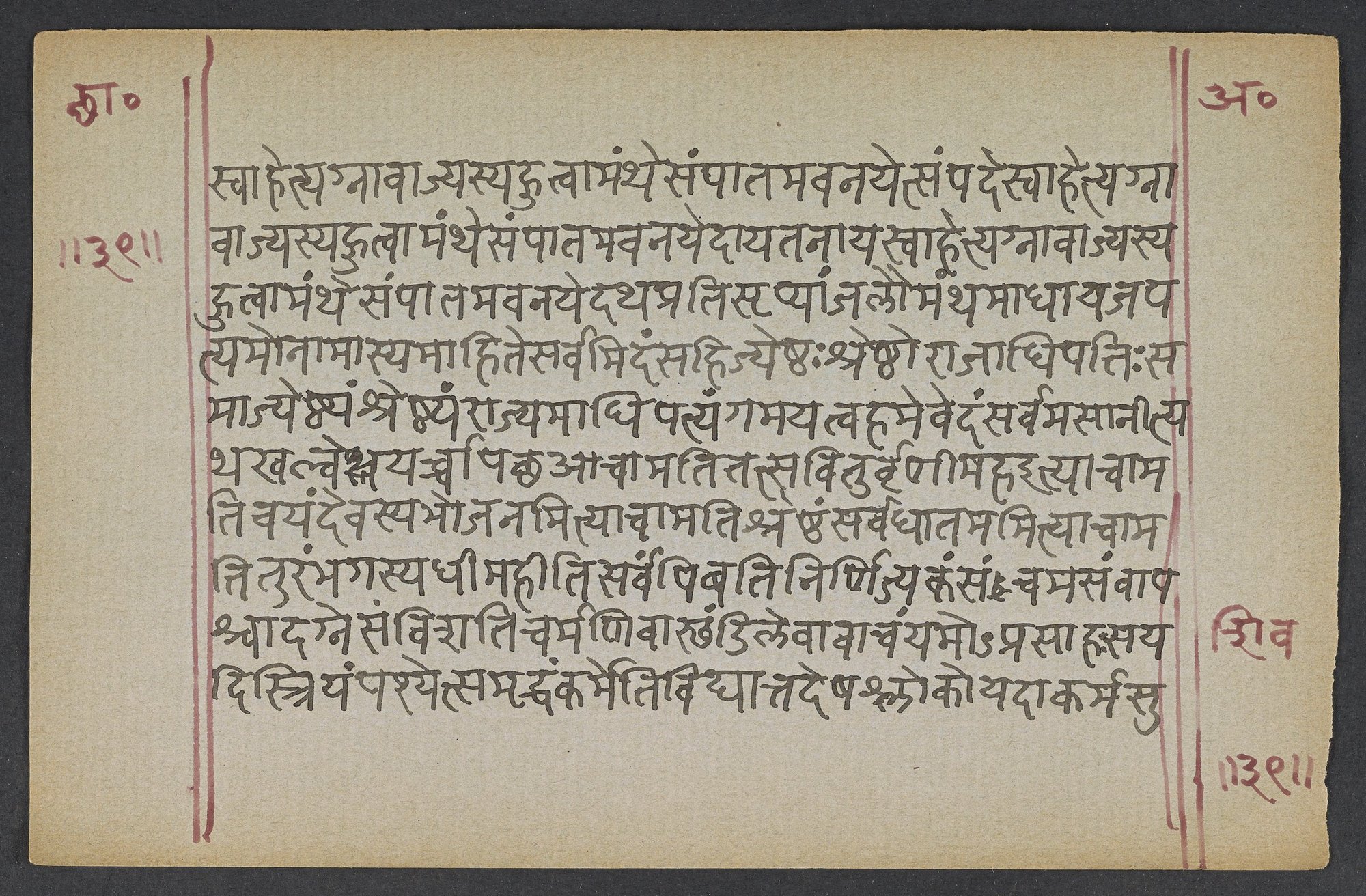
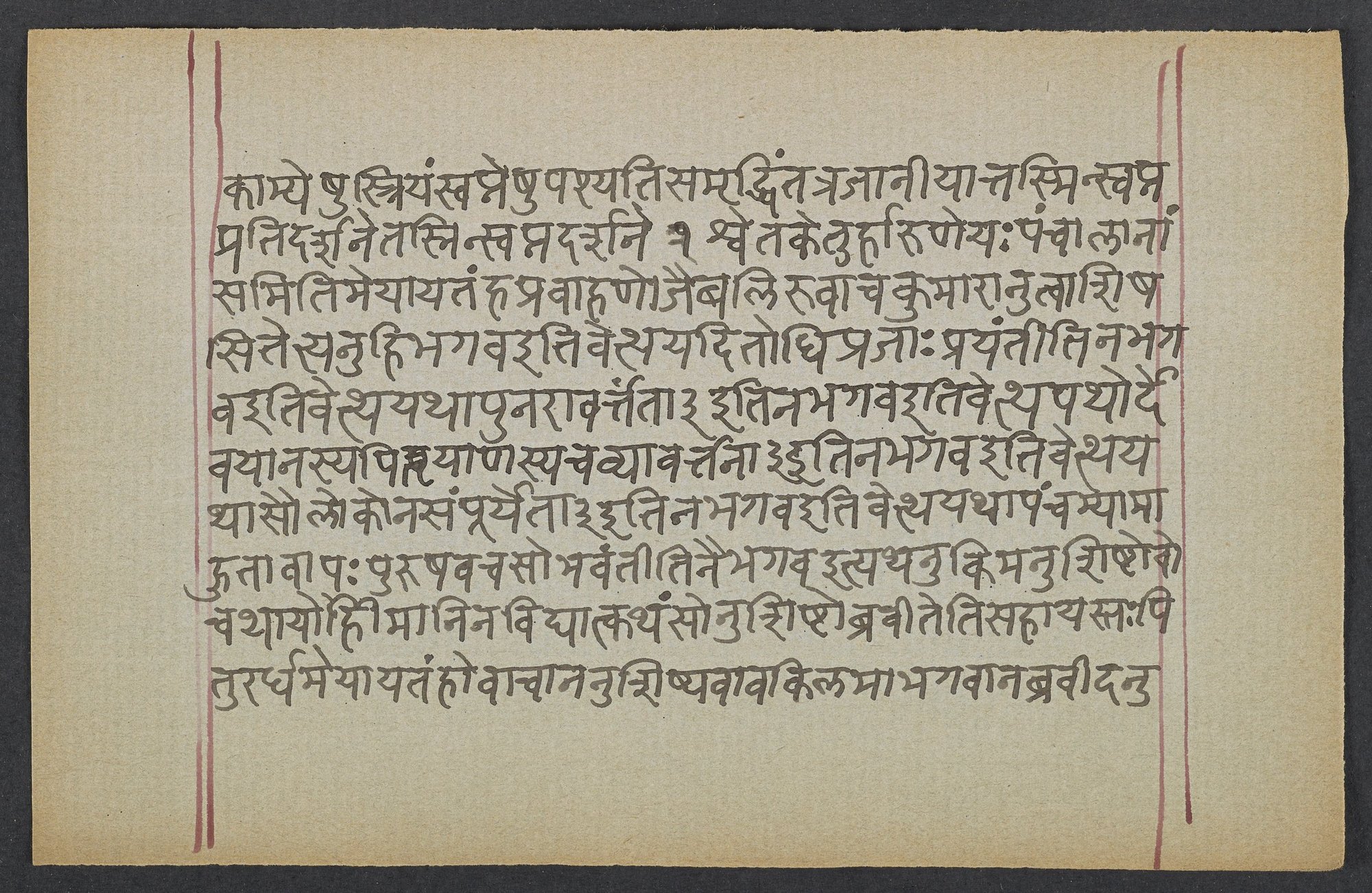
Penn Ms. Coll. 390 Item 945. fol. 38v begins ‹yo ha vai jyeṣṭhaṃ ca śreṣṭhaṃ ca veda jyeṣṭhaś ca ha vai śreṣṭhaś ca bhavati› and ends ‹sa hovāca kiṃ me 'nnaṃ bhaviṣyatīti yat kiṃ›; fol. 39r begins ‹cid idam ā śvabhya ā śakunibhya iti hocus tad vā etad anasyānnam› and ends ‹hutvā manthe saṃpātam avanayet pratiṣṭhāyai›; fol. 39v begins ‹svāhety agnāv ājyasya hutvā manthe saṃpātam avanayet saṃpade svāhety› and ends ‹tad eṣa śloko yadā karmasu›; fol. 40r begins ‹kāmyeṣu striyaṃ svapneṣu paśyati samṛddhiṃ tatra jānīyāt› and ends ‹taṃ hovācānanuśiṣya vāva kila mā bhagavān abravīd anu› (first and last words read on the image, transliterated). Notes: fol. 38v line 8: the copyist passes from 5.1.7 'tān hovāca yasmin va[ḥ]' (written 'yasmin vāti') directly to 5.1.15 'na vai vāco na cakṣūṃṣi ...': the rest of 5.1.7 and paragraphs 5.1.8-14 are not in this manuscript. Müller divides khanda 5.2 into paragraphs differently from the Sanskrit edition; the whole khanda is given here with his own numbers. The words were located in the GRETIL text by string matching and the page boundaries follow from them; readings and results are stored in data/sources/upanishads/mapping_945.json.
2.1sa hovāca kiṃ me 'nnaṃ bhaviṣyatīti |
yat kiṃcid idam ā śvabhya ā śakunibhya iti hocuḥ |
tad vā etad anasyānnam |
ano ha vai nāma pratyakṣam |
na ha vā evaṃvidi kiṃcanānannaṃ bhavatīti ||
2.2sa hovāca kiṃ me vāso bhaviṣyatīti |
āpa iti hocuḥ |
tasmād vā etad aśiṣyantaḥ purastāc copariṣṭāc cādbhiḥ paridadhati |
lambhuko ha vāso bhavati |
anagno ha bhavati ||
2.3tad dhaitat satyakāmo jābālo gośrutaye vaiyāghrapadyāyoktvovāca |
yady apy enac chuṣkāya sthāṇave brūyāj jāyerann evāsmiñ chākhāḥ praroheyuḥ palāśānīti ||
2.4atha yadi mahaj jigamiṣet, amāvāsyāyām dīkṣitvā paurṇamāsyāṃ rātrau sarvauṣadhasya mantham dadhimadhunor upamathya jyeṣṭhāya śreṣṭhāya svāhety agnāv ājyasya hutvā manthe saṃpātam avanayet ||
2.5vasiṣṭhāya svāhety agnāv ājyasya hutvā manthe saṃpātam avanayet |
pratiṣṭhāyai svāhety agnāv ājyasya hutvā manthe saṃpātam avanayet |
saṃpade svāhety agnāv ājyasya hutvā manthe saṃpātam avanayet |
āyatanāya svāhety agnāv ājyasya hutvā manthe saṃpātam avanayet ||
2.6atha pratisṛpyāñjalau mantham ādhāya japati |
amo nāmāsi |
amā hi te sarvam idam |
sa hi jyeṣṭhaḥ śreṣṭho rājādhipatiḥ |
sa mā jyaiṣṭhyaṃ śraiṣṭhyaṃ rājyam ādhipatyaṃ gamayatu |
aham evedaṃ sarvam asānīti ||
2.7atha khalv etayarcā paccha ācāmati |
tat savitur vṛṇīmaha ity ācāmati |
vayaṃ devasya bhojanam ity ācāmati |
śreṣṭhaṃ sarvadhātamam ity ācāmati |
turaṃ bhagasya dhīmahīti sarvaṃ pibati |
nirṇijya kaṃsaṃ camasaṃ vā paścād agneḥ saṃviśati |
carmaṇi vā sthaṇḍile vā vācaṃyamo 'prasāhaḥ |
sa yadi striyaṃ paśyet samṛddhaṃ karmeti vidyāt ||
2.8tad eṣa ślokaḥ |
yadā karmasu kāmyeṣu striyaṃ svapneṣu paśyati |
samṛddhiṃ tatra jānīyāt tasmin svapnanidarśane tasmin svapnanidarśane ||
3.1śvetaketur hāruṇeyaḥ pañcālānāṃ samitim eyāya |
taṃ ha pravāhaṇo jaivalir uvāca |
kumārānu tvā aśiṣat piteti |
anu hi bhagava iti ||
3.2vettha yad ito 'dhi prajāḥ prayantīti |
na bhagava iti |
vettha yathā punar āvartanta 3 iti |
na bhagava iti |
vettha pathor devayānasya pitṛyāṇasya ca vyāvartanā 3 iti |
na bhagava iti ||
3.3vettha yathāsau loko na saṃpūryata 3 iti |
na bhagava iti |
vettha yathā pañcamyām āhutāv āpaḥ puruṣavacaso bhavantīti |
naiva bhagava iti ||
2.1Breath said: 'What shall be my food?' They answered: 'Whatever there is, even unto dogs and birds.' Therefore this is food for Ana (the breather). His name is clearly Ana. To him who knows this there is nothing that is not (proper) food.
2.2He said: 'What shall be my dress?' They answered: "Water.' Therefore wise people, when they are going to eat food, surround their food before and after with water. He (prâna) thus gains a dress, and is no longer naked.
2.3Satyakâma Gâbâla, after he had communicated this to Gosruti Vaiyâghrapadya, said to him: 'If you were to tell this to a dry stick, branches would grow, and leaves spring from it.'
2.4If a man wishes to reach greatness, let him perform the Dîkshâ (preparatory rite) on the day of the new moon, and then, on the night of the full moon, let him stir a mash of all kinds of herbs with curds and honey, and let him pour ghee on the fire (âvasathya laukika), saying, 'Svâhâ to the oldest and the best.' After that let him throw all that remains (of the ghee) into the mash.
2.5In the same manner let him pour ghee on the fire, saying, 'Svâhâ to the richest.' After that let him throw all that remains together into the mash. In the same manner let him pour ghee on the fire, saying, 'Svâhâ to the firm rest.' After that let him throw all that remains together into the mash. In the same manner let him pour ghee on the fire, saying, 'Svâhâ to success.' After that let him throw all that remains together into the mash.
2.6Then going forward and placing the mash in his hands, he recites: 'Thou (Prâna) art Ama by name, for all this together exists in thee. He is the oldest and best, the king, the sovereign. May he make me the oldest, the best, the king, the sovereign. May I be all this.'
2.7Then he eats with the following Rik verse at every foot: 'We choose that food'—here he swallows—'Of the divine Savitri (prâna)'—here he swallows—'The best and all-supporting food'— here he swallows — "We meditate on the speed of Bhaga (Savitri, prâna)'—here he drinks all.
2.8Having cleansed the vessel, whether it be a kamsa or a kamasa, he sits down behind the fire on a skin or on the bare ground, without speaking or making any other effort. If in his dream he sees a woman, let him know this to be a sign that his sacrifice has succeeded.
2.9On this there is a Sloka: 'If during sacrifices which are to fulfil certain wishes he sees in his dreams a woman, let him know success from this vision in a dream, yea, from this vision in a dream.'
3.1Svetaketu Âruneya went to an assembly of the Pañkâlas. Pravâhana Gaivali said to him: 'Boy, has your father instructed you?' 'Yes, Sir,' he replied.
3.2'Do you know to what place men go from here?' 'No, Sir,' he replied. 'Do you know how they return again?' 'No Sir,' he replied. 'Do you know where the path of Devas and the path of the fathers diverge?' 'No, Sir,' he replied.
3.3"Do you know why that world never becomes full?' 'No, Sir," he replied. 'Do you know why in the fifth libation water is called Man?' 'No, Sir,' he replied.
Where on the image
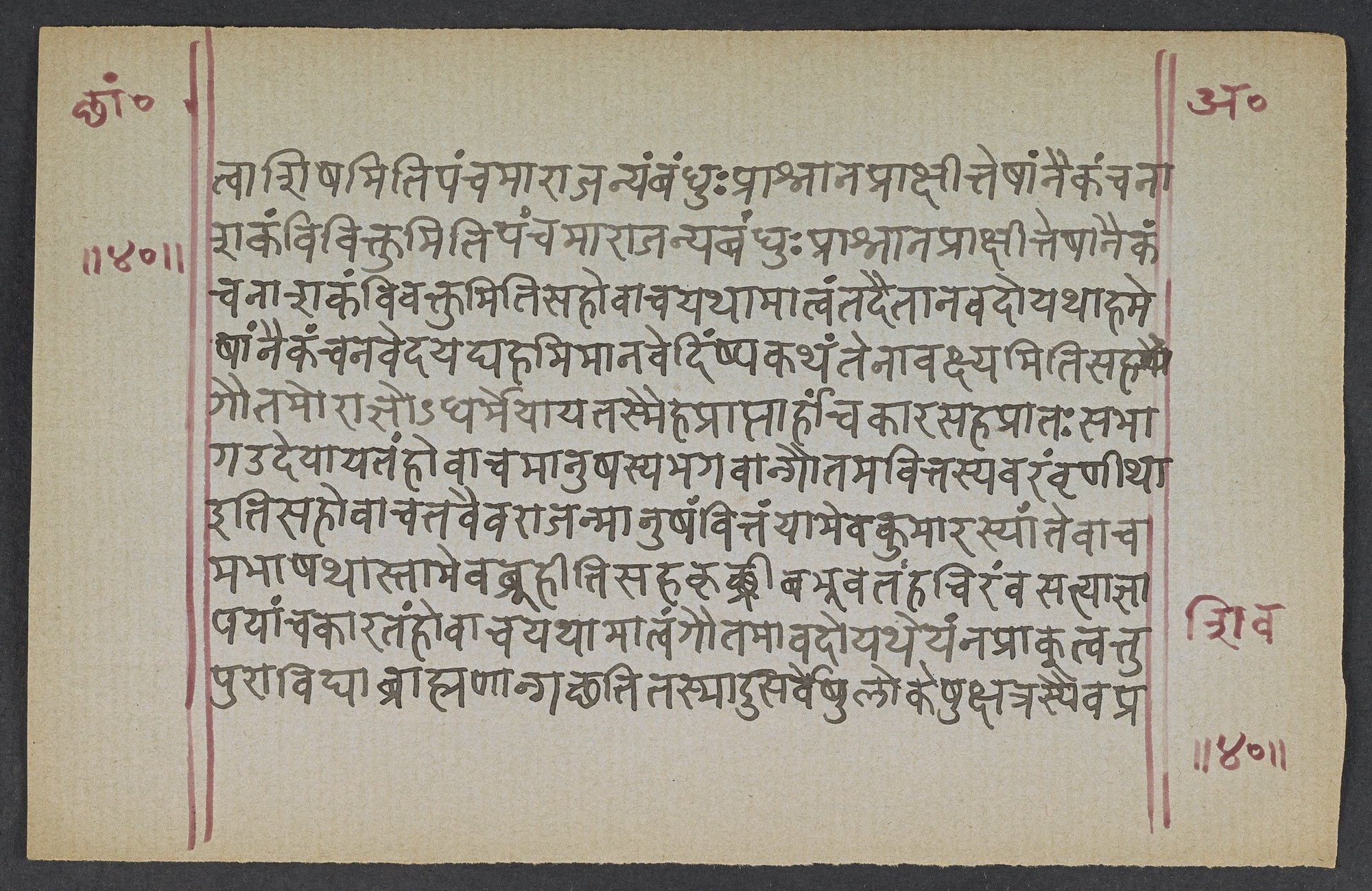
Penn Ms. Coll. 390 Item 945. fol. 40r begins ‹kāmyeṣu striyaṃ svapneṣu paśyati samṛddhiṃ tatra jānīyāt› and ends ‹taṃ hovācānanuśiṣya vāva kila mā bhagavān abravīd anu›; fol. 40v begins ‹tvāśiṣam iti pañca mā rājanyabandhuḥ praśnān aprākṣīt teṣāṃ naikaṃ canāśakaṃ vivaktum iti› and ends ‹purā vidyā brāhmaṇān gacchati tasmād u sarveṣu lokeṣu kṣatrasyaiva pra› (first and last words read on the image, transliterated). The words were located in the GRETIL text by string matching and the page boundaries follow from them; readings and results are stored in data/sources/upanishads/mapping_945.json.
3.4athānu kim anu śiṣṭho 'vocathā yo hīmāni na vidyāt |
kathaṃ so 'nuśiṣṭo bruvīteti |
sa hāyastaḥ pitur ardham eyāya |
taṃ hovācānanuśiṣya vāva kila mā bhagavān abravīd anu tvāśiṣam iti ||
3.5pañca mā rājanyabandhuḥ praśnān aprākṣīt |
teṣāṃ naikaṃcanāśakaṃ vivaktum iti |
sa hovāca yathā mā tvaṃ tadaitān avado yathāham eṣāṃ naikaṃcana veda |
yady aham imān avediṣyaṃ kathaṃ te nāvakṣyam iti ||
3.6sa ha gautamo rājño 'rdham eyāya |
tasmai ha prāptāyārhāṃ cakāra |
sa ha prātaḥ sabhāga udeyāya |
taṃ hovāca |
mānuṣasya bhagavan gautama vittasya varaṃ vṛṇīthā iti |
sa hovāca |
tavaiva rājan mānuṣaṃ vittam |
yām eva kumārasyānte vācam abhāṣathās tām eva me brūhīti |
sa ha kṛcchrī babhūva ||
3.4'Then why did you say (you had been) instructed? How could anybody who did not know these things say that he had been instructed?' Then the boy went back sorrowful to the place of his father, and said: 'Though you had not instructed me, Sir, you said you had instructed me.
3.5'That fellow of a Râganya asked me five questions, and I could not answer one of them.' The father said: 'As you have told me these questions of his, I do not know any one of them. If I knew these questions, how should I not have told you?
3.6Then Gautama went to the kings place, and when he had come to him, the king offered him proper respect. In the morning the king went out on his way to the assembly. The king said to him: 'Sir, Gautama, ask a boon of such things as men possess.' He replied: 'Such things as men possess may remain with you. Tell me the speech which you addressed to the boy.'
Where on the image
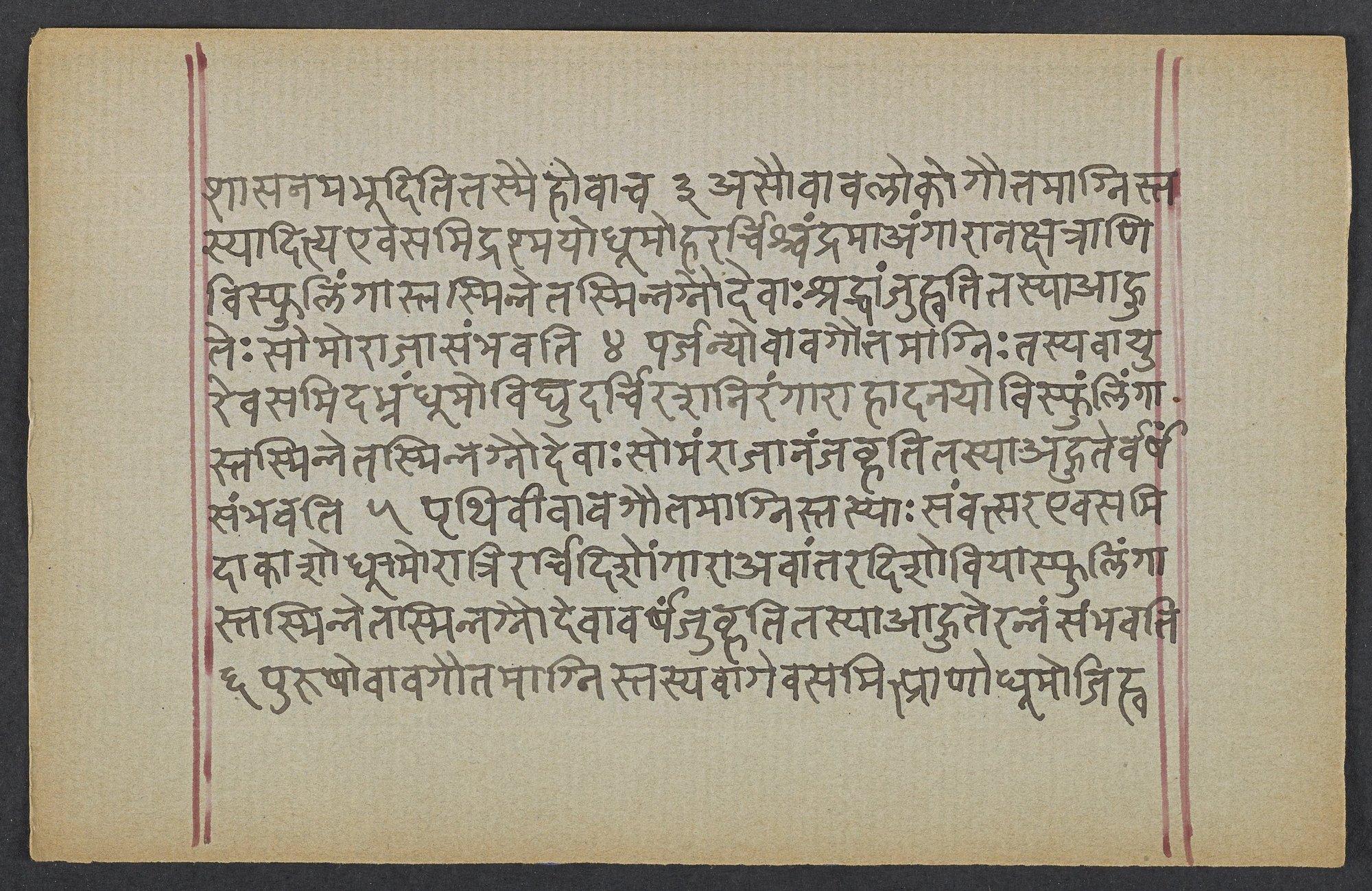
Penn Ms. Coll. 390 Item 945. fol. 40v begins ‹tvāśiṣam iti pañca mā rājanyabandhuḥ praśnān aprākṣīt teṣāṃ naikaṃ canāśakaṃ vivaktum iti› and ends ‹purā vidyā brāhmaṇān gacchati tasmād u sarveṣu lokeṣu kṣatrasyaiva pra›; fol. 41r begins ‹śāsanam abhūd iti tasmai hovāca asau vāva loko gautamāgniḥ› and ends ‹puruṣo vāva gautamāgnis tasya vāg eva samit prāṇo dhūmo jihvā› (first and last words read on the image, transliterated). The words were located in the GRETIL text by string matching and the page boundaries follow from them; readings and results are stored in data/sources/upanishads/mapping_945.json.
3.7taṃ ha ciraṃ vasety ājñāpayāṃ cakāra |
taṃ hovāca |
yathā mā tvaṃ gautamāvadaḥ |
yatheyaṃ na prāk tvattaḥ purā vidyā brāhmaṇān gacchati |
tasmād u sarveṣu lokeṣu kṣatrasyaiva praśāsanam abhūd iti |
tasmai hovāca ||
4.1asau vāva loko gautamāgniḥ |
tasyāditya eva samit |
raśmayo dhūmaḥ |
ahar arciḥ |
candramā aṅgārāḥ |
nakṣatrāṇi visphuliṅgāḥ ||
4.2tasminn etasminn agnau devāḥ śraddhāṃ juhvati |
tasyā āhuteḥ somo rājā saṃbhavati ||
5.1parjanyo vāva gautamāgniḥ |
tasya vāyur eva samit |
abhraṃ dhūmaḥ |
vidyud arciḥ |
aśanir aṅgārāḥ |
hrādunayo visphuliṅgāḥ ||
5.2tasminn etasminn agnau devāḥ somaṃ rājānaṃ juhvati |
tasyā āhuter varṣaṃ saṃbhavati ||
6.1pṛthivī vāva gautamāgniḥ |
tasyāḥ samvatsara eva samit |
ākāśo dhūmaḥ |
rātrir arciḥ |
diśo 'ṅgārāḥ |
avāntaradiśo visphuliṅgāḥ ||
6.2tasminn etasminn agnau devā varṣaṃ juhvati |
tasyā āhuter annaṃ saṃbhavati ||
3.7The king was perplexed, and commanded him, saying: 'Stay with me some time.' Then he said: 'As (to what) you have said to me, Gautama, this knowledge did not go to any Brâhmana before you, and therefore this teaching belonged in all the worlds to the Kshatra class alone. Then he began:
4.1'The altar (on which the sacrifice is supposed to be offered) is that world (heaven), O Gautama; its fuel is the sun itself, the smoke his rays, the light the day, the coals the moon, the sparks the stars.
4.2'On that altar the Devas (or prânas, represented by Agni, &c.) offer the sraddhâ libation (consisting of water). From that oblation rises Soma, the king (the moon).
5.1The altar is Parganya (the god of rain), O Gautama; its fuel is the air itself, the smoke the cloud, the light the lightning, the coals the thunderbolt, the sparks the thunderings.
5.2'On that altar the Devas offer Soma, the king (the moon). From that oblation rises rain.
6.1'The altar is the earth, O Gautama; its fuel is the year itself, the smoke the ether, the light the night, the coals the quarters, the sparks the intermediate quarters.
6.2'On that altar the Devas (prânas) offer rain. From that oblation rises food (corn, &c.)
Where on the image
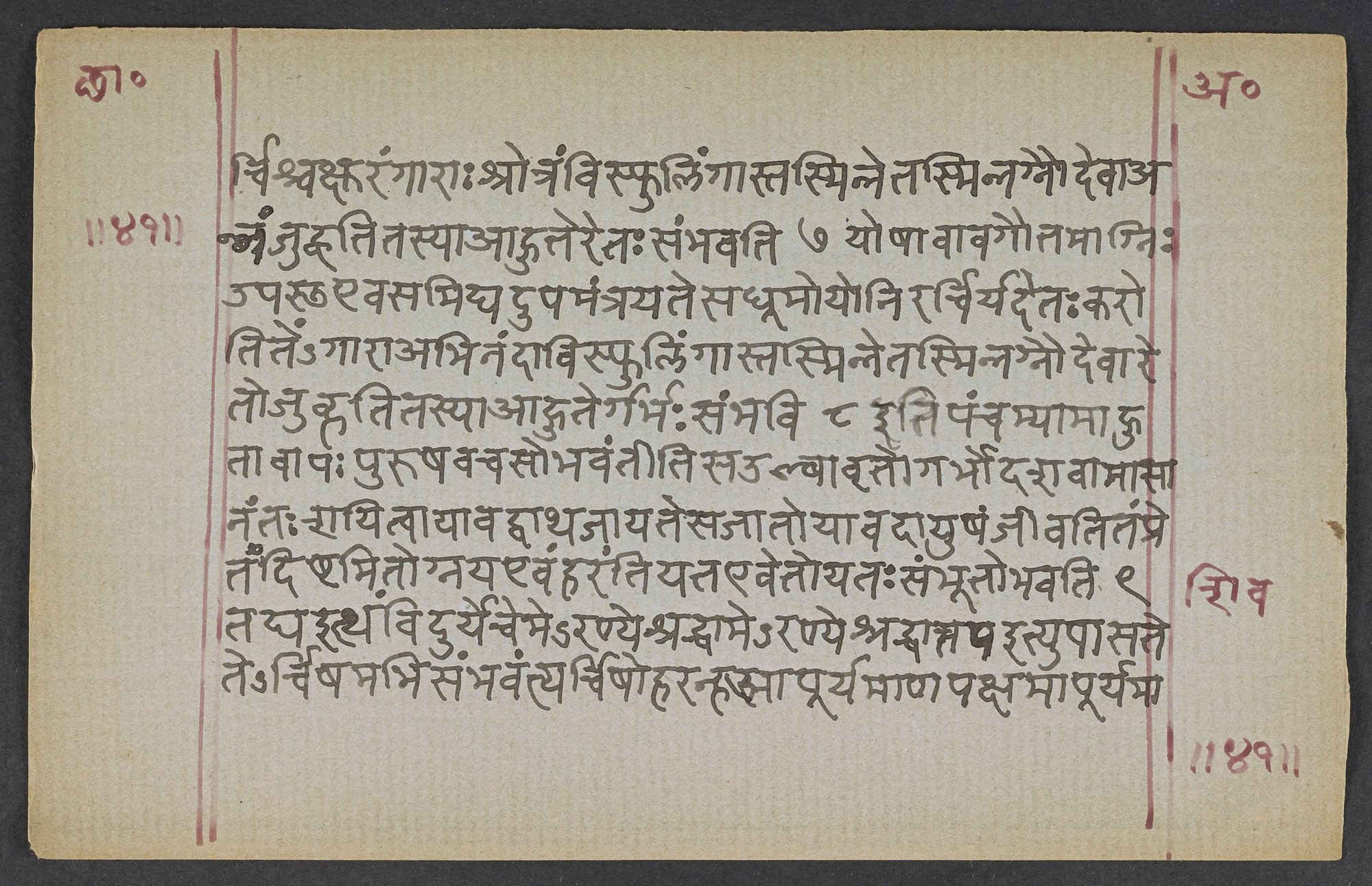
Penn Ms. Coll. 390 Item 945. fol. 41r begins ‹śāsanam abhūd iti tasmai hovāca asau vāva loko gautamāgniḥ› and ends ‹puruṣo vāva gautamāgnis tasya vāg eva samit prāṇo dhūmo jihvā›; fol. 41v begins ‹rciś cakṣur aṅgārāḥ śrotraṃ visphuliṅgāḥ› and ends ‹te 'rciṣam abhisaṃbhavanty arciṣo 'har ahna āpūryamāṇapakṣam āpūryamā› (first and last words read on the image, transliterated). The words were located in the GRETIL text by string matching and the page boundaries follow from them; readings and results are stored in data/sources/upanishads/mapping_945.json.
7.1puruṣo vāva gautamāgniḥ |
tasya vāg eva samit |
prāṇo dhūmaḥ |
jihvārciḥ |
cakṣur aṅgārāḥ |
śrotraṃ visphuliṅgāḥ ||
7.2tasminn etasminn agnau devā annaṃ juhvati |
tasyā āhuter retaḥ sambhavati ||
8.1yoṣā vāva gautamāgniḥ |
tasyā upastha eva samit |
yad upamantrayate sa dhūmaḥ |
yonir arciḥ |
yad antaḥ karoti te 'ṅgārāḥ |
abhinandā visphuliṅgāḥ ||
8.2tasminn etasminn agnau devā reto juhvati |
tasyā āhuter garbhaḥ saṃbhavati ||
9.1iti tu pañcamyām āhutāv āpaḥ puruṣavacaso bhavantīti |
sa ulbāvṛto garbho daśa vā nava vā māsān antaḥ śayitvā yāvad vātha jāyate ||
9.2sa jāto yāvadāyuṣaṃ jīvati |
taṃ pretaṃ diṣṭam ito 'gnaya eva haranti yata eveto yataḥ saṃbhūto bhavati ||
7.1'The altar is man, O Gautama; its fuel speech itself, the smoke the breath, the light the tongue, the coals the eye, the sparks the ear.
7.2'On that altar the Devas (prânas) offer food. From that oblation rises seed.
8.1'The altar is woman, O Gautama.
8.2'On that altar the Devas (prânas) offer seed. From that oblation rises the germ.
9.1'For this reason is water in the fifth oblation called Man. This germ, covered in the womb, having dwelt there ten months, or more or less, is born.
9.2'When born, he lives whatever the length of his life may be. When he has departed, his friends carry him, as appointed, to the fire (of the funeral pile) from whence he came, from whence he sprang.
Where on the image
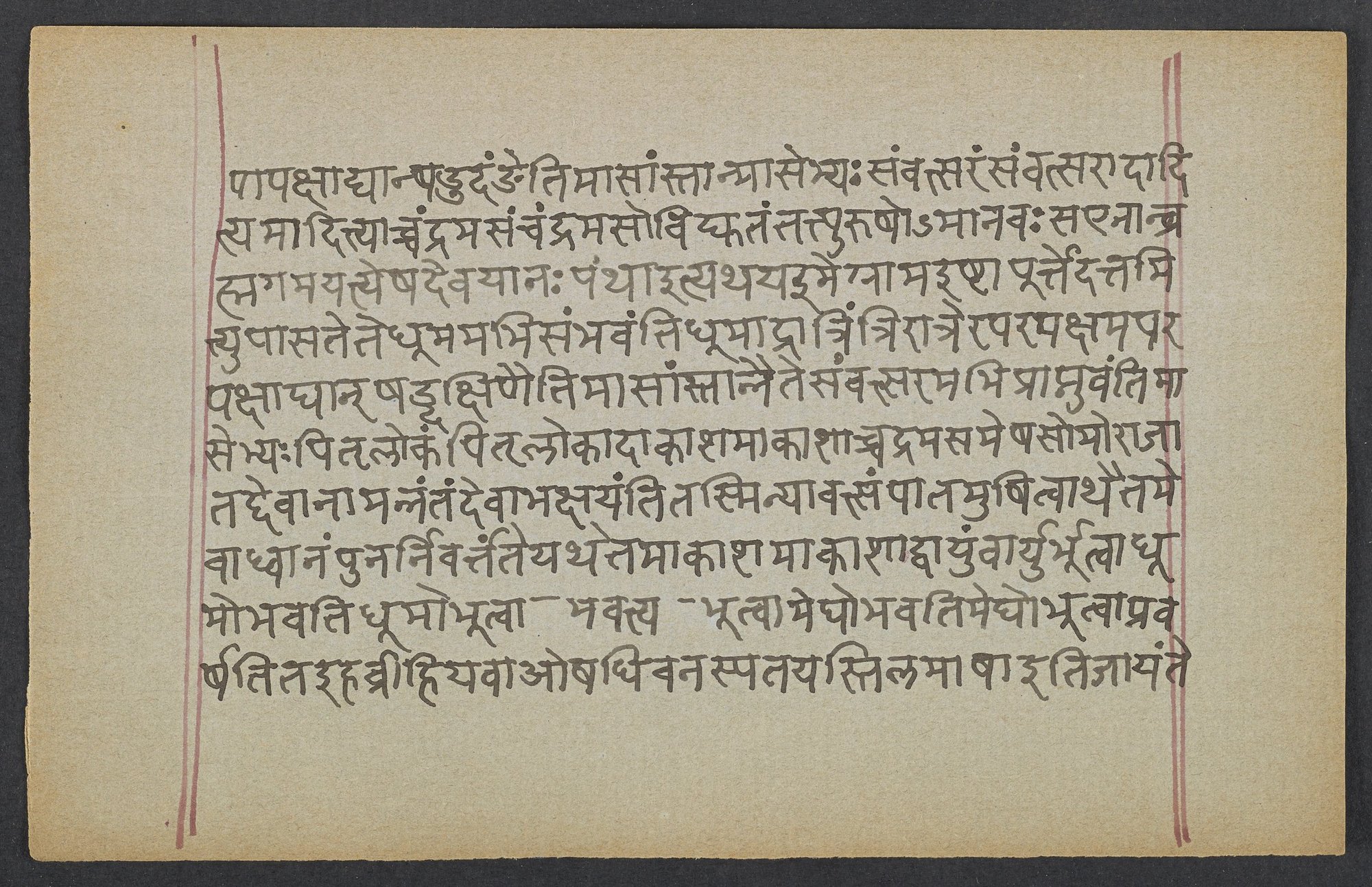
Penn Ms. Coll. 390 Item 945. fol. 41v begins ‹rciś cakṣur aṅgārāḥ śrotraṃ visphuliṅgāḥ› and ends ‹te 'rciṣam abhisaṃbhavanty arciṣo 'har ahna āpūryamāṇapakṣam āpūryamā›; fol. 42r begins ‹ṇapakṣād yān ṣaḍ udaṅṅ eti māsāṃs tān māsebhyaḥ saṃvatsaram› and ends ‹iti jāyante› (first and last words read on the image, transliterated). The words were located in the GRETIL text by string matching and the page boundaries follow from them; readings and results are stored in data/sources/upanishads/mapping_945.json.
10.1tad ya itthaṃ viduḥ |
ye ceme 'raṇye śraddhā tapa ity upāsate |
te 'rciṣam abhisaṃbhavanti |
arciṣo 'haḥ |
ahna āpūryamāṇapakṣam |
āpūryamāṇapakṣād yān ṣaḍ udaṅṅ eti māsāṃs tān ||
10.2māsebhyaḥ saṃvatsaram |
saṃvatsarād ādityam |
ādityāc candramasam |
candramaso vidyutam |
tat puruṣo 'mānavaḥ |
sa enān brahma gamayati |
eṣa devayānaḥ panthā iti ||
10.3atha ya ime grāma iṣṭāpūrte dattam ity upāsate |
te dhūmam abhisaṃbhavanti |
dhūmād rātrim |
rātrer aparapakṣam |
aparapakṣād yān ṣaḍ dakṣiṇaiti māsāṃs tān |
naite saṃvatsaram abhiprāpnuvanti ||
10.4māsebhyaḥ pitṛlokam |
pitṛlokād ākāśam |
ākāsāc candramasam |
eṣa somo rājā |
tad devānām annam |
taṃ devā bhakṣayanti ||
10.5tasmin yavātsaṃpātam uṣitvāthaitam evādhvānaṃ punar nivartante |
ākāśam |
ākāśād vāyum |
vāyur bhūtvā dhūmo bhavati |
dhūmo bhūtvābhraṃ bhavati ||
10.1'Those who know this (even though they still be grihasthas, householders) and those who in the forest follow faith and austerities (the vânaprasthas, and of the parivrâgakas those who do not yet know the Highest Brahman) go to light (arkis), from light to day, from day to the light half of the moon, from the light half of the moon to the six months when the sun goes to the north, from the six months when the sun goes to the north to the year, from the year to the sun, from the sun to the moon, from the moon to the lightning. There is a person not human,—
10.2'He leads them to Brahman (the conditioned Brahman). This is the path of the Devas.
10.3'But they who living in a village practise (a life of) sacrifices, works of public utility, and alms, they go to the smoke, from smoke to night, from night to the dark half of the moon, from the dark half of the moon to the six months when the sun goes to the south. But they do not reach the year.
10.4'From the months they go to the world of the fathers, from the world of the fathers to the ether, from the ether to the moon. That is Soma, the king. Here they are loved (eaten) by the Devas, yes, the Devas love (eat) them.
10.5'Having dwelt there, till their (good) works are consumed, they return again that way as they came, to the ether, from the ether to the air. Then the sacrificer, having become air, becomes smoke, having become smoke, he becomes mist,
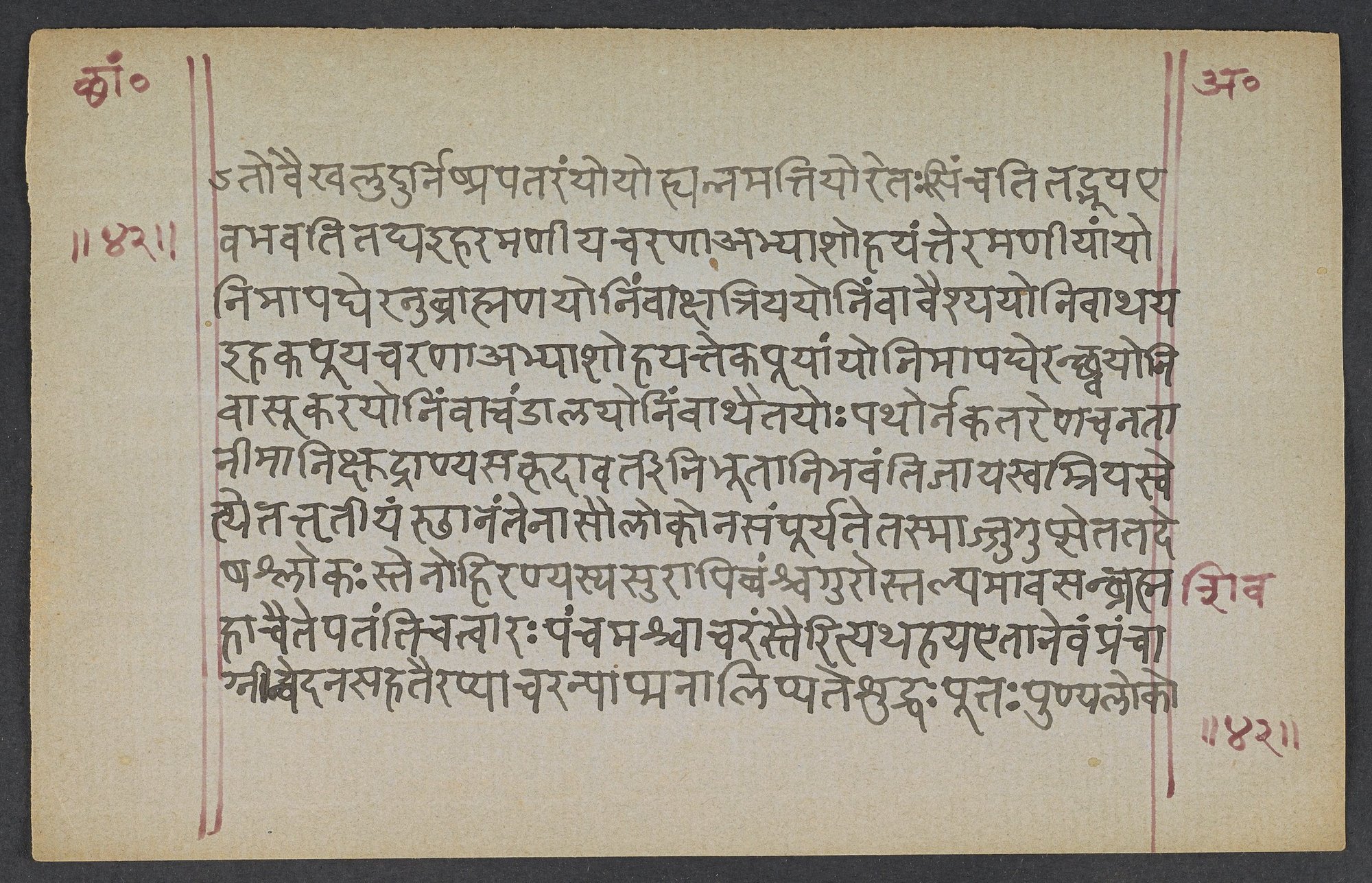
Where on the image
Penn Ms. Coll. 390 Item 945. fol. 42r begins ‹ṇapakṣād yān ṣaḍ udaṅṅ eti māsāṃs tān māsebhyaḥ saṃvatsaram› and ends ‹iti jāyante›; fol. 42v begins ‹'to vai khalu durniṣprapataraṃ yo yo hy annam atti yo retaḥ siñcati tadbhūya eva bhavati› and ends ‹pāpmanā lipyate śuddhaḥ pūtaḥ puṇyaloko› (first and last words read on the image, transliterated). The words were located in the GRETIL text by string matching and the page boundaries follow from them; readings and results are stored in data/sources/upanishads/mapping_945.json.
10.6abhraṃ bhūtvā megho bhavati |
megho bhūtvā pravarṣati |
ta iha vrīhiyavā oṣadhivanaspatayas tilamāsā iti jāyante 'to vai khalu durniṣprapataram |
yo yo hy annam atti yo retaḥ siñcati tad bhūya eva bhavati ||
10.7tad ya iha ramaṇīyacaraṇā abhyāśo ha yat te ramaṇīyāṃ yonim āpadyeran brāhmaṇayoniṃ vā kṣatriyayoniṃ vā vaiśyayoniṃ vā |
atha ya iha kapūyacaraṇā abhyāśo ha yat te kapūyāṃ yonim āpadyerañ śvayonim vā sūkarayoniṃ vā caṇḍālayoniṃ vā ||
10.8athaitayoḥ pathor na katareṇacana tānīmāni kṣudrāṇy asakṛdāvartīni bhūtāni bhavanti jāyasva mriyasveti |
etat tṛtīyaṃ sthānam |
tenāsau loko na saṃpūryate |
tasmāj jugupseta |
tad eṣa ślokaḥ ||
10.9steno hiraṇyasya surāṃ pibaṃś ca |
guros talpam āvasan brahmahā ca |
ete patanti catvāraḥ pañcamaś cācaraṃs tair iti ||
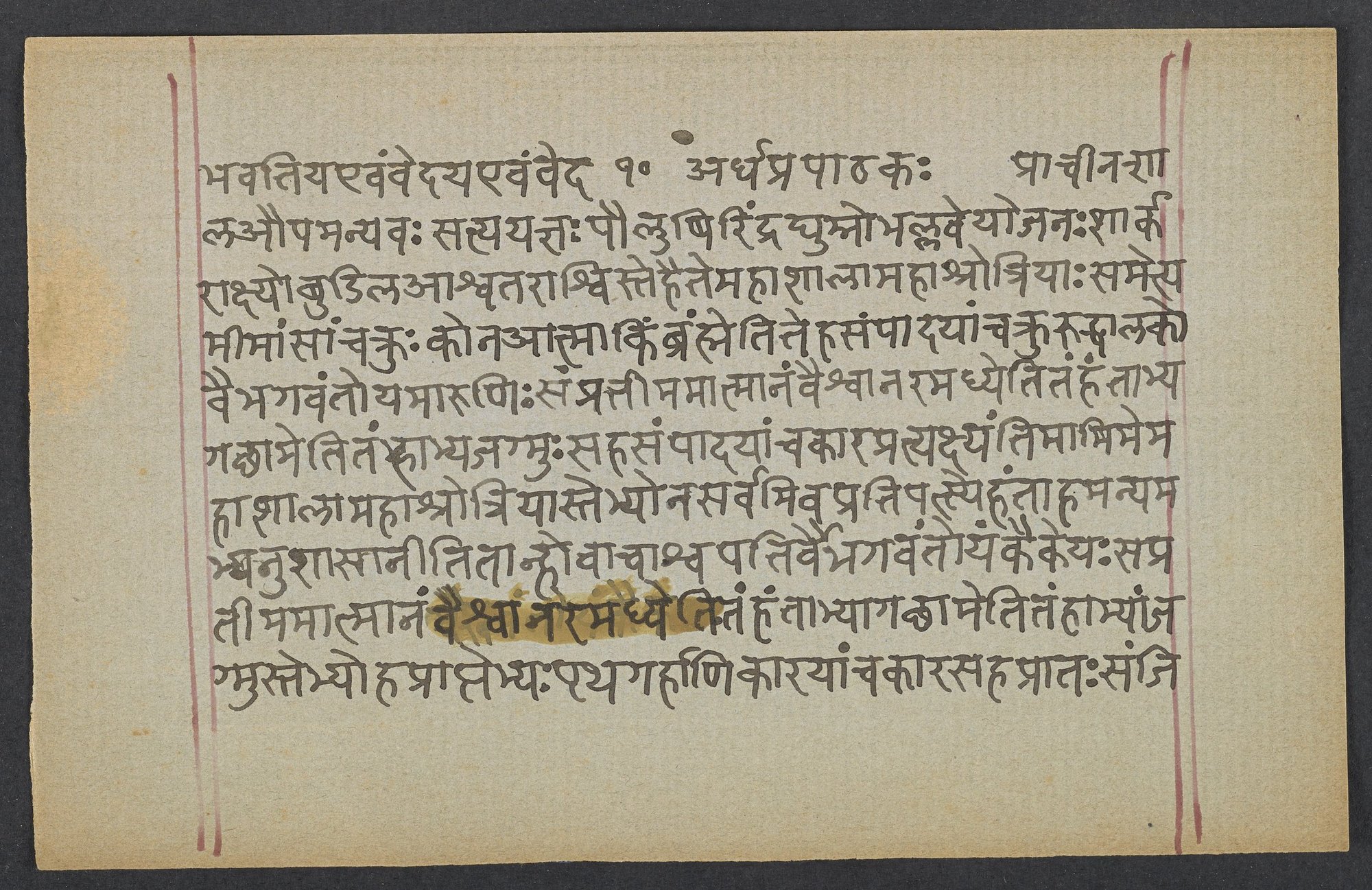
10.6'Having become mist, he becomes a cloud, having become a cloud, he rains down. Then he is born as rice and corn, herbs and trees, sesamum and beans. From thence the escape is beset with most difficulties. For whoever the persons may be that eat the food, and beget offspring, he henceforth becomes like unto them.
10.7'Those whose conduct has been good, will quickly attain some good birth, the birth of a Brâhmana, or a Kshatriya, or a Vaisya. But those whose conduct has been evil, will quickly attain an evil birth, the birth of a dog, or a hog, or a Kandâla.
10.8'On neither of these two ways those small creatures (flies, worms, &c.) are continually returning of whom it may be said, Live and die. Theirs is a third place. 'Therefore that world never becomes full (cf. V, 3, 2). 'Hence let a man take care to himself! And thus it is said in the following Sloka:—
10.9'A man who steals gold, who drinks spirits, who dishonours his Guru's bed, who kills a Brahman, these four fall, and as a fifth he who associates with them.
Where on the image
Penn Ms. Coll. 390 Item 945. fol. 42v begins ‹'to vai khalu durniṣprapataraṃ yo yo hy annam atti yo retaḥ siñcati tadbhūya eva bhavati› and ends ‹pāpmanā lipyate śuddhaḥ pūtaḥ puṇyaloko›; fol. 43r begins ‹bhavati ya evaṃ veda ya evaṃ veda prācīnaśāla aupamanyavaḥ› and ends ‹tebhyo ha prāptebhyaḥ pṛthag arhāṇi kārayāṃ cakāra sa ha prātaḥ saṃji› (first and last words read on the image, transliterated). The words were located in the GRETIL text by string matching and the page boundaries follow from them; readings and results are stored in data/sources/upanishads/mapping_945.json.
10.10atha ha ya etān evaṃ pañcāgnīn veda na saha tair apy ācaran pāpmanā lipyate |
śuddhaḥ pūtaḥ puṇyaloko bhavati ya evaṃ veda ya evaṃ veda ||
11.1prācīnaśāla aupamanyavaḥ satyayajñaḥ pauluṣir indradyumno bhāllaveyo janaḥ śārkarākṣyo buḍila āśvatarāśvis te haite mahāśālā mahāśrotriyāḥ sametya mīmāṃsāṃ cakruḥ |
ko na ātmā kiṃ brahmeti ||
11.2te ha saṃpādayāṃ cakruḥ |
uddālako vai bhagavanto 'yam āruṇiḥ saṃpratīmam ātmānaṃ vaiśvānaram adhyeti |
taṃ hantābhyāgacchāmeti |
taṃ hābhyājagmuḥ ||
11.3sa ha saṃpādayāṃ cakāra |
prakṣyanti mām ime mahāśālā mahāśrotriyāḥ |
tebhyo na sarvam iva pratipatsye |
hantāham anyam abhyanuśāsānīti ||
11.4tān hovāca |
aśvapatir vai bhagavanto 'yaṃ kaikeyaḥ saṃpratīmam ātmānaṃ vaiśvānaram adhyeti |
taṃ hantābhyāgacchāmeti |
taṃ hābhyājagmuḥ ||
10.10'But he who thus knows the five fires is not defiled by sin even though he associates with them. He who knows this, is pure, clean, and obtains the world of the blessed, yea, he obtains the world of the blessed.'
11.1Prâkînasâla Aupamanyava, Satyayagña Paulushi, Indradyumna Bhâllaveya, Gana Sârkarâkshya, and Budila Âsvatarasvi, these five great householders and great theologians came once together and held a discussion as to What is our Self, and what is Brahman.
11.2They reflected and said: 'Sirs, there is that Uddâlaka Âruni, who knows at present that Self, called Vaisvânara. Well, let us go to him.' They went to him.
11.3But he reflected: 'Those great householders and great theologians will examine me, and I shall not be able to tell them all; therefore I shall recommend another teacher to them.'
11.4He said to them: 'Sirs, Asvapati Kaikeya knows at present that Self, called Vaisvânara. Well, let us go to him.' They went to him.
Where on the image
Penn Ms. Coll. 390 Item 945. fol. 43r begins ‹bhavati ya evaṃ veda ya evaṃ veda prācīnaśāla aupamanyavaḥ› and ends ‹tebhyo ha prāptebhyaḥ pṛthag arhāṇi kārayāṃ cakāra sa ha prātaḥ saṃji›; fol. 43v begins ‹hāna uvāca na me steno janapade na kadaryo na madyapo nānāhitāgnir nāvidvān› and ends ‹sutaṃ kule dṛśyate 'tsy annaṃ paśyasi priyam atty annaṃ paśyati priyaṃ› (first and last words read on the image, transliterated). The words were located in the GRETIL text by string matching and the page boundaries follow from them; readings and results are stored in data/sources/upanishads/mapping_945.json.
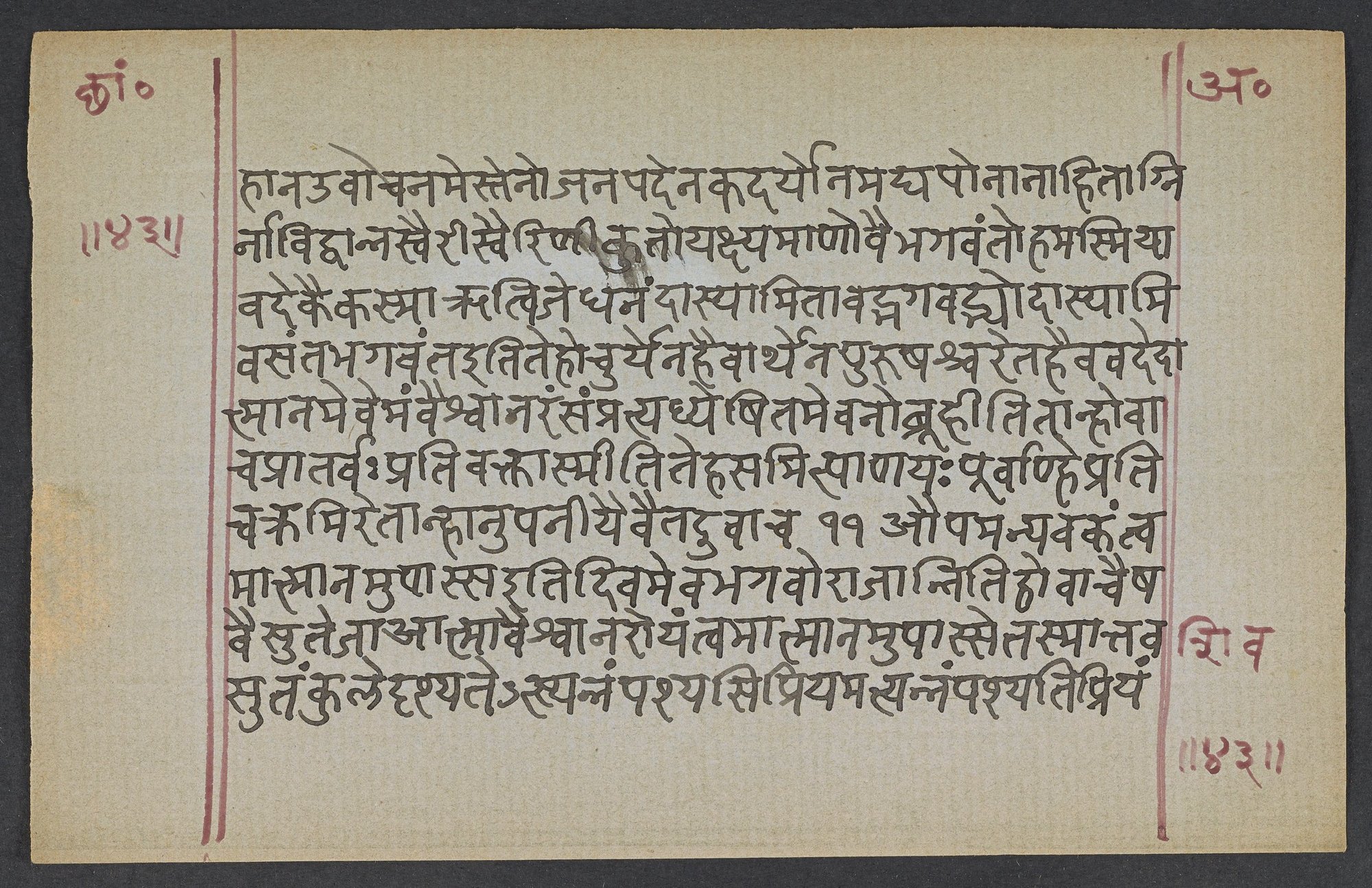
11.5tebhyo ha prāptebhyaḥ pṛthag arhāṇi kārayāṃ cakāra |
sa ha prātaḥ saṃjihāna uvāca |
na me steno janapade na kadaryo na madyapaḥ |
nānāhitāgnir nāvidvān na svairī svairiṇī kutaḥ |
yakṣyamāṇo vai bhagavanto 'ham asmi |
yāvad ekaikasmā ṛtvije dhanaṃ dāsyāmi tāvad bhagavadbhyo dāsyāmi |
vasantu bhagavanta iti ||
11.6te hocuḥ |
yena haivārthena puruṣaś caret taṃ haiva vadet |
ātmānam evemaṃ vaiśvānaraṃ saṃpraty adhyeṣi |
tam eva no brūhīti ||
11.7tān hovāca |
prātar vaḥ prativaktāsmīti |
te ha samitpāṇayaḥ pūrvāhṇe praticakramire |
tān hānupanīyaivaitad uvāca ||
12.1aupamanyava kaṃ tvam ātmānam upāssa iti |
divam eva bhagavo rājann iti hovāca |
eṣa vai sutejā ātmā vaiśvānaro yaṃ tvam ātmānam upāsse |
tasmāt tava sutaṃ prasutam āsutaṃ kule dṛśyate ||
11.5When they arrived (the king) ordered proper presents to be made separately to each of them. And rising the next morning he said: 'In my kingdom there is no thief, no miser, no drunkard, no man without an altar in his house, no ignorant person, no adulterer, much less an adulteress. I am going to perform a sacrifice, Sirs, and as much wealth as I give to each Ritvig priest, I shall give to you, Sirs. Please to stay here.'
11.6They replied: 'Every man ought to say for what purpose he comes. You know at present that Vaisvânara Self, tell us that.'
11.7He said: 'To-morrow I shall give you an answer.' Therefore on the next morning they approached him, carrying fuel in their hands (like students), and he, without first demanding any preparatory rites, said to them:
12.1'Aupamanyava, whom do you meditate on as the Self?' He replied: 'Heaven only, venerable king.' He said: 'The Self which you meditate on is the Vaisvânara Self, called Sutegas (having good light). Therefore every kind of Soma libation is seen in your house.
Where on the image
Penn Ms. Coll. 390 Item 945. fol. 43v begins ‹hāna uvāca na me steno janapade na kadaryo na madyapo nānāhitāgnir nāvidvān› and ends ‹sutaṃ kule dṛśyate 'tsy annaṃ paśyasi priyam atty annaṃ paśyati priyaṃ›; fol. 44r begins ‹bhavaty asya brahmavarcasaṃ kule ya etam evam ātmānaṃ vaiśvānaram upāste› and ends ‹atha hovācendradyumnaṃ bhāllaveyaṃ vaiyāghrapadya kaṃ tvam ātmānam upāssa iti vāyum eva› (first and last words read on the image, transliterated). The words were located in the GRETIL text by string matching and the page boundaries follow from them; readings and results are stored in data/sources/upanishads/mapping_945.json.
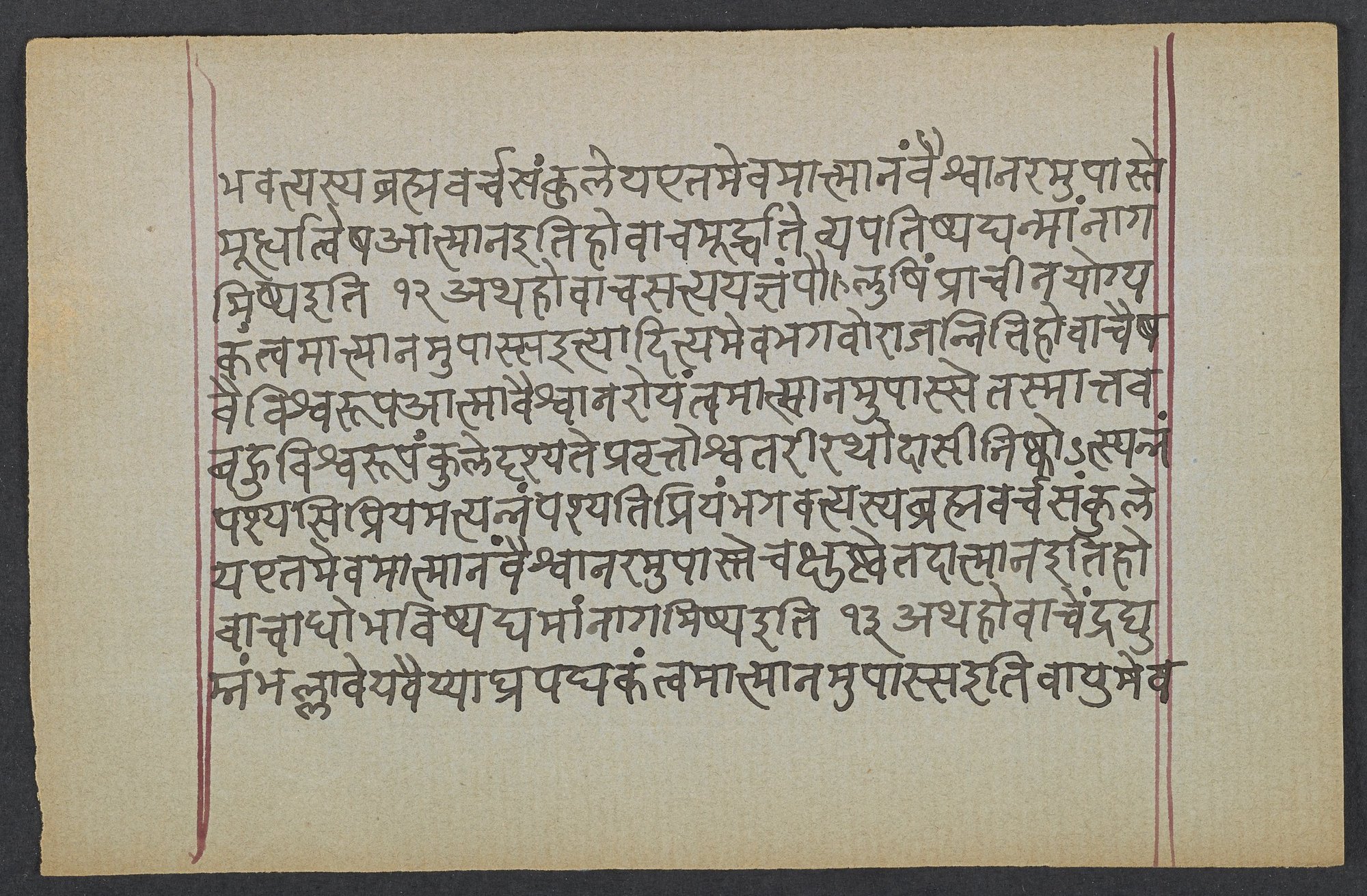
12.2atsy annaṃ paśyasi priyam |
atty annaṃ paśyati priyam bhavaty asya brahmavarcasaṃ kule ye etam evam ātmānaṃ vaiśvānaram upāste |
mūdhā tv eṣa ātmana iti hovāca |
mūrdhā te vyapatiṣyad yan māṃ nāgamiṣya iti ||
13.1atha hovāca satyayajñaṃ pauluṣim |
prācīnayogya kaṃ tvam ātmānam upāssa iti |
ādityam eva bhagavo rājann iti hovāca |
eṣa vai viśvarūpa ātmā vaiśvānaro yaṃ tvam ātmānam upāste |
tasmāt tava bahu viśvarūpaṃ kule dṛśyate ||
13.2pravṛtto 'śvatarīratho dāsī niṣkaḥ |
atsy annaṃ paśyasi priyam |
atty annaṃ paśyati priyaṃ bhavaty asya brahmavarcasaṃ kule ya etam evam ātmānaṃ vaiśvānaram upāste |
cakṣuṣ ṭv etad ātmana iti hovāca |
andho 'bhaviṣyo yan māṃ nāgamiṣya iti ||
12.2'You eat food, and see your desire (a son, &c), and whoever thus meditates on that Vaisvânara Self, eats food, sees his desire, and has Vedic glory (arising from study and sacrifice) in his house. That, however, is but the head of the Self, and thus your head would have fallen (in a discussion), if you had not come to me.'
13.1Then he said to Satyayagña Paulushi: 'O Prâkînayogya, whom do you meditate on as the Self?' He replied: 'The sun only, venerable king.' He said: 'The Self which you meditate on is the Vaisvânara Self, called Visvarûpa (multiform). Therefore much and manifold wealth is seen in your house.
13.2'There is a car with mules, full of slaves and jewels. You eat food and see your desire, and whoever thus meditates on that Vaisvânara Self, eats food and sees his desire, and has Vedic glory in his house. 'That, however, is but the eye of the Self, and you would have become blind, if you had not come to me.'
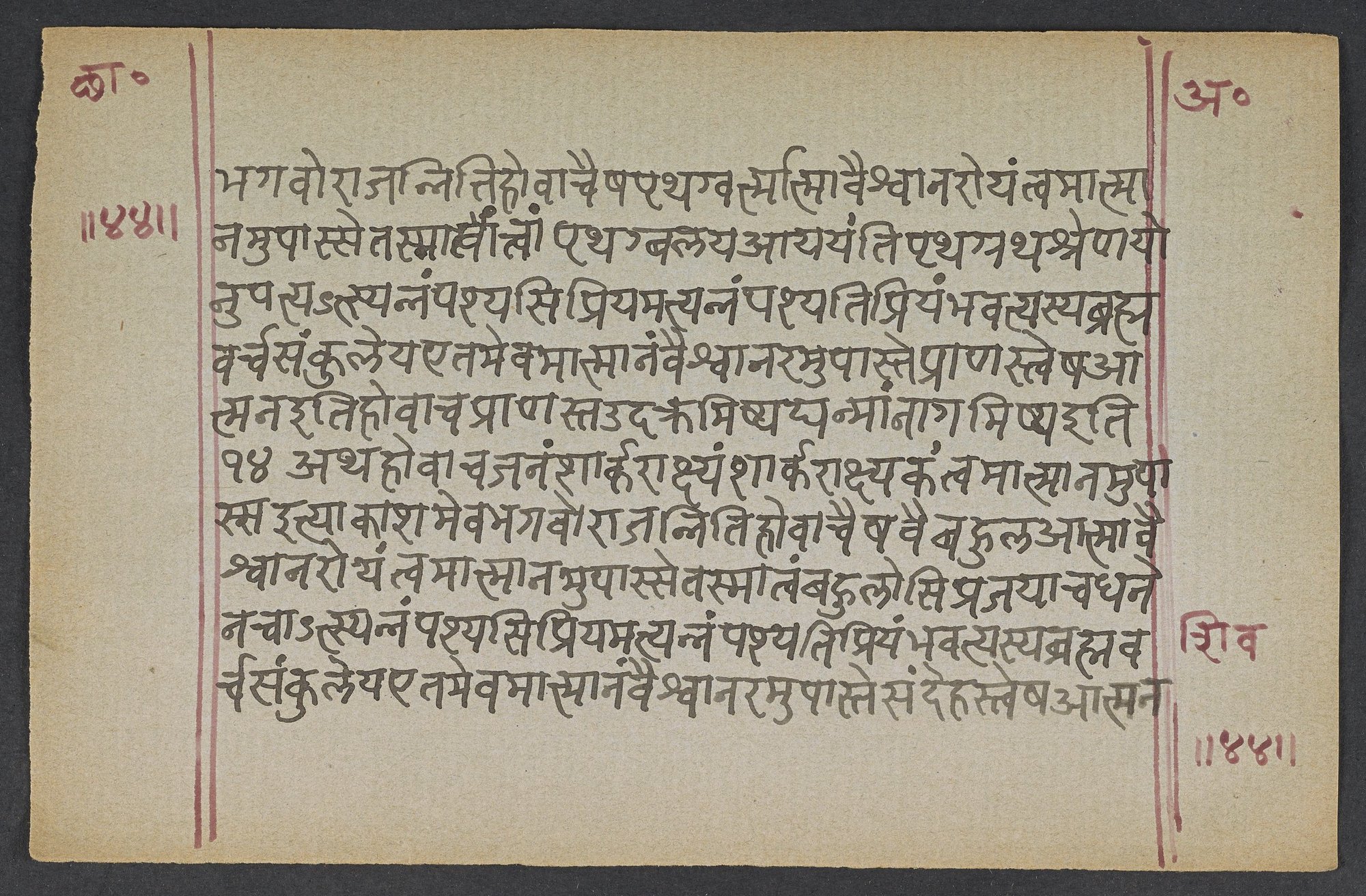
Where on the image
Penn Ms. Coll. 390 Item 945. fol. 44r begins ‹bhavaty asya brahmavarcasaṃ kule ya etam evam ātmānaṃ vaiśvānaram upāste› and ends ‹atha hovācendradyumnaṃ bhāllaveyaṃ vaiyāghrapadya kaṃ tvam ātmānam upāssa iti vāyum eva›; fol. 44v begins ‹bhagavo rājann iti hovācaiṣa vai pṛthagvartmātmā vaiśvānaro› and ends ‹ya etam evam ātmānaṃ vaiśvānaram upāste saṃdehas tv eṣa ātmana› (first and last words read on the image, transliterated). The words were located in the GRETIL text by string matching and the page boundaries follow from them; readings and results are stored in data/sources/upanishads/mapping_945.json.
14.1atha hovācendradyumnaṃ bhāllaveyam |
vaiyāghrapadya kaṃ tvam ātmānam upāssa iti |
vāyum eva bhagavo rājann iti hovāca |
eṣa vai pṛthagvartmātmā vaiśvānaro yaṃ tvam ātmānam upāsse |
tasmāt tvāṃ pṛthag balaya āyanti pṛthag rathaśreṇayo 'nuyanti ||
14.2atsy annaṃ paśyasi priyam |
atty annaṃ paśyati priyaṃ bhavaty asya brahmavarcasaṃ kule ya etam evam ātmānaṃ vaiśvānaram upāste |
prāṇas tv eṣa ātmana iti hovāca |
prāṇas ta udakramiṣyad yan māṃ nāgamiṣya iti ||
15.1atha hovāca janaṃ śārkarākṣyam |
śārkarākṣya kaṃ tvam ātmānam upāssa iti |
ākāśam eva bhagavo rājann iti hovāca |
eṣa vai bahula ātmā vaiśvānaro yaṃ tvam ātmānam upasse |
tasmāt tvaṃ bahulo 'si prajayā ca dhanena ca ||
14.1Then he said to Indradyumna Bhâllaveya: 'O Vaiyâghrapadya, whom do you meditate on as the Self?' He replied: 'Air only, venerable king.' He said: 'The Self which you meditate on is the Vaisvânara Self, called Prithagvartman (having various courses). Therefore offerings come to you in various ways, and rows of cars follow you in various ways.
14.2'You eat food and see your desire, and whoever thus meditates on that Vaisvânara Self, eats food and sees his desire, and has Vedic glory in his house. 'That, however, is but the breath of the Self, and your breath would have left you, if you had not come to me.'
15.1Then he said to Gana Sârkarâkshya: 'Whom do you meditate on as the Self?' He replied: 'Ether only, venerable king.' He said: 'The Self which you meditate on is the Vaisvânara Self, called Bahula (full). Therefore you are full of offspring and wealth.
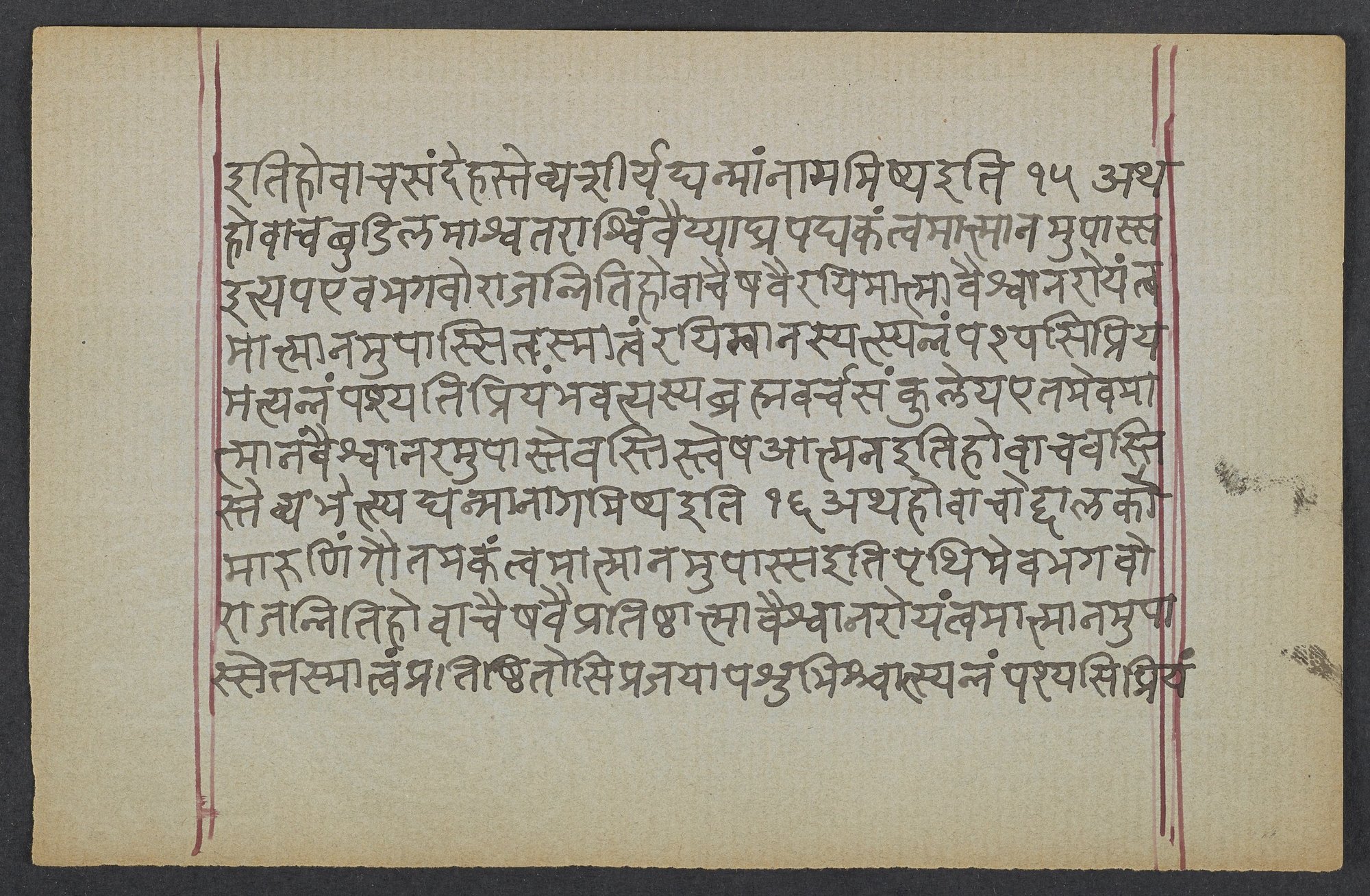
Where on the image
Penn Ms. Coll. 390 Item 945. fol. 44v begins ‹bhagavo rājann iti hovācaiṣa vai pṛthagvartmātmā vaiśvānaro› and ends ‹ya etam evam ātmānaṃ vaiśvānaram upāste saṃdehas tv eṣa ātmana›; fol. 45r begins ‹iti hovāca saṃdehas te vyaśīryad yan māṃ nāgamiṣya iti› and ends ‹tasmāt tvaṃ pratiṣṭhito 'si prajayā ca paśubhiś cāttsy annaṃ paśyasi priyam› (first and last words read on the image, transliterated). The words were located in the GRETIL text by string matching and the page boundaries follow from them; readings and results are stored in data/sources/upanishads/mapping_945.json.
15.2atsy annaṃ paśyasi priyam |
atty annaṃ paśyati priyaṃ bhavaty asya brahmavarcasaṃ kule ya etam evam ātmānaṃ vaiśvānaram upāste |
saṃdehas tv eṣa ātmana iti hovāca |
saṃdehas te vyaśīryad yan māṃ nāgamiṣya iti ||
16.1atha hovāca buḍilam āśvatarāśvim |
vaiyāghrapadya kaṃ tvam ātmānam upāssa iti |
apa eva bhagavo rājann iti hovāca |
eṣa vai rayir ātmā vaiśvānaro yaṃ tvam ātmānam upāsse |
tasmāt tvaṃ rayimān puṣṭimān asi ||
16.2atsy annaṃ paśyasi priyam |
atty annaṃ paśyati priyaṃ bhavaty asya brahmavarcasaṃ kule ya etam evam ātmānaṃ vaiśvānaram upāste |
bastis tv eṣa ātmana iti hovāca |
bastis te vyabhetsyad yan māṃ nāgamiṣya iti ||
17.1atha hovācoddālakam āruṇim |
gautama kaṃ tvam ātmānam upassa iti |
pṛthivīm eva bhagavo rājann iti hovāca |
eṣa vai pratiṣṭhātmā vaiśvānaro yaṃ tvam ātmānam upāsse |
tasmāt tvaṃ pratiṣṭhito 'si prajayā ca paśubhiś ca ||
15.2'You eat food and see your desire, and whoever thus meditates on that Vaisvânara Self, eats food and sees his desire, and has Vedic glory in his house. That, however, is but the trunk of the Self, and your trunk would have perished, if you had not come to me.'
16.1Then he said to Budila Âsvatarâsvi, 'O Vaiyâghrapadya, whom do you meditate on as the Self?' He replied: 'Water only, venerable king.' He said: 'The Self which you meditate on is the Vaisvânara Self, called Rayi (wealth). Therefore are you wealthy and flourishing.
16.2'You eat food and see your desire, and whoever thus meditates on that Vaisvânara Self, eats food and sees his desire, and has Vedic glory in his house. 'That, however, is but the bladder of the Self, and your bladder would have burst, if you had not come to me.'
17.1Then he said to Auddâlaka Âruni: 'O Gautama, whom do you meditate on as the Self?' He replied: 'The earth only, venerable king.' He said: 'The Self which you meditate on is the Vaisvânara Self, called Pratishthâ (firm rest). Therefore you stand firm with offspring and cattle.
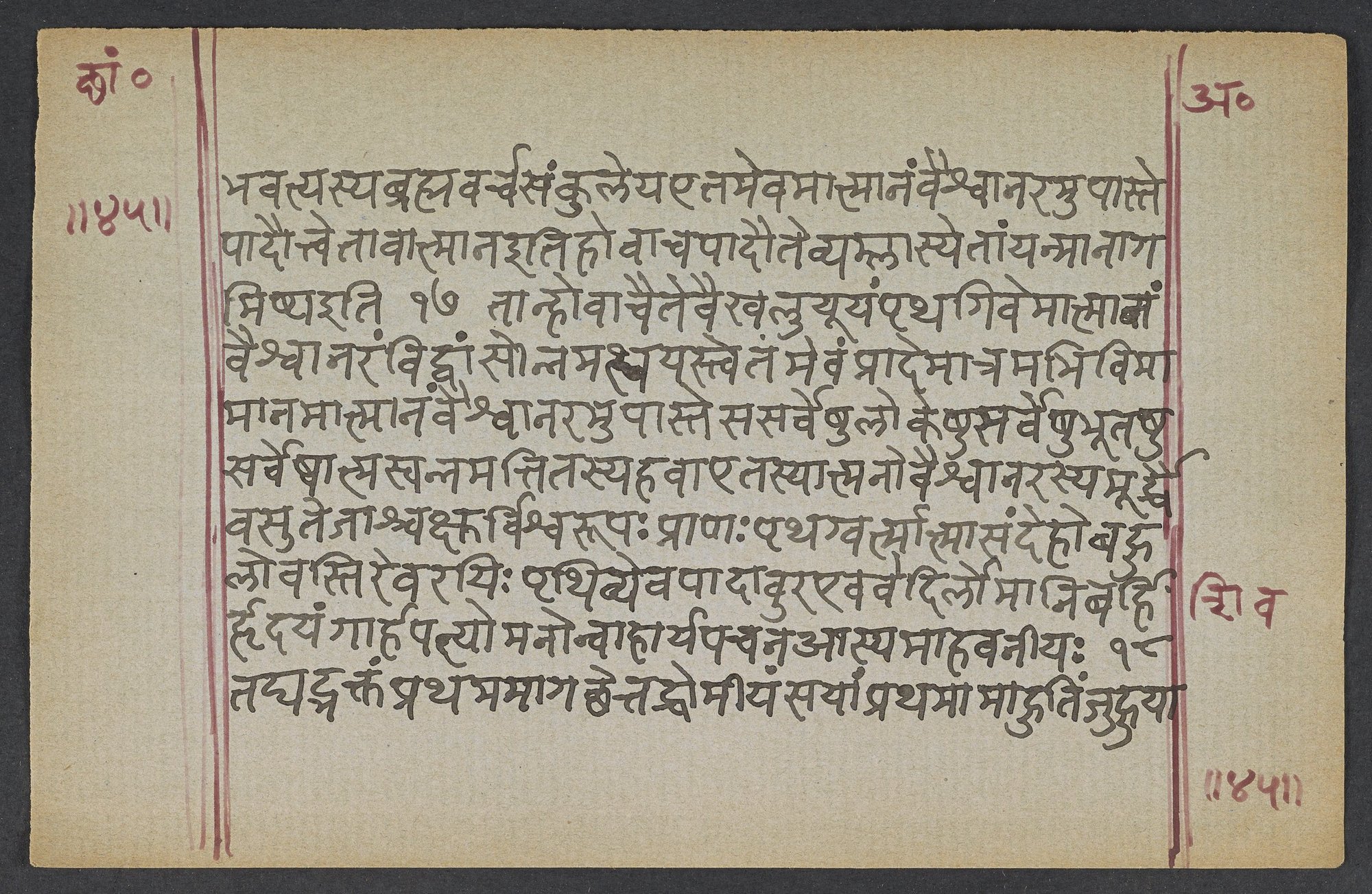
Where on the image
Penn Ms. Coll. 390 Item 945. fol. 45r begins ‹iti hovāca saṃdehas te vyaśīryad yan māṃ nāgamiṣya iti› and ends ‹tasmāt tvaṃ pratiṣṭhito 'si prajayā ca paśubhiś cāttsy annaṃ paśyasi priyam›; fol. 45v begins ‹bhavaty asya brahmavarcasaṃ kule ya etam evam ātmānaṃ vaiśvānaram upāste› and ends ‹tad yad bhaktaṃ prathamam āgacchet tad dhomīyaṃ sa yāṃ prathamām āhutiṃ juhuyāt› (first and last words read on the image, transliterated). Notes: the words 'atty annaṃ paśyati priyaṃ' of 5.17.2 are not written (fol. 45r ends 'paśyasi priyam', fol. 45v begins 'bhavaty asya'). The words were located in the GRETIL text by string matching and the page boundaries follow from them; readings and results are stored in data/sources/upanishads/mapping_945.json.
17.2atsy annaṃ paśyasi priyam |
atty annaṃ paśyati priyaṃ bhavaty asya brahmavarcasaṃ kule ya etam evam ātmānaṃ vaiśvānaram upāste |
pādau tv etāv ātmana iti hovāca |
pādau te vyamlāsyetāṃ yan māṃ nāgamiṣya iti ||
18.1tān hovāca |
ete vai khalu yūyaṃ pṛthag ivemam ātmānaṃ vaiśvānaraṃ vidvāṃso 'nnam attha |
yas tv etam evaṃ prādeśamātram abhivimānam ātmānaṃ vaiśvānaram upāste |
sa sarveṣu lokeṣu sarveṣu bhūteṣu sarveṣv ātmasv annam atti ||
18.2tasya ha vā etasyātmano vaiśvānarasya mūrdhaiva sutejāś cakṣur viśvarūpaḥ prāṇaḥ pṛthagvartmātmā saṃdeho bahulo bastir eva rayiḥ pṛthivy eva pādāv ura eva vedir lomāṇi barhir hṛdayaṃ gārhapatyo mano 'nvāhāryapacana āsyam āhavanīyaḥ ||
17.2'You eat food and see your desire, and whoever thus meditates on that Vaisvânara Self, eats food and sees his desire, and has Vedic glory in his house. 'That, however, are but the feet of the Self, and your feet would have given way, if you had not come to me.'
18.1Then he said to them all: 'You eat your food, knowing that Vaisvânara Self as if it were many. But he who worships the Vaisvânara Self as a span long, and as identical with himself, he eats food in all worlds, in all beings, in all Selfs.
18.2'Of that Vaisvânara Self the head is Sutegas (having good light), the eye Visvarûpa (multiform), the breath Prithagvartman (having various courses), the trunk Bahula (full), the bladder Rayi (wealth), the feet the earth, the chest the altar, the hairs the grass on the altar, the heart the Gârhapatya fire, the mind the Anvâhârya fire, the mouth the Âhavanîya fire.
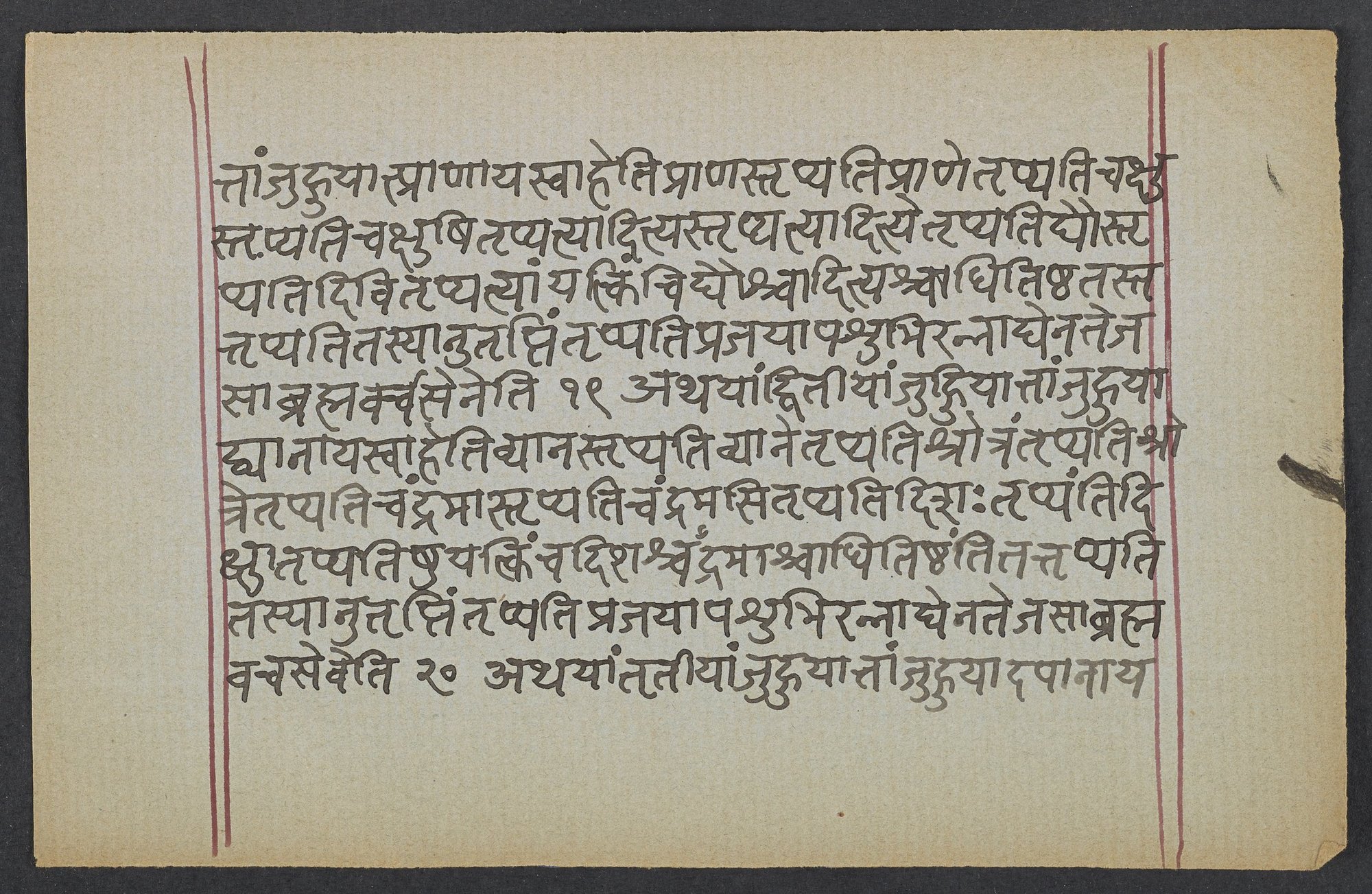
Where on the image
Penn Ms. Coll. 390 Item 945. fol. 45v begins ‹bhavaty asya brahmavarcasaṃ kule ya etam evam ātmānaṃ vaiśvānaram upāste› and ends ‹tad yad bhaktaṃ prathamam āgacchet tad dhomīyaṃ sa yāṃ prathamām āhutiṃ juhuyāt›; fol. 46r begins ‹tāṃ juhuyāt prāṇāya svāheti prāṇas tṛpyati› and ends ‹atha yāṃ tṛtīyāṃ juhuyāt tāṃ juhuyād apānāya› (first and last words read on the image, transliterated). Notes: the words 'atty annaṃ paśyati priyaṃ' of 5.17.2 are not written (fol. 45r ends 'paśyasi priyam', fol. 45v begins 'bhavaty asya'). The words were located in the GRETIL text by string matching and the page boundaries follow from them; readings and results are stored in data/sources/upanishads/mapping_945.json.
19.1tad yad bhaktaṃ prathamam āgacchet tad dhomīyam |
sa yāṃ prathamām āhutiṃ juhuyāt tāṃ juhuyāt prāṇāya svāheti |
prāṇas tṛpyati ||
19.2prāṇe tṛpyati cakṣus tṛpyati |
cakṣuṣi tṛpyaty ādityas tṛpyati |
āditye tṛpyati dyaus tṛpyati |
divi tṛpyantyāṃ yat kiṃca dyauś cādityaś cādhitiṣṭhatas tat tṛpyati |
tasyānu tṛptiṃ tṛpyati prajayā paśubhir annādyena tejasā brahmavarcaseneti ||
20.1atha yāṃ dvitīyāṃ juhuyāt tāṃ juhuyād vyānāya svāheti |
vyānas tṛpyati ||
20.2vyāne tṛpyati śrotraṃ tṛpyati |
śrotre tṛpyati candramās tṛpyati |
candramasi tṛpyati diśas tṛpyanti |
dikṣu tṛpyantīṣu yat kiṃca diśaś candramāś cādhitiṣṭhanti tat tṛpyati |
tasyānu tṛptiṃ tṛpyati prajayā paśubhir annādyena tejasā brahmavarcaseneti ||
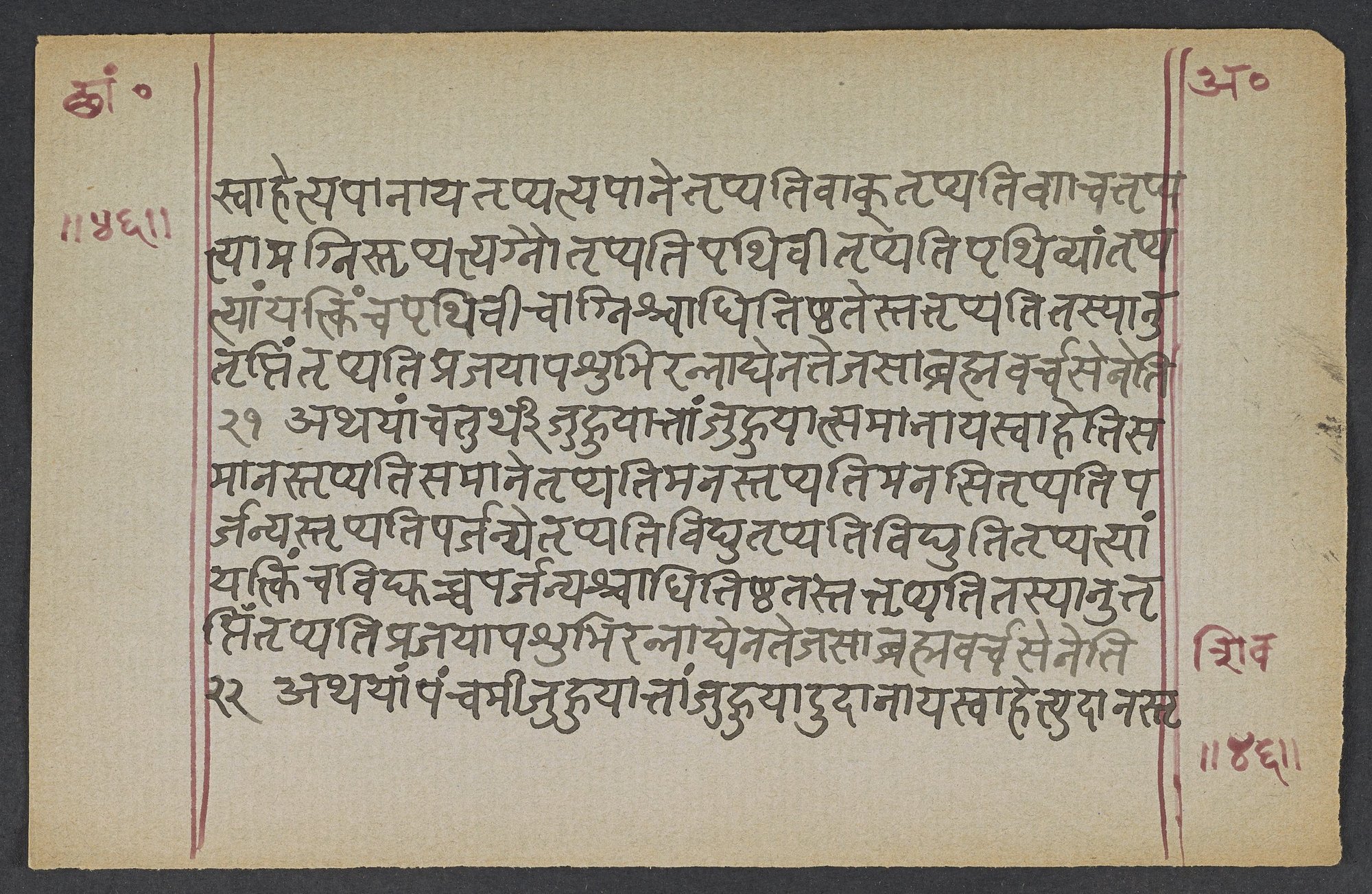
19.1'Therefore the first food which a man may take, is in the place of Homa. And he who offers that first oblation, should offer it to Prâna (up-breathing), saying Svâhâ. Then Prâna (up-breathing) is satisfied,
19.2'If Prâna is satisfied, the eye is satisfied, if the eye is satisfied, the sun is satisfied, if the sun is satisfied, heaven is satisfied, if heaven is satisfied, whatever is under heaven and under the sun is satisfied. And through their satisfaction he (the sacrificer or eater) himself is satisfied with offspring, cattle, health, brightness, and Vedic splendour.
20.1'And he who offers the second oblation, should offer it to Vyâna (back-breathing), saying Svâhâ. Then Vyina is satisfied,
20.2'If Vyâna is satisfied, the ear is satisfied, if the ear is satisfied, the moon is satisfied, if the moon is satisfied, the quarters are satisfied, if the quarters are satisfied, whatever is under the quarters and under the moon is satisfied. And through their satisfaction he (the sacrificer or eater) himself is satisfied with offspring, cattle, health, brightness, and Vedic splendour.
Where on the image
Penn Ms. Coll. 390 Item 945. fol. 46r begins ‹tāṃ juhuyāt prāṇāya svāheti prāṇas tṛpyati› and ends ‹atha yāṃ tṛtīyāṃ juhuyāt tāṃ juhuyād apānāya›; fol. 46v begins ‹svāhety apānāya tṛpyaty apāne tṛpyati vāk tṛpyati› and ends ‹atha yāṃ pañcamīṃ juhuyāt tāṃ juhuyād udānāya svāhety udāna› (first and last words read on the image, transliterated). The words were located in the GRETIL text by string matching and the page boundaries follow from them; readings and results are stored in data/sources/upanishads/mapping_945.json.
21.1atha yāṃ tṛtīyāṃ juhuyāt tāṃ juhuyād apānāya svāheti |
apānas tṛpyati ||
21.2apāne tṛpyati vāk tṛpyati |
vāci tṛpyantyām agnis tṛpyati |
agnau tṛpyati pṛthivī tṛpyati |
pṛthivyāṃ tṛpyantyāṃ yat kiṃ ca pṛthivī cāgniś cādhitiṣṭhatas tat tṛpyati |
tasyānutṛptiṃ tṛpyati prajayā paśubhir annādyena tejasā brahmavarcaseneti ||
22.1atha yāṃ caturthīṃ juhuyāt tāṃ juhuyāt samānāya svāheti |
samānas tṛpyati ||
22.2samāne tṛpyati manas tṛpyati |
manasi tṛpyati parjanyas tṛpyati |
parjanye tṛpyati vidyut tṛpyati |
vidyuti tṛpyantyāṃ yat kiṃ ca vidyuc ca parjanyaś cādhitiṣṭhatas tat tṛpyati |
tasyānu tṛptiṃ tṛpyati prajayā paśubhir annādyena tejasā brahmavarcaseneti ||
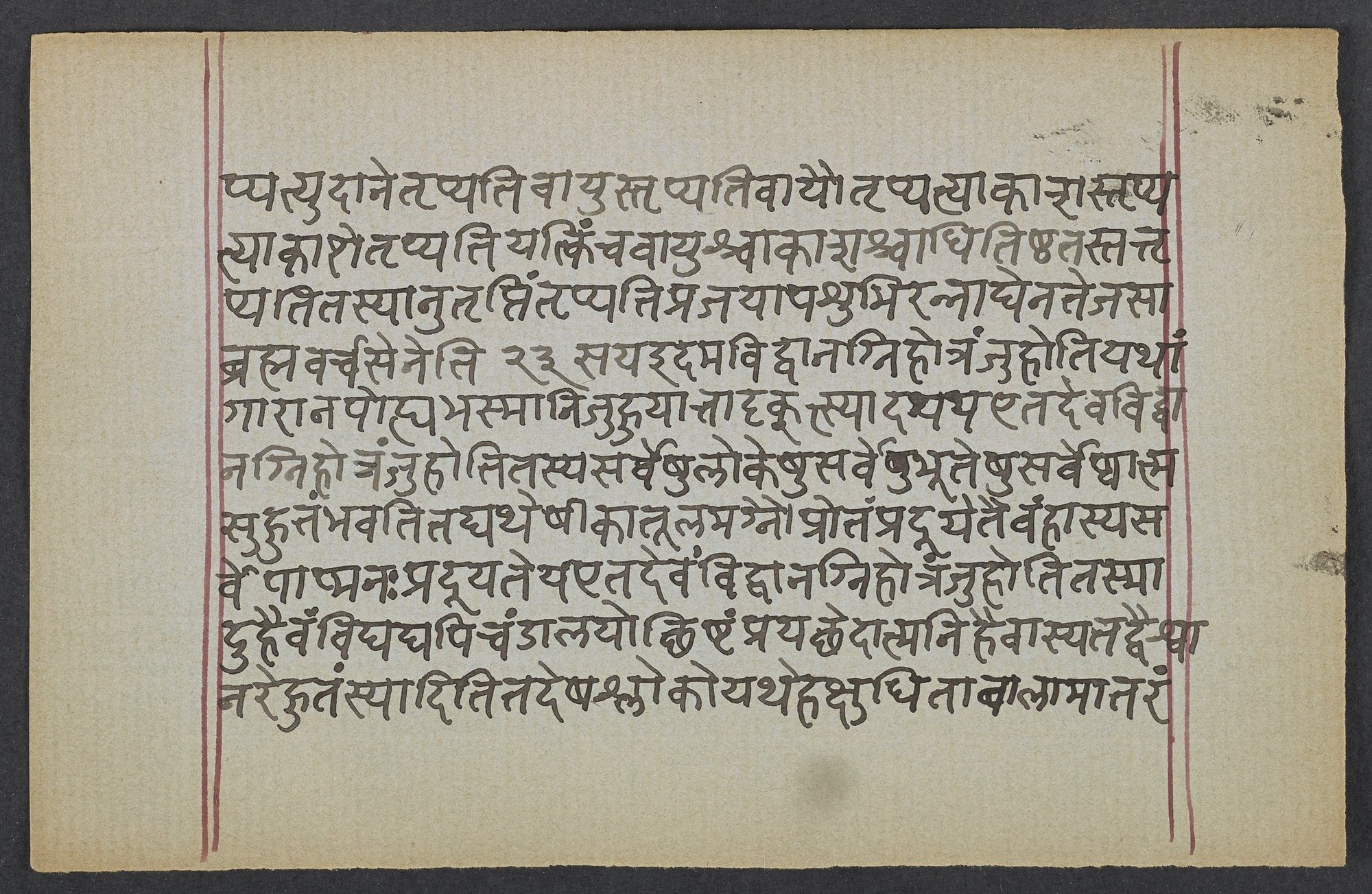
21.1'And he who offers the third oblation, should offer it to Apâna (down-breathing), saying Svâhâ. Then Apâna is satisfied. If Apâna is satisfied, the tongue is satisfied, if the tongue is satisfied, Agni (fire) is satisfied, if Agni is satisfied, the earth is satisfied, if the earth is satisfied, whatever is under the earth and under fire is satisfied.
21.2'And through their satisfaction he (the sacrificer or eater) himself is satisfied with offspring, cattle, health, brightness, and Vedic splendour.
22.1'And he who offers the fourth oblation, should offer it to Samâna (on-breathing), saying Svâhâ. Then Samâna is satisfied,
22.2'If Samâna is satisfied, the mind is satisfied, if the mind is satisfied, Parganya (god of rain) is satisfied, if Parganya is satisfied, lightning is satisfied, if lightning is satisfied, whatever is under Parganya and under lightning is satisfied. And through their satisfaction he (the sacrificer or eater) himself is satisfied with offspring, cattle, health, brightness, and Vedic splendour.
Where on the image
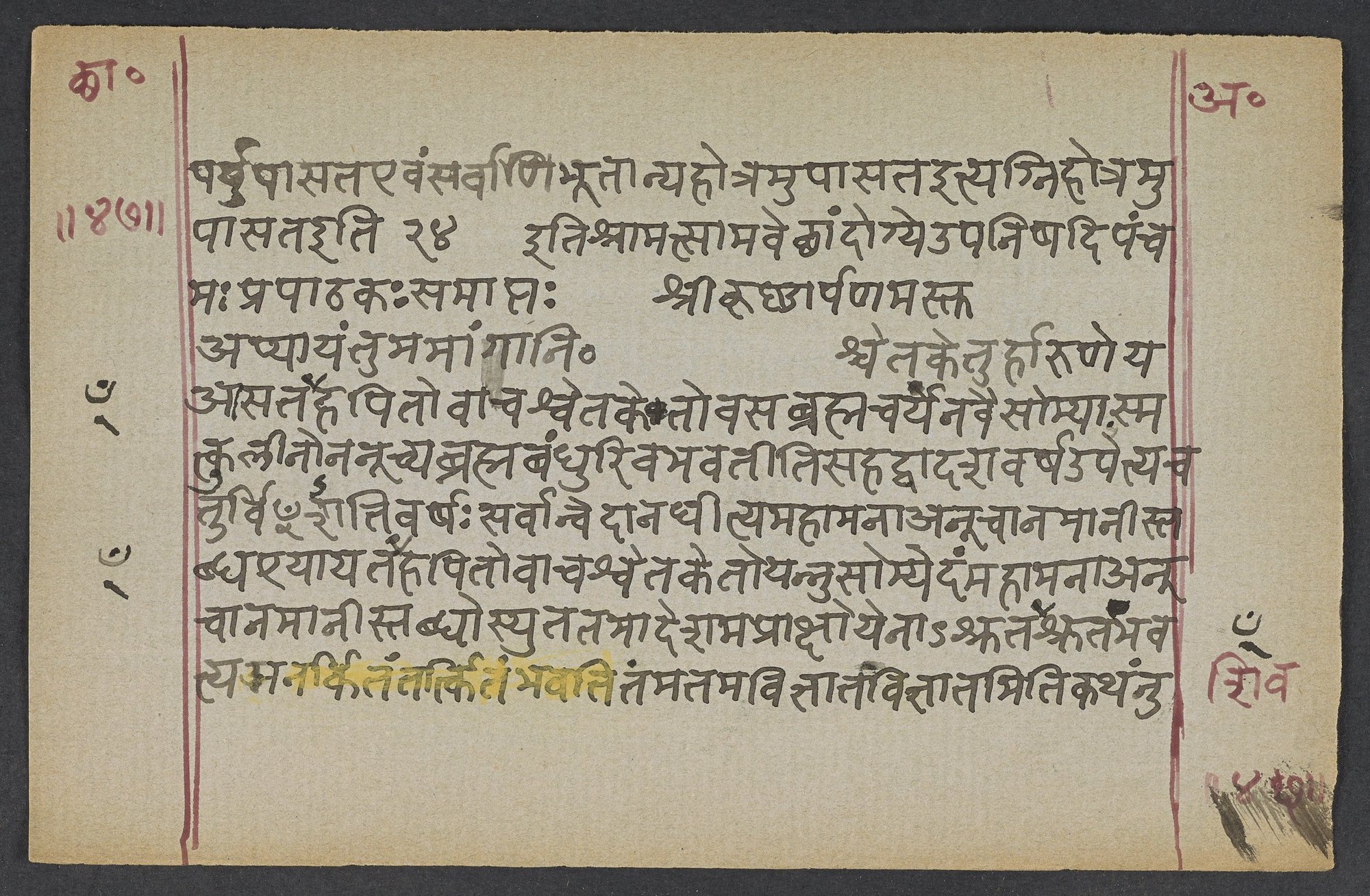
Penn Ms. Coll. 390 Item 945. fol. 46v begins ‹svāhety apānāya tṛpyaty apāne tṛpyati vāk tṛpyati› and ends ‹atha yāṃ pañcamīṃ juhuyāt tāṃ juhuyād udānāya svāhety udāna›; fol. 47r begins ‹tṛpyaty udāne tṛpyati vāyus tṛpyati vāyau tṛpyaty ākāśas tṛpyati› and ends ‹tad eṣa śloko yatheha kṣudhitā bālā mātaraṃ›; fol. 47v begins ‹paryupāsata evaṃ sarvāṇi bhūtāny agnihotram upāsata› and ends ‹agnihotram upāsata ity agnihotram upāsata iti› (first and last words read on the image, transliterated). Notes: Müller divides khanda 5.24 into paragraphs differently from the Sanskrit edition; the whole khanda is given here with his own numbers. The words were located in the GRETIL text by string matching and the page boundaries follow from them; readings and results are stored in data/sources/upanishads/mapping_945.json.
23.1atha yām pañcamīṃ juhuyāt tāṃ juhuyāt udānāya svāheti |
udānas tṛpyati ||
23.2udāne tṛpyati tvak tṛpyati tvaci tṛpyantyāṃ vāyus tṛpyati |
vāyau tṛpyaty ākāśas tṛpyati |
ākāśe tṛpyati yat kiṃca vāyuś cākāśaś cādhitiṣṭhatas tat tṛpyati |
tasyānu tṛptiṃ tṛpyati prajayā paśubhir annādyena tejasā brahmavarcaseneti ||
24.1sa ya idam avidvān agnihotraṃ juhoti yathāṅgārān apohya bhasmani juhuyāt tādṛk tat syāt ||
24.2atha ya etad evaṃ vidvān agnihotraṃ juhoti tasya sarveṣu lokeṣu sarveṣu bhūteṣu sarveṣv ātmasu hutaṃ bhavati ||
24.3tad yatheṣīkātūlam agnau protaṃ pradūyetaivaṃ hāsya sarve pāpmānaḥ pradūyante ya etad evaṃ vidvān agnihotraṃ juhoti ||
24.4tasmād u haivaṃvid yady api caṇḍālāya ucchiṣṭaṃ prayacchet |
ātmani haivāsya tad vaiśvānare hutaṃ syād iti |
tad eṣa ślokaḥ ||
24.5yatheha kṣudhitā bālā mātaraṃ paryupāsate |
evaṃ sarvāṇi bhūtāny agnihotram upāsata ||
23.1'And he who offers the fifth oblation, should offer it to Udâna (out-breathing), saying Svâhâ. Then Udâna is satisfied,
23.2'If Udâna is satisfied, Vâyu (air) is satisfied, if Vâyu is satisfied, ether is satisfied, if ether is satisfied, whatever is under Vâyu and under the ether is satisfied. And through their satisfaction he (the sacrificer or eater) himself is satisfied with offspring, cattle, health, brightness, and Vedic splendour.
24.1'If, without knowing this, one offers an Agnihotra, it would be as if a man were to remove the live coals and pour his libation on dead ashes.
24.2'But he who offers this Agnihotra with a full knowledge of its true purport, he offers it (i.e. he eats food) in all worlds, in all beings, in all Selfs.
24.3'As the soft fibres of the Ishîkâ reed, when thrown into the fire, are burnt, thus all his sins are burnt whoever offers this Agnihotra with a full knowledge of its true purport.
24.4'Even if he gives what is left of his food to a Kandâla, it would be offered in his (the Kandâla's) Vaisvânara Self. And so it is said in this Sloka:— 'As hungry children here on earth sit (expectantly) round their mother, so do all beings sit round the Agnihotra, yea, round the Agnihotra.'
Notes
- Sanskrit: GRETIL, Chandogyopanisad with the commentary ascribed to Samkara, mula text only (input by the Sansknet project). Paragraph numbers (khanda.paragraph) follow the edition. Three legacy encoding artifacts in GRETIL chapter 2 ('saptavidh.am', 'brahmavarcasy:', 'tejasvy:') are normalized.
- English: F. Max Müller, 'Khandogya-upanishad', The Upanishads part I, Sacred Books of the East 1 (1879), from the proofread English Wikisource transcription; footnotes are not reproduced. Where Müller divides a khanda into a different number of paragraphs than the Sanskrit edition, the whole khanda stands in one section and keeps his numbers. In other khandas his paragraph breaks sometimes fall a clause earlier or later than the Sanskrit ones.
- Transcription slips corrected to the printed page: 1.9.2 'udîttha' (printed udgîtha), 3.16.2 'sacrifices' (sacrificer,), 4.6.1 'toward' (towards), 7.25.1 'alt' (all); the stray heading 'Elventh Khanda' inside 2.10.6 is removed. 1.2.1 'Whent he' is a misprint in the book itself and is kept as printed.
- The manuscript readings differ from the edition in places; the Sanskrit shown is the edition text.
- fol. 38v line 8: the copyist passes from 5.1.7 'tān hovāca yasmin va[ḥ]' (written 'yasmin vāti') directly to 5.1.15 'na vai vāco na cakṣūṃṣi ...': the rest of 5.1.7 and paragraphs 5.1.8-14 are not in this manuscript
- the words 'atty annaṃ paśyati priyaṃ' of 5.17.2 are not written (fol. 45r ends 'paśyasi priyam', fol. 45v begins 'bhavaty asya')
Cite
Sources
- Source: Penn Ms. Coll. 390 Item 945 (OPenn, public domain) + GRETIL Sanskrit + F. Max Müller (1879) English (holding institution)
- Critical edition: GRETIL Sanskrit e-texts (Isa, Katha, Prasna, Mandukya, Aitareya, Taittiriya, Svetasvatara, Chandogya); Nirnaya Sagar edition of 1925, transcribed (Kena, Mundaka)
← previous · → next · v cycle view · l back to library