Chandogya Upanishad, Prapathaka 6 (Tat tvam asi)
Introduction
The Chandogya Upanishad belongs to the Samaveda. Its sixth chapter (prapathaka) is a dialogue between the teacher Uddalaka Aruni and his son Svetaketu, who returns home proud of his learning after twelve years of study. Through a series of examples (clay and its products, honey gathered from many trees, rivers merging in the sea, the seed of the banyan, salt dissolved in water) the father teaches that all things come from Being (sat), and closes each lesson with the words 'that is the Self; thou art that, Svetaketu' (tat tvam asi). The chapter has sixteen khandas.
The page images come from University of Pennsylvania Libraries, Ms. Coll. 390 Item 1213, a paper manuscript of seven leaves (11 x 24 cm) that holds the sixth prapathaka alone, in Devanagari with red accent marks, 9 to 10 lines to a side. Its colophon on fol. 7v is dated saka 1758 (1836 CE). The scribe marks the end of each khanda with its number (||1|| to ||16||) but does not number paragraphs; paragraphs were located by their words. Each section below holds the paragraphs of one khanda that end on one page; a paragraph that begins on the previous page is shown with both pages.
How was this verified? (Provenance)
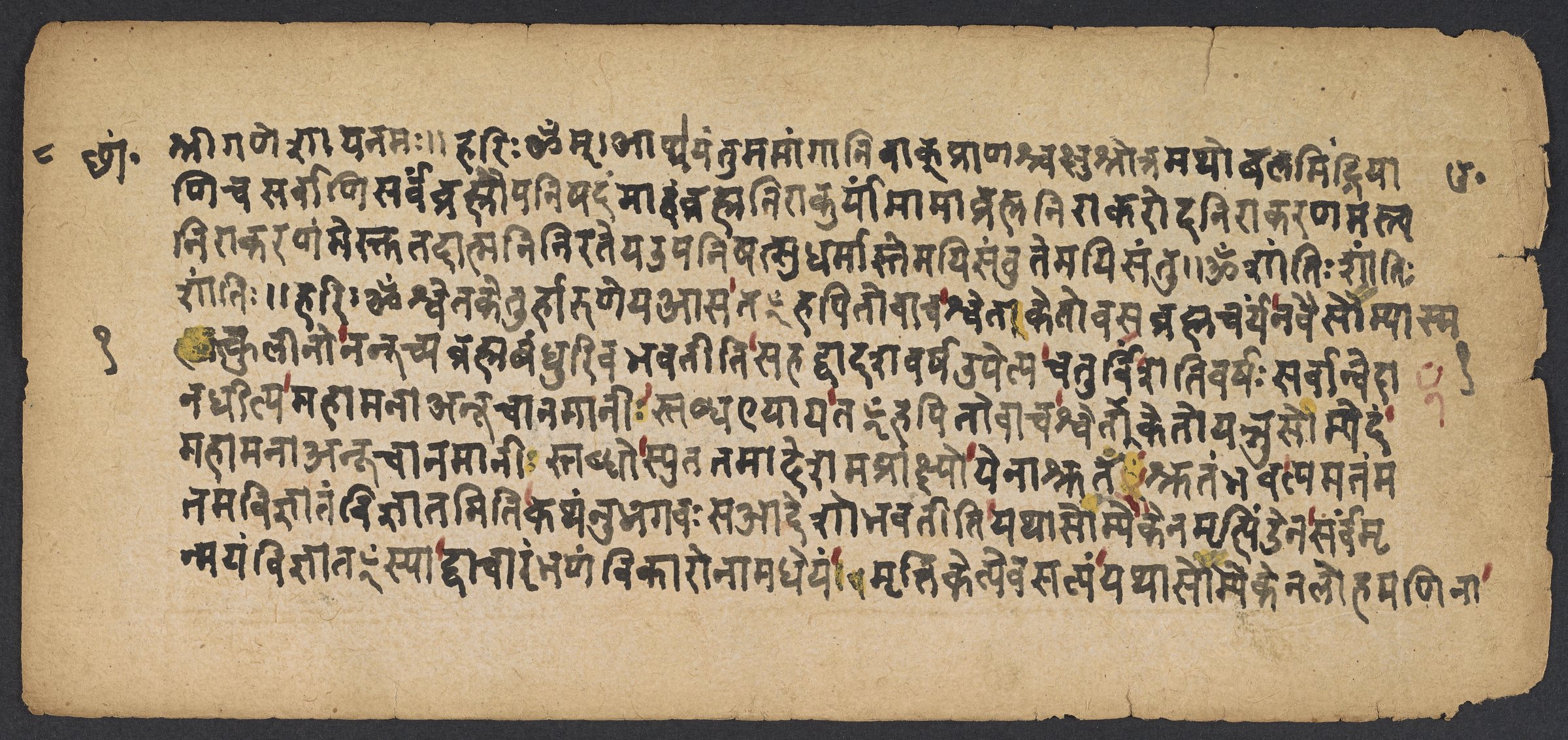
Where on the image
Penn Ms. Coll. 390 Item 1213, fol. 1v. fol. 1v (9 lines): after 'śrīgaṇeśāya namaḥ' and the invocation 'oṃ āpyāyantu mamāṅgāni ...' (lines 1-4), paragraph 1 begins in line 4 ‹hariḥ oṃ śvetaketur hāruṇeya āsa›; paragraph 4 ends in line 9 ‹mṛttikety eva satyaṃ›. Checked on the image; readings logged in data/sources/upanishads/mapping_notes_1213.txt.
1śvetaketur hāruṇeya āsa |
taṃ ha pitovāca śvetaketo vasa brahmacaryam |
na vai somyāsmat kulīno 'nanūcya brahmabandhur iva bhavatīti ||
2sa ha dvādaśavarṣa upetya caturviṃśativarṣaḥ sarvān vedān adhītya mahāmanā anūcānamānī stabdha eyāya |
taṃ ha pitovāca ||
3śvetaketo yan nu somyedaṃ mahāmanā anūcānamānī stabdho 'si |
uta tam ādeśam aprākṣyaḥ yenāśrutaṃ śrutaṃ bhavaty amataṃ matam avijñātaṃ vijñātam iti |
kathaṃ nu bhagavaḥ sa ādeśo bhavatīti ||
4yathā somyaikena mṛtpiṇḍena sarvaṃ mṛnmayaṃ vijñātaṃ syāt |
vācārambhaṇaṃ vikāro nāmadheyaṃ mṛttikety eva satyam ||
1Harih, Om. There lived once Svetaketu Âruneya (the grandson of Aruna). To him his father (Uddâlaka, the son of Aruna) said: 'Svetaketu, go to school; for there is none belonging to our race, darling, who, not having studied (the Veda), is, as it were, a Brâhmana by birth only.'
2Having begun his apprenticeship (with a teacher) when he was twelve years of age, Svetaketu returned to his father, when he was twenty-four, having then studied all the Vedas,—conceited, considering himself well-read, and stern.
3His father said to him: 'Svetaketu, as you are so conceited, considering yourself so well-read, and so stern, my dear, have you ever asked for that instruction by which we hear what cannot be heard, by which we perceive what cannot be perceived, by which we know what cannot be known?'
4'What is that instruction, Sir?' he asked. The father replied: 'My dear, as by one clod of clay all that is made of clay is known, the difference being only a name, arising from speech, but the truth being that all is clay;
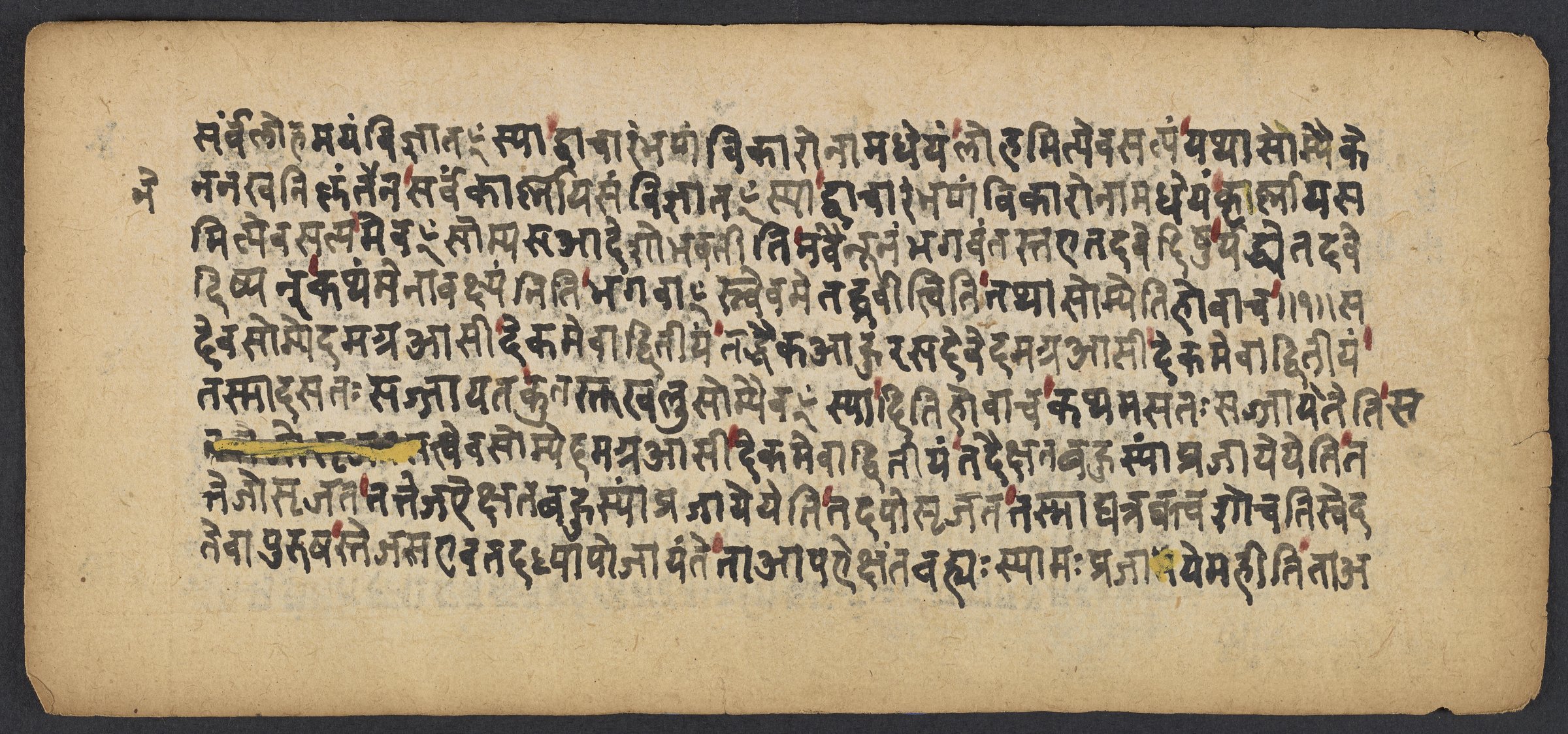
Where on the image
Penn Ms. Coll. 390 Item 1213, fol. 1v, fol. 2r. Paragraph 5 begins at the end of fol. 1v line 9 ‹yathā somyaikena lohamaṇinā› and ends at fol. 2r line 1 ‹loham ity eva satyaṃ›; paragraphs 6-7 follow to line 4 ‹tathā somyeti hovāca›, marked ‹||1||›. Checked on the image; readings logged in data/sources/upanishads/mapping_notes_1213.txt.
5yathā somyaikena lohamaṇinā sarvaṃ lohamayaṃ vijñātaṃ syāt |
vācārambhaṇaṃ vikāro nāmadheyaṃ loham ity eva satyam ||
6yathā somyaikena nakhanikṛntanena sarvaṃ kārṣṇāyasaṃ vijñātaṃ syāt |
vācārambhaṇaṃ vikāro nāmadheyaṃ kṛṣṇāyasam ity eva satyam |
evaṃ somya sa ādeśo bhavatīti ||
7na vai nūnaṃ bhagavantas ta etad avediṣuḥ |
yad dhy etad avediṣyan kathaṃ me nāvakṣyan |
iti bhagavāṃs tv eva me bravītv iti |
tathā somyeti hovāca ||
5'And as, my dear, by one nugget of gold all that is made of gold is known, the difference being only a name, arising from speech, but the truth being that all is gold?
6'And as, my dear, by one pair of nail-scissors all that is made of iron (kârshnâyasam) is known, the difference being only a name, arising from speech, but the truth being that all is iron,—thus, my dear, is that instruction.'
7The son said: 'Surely those venerable men (my teachers) did not know that. For if they had known it, why should they not have told it me? Do you, Sir, therefore tell me that.' 'Be it so,' said the father.
Where on the image
Penn Ms. Coll. 390 Item 1213, fol. 2r. fol. 2r lines 4-9: paragraph 1 begins ‹sad eva somyedam agra āsīt›; paragraph 3 ends ‹tad adhy āpo jāyante›. Some words in line 7 are covered in yellow (a scribal deletion). Checked on the image; readings logged in data/sources/upanishads/mapping_notes_1213.txt.
1sad eva somyedam agra āsīd ekam evādvitīyam |
tad dhaika āhur asad evedam agra āsīd ekam evādvitīyam |
tasmād asataḥ saj jāyata ||
2kutas tu khalu somyaivaṃ syād iti hovāca |
katham asataḥ saj jāyeta |
sat tv eva somyedam agra āsīd ekam evādvitīyam ||
3tad aikṣata |
bahu syāṃ prajāyeyeti |
tat tejo 'sṛjata |
tat teja aikṣata |
bahu syāṃ prajāyeyeti |
tad apo 'sṛjata |
tasmād yatra kva ca śocati svedate vā puruṣas tejasa eva tad adhy āpo jāyante ||
1'In the beginning,' my dear, "there was that only which is (τὸ ὄν), one only, without a second. Others say, in the beginning there was that only which is not (τὸ μὴ ὄν), one only, without a second; and from that which is not, that which is was born.
2'But how could it be thus, my dear?' the father continued. 'How could that which is, be born of that which is not? No, my dear, only that which is, was in the beginning, one only, without a second.
3'It thought may I be many, may I grow forth. It sent forth fire. 'That fire thought, may I be many, may I grow forth. It sent forth water. 'And therefore whenever anybody anywhere is hot and perspires, water is produced on him from fire alone.
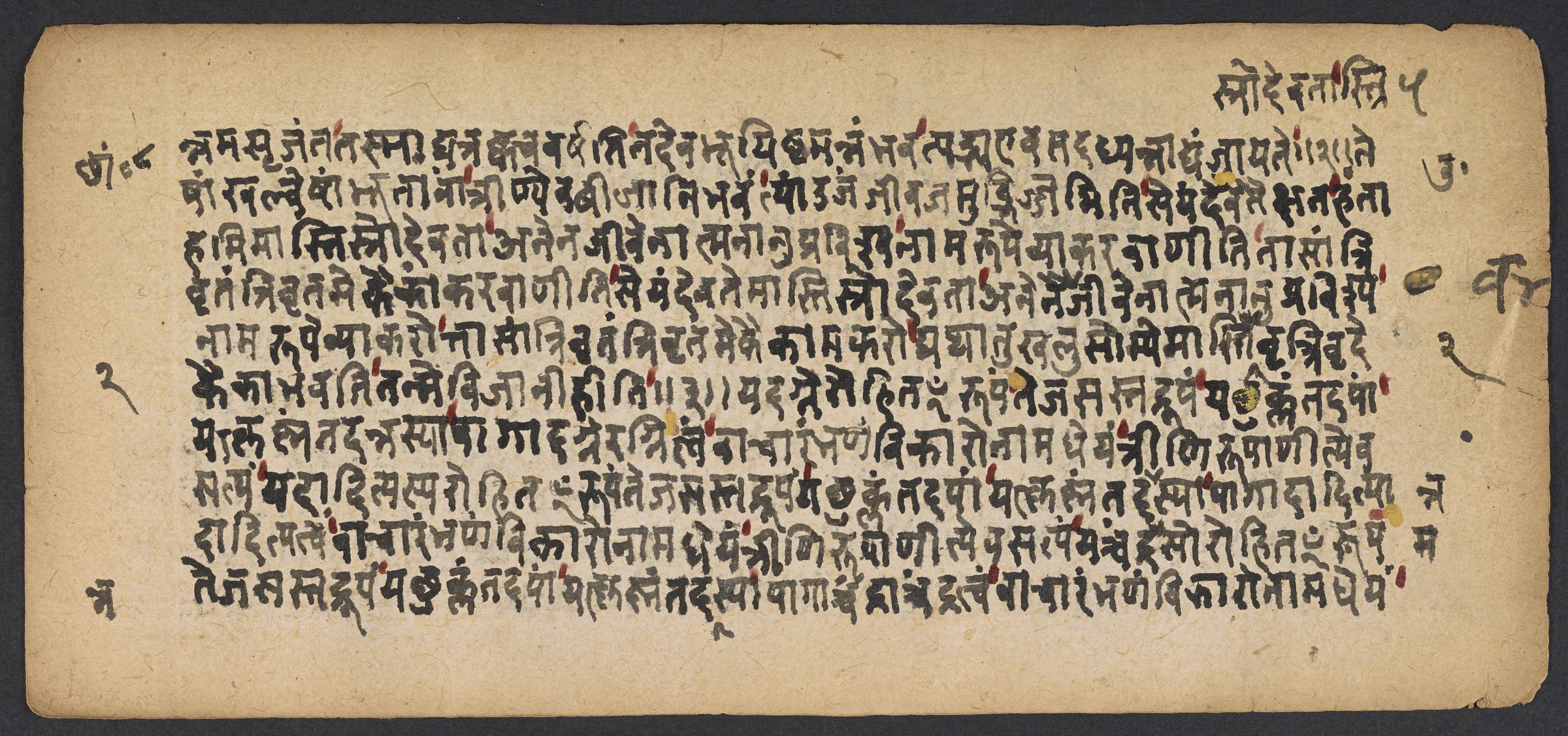
Where on the image
Penn Ms. Coll. 390 Item 1213, fol. 2r, fol. 2v. Paragraph 4 begins at the end of fol. 2r line 9 ‹tā āpa aikṣanta› and ends at fol. 2v line 1 ‹annādyaṃ jāyate›, marked ‹||2||›. Checked on the image; readings logged in data/sources/upanishads/mapping_notes_1213.txt.
4tā āpa aikṣanta bahvayaḥ syāma prajāyemahīti tā annamasṛjanta tasmādyatra
kva ca varṣati tadeva bhūyiṣṭhamannaṃ bhavatyadbhya eva tadadhyannādyaṃ jāyate //
4'Water thought, may I be many, may I grow forth. It sent forth earth (food). 'Therefore whenever it rains anywhere, most food is then produced. From water alone is eatable food produced.
Where on the image
Penn Ms. Coll. 390 Item 1213, fol. 2v. fol. 2v lines 1-6: paragraph 1 begins ‹teṣāṃ khalv eṣāṃ bhūtānāṃ›; paragraph 4 ends ‹tan me vijānīhīti›, marked ‹||3||›. Checked on the image; readings logged in data/sources/upanishads/mapping_notes_1213.txt.
1teṣāṃ khalv eṣāṃ bhūtānāṃ trīṇy eva bījāni bhavanty āṇḍajaṃ jīvajam udbhijjam iti ||
2seyaṃ devataikṣata |
hantāham imās tisro devatā anena jīvenātmanānupraviśya nāmarūpe vyākaravāṇīti ||
3tāsāṃ trivṛtaṃ trivṛtam ekaikāṃ karavāṇīti |
seyaṃ devatemās tisro devatā anenaiva jīvenātmanānupraviśya nāmarūpe vyākarot ||
4tāsāṃ trivṛtaṃ trivṛtam ekaikām akarot |
yathā tu khalu somyemās tisro devatās trivṛt trivṛd ekaikā bhavati tan me vijānīhīti ||
1'Of all living things there are indeed three origins only, that which springs from an egg (oviparous), that which springs from a living being (viviparous), and that which springs from a germ.
2'That Being (i.e. that which had produced fire, water, and earth) thought, let me now enter those three beings (fire, water, earth) with this living Self (gîva âtmâ), and let me then reveal (develop) names and forms.
3'Then that Being having said, Let me make each of these three tripartite (so that fire, water, and earth should each have itself for its principal ingredient, besides an admixture of the other two) entered into those three beings (devatâ) with this living self only, and revealed names and forms.
4'He made each of these tripartite; and how these three beings become each of them tripartite, that learn from me now, my friend!
Where on the image
Penn Ms. Coll. 390 Item 1213, fol. 2v. fol. 2v lines 6-9: paragraph 1 begins ‹yad agne rohitaṃ rūpaṃ›; paragraph 2 ends ‹trīṇi rūpāṇīty eva satyaṃ›. Checked on the image; readings logged in data/sources/upanishads/mapping_notes_1213.txt.
1yad agne rohitaṃ rūpaṃ tejasas tad rūpam |
yac chuklaṃ tad apām |
yat kṛṣṇaṃ tad annasya |
apāgād agner agnitvam |
vācārambhaṇaṃ vikāro nāmadheyaṃ trīṇi rūpāṇīty eva satyam ||
2yad ādityasya rohitaṃ rūpaṃ tejasas tad rūpam |
yac chuklaṃ tad apām |
yat kṛṣṇaṃ tad annasya |
apāgād ādityād ādityatvam |
vācārambhaṇaṃ vikāro nāmadheyaṃ trīṇi rūpāṇīty eva satyam ||
1'The red colour of burning fire (agni) is the colour of fire, the white colour of fire is the colour of water, the black colour of fire the colour of earth. Thus vanishes what we call fire, as a mere variety, being a name, arising from speech. What is true (satya) are the three colours (or forms).
2'The red colour of the sun (âditya) is the colour of fire, the white of water, the black of earth. Thus vanishes what we call the sun, as a mere variety, being a name, arising from speech. What is true are the three colours.
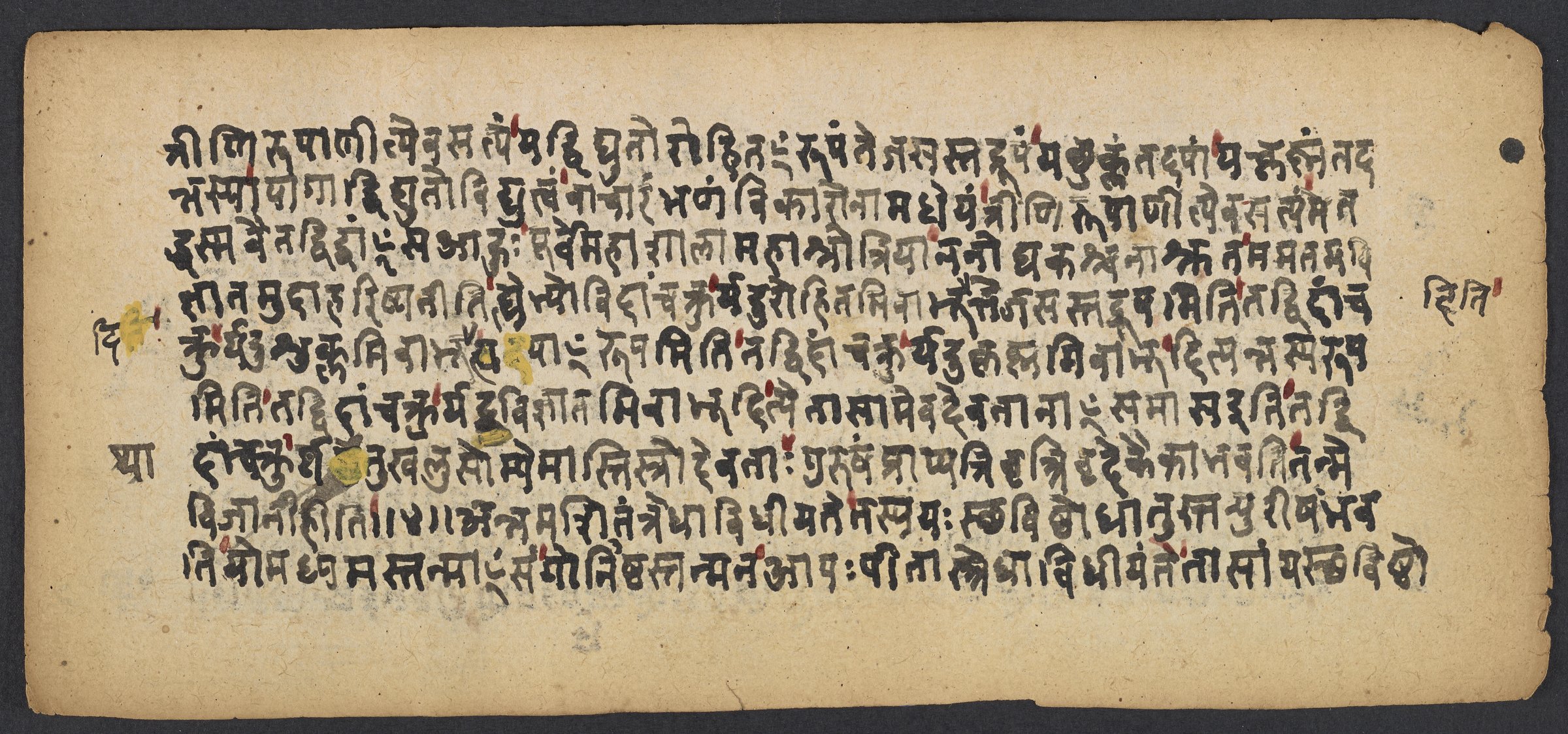
Where on the image
Penn Ms. Coll. 390 Item 1213, fol. 2v, fol. 3r. Paragraph 3 begins at fol. 2v line 9 ‹yac candramaso rohitaṃ rūpaṃ› and ends at fol. 3r line 1 ‹trīṇi rūpāṇīty eva satyaṃ›; paragraphs 4-7 follow to line 8 ‹tan me vijānīhīti›, marked ‹||4||›. Checked on the image; readings logged in data/sources/upanishads/mapping_notes_1213.txt.
3yac candramaso rohitaṃ rūpaṃ tejasas tad rūpam |
yac chuklaṃ tad apām |
yat kṛṣṇaṃ tad annasya |
apāgāc candrāc candratvam |
vācārambhaṇaṃ vikāro nāmadheyaṃ trīṇi rūpāṇīty eva satyam ||
4yad vidyuto rohitaṃ rūpaṃ tejasas tad rūpam |
yac chuklaṃ tad apām |
yat kṛṣṇaṃ tad annasya |
apāgād vidyuto vidyuttvam |
vācārambhaṇaṃ vikāro nāmadheyaṃ trīṇi rūpāṇīty eva satyam ||
5etad dha sma vai tadvidvāṃsa āhuḥ pūrve mahāśālā mahāśrotriyāḥ |
na no 'dya kaścanāśrutam amatam avijñātam udāhariṣyati |
iti hy ebhyo vidāṃ cakruḥ ||
6yad u rohitam ivābhūd iti tejasas tad rūpam iti tad vidāṃ cakruḥ |
yad u śuklam ivābhūd ity apāṃ rūpam iti tad vidāṃ cakruḥ |
yad u kṛṣṇam ivābhūd ity annasya rūpam iti tad vidāṃ cakruḥ ||
7yad v avijñātam ivābhūd ity etāsām eva devatānāṃ samāsa iti tad vidāṃ cakruḥ |
yathā nu khalu somyemās tisro devatāḥ puruṣaṃ prāpya trivṛt trivṛd ekaikā bhavati tan me vijānīhīti ||
3'The red colour of the moon is the colour of fire, the white of water, the black of earth. Thus vanishes what we call the moon, as a mere variety, being a name, arising from speech. What is true are the three colours.
4'The red colour of the lightning is the colour of fire, the white of water, the black of earth. Thus vanishes what we call the lightning, as a mere variety, being a name, arising from speech. What is true are the three colours.
5'Great householders and great theologians of olden times who knew this, have declared the same, saying, "No one can henceforth mention to us anything which we have not heard, perceived, or known." Out of these (three colours or forms) they knew all.
6'Whatever they thought looked red, they knew was the colour of fire. Whatever they thought looked white, they knew was the colour of water. Whatever they thought looked black, they knew was the colour of earth.
7'Whatever they thought was altogether unknown, they knew was some combination of those three beings (devatâ). 'Now learn from me, my friend, how those three beings, when they reach man, become each of them tripartite.'
Where on the image
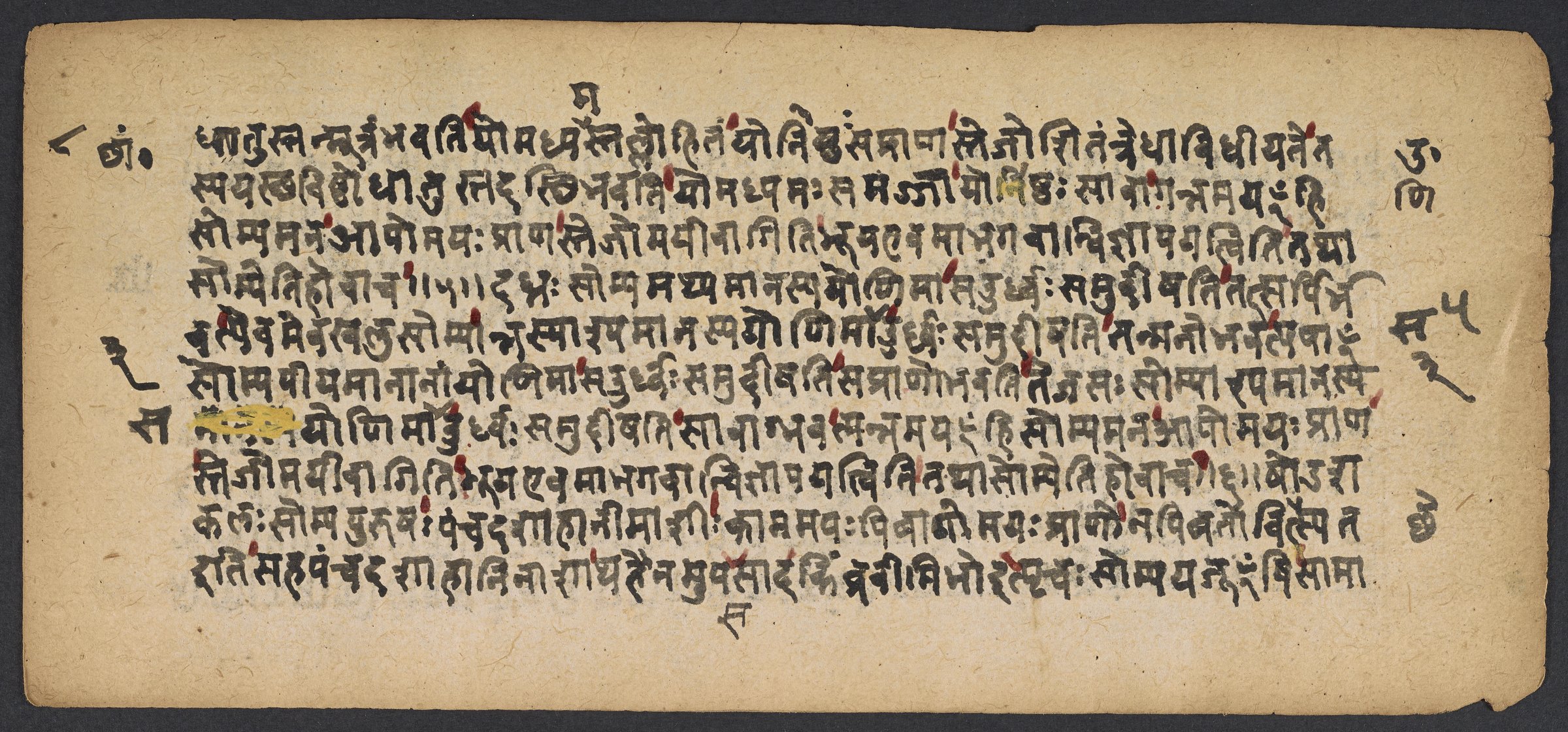
Penn Ms. Coll. 390 Item 1213, fol. 3r. fol. 3r lines 8-9: ‹annam aśitaṃ tredhā vidhīyate› ... ‹yo 'ṇiṣṭhas tan manaḥ›. Checked on the image; readings logged in data/sources/upanishads/mapping_notes_1213.txt.
1annam aśitaṃ tredhā vidhīyate |
tasya yaḥ sthaviṣṭho dhātus tat purīṣaṃ bhavati |
yo madhyamas tan māṃsam |
yo 'ṇiṣṭhas tan manaḥ ||
1'The earth (food) when eaten becomes threefold; its grossest portion becomes feces, its middle portion flesh, its subtilest portion mind.
Where on the image
Penn Ms. Coll. 390 Item 1213, fol. 3r, fol. 3v. Paragraph 2 begins at the end of fol. 3r line 9 ‹āpaḥ pītās tredhā vidhīyante› and ends at fol. 3v line 1 ‹sa prāṇaḥ›; paragraphs 3-4 follow to line 4 ‹tathā somyeti hovāca›, marked ‹||5||›. Checked on the image; readings logged in data/sources/upanishads/mapping_notes_1213.txt.
2āpaḥ pītās tredhā vidhīyante |
tāsāṃ yaḥ sthaviṣṭho dhātus tan mūtraṃ bhavati |
yo madhyamas tal lohitam |
yo 'ṇiṣṭhaḥ sa prāṇaḥ ||
3tejo 'śitaṃ tredhā vidhīyate |
tasya yaḥ sthaviṣṭho dhātus tad asthi bhavati |
yo madhyamaḥ sa majjā |
yo 'ṇiṣṭhaḥ sā vāk ||
4annamayaṃ hi somya manaḥ |
āpomayaḥ prāṇaḥ |
tejomayī vāg iti |
bhūya eva mā bhagavān vijñāpayatv iti |
tathā somyeti hovāca ||
2'Water when drunk becomes threefold; its grossest portion becomes water, its middle portion blood, its subtilest portion breath.
3'Fire (i.e. in oil, butter, &c.) when eaten becomes threefold; its grossest portion becomes bone, its middle portion marrow, its subtilest portion speech.
4'For truly, my child, mind comes of earth, breath of water, speech of fire.' 'Please, Sir, inform me still more,' said the son. 'Be it so, my child,' the father replied.
Where on the image
Penn Ms. Coll. 390 Item 1213, fol. 3v. fol. 3v lines 4-8: paragraph 1 begins ‹dadhnaḥ somya mathyamānasya›; paragraph 5 ends ‹tathā somyeti hovāca›, marked ‹||6||›. Checked on the image; readings logged in data/sources/upanishads/mapping_notes_1213.txt.
1dadhnaḥ somya mathyamānasya yo 'ṇimā sa ūrdhvaḥ samudīṣati |
tat sarpir bhavati ||
2evam eva khalu somyānnasyāśyamānasya yo 'ṇimā sa ūrdhvaḥ samudīṣati |
tan mano bhavati ||
3apāṃ somya pīyamānānāṃ yo 'ṇimā sa ūrdhvaḥ samudīṣati |
sā prāno bhavati ||
4tejasaḥ somyāśyamānasya yo 'ṇimā sa ūrdhvaḥ samudīṣati |
sā vāg bhavati ||
5annamayaṃ hi somya manaḥ |
āpomayaḥ prāṇaḥ |
tejomayī vāg iti |
bhūya eva mā bhagavān vijñāpayatv iti |
tathā somyeti hovāca ||
1'That which is the subtile portion of curds, when churned, rises upwards, and becomes butter.
2'In the same manner, my child, the subtile portion of earth (food), when eaten, rises upwards, and becomes mind.
3'That which is the subtile portion of water, when drunk, rises upwards, and becomes breath.
4'That which is the subtile portion of fire, when consumed, rises upwards, and becomes speech.
5'For mind, my child, comes of earth, breath of water, speech of fire.' 'Please, Sir, inform me still more,' said the son. 'Be it so, my child,' the father replied.
Where on the image
Penn Ms. Coll. 390 Item 1213, fol. 3v. fol. 3v lines 8-10: ‹ṣoḍaśakalaḥ somya puruṣaḥ› ... ‹na pibato vicchetsyata iti›. Checked on the image; readings logged in data/sources/upanishads/mapping_notes_1213.txt.
1ṣoḍaśakalaḥ somya puruṣaḥ |
pañcadaśāhāni māśīḥ |
kāmam apaḥ piba |
āpomayaḥ prāṇo na pibato vicchetsyata iti ||
1'Man (purusha), my son, consists of sixteen parts. Abstain from food for fifteen days, but drink as much water as you like, for breath comes from water, and will not be cut off, if you drink water.'
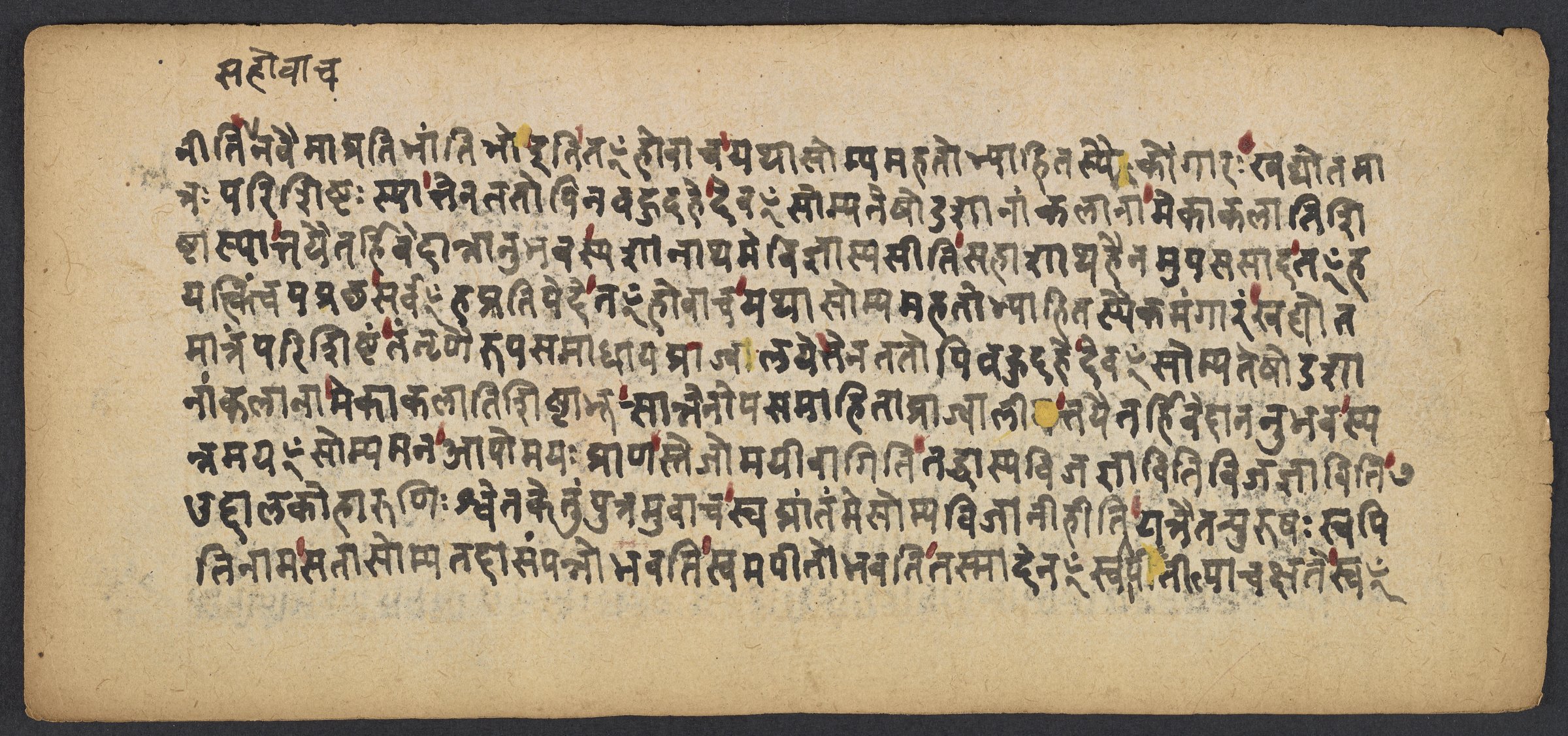
Where on the image
Penn Ms. Coll. 390 Item 1213, fol. 3v, fol. 4r. Paragraph 2 begins at the end of fol. 3v line 10 ‹sa ha pañcadaśāhāni nāśa› and ends at fol. 4r line 1 ‹na vai mā pratibhānti bho iti› (the words 'sa hovāca' are added in the top margin of fol. 4r); paragraphs 3-6 follow to line 7 ‹vijajñāv iti vijajñāv iti›, marked ‹||7||›. Checked on the image; readings logged in data/sources/upanishads/mapping_notes_1213.txt.
2sa ha pañcadaśāhāni nāśa |
atha hainam upasasāda kiṃ bravīmi bho iti |
ṛcaḥ somya yajūṃṣi sāmānīti |
sa hovāca na vai mā pratibhānti bho iti ||
3taṃ hovāca yathā somya mahato 'bhyāhitasyaiko 'ṅgāraḥ khadyotamātraḥ pariśiṣṭaḥ syāt |
tena tato 'pi na bahu dahet |
evaṃ somya te ṣoḍaśānāṃ kalānām ekā kalā atiśiṣṭā syāt |
tayaitarhi vedān nānubhavasi |
aśāna |
atha me vijñāsyasīti ||
4sa hāśa |
atha hainam upasasāda |
taṃ ha yat kiṃ ca papraccha sarvaṃ ha pratipede ||
5taṃ hovāca |
yathā somya mahato 'bhyāhitasyaikam aṅgāraṃ khadyotamātraṃ pariśiṣṭaṃ taṃ tṛnair upasamādhāya prājvalayet tena tato 'pi bahu dahet ||
6evaṃ somya te ṣoḍaśānāṃ kalānām ekā kalātiśiṣṭābhūt |
sānnenopasamāhitā prājvālī |
tayaitarhi vedān anubhavasi |
annamayaṃ hi somya manaḥ |
āpomayaḥ prāṇaḥ |
tejomayī vāg iti |
tad dhāsya vijajñāv iti vijajñāv iti ||
2Svetaketu abstained from food for fifteen days. Then he came to his father and said: 'What shall I say?' The father said: 'Repeat the Rik, Yagus, and Sâman verses.' He replied: 'They do not occur to me, Sir.'
3The father said to him: 'As of a great lighted fire one coal only of the size of a firefly may be left, which would not burn much more than this (i.e. very little), thus, my dear son, one part only of the sixteen parts (of you) is left, and therefore with that one part you do not remember the Vedas. Go and eat!
4'Then wilt thou understand me.' Then Svetaketu ate, and afterwards approached his father. And whatever his father asked him, he knew it all by heart. Then his father said to him:
5'As of a great lighted fire one coal of the size of a firefly, if left, may be made to blaze up again by putting grass upon it, and will thus burn more than this,
6'Thus, my dear son, there was one part of the sixteen parts left to you, and that, lighted up with food, burnt up, and by it you remember now the Vedas.' After that, he understood what his father meant when he said: 'Mind, my son, comes from food, breath from water, speech from fire.' He understood what he said, yea, he understood it.
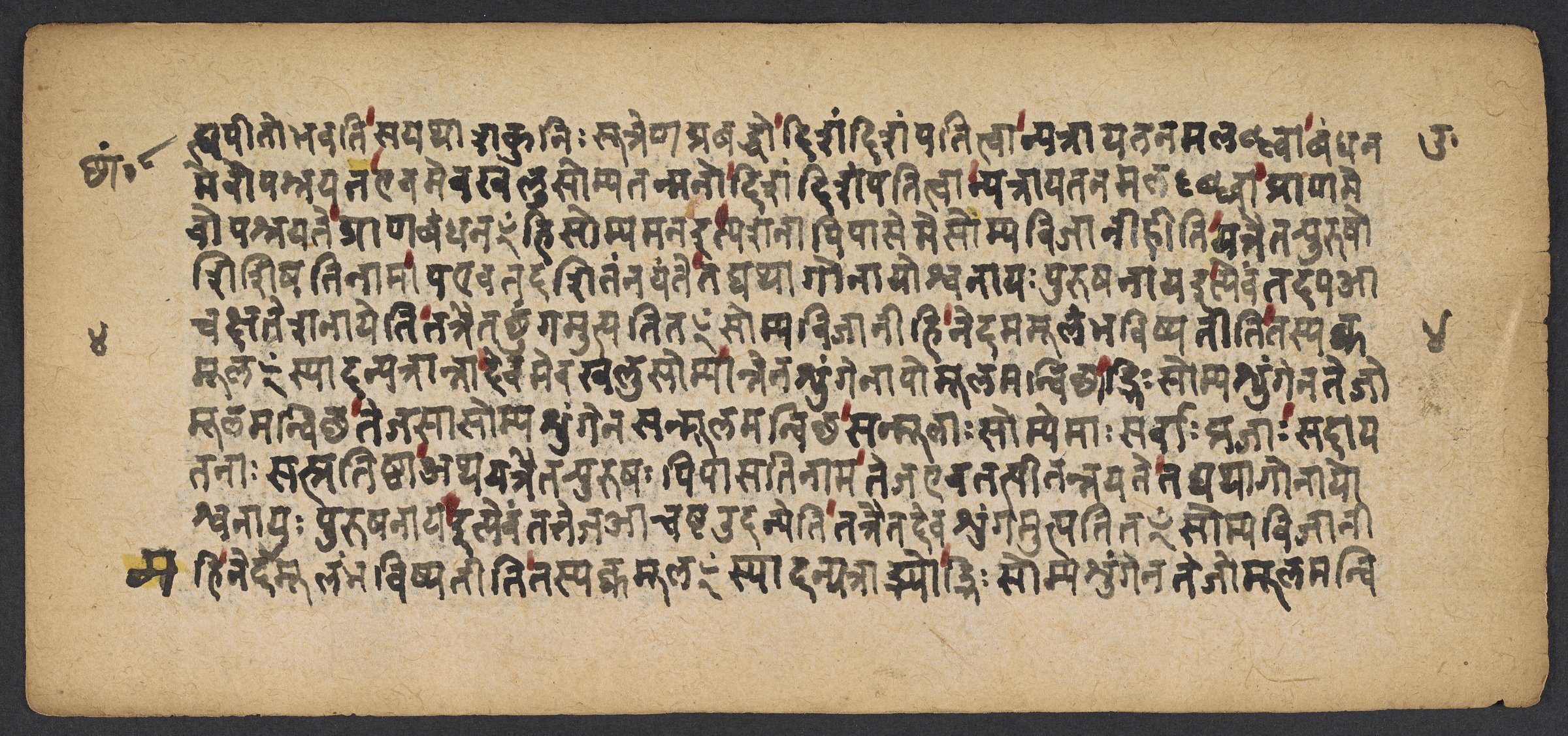
Where on the image
Penn Ms. Coll. 390 Item 1213, fol. 4r, fol. 4v. Paragraph 1 begins at fol. 4r line 8 ‹uddālako hāruṇiḥ śvetaketuṃ putram uvāca› and ends at fol. 4v line 1 ‹apīto bhavati›; paragraphs 2-5 follow to line 10 ‹nedam amūlaṃ bhaviṣyatīti›. Checked on the image; readings logged in data/sources/upanishads/mapping_notes_1213.txt.
1uddālako hāruṇiḥ śvetaketuṃ putram uvāca svapnāntaṃ me somya vijānīhīti |
yatraitat puruṣaḥ svapiti nāma satā somya tadā saṃpanno bhavati |
svam apīto bhavati |
tasmād enaṃ svapitīty ācakṣate |
svaṃ hy apīto bhavati ||
2sa yathā śakuniḥ sūtreṇa prabaddho diśaṃ diśaṃ patitvānyatrāyatanam alabdhvā bandhanam evopaśrayate |
evam eva khalu somya tan mano diśaṃ diśaṃ patitvānyatrāyatanam alabdhvā prāṇam evopaśrayate |
prāṇabandhanaṃ hi somya mana iti ||
3aśanāpipāse me somya vijānīhīti |
yatraitat puruṣo 'śiśiṣati nāmāpa eva tad aśitaṃ nayante |
tad yathā gonāyo 'śvanāyaḥ puruṣanāya ity evaṃ tad apa ācakṣate 'śanāyeti |
tatraitac chuṅgam utpatitaṃ somya vijānīhi |
nedam amūlaṃ bhaviṣyatīti ||
4tasya kva mūlaṃ syād anyatrānnāt |
evam eva khalu somyānnena śuṅgenāpo mūlam anviccha |
adbhiḥ somya śuṅgena tejo mūlam anviccha |
tejasā somya śuṅgena sanmūlam anviccha |
sanmūlāḥ somyemāḥ sarvāḥ prajāḥ sadāyatanāḥ satpratiṣṭhāḥ ||
5atha yatraitat puruṣaḥ pipāsati nāma teja eva tat pītaṃ nayate |
tad yathā gonāyo 'śvanāyaḥ puruṣanāya ity evaṃ tat teja ācaṣṭa udanyeti |
tatraitad eva śuṅgam utpatitaṃ somya vijānīhi |
nedam amūlaṃ bhaviṣyatīti ||
1Uddâlaka Âruni said to his son Svetaketu: 'Learn from me the true nature of sleep (svapna). When a man sleeps here, then, my dear son, he becomes united with the True, he is gone to his own (Self). Therefore they say, svapiti, he sleeps, because he is gone (apîta) to his own (sva).
2'As a bird when tied by a string flies first in every direction, and finding no rest anywhere, settles down at last on the very place where it is fastened, exactly in the same manner, my son, that mind (the gîva, or living Self in the mind, see VI, 3, 2), after flying in every direction, and finding no rest anywhere, settles down on breath; for indeed, my son, mind is fastened to breath.
3'Learn from me, my son, what are hunger and thirst. When a man is thus said to be hungry, water is carrying away (digests) what has been eaten by him. Therefore as they speak of a cow-leader (go-nâya), a horse-leader (asva-nâya), a man-leader (purusha-nâya), so they call water (which digests food and causes hunger) food-leader (asa-nâya). Thus (by food digested &c), my son, know this offshoot (the body) to be brought forth, for this (body) could not be without a root (cause).
4And where could its root be except in food (earth)? And in the same manner, my son, as food (earth) too is an offshoot, seek after its root, viz. water. And as water too is an offshoot, seek after its root, viz. fire. And as fire too is an offshoot, seek after its root, viz. the True. Yes, all these creatures, my son, have their root in the True, they dwell in the True, they rest in the True.
5'When a man is thus said to be thirsty, fire carries away what has been drunk by him. Therefore as they speak of a cow-leader (go-nâya), of a horse-leader (asva-nâya), of a man-leader (purusha-nâya), so they call fire udanyâ, thirst, i.e. water-leader. Thus (by water digested &c), my son, know this offshoot (the body) to be brought forth: this (body) could not be without a root (cause).
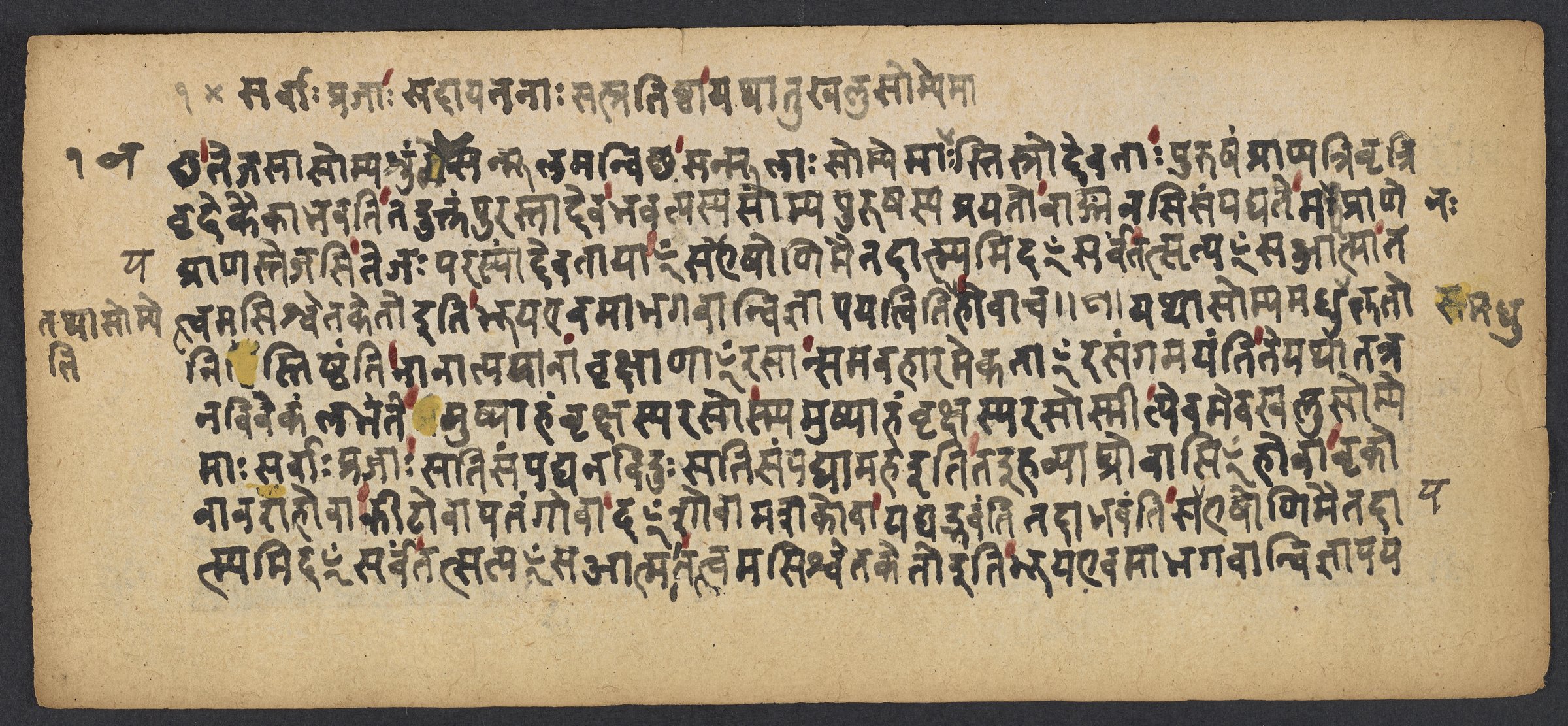
Where on the image
Penn Ms. Coll. 390 Item 1213, fol. 4v, fol. 5r. Paragraph 6 begins at the end of fol. 4v line 10 ‹tasya kva mūlaṃ syād anyatrādbhyaḥ› and ends at fol. 5r line 3 ‹parasyāṃ devatāyāṃ› (words left out in fol. 5r line 1 are supplied in the top margin); paragraph 7 follows to line 4, marked ‹||8||›. Checked on the image; readings logged in data/sources/upanishads/mapping_notes_1213.txt.
6tasya kva mūlaṃ syād anyatrādbhyaḥ |
adbhiḥ somya śuṅgena tejo mūlam anviccha |
tejasā somya śuṅgena sanmūlam anviccha |
sanmūlāḥ somyemāḥ sarvāḥ prajāḥ sad āyatanāḥ satpratiṣṭhāḥ |
yathā nu khalu somyemās tisro devatāḥ puruṣaṃ prāpya trivṛt trivṛd ekaikā bhavati tad uktaṃ purastād eva bhavati |
asya somya puruṣasya prayato vāṅ manasi saṃpadyate manaḥ prāṇe prāṇas tejasi tejaḥ parasyāṃ devatāyām ||
7sa ya eṣo 'ṇimaitad ātmyam idaṃ sarvam |
tat satyam |
sa ātmā |
tat tvam asi śvetaketo iti |
bhūya eva mā bhagavān vijñāpayatv iti |
tathā somyeti hovāca ||
6'And where could its root be except in water? As water is an offshoot, seek after its root, viz. fire. As fire is an offshoot, seek after its root, viz. the True. Yes, all these creatures, O son, have their root in the True, they dwell in the True, they rest in the True. 'And how these three beings (devatâ), fire, water, earth, O son, when they reach man, become each of them tripartite, has been said before (VI, 4, 7). When a man departs from hence, his speech is merged in his mind, his mind in his breath, his breath in heat (fire), heat in the Highest Being.
7'Now that which is that subtile essence (the root of all), in it all that exists has its self. It is the True. It is the Self, and thou, O Svetaketu, art it.' 'Please, Sir, inform me still more,' said the son. 'Be it so, my child,' the father replied.
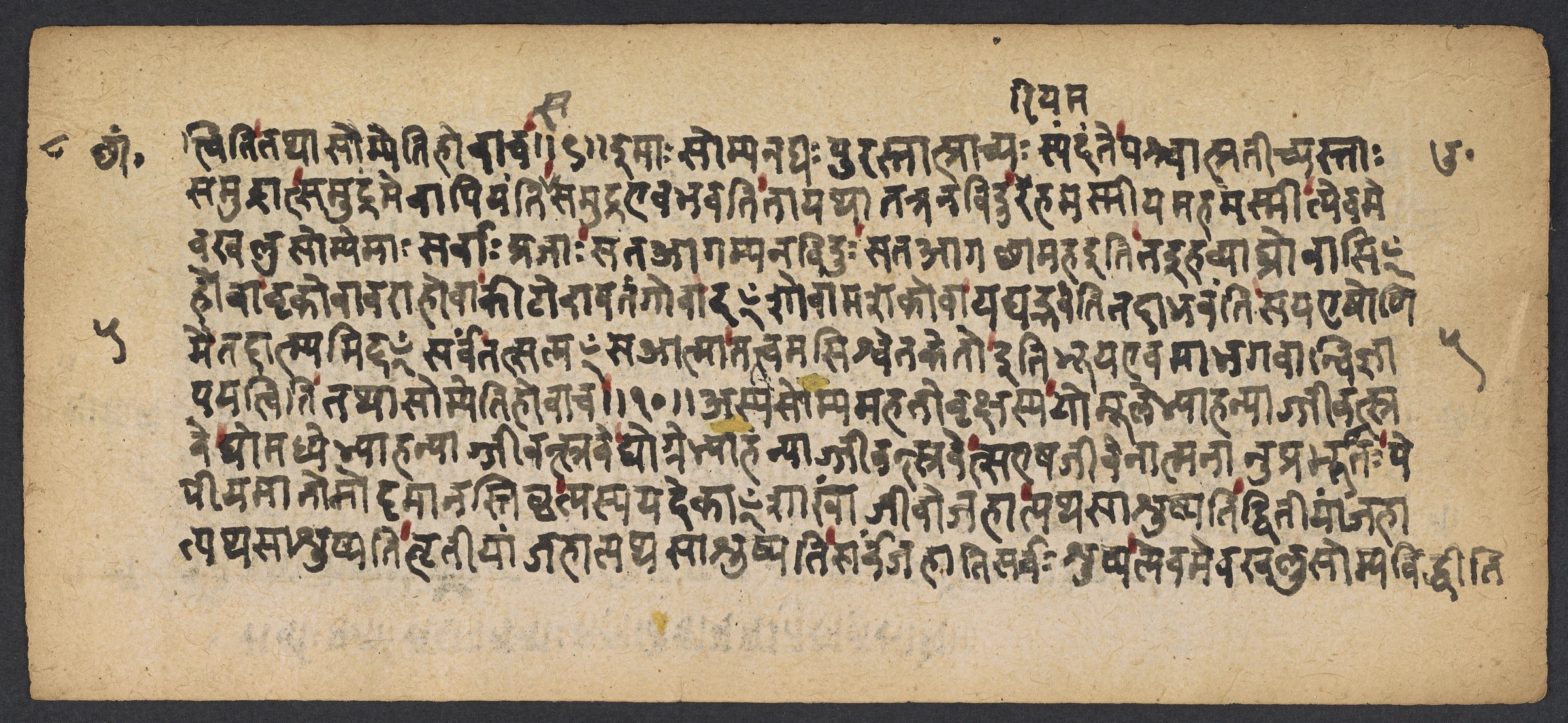
Where on the image
Penn Ms. Coll. 390 Item 1213, fol. 5r. fol. 5r lines 4-8: paragraph 1 begins ‹yathā somya madhu madhukṛtaḥ›; paragraph 3 ends ‹yad yad bhavanti tad ābhavanti›. Checked on the image; readings logged in data/sources/upanishads/mapping_notes_1213.txt.
1yathā somya madhu madhukṛto nistiṣṭhanti nānātyayānāṃ vṛkṣāṇāṃ rasān samavahāram ekatāṃ rasaṃ gamayanti ||
2te yathā tatra na vivekaṃ labhante 'muṣyāhaṃ vṛkṣasya raso 'smy amuṣyāhaṃ vṛkṣasya raso 'smīti |
evam eva khalu somyemāḥ sarvāḥ prajāḥ sati saṃpadya na viduḥ sati saṃpadyāmaha iti ||
3ta iha vyaghro vā siṃho vā vṛko vā varāho vā kīṭo vā pataṅgo vā daṃśo vā maśako vā yad yad bhavanti tad ābhavanti ||
1'As the bees, my son, make honey by collecting the juices of distant trees, and reduce the juice into one form,
2'And as these juices have no discrimination, so that they might say, I am the juice of this tree or that, in the same manner, my son, all these creatures, when they have become merged in the True (either in deep sleep or in death), know not that they are merged in the True.
3'Whatever these creatures are here, whether a lion, or a wolf, or a boar, or a worm, or a midge, or a gnat, or a musquito, that they become again and again.
Where on the image
Penn Ms. Coll. 390 Item 1213, fol. 5r, fol. 5v. Paragraph 4 begins at fol. 5r line 8 ‹sa ya eṣo 'ṇimaitadātmyam› and ends at fol. 5v line 1 ‹tathā somyeti hovāca›, marked ‹||9||›. Checked on the image; readings logged in data/sources/upanishads/mapping_notes_1213.txt.
4sa ya eṣo 'ṇimaitad ātmyam idaṃ sarvam |
tat satyam |
sa ātmā |
tat tvam asi śvetaketo iti |
bhūya eva mā bhagavān vijñāpayatv iti |
tathā somyeti hovāca ||
4'Now that which is that subtile essence, in it all that exists has its self. It is the True. It is the Self, and thou, O Svetaketu, art it.' 'Please, Sir, inform me still more,' said the son. 'Be it so, my child,' the father replied.
Where on the image
Penn Ms. Coll. 390 Item 1213, fol. 5v. fol. 5v lines 1-6: paragraph 1 begins ‹imāḥ somya nadyaḥ›; paragraph 3 ends ‹tathā somyeti hovāca›, marked ‹||10||›. Checked on the image; readings logged in data/sources/upanishads/mapping_notes_1213.txt.
1imāḥ somya nadyaḥ purastāt prācyaḥ syandante paścāt pratīcyaḥ |
tāḥ samudrāt samudram evāpiyanti |
sa samudra eva bhavati |
tā yathā tatra na vidur iyam aham asmīyam aham asmīti ||
2evam eva khalu somyemāḥ sarvāḥ prajāḥ sata āgamya na viduḥ sata āgacchāmaha iti |
ta iha vyāghro vā siṃho vā vṛko vā varāho vā kīṭo vā pataṅgo vā daṃśo vā maśako vā yad yad bhavanti tad ābhavanti ||
3sa ya eṣo 'ṇimaitad ātmyam idaṃ sarvam |
tat satyam |
sa ātmā |
tat tvam asi śvetaketo iti |
bhūya eva mā bhagavān vijñāpayatv iti |
tathā somyeti hovāca ||
1'These rivers, my son, run, the eastern (like the Gangâ) toward the east, the western (like the Sindhu) toward the west. They go from sea to sea (i.e. the clouds lift up the water from the sea to the sky, and send it back as rain to the sea). They become indeed sea. And as those rivers, when they are in the sea, do not know, I am this or that river,
2'In the same manner, my son, all these creatures, when they have come back from the True, know not that they have come back from the True. Whatever these creatures are here, whether a lion, or a wolf, or a boar, or a worm, or a midge, or a gnat, or a musquito, that they become again and again.
3'That which is that subtile essence, in it all that exists has its self. It is the True. It is the Self, and thou, O Svetaketu, art it.' 'Please, Sir, inform me still more,' said the son. 'Be it so, my child,' the father replied.
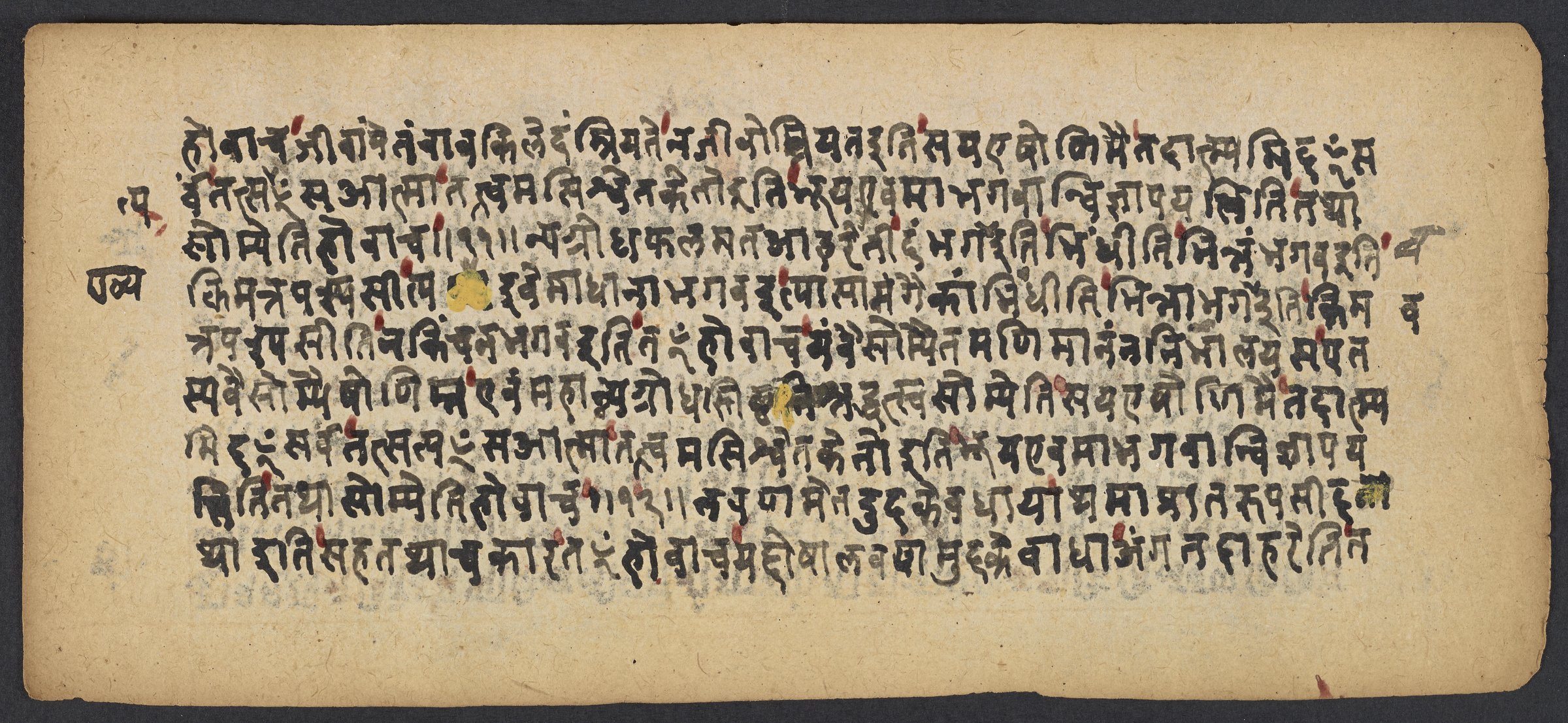
Where on the image
Penn Ms. Coll. 390 Item 1213, fol. 5v. fol. 5v lines 6-9: paragraph 1 begins ‹asya somya mahato vṛkṣasya›; paragraph 2 ends ‹sarvaḥ śuṣyati›. Müller ends his paragraph 2 with 'In exactly the same manner, my son, know this. Thus he spoke', which renders the opening words of Sanskrit paragraph 3 (‹evam eva khalu somya viddhīti hovāca›, line 9). Checked on the image; readings logged in data/sources/upanishads/mapping_notes_1213.txt.
1asya somya mahato vṛkṣasya yo mūle 'bhyāhanyāj jīvan sraved yo madhye 'bhyāhanyāj jīvan sraved yo 'gre 'bhyāhanyāj jīvan sravet |
sa eṣa jīvenātmanānuprabhūtaḥ pepīyamāno modamānas tiṣṭhati ||
2asya yad ekāṃ śākhāṃ jīvo jahāty atha sā śuṣyati |
dvitīyāṃ jahāty atha sā śuṣyati |
tṛtīyāṃ jahāty atha sā śuṣyati |
sarvaṃ jahāti sarvaḥ śuṣyati ||
1"If some one were to strike at the root of this large tree here, it would bleed, but live. If he were to strike at its stem, it would bleed, but live. If he were to strike at its top, it would bleed, but live. Pervaded by the living Self that tree stands firm, drinking in its nourishment and rejoicing;
2'But if the life (the living Self) leaves one of its branches, that branch withers; if it leaves a second, that branch withers; if it leaves a third, that branch withers. If it leaves the whole tree, the whole tree withers. In exactly the same manner, my son, know this.' Thus he spoke:
Where on the image
Penn Ms. Coll. 390 Item 1213, fol. 5v, fol. 6r. Paragraph 3 begins at the end of fol. 5v line 9 ‹evam eva khalu somya viddhīti› and ends at fol. 6r line 3 ‹tathā somyeti hovāca›, marked ‹||11||›. Checked on the image; readings logged in data/sources/upanishads/mapping_notes_1213.txt.
3evam eva khalu somya viddhīti ha uvāca |
jīvāpetaṃ vāva kiledaṃ mriyate na jīvo mriyata iti |
sa ya eṣo 'ṇimaitad ātmyam idaṃ sarvam |
tat satyam |
sa ātmā |
tat tvam asi śvetaketo iti |
bhūya eva mā bhagavān vijñāpayatv iti |
tathā somyeti hovāca ||
3'This (body) indeed withers and dies when the living Self has left it; the living Self dies not. That which is that subtile essence, in it all that exists has its self. It is the True. It is the Self, and thou, Svetaketu, art it.' 'Please, Sir, inform me still more,' said the son. 'Be it so, my child,' the father replied.
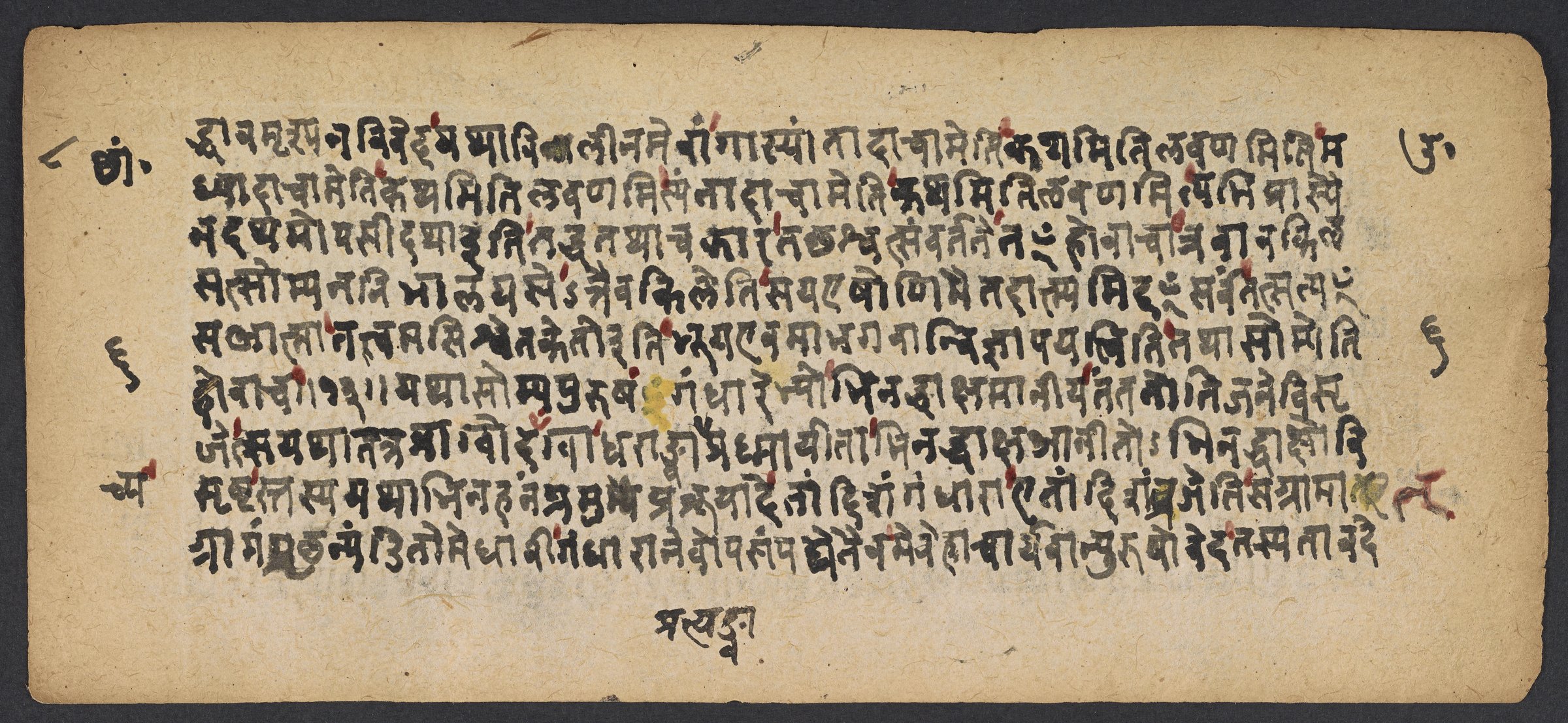
Where on the image
Penn Ms. Coll. 390 Item 1213, fol. 6r. fol. 6r lines 3-8: paragraph 1 begins ‹nyagrodhaphalam ata āhareti›; paragraph 3 ends ‹tathā somyeti hovāca›, marked ‹||12||›. Checked on the image; readings logged in data/sources/upanishads/mapping_notes_1213.txt.
1nyagrodhaphalam ata āhareti |
idaṃ bhagava iti |
bhinddhīti |
bhinnaṃ bhagava iti |
kim atra paśyasīti |
aṇvya ivemā dhānā bhagava iti |
āsām aṅgaikāṃ bhinddhīti |
bhinnā bhagava iti |
kim atra paśyasīti |
na kiṃcana bhagava iti ||
2taṃ hovāca yaṃ vai somyaitam aṇimānaṃ na nibhālayasa etasya vai somyaiṣo 'ṇimna evaṃ mahānyagrodhas tiṣṭhati |
śraddhatsva somyeti ||
3sa ya eṣo 'ṇimaitad ātmyam idaṃ sarvam |
tat satyam |
sa ātmā |
tat tvam asi śvetaketo iti |
bhūya eva mā bhagavān vijñāpayatv iti |
tathā somyeti hovāca ||
1'Fetch me from thence a fruit of the Nyagrodha tree.' 'Here is one, Sir.' 'Break it.' 'It is broken, Sir.' 'What do you see there?' 'These seeds, almost infinitesimal.' 'Break one of them.' 'It is broken, Sir.' 'What do you see there?' 'Not anything, Sir.'
2The father said: 'My son, that subtile essence which you do not perceive there, of that very essence this great Nyagrodha tree exists.
3'Believe it, my son. That which is the subtile essence, in it all that exists has its self. It is the True. It is the Self, and thou, O Svetaketu, art it.' 'Please, Sir, inform me still more,' said the son. 'Be it so, my child,' the father replied.
Where on the image
Penn Ms. Coll. 390 Item 1213, fol. 6r, fol. 6v. Paragraph 1 begins at fol. 6r line 8 ‹lavaṇam etad udake 'vadhāya› and ends at fol. 6v line 1 ‹na viveda›; paragraphs 2-3 follow to line 6 ‹tathā somyeti hovāca›, marked ‹||13||›. Checked on the image; readings logged in data/sources/upanishads/mapping_notes_1213.txt.
1lavaṇam etad udake 'vadhāyātha mā prātar upasīdathā iti |
sa ha tathā cakāra |
taṃ hovāca |
yad doṣā lavaṇam udake 'vādhā aṅga tad āhareti |
tad dhāvamṛśya na viveda ||
2yathā vilīnam eva |
aṅgāsyāntād ācāmeti |
katham iti |
lavaṇam iti |
madhyād ācāmeti |
katham iti |
lavaṇam iti |
antād ācāmeti |
katham iti |
lavaṇam iti |
abhiprāsyaitad atha mopasīdathā iti |
tad dha tathā cakāra |
tac chaśvat saṃvartate |
taṃ hovācātra vāva kila tat somya na nibhālayase 'traiva kileti ||
3sa ya eṣo 'ṇimaitad ātmyam idaṃ sarvam |
tat satyam |
sa ātmā |
tat tvam asi śvetaketo iti |
bhūya eva mā bhagavān vijñāpayatv iti |
tathā somyeti hovāca ||
1'Place this salt in water, and then wait on me in the morning.' The son did as he was commanded. The father said to him: 'Bring me the salt, which you placed in the water last night.' The son having looked for it, found it not, for, of course, it was melted.
2The father said: 'Taste it from the surface of the water. How is it?' The son replied: 'It is salt.' 'Taste it from the middle. How is it?' The son replied: "It is salt.' 'Taste it from the bottom. How is it?' The son replied: 'It is salt.' The father said: 'Throw it away and then wait on me.' He did so; but salt exists for ever. Then the father said: 'Here also, in this body, forsooth, you do not perceive the True (Sat), my son; but there indeed it is.
3'That which is the subtile essence, in it all that exists has its self. It is the True. It is the Self, and thou, O Svetaketu, art it.' 'Please, Sir, inform me still more,' said the son. 'Be it so, my child,' the father replied.
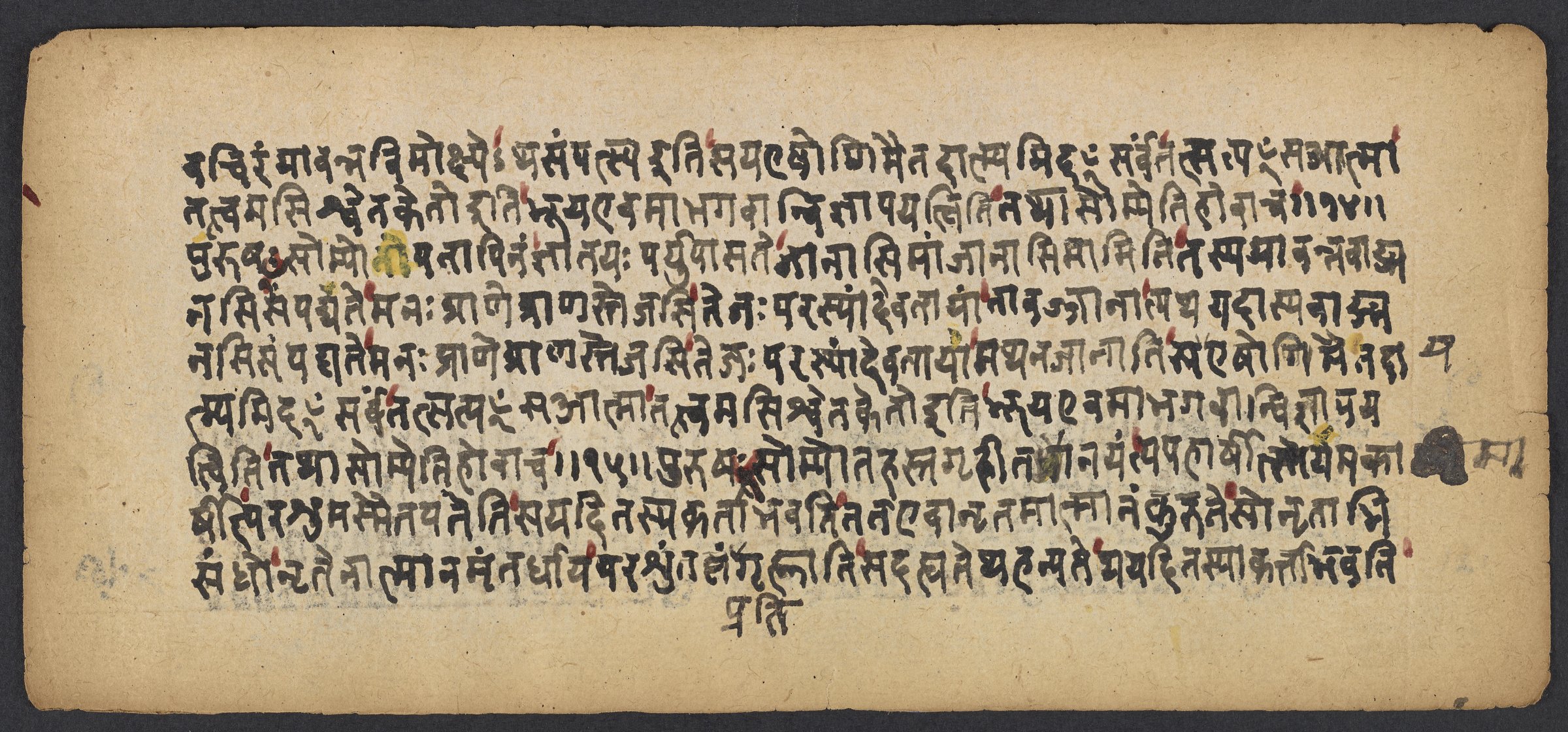
Where on the image
Penn Ms. Coll. 390 Item 1213, fol. 6v. fol. 6v lines 6-8: ‹yathā somya puruṣaṃ gandhārebhyaḥ› ... ‹abhinaddhākṣo visṛṣṭaḥ›. Checked on the image; readings logged in data/sources/upanishads/mapping_notes_1213.txt.
1yathā somya puruṣaṃ gandhārebhyo 'bhinaddhākṣam ānīya taṃ tato 'tijane visṛjet |
sa yathā tatra prāṅ vodaṅ vā adharāṅ vā pratyaṅ vā pradhmāyītābhinaddhākṣa ānīto 'bhinaddhākṣo visṛṣṭaḥ ||
1'As one might lead a person with his eyes covered away from the Gandhâras, and leave him then in a place where there are no human beings; and as that person would turn towards the east, or the north, or the west, and shout, "I have been brought here with my eyes covered, I have been left here with my eyes covered,"
Where on the image
Penn Ms. Coll. 390 Item 1213, fol. 6v, fol. 7r. Paragraph 2 begins at fol. 6v line 8 ‹tasya yathābhinahanaṃ› (the word 'pramucya' is added below the text) and ends at fol. 7r line 1 ‹saṃpatsya iti›; paragraph 3 follows to line 2, marked ‹||14||›. Checked on the image; readings logged in data/sources/upanishads/mapping_notes_1213.txt.
2tasya yathābhinahanaṃ pramucya prabrūyād etāṃ diśaṃ gandhārā etāṃ diśaṃ vrajeti |
sa grāmād grāmaṃ pṛcchan paṇḍito medhāvī gandhārān evopasaṃpadyeta |
evam evehācāryavān puruṣo veda |
tasya tāvad eva ciraṃ yāvan na vimokṣye 'tha saṃpatsya iti ||
3sa ya eṣo 'ṇimaitad ātmyam idaṃ sarvam |
tat satyam |
sa ātmā |
tat tvam asi śvetaketo iti |
bhūya eva mā bhagavān vijñāpayatv iti |
tathā somyeti hovāca ||
2'And as thereupon some one might loose his bandage and say to him, "Go in that direction, it is Gandhâra, go in that direction;" and as thereupon, having been informed and being able to judge for himself, he would by asking his way from village to village arrive at last at Gandhâra,—in exactly the same manner does a man, who meets with a teacher to inform him, obtain the true knowledge. For him there is only delay so long as he is not delivered (from the body); then he will be perfect.
3'That which is the subtile essence, in it all that exists has its self. It is the True. It is the Self, and thou, O Svetaketu, art it.' 'Please, Sir, inform me still more,' said the son. 'Be it so, my child,' the father replied.
Where on the image
Penn Ms. Coll. 390 Item 1213, fol. 7r. fol. 7r lines 3-7: paragraph 1 begins ‹puruṣaṃ somyotopatāpinaṃ›; paragraph 3 ends ‹tathā somyeti hovāca›, marked ‹||15||›. Müller numbers this khanda in two paragraphs; his 2 covers Sanskrit 2 and 3. Checked on the image; readings logged in data/sources/upanishads/mapping_notes_1213.txt.
1puruṣaṃ somyotopatāpinaṃ jñātayaḥ paryupāsate jānāsi māṃ jānāsi mām iti |
tasya yāvan na vāṅ manasi saṃpadyate manaḥ prāṇe prāṇas tejasi tejaḥ parasyāṃ devatāyāṃ tāvaj jānāti ||
2atha yadāsya vāṅ manasi saṃpadyate manaḥ prāṇe prāṇas tejasi tejaḥ parasyāṃ devatāyām atha na jānāti ||
3sa ya eṣo 'ṇimaitad ātmyam idaṃ sarvam |
tat satyam |
sa ātmā |
tat tvam asi śvetaketo iti |
bhūya eva mā bhagavān vijñāpayatv iti |
tathā somyeti hovāca ||
1'If a man is ill, his relatives assemble round him and ask: "Dost thou know me? Dost thou know me?" Now as long as his speech is not merged in his mind, his mind in breath, breath in heat (fire), heat in the Highest Being (devatâ), he knows them.
2-3'But when his speech is merged in his mind, his mind in breath, breath in heat (fire), heat in the Highest Being, then he knows them not. 'That which is the subtile essence, in it all that exists has its self. It is the True. It is the Self, and thou, O Svetaketu, art it.' 'Please, Sir, inform me still more,' said the son. 'Be it so, my child,' the father replied.
Where on the image
Penn Ms. Coll. 390 Item 1213, fol. 7r. fol. 7r lines 7-9: ‹puruṣaṃ somyota hastagṛhītam ānayanti› ... ‹atha hanyate›. Checked on the image; readings logged in data/sources/upanishads/mapping_notes_1213.txt.
1puruṣaṃ somyota hastagṛhītam ānayanti |
apahārṣīt steyam akārṣīt paraśum asmai tapateti |
sa yadi tasya kartā bhavati tata evānṛtam ātmānaṃ kurute |
so 'nṛtābhisaṃdho 'nṛtenātmānam antardhāya paraśuṃ taptaṃ pratigṛhṇāti |
sa dahyate |
atha hanyate ||
1'My child, they bring a man hither whom they have taken by the hand, and they say: "He has taken something, he has committed a theft." (When he denies, they say), "Heat the hatchet for him." If he committed the theft, then he makes himself to be what he is not. Then the false-minded, having covered his true Self by a falsehood, grasps the heated hatchet—he is burnt, and he is killed.
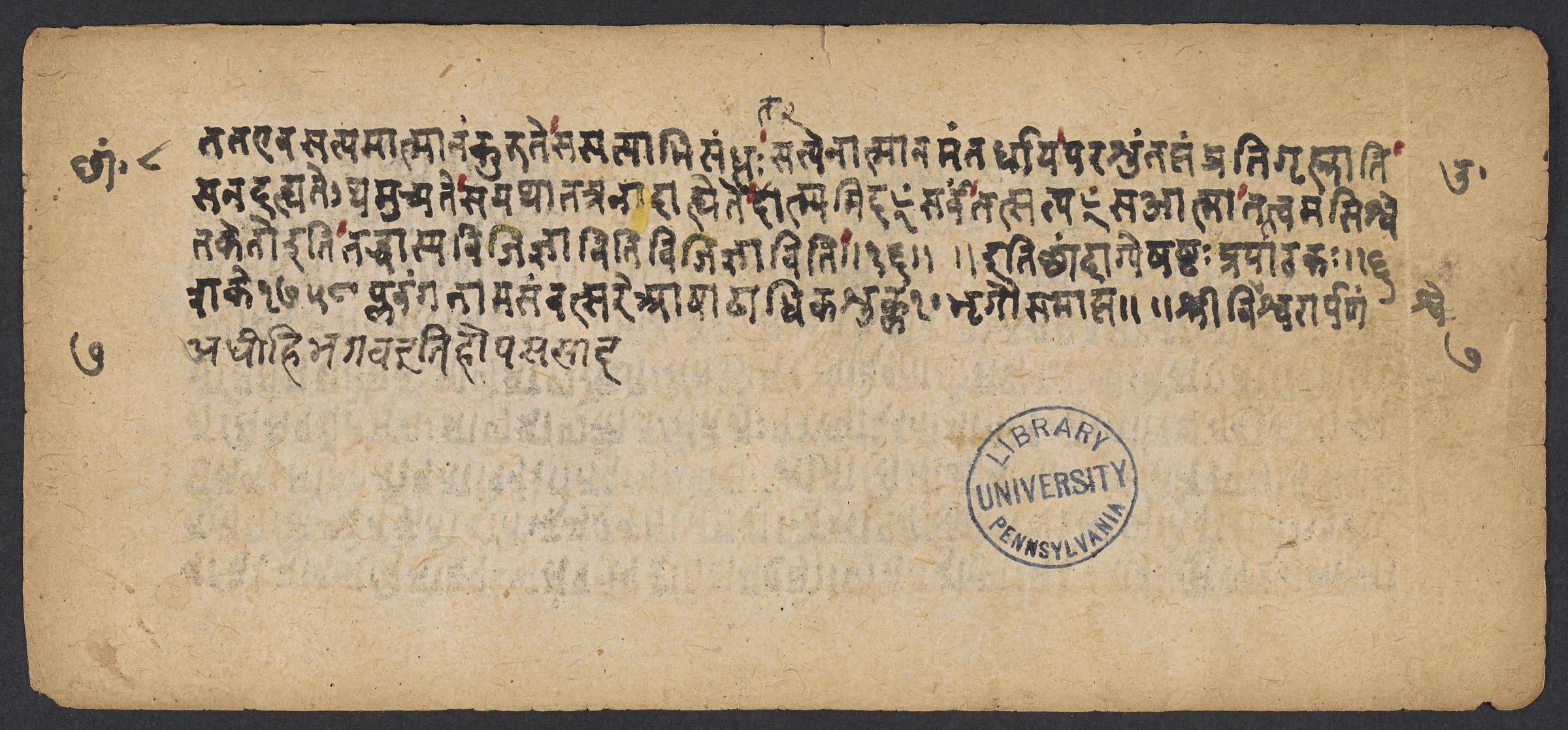
Where on the image
Penn Ms. Coll. 390 Item 1213, fol. 7r, fol. 7v. Paragraph 2 begins at the end of fol. 7r line 9 ‹atha yadi tasyākartā bhavati› and ends at fol. 7v line 2 ‹atha mucyate›; paragraph 3 follows to line 3 ‹vijajñāv iti vijajñāv iti›, marked ‹||16||›, then the colophon ‹iti chāndogye ṣaṣṭhaḥ prapāṭhakaḥ› and a dated colophon (śaka 1758). Müller's paragraph 2 covers Sanskrit 2 and 3. Checked on the image; readings logged in data/sources/upanishads/mapping_notes_1213.txt.
2atha yadi tasyākartā bhavati |
tata eva satyam ātmānaṃ kurute |
sa satyābhisandhaḥ satyenātmānam antardhāya paraśuṃ taptaṃ pratigṛhṇāti |
sa na dahyate |
atha mucyate ||
3sa yathā tatra nādāhyeta |
etad ātmyam idaṃ sarvam |
tat satyam |
sa ātmā |
tat tvam asi śvetaketo iti |
tad dhāsya vijajñāv iti vijajñāv iti ||
2-3'But if he did not commit the theft, then he makes himself to be what he is. Then the true-minded, having covered his true Self by truth, grasps the heated hatchet—he is not burnt, and he is delivered. 'As that (truthful) man is not burnt, thus has all that exists its self in That. It is the True. It is the Self, and thou, O Svetaketu, art it.' He understood what he said, yea, he understood it.
Notes
- Sanskrit: GRETIL, Chandogyopanisad with the commentary ascribed to Samkara, mula text only; input by the Sansknet project. In 6.13.2 a legacy encoding artifact ('an;gāsyāntād') is shown as aṅgāsyāntād. Paragraph 6.2.4 is entered in GRETIL without word division; it is shown as given.
- English: F. Max Müller, 'Khandogya-upanishad, Sixth Prapathaka', The Upanishads part I, Sacred Books of the East 1 (1879), from the proofread English Wikisource transcription; footnotes are not reproduced. One transcription slip is corrected to the printed page (6.11.2 'leaves at second' for 'leaves a second').
- Müller divides khandas 15 and 16 into two paragraphs each; his second paragraph covers Sanskrit paragraphs 2 and 3 and is numbered 2-3 here. Elsewhere his paragraph breaks fall in a few places a clause earlier or later than the Sanskrit numbering (6.7.3-5, 6.11.2-3, 6.12.2-3, 6.13.1-2); each such case lies inside one section except 6.11, explained in its scan note.
Cite
Sources
- Source: Penn Ms. Coll. 390 Item 1213 (OPenn, public domain) + GRETIL Sanskrit + F. Max Müller (1879) English (holding institution)
- Critical edition: GRETIL Sanskrit e-texts (Isa, Katha, Prasna, Mandukya, Aitareya, Taittiriya, Svetasvatara, Chandogya); Nirnaya Sagar edition of 1925, transcribed (Kena, Mundaka)
← previous · → next · v cycle view · l back to library