Katha Upanishad, Adhyaya I, Valli 3
Introduction
The Katha Upanishad belongs to the Black Yajurveda. It tells how the boy Naciketas, given to Death by his father, waits three nights at Death's house and is granted three wishes; the third, to know what happens to a man after death, leads to Death's teaching on the Self. The text has two adhyayas of three vallis each. This entry gives valli 3 of 6 (adhyaya I, valli 3).
The page images come from a single paper manuscript in the University of Pennsylvania Libraries, Ms. Coll. 390 Item 869, catalogued as 'Six early upanisads'. It has 16 leaves (13 x 27 cm) written in Devanagari, 11 to 13 lines to a side, and is undated (the library assigns it to the 18th or 19th century). It contains the Isa, Kena, Katha, Prasna, Mundaka and Mandukya Upanisads in that order; its title page names a set of ten. Leaves are numbered in the right margin of each verso and carry abbreviated titles in the upper left margin.
The Katha runs from fol. 3v to fol. 8v of the manuscript. The scribe closes each valli with a colophon (for example 'iti prathamādhyāye prathamavallī'), which makes the valli boundaries visible on the pages. Each section below holds the verses that end on one page; a verse that begins at the foot of the previous page is shown with both pages.
How was this verified? (Provenance)
Where on the image
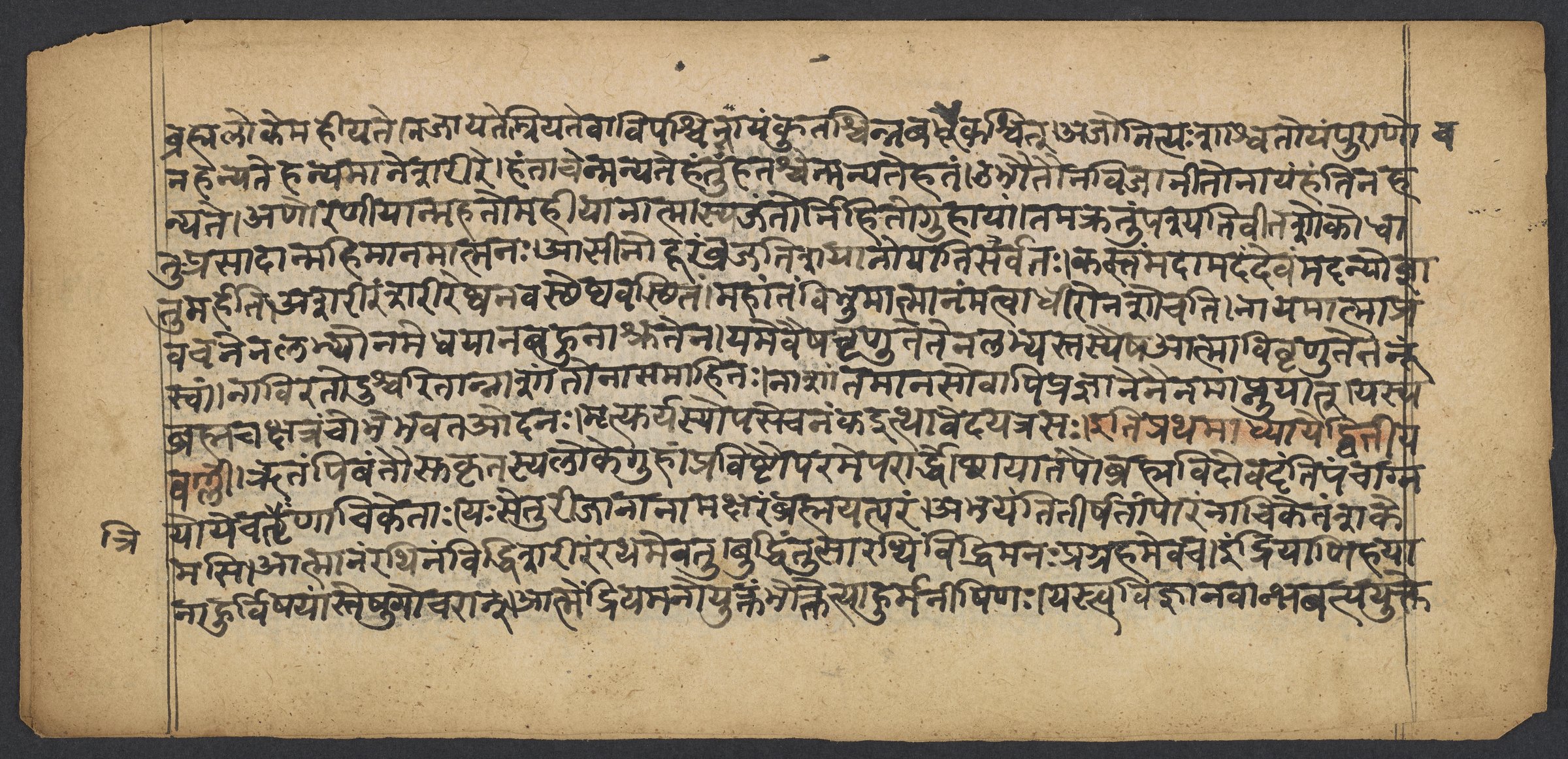
Penn Ms. Coll. 390 Item 869, fol. 6r. fol. 6r line 9: verse 1 begins ‹ṛtaṃ pibantau›; verse 4 ends in line 12 ‹bhoktety āhur manīṣiṇaḥ›. Checked on the image; readings logged in data/sources/upanishads/mapping_notes_869.txt.
1ṛtaṃ pibantau sukṛtasya loke guhāṃ praviṣṭau parame parārdhe /
chāyātapau brahmavido vadanti pañcāgnayo ye ca triṇāciketāḥ //
2yaḥ setur ījānānām akṣaraṃ brahma yat param /
abhayaṃ titīrṣatāṃ pāraṃ nāciketaṃ śakemahi //
3ātmānaṃ rathinaṃ viddhi śarīraṃ ratham eva tu /
buddhiṃ tu sārathiṃ viddhi manaḥ pragraham eva ca //
4indriyāṇi hayān āhur viṣayāṃs teṣu gocarān /
ātmendriyamanoyuktaṃ bhoktety āhur manīṣiṇaḥ //
1"There are the two, drinking their reward in the world of their own works, entered into the cave (of the heart), dwelling on the highest summit (the ether in the heart). Those who know Brahman call them shade and light; likewise, those householders who perform the Trinâkiketa sacrifice.
2May we be able to master that Nâkiketa rite which is a bridge for sacrificers; also that which is the highest, imperishable Brahman for those who wish to cross over to the fearless shore.
3Know the Self to be sitting in the chariot, the body to be the chariot, the intellect (buddhi) the charioteer, and the mind the reins.
4The senses they call the horses, the objects of the senses their roads. When he (the Highest Self) is in union with the body, the senses, and the mind, then wise people call him the Enjoyer.
Where on the image
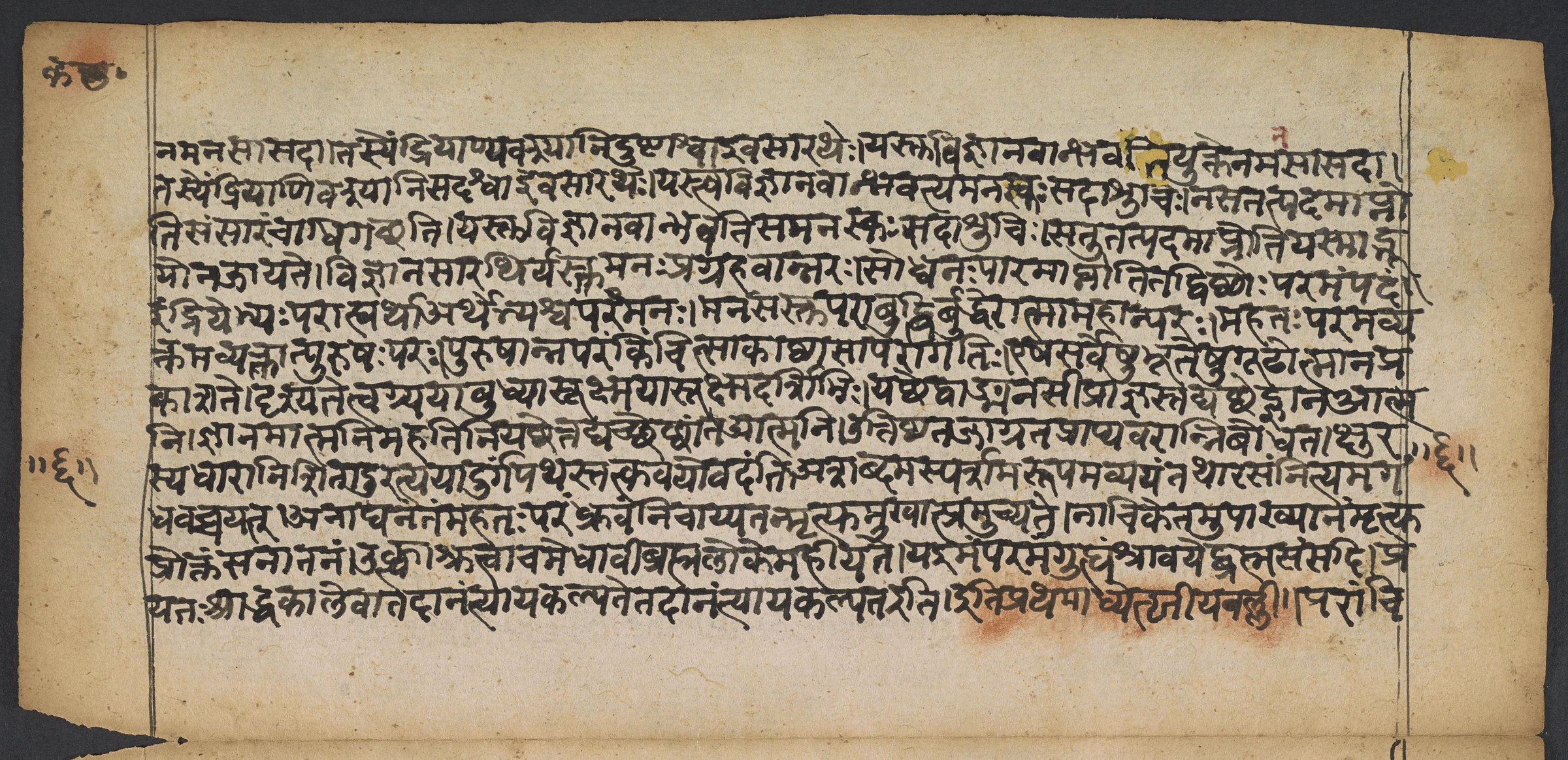
Penn Ms. Coll. 390 Item 869, fol. 6r, fol. 6v. Verse 5 begins at the end of fol. 6r line 12 ‹yas tv avijñānavān bhavaty ayuktena› and ends at fol. 6v line 1 ‹sāratheḥ›; verses 6-17 follow on fol. 6v to line 12 ‹tad ānantyāya kalpata iti›, then the colophon ‹iti prathamādhyāye tṛtīyavallī›. Checked on the image; readings logged in data/sources/upanishads/mapping_notes_869.txt.
5yas tv avijñānavān bhavaty ayuktena manasā sadā /
tasyendriyāṇy avaśyāni duṣṭāśvā iva sāratheḥ //
6yas tu vijñānavān bhavati yuktena manasā sadā /
tasyendriyāṇi vaśyāni sadaśvā iva sāratheḥ //
7yas tv avijñānavān bhavaty amanaskaḥ sadāśuciḥ /
na sa tat padam āpnoti saṃsāraṃ cādhigacchati //
8yas tu vijñānavān bhavati samanaskaḥ sadā śuciḥ /
sa tu tat padam āpnoti yasmād bhūyo na jāyate //
9vijñānasārathir yas tu manaḥ pragrahavān naraḥ /
so 'dhvanaḥ pāram āpnoti tad viṣṇoḥ paramaṃ padam //
10indriyebhyaḥ parā hy arthā arthebhyaś ca paraṃ manaḥ /
manasas tu parā buddhir buddher ātmā mahān paraḥ //
11mahataḥ param avyaktam avyaktāt puruṣaḥ paraḥ /
puruśān na paraṃ kiṃcit sā kāṣṭhā sā parā gatiḥ //
12eṣa sarveṣu bhūteṣu gūḍho 'tmā na prakāśate /
dṛṣyate tv agryayā buddhyā sūkṣmayā sūkṣmadarśibhiḥ //
13yacched vāṅmanasī prājñas tad yacchej jñāna ātmani /
jñānam ātmani mahati niyacchet tad yacchec chānta ātmani //
14uttiṣṭhata jāgrata prāpya varān nibodhata /
kṣurasya dhārā niśitā duratyayā durgaṃ pathas tat kavayo vadanti //
15aśabdam asparśam arūpam avyayaṃ tathārasaṃ nityam agandhavac ca yat /
anādy anantaṃ mahataḥ paraṃ dhruvaṃ nicāyya tan mṛtyumukhāt pramucyate //
16nāciketam upākhyānaṃ mṛtyuproktaṃ sanātanam /
uktvā śrutvā ca medhāvī brahmaloke mahīyate //
17ya imaṃ paramaṃ guhyaṃ śrāvayed brahmasaṃsadi /
prayataḥ śrāddhakāle vā tad ānantyāya kalpate /
tad ānantyāya kalpata iti //
5He who has no understanding and whose mind (the reins) is never firmly held, his senses (horses) are unmanageable, like vicious horses of a charioteer.
6But he who has understanding and whose mind is always firmly held, his senses are under control, like good horses of a charioteer.
7He who has no understanding, who is unmindful and always impure, never reaches that place, but enters into the round of births.
8But he who has understanding, who is mindful and always pure, reaches indeed that place; from whence he is not born again.
9But he who has understanding for his charioteer, and who holds the reins of the mind, he reaches the end of his journey, and that is the highest place of Vishnu.
10Beyond the senses there are the objects, beyond the objects there is the mind, beyond the mind there is the intellect, the Great Self is beyond the intellect.
11Beyond the Great there is the Undeveloped, beyond the Undeveloped there is the Person (purusha). Beyond the Person there is nothing — this is the goal, the highest road.
12That Self is hidden in all beings and does not shine forth, but it is seen by subtle seers through their sharp and subtle intellect.
13A wise man should keep down speech and mind; he should keep them within the Self which is knowledge; he should keep knowledge within the Self which is the Great; and he should keep that (the Great) within the Self which is the Quiet.
14Rise, awake! having obtained your boons, understand them! The sharp edge of a razor is difficult to pass over; thus the wise say the path (to the Self) is hard.
15He who has perceived that which is without sound, without touch, without form, without decay, without taste, eternal, without smell, without beginning, without end, beyond the Great, and unchangeable, is freed from the jaws of death.
16A wise man who has repeated or heard the ancient story of Nakiketas told by Death, is magnified in the world of Brahman.
17And he who repeats this greatest mystery in an assembly of Brâhmans, or full of devotion at the time of the Srâddha sacrifice, obtains thereby infinite rewards."
Notes
- Sanskrit: GRETIL, Kathopanisad, input by the Vienna University student team after P. Olivelle, The Early Upanisads (1998). Verse numbers follow the edition; the manuscript has none.
- English: F. Max Müller, 'Katha-upanishad', The Upanishads part II, Sacred Books of the East 15 (1884), from the proofread English Wikisource transcription. Müller numbers the vallis of the second adhyaya IV-VI; his verse numbers agree with the Sanskrit. Footnotes are not reproduced.
- Four slips in the Wikisource transcription are corrected to the printed page (SBE 15 pp. 4, 11, 13, 23): I.1.13 'fire-sacrificef', I.2.23 'can be can gained', I.3.13 'whichs', II.3.15 'Whean'. The transcription also numbers I.3.15-17 as 18-20; the book has 15-17.
- Müller ends the sixth valli with a 19th paragraph, the closing prayer 'May He protect us both!' (saha nāv avatu). It is not part of the edited Sanskrit text and is not shown; in the manuscript this prayer stands on fol. 8v line 11 as the opening invocation of the Prasna.
Cite
Sources
- Source: Penn Ms. Coll. 390 Item 869 (OPenn, public domain) + GRETIL Sanskrit + F. Max Müller (1884) English (holding institution)
- Critical edition: GRETIL Sanskrit e-texts (Isa, Katha, Prasna, Mandukya, Aitareya, Taittiriya, Svetasvatara, Chandogya); Nirnaya Sagar edition of 1925, transcribed (Kena, Mundaka)
← previous · → next · v cycle view · l back to library