Katha Upanishad, Adhyaya II, Valli 1
Introduction
The Katha Upanishad belongs to the Black Yajurveda. It tells how the boy Naciketas, given to Death by his father, waits three nights at Death's house and is granted three wishes; the third, to know what happens to a man after death, leads to Death's teaching on the Self. The text has two adhyayas of three vallis each. This entry gives valli 4 of 6 (adhyaya II, valli 1).
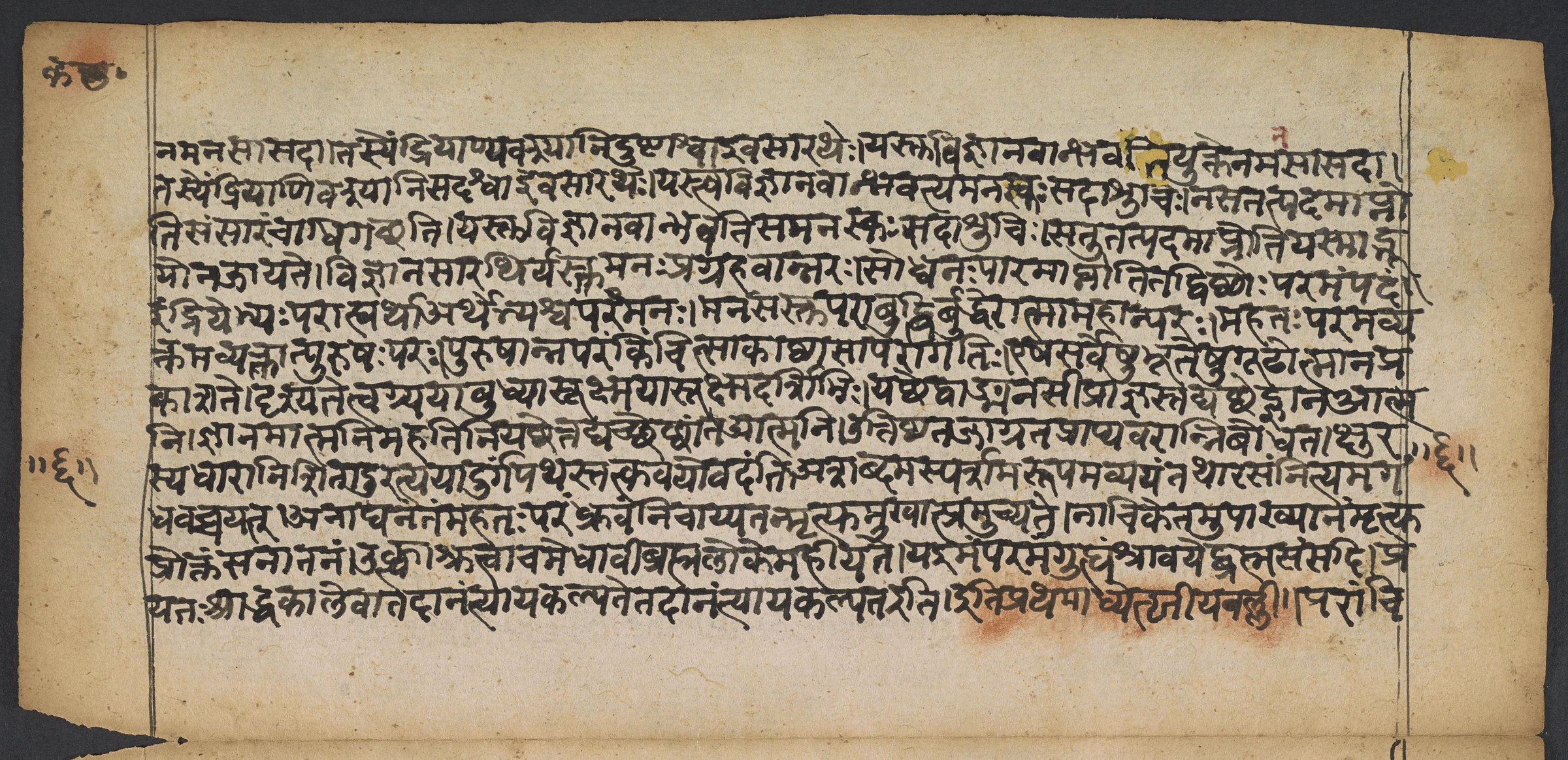
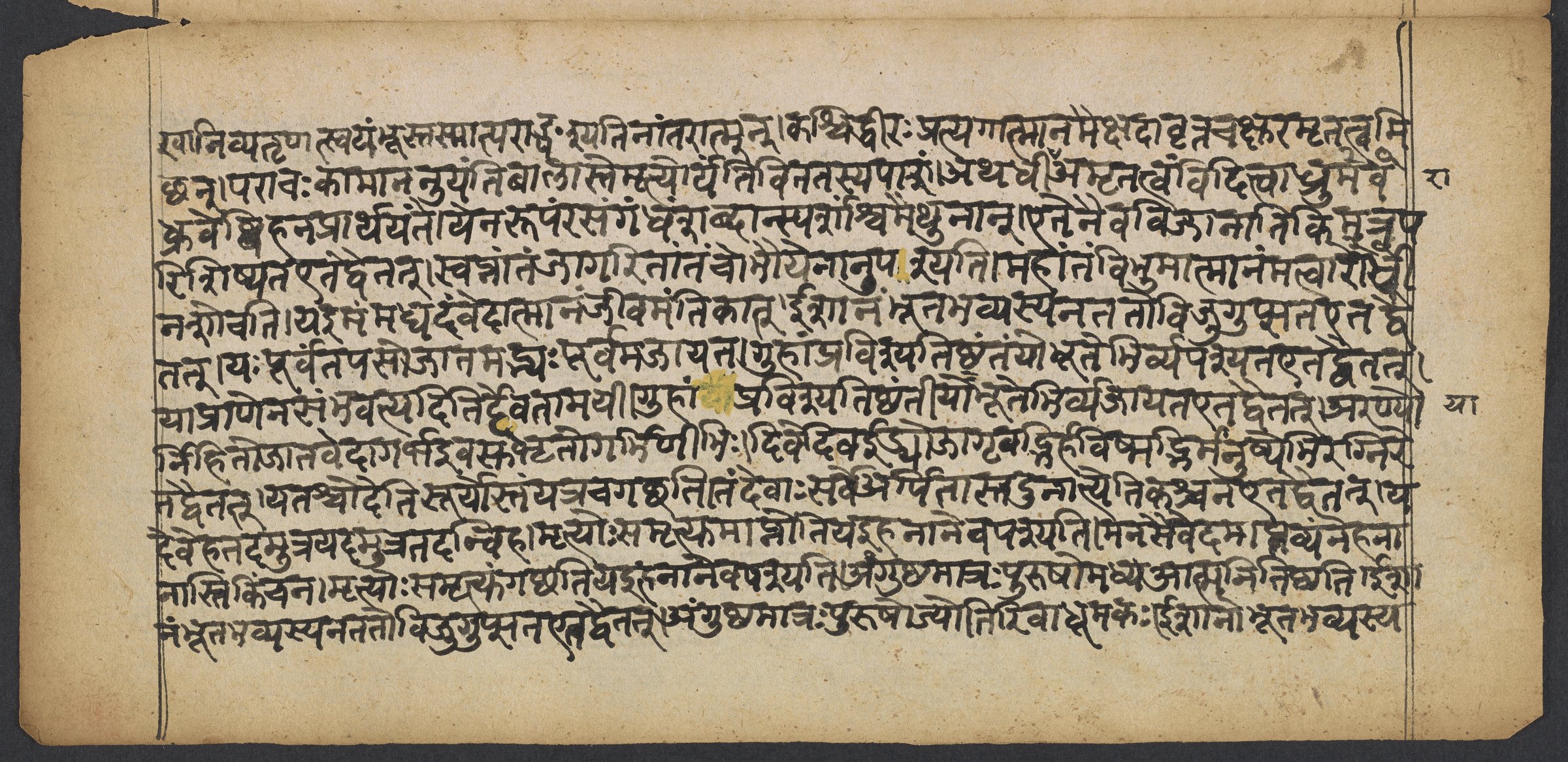
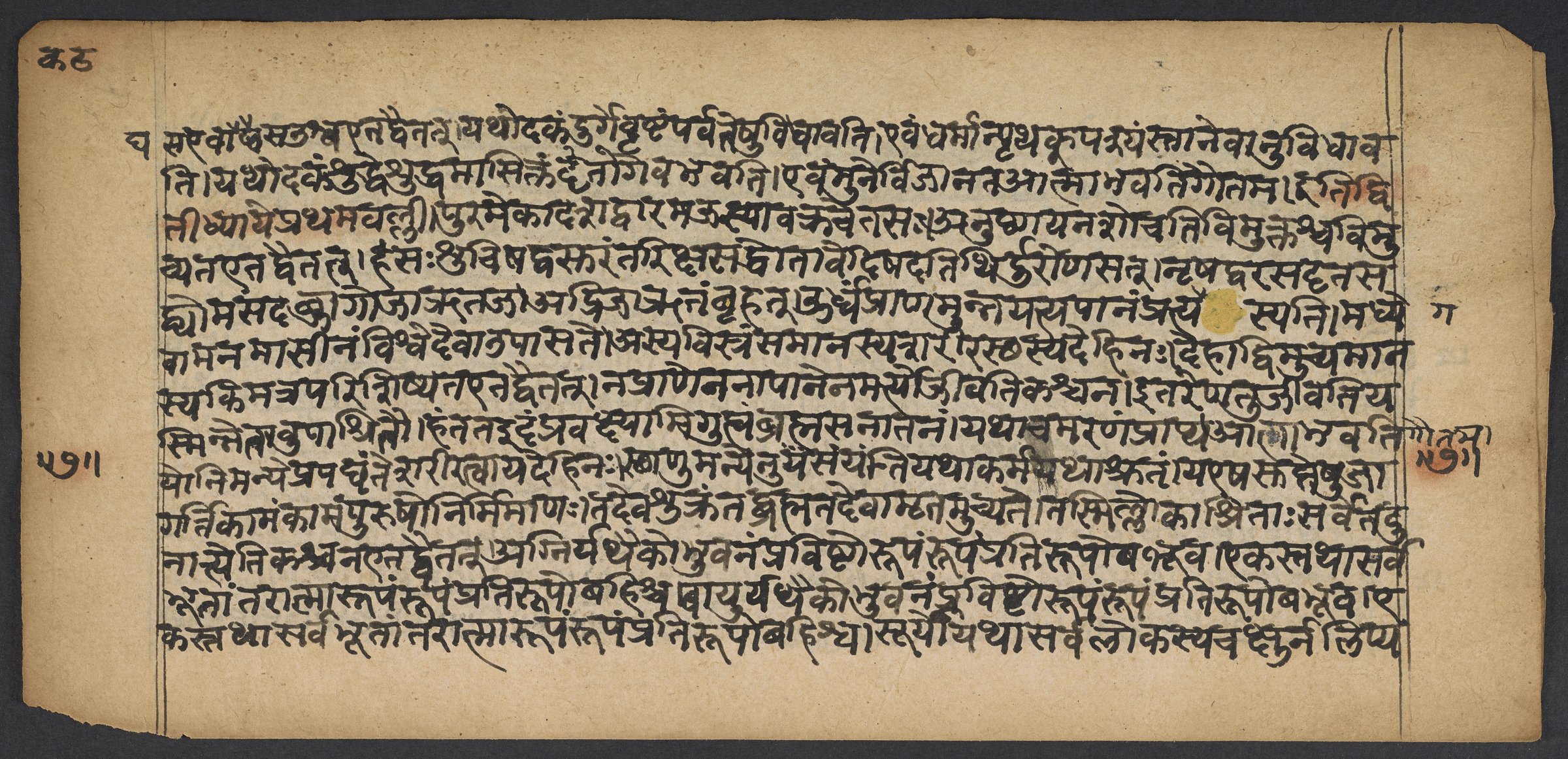
The page images come from a single paper manuscript in the University of Pennsylvania Libraries, Ms. Coll. 390 Item 869, catalogued as 'Six early upanisads'. It has 16 leaves (13 x 27 cm) written in Devanagari, 11 to 13 lines to a side, and is undated (the library assigns it to the 18th or 19th century). It contains the Isa, Kena, Katha, Prasna, Mundaka and Mandukya Upanisads in that order; its title page names a set of ten. Leaves are numbered in the right margin of each verso and carry abbreviated titles in the upper left margin.
The Katha runs from fol. 3v to fol. 8v of the manuscript. The scribe closes each valli with a colophon (for example 'iti prathamādhyāye prathamavallī'), which makes the valli boundaries visible on the pages. Each section below holds the verses that end on one page; a verse that begins at the foot of the previous page is shown with both pages.
How was this verified? (Provenance)
Where on the image
Penn Ms. Coll. 390 Item 869, fol. 6v, fol. 7r. Verse 1 begins at the end of fol. 6v line 12 ‹parāñci› and ends at fol. 7r line 2 ‹amṛtatvam icchan›; verses 2-12 follow on fol. 7r to line 12 ‹etad vai tat›. Checked on the image; readings logged in data/sources/upanishads/mapping_notes_869.txt.
1parāñci khāni vyatṛṇat svayaṃbhūs tasmāt parāṅ paśyati nāntarātman /
kaścid dhīraḥ pratyag ātmānam aikṣad āvṛttacakṣur amṛtatvam icchan //
2parācaḥ kāmān anuyanti bālās te mṛtyor yanti vitatasya pāśam /
atha dhīrā amṛtatvaṃ viditvā dhruvam adhruveṣv iha na prārthayante //
3yena rūpaṃ rasaṃ gandhaṃ śabdān sparśīṃś ca maithunān /
etenaiva vijānāti kim atra pariśiṣyate //
etad vai tat //
4svapnāntaṃ jāgaritāntaṃ cobhau yenānupaśyati /
mahāntaṃ vibhum ātmānaṃ matvā dhīro na śocati //
5ya imaṃ madhvadaṃ veda ātmānaṃ jīvam antikāt /
īśānaṃ bhūtabhavyasya na tato vijugupsate //
etad vai tat //
6yaḥ pūrvaṃ tapaso jātam adbhyaḥ pūrvam ajāyata /
guhāṃ praviśya tiṣṭhantaṃ yo bhūtebhir vyapaśyata //
etad vai tat //
7yā prāṇena saṃbhavati aditir devatāmayī /
guhāṃ praviśya tiṣṭhantīṃ yā bhūtebhir vyajāyata //
etad vai tat //
8araṇyor nihito jātavedā garbha iva subhṛto garbhiṇībhiḥ /
divediva īḍyo jāgṛvadbhir haviṣmadbhir manuṣyebhir agniḥ //
etad vai tat //
9yataś codeti sūryo astaṃ yatra ca gacchati /
taṃ devāḥ sarve arpitās tad u nātyeti kaścana //
etad vai tat //
10yad eveha tad amutra yad amutra tad anv iha /
mṛtyoḥ sa mṛtyum āpnoti ya iha nāneva paśyati //
11manasaivedam āptavyaṃ neha nānāsti kiṃcana /
mṛtyoḥ sa mṛtyuṃ gacchati ya iha nāneva paśyati //
12aṅguṣṭhamātraḥ puruṣo madhya ātmani tiṣṭhati /
īśāno bhūtabhavyasya na tato vijugupsate //
etad vai tat //
1Death said: "The Self-existent pierced the openings (of the senses) so that they turn forward; therefore man looks forward, not backward into himself. Some wise man, however, with his eyes closed and wishing for immortality, saw the Self behind.
2Children follow after outward pleasures, and fall into the snare of wide-spread death. Wise men only, knowing the nature of what is immortal, do not look for anything stable here among things unstable.
3That by which we know form, taste, smell, sounds, and loving touches, by that also we know what exists besides. This is that (which thou hast asked for).
4The wise, when he knows that that by which he perceives all objects in sleep or in waking is the great omnipresent Self, grieves no more.
5He who knows this living soul, which eats honey (perceives objects) as being the Self, always near, the Lord of the past and the future, henceforward fears no more. This is that.
6He who (knows) him who was born first from the brooding heat (for he was born before the water), who, entering into the heart, abides therein, and was perceived from the elements. This is that.
7(He who knows) Aditi also, who is one with all deities, who arises with Prâna (breath or Hiranyagarbha), who, entering into the heart, abides therein, and was born from the elements. This is that.
8There is Agni (fire), the all-seeing, hidden in the two fire-sticks, well-guarded like a child (in the womb) by the mother, day after day to be adored by men when they awake and bring oblations. This is that.
9And that whence the sun rises, and whither it goes to set, there all the Devas are contained, and no one goes beyond. This is that.
10What is here (visible in the world), the same is there (invisible in Brahman); and what is there, the same is here. He who sees any difference here (between Brahman and the world), goes from death to death.
11Even by the mind this (Brahman) is to be obtained, and then there is no difference whatsoever. He goes from death to death who sees any difference here.
12The person (purusha), of the size of a thumb, stands in the middle of the Self (body ?), as lord of the past and the future, and henceforward fears no more. This is that.
Where on the image
Penn Ms. Coll. 390 Item 869, fol. 7r, fol. 7v. Verse 13 begins at the end of fol. 7r line 12 ‹aṅguṣṭhamātraḥ puruṣo jyotir ivādhūmakaḥ› and ends at fol. 7v line 1 ‹sa evādya sa u śvaḥ etad vai tat›; verses 14-15 follow, and the colophon ‹iti dvitīyādhyāye prathamavallī› stands in fol. 7v lines 2-3. Checked on the image; readings logged in data/sources/upanishads/mapping_notes_869.txt.
13aṅguṣṭhamātraḥ puruṣo jyotir iva adhūmakaḥ /
īśāno bhūtabhavyasya sa evādya sa u śvaḥ //
etad vai tat //
14yathodakaṃ durge vṛṣṭaṃ parvateṣu vidhāvati /
evaṃ dharmān pṛthak paśyaṃs tān evānu vidhāvati //
15yathodakaṃ śuddhe śuddham āsiktaṃ tādṛg eva bhavati /
evaṃ muner vijānata ātmā bhavati gautama //
13That person, of the size of a thumb, is like a light without smoke, lord of the past and the future, he is the same to-day and to-morrow. This is that.
14As rain-water that has fallen on a mountain-ridge runs down the rocks on all sides, thus does he, who sees a difference between qualities, run after them on all sides.
15As pure water poured into pure water remains the same, thus, O Gautama, is the Self of a thinker who knows."
Notes
- Sanskrit: GRETIL, Kathopanisad, input by the Vienna University student team after P. Olivelle, The Early Upanisads (1998). Verse numbers follow the edition; the manuscript has none.
- English: F. Max Müller, 'Katha-upanishad', The Upanishads part II, Sacred Books of the East 15 (1884), from the proofread English Wikisource transcription. Müller numbers the vallis of the second adhyaya IV-VI; his verse numbers agree with the Sanskrit. Footnotes are not reproduced.
- Four slips in the Wikisource transcription are corrected to the printed page (SBE 15 pp. 4, 11, 13, 23): I.1.13 'fire-sacrificef', I.2.23 'can be can gained', I.3.13 'whichs', II.3.15 'Whean'. The transcription also numbers I.3.15-17 as 18-20; the book has 15-17.
- Müller ends the sixth valli with a 19th paragraph, the closing prayer 'May He protect us both!' (saha nāv avatu). It is not part of the edited Sanskrit text and is not shown; in the manuscript this prayer stands on fol. 8v line 11 as the opening invocation of the Prasna.
Cite
Sources
- Source: Penn Ms. Coll. 390 Item 869 (OPenn, public domain) + GRETIL Sanskrit + F. Max Müller (1884) English (holding institution)
- Critical edition: GRETIL Sanskrit e-texts (Isa, Katha, Prasna, Mandukya, Aitareya, Taittiriya, Svetasvatara, Chandogya); Nirnaya Sagar edition of 1925, transcribed (Kena, Mundaka)
← previous · → next · v cycle view · l back to library