Katha Upanishad, Adhyaya II, Valli 2
Introduction
The Katha Upanishad belongs to the Black Yajurveda. It tells how the boy Naciketas, given to Death by his father, waits three nights at Death's house and is granted three wishes; the third, to know what happens to a man after death, leads to Death's teaching on the Self. The text has two adhyayas of three vallis each. This entry gives valli 5 of 6 (adhyaya II, valli 2).
The page images come from a single paper manuscript in the University of Pennsylvania Libraries, Ms. Coll. 390 Item 869, catalogued as 'Six early upanisads'. It has 16 leaves (13 x 27 cm) written in Devanagari, 11 to 13 lines to a side, and is undated (the library assigns it to the 18th or 19th century). It contains the Isa, Kena, Katha, Prasna, Mundaka and Mandukya Upanisads in that order; its title page names a set of ten. Leaves are numbered in the right margin of each verso and carry abbreviated titles in the upper left margin.
The Katha runs from fol. 3v to fol. 8v of the manuscript. The scribe closes each valli with a colophon (for example 'iti prathamādhyāye prathamavallī'), which makes the valli boundaries visible on the pages. Each section below holds the verses that end on one page; a verse that begins at the foot of the previous page is shown with both pages.
How was this verified? (Provenance)
Where on the image
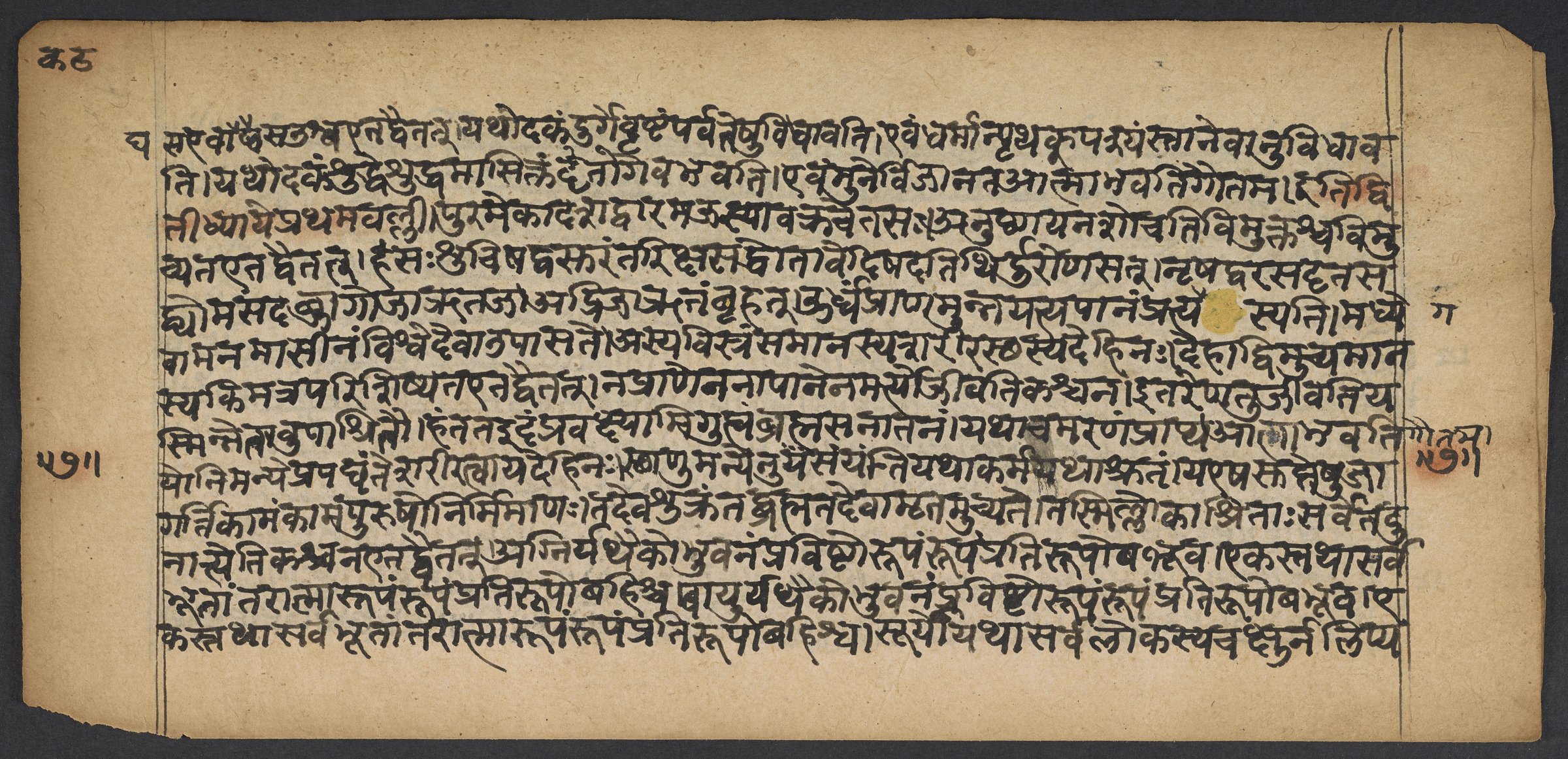
Penn Ms. Coll. 390 Item 869, fol. 7v. fol. 7v line 3: verse 1 begins ‹puram ekādaśadvāram›; verse 10 ends in line 13 ‹pratirūpo bahiś ca›. In verse 6 the word 'gautama' is added in the right margin. Checked on the image; readings logged in data/sources/upanishads/mapping_notes_869.txt.
1puram ekādaśadvāram ajasyāvakracetasaḥ /
anuṣṭhāya na śocati vimuktaś ca vimucyate //
etad vai tat //
2haṃsaḥ śuciṣad vasur antarikṣasad dhotā vediṣad atithir duroṇasat /
nṛṣad varasad ṛtasad vyomasad abjā gojā ṛtajā adrijā ṛtaṃ bṛhat //
3ūrdhvaṃ prāṇam unnayati apānaṃ pratyag asyati /
madhye vāmanam āsīnaṃ viśve devā upāsate //
4asya visraṃsamānasya śarīrasthasya dehinaḥ /
dehād vimucyamānasya kim atra pariśiṣyate //
etad vai tat //
5na prāṇena nāpānena martyo jīvati kaścana /
itareṇa tu jīvanti yasminn etāv upāśritau //
6hanta ta idaṃ pravakṣyāmi guhyaṃ brahma sanātanam /
yathā ca maraṇaṃ prāpya ātmā bhavati gautama //
7yonim anye prapadyante śarīratvāya dehinaḥ /
sthāṇum anye 'nusaṃyanti yathākarma yathāśrutam //
8ya eṣa supteṣu jāgarti kāmaṃ kāmaṃ puruṣo nirmimāṇaḥ /
tad eva śukraṃ tad brahma tad evāmṛtam ucyate /
tasmiṃl lokāḥ śritāḥ sarve tad u nātyeti kaścana //
etad vai tat //
9agnir yathaiko bhuvanaṃ praviṣṭo rūpaṃ rūpaṃ pratirūpo babhūva /
ekas tathā sarvabhūtāntarātmā rūpaṃ rūpaṃ pratirūpo bahiś ca //
10vāyur yathaiko bhuvanaṃ praviṣṭo rūpaṃ rūpaṃ pratirūpo babhūva /
ekas tathā sarvabhūtāntarātmā rūpaṃ rūpaṃ pratirūpo bahiś ca //
1"There is a town with eleven gates belonging to the Unborn (Brahman), whose thoughts are never crooked. He who approaches it, grieves no more, and liberated (from all bonds of ignorance) becomes free. This is that.
2He (Brahman) is the swan (sun), dwelling in the bright heaven; he is the Vasu (air), dwelling in the sky; he is the sacrificer (fire), dwelling on the hearth; he is the guest (Soma), dwelling in the sacrificial jar; he dwells in men, in gods (vara), in the sacrifice (rita), in heaven; he is born in the water, on earth, in the sacrifice (rita), on the mountains; he is the True and the Great.
3He (Brahman) it is who sends up the breath (prâna), and who throws back the breath (apâna). All the Devas (senses) worship him, the adorable (or the dwarf), who sits in the centre.
4When that incorporated (Brahman), who dwells in the body, is torn away and freed from the body, what remains then? This is that.
5No mortal lives by the breath that goes up and by the breath that goes down. We live by another, in whom these two repose.
6Well then, O Gautama, I shall tell thee this mystery, the old Brahman, and what happens to the Self, after reaching death.
7Some enter the womb in order to have a body, as organic beings, others go into inorganic matter, according to their work and according to their knowledge.
8He, the highest Person, who is awake in us while we are asleep, shaping one lovely sight after another, that indeed is the Bright, that is Brahman, that alone is called the Immortal. All worlds are contained in it, and no one goes beyond. This is that.
9As the one fire, after it has entered the world, though one, becomes different according to whatever it burns, thus the one Self within all things becomes different, according to whatever it enters, and exists also without.
10As the one air, after it has entered the world, though one, becomes different according to whatever it enters, thus the one Self within all things becomes different, according to whatever it enters, and exists also without.
Where on the image
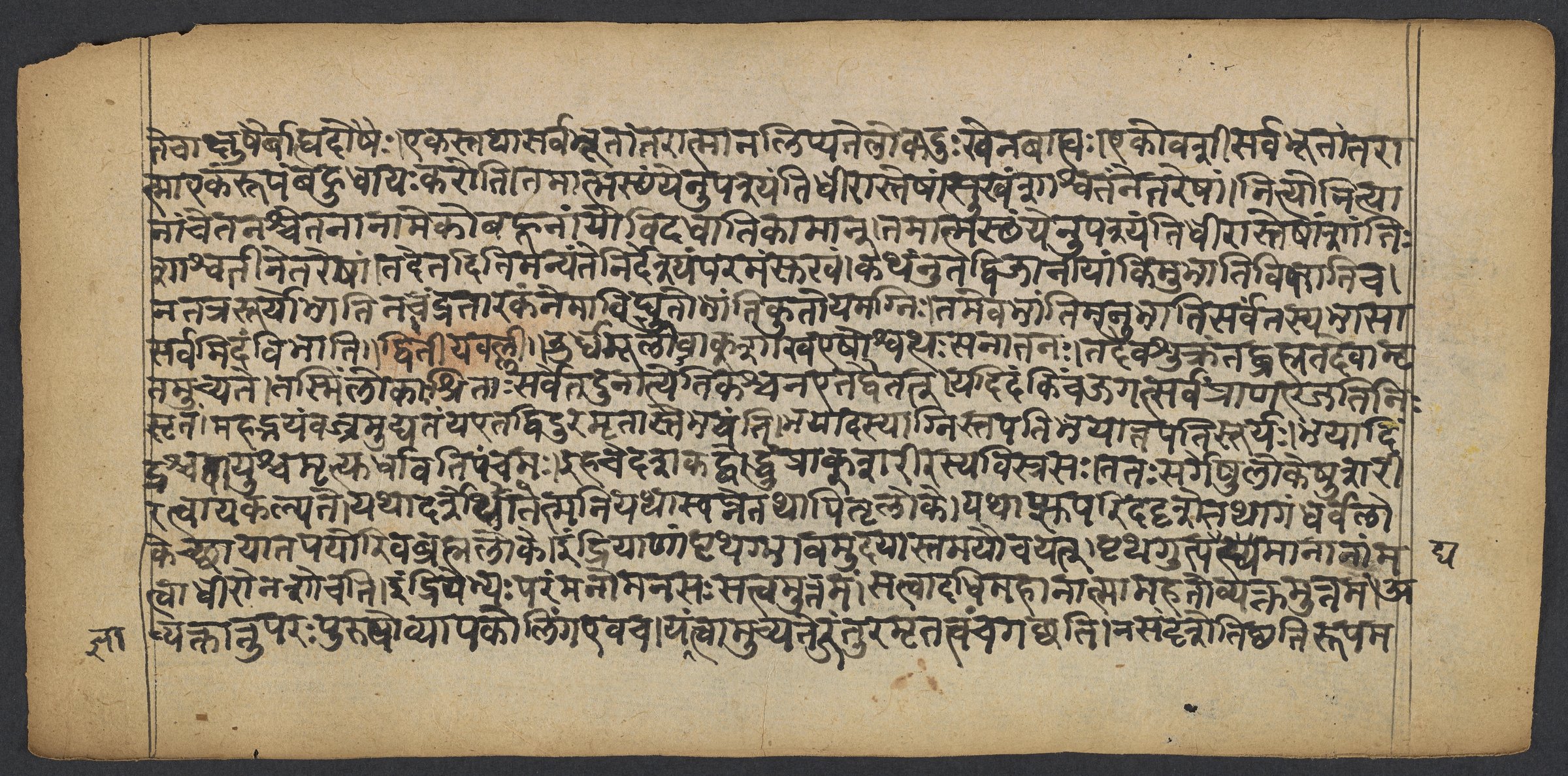
Penn Ms. Coll. 390 Item 869, fol. 7v, fol. 8r. Verse 11 begins at the end of fol. 7v line 13 ‹sūryo yathā sarvalokasya cakṣuḥ› and ends at fol. 8r line 1 ‹bāhyadoṣaiḥ›; verses 12-15 follow, and the red colophon ‹dvitīyavallī› stands in fol. 8r line 6. Checked on the image; readings logged in data/sources/upanishads/mapping_notes_869.txt.
11sūryo yathā sarvalokasya cakṣur na lipyate cākṣuṣair bāhyadoṣaiḥ /
ekas tathā sarvabhūtāntarātmā na lipyate lokaduḥkhena bāhyaḥ //
12eko vaśī sarvabhūtāntarātmā ekaṃ rūpaṃ bahudhā yaḥ karoti /
tam ātmasthaṃ ye 'nupaśyanti dhīrās teṣāṃ sukhaṃ śāśvataṃ netareṣām //
13nityo 'nityānāṃ cetanaś cetanānām eko bahūnāṃ yo vidadhāti kāmān /
tam ātmasthaṃ ye 'nupaśyanti dhīrās teṣaṃ śāntiḥ śāśvatī netareṣām //
14tad etad iti manyante 'nirdeśyaṃ paramaṃ sukham /
kathaṃ nu tad vijānīyāṃ kim u bhāti vibhāti vā //
15na tatra sūryo bhāti na candratārakaṃ nemā vidyuto bhānti kuto 'yam agniḥ /
tam eva bhāntam anu bhāti sarvaṃ tasya bhāsā sarvam idaṃ vibhāti //
11As the sun, the eye of the whole world, is not contaminated by the external impurities seen by the eyes, thus the one Self within all things is never contaminated by the misery of the world, being himself without.
12There is one ruler, the Self within all things, who makes the one form manifold. The wise who perceive him within their Self, to them belongs eternal happiness, not to others.
13There is one eternal thinker, thinking non-eternal thoughts, who, though one, fulfils the desires of many. The wise who perceive him within their Self, to them belongs eternal peace, not to others.
14They perceive that highest indescribable pleasure, saying, This is that. How then can I understand it? Has it its own light, or does it reflect light?
15The sun does not shine there, nor the moon and the stars, nor these lightnings, and much less this fire. When he shines, everything shines after him; by his light all this is lighted."
Notes
- Sanskrit: GRETIL, Kathopanisad, input by the Vienna University student team after P. Olivelle, The Early Upanisads (1998). Verse numbers follow the edition; the manuscript has none.
- English: F. Max Müller, 'Katha-upanishad', The Upanishads part II, Sacred Books of the East 15 (1884), from the proofread English Wikisource transcription. Müller numbers the vallis of the second adhyaya IV-VI; his verse numbers agree with the Sanskrit. Footnotes are not reproduced.
- Four slips in the Wikisource transcription are corrected to the printed page (SBE 15 pp. 4, 11, 13, 23): I.1.13 'fire-sacrificef', I.2.23 'can be can gained', I.3.13 'whichs', II.3.15 'Whean'. The transcription also numbers I.3.15-17 as 18-20; the book has 15-17.
- Müller ends the sixth valli with a 19th paragraph, the closing prayer 'May He protect us both!' (saha nāv avatu). It is not part of the edited Sanskrit text and is not shown; in the manuscript this prayer stands on fol. 8v line 11 as the opening invocation of the Prasna.
Cite
Sources
- Source: Penn Ms. Coll. 390 Item 869 (OPenn, public domain) + GRETIL Sanskrit + F. Max Müller (1884) English (holding institution)
- Critical edition: GRETIL Sanskrit e-texts (Isa, Katha, Prasna, Mandukya, Aitareya, Taittiriya, Svetasvatara, Chandogya); Nirnaya Sagar edition of 1925, transcribed (Kena, Mundaka)
← previous · → next · v cycle view · l back to library