Katha Upanishad, Adhyaya II, Valli 3
Introduction
The Katha Upanishad belongs to the Black Yajurveda. It tells how the boy Naciketas, given to Death by his father, waits three nights at Death's house and is granted three wishes; the third, to know what happens to a man after death, leads to Death's teaching on the Self. The text has two adhyayas of three vallis each. This entry gives valli 6 of 6 (adhyaya II, valli 3).
The page images come from a single paper manuscript in the University of Pennsylvania Libraries, Ms. Coll. 390 Item 869, catalogued as 'Six early upanisads'. It has 16 leaves (13 x 27 cm) written in Devanagari, 11 to 13 lines to a side, and is undated (the library assigns it to the 18th or 19th century). It contains the Isa, Kena, Katha, Prasna, Mundaka and Mandukya Upanisads in that order; its title page names a set of ten. Leaves are numbered in the right margin of each verso and carry abbreviated titles in the upper left margin.
The Katha runs from fol. 3v to fol. 8v of the manuscript. The scribe closes each valli with a colophon (for example 'iti prathamādhyāye prathamavallī'), which makes the valli boundaries visible on the pages. Each section below holds the verses that end on one page; a verse that begins at the foot of the previous page is shown with both pages.
How was this verified? (Provenance)
Where on the image
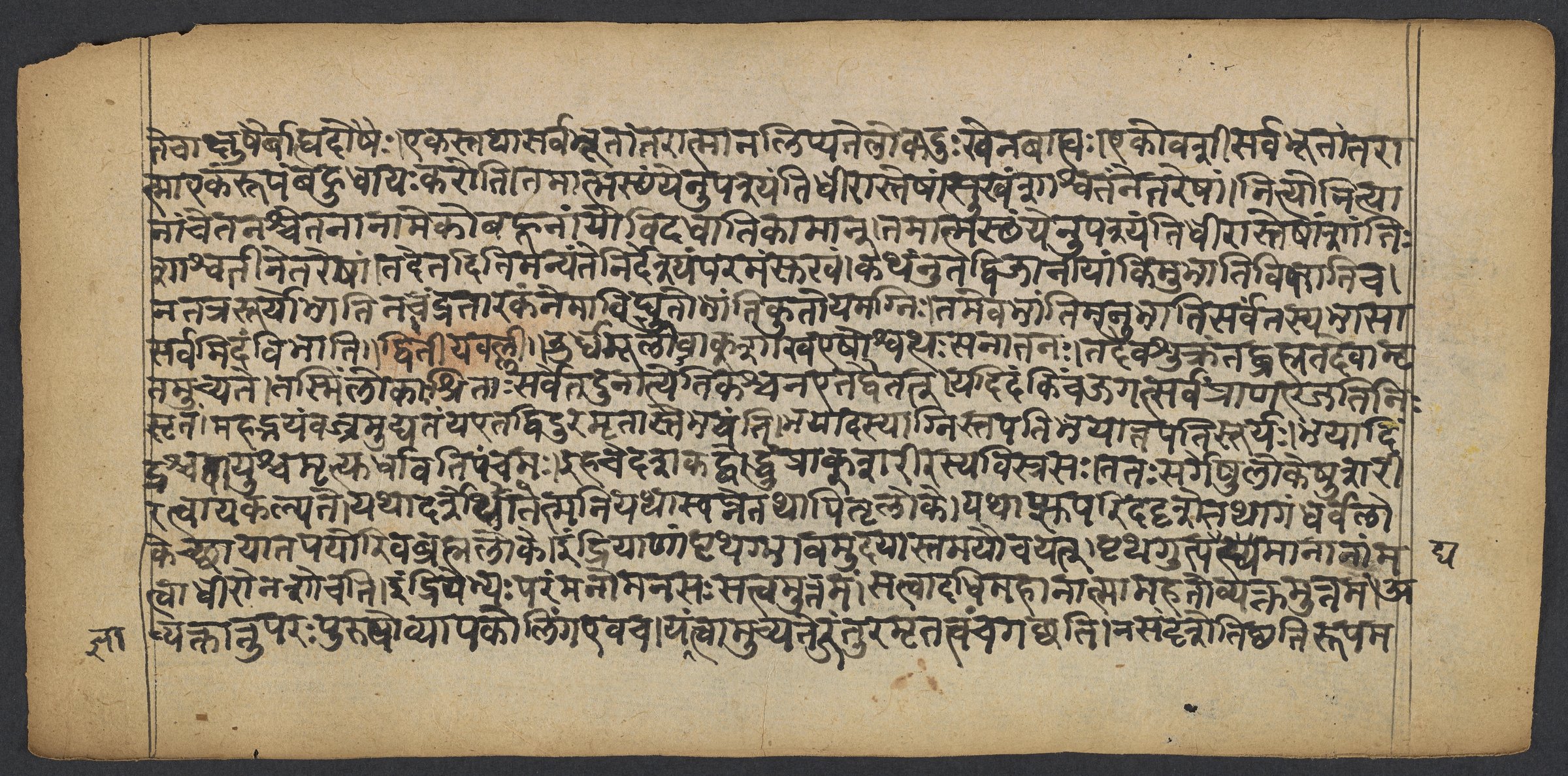
Penn Ms. Coll. 390 Item 869, fol. 8r. fol. 8r line 6: verse 1 begins ‹ūrdhvamūlo 'vākśākhaḥ›; verse 8 ends in line 13 ‹amṛtatvaṃ ca gacchati›. Checked on the image; readings logged in data/sources/upanishads/mapping_notes_869.txt.
1ūrdhvamūlo avākśākha eṣo 'śvatthaḥ sanātanaḥ /
tad eva śukraṃ tad brahma tad evāmṛtam ucyate /
tasmiṃl lokāḥ śritāḥ sarve tad u nātyeti kaścana //
etad vai tat //
2yad idaṃ kiṃca jagat sarvaṃ prāṇa ejati niḥsṛtam /
mahad bhayaṃ vajram udyataṃ ya etad vidur amṛtās te bhavanti //
3bhayād asyāgnis tapati bhayāt tapati sūryaḥ /
bhayād indraś ca vāyuś ca mṛtyur dhāvati pañcamaḥ //
4iha ced aśakad boddhuṃ prākśarīrasya visrasaḥ /
tataḥ sargeṣu lokeṣu śarīratvāya kalpate //
5yathādarśe tathātmani yathā svapne tathā pitṛloke /
yathāpsu parīva dadṛśe tathā gandharvaloke chāyātapayor iva brahmaloke //
6indriyāṇāṃ pṛthagbhāvam udayāstamayau ca yat /
pṛthag utpadyamānānāṃ matvā dhīro na śocati //
7indriyebhyaḥ paraṃ mano manasaḥ sattvam uttamam /
sattvād adhi mahānātmā mahato 'vyaktam uttamam //
8avyaktāt tu paraḥ puruṣo vyāpako 'liṅga eva ca /
yaṃ jñātvā mucyate jantur amṛtatvaṃ ca gacchati //
1"There is that ancient tree, whose roots grow upward and whose branches grow downward; — that indeed is called the Bright that is called Brahman, that alone is called the Immortal. All worlds are contained in it, and no one goes beyond. This is that.
2Whatever there is, the whole world, when gone forth (from the Brahman), trembles in its breath. That Brahman is a great terror, like a drawn sword. Those who know it become immortal.
3From terror of Brahman fire burns, from terror the sun burns, from terror Indra and Vâyu, and Death, as the fifth, run away.
4If a man could not understand it before the falling asunder of his body, then he has to take body again in the worlds of creation.
5As in a mirror, so (Brahman may be seen clearly) here in this body; as in a dream, in the world of the Fathers; as in the water, he is seen about in the world of the Gandharvas; as in light and shade in the world of Brahmâ.
6Having understood that the senses are distinct (from the Âtman), and that their rising and setting (their waking and sleeping) belongs to them in their distinct existence (and not to the Âtman), a wise man grieves no more.
7Beyond the senses is the mind, beyond the mind is the highest (created) Being, higher than that Being is the Great Self, higher than the Great, the highest Undeveloped.
8Beyond the Undeveloped is the Person, the all-pervading and entirely imperceptible. Every creature that knows him is liberated, and obtains immortality.
Where on the image
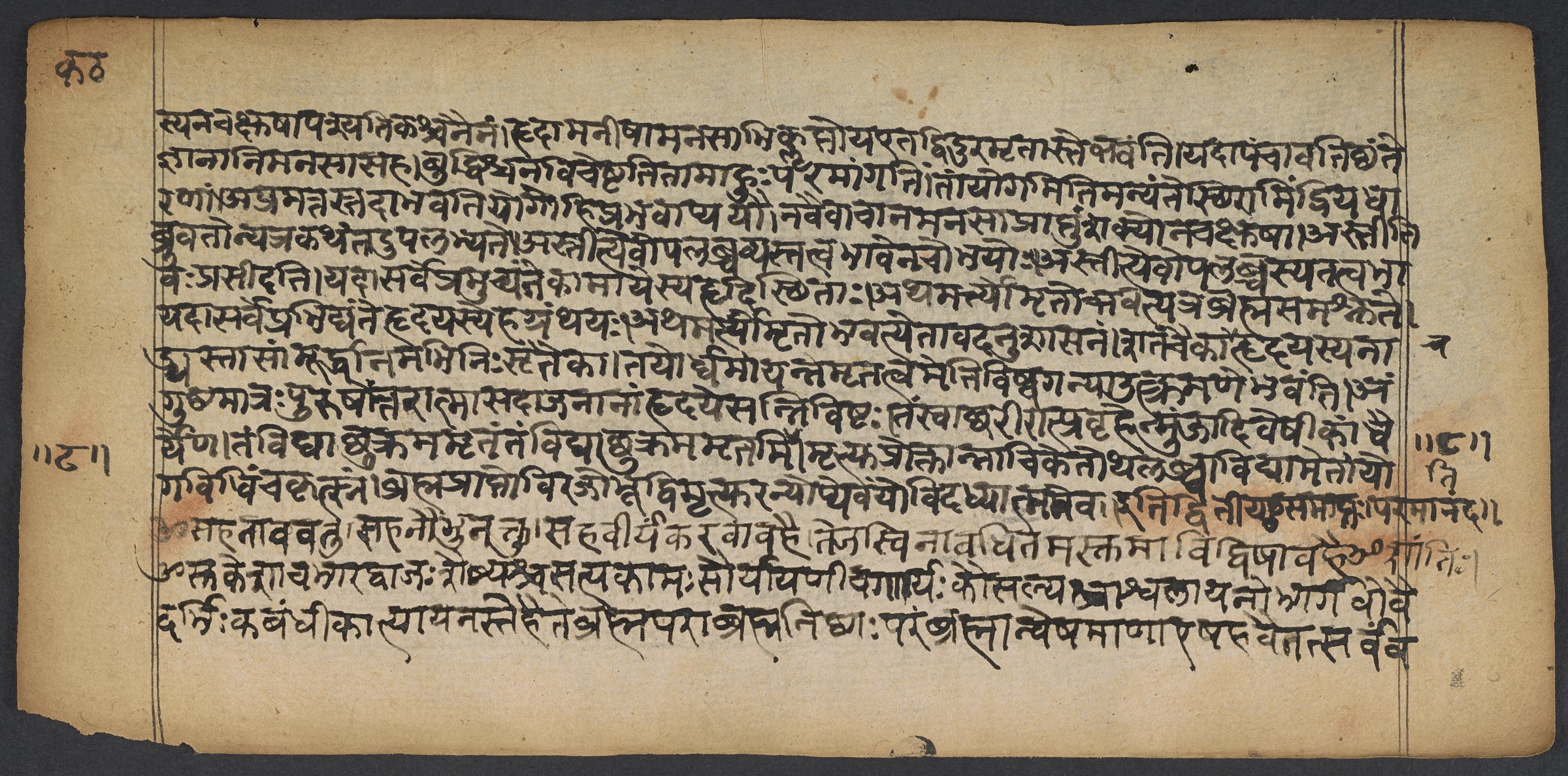
Penn Ms. Coll. 390 Item 869, fol. 8r, fol. 8v. Verse 9 begins at the end of fol. 8r line 13 ‹na saṃdṛśe tiṣṭhati rūpam› and ends at fol. 8v line 1 ‹na cakṣuṣā paśyati›; verses 10-18 follow to line 10 ‹yo vid adhyātmam eva›, then a red colophon closing the Katha (‹iti dvitīya[...] samāptaḥ paramānanda›). Checked on the image; readings logged in data/sources/upanishads/mapping_notes_869.txt.
9na saṃdṛśe tiṣṭhati rūpam asya na cakṣuṣā paśyati kaścanainam /
hṛdā manīṣā manasābhikḷpto ya etad vidur amṛtās te bhavanti //
10yadā pañcāvatiṣṭhante jñānāni manasā saha /
buddhiś ca na viceṣṭati tām āhuḥ paramāṃ gatim //
11tāṃ yogam iti manyante sthirām indriyadhāraṇām /
apramattas tadā bhavati yogo hi prabhavāpyayau //
12naiva vācā na manasā prāptuṃ śakyo na cakṣuṣā /
astīti bruvato 'nyatra kathaṃ tad upalabhyate //
13astīty evopalabdhavyas tattvabhāvena cobhayoḥ /
astīty evopalabdhasya tattvabhāvaḥ prasīdati //
14yadā sarve pramucyante kāmā ye 'sya hṛdi śritāḥ /
atha martyo 'mṛto bhavaty atra brahma samaśnute //
15yadā sarve prabhidyante hṛdayasyeha granthayaḥ /
atha martyo 'mṛto bhavaty etāvad dhy anuśāsanam //
16śataṃ caikā ca hṛdayasya nāḍyas tāsāṃ mūrdhānam abhiniḥsṛtaikā /
tayordhvam āyann amṛtatvam eti viṣvaṅṅ anyā utkramaṇe bhavati //
17aṅguṣṭhamātraḥ puruṣo 'ntarātmā sadā janānāṃ hṛdaye saṃniviṣṭaḥ /
taṃ svāc charīrāt pravṛhen muñjād iveṣīkāṃ dhairyeṇa /
taṃ vidyāc chukram amṛtaṃ taṃ vidyāc chukram amṛtam iti //
18mṛtyuproktāṃ naciketo 'tha labdhvā vidyām etāṃ yogavidhiṃ ca kṛtsnam /
brahmaprāpto virajo 'bhūd vimṛtyur anyo 'py evaṃ yo vid adhyātmam eva //
9His form is not to be seen, no one beholds him with the eye. He is imagined by the heart, by wisdom, by the mind. Those who know this, are immortal.
10When the five instruments of knowledge stand still together with the mind, and when the intellect does not move, that is called the highest state.
11This, the firm holding back of the senses, is what is called Yoga. He must be free from thoughtlessness then, for Yoga comes and goes.
12He (the Self) cannot be reached by speech, by mind, or by the eye. How can it be apprehended except by him who says: "He is?"
13By the words "He is," is he to be apprehended, and by (admitting) the reality of both (the invisible Brahman and the visible world, as coming from Brahman). When he has been apprehended by the words "He is," then his reality reveals itself.
14When all desires that dwell in his heart cease, then the mortal becomes immortal, and obtains Brahman.
15When all the ties of the heart are severed here on earth, then the mortal becomes immortal — here ends the teaching.
16There are a hundred and one arteries of the heart, one of them penetrates the crown of the head. Moving upwards by it, a man (at his death) reaches the Immortal; the other arteries serve for departing in different directions.
17The Person not larger than a thumb, the inner Self, is always settled in the heart of men. Let a man draw that Self forth from his body with steadiness, as one draws the pith from a reed. Let him know that Self as the Bright, as the Immortal; yes, as the Bright, as the Immortal.
18Having received this knowledge taught by Death and the whole rule of Yoga (meditation), Nakiketa became free from passion and death, and obtained Brahman. Thus it will be with another also who knows thus what relates to the Self.
Notes
- Sanskrit: GRETIL, Kathopanisad, input by the Vienna University student team after P. Olivelle, The Early Upanisads (1998). Verse numbers follow the edition; the manuscript has none.
- English: F. Max Müller, 'Katha-upanishad', The Upanishads part II, Sacred Books of the East 15 (1884), from the proofread English Wikisource transcription. Müller numbers the vallis of the second adhyaya IV-VI; his verse numbers agree with the Sanskrit. Footnotes are not reproduced.
- Four slips in the Wikisource transcription are corrected to the printed page (SBE 15 pp. 4, 11, 13, 23): I.1.13 'fire-sacrificef', I.2.23 'can be can gained', I.3.13 'whichs', II.3.15 'Whean'. The transcription also numbers I.3.15-17 as 18-20; the book has 15-17.
- Müller ends the sixth valli with a 19th paragraph, the closing prayer 'May He protect us both!' (saha nāv avatu). It is not part of the edited Sanskrit text and is not shown; in the manuscript this prayer stands on fol. 8v line 11 as the opening invocation of the Prasna.
Cite
Sources
- Source: Penn Ms. Coll. 390 Item 869 (OPenn, public domain) + GRETIL Sanskrit + F. Max Müller (1884) English (holding institution)
- Critical edition: GRETIL Sanskrit e-texts (Isa, Katha, Prasna, Mandukya, Aitareya, Taittiriya, Svetasvatara, Chandogya); Nirnaya Sagar edition of 1925, transcribed (Kena, Mundaka)
← previous · → next · v cycle view · l back to library