Prasna Upanishad, Question 1
Introduction
The Prasna ('Question') Upanishad belongs to the Atharvaveda (Paippalada school). Six students come to the sage Pippalada, and after a year of discipline each asks one question: on the origin of creatures, the powers that sustain the body, the breath, sleep and dreaming, meditation on the syllable Om, and the person of sixteen parts. This entry gives question 1, asked by Kabandhin Katyayana.
The page images come from a single paper manuscript in the University of Pennsylvania Libraries, Ms. Coll. 390 Item 869, catalogued as 'Six early upanisads'. It has 16 leaves (13 x 27 cm) written in Devanagari, 11 to 13 lines to a side, and is undated (the library assigns it to the 18th or 19th century). It contains the Isa, Kena, Katha, Prasna, Mundaka and Mandukya Upanisads in that order; its title page names a set of ten. Leaves are numbered in the right margin of each verso and carry abbreviated titles in the upper left margin.
The Prasna runs from fol. 8v to fol. 12v. The scribe numbers the end of each question (||1|| to ||6||) and groups the questions in pairs as three adhyayas. Each section below holds the paragraphs that end on one page; a paragraph that begins on the previous page is shown with both pages.
How was this verified? (Provenance)
Where on the image
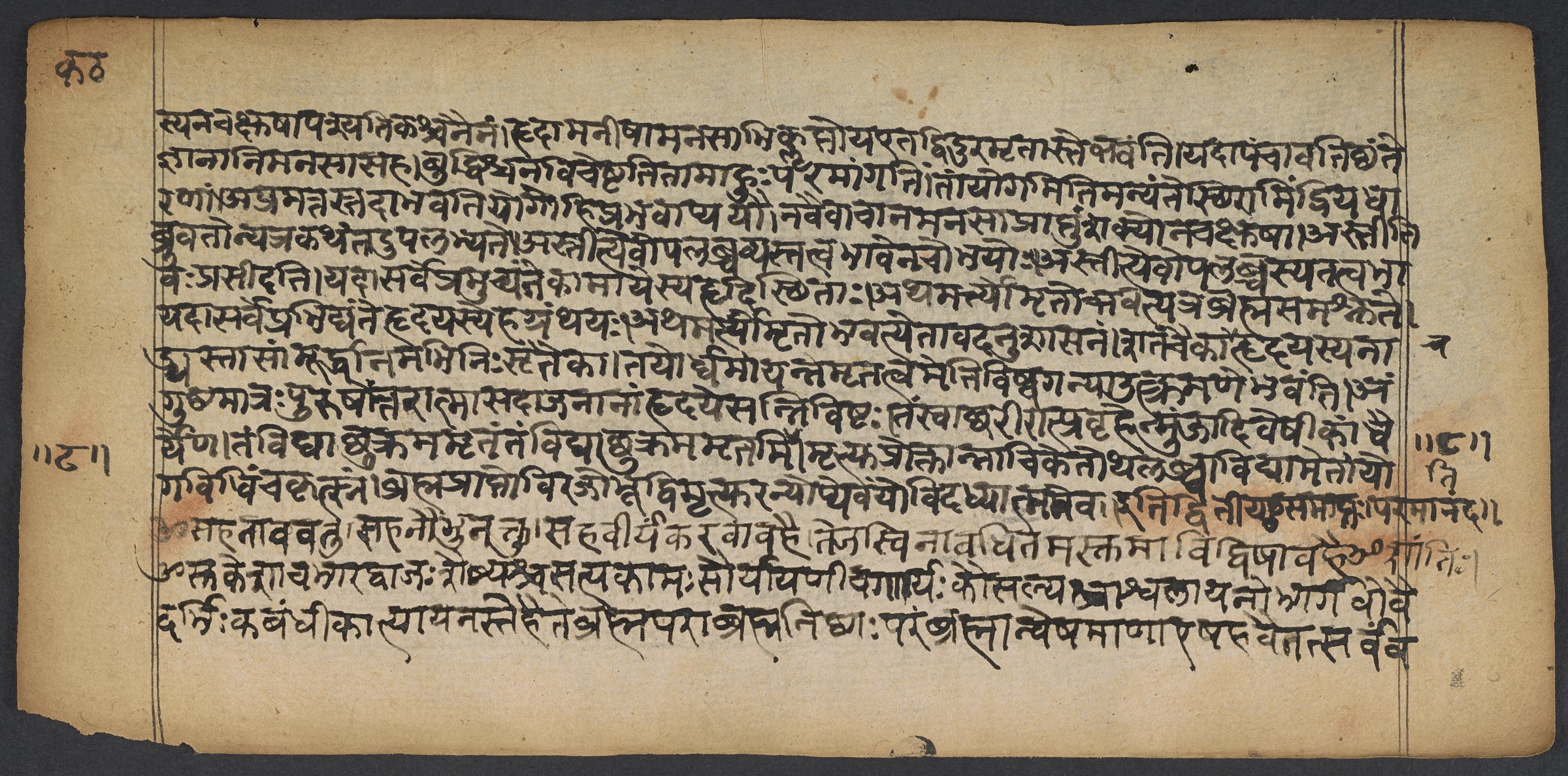
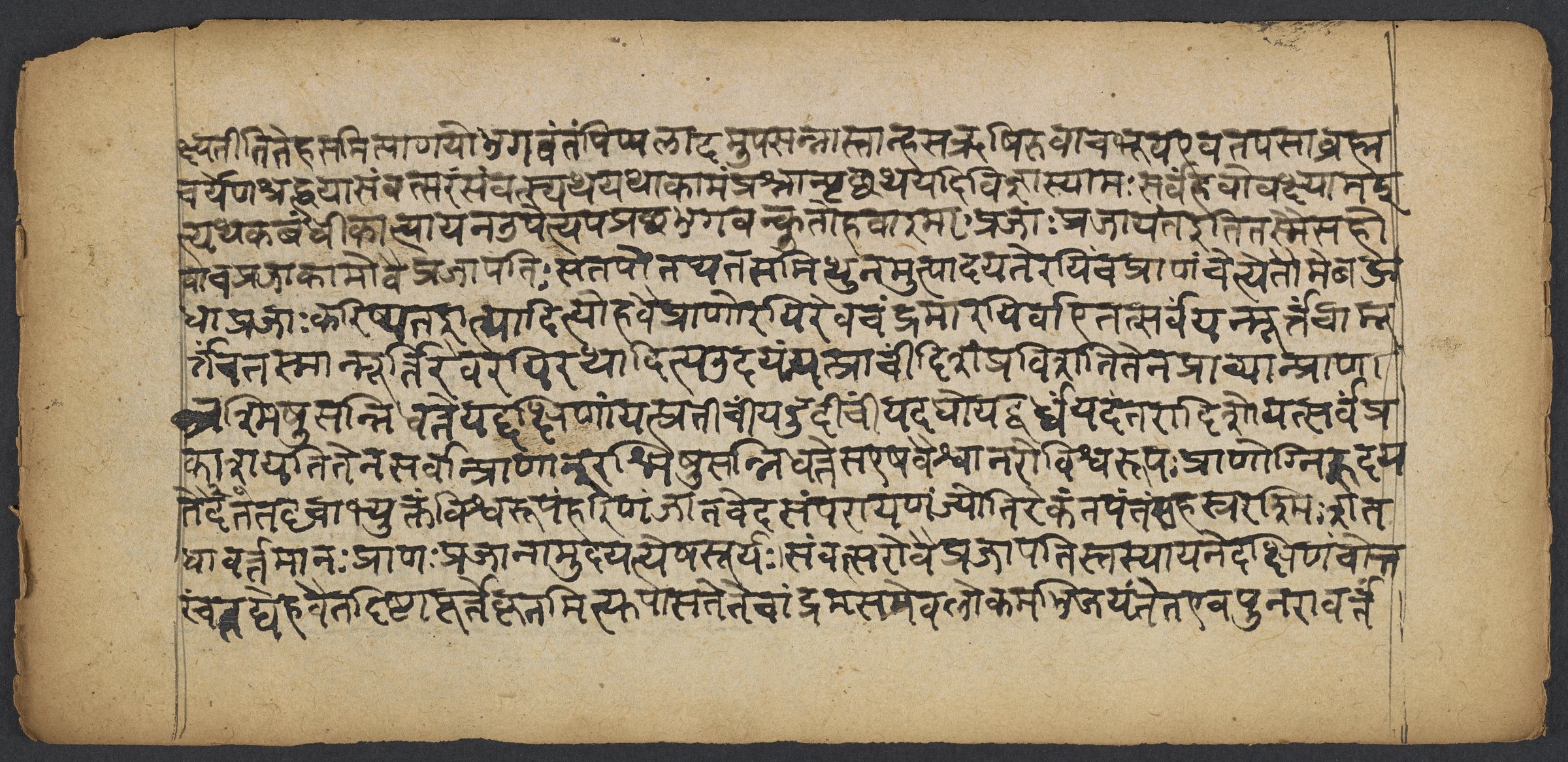
Penn Ms. Coll. 390 Item 869, fol. 8v, fol. 9r. Question 1, paragraph 1 begins at fol. 8v line 12 ‹oṃ sukeśā ca bhāradvājaḥ› (after the invocation 'oṃ saha nāv avatu ... śāntiḥ' in line 11) and ends at fol. 9r line 1 ‹pippalādam upasannāḥ›; paragraphs 2-8 follow on fol. 9r to line 10 ‹udayaty eṣa sūryaḥ›. Checked on the image; readings logged in data/sources/upanishads/mapping_notes_869.txt.
1sukeśā ca bhāradvājaḥ śaibyaś ca satyakāmaḥ sauryāyaṇī ca gārgyaḥ kausalyaś cāśvalāyano bhārgavo vaidarbhiḥ kabandhī kātyāyanas te haite brahmaparā brahmaniṣṭhā paraṃ brahmānveṣamāṇā eṣa ha vai tatsarvaṃ vakṣyatīti te ha samitpāṇayo bhagavantaṃ pippalādam upasannāḥ ||
2tān ha sa ṛṣir uvāca |
bhūya eva tapasā brahmacaryeṇa śraddhayā saṃvatsaraṃ saṃvatsyatha |
yathākāmaṃ praśnān pṛcchata |
yadi vijñāsyāmaḥ sarvaṃ ha vo vakṣyāma iti ||
3atha kabandhī kātyāyana upetya papraccha |
bhagavan kuto ha vā imāḥ prajāḥ prajāyanta iti ||
4tasmai sa hovāca |
prajākāmo vai prajāpatiḥ |
sa tapo 'tapyata |
sa tapas taptvā sa mithunam utpādayate rayiṃ ca prāṇaṃ ceti |
etau me bahudhāḥ prajāḥ kariṣyata iti ||
5ādityo ha vai prāṇo rayir eva candramāḥ |
rayir vā etat sarvaṃ yanmūrtaṃ cāmūrtaṃ ca |
tasmān mūrtir eva rayiḥ ||
6athāditya udayan yatprācīṃ diśaṃ praviśati tena prācyān prāṇān raśmiṣu saṃnidhatte |
yad dakṣiṇaṃ yat pratīcīṃ yad udīcīṃ yad adho yad ūrdhvaṃ yad antarā diśo yat sarvaṃ prakāśayati tena sarvān prāṇān raśmiṣu saṃnidhatte ||
7sa eṣa vaiśvānaro viśvarūpaḥ prāṇo 'gnirudayate |
tad etad dacābhyuktam ||
8viśvarūpaṃ hariṇaṃ jātavedasaṃ parāyaṇaṃ jyotir ekaṃ tapantam /
sahasraraśmiḥ śatadhā vartamānaḥ prāṇaḥ prajānām udayaty eṣa sūryaḥ //
1Sukesas Bhâradvâga, and Saivya Satyakâma, and Sauryâyanin Gârgya, and Kausalya Âsvalâyana, and Bhârgava Vaidarbhi, and Kabandhin Kâtyâyana, these were devoted to Brahman, firm in Brahman, seeking for the Highest Brahman. They thought that the venerable Pippalâda could tell them all that, and they therefore took fuel in their hands (like pupils), and approached him.
2That Rishi said to them: "Stay here a year longer, with penance, abstinence, and faith; then you may ask questions according to your pleasure, and if we know them, we shall tell you all."
3Then Kabandhin Kâtyâyana approached him and asked: "Sir, from whence may these creatures be born?"
4He replied: "Pragâpati (the lord of creatures) was desirous of creatures (pragâh). He performed penance, and having performed penance, he produces a pair, matter (rayi) and spirit (prâna), thinking that they together should produce creatures for him in many ways.
5The sun is spirit, matter is the moon. All this, what has body and what has no body, is matter, and therefore body indeed is matter.
6Now Âditya, the sun, when he rises, goes toward the East, and thus receives the Eastern spirits into his rays. And when he illuminates the South, the West, the North, the Zenith, the Nadir, the intermediate quarters, and everything, he thus receives all spirits into his rays.
7Thus he rises, as Vaisvânara, (belonging to all men,) assuming all forms, as spirit, as fire. This has been said in the following verse:
8(They knew) him who assumes all forms, the golden, who knows all things, who ascends highest, alone in his splendour, and warms us; the thousand-rayed, who abides in a hundred places, the spirit of all creatures, the Sun, rises.
Where on the image
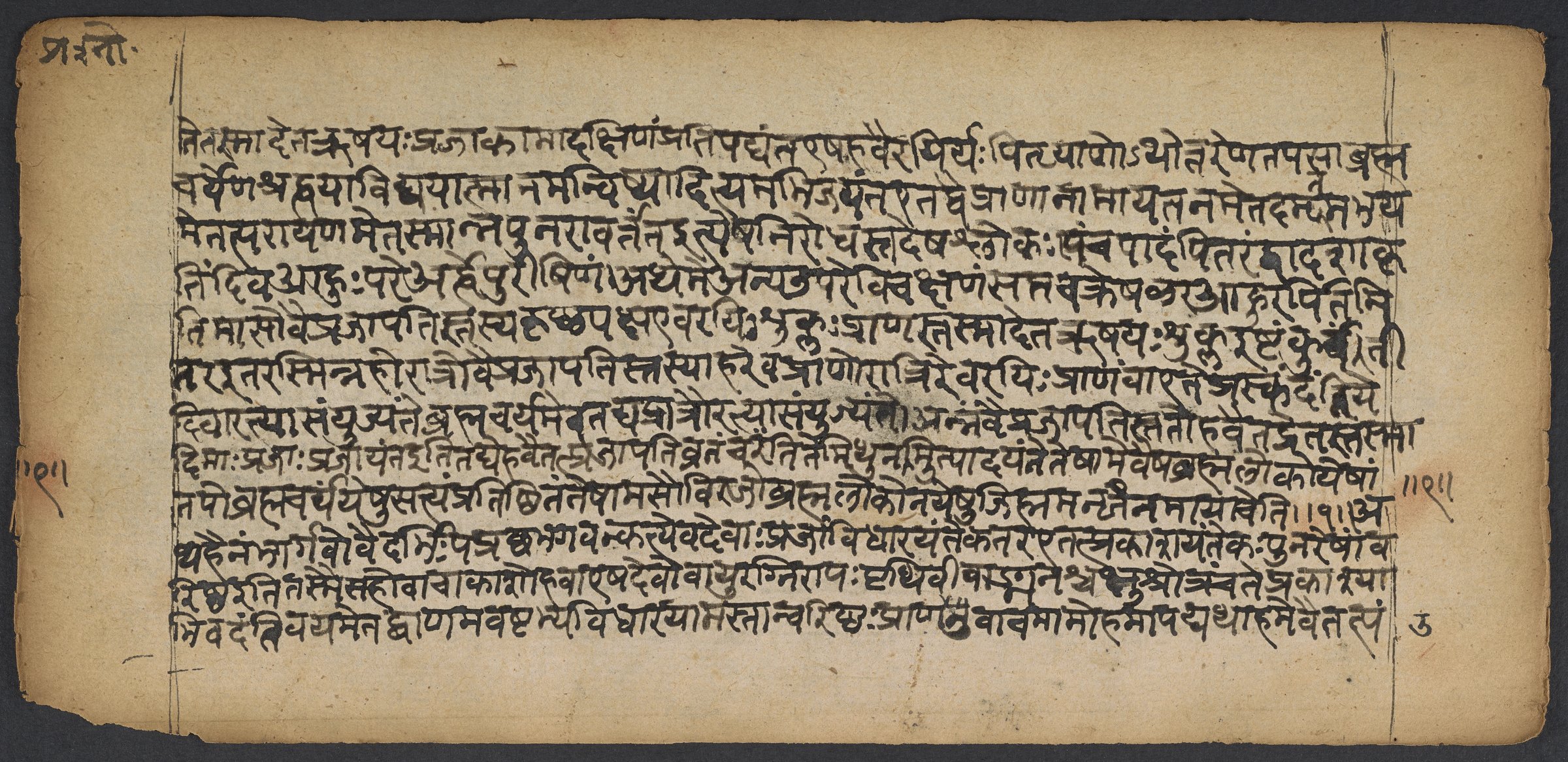
Penn Ms. Coll. 390 Item 869, fol. 9r, fol. 9v. Paragraph 9 begins at fol. 9r line 10 ‹saṃvatsaro vai prajāpatiḥ› and ends at fol. 9v line 1 ‹eṣa ha vai rayir yaḥ pitṛyāṇaḥ›; paragraphs 10-16 follow to line 9 ‹na māyā ceti›, marked ‹||1||›. Checked on the image; readings logged in data/sources/upanishads/mapping_notes_869.txt.
9saṃvatsaro vai prajāpatiḥ |
tasyāyane dakṣiṇaṃ cottaraṃ ca |
tad ye ha vai tadiṣṭāpūrte kṛtim ity upāsate te cāndramasam eva lokam abhijayante |
ta eva punar āvartante |
tasmād eta ṛṣayaḥ prajākāmā dakṣiṇaṃ pratipadyante |
eṣa ha vai rayir yaḥ pitṛyāṇaḥ ||
10athottareṇa tapasā brahmacaryeṇa śraddhayā vidyayātmānam anviṣyādityam abhijayante |
etad vai prāṇānām āyatanam etad amṛtam ayam etat parāyaṇam |
etasmān na punarāvartanta iti |
eṣa nirodhaḥ |
tad eṣa ślokaḥ ||
11pañcapādaṃ pitaraṃ dvādaśakṛtiṃ diva āhuḥ pare ardhe purīṣiṇam /
atheme anya u pare vicakṣaṇaṃ saptacakre ṣaḍara āhurarpitamiti //
12māso vai prajāpatiḥ |
tasya kṛṣṇapakṣa eva rayiḥ śuklaḥ prāṇaḥ |
tasmād eta ṛṣayaḥ śukla iṣṭaṃ kurvantītara itarasmin ||
13ahorātro vai prajāpatiḥ |
tasyāhareva prāṇo rātrireva rayiḥ |
prāṇaṃ vā ete praskandanti ye divā ratyā saṃyujyante |
brahmacaryameva tadyadrātrau ratyā saṃyujyante ||
14annaṃ vai prajāpatis tato ha vai tadretaḥ |
tasmād imāḥ prajāḥ prajāyanta iti ||
15tad ye ha vai tatprajāpativrataṃ caranti |
te mithunam utpādayante |
teṣāmevaiṣa brahmalokaḥ |
yeṣāṃ tapo brahmacaryaṃ |
yeṣu satyaṃ pratiṣṭhitam ||
16teṣām asau virajo brahmaloko na yeṣu jihvam anṛtaṃ na māyā ceti ||
9The year indeed is Pragâpati, and there are two paths thereof, the Southern and the Northern. Now those who here believe in sacrifices and pious gifts as work done, gain the moon only as their (future) world, and return again. Therefore the Rishis who desire offspring, go to the South, and that path of the Fathers is matter (rayi).
10But those who have sought the Self by penance, abstinence, faith, and knowledge, gain by the Northern path Âditya, the sun. This is the home of the spirits, the immortal, free from danger, the highest. From thence they do not return, for it is the end. Thus says the Sloka:
11Some call him the father with five feet (the five seasons), and with twelve shapes (the twelve months), the giver of rain in the highest half of heaven; others again say that the sage is placed in the lower half, in the chariot with seven wheels and six spokes.
12The month is Pragâpati; its dark half is matter, its bright half spirit. Therefore some Rishis perform sacrifice in the bright half, others in the other half.
13Day and Night are Pragâpati; its day is spirit, its night matter. Those who unite in love by day waste their spirit, but to unite in love by night is right.
14Food is Pragâpati. Hence proceeds seed, and from it these creatures are born.
15Those therefore who observe this rule of Pragâpati (as laid down in §13), produce a pair, and to them belongs this Brahma-world here. But those in whom dwell penance, abstinence, and truth,
16To them belongs that pure Brahma-world, to them, namely, in whom there is nothing crooked, nothing false, and no guile."
Notes
- Sanskrit: GRETIL, Prasnopanisad with the commentary ascribed to Samkara, mula text only; input by the Sansknet project. Paragraph numbers follow the edition; the manuscript has none.
- Prasna 2.9: the GRETIL file (TEI and legacy mula file alike) prints Samkara's paraphrase in place of this verse, so its Sanskrit is left out and marked [...]; the verse itself can be read on fol. 10r lines 7-8 of the manuscript.
- English: F. Max Müller, 'Prasña-upanishad', The Upanishads part II, Sacred Books of the East 15 (1884), from the proofread English Wikisource transcription. Footnotes are not reproduced.
Cite
Sources
- Source: Penn Ms. Coll. 390 Item 869 (OPenn, public domain) + GRETIL Sanskrit + F. Max Müller (1884) English (holding institution)
- Critical edition: GRETIL Sanskrit e-texts (Isa, Katha, Prasna, Mandukya, Aitareya, Taittiriya, Svetasvatara, Chandogya); Nirnaya Sagar edition of 1925, transcribed (Kena, Mundaka)
← previous · → next · v cycle view · l back to library