Prasna Upanishad, Question 2
Introduction
The Prasna ('Question') Upanishad belongs to the Atharvaveda (Paippalada school). Six students come to the sage Pippalada, and after a year of discipline each asks one question: on the origin of creatures, the powers that sustain the body, the breath, sleep and dreaming, meditation on the syllable Om, and the person of sixteen parts. This entry gives question 2, asked by Bhargava Vaidarbhi.
The page images come from a single paper manuscript in the University of Pennsylvania Libraries, Ms. Coll. 390 Item 869, catalogued as 'Six early upanisads'. It has 16 leaves (13 x 27 cm) written in Devanagari, 11 to 13 lines to a side, and is undated (the library assigns it to the 18th or 19th century). It contains the Isa, Kena, Katha, Prasna, Mundaka and Mandukya Upanisads in that order; its title page names a set of ten. Leaves are numbered in the right margin of each verso and carry abbreviated titles in the upper left margin.
The Prasna runs from fol. 8v to fol. 12v. The scribe numbers the end of each question (||1|| to ||6||) and groups the questions in pairs as three adhyayas. Each section below holds the paragraphs that end on one page; a paragraph that begins on the previous page is shown with both pages.
How was this verified? (Provenance)
Where on the image
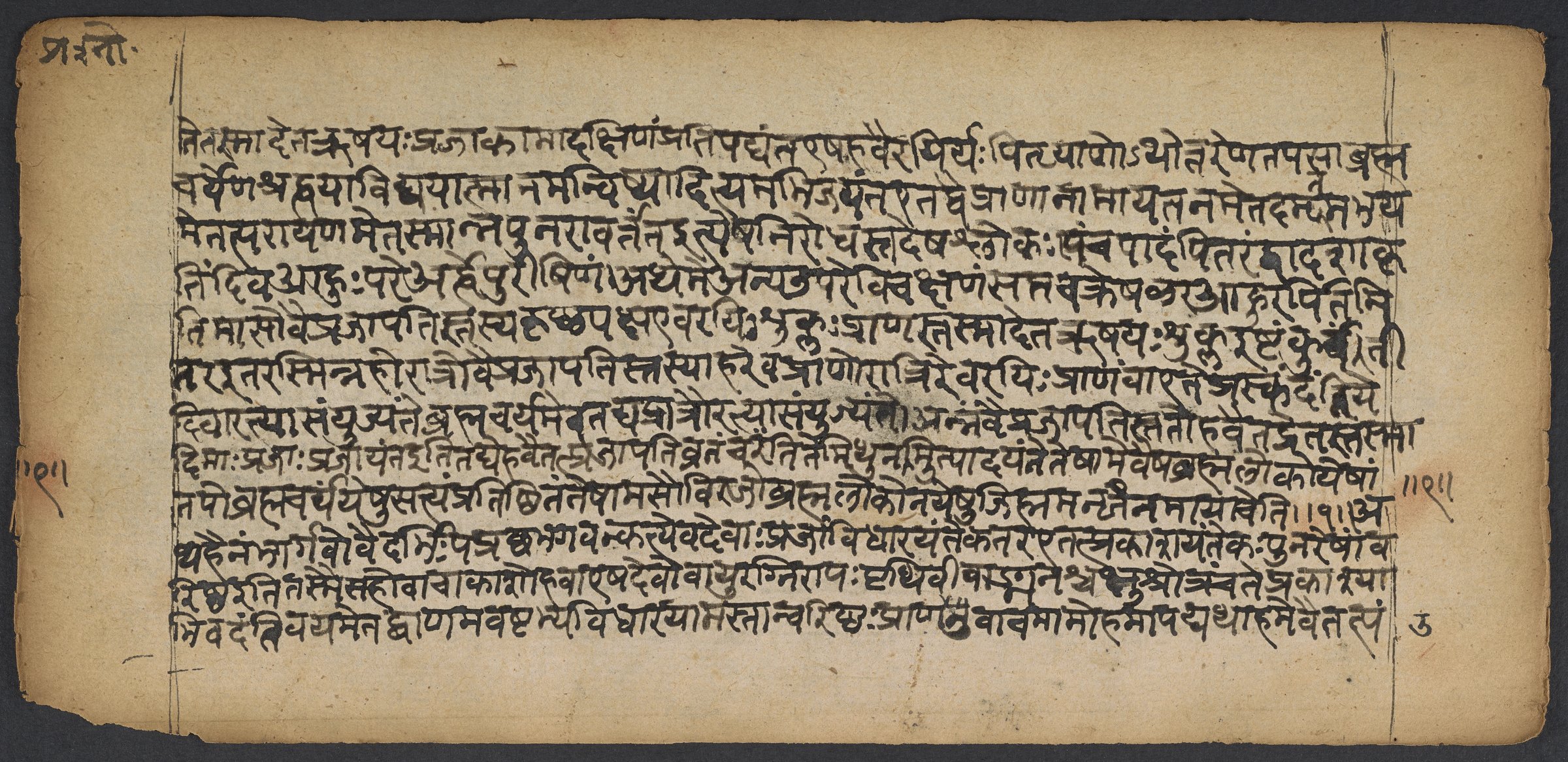
Penn Ms. Coll. 390 Item 869, fol. 9v. fol. 9v lines 9-12: paragraph 1 begins ‹atha hainaṃ bhārgavo vaidarbhiḥ›; paragraph 2 ends in line 12 ‹vidhārayāmaḥ›. Checked on the image; readings logged in data/sources/upanishads/mapping_notes_869.txt.
1ata hainaṃ bhārgavo vaidarbhiḥ papraccha |
bhagavan katyeva devāḥ prajāṃ vidhārayante |
katara etat prakāśayante |
kaḥ punar eṣāṃ variṣṭha iti ||
2tasmai sa hovāca |
ākāśo ha vā eṣa devo vāyur agnir āpaḥ pṛthivī vāṅmanaścakṣu śrotraṃ ca |
te prakāśyābhivadanti |
vayam etad bāṇam avaṣṭabhya vidhārayāmaḥ ||
1Then Bhârgava Vaidarbhi asked him: "Sir, How many gods keep what has thus been created, how many manifest this, and who is the best of them?"
2He replied: "The ether is that god, the wind, fire, water, earth, speech, mind, eye, and ear. These, when they have manifested (their power), contend and say: We (each of us) support this body and keep it.
Where on the image
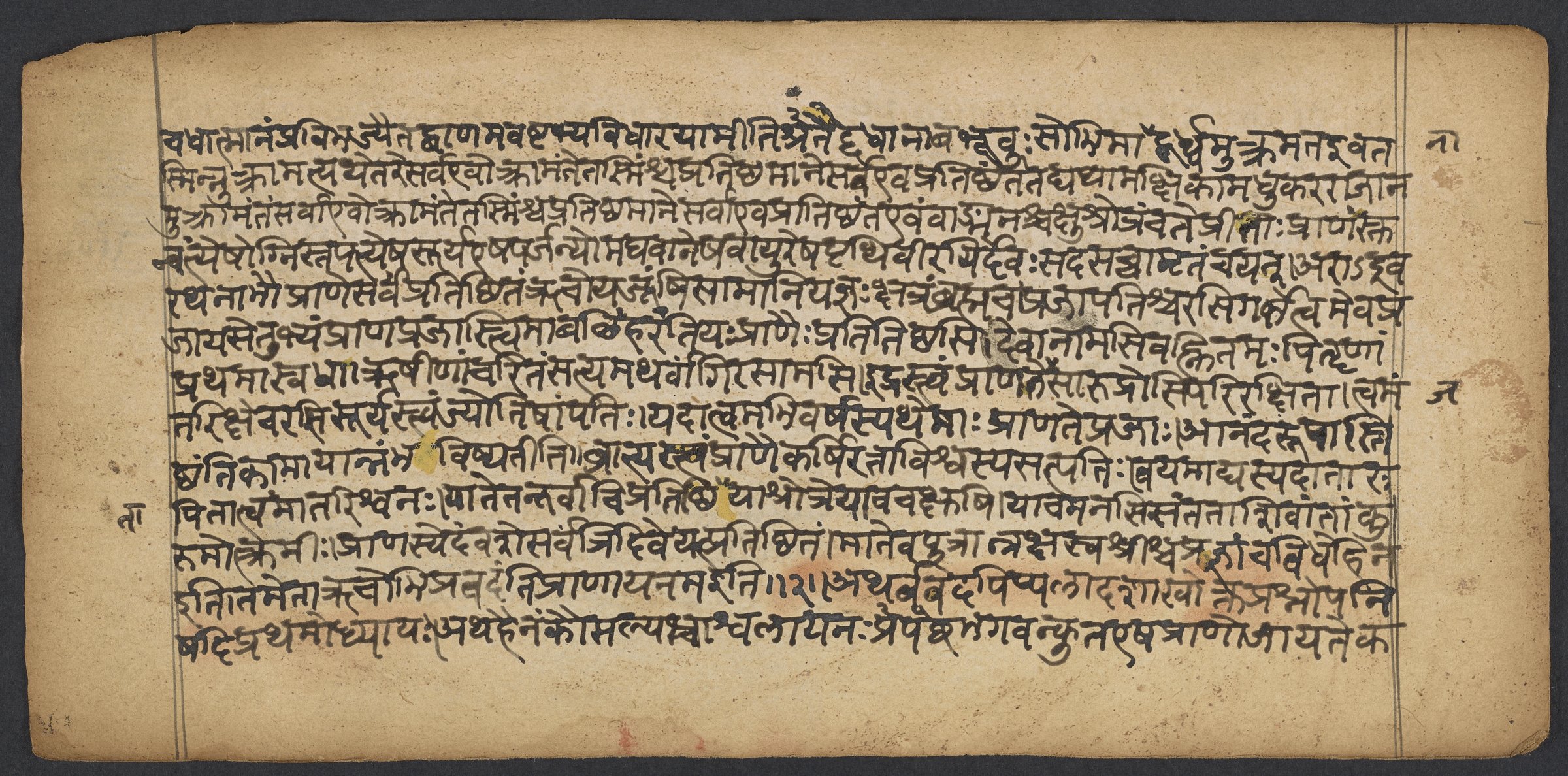
Penn Ms. Coll. 390 Item 869, fol. 9v, fol. 10r. Paragraph 3 begins at fol. 9v line 12 ‹tān variṣṭhaḥ prāṇa uvāca› and ends at fol. 10r line 1 ‹te 'śraddadhānā babhūvuḥ›; paragraphs 4-13 follow to line 12 ‹vidhehi na iti›. Verse 9 stands on fol. 10r lines 7-8 ‹indras tvaṃ prāṇa tejasā rudro 'si parirakṣitā› ... ‹jyotiṣāṃ patiḥ›; its Sanskrit is not shown here because the GRETIL e-text gives the commentary's paraphrase in place of the verse. The scribe then adds a short sentence ending ‹prāṇāyanam arhati› that is not in the edition, the number ‹||2||› and a red colophon ending ‹praśnopaniṣadi prathamo 'dhyāyaḥ› (lines 12-13). Checked on the image; readings logged in data/sources/upanishads/mapping_notes_869.txt.
3tān variṣṭaḥ prāṇa uvāca |
mā mohamāpadyatha, aham evaitat pañcadhātmānaṃ pravibhajyaitad bāṇamavaṣṭabhya vidhārayāmīti |
te 'śraddadhānā babhūvuḥ ||
4so 'bhimānādūrdhvamutkramata iva |
tasminn utkrāmaty athetare sarva evotkrāmante |
tasmiṃś ca pratiṣṭhamāne sarva eva prātiṣṭhante |
tad yathā makṣikā madhukararājānam utkrāmantaṃ sarvā evotkrāmante |
tasmiṃś ca pratiṣṭhamāne sarvā eva prātiṣṭhante |
evaṃ vāṅmanaścakṣuḥśrotraṃ ca |
te prītāḥ prāṇaṃ stunvanti ||
5eṣo 'gnis tapaty eṣa sūrya eṣa parjanyo maghavān eṣa vāyuḥ /
eṣa pṛthivī rayir devaḥ sadasac cāmṛtaṃ ca yat //
6arā iva rathanābhau prāṇe sarvaṃ pratiṣṭhitam /
ṛco yajūṃṣi sāmāni yajñaḥ kṣatraṃ brahma ca //
7prajāpatiś carasi garbhe tvam eva pratijāyase |
tubhyaṃ prāṇa prajās tv imā baliṃ haranti yaḥ prāṇaiḥ pratiṣṭhasi ||
8devānām asi vahnitamaḥ pitṝṇāṃ prathamā svadhā /
ṛṣīṇāṃ caritaṃ satyam atharvāṅgirasām asi //
9[…]
10yadā tvam abhivarṣasy athemāḥ prāṇa te prajāḥ /
ānandarūpās tiṣṭhanti kāmāyānnaṃ bhaviṣyatīti //
11vrātyas tvaṃ prāṇaikaṛṣirattā viśvasya satpatiḥ /
vayam ādyasya dātāraḥ pitā tvaṃ mātariśva naḥ //
12yā te tanūrvāci pratiṣṭhitā yā śrotraṃ yā ca cakṣuṣi /
yā ca manasi saṃtatā śivāṃ tāṃ kuru motkramīḥ //
13prāṇasyedaṃ vaśe sarvaṃ tridive yat pratiṣṭhitam /
māteva putrān rakṣasva śrīś ca prajñāṃ ca vidhehi na iti //
3Then Prâna (breath, spirit, life), as the best, said to them: Be not deceived, I alone, dividing myself fivefold, support this body and keep it.
4They were incredulous; so he, from pride, did as if he were going out from above. Thereupon, as he went out, all the others went out, and as he returned, all the others returned. As bees go out when their queen goes out, and return when she returns, thus (did) speech, mind, eye, and ear; and, being satisfied, they praise Prâna, saying:
5He is Agni (fire), he shines as Sûrya (sun), he is Parganya (rain), the powerful (Indra), he is Vâyu (wind), he is the earth, he is matter, he is God — he is what is and what is not, and what is immortal.
6As spokes in the nave of a wheel, everything is fixed in Prâna, the verses of the Rig-veda, Yagur-veda, Sâma-veda, the sacrifice, the Kshatriyas, and the Brâhmans.
7As Pragâpati (lord of creatures) thou movest about in the womb, thou indeed art born again. To thee, the Prâna, these creatures bring offerings, to thee who dwellest with the other prânas (the organs of sense).
8Thou art the best carrier for the Gods, thou art the first offering to the Fathers. Thou art the true work of the Rishis, of the Atharvângiras.
9O Prâna, thou art Indra by thy light, thou art Rudra, as a protector; thou movest in the sky, thou art the sun, the lord of lights.
10When thou showerest down rain, then, O Prâna, these creatures of thine are delighted, hoping that there will be food, as much as they desire.
11Thou art a Vrâtya, O Prâna, the only Rishi, the consumer of everything, the good lord. We are the givers of what thou hast to consume, thou, O Mâtarisva, art our father.
12Make propitious that body of thine which dwells in speech, in the ear, in the eye, and which pervades the mind; do not go away!
13All this is in the power of Prâna, whatever exists in the three heavens. Protect us like a mother her sons, and give us happiness and wisdom."
Notes
- Sanskrit: GRETIL, Prasnopanisad with the commentary ascribed to Samkara, mula text only; input by the Sansknet project. Paragraph numbers follow the edition; the manuscript has none.
- Prasna 2.9: the GRETIL file (TEI and legacy mula file alike) prints Samkara's paraphrase in place of this verse, so its Sanskrit is left out and marked [...]; the verse itself can be read on fol. 10r lines 7-8 of the manuscript.
- English: F. Max Müller, 'Prasña-upanishad', The Upanishads part II, Sacred Books of the East 15 (1884), from the proofread English Wikisource transcription. Footnotes are not reproduced.
Cite
Sources
- Source: Penn Ms. Coll. 390 Item 869 (OPenn, public domain) + GRETIL Sanskrit + F. Max Müller (1884) English (holding institution)
- Critical edition: GRETIL Sanskrit e-texts (Isa, Katha, Prasna, Mandukya, Aitareya, Taittiriya, Svetasvatara, Chandogya); Nirnaya Sagar edition of 1925, transcribed (Kena, Mundaka)
← previous · → next · v cycle view · l back to library