Prasna Upanishad, Question 3
Introduction
The Prasna ('Question') Upanishad belongs to the Atharvaveda (Paippalada school). Six students come to the sage Pippalada, and after a year of discipline each asks one question: on the origin of creatures, the powers that sustain the body, the breath, sleep and dreaming, meditation on the syllable Om, and the person of sixteen parts. This entry gives question 3, asked by Kausalya Asvalayana.
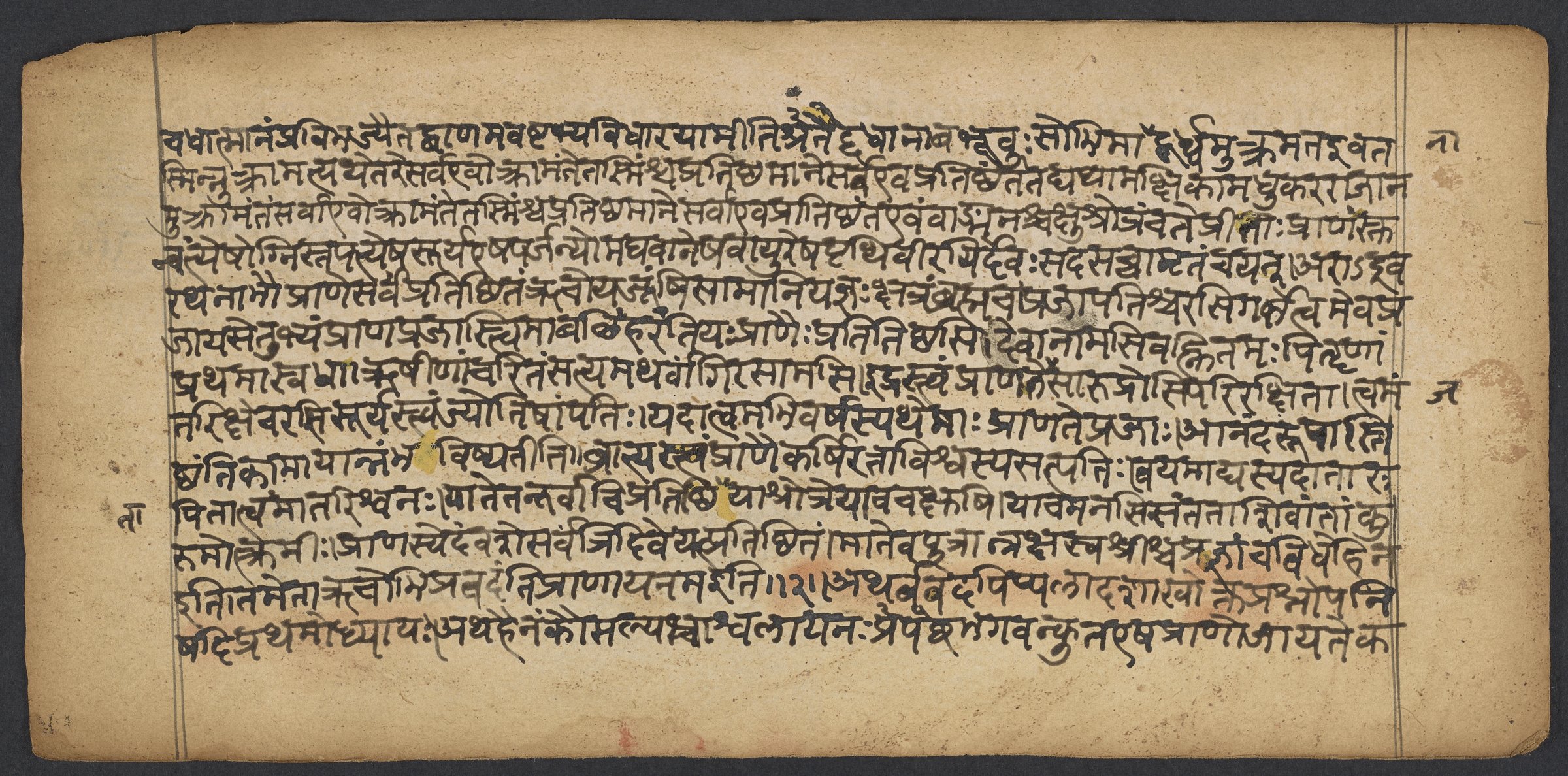
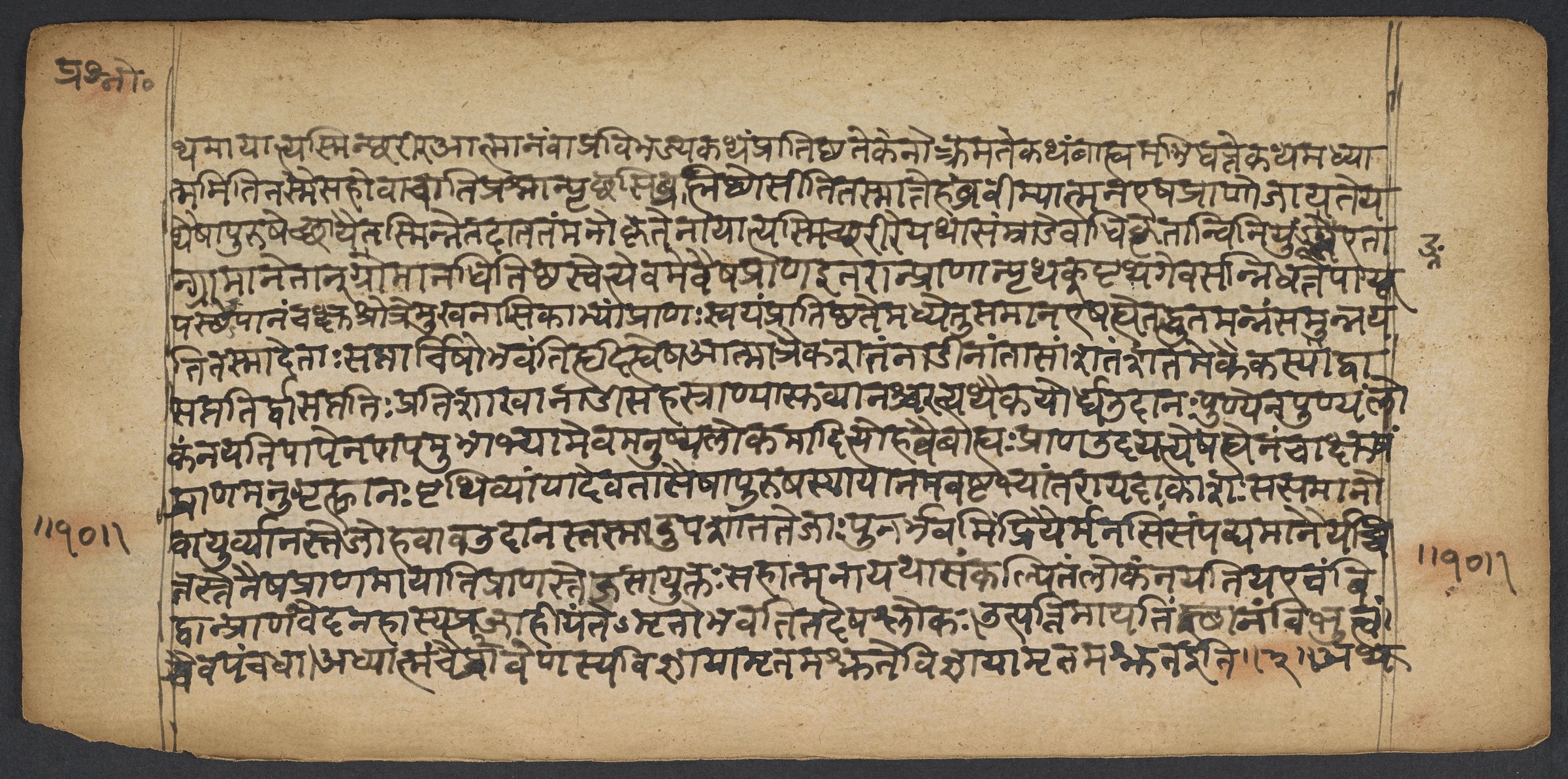
The page images come from a single paper manuscript in the University of Pennsylvania Libraries, Ms. Coll. 390 Item 869, catalogued as 'Six early upanisads'. It has 16 leaves (13 x 27 cm) written in Devanagari, 11 to 13 lines to a side, and is undated (the library assigns it to the 18th or 19th century). It contains the Isa, Kena, Katha, Prasna, Mundaka and Mandukya Upanisads in that order; its title page names a set of ten. Leaves are numbered in the right margin of each verso and carry abbreviated titles in the upper left margin.
The Prasna runs from fol. 8v to fol. 12v. The scribe numbers the end of each question (||1|| to ||6||) and groups the questions in pairs as three adhyayas. Each section below holds the paragraphs that end on one page; a paragraph that begins on the previous page is shown with both pages.
How was this verified? (Provenance)
Where on the image
Penn Ms. Coll. 390 Item 869, fol. 10r, fol. 10v. Paragraph 1 begins at fol. 10r line 13 ‹atha hainaṃ kausalyaś cāśvalāyanaḥ› and ends at fol. 10v line 2 ‹katham adhyātmam iti›; paragraphs 2-12 follow on fol. 10v to line 13 ‹vijñāyāmṛtam aśnuta iti›, marked ‹||3||›. Checked on the image; readings logged in data/sources/upanishads/mapping_notes_869.txt.
1atha hainaṃ kausalyaś cāśvalāyanaḥ papraccha |
bhagavan kuta eṣa prāṇo jāyate |
katham āyāty asmin śarīre |
ātmānaṃ vā pravibhajya kathaṃ prātiṣṭhate |
kenotkramate |
kathaṃ bāhyam abhidhatte |
katham adhyātmam iti ||
2tasmai sa hovāca |
atipraśnān pṛcchasi |
brahmiṣṭho 'sīti |
tasmāt te 'haṃ bravīmi ||
3ātmana eṣa prāṇo jāyate |
yathaiṣā puruṣe chāyaitasminn etadātatam |
manokṛtenāyāty asmiñ śarīre ||
4yathā samrāḍ evādhikṛtān viniyuṅkte |
etān grāmān etān grāmān adhitiṣṭhasveti |
evam evaiṣa prāṇa itarān prāṇān pṛthak pṛthag eva saṃnidhatte ||
5pāyūpasthe 'pānam |
cakṣuḥśrotre mukhanāsikābhyāṃ prāṇaḥ svayaṃ pratiṣṭhate |
madhye tu samānaḥ |
eṣa hy etad dhutam annaṃ samaṃ nayati |
tasmād etāḥ saptārciṣo bhavanti ||
6hṛdi hy eṣa ātmā |
atraitad ekaśataṃ nāḍīnām |
tāsāṃ śataṃ śatam ekaikasyāḥ |
dvāsaptatir dvāsaptatiḥ pratiśākhānāḍīsahasrāṇi bhavanti |
āsu vyānaścarati ||
7athaikayordhva udānaḥ puṇyena puṇyaṃ lokaṃ nayati |
pāpena pāpam |
ubhābhyām eva manuṣyalokam ||
8ādityo ha vai bāhyaḥ prāṇa udayati |
eṣa hy enaṃ cākṣuṣaṃ prāṇam anugṛhṇānaḥ |
pṛthivyāṃ yā devatā saiṣā puruṣasyāpānam avaṣṭabhya |
antarā yadākāśaḥ sa samānaḥ |
vāyur vyānaḥ ||
9tejo ha vā udānaḥ |
tasmād upaśāntatejāḥ |
punarbhavam indriyair manasi saṃpadyamānaiḥ ||
10yaccittas tenaiṣa prāṇam āyāti |
prāṇas tejasā yuktaḥ sahātmanā yathā saṃkalpitaṃ lokaṃ nayati ||
11ya evaṃ vidvān prāṇaṃ veda |
na hāsya prajā hīyate 'mṛto bhavati |
tad eṣa ślokaḥ ||
12utpattim āyātiṃ sthānaṃ vibhutvaṃ caiva pañcadhā |
adhyātmaṃ caiva prāṇasya vijñāyāmṛtam aśnute vijñāyāmṛtam aśnuta iti ||
1Then Kausalya Âsvalâyana asked: "Sir, whence is that Prâna (spirit) born? How does it come into this body? And how does it abide, after it has divided itself? How does it go out? How does it support what is without, and how what is within?"
2He replied: "You ask questions more difficult, but you are very fond of Brahman, therefore I shall tell it you.
3This Prâna (spirit) is born of the Self. Like the shadow thrown on a man, this (the prâna) is spread out over it (the Brahman). By the work of the mind does it come into this body.
4As a king commands officials, saying to them: Rule these villages or those, so does that Prâna (spirit) dispose the other prânas, each for their separate work.
5The Apâna (the down-breathing) in the organs of excretion and generation; the Prâna himself dwells in eye and ear, passing through mouth and nose. In the middle is the Samâna (the on-breathing); it carries what has been sacrificed as food equally (over the body), and the seven lights proceed from it.
6The Self is in the heart. There are the 101 arteries, and in each of them there are a hundred (smaller veins), and for each of these branches there are 72,000. In these the Vyâna (the back-breathing) moves.
7Through one of them, the Udâna (the out-breathing) leads (us) upwards to the good world by good work, to the bad world by bad work, to the world of men by both.
8The sun rises as the external Prâna, for it assists the Prâna in the eye. The deity that exists in the earth, is there in support of man's Apâna (down-breathing). The ether between (sun and earth) is the Samâna (on-breathing), the air is Vyâna (back-breathing).
9Light is the Udâna (out-breathing), and therefore he whose light has gone out comes to a new birth with his senses absorbed in the mind.
10Whatever his thought (at the time of death) with that he goes back to Prâna, and the Prâna, united with light, together with the self (the gîvâtmâ) leads on to the world, as deserved.
11He who, thus knowing, knows Prâna, his offspring does not perish, and he becomes immortal. Thus says the Sloka:
12He who has known the origin, the entry, the place, the fivefold distribution, and the internal state of the Prâna, obtains immortality, yes, obtains immortality."
Notes
- Sanskrit: GRETIL, Prasnopanisad with the commentary ascribed to Samkara, mula text only; input by the Sansknet project. Paragraph numbers follow the edition; the manuscript has none.
- Prasna 2.9: the GRETIL file (TEI and legacy mula file alike) prints Samkara's paraphrase in place of this verse, so its Sanskrit is left out and marked [...]; the verse itself can be read on fol. 10r lines 7-8 of the manuscript.
- English: F. Max Müller, 'Prasña-upanishad', The Upanishads part II, Sacred Books of the East 15 (1884), from the proofread English Wikisource transcription. Footnotes are not reproduced.
Cite
Sources
- Source: Penn Ms. Coll. 390 Item 869 (OPenn, public domain) + GRETIL Sanskrit + F. Max Müller (1884) English (holding institution)
- Critical edition: GRETIL Sanskrit e-texts (Isa, Katha, Prasna, Mandukya, Aitareya, Taittiriya, Svetasvatara, Chandogya); Nirnaya Sagar edition of 1925, transcribed (Kena, Mundaka)
← previous · → next · v cycle view · l back to library