Prasna Upanishad, Question 4
Introduction
The Prasna ('Question') Upanishad belongs to the Atharvaveda (Paippalada school). Six students come to the sage Pippalada, and after a year of discipline each asks one question: on the origin of creatures, the powers that sustain the body, the breath, sleep and dreaming, meditation on the syllable Om, and the person of sixteen parts. This entry gives question 4, asked by Sauryayanin Gargya.
The page images come from a single paper manuscript in the University of Pennsylvania Libraries, Ms. Coll. 390 Item 869, catalogued as 'Six early upanisads'. It has 16 leaves (13 x 27 cm) written in Devanagari, 11 to 13 lines to a side, and is undated (the library assigns it to the 18th or 19th century). It contains the Isa, Kena, Katha, Prasna, Mundaka and Mandukya Upanisads in that order; its title page names a set of ten. Leaves are numbered in the right margin of each verso and carry abbreviated titles in the upper left margin.
The Prasna runs from fol. 8v to fol. 12v. The scribe numbers the end of each question (||1|| to ||6||) and groups the questions in pairs as three adhyayas. Each section below holds the paragraphs that end on one page; a paragraph that begins on the previous page is shown with both pages.
How was this verified? (Provenance)
Where on the image
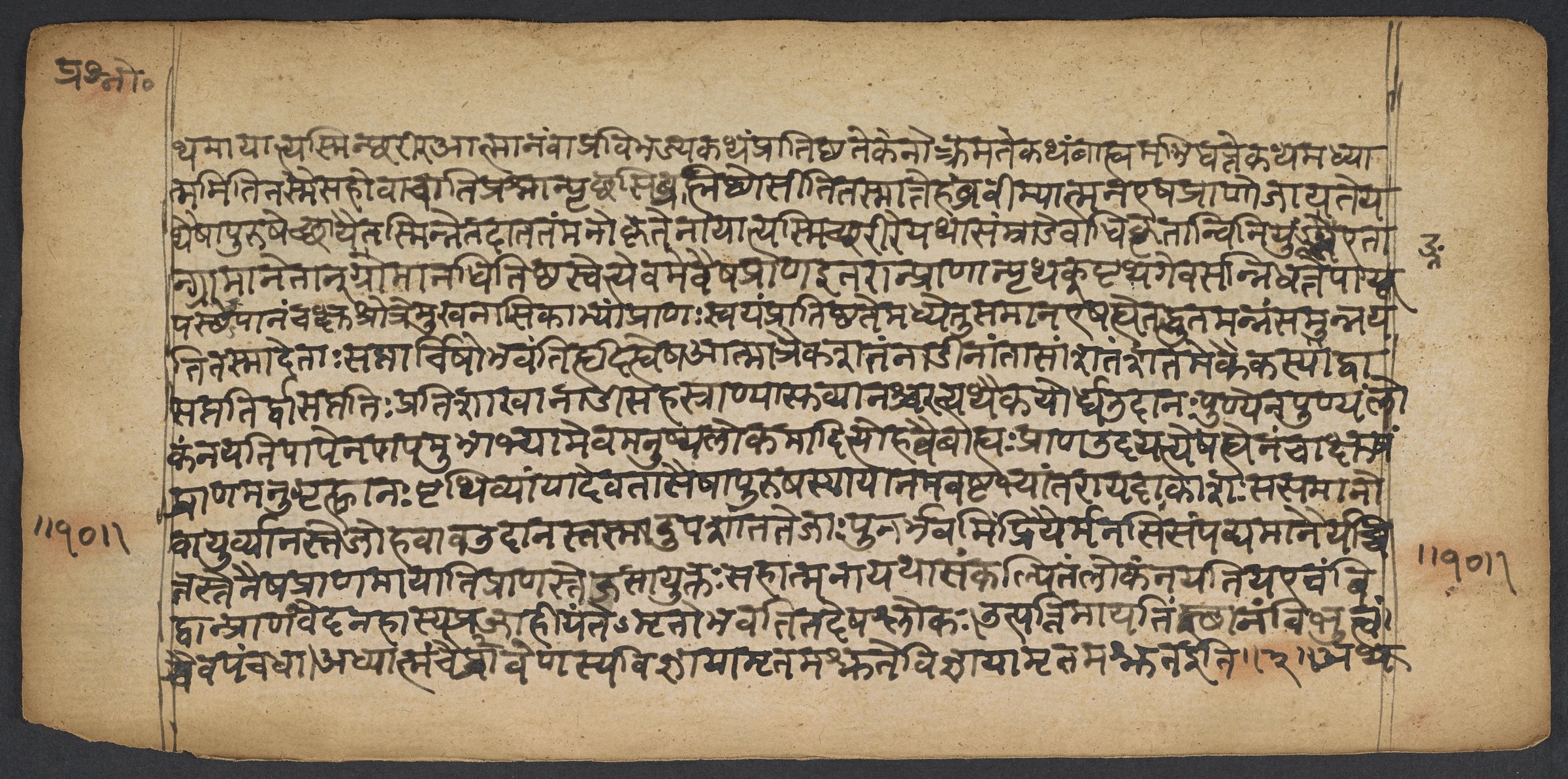
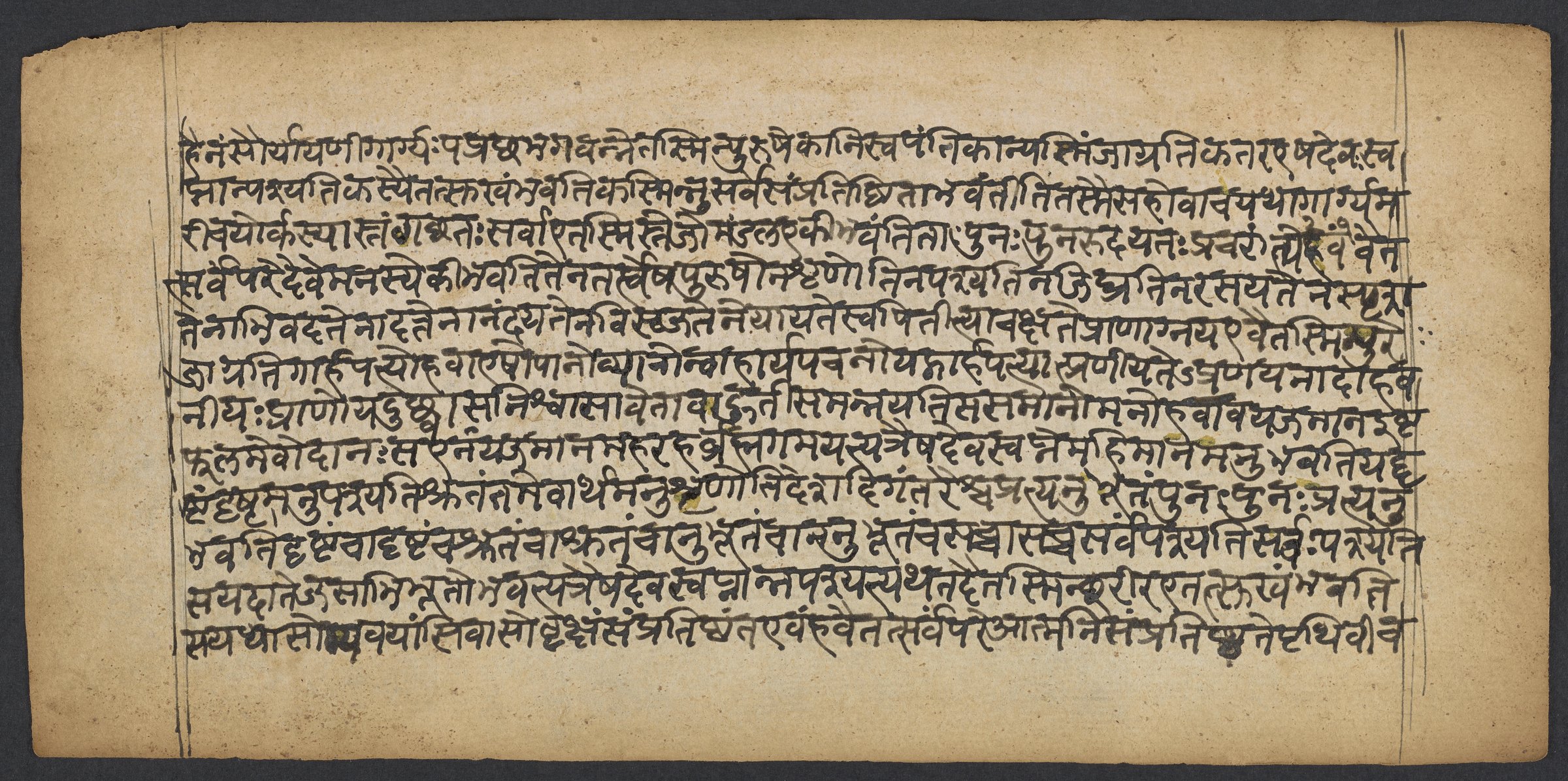
Penn Ms. Coll. 390 Item 869, fol. 10v, fol. 11r. Paragraph 1 begins at the end of fol. 10v line 13 ‹atha ha› and goes on at fol. 11r line 1 ‹hainaṃ sauryāyaṇī gārgyaḥ›, ending in line 2; paragraphs 2-7 follow on fol. 11r to line 12 ‹para ātmani saṃpratiṣṭhate›. Checked on the image; readings logged in data/sources/upanishads/mapping_notes_869.txt.
1atha hainaṃ sauryāyaṇī gārgyaḥ papraccha |
bhagavann etasmin puruṣe kāni svapanti |
kāny asmiñ jāgrati |
katara eṣa devaḥ svapnān paśyati |
kasyaitat sukhaṃ bhavati |
kasmin nu sarve saṃpratiṣṭhitā bhavantīti ||
2tasmai sa hovāca |
yathā gārgya marīcayo'rkasyās taṃ gacchataḥ sarvā etasmiṃs tejomaṇḍala ekībhavanti |
tāḥ punaḥ punar udayataḥ pracaranti |
evaṃ ha vai tat sarvaṃ pare deve manasy ekībhavati |
tena tarhy eṣa puruṣo na śṛṇoti |
na paśyati |
na jighrati |
na rasayate |
na spṛśate |
nābhivadate |
nādatte |
nānandayate |
na visṛjate |
neyāyate |
svapatīty ācakṣate ||
3prāṇāgnaya evaitasmin pure jāgrati |
gārhapatyo ha vā eṣo 'pānaḥ |
vyāno 'nvāhāryapacanaḥ |
yad gārhapatyāt praṇīyate praṇayanāt |
āhavanīyaḥ prāṇaḥ ||
4yad ucchvāsaniḥśvāsāvetāvāhutī samaṃ nayatīti sa samānaḥ |
mano ha vāvana yajamānaḥ |
iṣṭaphalam evodānaḥ |
sa enaṃ yajamānam aharaharbrahma gamayati ||
5atraiṣa devaḥ svapne mahimānam anubhavati |
yad dṛṣṭaṃ iṣṭam anupaśyati |
śrutaṃ śrutam evārtham anuśṛṇoti |
deśadigantaraiś ca pratyanubhūtaṃ punaḥ punaḥ pratyanubhavati |
dṛṣṭaṃ cādṛṣṭaṃ ca śrutaṃ cāśrutaṃ cānubhūtaṃ cānanubhūtaṃ ca saccāsacca sarvaṃ paśyati |
sarvaḥ paśyati ||
6sa yadā tejasābhibhūto bhavati |
atraiṣa devaḥ svapnānna paśyati |
atha tadaitasmiñ śarīra etat sukhaṃ bhavati ||
7sa yathā somya vayāṃsi vāsovṛkṣaṃ saṃpratiṣṭhante |
evaṃ ha vai tat sarvaṃ para ātmani saṃpratiṣṭhate ||
1Then Sauryâyanin Gârgya asked: "Sir, What are they that sleep in this man, and what are they that are awake in him? What power (deva) is it that sees dreams? Whose is the happiness? On what do all these depend?"
2He replied: "O Gârgya, As all the rays of the sun, when it sets, are gathered up in that disc of light, and as they, when the sun rises again and again, come forth, so is all this (all the senses) gathered up in the highest faculty (deva) the mind. Therefore at that time that man does not hear, see, smell, taste, touch, he does not speak, he does not take, does not enjoy, does not evacuate, does not move about. He sleeps, that is what people say.
3The fires of the prânas are, as it were, awake in that town (the body). The Apâna is the Gârhapatya fire, the Vyâna the Anvâhâryapakana fire; and because it is taken out of the Gârhapatya fire, which is fire for taking out, therefore the Prâna is the Âhavanlya fire.
4Because it carries equally these two oblations, the out-breathing and the in-breathing, the Samâna is he (the Hotri priest). The mind is the sacrificer, the Udâna is the reward of the sacrifice, and it leads the sacrificer every day (in deep sleep) to Brahman.
5There that god (the mind) enjoys in sleep greatness. What has been seen, he sees again; what has been heard, he hears again; what has been enjoyed in different countries and quarters, he enjoys again; what has been seen and not seen, heard and not heard, enjoyed and not enjoyed, he sees it all; he, being all, sees.
6And when he is overpowered by light, then that god sees no dreams, and at that time that happiness arises in his body.
7And, O friend, as birds go to a tree to roost, thus all this rests in the Highest Âtman,—
Where on the image
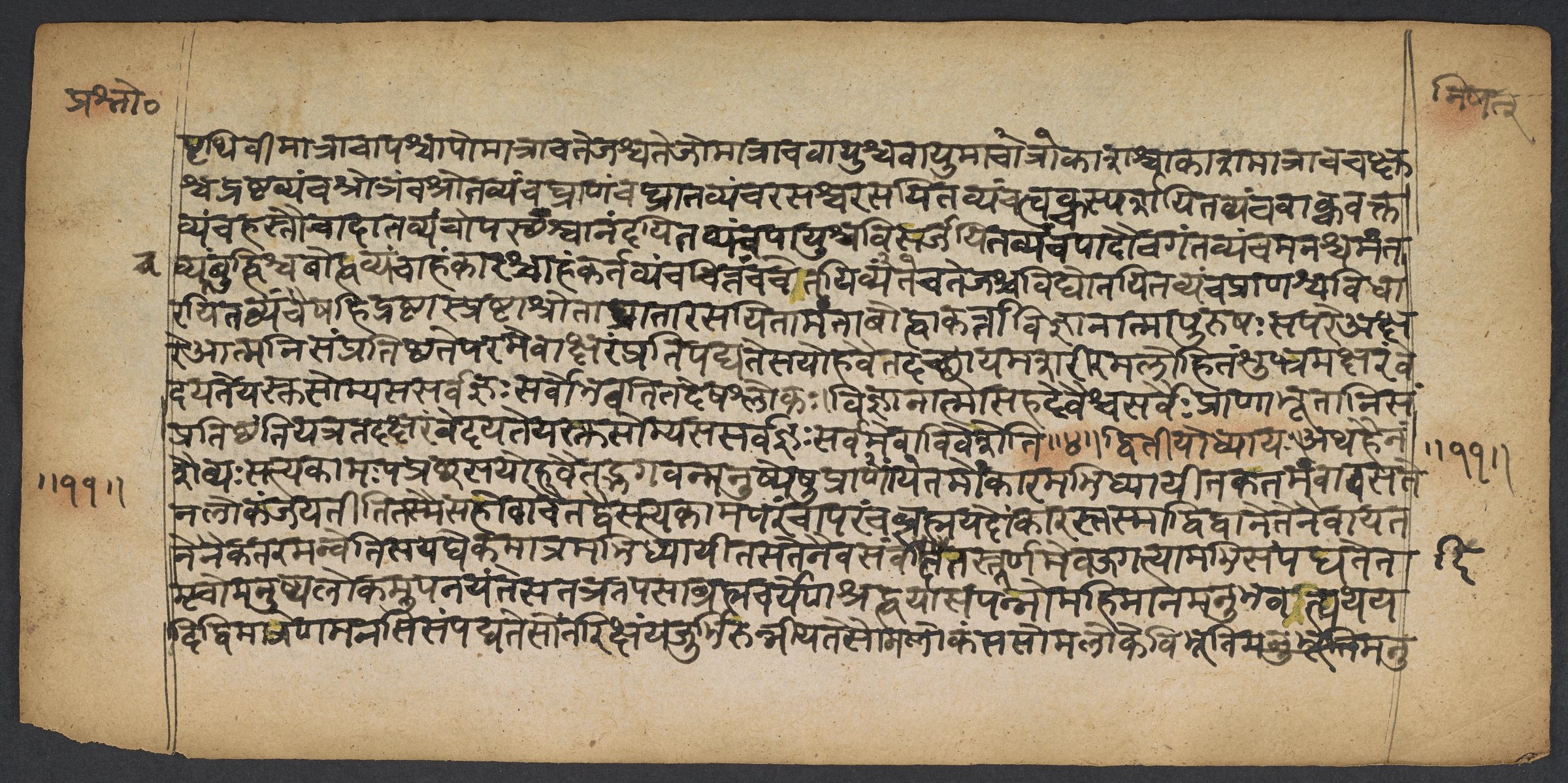
Penn Ms. Coll. 390 Item 869, fol. 11r, fol. 11v. Paragraph 8 begins at the end of fol. 11r line 12 ‹pṛthivī ca› and ends at fol. 11v line 5 ‹prāṇaś ca vidhārayitavyaṃ ca›; paragraphs 9-11 follow to line 8 ‹sarvam evāviveśeti›, marked ‹||4||›, and the colophon ‹dvitīyo 'dhyāyaḥ›. Checked on the image; readings logged in data/sources/upanishads/mapping_notes_869.txt.
8pṛthivī ca pṛthivīmātrā ca |
āpaś cāpomātrā ca |
tejaś ca tejomātrā ca |
vāyuś ca vāyumātrā ca |
ākāśaś cākāśamātrā ca |
cakṣuś ca draṣṭavyaṃ ca |
śrotraṃ ca śrotavyaṃ ca |
ghrāṇaṃ ca ghrātavyaṃ ca |
rasaś ca rasayitavyaṃ ca |
tvak ca sparśayitavyaṃ ca |
vāk ca vaktavyaṃ ca |
hastau cādātavyaṃ ca |
upasthaś cānandayitavyaṃ ca |
pāyuś ca visarjayitavyaṃ ca |
pādau ca gantavyaṃ ca |
manaś ca mantavyaṃ ca |
buddhiś ca boddhavyaṃ ca |
ahaṅkāraś cāhaṅkartavyaṃ ca |
cittaṃ ca cetayitavyaṃ ca |
tejaś ca vidyotayitavyaṃ ca |
prāṇaś ca vidhārayitavyaṃ ca ||
9eṣa hi draṣṭā spraṣṭā śrotā ghrātā rasayitā mantā boddhā kartā vijñānātmā puruṣaḥ |
sa pare 'kṣara ātmani saṃpratiṣṭhate ||
10param evākṣaraṃ pratipadyate |
sa yo ha vai tadacchāyam aśarīram alohitaṃ śubhram akṣaraṃ vedayate yas tu somya |
sa sarvaḥ sarvo bhavati |
tad eṣa ślokaḥ ||
11vijñānātmā saha devaiś ca sarvaiḥ prāṇā bhūtāni saṃpratiṣṭhanti yatra /
tad akṣaraṃ vedayate yas tu somya sa sarvajñaḥ sarvam evāviveśeti //
8The earth and its subtile elements, the water and its subtile elements, the light and its subtile elements, the air and its subtile elements, the ether and its subtile elements; the eye and what can be seen, the ear and what can be heard, the nose and what can be smelled, the taste and what can be tasted, the skin and what can be touched, the voice and what can be spoken, the hands and what can be grasped, the feet and what can be walked, the mind and what can be perceived, intellect (buddhi) and what can be conceived, personality and what can be personified, thought and what can be thought, light and what can be lighted up, the Prâna and what is to be supported by it.
9For he it is who sees, hears, smells, tastes, perceives, conceives, acts, he whose essence is knowledge, the person, and he dwells in the highest, indestructible Self,—
10He who knows that indestructible being, obtains (what is) the highest and indestructible, he without a shadow, without a body, without colour, bright,— yes, O friend, he who knows it, becomes all-knowing, becomes all. On this there is this Sloka:
11He, O friend, who knows that indestructible being wherein the true knower, the vital spirits (prânas), together with all the powers (deva), and the elements rest, he, being all-knowing, has penetrated all."
Notes
- Sanskrit: GRETIL, Prasnopanisad with the commentary ascribed to Samkara, mula text only; input by the Sansknet project. Paragraph numbers follow the edition; the manuscript has none.
- Prasna 2.9: the GRETIL file (TEI and legacy mula file alike) prints Samkara's paraphrase in place of this verse, so its Sanskrit is left out and marked [...]; the verse itself can be read on fol. 10r lines 7-8 of the manuscript.
- English: F. Max Müller, 'Prasña-upanishad', The Upanishads part II, Sacred Books of the East 15 (1884), from the proofread English Wikisource transcription. Footnotes are not reproduced.
Cite
Sources
- Source: Penn Ms. Coll. 390 Item 869 (OPenn, public domain) + GRETIL Sanskrit + F. Max Müller (1884) English (holding institution)
- Critical edition: GRETIL Sanskrit e-texts (Isa, Katha, Prasna, Mandukya, Aitareya, Taittiriya, Svetasvatara, Chandogya); Nirnaya Sagar edition of 1925, transcribed (Kena, Mundaka)
← previous · → next · v cycle view · l back to library